QQuestionAnatomy and Physiology
QuestionAnatomy and Physiology
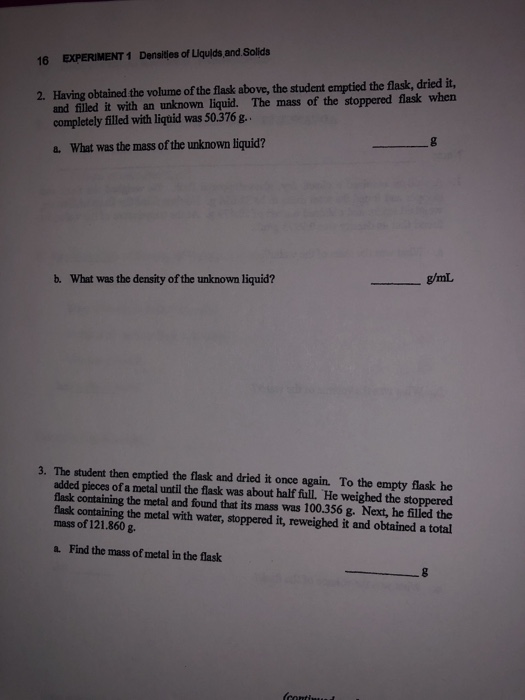
2. Having obtained the volume of the flask above, the student emptied the flask, dried it, and filled it with an unknown liquid. The mass of the stoppered flask when completely filled with liquid was 50.376 g .
a. What was the mass of the unknown liquid? $\qquad$
b. What was the density of the unknown liquid? $\qquad$ $\mathrm{g} / \mathrm{mL}$
3. The student then emptied the flask and dried it once again. To the empty flask he added pieces of a metal until the flask was about half full. He weighed the stoppered flask containing the metal and found that its mass was 106.366 g . Next, he filled the flask containing the metal with water, stoppered it, reweighed it and obonised a total mass of 121.860 g .
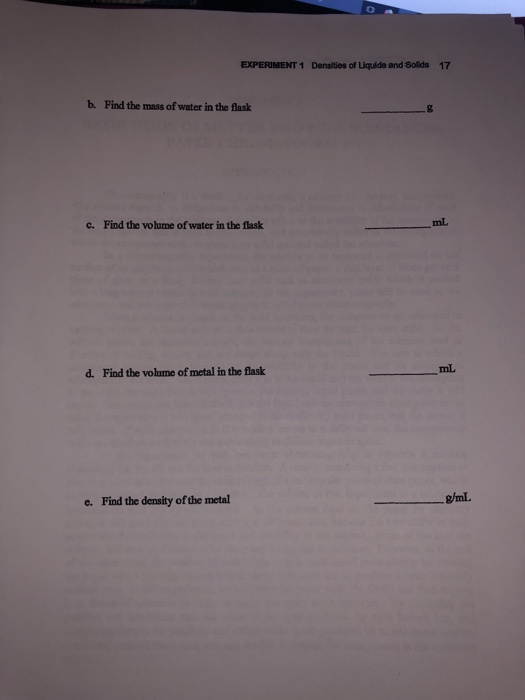
a. Find the mass of metal in the flask $\qquad$
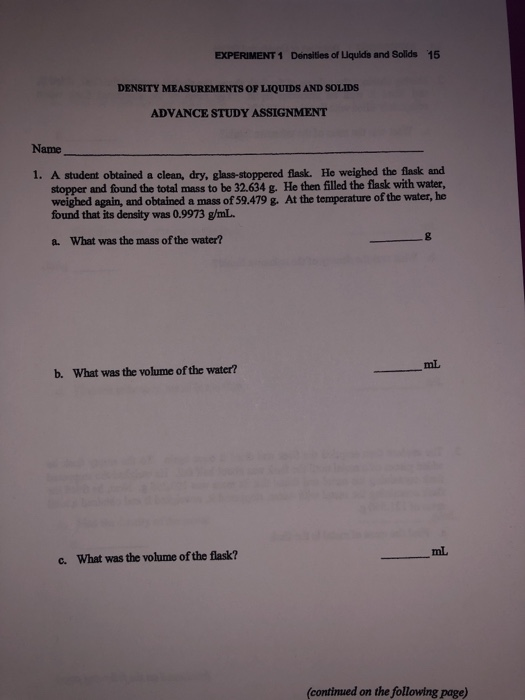
# DENSITY MEASUREMENTS OF LIQUIDS AND SOLIDS
## ADVANCE STUDY ASSIGNMENT
## Name
1. A student obtained a clean, dry, glass-stoppered flask. He weighed the flask and stopper and found the total mass to be 22.624 g . He then filled the flask with water, weighed again, and obtained a mass of 59.479 g . At the temperature of the water, he found that its density was $0.9973 \mathrm{~g} / \mathrm{mL}$.
a. What was the mass of the water?
$\qquad$ g
b. What was the volume of the water?
$\qquad$ mL
c. What was the volume of the flask?
$\qquad$ mL
Attachments
6 months agoReport content
Answer
Full Solution Locked
Sign in to view the complete step-by-step solution and unlock all study resources.
Step 1
To find the mass of the water in the flask, subtract the mass of the flask and stopper from the total mass of the flask filled with water: Mass of water = Mass of flask + water - Mass of flask Mass of water = 59.479 g - 22.624 g = 36.855 g
Final Answer
2. To find the volume of the water, use the given density: Volume = Mass / Density Volume = 36.855 g / 0.9973 g/mL = 36.995 mL (rounded to three decimal places) 3. To find the volume of the flask, subtract the volume of the stopper from the total volume when the flask is filled with water: Volume of flask = Volume of flask + water - Volume of stopper Assuming the stopper is made of a material with a density close to 1 g/mL, the volume of the stopper can be approximated as the mass of the stopper divided by its density: Volume of stopper = Mass of stopper / Density of stopper Volume of stopper ≈ 22.624 g / 1 g/mL = 22.624 mL Now, calculate the volume of the flask: Volume of flask = 37.000 mL - 22.624 mL = 14.376 mL 4. To find the mass of the metal in the flask, subtract the mass of the flask from the total mass of the flask containing the metal: Mass of metal = Mass of flask + metal - Mass of flask Mass of metal = 106.366 g - 22.624 g = 83.742 g
Need Help with Homework?
Stuck on a difficult problem? We've got you covered:
- Post your question or upload an image
- Get instant step-by-step solutions
- Learn from our AI and community of students