QQuestionAnatomy and Physiology
QuestionAnatomy and Physiology
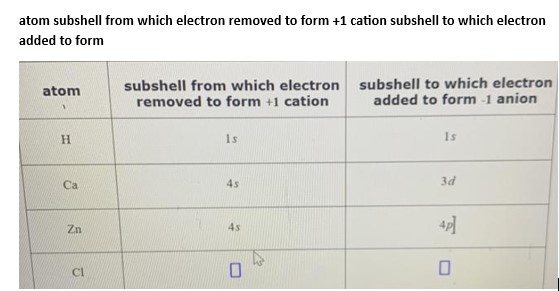
**atom subshell from which electron removed to form + 1 cation subshell to which electron added to form**
| atom | subshell from which electron removed to form + 1 cation | subshell to which electron added to form - 1 anion |
| --- | --- | --- |
| H | 1s | 1s |
| Ca | 4s | 3d |
| Zn | 4s | 4p |
| Cl | ☐ | ☐ |
Attachments
6 months agoReport content
Answer
Full Solution Locked
Sign in to view the complete step-by-step solution and unlock all study resources.
Step 1: Identify the subshells for each atom in the neutral state.
- Hydrogen (H): The electron configuration of H is 1s^1. - Calcium (Ca): The electron configuration of Ca is [Ar]4s^2. - Zinc (Zn): The electron configuration of Zn is [Ar]4s^2 3d^10. - Chlorine (Cl): The electron configuration of Cl is [Ne]3s^2 3p^5.
Step 2: Determine the subshell from which an electron is removed to form a + 1 cation.
- Hydrogen (H): Removing an electron from the 1s subshell forms H^+ with the configuration 1s^0. - Calcium (Ca): Removing an electron from the 4s subshell forms Ca^+ with the configuration [Ar]4s^1. - Zinc (Zn): Removing an electron from the 4s subshell forms Zn^+ with the configuration [Ar]4s^0 3d^10. - Chlorine (Cl): The question does not apply to Cl as it forms a - 1 anion, not a + 1 cation.
Final Answer
- Hydrogen (H): 1s (cation), 1s (anion) - Calcium (Ca): 4s (cation), 3d (anion) - Zinc (Zn): 4s (cation), 4p (anion) - Chlorine (Cl): Not applicable, 3p (anion)
Need Help with Homework?
Stuck on a difficult problem? We've got you covered:
- Post your question or upload an image
- Get instant step-by-step solutions
- Learn from our AI and community of students