QQuestionAnatomy and Physiology
QuestionAnatomy and Physiology
# Question 10 (1 point)
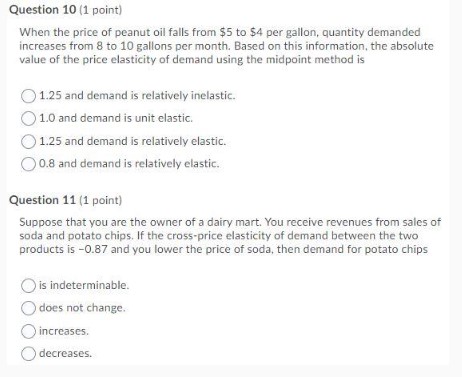
When the price of peanut oil falls from $\$ 5$ to $\$ 4$ per gallon, quantity demanded increases from 8 to 10 gallons per month. Based on this information, the absolute value of the price elasticity of demand using the midpoint method is
$\square 1.25$ and demand is relatively inelastic.
$\square 1.0$ and demand is unit elastic.
$\square 1.25$ and demand is relatively elastic.
$\square 0.8$ and demand is relatively elastic.
## Question 11 (1 point)
Suppose that you are the owner of a dairy mart. You receive revenues from sales of soda and potato chips. If the cross-price elasticity of demand between the two products is - 0.87 and you lower the price of soda, then demand for potato chips
$\square$ is indeterminable.
$\square$ does not change.
$\square$ increases.
$\square$ decreases.
Attachments
6 months agoReport content
Answer
Full Solution Locked
Sign in to view the complete step-by-step solution and unlock all study resources.
Step 1: Calculate the midpoint of the initial and final prices of peanut oil.
\text{Midpoint} &= \frac{\$5 + \$4}{2} \
The midpoint formula is given by: Using the given information, we have: \begin{align*} &= \$4.50 \end{align*}
Step 2: Calculate the midpoint of the initial and final quantities demanded.
\text{Midpoint} &= \frac{8 + 10}{2} \
Using the given information, we have: \begin{align*} &= 9 \end{align*}
Final Answer
Question 10: $\square 1.25$ and demand is relatively elastic. Question 11: $\square$ decreases.
Need Help with Homework?
Stuck on a difficult problem? We've got you covered:
- Post your question or upload an image
- Get instant step-by-step solutions
- Learn from our AI and community of students