QQuestionAnatomy and Physiology
QuestionAnatomy and Physiology
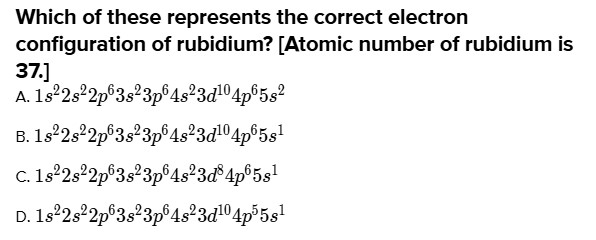
# Which of these represents the correct electron configuration of rubidium? [Atomic number of rubidium is 37.]
A. $1 s^{2} 2 s^{2} 2 p^{6} 3 s^{2} 3 p^{6} 4 s^{2} 3 d^{10} 4 p^{6} 5 s^{2}$
B. $1 s^{2} 2 s^{2} 2 p^{6} 3 s^{2} 3 p^{6} 4 s^{2} 3 d^{10} 4 p^{6} 5 s^{1}$
C. $1 s^{2} 2 s^{2} 2 p^{6} 3 s^{2} 3 p^{6} 4 s^{2} 3 d^{8} 4 p^{6} 5 s^{1}$
D. $1 s^{2} 2 s^{2} 2 p^{6} 3 s^{2} 3 p^{6} 4 s^{2} 3 d^{10} 4 p^{5} 5 s^{1}$
Attachments
6 months agoReport content
Answer
Full Solution Locked
Sign in to view the complete step-by-step solution and unlock all study resources.
Step 1: Write down the atomic number of rubidium and determine the number of electrons.
The atomic number of rubidium is 37, which means that a neutral rubidium atom has 37 electrons.
Step 2: Write the electron configuration up to the noble gas configuration of the previous period.
[Ar] = 1s^2 2s^2 2p^6 3s^2 3p^6 4s^2 3d^{10} 4p^6
So, the electron configuration of rubidium starts as:
Final Answer
Therefore, option B is the correct answer.
Need Help with Homework?
Stuck on a difficult problem? We've got you covered:
- Post your question or upload an image
- Get instant step-by-step solutions
- Learn from our AI and community of students