
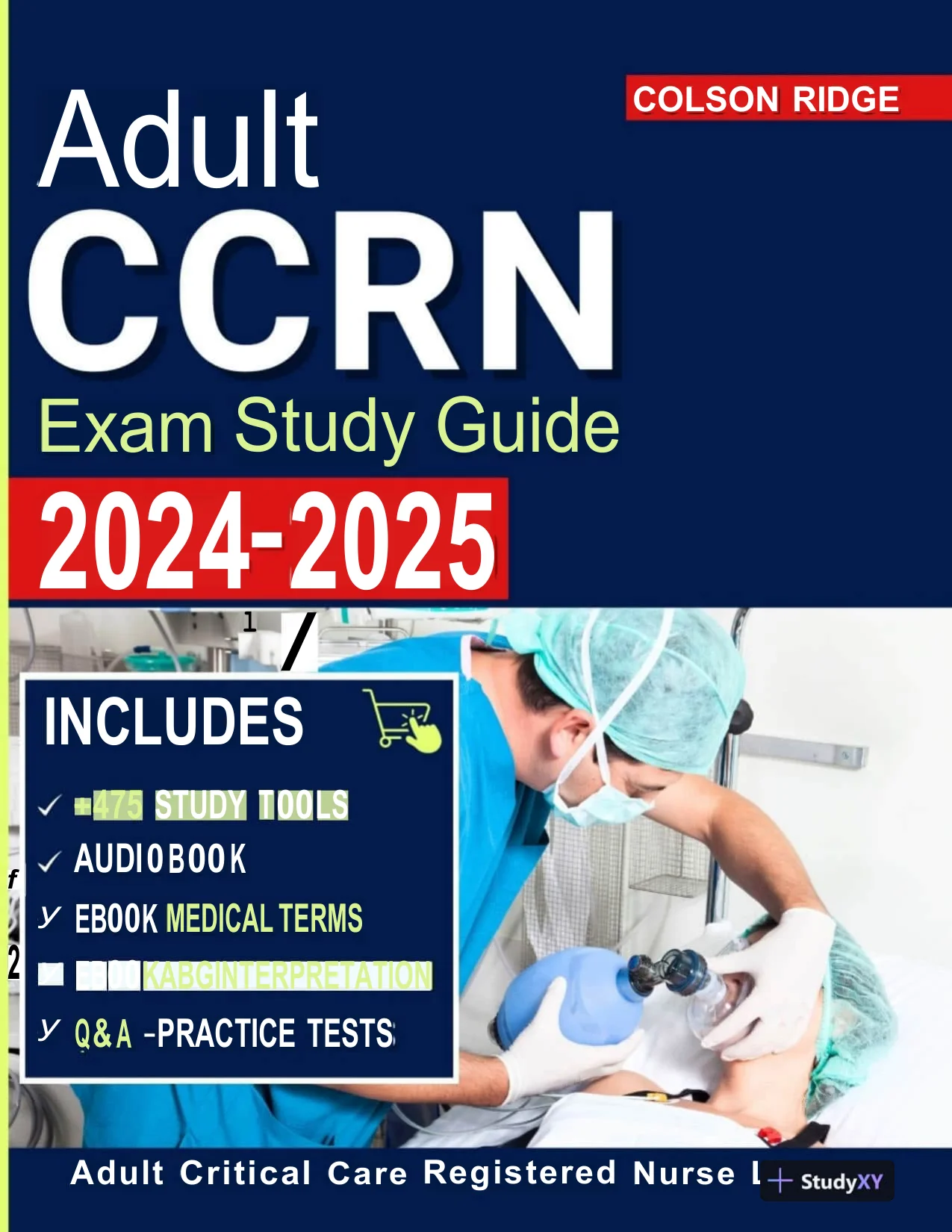
CCRN Study Guide 2024-2025: 2 Practice Tests and Review Book (2023)

Stay ahead of the competition with CCRN Study Guide 2024-2025: 2 Practice Tests and Review Book for the Adult Critical Care Registered Nurse Exam [2nd Edition] (2023) , an essential exam guide featuring detailed explanations and practice tests.

Aiden Campbell
Contributor
4.9
43
10 months ago
Preview (16 of 90 Pages)
100%
Log in to unlock

Page 1

CCRN Study Guide 2024-2025: 2 Practice Tests and Review Book (2023) - Page 1 preview image

Loading page ...

COLSONRIDGEAdultExamStudyGuide2024-2025l/INCLUDES+475STUDYT00LSAUDI0B00Kf\yEB00KMEDICALTERMS2yEB00KABGINTERPRETATIONyQ&A-PRACTICETESTSAdultCriticalCareRegisteredNurseLicense

Page 2

CCRN Study Guide 2024-2025: 2 Practice Tests and Review Book (2023) - Page 2 preview image

Loading page ...

Page 3

CCRN Study Guide 2024-2025: 2 Practice Tests and Review Book (2023) - Page 3 preview image

Loading page ...

CCRNEXAM STUDY GUIDEAce your Adult Critical Care Registered NurseLicense on the First Try!Q&A | Tests | Extra ContentColson Ridge

Page 4

CCRN Study Guide 2024-2025: 2 Practice Tests and Review Book (2023) - Page 4 preview image

Loading page ...

© Copyright2024byColson RidgeAll rights reserved. The information in this book is intended to be accurate, but neither the publisher nor the author are experts on the topicsdiscussed. Any recommendations are for entertainment purposes only, and readers should consult professionals before taking action.Reproducing or transmitting any part of this work without written consent is prohibited. The publisher and author cannot be held liable for anyconsequences resulting from the use of this information.EXTRA STUDY AIDS ARE READY FOR YOU!Includes audiobookfor on-the-go learning.Digital copy of this bookto have with you at all times for revisionwhenever and wherever you want.Two Bonus EBooks:Gain access to"ABG Interpretation for Nurse"and"Medical Terms for Healthcare Workers"at no additional cost.Over 475 CCRN flashcardsin PDF format ready to print and in .APKGformat for Anki app, for a dynamic and interactive learning experience.Elevate your study sessions by utilizing these flashcards to effortlessly recallkey terms and concepts. Available for download on Anki APP, AnkiDroid,or through our website—no registration or payment required. Import thegift files and study at your leisure, tracking your progress as you goACCRN extra printable testfor readers with detailed explanationsDirect contactfor assistance or clarifications, ensuring continuous supportin your preparation.

Page 5

CCRN Study Guide 2024-2025: 2 Practice Tests and Review Book (2023) - Page 5 preview image

Loading page ...

TABLE OF CONTENTSINTRODUCTIONTHE CARDIOVASCULAR SYSTEMCardiovascular assessmentManagement of Acute Coronary SyndromesHeart Failure and Shock StatesArrhythmia ManagementRESPIRATORY SYSTEMAssessment of Respiratory FunctionManagement of Acute Respiratory FailureVentilatory Support StrategiesPulmonary Infections and Acute Respiratory Distress Syndrome (ARDS)ENDOCRINE SYSTEMAnatomy and Physiology of the Endocrine SystemDiabetes Management in Critical CareThyroid and Adrenal DisordersGASTROINTESTINAL SYSTEMAnatomy and PhysiologyGI Bleed and Acute Abdomen ManagementLiver Failure and Hepatic EncephalopathyLiver FailureHepatic EncephalopathyRENAL AND GENITOURINARY SYSTEMAcute Kidney Injury and Chronic Renal FailureElectrolyte ImbalancesINTEGUMENTARY SYSTEMAnatomy and PhysiologyBurn Care and Wound ManagementSkin Integrity and Pressure UlcersMUSCULOSKELETAL SYSTEMAnatomy and PhysiologyTrauma and Orthopedic Surgery Care

Page 6

CCRN Study Guide 2024-2025: 2 Practice Tests and Review Book (2023) - Page 6 preview image

Loading page ...

RhabdomyolysisQUESTIONS & ANSWERSPRACTICE TEST & ANSWER KEYCardiovascular System Test (1)Respiratory System Test (2)Endocrine System Test (3)Hematology Test (4)Gastrointestinal System Test (5)Renal and Genitourinary System Test (6)Integumentary System Test (7)Musculoskeletal System Test (8)Cardiovascular System Answers (1)Respiratory System Answers (2)Endocrine System Answers (3)Hematology Answers (4)Gastrointestinal System Answers (5)Renal and Genitourinary System Answers (6)Integumentary System Answers (7)Musculoskeletal System Answers (8)CONCLUSIONDOWNLOAD

Page 7

CCRN Study Guide 2024-2025: 2 Practice Tests and Review Book (2023) - Page 7 preview image

Loading page ...

WINTRODUCTIONelcome to the CCRN Exam Study Guide, which is dedicated to adult critical care nurses who wishto prove their expert status and professional credentials. Through this study guide, we offer youcomplete resources and successful test strategies toward the completeness of the CCRN certificationexamination, which is founded on high standards of the competency level of nursing in adult critical care.Certification as a CCRN (Critical Care Registered Nurse) is a highly respected distinction that indicatesan advanced level of knowledge and skill in the management of acutely and critically ill adult patientpopulations. Therefore, receiving such a certification becomes a commitment to excellence, giving deepmeaning to the practices of critical care; hence, it becomes a stepping stone, a crucial milestone, in anurse's career.Preparing for the CCRN examination can be overwhelming. With so many topics covered—fromcardiovascular and pulmonary to endocrine and renal conditions—the examination will test not only thefacts but, more importantly, the application of such facts in a complex, pressurized adult critical caredomain.This guide helps the student break down the essential content areas for the CCRN test. For each majortopic area, you will receive key points, strategies, and important insights that closely support the format ofthe test. Tips are also offered on how to approach the exam questions, manage study time, and maintainmental and emotional resilience in the examination conditions. Whether you are at the beginning of thepath to CCRN certification or are getting ready to cross that finish line, this study guide is your route tounderstanding the full scope of adult critical care nursing—the theoretical underpinnings and practicalapplications of critical care. It will help in the success of the CCRN and career advancement in nursing.Critical care nursing is a highly knowledge-required area of specialization. Responding to rapidlychanging situations lies at the core of a critical care nurse's work. Decisions must be precise andconfidently guided. This chapter examines the key areas of knowledge underpinning adult critical carenursing and how to safely and effectively practice complex pathophysiology, advanced pharmacology,patient assessment and monitoring, and integrating emotional and ethical decision-making into care.

Page 8

CCRN Study Guide 2024-2025: 2 Practice Tests and Review Book (2023) - Page 8 preview image

Loading page ...

TTHE CARDIOVASCULAR SYSTEMCardiovascular assessmenthorough assessment and a precise diagnosis are the first steps in effectively caring for patients in theadult intensive care unit. This section covers the major scale of cardiovascular assessment and thediagnostic tools that critical care nurses use to evaluate and track cardiovascular disease.We must have a detailed and well-documented patient history. Examples of relevant backgroundinformation to record include details such as the patient's history of cardiovascular disease, surgery, orother interventions. Obtaining an insight into family history is particularly important, as it may determinegenetic trends toward heart disease. In addition, factors such as diet, physical activity, whether a personsmokes, and alcohol intake all come under lifestyle considerations and are seen to have a major effect oncardiovascular health.A completemedication history should betaken,up to andincluding over-the-counterdrugsandsupplements. This, again, is an essential part of cardiovascular patient assessment. When watching thepatient for signs such as jugular vein distention, swelling (edema), or blue discolouration (cyanosis),these can all give important hints about their heart condition. When the pulse is felt, its size, frequency,and rhythm, as well as any irregular heartbeats, are of prime interest. Using a stethoscope to hear heartsounds, including murmurs, gallops, or rubs, is crucial for uncovering different cardiovascular diseases.Evaluation of lung sounds for bubbling or noise that rhymes will help diagnose complications like heartfailure. Checking blood pressure in both arms will show differences and provide further informationabout the patient's cardiovascular health.Diagnostic tools and methodsHowever, the final conclusion must be based on EOC. Electrocardiography (ECG) is a basic means ofother contemporary and meaningful heart disease diagnostics as well. It provides a digital record of heartelectrical activity and is of great value in finding heart arrhythmias, myocardial ischemia, and infarction.Doctors also use ECG to detect electrolyte imbalances that affect the way the heart works parasiticallycompared with other case studies. Echocardiography can also reveal fluid collecting around the heart, acondition known as pericardial effusion.Hemodynamics monitoring provides continuous information on the state of a patient's circulation, helpingwith real-time decision-making. Techniques such as directly measuring blood pressure by placement of anarterial line are now being used together with more frequent arterial blood gas sampling. Pulmonaryartery catheters make possible the measurement of cardiac output, as well as pulmonary artery pressuresand central venous pressure, yielding comprehensive hemodynamic data. Non-invasive methods likepulse contour analysis (PCA) and bioimpedance provide an estimate of cardiac output and stroke volume,adding yet another dimension to our understanding of cardiovascular function.However, laboratory tests are indispensable in diagnosing and managing cardiovascular disease. Cardiacbiomarkers such as troponin will rise in the face of myocardial damage, thus making them primordialmarkers for the diagnosis of heart infarction. A lipid profile will determine cholesterol levels, and fromthis, people can judge their risk of heart disease. B-type natriuretic Peptide (BNP) levels indicate molars-trained heart failure and can help set it apart from other causes of disability. Electrolyte and kidney

Page 9

CCRN Study Guide 2024-2025: 2 Practice Tests and Review Book (2023) - Page 9 preview image

Loading page ...

function tests are also needed because abnormal levels can affect heart function and require immediatecorrection.Interpretation of FindingsIntegrating data from the patient history, physical examination, diagnostics and lab tests is essential for itallows one to understand the patient's condition fully. Combined in this way, it becomes possible to seehow one observation might relate to another and what it means in combination with others. On the otherhand, if patterns between differing findings can be found, then it could lead one quickly straight to what'swrong beneath everything else all along. Diagnostic information guides treatment decisions and keepstrack of their effects, thus ensuring timely as well well-targeted intervention. Also it will help nurses injudging the general severity of a case - which type of care is needed for each person, for example.Critical care nursing experts must apply their clinical judgment in interpreting diagnostic findings. Thisinvolves logical thinking and correlating symptoms and test results. Experience gained from clinicalpractice enables nurses to spot subtle signs or symptoms that indicate serious issues. Cooperation with thehealthcare team to discuss findings and plan a continuous mode of treatment is also essential.For critical care nursing practitioners skilled in the diagnosis and assessment of cardiac conditions, theseare basic facts of life. Now, it is up to you: By mastering these skills, critical care nurses ensure, in alltheir work with patients, that timely and appropriate interventions will be made. This, in turn, improvestheir ultimate fate.Management of Acute Coronary SyndromesThissectionwillcoverACSandthekeypartsofmanagement,includinginitialassessment,pharmacological interventions, invasive procedures, and treatment nursing.Rapid Assessment:It is important now to recognize and evaluate ACS in a patient. When apatient comes in with symptoms of ACS, quick examination is very critical. The details toascertain include symptoms such as chest pain or pressure (or discomfort), difficulty inbreathing or shortness and sweating, nausea and vomiting pain radiating to the jaw, neck, orarms. Vital signs (heart rate, BP, R-R interval) should also be continuously monitored. A 12-lead ECG, which must be completed within 10 min of arrival at the hospital, is the key topicking up ischemic changes and determining the type of ACS, making it essential forsubsequent management.Stabilization:The purpose of immediate stabilization is to reduce myocardial oxygendemand and increase supply. Supplemental oxygen should be given if the patient is hypoxic(oxygen saturation < 90%). Sublingual nitroglycerin may be used for chest pain relief and toimprove coronary blood flow if there are no contraindications to its use. A loading dose ofaspirin (162–325 mg) should be given to inhibit platelet aggregation. If chest pain persists,although sublingual nitroglycerin has been started, morphine may have to be considered forpain relief.Pharmacological as Antithrombin Heparin.Anticoagulation should be administered. Theanticoagulant prevents thrombus expansion, and new clot production will be reduced.Hyperfractionated heparin (UFH) is often administered as a continuous intravenous infusion,and therapeutic levels are maintained with the activated partial thromboplastin time (aPTT),which is monitored. Even where continuous anticoagulation is required, among the LMWHs,

Page 10

CCRN Study Guide 2024-2025: 2 Practice Tests and Review Book (2023) - Page 10 preview image

Loading page ...

enoxaparin provides a consistent and reliable effect as well as ease of use. It can serve as analternative to UFH. Bivalirudin, a direct thrombin inhibitor, can be administered in patientswith a high risk of bleeding or those undergoing PCI (percutaneous coronary intervention).Beta-Blockers:Becausebeta-blockerscan reducethemyocardialoxygen demand byinfluencing heart rate and contractility, oral beta-blockers (such as metoprolol) should beused unless a condition—such as bradycardia, heart block, or severely restrictive asthma —is present, making this contraindicated. Intravenous beta-blockers may be recommended forpatients with ongoing ischemia, hypertension, or tachycardia.Statins:Intense statins are suggested to stabilize the sticky atherosclerotic plaque and reducethe risk of recurrent cardiovascular events. High-dose atorvastatin or rosuvastatin should bestarted, irrespective of the lipid values at the beginning.Thrombolytic Therapy:When percutaneous coronary intervention cannot be started withinthe recommended period, thrombolytic therapy can be given as an alternative therapy forpatients with STEMI. Fibrinolytic agents such as alteplase, tenecteplase, or reteplasedissolve the thrombus, and treatment should be initiated within 30 minutes of arrival at thehospital.Continuous Monitoring:Continuous ECG monitoring is performed to find arrhythmias,ischemia, or infarction. Hemodynamic monitoring includes skills such as regularly checkingblood pressure, heart rate, and oxygen saturation. It focuses on frequently performinglaboratorytestssuchascardiacbiomarkers(troponins),electrolytes,renalfunction,coagulation parameters, and so forth.Patient Education:Educate patients and their family members on what ACS is and how tomanage it as are essential nursing care components. Patients should be warned of the peril ofrelapses.Adventistsandweighttostresstheimportanceoflifestylemodifications.Medication compliance Regular follow-up appointmentsThe management of Acute Coronary Syndromes demands a multi-faceted approach that includes rapidassessment, timely pharmacologic and invasive interventions, and vigilant nursing care. By understandingand enacting these strategies, critical care nurses in intensive care units can significantly improve theoutcomes of their patients with ACS and contribute to the achievement management of ACS. So, in yourCCRN preparation, concentrate on mastering these functions well to expand your clinical ability furtherand thus provide quality care for the patient.Heart Failure and Shock StatesCritical conditions that are common in adult care include heart failure and shock states. We mustunderstand the pathophysiology of these diseases and recognize their signs and symptoms in time to takeaction for prevention before there is damage done. Long-term medical management of these patients willrequire a team effort from everyone involved in their care team. This unit provides a comprehensiveoverview of heart failure and various types of shock. It emphasizes gathering information on theirmeasurement, method of diagnosis, and treatment strategy.Heart FailureHeart failure is a complex clinical syndrome resulting from the heart's inability to pump blood efficientlyto meet the body's demands. It has different episodes of occurrence, such as acute and chronic periods, aswell its symptoms may be categorized according to which part is damaged.

Page 11

CCRN Study Guide 2024-2025: 2 Practice Tests and Review Book (2023) - Page 11 preview image

Loading page ...

1.Systolic Heart Failure, also known as heart failure with reduced ejection fraction (HFrEF),occurs when the heart's left ventricle cannot contract and is thus not capable of ejecting bloodeffectively. Common causes include coronary artery disease, myocardial infarction, andcardiomyopathies.2.Diastolic Heart Failure:Also referred to as heart failure with preserved ejection (HFpEF),this form affects people whose left ventricle is unable to loosen up and fill properly duringdiastole. Such disorders can be encouraged under conditions such as hypertension, aorticstenosis, or hypertrophied muscle.3.Right-Sided Heart Failure:This type of heart failure hits the right ventricle, and thedigestive functions mainly as a pump, sending blood to the lungs. Often, it is secondary to leftventricular failure since the pressure there rises above lung pressure. However, the conditioncan also result from chronic lung disease and pulmonary hypertension.4.Left-Sided Heart Failure:This kind of heart failure affects the left ventricle's capacity topump blood to the systemic circulation. Symptoms include pulmonary congestion, extremefatigue, shortness of breath, and swelling of the extremities.ManagementPharmacological Therapy:Active in managing heart failure is drug therapy; patients are commonlytreated using:Diuretics:Played in the swelling of the ankles, breathing lungs, etc. This can relieve symptoms of acongestive state.ACE Inhibitors and ARBs:Lower afterload, improve cardiac output, and inhibit the renin-angiotensin system.Beta-Blockers:Reduce heart rate and the demand of myocardial insufficiency in hypoxia andincrease survival.Aldosterone Antagonists:Lessen fluid retention and fibrosis.Digoxin:Used for some patients to improve symptoms and exercise tolerance.Lifestyle Modifications:Patients are told to take a diet low in sodium, watch how much they drink,or engage in regular physical training at a level compatible with their particular tolerance.Advanced Therapies:In severe cases, patients may require mechanical circulatory support, suchas left ventricular assist devices (LVADs) or heart transplantation.Hypovolemic ShockHypovolemic shock occurs due to a significant loss of blood or fluid volume. Common causes includetrauma, gastrointestinal bleeding, and severe dehydration.Clinical Manifestations:Symptoms of hypovolemic shock may include low blood pressure, rapidheart rate, cool, moist, tight skin, sweating, reduced urine output, and changes in consciousness.Diagnostic Findings:A blood gas or the level of blood lactate may show increased quantities, anindication that tissues are not oxygenated enough. Hemoglobin and hematocrit levels show theseriousness of blood loss.Management:The primary treatment goal is rapid infusion of fluids with crystalloids or blood torestore the volume of circulating blood and to correct perfusion.Cardiogenic ShockCardiogenic shock results from the inability of the heart to effectively pump blood, often arising inassociation with severe myocardial infarction, cardiomyopathy, or valvular disease.

Page 12

CCRN Study Guide 2024-2025: 2 Practice Tests and Review Book (2023) - Page 12 preview image

Loading page ...

Clinical Manifestations:Patients with cardiogenic shock typically have low blood pressure, arapid heart rate, distended neck veins, signs of pulmonary edema, and indications of failing bodyorgans.Diagnostic Findings:Elevated troponin or other cardiac enzymes, evidenced by echocardiographyof poor cardiac function, and hemodynamic monitoring, which reveals low blood flow along withincreased filling pressures in the heart, are all signs of this syndrome.Management:The best treatment is inotropes such as dobutamine. The use of vasopressors alsohelps maintain circulation pressure if necessary. Mechanical ventilation is often required, andsupport for the circulation with heart assist pumps and perforations to release air from invasivedevices should only be attempted when there is no alternative but death.Distributive ShockDistributive shock is a condition in which the blood flow patterns of the body are severely disturbed,often because one has septicemia, urticaria, or cerebral injury.Clinical Manifestations:Patients in shock may be hypotensive, their skin flushed warm, and theyare tachycardic, too. Yet, or because they have reached a certain point in life, they can no longerachieve a sufficient increase in heartbeat rate. Reactive processes are not uncommon in thesecases, especially if another infection disease is also present.Diagnostic Findings:Blood cultures can diagnose sepsis, and various inflammatory markers, suchas C-reactive protein and lactate levels, give clues as well.Management:Treatment consists of crystalloids, vasopressors, and antibiotics (in the case ofsepsis). Specific treatments for anaphylaxis can include epinephrine.Obstructive ShockThis type of shock results from obstruction to blood flow caused by factors such as pulmonary embolism,cardiac tamponade, or tension pneumothorax.Clinical Manifestations:Symptoms differ according to the cause, but they may include hypotensionand neck veins nodding gently in response to respiration rate. Please note that while patients arenot feeling pressure from above, they may still be moving their necks, and signs of right ventricularstrain or cardiac tamponade on the ECG represent grave conditions.Diagnosisand Treatment:Images,includingaCTscanforpulmonaryembolism,echocardiography, and hemodynamic monitoring, may be required to establish a diagnosis.Necessary adjunctive treatments, such as opening a chest for tension pneumothorax, should bedone promptly.Treatment:The approach to therapy is to remove the obstacle, such as thrombolysis for PE,pericardiocentesis in heart tamponade, or inserting a chest tube for tension pneumothorax.Another important factor is that while these diseases require timely treatment and diagnosis, the role ofnurses is indispensable. By remaining aware of the mechanism of disease, clinical manifestations,diagnostic findings, and treatment of these conditions, it is possible to contribute greatly to the care ofcritical patients. Nurses have a responsibility to master these ideas themselves so that they can moreeffectively help their patients, enjoy better results for them, and stand erect within their specialties amongnurses in adult critical care units. Moreover, keep in mind that part of your preparation for the CCRN testis to use this knowledge in conjunction with clinical experience for full and satisfactory patientmanagement.

Page 13

CCRN Study Guide 2024-2025: 2 Practice Tests and Review Book (2023) - Page 13 preview image

Loading page ...

Arrhythmia ManagementArrhythmias are areas of the heart's electrical system that don't behave as they should. They can causeyour heartbeat to become irregular and range from mild to life-threatening conditions. In adult criticalcare, the effective management of arrhythmias is crucial, requiring a full knowledge about all types andunderlying mechanisms, how they're diagnosed, and ideas for treatment strategies. This culminates in adetailed overview of arrhythmia management in which timely intervention is crucial-things can go wrongfast.The Types of ArrhythmiaAtrial ArrhythmiasAtrial Fibrillation (AFib):The most common type of arrhythmia that can result in an irregularheartbeat. As a result, people become exhausted and have rapid breathing or even palpitations. Itincreases your chances for strokes greatly due to blood leaks into or out from the heart's chambersthemselves during periods when they aren't contracting.Atrial Flutter:Atrial flutter involves a more organized but rapid G th humanity rial rhythm. Anorganized rapid atrial rhythm usually means a predominantly regular ventricular rate, remainingonly fast until now. It shares similar risk factors and symptoms with AFib and requires similarmanagement approaches.Supraventricular Tachycardia (SVT):SVT is actually a group of arrhythmias that originate inareasabovetheventricles.Examplesincludeatrioventricularnodalreentranttachycardia(AVNRT) and atrioventricular reentrant tachycardia (AVRT). SVT often presents suddenly withoverwhelming palpitations accompanied by dizziness or chest discomfort.Ventricular ArrhythmiasVentricular Tachycardia (VT):VT is a fast heart rate that starts in the ventricles. It may be brief orlast for longer periods and is highly associated with underlying heart disease. Any VT thatcontinues over time can turn into ventricular fibrillation.Ventricular Fibrillation (VF):VF is a life-threatening arrhythmia where the ventricles quiverineffectively instead of contracting. This results in immediate loss of cardiac output and requiresprompt defibrillation.Premature Ventricular Contractions (PVCs):PVCs are early contractions that originate in theventricles. Although they are frequently harmless, frequently Occurring PVCsmight be anindicator of underlying heart disease and could develop into much more serious arrhythmias lateron.Assessment and Diagnostic FindingsClinical AssessmentA detailed clinical assessment is crucial in diagnosing and managing arrhythmias. Key elements include:Patient History:A history of symptoms such as palpitations, dizziness, syncope, and chest painshould be documented. Also note any history of heart disease electrolyte imbalances, which cancause arrhythmias and medications taken.Physical Examination:Check vital signs, listen for an irregular heart rhythm, and look for obvioussigns of hemodynamic instability, such as hypotension or disruption to mental state.

Page 14

CCRN Study Guide 2024-2025: 2 Practice Tests and Review Book (2023) - Page 14 preview image

Loading page ...

Diagnostic ToolsECG records the heart's electrical activity, helping physicians determine the type and location of thearrhythmia. Continuous monitoring is necessary in critical care settings to detect transient arrhythmias.Holter Monitor:Recording the heart's activity over 24-48 hours on a Holter monitor helps patientswho have fits of intermittent symptoms. It can also include some arrhythmias with data on theirfrequency and triggering factors. There is also something called an event monitor, which looks likea Holter monitor but has no cutoff point. The patient does it.Electrophysiological Study (EPS):This involves using electrophysiology catheters inserted intothe heart to map its electricalactivity. This invasive procedure helps find exactly wherearrhythmias take place and becomes a roadmap for therapeutic intervention, such as ablation.Management StrategiesPharmacologic TherapyAntiarrhythmic Drugs:Amiodarone, sotalol, and flecainide have all been used to manage varioustypes of arrhythmias. The choice among them depends on the type of arrhythmia and whether otherheart conditions and patient-specific factors accompany it.Rate Control:In arrhythmias, such as AFib, rate control is crucial. Some general methods includebeta-blockers (e.g., metoprolol), calcium channel blockers (e.g., diltiazem), and digoxin.In Patients with AFib, those with AFib are at increased risk of thromboembolism and stroke, soanticoagulantslike warfarin and direct oral anticoagulants (DOACs) such as apixaban orrivaroxaban are prescribed in order to decrease this risk.Non-Pharmacologic ProceduresCardioversion:Electrical cardioversion is used to return patients with certain arrhythmias (e.g.,atrial fibrillation (AFib) and Ventricular tachycardia (VT)) to their normal sinus rhythm. A limitedamount of electricity is delivered to the heart.Catheter Ablation:This minimally invasive procedure targets specific areas of the heart, i.e.,Catheter ablation is indicated for arrhythmias, and it destroys those aberrant slow-moving cells.Implantable Devices:Implantable cardioverter-defibrillators (ICDs) and pacemakers are toolsused in treating life-threatening cardiac conditions where arrhythmia is either expected oroccurring. ICDs pick up VT and VF and stop them, and pacemakers, if Bradyarrhythmias occur,maintain an appropriate heart rate.Continuous Monitoring and Ongoing CareContinuous monitoring in a critical care setting is essential for patients with arrhythmias. This involvesregular ECG monitoring, frequent evaluation of vital signs, and observation for any signs of hemodynamicinstability. Ensuring optimal follow-up care is also crucial because it means adjusting the patient'smedicines. Interventions must be evaluated for effectiveness over time, with any return of symptomsmonitored and recorded.Patient Education and SupportPatient education and support are key elements of arrhythmia management; patients should be informedabout the nature of their condition, their treatment options, and how changes in lifestyle might help. Theymust know the importance of taking their medicine on time, making regular follow-up visits, and reducing

Page 15

CCRN Study Guide 2024-2025: 2 Practice Tests and Review Book (2023) - Page 15 preview image

Loading page ...

risk by recognizing symptoms that need immediate medical attention. Patients must have at least somemeans available for dealing with the psychological stress of carrying forward through life and arrhythmia.This could be a support group or something as simple as a conversation with someone who has beenthere.

Page 16

CCRN Study Guide 2024-2025: 2 Practice Tests and Review Book (2023) - Page 16 preview image

Loading page ...

TRESPIRATORY SYSTEMhe respiratory system is a focal point of adult critical care; this includes making sure gas exchange canhappen and knowing all the rhythms involved in breath-taking. Cognitive critical care nurses, the firsttime you are preparing for the CCRN exam, you should have a firm grasp of respiratory anatomy,diagnostics modalities, common respiratory conditions, and how to manage them. This chapter discussessuch theory in detail, emphasizing that an effective Respiratory assessment and management from anurgent standpoint are necessary.Respiratory Anatomy and Physiology1.The respiratory tract2.Larynx3.Pharynx4.LungThe Lower Respiratory TractThe alveoli are tiny air sacs around which weblike tissues of capillaries that carry red blood cells arewrapped. This is the site where gas exchange occurs between what we call "breathing" and circulation inour body. When oxygen enters an alveolus' space, it diffuses across its membrane into blood, which thengoes on to nourish tissues or cells. A network of microscopic blood vessels surrounds every alveolus,just as they do in the left main bronchus itself.Gas ExchangeIn the alveoli, gas exchange occurs by diffusion. The concentration gradient of oxygen concentration frominspired air permits widespread flow into the bloodstream and can be explained by this simple principle:at one end, there are particles with much higher partial pressure than those on the other side who breatheout carbon dioxide.Common Respiratory ConditionsAcute Respiratory Distress Syndrome (ARDS)ARDS is a grave illness suddenly characterized or caused by widely distributed inflammation in bothlungs at once. It may come from many sources, including septicemia, trauma, or pneumonia. One of itschief effects is to render the membrane that separates the alveolus from the capillary increasinglypermeable, leading to non-cardiogenic pulmonary edema and impairment of gas exchange.Clinical features:A patient who has ARDS presents with an abrupt attack and intense dyspnoea;blood oxygen levels cannot be raised even when pure oxygen is inhaled; a chest X-ray shows bothlungs as if they are infiltrated from one end to another.Management:Treatment consists of measures that maintain life, such as mechanical ventilationusing lung-protective strategies, putting patients prone on their chest, and treating the underlyingcause.Chronic Obstructive Pulmonary Disease (COPD)COPD is a progressive lung disease characterized by chronic inflammation and obstruction of the
Preview Mode

This document has 90 pages. Sign in to access the full document!

Study Now!

X-Copilot AI
Unlimited Access
Secure Payment
Instant Access
24/7 Support
Document Chat