

Biochemistry-II - Integrated Metabolism
- Biochemistry
- Texas A&M University
- 34 pages
- Shared March 2026
Preview 10 of 34 pages
See the first 10 pages exactly as they appear in the document.
Page 1 Read page 1 as text
Study Guide Biochemistry - II – Integrated Metabolism 1. Exercise and Metabolism Exercise and fasting place special demands on the body’s metabolism. The type of activity — short and intense or long and sustained — determines which energy systems are used and how nucleotides like ATP are regenerated . 1.1 Immediate Energy for Exercise: Creatine Phosphate Role of Creatine Phosphate Sprinting requires a very rapid supply of energy . The first energy source used by muscles is creatine phosphate (Cr~P) . • Creatine contains a guanidino group , similar to arginine • It acts as a storage system for high - energy phosphate bonds in muscle • The free energy of hydrolysis of creatine phosphate is about 10.3 kcal/mol , which is higher than ATP This makes creatine phosphate an excellent temporary energy reservoir . Creatine Kinase Reaction Creatine phosphate transfers its phosphate group to ADP to regenerate ATP. Although this reaction favors the left side under standard conditions, real muscle cells are not in standard conditions . • ATP : ADP ratio in active muscle can be 50 – 100 : 1 • This drives the formation and use of creatine phosphate • Creatine phosphate functions like a charged battery or water reservoir , storing energy for rapid release
Page 2 Read page 2 as text
Study Guide Anaerobic Exercise: Sprinting During short, intense exercise (such as sprinting), the following sequence occurs: 1. ATP is rapidly consumed during muscle contraction 2. ADP levels increase 3. Creatine phosphate transfers phosphate to ADP , regenerating ATP 4. Creatine phosphate stores several times more energy than ATP 5. This system supplies energy for only a few seconds 6. Anaerobic glycolysis then becomes the primary ATP source Glycolysis and Lactate Formation • Glucose comes from muscle glycogen • It is converted to lactate , which enters the bloodstream • ATP levels still fall as demand continues At this point, the enzyme myokinase (adenylate kinase) helps salvage ATP: This reaction allows one ATP molecule to be formed from two ADP molecules. Fatigue During Sprinting Eventually: • ATP levels fall too low to support myosin binding • Protons (acid) from metabolism accumulate • Oxygen is released more easily from hemoglobin (Bohr effect) • Metabolism begins shifting toward aerobic pathways Lactate and acidity contribute to muscle fatigue , limiting speed and power.
Page 3 Read page 3 as text
Study Guide In most people, this occurs after about 400 meters , which explains why this distance feels especially exhausting. 1.2 Aerobic Metabolism: Prolonged Exercise Limits of Glycogen Humans store only a limited amount of glycogen: • Total glucose + glycogen ≈ 600 – 700 kcal • This supply lasts 1.5 – 2 hours during aerobic exercise To continue exercising, the body must rely on: • Fat oxidation • Sometimes muscle protein breakdown Strategies Used by Endurance Athletes To improve performance during long - distance exercise, athletes use several strategies: • Fat mobilization early in exercise • Caffeine , which: o Prevents cAMP breakdown o Activates glycogen phosphorylase o Mimics epinephrine and glucagon o Promotes lipid mobilization • Carnitine supplementation , which helps transport fatty acids into mitochondria • Carbohydrate loading , a two - step process: 1. Low - carbohydrate diet + heavy exercise to deplete glycogen 2. High - carbohydrate intake to overfill glycogen stores beyond normal levels
Page 4 Read page 4 as text
Study Guide Nutritional State and Metabolism Humans normally alternate between two metabolic states: • Well - fed state • Fasting state The key difference between these states is the source of glucose , especially for the brain. 1.3 The Well - Fed State (0 – 4 Hours After a Meal) During this state: • Glucose and amino acids are absorbed from the intestine • Excess energy is converted to fat in the liver • Fat and triglycerides are stored in adipose tissue • The pancreas releases insulin Insulin promotes: • Glucose → glycogen • Amino acids → protein • Fatty acids → triglycerides A lack of insulin leads to diabetes mellitus , where glucose remains elevated in the blood. The Fasting State As fasting begins: • Glycogen breakdown supplies glucose • Gluconeogenesis starts using amino acids, lactate, and pyruvate • Fatty acids fuel peripheral tissues • Glycerol is converted to glucose in the liver
Page 5 Read page 5 as text
Study Guide After about 16 hours : • Gluconeogenesis becomes more important than glycogen breakdown Starvation and Ketone Bodies After 2 days without food : • Fat breakdown produces ketone bodies • Ketones become a major fuel for the brain • Glucose use by the brain decreases This marks the beginning of starvation , which may last 6 – 10 weeks . Metabolic Consequences of Starvation During starvation: • The body enters negative nitrogen balance • Protein breakdown exceeds protein intake • Limited glucose is reserved for: o Brain o Kidneys o Red blood cells • Fat and ketone bodies supply most energy Once fat stores are exhausted: • Muscle protein becomes the only energy source • Nitrogen is excreted • Organ failure eventually occurs
Page 6 Read page 6 as text
Study Guide Key Takeaways • Creatine phosphate provides immediate energy for sprinting • Anaerobic glycolysis sustains short - term high - intensity activity • Aerobic metabolism and fat oxidation support long - term exercise • Nutritional state strongly affects metabolic pathways • Starvation leads to ketone body use and protein breakdown 2. Hormonal Regulation What Are Hormones? Hormones are chemical messengers that regulate metabolism and coordinate activities between different tissues. A hormone can be defined as: • A signaling molecule • Released by one cell into the bloodstream or extracellular fluid • That changes the metabolism of the same cell or a different cell Hormones differ from: • Gap junction signaling , which requires direct cell - to - cell contact • Neurotransmitters , although this distinction is not strict (Some neurotransmitters act like hormones, and some hormones act like neurotransmitters.) 2.1 How Hormones Work: Receptors Hormones act by binding to receptors , which are usually proteins . Each receptor has two major functions : 1. Binding the hormone 2. Transducing the signal , meaning converting the hormone signal into a metabolic or genetic response inside the cell
Page 7 Read page 7 as text
Study Guide What Determines a Cell’s Response to a Hormone? A cell’s response depends on two properties of its receptors: 1. Receptor Number • How many receptors are present on the cell surface or inside the cell 2. Receptor Affinity • How tightly the receptor binds the hormone • Measured by the dissociation constant (K ₍ d ₎ ) The actual response depends on the number of occupied receptors , not simply how much hormone is present. 2.2 Hormone – Receptor Binding Equilibrium The binding of a hormone (H) to a receptor (R) forms a hormone – receptor complex (RH). • A low Kd means high affinity • A high Kd means low affinity Rearranging the Equation We can rearrange the equation to calculate hormone concentration. This equation shows how hormone concentration, receptor number, and affinity work together.
Page 8 Read page 8 as text
Study Guide Receptor Number vs Receptor Affinity: An Example Suppose: • 50 occupied receptors are required to trigger a metabolic response This can happen in two ways: • 100 receptors with 50% occupancy • 55 receptors with 90% occupancy Both situations give the same response because the number of occupied receptors is the same . If the second receptor has tenfold higher affinity , the same hormone concentration will bind more receptors. Two Receptor Types Responding to the Same Hormone If two receptor types (R ₁ and R ₂ ) bind the same hormone: If both receptor types have 50 occupied receptors : • R ₁ requires 50 unoccupied receptors • R ₂ requires only 5 unoccupied receptors This means R ₂ has higher affinity . Responsiveness to Hormone Changes If hormone concentration increases by 50%: • R ₁ responds strongly • R ₂ is nearly saturated and shows little additional response
Page 9 Read page 9 as text
Study Guide Key concept : A receptor system is most sensitive to changes in hormone concentration when: • The receptor is about half occupied • The receptor’s Kd is close to the physiological hormone concentration Agonists and Antagonists Not all molecules that bind receptors are hormones. Agonists • Bind to receptors • Mimic the hormone • Activate the receptor Antagonists • Bind to receptors • Do not activate them • Block hormone action Examples: • Isoproterenol : agonist that increases blood pressure • Propranolol : antagonist used to lower blood pressure Both are structurally related to epinephrine . Down - Regulation of Receptors When receptors are constantly occupied , cells protect themselves by reducing receptor numbers . This process is called down - regulation . Diabetes as an Example Type I Diabetes • Pancreas cannot produce insulin • Caused by insulin deficiency
Page 10 Read page 10 as text
Study Guide Type II Diabetes • More common • Associated with obesity • High insulin levels persist in blood • Cells down - regulate insulin receptors As a result: • Fewer occupied receptors • Poor glucose regulation • High blood glucose levels This leads to complications such as: • Vision problems • Poor circulation 2.3 Types of Hormone Receptors Hormone receptors fall into two main categories . 1. Cell - Surface Receptors (Water - Soluble Hormones) Examples: • Epinephrine • Growth hormone • Insulin Mechanism: • Hormone binds to a membrane receptor • A second messenger is produced • This triggers metabolic changes inside the cell
24 more pages in the full document
Unlock it once and it stays in your library, ready to chat with or turn into flashcards.
Unlock the full documentMore Biochemistry study materials
See all Quick Guides
Biochemistry-II - Molecular Cloning of DNA
Biochemistry
38 pagesMar 2026 Quick Guides
Biochemistry-II - RNA and Transcription
Biochemistry
37 pagesMar 2026 Quick Guides
Biochemistry-II - DNA Structure, Replication, and Repair
Biochemistry
36 pagesMar 2026 Quick Guides
Biochemistry-II - Eukaryotic Genes
Biochemistry
52 pagesMar 2026 Quick Guides
Biochemistry-II - Purines and Pyrimidines
Biochemistry
29 pagesMar 2026 Quick Guides
Biochemistry-II - Photosynthesis
Biochemistry
36 pagesMar 2026 Quick Guides
Biochemistry-II - Amino Acid Metabolism Carbon
Biochemistry
21 pagesMar 2026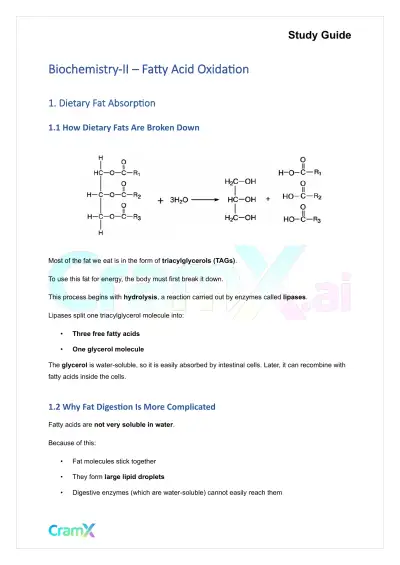 Quick Guides
Biochemistry-II - Fatty Acid Oxidation
Biochemistry
35 pagesMar 2026
Study this document with CramX
Once it is in your library, every tool can work from it.