

Biology - The Unity and Diversity of Life
- Biology
- Texas A&M University
- 18 pages
- Shared March 2026
Preview 6 of 18 pages
See the first 6 pages exactly as they appear in the document.
Page 1 Read page 1 as text
Study Guide Biology – The Unity and Diversity of Life 1. Basics of Classification (Taxonomy) 1.1 Why Do We Classify Living Things? Earth is home to more than 8 million different species . This number keeps changing as scientists discover new species every year. With so many living things, biologists need a clear way to organize them. The branch of biology that does this is called taxonomy , and scientists who work in this field are known as taxonomists . Taxonomy helps us understand how living things are related and how life on Earth is both diverse and connected . 1.2 The Beginning of Modern Taxonomy In the mid - 1700s, a Swedish scientist named Carolus Linnaeus made a major contribution to biology. He studied plants and animals and grouped them based on their reproductive parts . Linnaeus also introduced a naming system called binomial taxonomy , which gives every organism a two - part scientific name . His system was so well designed that it is still used today. Later, Linnaeus’s work was combined with Charles Darwin’s theory of evolution . Darwin explained that: • All modern species evolved from earlier species. • All living organisms share a common ancestry . Because of this, evolution became the organizing principle of modern taxonomy. Today, organisms are classified in ways that reflect their evolutionary relationships . 1.3 What Is Classification? The word classification means the same thing as taxonomy . It refers to the process of organizing and naming organisms based on shared characteristics and ancestry.
Page 2 Read page 2 as text
Study Guide Because evolutionary relationships can be complex, classification systems can also be complex. Scientists often revise them as new evidence is discovered. Even so, classification gives us valuable insight into how life on Earth is organized. 1.4 Rules for Naming Organisms All living organisms are named and classified using an international system of rules developed in the early twentieth century. These rules: • Apply only to scientific names , not common names. • Provide a standard method for naming new species . This ensures that scientists around the world can communicate clearly and avoid confusion. 1.5 Scientific Names: Binomial Nomenclature Each organism has a binomial name , which means it has two parts : 1. Genus name 2. Species modifier For example, the scientific name of humans is Homo sapiens : • Homo is the genus • sapiens is the species modifier The genus name is usually a noun , and the species modifier is often an adjective . Together, Homo sapiens roughly means “knowing human” or “intelligent human.” 1.6 What Is a Species? A species is generally defined as a group of organisms that: • Can interbreed naturally • Produce fertile offspring Organisms from different species usually do not mate. If they do, one of two things happens:
Page 3 Read page 3 as text
Study Guide • The mating is unsuccessful, or • The offspring is sterile (cannot reproduce) Example: • A horse ( Equus caballus ) and a donkey ( Equus assinus ) can mate and produce a mule . • However, mules are sterile, so horses and donkeys are considered different species . In contrast, different breeds of horses (like quarter horses and thoroughbreds) can produce fertile offspring, so they all belong to the same species . 1.7 Human Species, Past and Present Today, there is only one living human species : Homo sapiens . In the past, other human species existed, such as Homo erectus . These are considered separate species because they likely could not interbreed with Homo sapiens . 1.8 Levels of Classification Classification groups organisms into larger and larger categories based on shared traits. Here is the general order, from smallest to largest: • Species • Genus (plural: genera) • Family • Order • Class • Phylum (used for animals) or Division (used for plants and fungi) • Kingdom • Domain The domain is the largest and most inclusive category and has replaced kingdom as the highest level.
Page 4 Read page 4 as text
Study Guide 1.9 Human Classification: An Example Let’s see how humans fit into this system, starting from the broadest category: • Domain: Eukarya (made of eukaryotic cells) • Kingdom: Animalia (has animal characteristics) • Phylum: Chordata (has a backbone at some stage of life) • Class: Mammalia (has mammary glands and nurses young) • Order: Primata (includes primates like monkeys and gorillas) • Family: Hominidae (human - like creatures) • Genus: Homo • Species: Homo sapiens This step - by - step system shows how classification helps us understand both what makes humans unique and how we are related to other living organisms . 2. Quiz Basics of Classification Taxonomy 1. Question Taxonomy is best described as: Answer Choices • a method of scientifically naming species that once created, never changes • classifying organisms that reflect their biological ancestry, and is often the subject of revision • the art of preparing, stuffing, and mounting the skins of animals with lifelike effect Correct Answer classifying organisms that reflect their biological ancestry, and is often the subject of revision
Page 5 Read page 5 as text
Study Guide Why This Is Correct Taxonomy is the science of classifying living organisms based on shared characteristics and evolutionary (biological) relationships. As new evidence — such as genetic data — is discovered, classifications can change. This is why taxonomy is often revised over time. 2. Question Earth today is home to about how many different species? Answer Choices • 8 million • 80,000 • 800,000 Correct Answer 8 million Why This Is Correct Scientists estimate that Earth is home to around 8 million different species of plants, animals, fungi, and microorganisms. Many of these species have not yet been discovered or formally described, especially those living in oceans and tropical regions. 3. Question Which characteristic does NOT define a species? Answer Choices • ability to interbreed • ability to produce fertile offspring • ability to produce offspring that may or may not be fertile
Page 6 Read page 6 as text
Study Guide Correct Answer ability to produce offspring that may or may not be fertile Why This Is Correct A species is defined as a group of organisms that can interbreed naturally and produce fertile offspring . If offspring may be infertile (like a mule, which comes from a horse and a donkey), the parents are considered different species. 4. Question Which of the following pairs are NOT considered the same species? Answer Choices • Chihuahua and Dalmatian • donkey and horse • quarter horse and thoroughbred Correct Answer donkey and horse Why This Is Correct Donkeys and horses can mate, but their offspring (a mule or hinny) is usually infertile , which means they are not the same species . In contrast, different dog breeds (like Chihuahuas and Dalmatians) and different horse breeds (like Quarter Horses and Thoroughbreds) can interbreed and produce fertile offspring , so they are considered the same species. 5. Question What is the correct order of classification, from broadest to most specific ?
12 more pages in the full document
Unlock it once and it stays in your library, ready to chat with or turn into flashcards.
Unlock the full documentMore Biology study materials
See all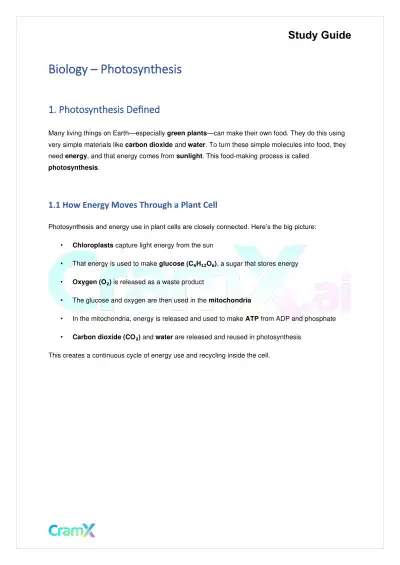 Quick Guides
Biology - Photosynthesis
Biology
15 pagesMar 2026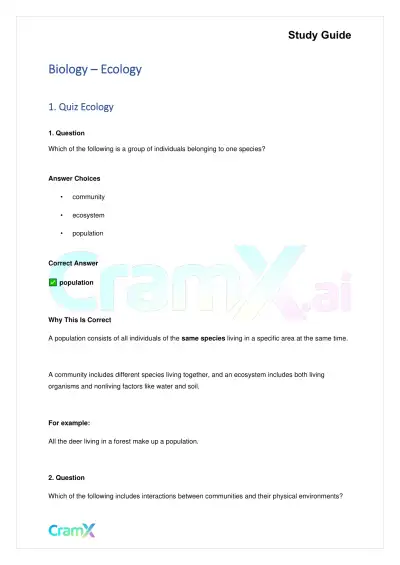 Quick Guides
Biology - Ecology
Biology
19 pagesMar 2026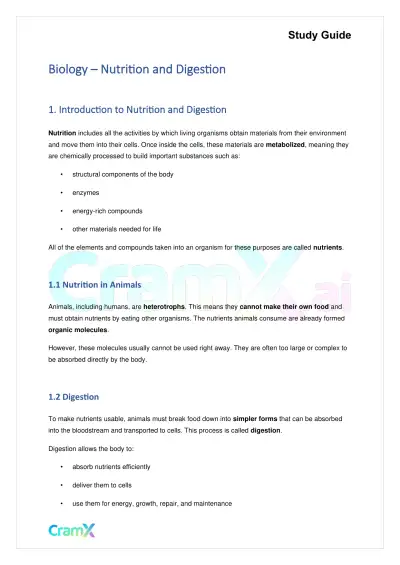 Quick Guides
Biology - Nutrition and Digestion
Biology
17 pagesMar 2026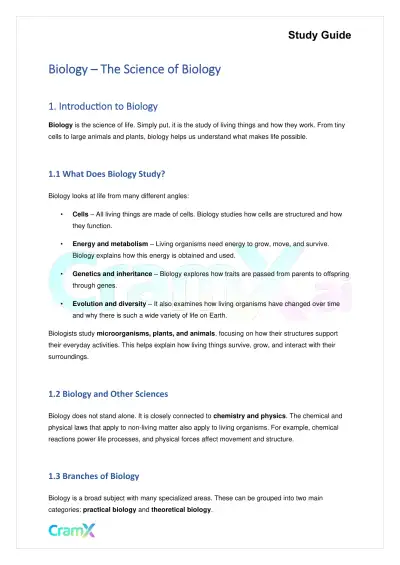 Quick Guides
Biology - The Science of Biology
Biology
13 pagesMar 2026 Quick Guides
Biology - Animals Vertebrates
Biology
21 pagesMar 2026 Quick Guides
Biology - Nervous Coordination
Biology
22 pagesMar 2026 Quick Guides
Biology - Classical (Mendelian) Genetics
Biology
14 pagesMar 2026 Quick Guides
Biology - Protista
Biology
28 pagesMar 2026
Study this document with CramX
Once it is in your library, every tool can work from it.