

Real Estate Principles: A Value Approach (The Mcgraw-hill/Irwin Series in Finance, Insurance, and Real Estate) 3rd Edition Test Bank
- Business Law
- 209 pages
- Shared February 2025
- 37 downloads
Real Estate Principles: A Value Approach (The Mcgraw-hill/Irwin Series in Finance, Insurance, and Real Estate) 3rd Edition Test Bank delivers a complete question bank to help you study smarter and score higher.
Preview 31 of 209 pages
See the first 31 pages exactly as they appear in the document.
Page 1 Read page 1 as text
1 1. When viewed as a tangible asset, real estate can be defined as the land and its permanent improvements. Improvements on the land include: A. fences B. walkways C. sewer systems D. streets 2. Real estate is property, which can be either a tangible or an intangible asset. Which of the following would be considered an intangible asset? A. Land B. Building C. Mortgage D. Motor home 3. When the value of land is considered, it is important to distinguish between land and raw land. Raw land refers to a(n): A. building site B. structure on the land C. property's infrastructure D. area that does not include any improvements 4. The size of a single family residential lot is typically: A. less than one acre B. between one and two acres C. between two and three acres D. greater than three acres 5. As of 2008, the single largest asset category in the net worth portfolios of households is: A. government and corporate bonds B. stocks and mutual fund shares C. consumer durable goods D. housing 6. As of December 2008, the market value of outstanding real estate mortgage debt was: A. greater than the market value of corporate equities B. less than the market value of U.S. Treasury securities C. less than the market value of corporate and foreign bonds D. greater than the market value of corporate, foreign, and U.S. Treasury debt securities combined 7. Real estate values derive from the interaction of three different sectors in the economy. Which of the following sectors serves to allocate financial resources among households and firms requiring funds? A. User market B. Capital market C. Government D. Local market 8. The demand for real estate derives from the need that participants in the user market have for shelter and convenient access to other locations. The primary participants in the user market include all of the following EXCEPT: A. owner occupants B. tenants C. renters D. pension fund managers
Page 2 Page 3 Read page 3 as text
9. In 2007, the housing market was widely viewed as: A. a resilient asset class that significantly softened the severity of the recession B. a surging market pushing prices and new construction to unprecedented levels C. the primary cause of a major economic downturn D. unrelated to the condition of the U.S. economy 10. Capital markets can be divided into four main categories: private equity, public equity, private debt, and public debt. An example of a real estate asset that trades in the private equity market is: A. real property B. home mortgages C. equity REITs D. mortgage backed securities 11. Primarily through land use controls and property tax policy, which of the following branches of government has the largest influence on real estate values? A. Local government B. State government C. National government D. Foreign government 12. Competition in the _________, where households and firms compete for the currently available supply of locations and space, determines the level of rental income for each submarket and property. A. user market B. capital market C. government D. local market 13. The expected stream of rental income is capitalized into value by converting expected future cash flows into present value through a process called: A. amortization B. discounting C. compounding D. accounting 14. Large commercial properties valued well over $10 million are often referred to as: A. segmented property B. investment-grade property C. speculative-grade property D. immobile property 15. Each property has unique features, whether it is its age, the building design of its structures, or its location. As such, real estate markets, in contrast to other goods, are considered: A. homogeneous B. heterogeneous C. substitutes D. complements 16. What proportion of U.S. households own their home? A. One-third B. One-half C. Two-thirds D. Three-fourths 17. The national government can have a significant impact on the value of real estate through: A. property tax policy B. income tax policy C. building codes D. real estate licensing requirements
Page 4 Read page 4 as text
18. The required rate of return that an individual demands on a real estate investment is determined in the: A. user market B. capital market C. government D. local market 19. The market for buying, selling, and leasing real estate can be characterized by all of the following EXCEPT: A. localized markets B. highly segmented markets C. privately negotiated contracts D. low transaction costs 20. Especially in terms of retail properties, which of the following attributes is considered the most likely to result in drastic value differences between otherwise similar properties? A. Structural attributes B. Financing attributes C. Location attributes D. Land attributes
Page 5 Read page 5 as text
1 Key 1. When viewed as a tangible asset, real estate can be defined as the land and its permanent improvements. Improvements on the land include: A. fences B. walkways C. sewer systems D. streets Difficulty: Intermediate Learning Objective: 1 Ling - Chapter 01 #1 2. Real estate is property, which can be either a tangible or an intangible asset. Which of the following would be considered an intangible asset? A. Land B. Building C. Mortgage D. Motor home Difficulty: Basic Learning Objective: 1 Ling - Chapter 01 #2 3. When the value of land is considered, it is important to distinguish between land and raw land. Raw land refers to a(n): A. building site B. structure on the land C. property's infrastructure D. area that does not include any improvements Difficulty: Basic Learning Objective: 1 Ling - Chapter 01 #3 4. The size of a single family residential lot is typically: A. less than one acre B. between one and two acres C. between two and three acres D. greater than three acres Difficulty: Intermediate Learning Objective: 2 Ling - Chapter 01 #4 5. As of 2008, the single largest asset category in the net worth portfolios of households is: A. government and corporate bonds B. stocks and mutual fund shares C. consumer durable goods D. housing Difficulty: Intermediate Learning Objective: 4 Ling - Chapter 01 #5 6. As of December 2008, the market value of outstanding real estate mortgage debt was: A. greater than the market value of corporate equities B. less than the market value of U.S. Treasury securities C. less than the market value of corporate and foreign bonds D. greater than the market value of corporate, foreign, and U.S. Treasury debt securities combined Difficulty: Intermediate Learning Objective: 3 Ling - Chapter 01 #6
Page 6 Read page 6 as text
7. Real estate values derive from the interaction of three different sectors in the economy. Which of the following sectors serves to allocate financial resources among households and firms requiring funds? A. User market B. Capital market C. Government D. Local market Difficulty: Intermediate Learning Objective: 3 Ling - Chapter 01 #7 8. The demand for real estate derives from the need that participants in the user market have for shelter and convenient access to other locations. The primary participants in the user market include all of the following EXCEPT: A. owner occupants B. tenants C. renters D. pension fund managers Difficulty: Intermediate Learning Objective: 3 Ling - Chapter 01 #8 9. In 2007, the housing market was widely viewed as: A. a resilient asset class that significantly softened the severity of the recession B. a surging market pushing prices and new construction to unprecedented levels C. the primary cause of a major economic downturn D. unrelated to the condition of the U.S. economy Difficulty: Basic Learning Objective: 3 Ling - Chapter 01 #9 10. Capital markets can be divided into four main categories: private equity, public equity, private debt, and public debt. An example of a real estate asset that trades in the private equity market is: A. real property B. home mortgages C. equity REITs D. mortgage backed securities Difficulty: Intermediate Learning Objective: 3 Ling - Chapter 01 #10 11. Primarily through land use controls and property tax policy, which of the following branches of government has the largest influence on real estate values? A. Local government B. State government C. National government D. Foreign government Difficulty: Intermediate Learning Objective: 3 Ling - Chapter 01 #11 12. Competition in the _________, where households and firms compete for the currently available supply of locations and space, determines the level of rental income for each submarket and property. A. user market B. capital market C. government D. local market Difficulty: Intermediate Learning Objective: 3 Ling - Chapter 01 #12
Page 7 Read page 7 as text
13. The expected stream of rental income is capitalized into value by converting expected future cash flows into present value through a process called: A. amortization B. discounting C. compounding D. accounting Difficulty: Basic Learning Objective: 3 Ling - Chapter 01 #13 14. Large commercial properties valued well over $10 million are often referred to as: A. segmented property B. investment-grade property C. speculative-grade property D. immobile property Difficulty: Intermediate Learning Objective: 5 Ling - Chapter 01 #14 15. Each property has unique features, whether it is its age, the building design of its structures, or its location. As such, real estate markets, in contrast to other goods, are considered: A. homogeneous B. heterogeneous C. substitutes D. complements Difficulty: Basic Learning Objective: 5 Ling - Chapter 01 #15 16. What proportion of U.S. households own their home? A. One-third B. One-half C. Two-thirds D. Three-fourths Difficulty: Intermediate Learning Objective: 4 Ling - Chapter 01 #16 17. The national government can have a significant impact on the value of real estate through: A. property tax policy B. income tax policy C. building codes D. real estate licensing requirements Difficulty: Intermediate Learning Objective: 3 Ling - Chapter 01 #17 18. The required rate of return that an individual demands on a real estate investment is determined in the: A. user market B. capital market C. government D. local market Difficulty: Intermediate Learning Objective: 3 Ling - Chapter 01 #18
Page 8 Read page 8 as text
19. The market for buying, selling, and leasing real estate can be characterized by all of the following EXCEPT: A. localized markets B. highly segmented markets C. privately negotiated contracts D. low transaction costs Difficulty: Intermediate Learning Objective: 5 Ling - Chapter 01 #19 20. Especially in terms of retail properties, which of the following attributes is considered the most likely to result in drastic value differences between otherwise similar properties? A. Structural attributes B. Financing attributes C. Location attributes D. Land attributes Difficulty: Intermediate Learning Objective: 5 Ling - Chapter 01 #20
Page 9 Read page 9 as text
1 Summary Category # of Questions Difficulty: Basic 5 Difficulty: Intermediate 15 Learning Objective: 1 3 Learning Objective: 2 1 Learning Objective: 3 10 Learning Objective: 4 2 Learning Objective: 5 4 Ling - Chapter 01 20
Page 10 Read page 10 as text
2 1. A principal definition of real estate is as a bundle of rights associated with the possession, use, and disposition of property. Each of the following is a fundamental characteristic of property rights EXCEPT: A. they are enforceable by the government. B. they apply only to tangible assets. C. they are nonrevocable. D. they are enduring. 2. Property rights can be divided into two classes, real and personal. Which of the following is an example of real property? A. Vehicles B. Stocks and bonds C. Patents D. Commercial building 3. A fixture is an object that formerly was personal property but has become real property. Of the following four rules for determining whether an object has become a fixture, which is the most dominant (i.e. if there is a conflict, which rule prevails)? A. Manner of the attachment B. Character of the article and manner of adaptation C. Intention of the parties D. Relation of the parties 4. Which of the following items would most likely be considered a fixture? A. Custom bookshelves B. Refrigerator in a single-family residence being sold C. Fence installed by the tenant of a rental property D. Antique chandelier 5. Property rights can be dismantled into lesser bundles, referred to as interests, which can then be held by different individuals. Interests in real property that include possessions are referred to as: A. fixtures B. townships C. licenses D. estates 6. Which of the following types of ownership estates is the most complete bundle of rights, and therefore carries the greatest value? A. Fee simple absolute B. Fee simple conditional C. Ordinary life estate D. Legal life estate 7. Suppose an older homeowner lives adjacent to an expanding university that is interested in acquiring her residence for future university use. To allow the homeowner to continue to retain all rights of exclusive possession, use, and enjoyment during her lifetime, yet provide the university with the right of disposition, the university may want to purchase a: A. life estate B. reverter interest C. remainder estate D. tenancy for years
Page 11 Read page 11 as text
8. While leasehold interests are considered estates, they differ from freehold estates in all of the following respects EXCEPT: A. leasehold estates are limited in time. B. the right of disposition is diminished with a leasehold estate. C. leasehold estates are not titled interests. D. leasehold estates are possessory interests. 9. Nonposessory interests (i.e. bundles of real property rights that do not include possession) include all of the following EXCEPT: A. leasehold interests B. easements C. restrictive covenants D. liens 10. An easement is the right to use land for a specific and limited purpose. Which of the following easements involves a relationship between two parcels of land, is a permanent feature of both parcels involved, and gives the dominant parcel some intrusive use of the servient parcel? A. Affirmative easement appurtenant B. Negative easement appurtenant C. Easement in gross D. License 11. Which of the following is an example of a negative easement appurtenant? A. A driveway easement across one parcel to another. B. Rights-of-way for roads. C . A common drive easement where owners of adjoining lots must permit each other to use a driveway lying on their shaped property line. D. A scenic easement used to restrict construction on adjacent parcels so as to preserve a valued view. 12. An important distinction both practically and conceptually is the difference between an easement and a license. In contrast to an easement, a license: A. is revocable by the grantor. B. can be granted orally. C. is enduring. D. grants permission to use another's land for a specific and limited purpose. 13. A lien is an interest in real property that serves as security for an obligation. Which of the following is an example of a general lien? A. Property tax and assessment lien B. Mortgage lien C. Lien arising from a court judgment unrelated to ownership of the property D. Mechanics' lien 14. Which of the following types of liens is automatically superior to any other lien? A. Property tax and assessment lien B. Mortgage lien C. Lien arising from a court judgment unrelated to ownership of the property D. Mechanics' lien 15. Co-ownership can occur in a variety of ways, with significant variation in how the bundle of rights is jointly held. All of the following entities are forms of direct co-ownership EXCEPT: A. Tenancy in common B. Tenancy by the entirety C. Condominium D. Partnership
Page 12 Read page 12 as text
16. Direct co-ownership implies that each co-owner holds a titled interest in the property, but without exclusive possession with respect to the other co-owners. Which of the following types of direct co- ownership is considered the closest to the fee simple absolute estate? A. Tenancy in common B. Tenancy by the entirety C. Condominium D. Partnership 17. Which of the following types of direct co-ownership is a form of joint tenancy for husband and wife? A. Tenancy in common B. Tenancy by the entirety C. Condominium D. Partnership 18. Which of the following types of direct co-ownership combines single person ownership with tenancy in common? A. Cooperative B. Tenancy by the entirety C. Condominium D. Partnership 19. Which of the following forms of co-ownership, historically used for apartment buildings, is not considered a form of true direct co-ownership, but rather qualifies as a proprietary corporation? A. Cooperative B. Tenancy by the entirety C. Condominium D. Partnership 20. Property rights created from marriage have a clear implication for real estate transactions. Which of the following marital property rights gives a spouse a one-half claim on all property acquired "from the fruits of the marriage?" A. Dower B. Curtesy C. Elective share D. Community property 21. Restrictive covenants impose constraints on the use of the land, yet are limited in terms of their enforcement. All of the following are true regarding the enforcement of restrictive covenants EXCEPT: A . Courts have been reluctant to maintain restrictive covenants for an unreasonably long time and in some cases states have enacted a time limit on their applicability. B. Courts may refuse to enforce restrictive covenants due to changing neighborhood character. C. Courts may refuse to enforce restrictive covenants due to abandonment of the property. D. Restrictive covenants can be enforced by those who do not hold a legal interest in the property. 22. When multiple individuals have use of a property, but their interests are not simultaneous, this type of co- ownership is referred to as a: A. Cooperative B. Tenancy by the entirety C. Condominium D. Timeshare
Page 13 Read page 13 as text
23. In some states, mining companies are deemed to own not only the minerals but also the space the minerals occupied before they were removed, thereby earning the distinction of ownership states. However, when the owner of an oil or gas well is able to claim all that is pumped from it, regardless of whether the oil or gas migrated from adjacent property, this is referred to as a _____________ state. A. Manner of attachment B. Law of capture C. Intention of the parties D. Relation of the parties 24. Bill and Mike go in together to purchase 342 acres of land to use for hunting and family vacations. Ten years later, Bill dies and Bill's wife wants to sell his half of the land. Mike informs her that, unfortunately, she has no claim to the land and that upon Bill's death, his ownership interest transferred to Mike. What type of co-ownership did Bill and Mike have? A. Tenancy by the entireties B. Tenancy in common C. Joint tenancy D. Condominium 25. The City of Grand Rapids installed a new water main on Oak Street. The city then decided to charge the property owners along Oak Street a proportional cost of the new water main. If a property owner refuses to pay their proportional share of the cost, the city may file a(n): A. property tax lien. B. assessment lien. C. general lien. D. mechanics' lien. 26. Jeff owns 150 acres between a highway and a public beach. The state would like to build a road directly from the highway to the beach across Jeff's property. The space for this road would be considered a(n): A. easement appurtenant. B. easement in gross. C. negative easement appurtenant. D. positive easement appurtenant.
Page 14 Read page 14 as text
2 Key 1. A principal definition of real estate is as a bundle of rights associated with the possession, use, and disposition of property. Each of the following is a fundamental characteristic of property rights EXCEPT: A. they are enforceable by the government. B. they apply only to tangible assets. C. they are nonrevocable. D. they are enduring. Difficulty: Basic Learning Objective: 1 Ling - Chapter 02 #1 2. Property rights can be divided into two classes, real and personal. Which of the following is an example of real property? A. Vehicles B. Stocks and bonds C. Patents D. Commercial building Difficulty: Basic Learning Objective: 1 Ling - Chapter 02 #2 3. A fixture is an object that formerly was personal property but has become real property. Of the following four rules for determining whether an object has become a fixture, which is the most dominant (i.e. if there is a conflict, which rule prevails)? A. Manner of the attachment B. Character of the article and manner of adaptation C. Intention of the parties D. Relation of the parties Difficulty: Intermediate Learning Objective: 1 Ling - Chapter 02 #3 4. Which of the following items would most likely be considered a fixture? A. Custom bookshelves B. Refrigerator in a single-family residence being sold C. Fence installed by the tenant of a rental property D. Antique chandelier Difficulty: Intermediate Learning Objective: 1 Ling - Chapter 02 #4 5. Property rights can be dismantled into lesser bundles, referred to as interests, which can then be held by different individuals. Interests in real property that include possessions are referred to as: A. fixtures B. townships C. licenses D. estates Difficulty: Basic Learning Objective: 2 Ling - Chapter 02 #5 6. Which of the following types of ownership estates is the most complete bundle of rights, and therefore carries the greatest value? A. Fee simple absolute B. Fee simple conditional C. Ordinary life estate D. Legal life estate Difficulty: Intermediate Learning Objective: 2 Ling - Chapter 02 #6
Page 15 Read page 15 as text
7. Suppose an older homeowner lives adjacent to an expanding university that is interested in acquiring her residence for future university use. To allow the homeowner to continue to retain all rights of exclusive possession, use, and enjoyment during her lifetime, yet provide the university with the right of disposition, the university may want to purchase a: A. life estate B. reverter interest C. remainder estate D. tenancy for years Difficulty: Advanced Learning Objective: 2 Ling - Chapter 02 #7 8. While leasehold interests are considered estates, they differ from freehold estates in all of the following respects EXCEPT: A. leasehold estates are limited in time. B. the right of disposition is diminished with a leasehold estate. C. leasehold estates are not titled interests. D. leasehold estates are possessory interests. Difficulty: Intermediate Learning Objective: 2 Ling - Chapter 02 #8 9. Nonposessory interests (i.e. bundles of real property rights that do not include possession) include all of the following EXCEPT: A. leasehold interests B. easements C. restrictive covenants D. liens Difficulty: Intermediate Learning Objective: 3 Ling - Chapter 02 #9 10. An easement is the right to use land for a specific and limited purpose. Which of the following easements involves a relationship between two parcels of land, is a permanent feature of both parcels involved, and gives the dominant parcel some intrusive use of the servient parcel? A. Affirmative easement appurtenant B. Negative easement appurtenant C. Easement in gross D. License Difficulty: Basic Learning Objective: 3 Ling - Chapter 02 #10 11. Which of the following is an example of a negative easement appurtenant? A. A driveway easement across one parcel to another. B. Rights-of-way for roads. C. A common drive easement where owners of adjoining lots must permit each other to use a driveway lying on their shaped property line. D. A scenic easement used to restrict construction on adjacent parcels so as to preserve a valued view. Difficulty: Intermediate Learning Objective: 3 Ling - Chapter 02 #11 12. An important distinction both practically and conceptually is the difference between an easement and a license. In contrast to an easement, a license: A. is revocable by the grantor. B. can be granted orally. C. is enduring. D. grants permission to use another's land for a specific and limited purpose. Difficulty: Basic Learning Objective: 3 Ling - Chapter 02 #12
Page 16 Read page 16 as text
13. A lien is an interest in real property that serves as security for an obligation. Which of the following is an example of a general lien? A. Property tax and assessment lien B. Mortgage lien C. Lien arising from a court judgment unrelated to ownership of the property D. Mechanics' lien Difficulty: Intermediate Learning Objective: 5 Ling - Chapter 02 #13 14. Which of the following types of liens is automatically superior to any other lien? A. Property tax and assessment lien B. Mortgage lien C. Lien arising from a court judgment unrelated to ownership of the property D. Mechanics' lien Difficulty: Intermediate Learning Objective: 5 Ling - Chapter 02 #14 15. Co-ownership can occur in a variety of ways, with significant variation in how the bundle of rights is jointly held. All of the following entities are forms of direct co-ownership EXCEPT: A. Tenancy in common B. Tenancy by the entirety C. Condominium D. Partnership Difficulty: Basic Learning Objective: 6 Ling - Chapter 02 #15 16. Direct co-ownership implies that each co-owner holds a titled interest in the property, but without exclusive possession with respect to the other co-owners. Which of the following types of direct co- ownership is considered the closest to the fee simple absolute estate? A. Tenancy in common B. Tenancy by the entirety C. Condominium D. Partnership Difficulty: Intermediate Learning Objective: 6 Ling - Chapter 02 #16 17. Which of the following types of direct co-ownership is a form of joint tenancy for husband and wife? A. Tenancy in common B. Tenancy by the entirety C. Condominium D. Partnership Difficulty: Basic Learning Objective: 6 Ling - Chapter 02 #17 18. Which of the following types of direct co-ownership combines single person ownership with tenancy in common? A. Cooperative B. Tenancy by the entirety C. Condominium D. Partnership Difficulty: Basic Learning Objective: 6 Ling - Chapter 02 #18
Page 17 Read page 17 as text
19. Which of the following forms of co-ownership, historically used for apartment buildings, is not considered a form of true direct co-ownership, but rather qualifies as a proprietary corporation? A. Cooperative B. Tenancy by the entirety C. Condominium D. Partnership Difficulty: Basic Learning Objective: 6 Ling - Chapter 02 #19 20. Property rights created from marriage have a clear implication for real estate transactions. Which of the following marital property rights gives a spouse a one-half claim on all property acquired "from the fruits of the marriage?" A. Dower B. Curtesy C. Elective share D. Community property Difficulty: Basic Learning Objective: 7 Ling - Chapter 02 #20 21. Restrictive covenants impose constraints on the use of the land, yet are limited in terms of their enforcement. All of the following are true regarding the enforcement of restrictive covenants EXCEPT: A . Courts have been reluctant to maintain restrictive covenants for an unreasonably long time and in some cases states have enacted a time limit on their applicability. B. Courts may refuse to enforce restrictive covenants due to changing neighborhood character. C. Courts may refuse to enforce restrictive covenants due to abandonment of the property. D. Restrictive covenants can be enforced by those who do not hold a legal interest in the property. Difficulty: Advanced Learning Objective: 4 Ling - Chapter 02 #21 22. When multiple individuals have use of a property, but their interests are not simultaneous, this type of co-ownership is referred to as a: A. Cooperative B. Tenancy by the entirety C. Condominium D. Timeshare Difficulty: Basic Learning Objective: 8 Ling - Chapter 02 #22 23. In some states, mining companies are deemed to own not only the minerals but also the space the minerals occupied before they were removed, thereby earning the distinction of ownership states. However, when the owner of an oil or gas well is able to claim all that is pumped from it, regardless of whether the oil or gas migrated from adjacent property, this is referred to as a _____________ state. A. Manner of attachment B. Law of capture C. Intention of the parties D. Relation of the parties Difficulty: Advanced Learning Objective: 1 Ling - Chapter 02 #23
Page 18 Read page 18 as text
24. Bill and Mike go in together to purchase 342 acres of land to use for hunting and family vacations. Ten years later, Bill dies and Bill's wife wants to sell his half of the land. Mike informs her that, unfortunately, she has no claim to the land and that upon Bill's death, his ownership interest transferred to Mike. What type of co-ownership did Bill and Mike have? A. Tenancy by the entireties B. Tenancy in common C. Joint tenancy D. Condominium Difficulty: Advanced Learning Objective: 6 Ling - Chapter 02 #24 25. The City of Grand Rapids installed a new water main on Oak Street. The city then decided to charge the property owners along Oak Street a proportional cost of the new water main. If a property owner refuses to pay their proportional share of the cost, the city may file a(n): A. property tax lien. B. assessment lien. C. general lien. D. mechanics' lien. Difficulty: Advanced Learning Objective: 5 Ling - Chapter 02 #25 26. Jeff owns 150 acres between a highway and a public beach. The state would like to build a road directly from the highway to the beach across Jeff's property. The space for this road would be considered a(n): A. easement appurtenant. B. easement in gross. C. negative easement appurtenant. D. positive easement appurtenant. Difficulty: Advanced Learning Objective: 3 Ling - Chapter 02 #26
Page 19 Read page 19 as text
2 Summary Category # of Questions Difficulty: Advanced 6 Difficulty: Basic 11 Difficulty: Intermediate 9 Learning Objective: 1 5 Learning Objective: 2 4 Learning Objective: 3 5 Learning Objective: 4 1 Learning Objective: 5 3 Learning Objective: 6 6 Learning Objective: 7 1 Learning Objective: 8 1 Ling - Chapter 02 26
Page 20 Read page 20 as text
3 1. A deed is a special form of written contract used to convey a permanent interest in real property. Unlike most contracts, a deed requires: A. both parties to be legally competent and of legal majority age. B. only the grantee to be legally competent and of legal majority age. C. only the grantor to be legally competent and of legal majority age. D. both parties to make promises to perform. 2. The type of deed offered by the grantor is communicated through a phrase such as "does herby grant, bargain, sell and convey unto . . ." This clause is referred to as the: A. recital of consideration B. words of conveyance C. covenant D. habendum clause 3. The covenants in a deed are the most important differences among types of deeds. Which of the following covenants promises that the grantor truly has good title and the right to convey it? A. Covenant of seizin B. Covenant against encumbrances C. Covenant of quiet enjoyment D. Exceptions and reservation clause 4. Which of the following clauses contained in a deed defines or limits the type of interest being conveyed? A. Recital of consideration B. Words of conveyance C. Covenant D. Habendum clause 5. Although deeds can only deliver what a grantor actually owns, they can still vary in "quality." Which of the following types of deeds is considered to be the "highest quality" because it contains the full set of legal promises the grantor can make? A. General warranty deed B. Special warranty deed C. Deed of bargain and sale D. Quitclaim deed 6. Considered a "questionable conveyance of title" by most courts, which of the following types of deeds is worded to imply no claim of title, but rather only convey what interest the grantor actually has? (Hint: This type of deed may be used by a developer to convey certain lands of a subdivision to the local government through dedication.) A. General warranty deed B. Special warranty deed C. Deed of bargain and sale D. Quitclaim deed 7. While several kinds of real property conveyances result from events beyond the control of the grantor, the majority of conveyances are voluntary through a deed. Which of the following is an example of a voluntary conveyance of real property with a deed? A. Patent B. Probate C. Condemnation D. Implied Easement
Page 21 Read page 21 as text
8. At the death of a property owner, property will convey either in accordance with a will or without a will. If a will dictates the distribution of the decedent's real property, the property is said to be conveyed by: A. patent B. devise C. the law of descent D. dedication 9. While the vast majority of conveyances of real property are private grants through a deed, there are multiple ways in which voluntary conveyance can occur without a deed. Which of the following types of easements can occur if a landowner gives an adjacent landowner permission to depend on her land? (E.g. A landowner may give a neighbor permission to rely on sewer access or drainage across his or her land.) A. Easement by prior use B. Easement of necessity C. Easement by estoppel D. Dedication 10. When a landowner subdivides land in a way that causes a parcel to be landlocked, it is possible for property to be voluntarily conveyed without a deed. If the landlocked parcel has no prior path of access, which of the following types of easements will automatically be created to make the land useful? A. Easement by prior use B. Easement of necessity C. Easement by estoppel D. Dedication 11. An owner of land may involuntarily and unknowingly give up the rights to land. When a fee simple interest is conveyed to a new owner without a deed and without the consent or knowledge of the original owner, this is said to be conveyed by: A. Prescription B. Adverse possession C. Accretion D. Reliction 12. Once a document conveying an interest in real property is placed in the public records it is binding on the public, whether or not they make an effort to learn of it. Based on the common law tradition, this policy is known as the: A. Statute of Frauds B. doctrine of constructive notice C. habendum clause D. actual notice 13. A contract for sale of real estate usually calls for the seller to provide evidence of title as a requisite to completing the sale. Today, the predominant medium through which a seller meets this requirement is by providing: A. only a title abstract. B. only an attorney's opinion of title. C. only a title insurance commitment. D. only a Torrens certificate. 14. A law requiring any contract conveying a real property interest to be in writing in order to be enforceable is a modern application of the: A. Statute of Frauds B. doctrine of constructive notice C. habendum clause D. actual notice
Page 22 Read page 22 as text
15. Unlike other forms of evidence of title, title insurance guards the grantee against certain risks. However, there are a number of important limits to title insurance. Which of the following is an example of the limits to title insurance? A. It does not protect the grantee from the threat of physical damage to the property. B. It does not protect a grantee against the legal costs of defending the title. C. It does not protect a grantee against loss of the property in case of an unsuccessful title defense. D. It does not protect against legal attack on the owner's title arising from a claim that diminishes the owner's rights of use. 16. Recognizing that only recent conveyances alter the status of title, states have established laws that set limits on how far back a title search must go. These laws are commonly referred to as: A. Statute of Frauds B. recording statutes C. encroachments D. marketable title laws 17. One of the most important requirements of a land description is for it to be unambiguous. Which of the following methods of property description is the most unambiguous and is appropriate for use in legal documents? A. Street Address B. Tax parcel number C. Reference to prominent features of the land (e.g. monuments, river banks, roads) D. Metes and bounds 18. The most flexible method of land description, capable of describing even the most irregular of parcels, can be described as a very precise, compass-directed walk around the boundary of a parcel. This method is commonly referred to as: A. metes and bounds B. subdivision plat lot and block number C. government rectangular survey D. tax parcel number 19. Most often used in the description of urban property, which of the following methods of land description contains information regarding the location of various easements and may even contain a list of restrictive covenants? A. metes and bounds B. subdivision plat lot and block number C. government rectangular survey D. tax parcel number 20. Initially used to survey the Old Northwest Territory (Ohio, Indiana, Illinois, and Michigan) in 1789, which of the following methods of land description relies on townships and section numbers as essential units of identification? A. metes and bounds B. subdivision plat lot and block number C. government rectangular survey D. tax parcel number
Page 23 Read page 23 as text
3 Key 1. A deed is a special form of written contract used to convey a permanent interest in real property. Unlike most contracts, a deed requires: A. both parties to be legally competent and of legal majority age. B. only the grantee to be legally competent and of legal majority age. C. only the grantor to be legally competent and of legal majority age. D. both parties to make promises to perform. Difficulty: Basic Learning Objective: 1 Ling - Chapter 03 #1 2. The type of deed offered by the grantor is communicated through a phrase such as "does herby grant, bargain, sell and convey unto . . ." This clause is referred to as the: A. recital of consideration B. words of conveyance C. covenant D. habendum clause Difficulty: Basic Learning Objective: 2 Ling - Chapter 03 #2 3. The covenants in a deed are the most important differences among types of deeds. Which of the following covenants promises that the grantor truly has good title and the right to convey it? A. Covenant of seizin B. Covenant against encumbrances C. Covenant of quiet enjoyment D. Exceptions and reservation clause Difficulty: Basic Learning Objective: 3 Ling - Chapter 03 #3 4. Which of the following clauses contained in a deed defines or limits the type of interest being conveyed? A. Recital of consideration B. Words of conveyance C. Covenant D. Habendum clause Difficulty: Basic Learning Objective: 2 Ling - Chapter 03 #4 5. Although deeds can only deliver what a grantor actually owns, they can still vary in "quality." Which of the following types of deeds is considered to be the "highest quality" because it contains the full set of legal promises the grantor can make? A. General warranty deed B. Special warranty deed C. Deed of bargain and sale D. Quitclaim deed Difficulty: Intermediate Learning Objective: 3 Ling - Chapter 03 #5
Page 24 Read page 24 as text
6. Considered a "questionable conveyance of title" by most courts, which of the following types of deeds is worded to imply no claim of title, but rather only convey what interest the grantor actually has? (Hint: This type of deed may be used by a developer to convey certain lands of a subdivision to the local government through dedication.) A. General warranty deed B. Special warranty deed C. Deed of bargain and sale D. Quitclaim deed Difficulty: Basic Learning Objective: 3 Ling - Chapter 03 #6 7. While several kinds of real property conveyances result from events beyond the control of the grantor, the majority of conveyances are voluntary through a deed. Which of the following is an example of a voluntary conveyance of real property with a deed? A. Patent B. Probate C. Condemnation D. Implied Easement Difficulty: Basic Learning Objective: 4 Ling - Chapter 03 #7 8. At the death of a property owner, property will convey either in accordance with a will or without a will. If a will dictates the distribution of the decedent's real property, the property is said to be conveyed by: A. patent B. devise C. the law of descent D. dedication Difficulty: Basic Learning Objective: 4 Ling - Chapter 03 #8 9. While the vast majority of conveyances of real property are private grants through a deed, there are multiple ways in which voluntary conveyance can occur without a deed. Which of the following types of easements can occur if a landowner gives an adjacent landowner permission to depend on her land? (E.g. A landowner may give a neighbor permission to rely on sewer access or drainage across his or her land.) A. Easement by prior use B. Easement of necessity C. Easement by estoppel D. Dedication Difficulty: Intermediate Learning Objective: 5 Ling - Chapter 03 #9 10. When a landowner subdivides land in a way that causes a parcel to be landlocked, it is possible for property to be voluntarily conveyed without a deed. If the landlocked parcel has no prior path of access, which of the following types of easements will automatically be created to make the land useful? A. Easement by prior use B. Easement of necessity C. Easement by estoppel D. Dedication Difficulty: Intermediate Learning Objective: 5 Ling - Chapter 03 #10
Page 25 Read page 25 as text
11. An owner of land may involuntarily and unknowingly give up the rights to land. When a fee simple interest is conveyed to a new owner without a deed and without the consent or knowledge of the original owner, this is said to be conveyed by: A. Prescription B. Adverse possession C. Accretion D. Reliction Difficulty: Basic Learning Objective: 5 Ling - Chapter 03 #11 12. Once a document conveying an interest in real property is placed in the public records it is binding on the public, whether or not they make an effort to learn of it. Based on the common law tradition, this policy is known as the: A. Statute of Frauds B. doctrine of constructive notice C. habendum clause D. actual notice Difficulty: Basic Learning Objective: 6 Ling - Chapter 03 #12 13. A contract for sale of real estate usually calls for the seller to provide evidence of title as a requisite to completing the sale. Today, the predominant medium through which a seller meets this requirement is by providing: A. only a title abstract. B. only an attorney's opinion of title. C. only a title insurance commitment. D. only a Torrens certificate. Difficulty: Intermediate Learning Objective: 8 Ling - Chapter 03 #13 14. A law requiring any contract conveying a real property interest to be in writing in order to be enforceable is a modern application of the: A. Statute of Frauds B. doctrine of constructive notice C. habendum clause D. actual notice Difficulty: Intermediate Learning Objective: 6 Ling - Chapter 03 #14 15. Unlike other forms of evidence of title, title insurance guards the grantee against certain risks. However, there are a number of important limits to title insurance. Which of the following is an example of the limits to title insurance? A. It does not protect the grantee from the threat of physical damage to the property. B. It does not protect a grantee against the legal costs of defending the title. C. It does not protect a grantee against loss of the property in case of an unsuccessful title defense. D. It does not protect against legal attack on the owner's title arising from a claim that diminishes the owner's rights of use. Difficulty: Intermediate Learning Objective: 8 Ling - Chapter 03 #15 16. Recognizing that only recent conveyances alter the status of title, states have established laws that set limits on how far back a title search must go. These laws are commonly referred to as: A. Statute of Frauds B. recording statutes C. encroachments D. marketable title laws Difficulty: Basic Learning Objective: 7 Ling - Chapter 03 #16
Page 26 Read page 26 as text
17. One of the most important requirements of a land description is for it to be unambiguous. Which of the following methods of property description is the most unambiguous and is appropriate for use in legal documents? A. Street Address B. Tax parcel number C. Reference to prominent features of the land (e.g. monuments, river banks, roads) D. Metes and bounds Difficulty: Basic Learning Objective: 9 Ling - Chapter 03 #17 18. The most flexible method of land description, capable of describing even the most irregular of parcels, can be described as a very precise, compass-directed walk around the boundary of a parcel. This method is commonly referred to as: A. metes and bounds B. subdivision plat lot and block number C. government rectangular survey D. tax parcel number Difficulty: Basic Learning Objective: 9 Ling - Chapter 03 #18 19. Most often used in the description of urban property, which of the following methods of land description contains information regarding the location of various easements and may even contain a list of restrictive covenants? A. metes and bounds B. subdivision plat lot and block number C. government rectangular survey D. tax parcel number Difficulty: Intermediate Learning Objective: 9 Ling - Chapter 03 #19 20. Initially used to survey the Old Northwest Territory (Ohio, Indiana, Illinois, and Michigan) in 1789, which of the following methods of land description relies on townships and section numbers as essential units of identification? A. metes and bounds B. subdivision plat lot and block number C. government rectangular survey D. tax parcel number Difficulty: Intermediate Learning Objective: 9 Ling - Chapter 03 #20
Page 27 Read page 27 as text
3 Summary Category # of Questions Difficulty: Basic 12 Difficulty: Intermediate 8 Learning Objective: 1 1 Learning Objective: 2 2 Learning Objective: 3 3 Learning Objective: 4 2 Learning Objective: 5 3 Learning Objective: 6 2 Learning Objective: 7 1 Learning Objective: 8 2 Learning Objective: 9 4 Ling - Chapter 03 20
Page 28 Read page 28 as text
4 1. While most real property in the United States is privately owned, government regulations limit private property use and therefore play an important role in the determination of property value. Proponents of government intervention argue that regulation is needed to address the unintended and unaccounted for consequences of one land user upon others, more commonly referred to as: A. incomplete information B. locational monopoly C. externalities D. urban sprawl 2. Externalities can play an important role in determining a property's price, either by adding value through positive externalities or by diminishing value through negative externalities. Which of the following is most likely to be considered a negative externality? A. Nearby parks and recreation facilities. B. Quality neighborhood schools. C. Public assistance facilities such as homeless shelters. D. Well-kept landscapes. 3. Development taking place in rural areas well beyond the urban fringe is commonly referred to as: A. urban sprawl B. holdout C. urban service areas D. homestead 4. It was not until the late 1960's that land use controls moved to the forefront of public interest, as the belief that the environment was an endless and costless resource was replaced with the notion that the world was a closed system with limited space, air, water, and other resources. Environmentalists coined which of the following terms to refer to this new point of view? A. Smart growth B. The Silent Spring C. Spaceship earth D. Urban sprawl 5. After a structure is built, it is impractical for even a building expert to fully assess the quality of the construction and the safety hazards it may harbor. This is an example of which of the following problems that plagues private real estate markets? A. Externalities B. Incomplete information C. Locational monopoly D. Holdout 6. Growth management laws at the state level require local jurisdictions to plan for and meet certain requirements. One such requirement prohibits local development unless adequate infrastructure, schools, police/fire protection, and social services have been put in place first. This requirement is referred to as the: A. economic and environmental impact requirement B. concurrency requirement C. affordable housing requirement D. extraterritorial jurisdiction requirement
Page 29 Read page 29 as text
7. A contemporary planning movement that explicitly advocates a traditional grid pattern of development designed to give pedestrian life priority over motor vehicles (e.g., including narrowed streets with houses close to the street and garage access through side alleys) is commonly referred to as: A. urban sprawl B. urban service area C. traditional residential planning D. new urbanism 8. Which of the following tools of public land use control represents the earliest method of police power to regulate land use? (Hint: Standards for energy efficiency and sustainability are the most recent trends in the application of this land use control) A. Subdivision regulation B. Zoning C. Building Codes D. Planned Unit Developments 9. When a zoning ordinance is revised, some existing land uses then fall outside the new zoning classification. These land uses are referred to as: A. special uses B. nonconforming uses C. conforming uses D. exclusionary uses 10. When land use controls impose exceptional hardship and loss of value, a relief mechanism must be provided. This relief is referred to as a: A. building code B. zoning ordinance C. comprehensive plan D. variance 11. In order for the board of adjustment to approve a variance, all of the following conditions must be met EXCEPT: A. The owner must be unable to use the lot as zoned. B. The condition is common to other parcels of land in the vicinity. C. The variance must not materially change the character of the neighborhood. D. The condition is unique to the lot. 12. A traditional zoning ordinance includes all of the following EXCEPT: A. Minimum setback requirements B. Minimum lot dimensions C. Provisions for special use districts D. Performance standards 13. State and federal control of land uses has increased greatly over the past 40 years due in part to an increased awareness of environmental hazards. Which of the following federal environmental control laws was responsible for establishing the "Superfund" to finance emergency responses and cleanups of abandoned and unregulated waste dumps? A. Clean Water Act B. Resource Conservation and Recovery Act C. Toxic Substances Control Act D. Comprehensive Environmental Response Compensation and Liability Act 14. Negative externalities can diminish a property's value by imposing costs on the community at large. In order to offset this detrimental impact, economists advocate "internalizing" these externalities by implementing: A. performance standards B. impact fees C. growth moratoriums D. planned unit developments
Page 30 Read page 30 as text
15. A major problem in buildings constructed prior to the early 1970's, which of the following environmental hazards commonly associated with insulation has been the focus of costly cleanups at many public buildings, especially schools? A. Asbestos B. Radon C. PCBs (Polychlorinated biphenyls) D. LUSTs (leaking underground storage tanks) 16. The right of government to acquire private property, without the owner's consent, for public use in exchange for just compensation is referred to as: A. inverse condemnation B. regulatory taking C. eminent domain D. dedication 17. All of the following statements are true in describing the determination of just compensation EXCEPT: A. The value of the property is based on its highest and best use at the time. B. The value of the property is determined solely by its current use. C . The value is the amount that restores the property owner to a financial position equivalent to that existing before the property was taken. D. The value is the market value of the property if completely taken, or the total value of all financial loss if partially taken. 18. Real estate taxes represent the largest single source of revenue for a large portion of local governments. Most property taxes are applied in relation to the value of the property, or in other words, they are: A. effective tax rates B. ad valorem taxes C. tax-exempt D. regressive 19. A developer plans to place a subdivision slightly outside the city limits in an area that is rapidly developing. However, the city claims to have the right to control urban development even in the proposed area. The right the city is attempting to invoke is referred to as: A. extraterritorial jurisdiction. B. urban service area. C. comprehensive plan. D. growth constraint. 20. While most property taxes are levied in order to finance services that benefit the community, special assessments are levied to pay for specific improvements that benefit a particular group of properties. All of the following characteristics of special assessments are true EXCEPT: A. They are considered ad valorem taxes. B. They are applied as pro rata charges. C. They are levied directly on the properties benefited. D. They are commonly used to finance streets, storm water systems, sidewalks, and other area improvements. 21. The right to pay unpaid taxes, plus interest and penalties, before public sale and to reclaim full title of the property is referred to as: A. inverse condemnation B. foreclosure C. equity right of redemption D. regulatory taking
Page 31 Read page 31 as text
22. One of the main criticisms of property taxes is that the property tax of lower income households is higher than that of higher income households, as a percentage of their respective incomes. In other words, taxes are criticized for being: A. regressive B. comprehensive C. concurrent D. extraterritorial 23. In the state of Florida, for example, homeowners may qualify for a tax exemption in which up to $50,000 will be deducted from the assessed value of the property before taxes are calculated as long as the property owner occupies a home as the family's principal residence and has claimed residency within the state. This exemption is better known as the: A. ad valorem exemption B. affordable housing exemption C. growth moratorium D. homestead exemption 24. Given the following information, compute the property tax rate for the community in percentage terms. Total budget expenditures: $108 million, Total non-property tax income: $50 million, Total assessed value of all properties: $2 billion, Total exemptions: $550 million. A. 2.5% B. 4.0% C. 10.0% D. 12.0% 25. Tax rates are usually stated in mills. Assuming the tax rate in percentage terms is 6.5%, convert this rate to mills. A. 0.065 mills B. 6.5 mills C. 65 mills D. 650 mills 26. Given the following information, compute the effective tax rate for the particular piece of property in percentage terms. Market value of property: $325,000, Assessed value of property: $250,000, Exemptions: $50,000, Taxes paid: $5,363. A. 1.50% B. 2.35% C. 1.65% D. 2.68% 27. Given the following information, compute the taxable value for the particular piece of property in dollar terms. Market value of property: $500,000, Assessed value of property: 85 % of the market value of the property, Exemptions: $50,000, Taxes paid: $8,250. A. $75,000 B. $375,000 C. $416,750 D. $425,000
178 more pages in the full document
Unlock it once and it stays in your library, ready to chat with or turn into flashcards.
Unlock the full documentMore Business Law study materials
See all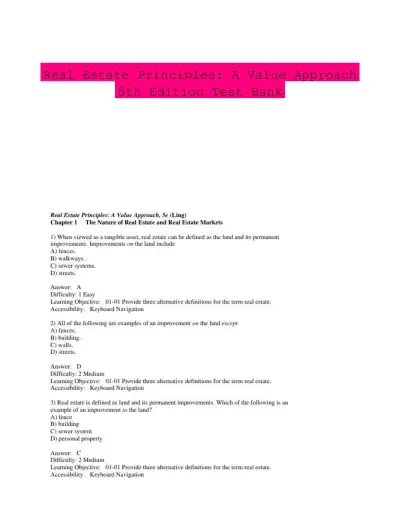 Exam Guides
Real Estate Principles: A Value Approach 5th Edition Test Bank
Business Law
448 pagesMay 2025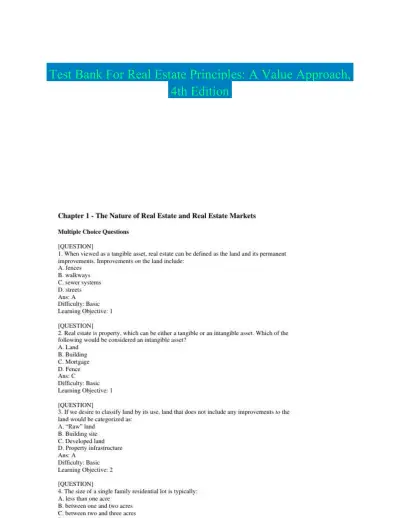 Exam Guides
Test Bank For Real Estate Principles: A Value Approach, 4th Edition
Business Law
206 pagesMay 2025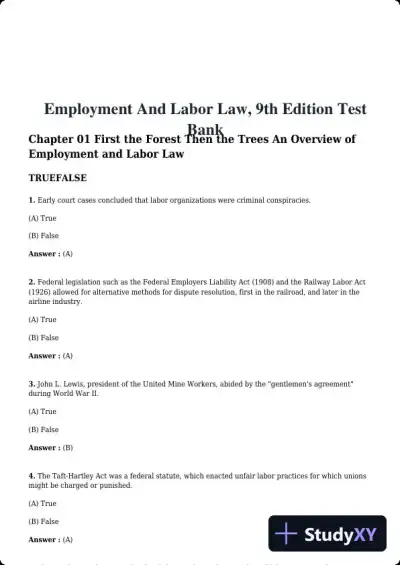 Exam Guides
Employment And Labor Law, 9th Edition Test Bank
Business Law
349 pages146downloadsFeb 2025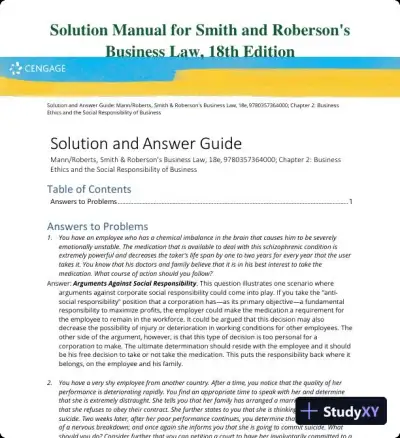 Textbook Guides
Solution Manual for Smith and Roberson's Business Law, 18th Edition
Business Law
572 pages136downloadsFeb 2025 Exam Guides
Test Bank for Ethics and the Conduct of Business, 8th Edition
Business Law
81 pages119downloadsFeb 2025 Exam Guides
Test Bank for Contract Law for Paralegals: Traditional and e-Contracts, 3rd Edition
Business Law
458 pages65downloadsFeb 2025 Exam Guides
Test Bank For Ethics And The Conduct Of Business 8th Edition Test Bank
Business Law
80 pages53downloadsFeb 2025 Textbook Guides
Quantitative Methods For Business, 12th Edition Solution Manual
Business Law
469 pages51downloadsFeb 2025
Study this document with CramX
Once it is in your library, every tool can work from it.