

MGMT310 Quiz 1: Principles of Management and Organizational Behavior
- Business Management
- American Public University
- 5 pages
- Shared May 2025
Quiz assessing knowledge of management principles and organizational behavior.
Preview 2 of 5 pages
See the first 2 pages exactly as they appear in the document.
Page 1 Read page 1 as text
MGMT310 Quiz 1: Principles of Management and Organizational Behavior Part 1 of 1 - 100.0/ 100.0 Points Question 1 of 25 4.0/ 4.0 Points Managers are responsible for getting activities completed efficiently and achieving the firm’s goals by utilizing: A. Human, financial, and material resources B .Information, human, and service resources C. Human resources, organizational competitiveness, and organizational goals D. Financial resources, top management, and organizational goals Answer Key: A Question 2 of 25 4.0/ 4.0 Points A difference between management and leadership can be defined in the following way A. management is human capital, and leadership is directing staff B. management is getting things done, and leadership is deciding what needs to be done C. management is getting things done, and leadership is inspiring action taken by others D. management is a position of authority or power, and leadership is inspiring action taken by others Answer Key: C Question 3 of 25 4.0/ 4.0 Points Three different types of planning used in the function of management are A. strategic, tactical, and operational B. strategic, organizational design, and job design C. job design, job enrichment, and teamwork D. strategic, organizational design, and operational Answer Key: A Question 4 of 25 4.0/ 4.0 Points Triple bottom line refers to the measurement of business performance along A. social, economic and organizational dimensions B. social, economic and environmental dimensions C. economic, organizational, and human performance dimensions D. environmental, organizational and corporate responsibility Answer Key: B Question 5 of 25 4.0/ 4.0 Points The difference between group and team is A. A collection of people is a group and not necessarily a team B. Complementary skills are found in a group but not a team C. The aim and purpose of a group is to perform in the workplace D. Groups are defined by their relatively small size Answer Key: A
Page 2
3 more pages in the full document
Unlock it once and it stays in your library, ready to chat with or turn into flashcards.
Unlock the full documentMore Business Management study materials
See all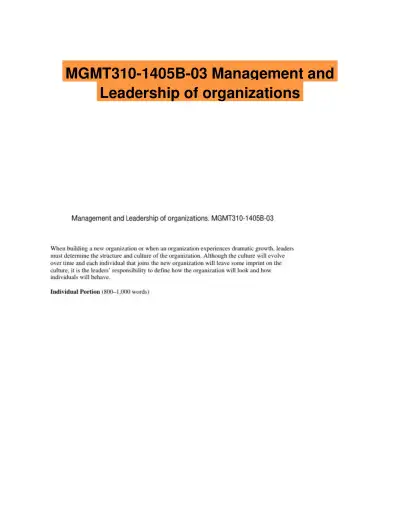 Solved Assignments
MGMT310-1405B-03 Management and Leadership of organizations
Business Management
6 pagesMay 2025 Textbook Guides
Solution Manual For Quality Technician's Handbook, The, 6th Edition
Business Management
22 pages173downloadsFeb 2025 Textbook Guides
Solution Manual for Business Essentials, 12th Edition
Business Management
421 pages147downloadsFeb 2025 Exam Guides
Solution Manual for Practice of Public Relations, The, 13th Edition
Business Management
310 pages146downloadsFeb 2025 Exam Guides
Test Bank for ISE International Business: Competing in the Global Marketplace, 14th Edition (Chapters 1-10)
Business Management
299 pages146downloadsFeb 2025 Exam Guides
Test Bank for Concepts in Strategic Management and Business Policy: Globalization, Innovation and Sustainability, 15th Edition
Business Management
374 pages138downloadsFeb 2025 Exam Guides
Test Bank for Interpersonal Communication, 7th New International Edition
Business Management
380 pages137downloadsFeb 2025 Textbook Guides
Concepts in Strategic Management and Business Policy: Globalization, Innovation and Sustainability, 15th Edition Solution Manual
Business Management
92 pages137downloadsFeb 2025
Study this document with CramX
Once it is in your library, every tool can work from it.