

Test Bank for Strategic Management: A Competitive Advantage Approach, Concepts and Cases, 17th Edition
- Business Management
- 302 pages
- Shared May 2025
Test Bank for Strategic Management: A Competitive Advantage Approach, Concepts and Cases, 17th Edition simplifies your exam prep with detailed solutions and a wide range of test questions.
Preview 16 of 302 pages
See the first 16 pages exactly as they appear in the document.
Page 1 Read page 1 as text
Strategic Management: A Competitive Advantage Approach, Concepts and Cases Seventeenth Edition Fred R. David Forest R. David Meredith E. David Test Bank (Download only) for Strategic Management: A Competitive Advantage Approach, Concepts and Cases, 17e Revised by Ramachandran Subramanian
Page 2 Page 3 Read page 3 as text
1 Strategic Management: A Competitive Advantage Approach, 17e (David/David) Chapter 1 The Nature of Strategic Management 1) The goal of strategic management is to A) achieve competitive advantage. B) maintain competitive advantage. C) achieve and maintain competitive advantage. D) eliminate competitive advantage. E) eliminate and abolish competitive advantage. Answer: C Diff: 2 LO: 1.1: Describe the strategic - management process. AACSB: Analytical thinking 2) Strategic management focuses on integrating functional areas to achieve organizational success. Which of the following is NOT one of the functional areas that is the focus of strategic management? A) marketing B) finance and accounting C) production and operations D) research and development E) orga nizational behavior Answer: E Diff: 2 LO: 1.1: Describe the strategic - management process. AACSB: Reflective thinking 3) What can be defined as the art and science of formulating, implementing and evaluating cross - functional decisions that enable an org anization to achieve its objectives? A) Strategy formulation B) Strategy evaluation C) Strategy implementation D) Strategic management E) Strategic leading Answer: D Diff: 1 LO: 1.1: Describe the strategic - management process. AACSB: Reflective thinking
Page 4 Read page 4 as text
2 4) To gain ________ firms need to provide unique products and services. A) a bank loan B) governmental legitimacy C) a sustainable competitive advantage D) competitors E) export orders Answer: C Diff: 2 LO: 1.1: Describe the strategic - management proces s. AACSB: Analytical thinking 5) The strategic - management process is becoming more widely used by A) small firms. B) nonprofit institutions. C) governmental organizations. D) multinational conglomerates. E) all types of organizations. Answer: E Diff: 2 LO: 1.1: Describe the strategic - management process. AACSB: Reflective thinking 6) An organization should take a(n) ________ approach in its industry. A) adversarial rather than a collegial B) collegial rather than an adversarial C) reactive rather than a proactive D) proactive rather than a reactive E) cooperative rather than a competitive Answer: D Diff: 2 LO: 1.1: Describe the strategic - management process. AACSB: Reflective thinking 7) The strategic - management process A) occurs once a year. B) is a semiannual process. C) is a continuous process. D) applies mostly to companies with sales greater than $100 million. E) applies mostly to small businesses. Answer: C Diff: 3 LO: 1.1: Describe the strategic - management process. AACSB: Analytical thinking
Page 5 Read page 5 as text
3 8) Sometimes ________ is used to refer to strategic formulation, implementation and evaluation, with ________ referring only to strategic formulation. A) strategic planning; strategic management B) strategic planning; strategic processing C) strategic m anagement; strategic planning D) strategic management; strategic processing E) strategic implementation; strategic focus Answer: C Diff: 2 LO: 1.1: Describe the strategic - management process. AACSB: Reflective thinking 9) The terms "strategic management " and "strategic planning" are used synonymously in this text. Answer: TRUE Diff: 1 LO: 1.1: Describe the strategic - management process. AACSB: Reflective thinking 10) Strategic management focuses on integrating management, marketing, finance and accoun ting, production and operations, research and development, and information systems to achieve organizational success. Answer: TRUE Diff: 1 LO: 1.1: Describe the strategic - management process. AACSB: Reflective thinking 11) Optimizing for tomorrow the tr ends of today is the purpose of strategic management. Answer: FALSE Diff: 2 LO: 1.1: Describe the strategic - management process. AACSB: Reflective thinking 12) U.S. firms are not being aggressively challenged in the computer industry. Answer: FALSE Dif f: 2 LO: 1.1: Describe the strategic - management process. AACSB: Analytical thinking 13) By occasionally monitoring external events, companies should be able to identify when change is required. Answer: FALSE Diff: 3 LO: 1.1: Describe the strategic - man agement process. AACSB: Analytical thinking
Page 6 Read page 6 as text
4 14) Application of the strategic - management process is typically more formal in larger and well - established organizations. Answer: TRUE Diff: 2 LO: 1.1: Describe the strategic - management process. AACSB: Ref lective thinking 15) To be effective, strategic - management must be a process that familiarizes managers and employees with the key strategic issues facing an organization and the feasible alternatives for resolving those issues. Answer: TRUE Diff: 3 LO: 1.1: Describe the strategic - management process. AACSB: Analytical thinking 16) The most effective strategic management is ritualistic, predictable, and formal. Answer: FALSE Diff: 3 LO: 1.1: Describe the strategic - management process. AACSB: Analytica l thinking 17) All firms have a strategy, even if it is informal, unstructured, and sporadic. Answer: TRUE Diff: 2 LO: 1.1: Describe the strategic - management process. AACSB: Reflective thinking 18) Despite its great popularity in the 1980s, strategic planning by corporate America is now a valuable though rare activity. Answer: FALSE Diff: 2 LO: 1.1: Describe the strategic - management process. AACSB: Analytical thinking 19) The strengths and weaknesses of an organization are determined relative to th e strengths and weaknesses of its competitors. Answer: TRUE Diff: 2 LO: 1.1: Describe the strategic - management process. AACSB: Reflective thinking
Page 7 Read page 7 as text
5 20) Compare and contrast strategic planning with strategic management. Answer: The term "strategic plan ning" is more often used in the business world, whereas "strategic management" is often used in academia. Sometimes, strategic management is used to refer to strategy formulation, implementation and evaluation, with strategic planning referring only to str ategy formulation. Diff: 2 LO: 1.1: Describe the strategic - management process. AACSB: Reflective thinking 21) Discuss some forces that influence the formality of the strategic - management process. Answer: Application of the strategic - management process is typically more formal in larger and well - established organizations. Formality refers to the extent that participants, responsibilities, authority, duties, and approach are specified. Smaller businesses tend to be less formal. Firms that compete in comp lex, rapidly changing environments, such as technology companies, tend to be more formal in strategic planning. Firms that have many divisions, products, markets and technologies also tend to be more formal in applying strategic - management concepts. Greate r formality in applying the strategic - management process is usually positively associated with organizational success. Diff: 3 LO: 1.1: Describe the strategic - management process. AACSB: Analytical thinking 22) During what stage of strategic management i s a firm's specific internal strengths and weaknesses determined? A) Formulation B) Implementation C) Evaluation D) Feedback E) Goal - setting Answer: A Diff: 2 LO: 1.2: Discuss the three stages of strategy formulation, implementation, and evaluation activ ities. AACSB: Reflective thinking 23) An important activity in ________ is taking corrective action. A) strategy evaluation B) strategy implementation C) strategy formulation D) strategy leadership E) strategic analysis Answer: A Diff: 2 LO: 1.2: Discu ss the three stages of strategy formulation, implementation, and evaluation activities. AACSB: Reflective thinking
Page 8 Read page 8 as text
6 24) What step in the strategic management process involves mobilizing employees and managers to put strategies into action? A) Strategy for mulation B) Strategy evaluation C) Strategy implementation D) Strategic advantage E) Competitive advantage Answer: C Diff: 2 LO: 1.2: Discuss the three stages of strategy formulation, implementation, and evaluation activities. AACSB: Interpersonal relat ions and teamwork 25) What types of skills are especially critical for successful strategy implementation? A) Interpersonal B) Marketing C) Technical D) Conceptual E) Visionary Answer: A Diff: 2 LO: 1.2: Discuss the three stages of strategy formulation, implementation, and evaluation activities. AACSB: Interpersonal relations and teamwork 26) Which phase of strategic management is most strongly associated with "action"? A) Strategy formulation B) Strategy implementation C) Strategy evaluation D) Compet ing advantages E) Measuring performance Answer: B Diff: 1 LO: 1.2: Discuss the three stages of strategy formulation, implementation, and evaluation activities. AACSB: Reflective thinking
Page 9 Read page 9 as text
7 27) ________ is NOT a strategy - implementation activity. A) Takin g corrective actions B) Establishing annual objectives C) Devising policies D) Allocating resources E) Motivating employees Answer: A Diff: 2 LO: 1.2: Discuss the three stages of strategy formulation, implementation, and evaluation activities. AACSB: An alytical thinking 28) Strategy evaluation is necessary because A) internal and external factors are constantly changing. B) the SEC requires strategy evaluation. C) success today is a guarantee of success tomorrow. D) the IRS requires strategy evaluation. E) firms have limited resources. Answer: A Diff: 2 LO: 1.2: Discuss the three stages of strategy formulation, implementation, and evaluation activities. AACSB: Analytical thinking 29) In which phase of strategic management are annual objectives especi ally important? A) Reduction B) Formulation C) Implementation D) Evaluation E) Policy Answer: C Diff: 2 LO: 1.2: Discuss the three stages of strategy formulation, implementation, and evaluation activities. AACSB: Reflective thinking 30) In which phase of strategic management are long - term objectives especially important? A) Formulation B) Control C) Evaluation D) Implementation E) Management Answer: A Diff: 2 LO: 1.2: Discuss the three stages of strategy formulation, implementation, and evaluation act ivities. AACSB: Reflective thinking
Page 10 Read page 10 as text
8 31) The decision to expand or diversify operations is a strategy - formulation issue. Answer: TRUE Diff: 2 LO: 1.2: Discuss the three stages of strategy formulation, implementation, and evaluation activities. AACSB: A nalytical thinking 32) The decision to merge is a strategy - formulation issue, but the decision to form a joint venture is a strategy - implementation issue. Answer: FALSE Diff: 1 LO: 1.2: Discuss the three stages of strategy formulation, implementation, a nd evaluation activities. AACSB: Reflective thinking 33) Strategy implementation is often considered to be the most difficult stage in the strategic - management process. Answer: TRUE Diff: 2 LO: 1.2: Discuss the three stages of strategy formulation, imp lementation, and evaluation activities. AACSB: Reflective thinking 34) The final stage in strategic management is strategy implementation. Answer: FALSE Diff: 1 LO: 1.2: Discuss the three stages of strategy formulation, implementation, and evaluation a ctivities. AACSB: Reflective thinking 35) In most large organizations that engage in strategic management, the formulation, implementation, and evaluation of strategy activities occur at three hierarchical levels: corporate; divisional or strategic busin ess unit; and functional. Answer: TRUE Diff: 2 LO: 1.2: Discuss the three stages of strategy formulation, implementation, and evaluation activities. AACSB: Reflective thinking 36) One of the fundamental strategy evaluation activities is reviewing the e xternal and internal factors on which strategies are based. Answer: TRUE Diff: 2 LO: 1.2: Discuss the three stages of strategy formulation, implementation, and evaluation activities. AACSB: Reflective thinking
Page 11 Read page 11 as text
9 37) Many organizations mistakenly spend mo re time and effort on the implementation of a plan, than on the formulation of the plan itself. Answer: FALSE Diff: 3 LO: 1.2: Discuss the three stages of strategy formulation, implementation, and evaluation activities. AACSB: Analytical thinking 38) W hich stage in the strategic - management process is the most difficult? Explain why. Answer: Strategy implementation is the most difficult stage in the strategic - management process because it requires personal discipline, commitment, and sacrifice. Successf ul strategy implementation hinges upon managers' ability to motivate employees, which is more of an art than a science. Interpersonal skills are especially critical for successful strategy implementation. Diff: 3 LO: 1.2: Discuss the three stages of strat egy formulation, implementation, and evaluation activities. AACSB: Reflective thinking 39) The strategic - management process represents a(n) ________, ________, and ________ approach for determining an enterprise's future direction. A) logical; systematic ; subjective B) intuitive; disorganized; subjective C) logical; systematic; objective D) intuitive; disorganized; objective E) inconsistent; systematic; subjective Answer: C Diff: 2 LO: 1.3: Explain the need for integrating analysis and intuition in stra tegic management. AACSB: Reflective thinking 40) Which statement best describes intuition? A) It alone should be used in decision making. B) It represents a minor factor in decision making integrated with analysis. C) It should be coupled with analysis i n decision making. D) It is better than analysis in decision making. E) It is management by ignorance. Answer: C Diff: 3 LO: 1.3: Explain the need for integrating analysis and intuition in strategic management. AACSB: Analytical thinking
Page 12 Read page 12 as text
10 41) Strategic management is an attempt to organize qualitative and quantitative information in a way that allows effective decisions to be made under conditions of uncertainty. Answer: TRUE Diff: 2 LO: 1.3: Explain the need for integrating analysis and intuition in s trategic management. AACSB: Reflective thinking 42) Firms, like organisms, must be "adept at adapting" or they will not survive. Answer: TRUE Diff: 2 LO: 1.3: Explain the need for integrating analysis and intuition in strategic management. AACSB: Refl ective thinking 43) Once an effective strategy is designed, modifications are rarely required. Answer: FALSE Diff: 2 LO: 1.3: Explain the need for integrating analysis and intuition in strategic management. AACSB: Analytical thinking 44) Analytical an d intuitive thinking complement each other. Answer: TRUE Diff: 1 LO: 1.3: Explain the need for integrating analysis and intuition in strategic management. AACSB: Reflective thinking 45) According to Albert Einstein, "Knowledge is far more important tha n intuition." Answer: FALSE Diff: 1 LO: 1.3: Explain the need for integrating analysis and intuition in strategic management. AACSB: Reflective thinking 46) According to Peter Drucker "Imagination is more important than knowledge, because knowledge is limited, whereas imagination embraces the entire world." Answer: FALSE Diff: 2 LO: 1.3: Explain the need for integrating analysis and intuition in strategic management. AACSB: Reflective thinking 47) Management by intuition can be defined as operating from the "I've - already - made - up - my - mind - don't - bother - me - with - the - facts mode." Answer: FALSE Diff: 2 LO: 1.3: Explain the need for integrating analysis and intuition in strategic management. AACSB: Reflective thinking
Page 13 Read page 13 as text
11 48) An objective, logical, systemat ic, and non - intuitive approach for making major decisions in an organization is a way to describe the strategic - management process. Answer: FALSE Diff: 3 LO: 1.3: Explain the need for integrating analysis and intuition in strategic management. AACSB: R eflective thinking 49) Discuss the value of integrating intuition and analysis. Answer: Most organizations can benefit from strategic management, which is based on integrating intuition and analysis in decision making. Choosing an intuitive or analytic a pproach to decision making is not an either - or proposition. Managers at all levels in an organization inject their intuition and judgment into strategic - management analyses. Analytical thinking and intuitive thinking complement each other. Operating from t he "I've - already - made - up - my - mind - don't - bother - me - with - the - facts" mode is not management by intuition; it is management by ignorance. Drucker says, "I believe in intuition only if you discipline it. 'Hunch' artists, who make a diagnosis, but don't check it out with facts, are the ones in medicine who kill people, and in management kill businesses." In a sense, the strategic - management process is an attempt both to duplicate what goes on in the mind of a brilliant, intuitive person who knows the business, and assimilates and integrates that knowledge using analysis to formulate effective strategies. Diff: 2 LO: 1.3: Explain the need for integrating analysis and intuition in strategic management. AACSB: Analytical thinking 50) Which individuals are most resp onsible for the success and failure of an organization? A) Strategists B) Financial planners C) Personnel directors D) Stakeholders E) Human resource managers Answer: A Diff: 1 LO: 1.4: Define and give examples of key terms in strategic management. AACSB : Reflective thinking 51) What are enduring statements of purpose that distinguish one business from other similar firms? A) Policies B) Mission statements C) Objectives D) Rules E) Employee conduct guidelines Answer: B Diff: 2 LO: 1.4: Define and give examples of key terms in strategic management. AACSB: Written and oral communication
Page 14 Read page 14 as text
12 52) An organization's vision statement A) is a constant reminder to its employees of why the organization exists. B) broadly charts the future direction of an organiza tion. C) addresses the basic question: "What is our business?" D) answers the question: "What do we want to become?" E) is mandated by law. Answer: D Diff: 1 LO: 1.4: Define and give examples of key terms in strategic management. AACSB: Written and oral communication 53) Generally, external opportunities and threats are A) uncontrollable by a single organization. B) unable to have a significant impact on an organization. C) not worth monitoring and evaluating. D) key functions in strategy implementation . E) key functions in strategy exploitation. Answer: A Diff: 2 LO: 1.4: Define and give examples of key terms in strategic management. AACSB: Reflective thinking 54) Specific results an organization seeks to achieve in pursuing its basic mission are A) strategies. B) rules. C) objectives. D) policies. E) tenets. Answer: C Diff: 1 LO: 1.4: Define and give examples of key terms in strategic management. AACSB: Reflective thinking 55) Internal ________ are controllable activities in an organization that are performed especially well. A) opportunities B) incompetencies C) strengths D) objectives E) factors Answer: C Diff: 1 LO: 1.4: Define and give examples of key terms in strategic management. AACSB: Reflective thinking
Page 15 Read page 15 as text
13 56) What are the means by wh ich long - term objectives will be achieved? A) Strategies B) Strengths C) Weaknesses D) Policies E) Opportunities Answer: A Diff: 2 LO: 1.4: Define and give examples of key terms in strategic management. AACSB: Reflective thinking 57) Long - term objectiv es should be all of the following EXCEPT A) measurable. B) continually changing. C) reasonable. D) challenging. E) consistent. Answer: B Diff: 2 LO: 1.4: Define and give examples of key terms in strategic management. AACSB: Reflective thinking 58) Whic h of the following is NOT a type of strategy developed from a SWOT analysis? A) Strengths/Opportunities B) Strengths/Threats C) Threats/Opportunities D) Weaknesses/Opportunities E) Weaknesses/Threats Answer: C Diff: 1 LO: 1.4: Define and give examples of key terms in strategic management. AACSB: Reflective thinking 59) Because of the success of the iPad and the iPhone, Apple has tremendous brand recognition. Brand recognition is one of Apple's A) weaknesses. B) opportunities. C) strengths. D) threats. E ) strategies. Answer: C Diff: 3 LO: 1.4: Define and give examples of key terms in strategic management. AACSB: Reflective thinking
Page 16 Read page 16 as text
14 60) Which of the following is often considered to be the first step in strategic planning? A) Developing a vision statem ent B) Establishing goals and objectives C) Making a profit D) Developing a mission statement E) Determining opportunities and threats Answer: A Diff: 1 LO: 1.4: Define and give examples of key terms in strategic management. AACSB: Written and oral comm unication 61) Uber has fewer fixed assets than the typical taxi fleet company. This type of benefit that a company such as Uber has is called a(n) A) business moat. B) first - mover advantage. C) asset margin. D) strategic advantage. E) competitive advantag e. Answer: E Diff: 2 LO: 1.4: Define and give examples of key terms in strategic management. AACSB: Written and oral communication 62) Anything that a firm does especially well compared to rival firms is referred to as A) competitive advantage. B) comp arative disadvantage. C) opportunity cost. D) unsustainable advantage. E) an external opportunity. Answer: A Diff: 1 LO: 1.4: Define and give examples of key terms in strategic management. AACSB: Reflective thinking 63) The fact that Apple has no manuf acturing facilities of its own A) has caused it to build up massive debt on its balance sheet. B) has enabled it to remain financially lean. C) has been problematic for Apple in terms of debt. D) illustrates that having more fixed assets than rival firms, can provide major competitive advantages in a global recession. E) means that it is in the same position as Sony. Answer: B Diff: 2 LO: 1.4: Define and give examples of key terms in strategic management. AACSB: Reflective thinking
286 more pages in the full document
Unlock it once and it stays in your library, ready to chat with or turn into flashcards.
Unlock the full documentMore Business Management study materials
See all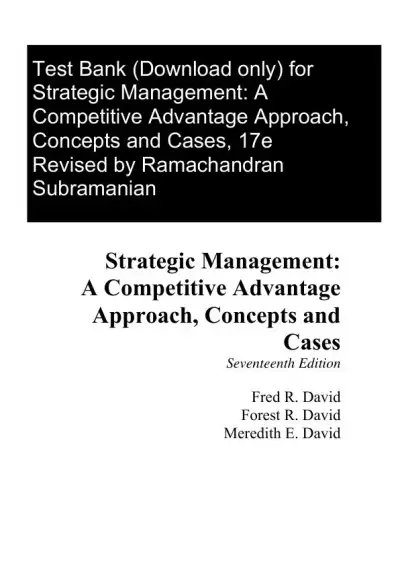 Exam Guides
Test Bank for Strategic Management: A Competitive Advantage Approach Concepts and Cases, 17th Edition
Business Management
302 pagesMay 2025 Textbook Guides
Solution Manual For Quality Technician's Handbook, The, 6th Edition
Business Management
22 pages173downloadsFeb 2025 Textbook Guides
Solution Manual for Business Essentials, 12th Edition
Business Management
421 pages147downloadsFeb 2025 Exam Guides
Solution Manual for Practice of Public Relations, The, 13th Edition
Business Management
310 pages146downloadsFeb 2025 Exam Guides
Test Bank for ISE International Business: Competing in the Global Marketplace, 14th Edition (Chapters 1-10)
Business Management
299 pages146downloadsFeb 2025 Exam Guides
Test Bank for Concepts in Strategic Management and Business Policy: Globalization, Innovation and Sustainability, 15th Edition
Business Management
374 pages138downloadsFeb 2025 Exam Guides
Test Bank for Interpersonal Communication, 7th New International Edition
Business Management
380 pages137downloadsFeb 2025 Textbook Guides
Concepts in Strategic Management and Business Policy: Globalization, Innovation and Sustainability, 15th Edition Solution Manual
Business Management
92 pages137downloadsFeb 2025
Study this document with CramX
Once it is in your library, every tool can work from it.