
CPFA Management Version 2 Practice Exam With Answers (163 Solved Questions)

Get exam-ready with CPFA Management Version 2 Practice Exam With Answers, a reliable collection of past test questions.

5.0
47
10 months ago
Preview (6 of 19 Pages)
100%
Log in to unlock

Page 1

CPFA Management Version 2 Practice Exam With Answers (163 Solved Questions) - Page 1 preview image

Loading page ...

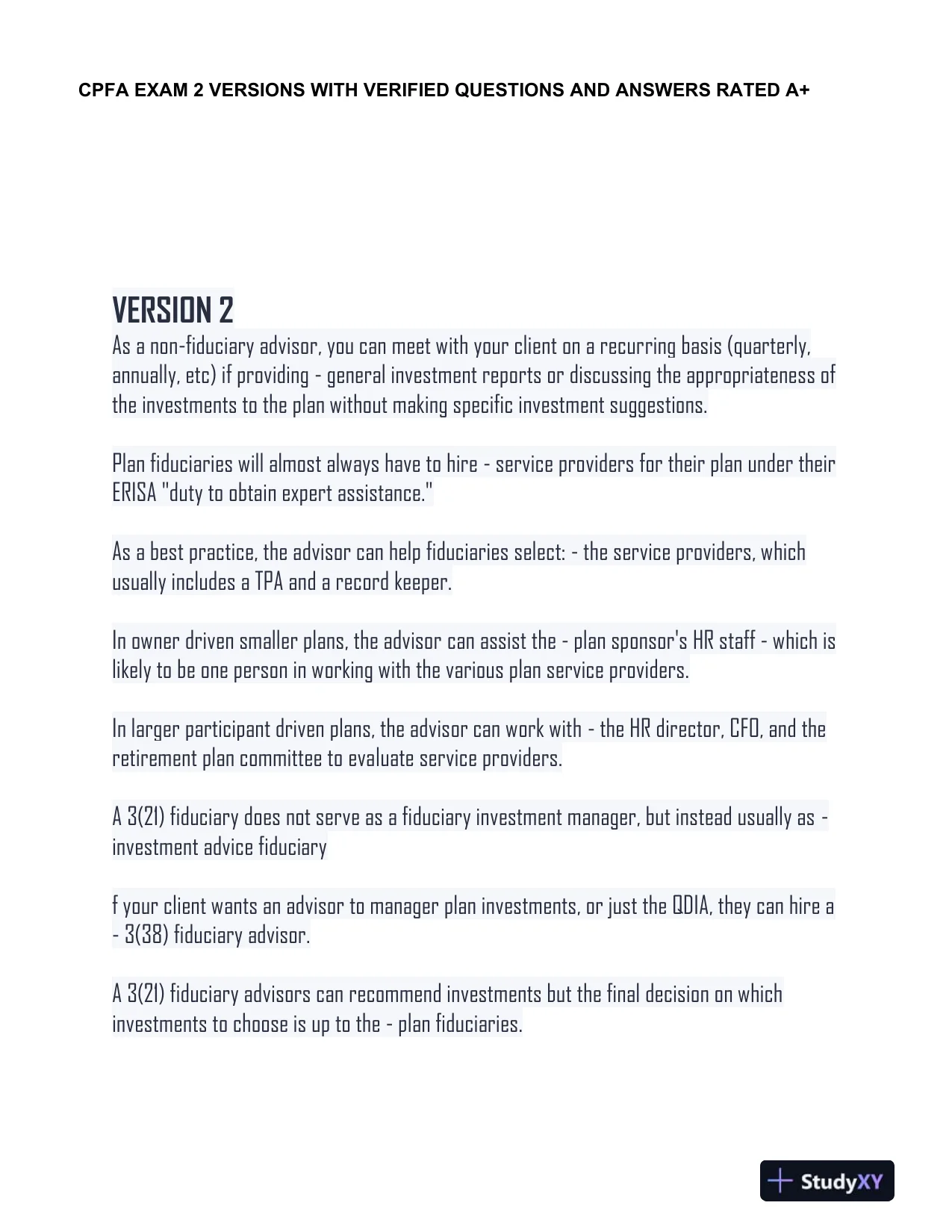
VERSION 2As a non-fiduciary advisor, you can meet with your client on a recurring basis (quarterly,annually, etc) if providing - general investment reports or discussing the appropriateness ofthe investments to the plan without making specific investment suggestions.Plan fiduciaries will almost always have to hire - service providers for their plan under theirERISA "duty to obtain expert assistance."As a best practice, the advisor can help fiduciaries select: - the service providers, whichusually includes a TPA and a record keeper.In owner driven smaller plans, the advisor can assist the - plan sponsor's HR staff - which islikely to be one person in working with the various plan service providers.In larger participant driven plans, the advisor can work with - the HR director, CFO, and theretirement plan committee to evaluate service providers.A 3(21) fiduciary does not serve as a fiduciary investment manager, but instead usually as -investment advice fiduciaryf your client wants an advisor to manager plan investments, or just the QDIA, they can hire a- 3(38) fiduciary advisor.A 3(21) fiduciary advisors can recommend investments but the final decision on whichinvestments to choose is up to the - plan fiduciaries.CPFA EXAM 2 VERSIONS WITH VERIFIED QUESTIONS AND ANSWERS RATED A+

Page 2

CPFA Management Version 2 Practice Exam With Answers (163 Solved Questions) - Page 2 preview image

Loading page ...

Page 3

CPFA Management Version 2 Practice Exam With Answers (163 Solved Questions) - Page 3 preview image

Loading page ...

A 3(16) plan administrator can take on administrative duties for the plan but does not act in- an investment capacity.A non-fiduciary advisors can provide - educationThe DOL is not required to be notified if - the plan hires a 3(21) advisor.Under the DOL regulation, many advisors to retirement plans and their participants will be -3(21) fiduciaries. They will act alongside other fiduciary service providers who are also notnecessarily named in the plan document but who exercise discretionary control over planprovisions or plan investments.The advisor should educate the - plan sponsor about hiring fiduciary service providers,including the different roles service providers, including the different roles serviceproviders may take on within the plan, how to select a qualified candidate, and the plansponsor's ongoing responsibility to monitor them.The fiduciary definition has two parts: - who is a fiduciaryto what extent the person is a fiduciaryClarifying fiduciary status is arguably incomplete without addressing both.A best practice for a service provider's formal description of services might thereforeinclude two parts: - a. an acknowledgment of fiduciary statusb. clarification as to the extent of responsibilitiesAs a non-fiduciary advisor, you can - educate your client and present possible investmentsfor the Retirement Plan Committee consideration.If you recommend a specific fund replacement to the plan sponsor or plan participants, youare considered to be - giving investment advice and are therefore a functional fiduciary tothe plan.

Page 4

CPFA Management Version 2 Practice Exam With Answers (163 Solved Questions) - Page 4 preview image

Loading page ...

If fiduciaries of participants use your recommendations - as opposed to information - tomake investment decisions, this could be considered - a fiduciary actThe fiduciaries should do a review of the service provider qualifications in order to prove a -prudent process was not followed when selecting the service provider. They should alsoreview the service agreement, document the decision process, and have a serviceagreement with the 3(21) advisor.A 3(21) advisor fiduciary is considered a - fiduciary to the plan, but different than advisorsworking as 3(38) fiduciaries, it is rarely named in the plan document.The service agreement between the plan sponsor and the TPA is what determines if - a TPAwill work as a 3(16) fiduciary Plan Administrator.ERISA 3(16) fiduciaries serve as the - "Plan Administrator" and are responsible foradministrative responsibilities in the plan. These include assuring the plan operation remainsin compliance with the plan document, providing administrative and compliance documentsfor the fiduciary file and assuring that employee notices are drafted and distributed.ERISA 3(21) and 3(38) fiduciaries serve as - investment fiduciaries and their main dutyunder ERISA is to provide investment advice.3(38) fiduciaries may also serve as the - named investment manager for the plan, and unlike3(21) investment advice fiduciaries, will have discretionary control over plan investments.Employee education through enrollment meetings is performed by - retirement planadvisors, including non-fiduciary, 3(21), and 3(38) fiduciary advisors. Assisting with fiduciaryfile documentation is another function that all retirement plan advisors, both fiduciary andnon-fiduciary are likely to perform.As the advisor, you can assist the plan sponsor by - by asking about documents he or shemay be missing from the fiduciary file.For example:

Page 5

CPFA Management Version 2 Practice Exam With Answers (163 Solved Questions) - Page 5 preview image

Loading page ...

Are there any plan amendments?Does he or she have copies of the required participant notices (including participant feedisclosure) and account statements?Where are the 408(b)(2) fee disclosure notices?Does he or she have evidence that looked at the fee disclosure to determine if plan fees arereasonable?You can also assist the plan sponsor in identifying the - plan service providers who mayhave copies of these documents, and assist him in setting up a fiduciary file.You may also want to show the sponsor a - sample DOL investigation letter, so he is awareof what the DOL might ask in advance of an investigation. You can point out that unsigneddocuments or amendments and/or missing and incomplete plan documentation may put himat risk in an audit.You should assure the that Plan Sponsor is aware of - both your role as an investmentfiduciary regulations and what documentation she may need to review based on specificfinancial institution requirements.The advisor or the CPA is not responsible for - the required plan amendments. The TPA orERISA counsel can prepare the required amendment.The plan docs need to be amended when - there is a law change that impacts the plan, orwhen the fiduciaries are changing the plan provisions.It is the fiduciaries' responsibility to - distribute fee disclosures notices, the record keeperis the one who prepares them.The plan document, IPS, and SPD are only required to be updated if - changes have beenmade by the plan fiduciaries or law changes require a plan amendment and changes to theSPD.Fiduciaries have personal liability for - a "breach" of their duties.

Page 6

CPFA Management Version 2 Practice Exam With Answers (163 Solved Questions) - Page 6 preview image

Loading page ...

It is important to remind the fiduciaries that an investment involving a party in interest isprohibited even if - it has been beneficial to the plan participants and beneficiaries. Theprohibited transaction still must be corrected.Correcting prohibited transactions may or may not be done through - the DOL VoluntaryFiduciary Corrections Program (VFCP). Regardless, it is not the advisor's role to correctprohibited transactions. Fiduciaries should consult an ERISA attorney to identified prohibitedtransactions and assist in correcting the transactions. Transactions should be corrected assoon as possible to avoid additional taxation.Non-traditional plan investments can be associated with - prohibited transactionsIt is a best practice to recommend that an ERISA attorney review - non-traditional planinvestments to identify potential prohibited transactions.Spouses and lineal relatives of plan fiduciaries, such as children, are - parties in interestService providers to the plan, such as CPAs doing audits, ERISA counsel, and plan advisorsare also - parties in interestDeferrals must be - deposited as soon as possible after the payroll is run or it is a fiduciarybreach. Not only are late deferral deposits and investing with a party in interest prohibitedtransactions, they may be fiduciary breaches as well. Fiduciaries are liable for thesetransactions and should contact ERISA counsel on how to remedy them.Improper valuation of privately held employer stock and purchasing a stock investmentbased on a tip from a broker are errors that - cannot be corrected using the DOL correctionprogram.It is the position of the DOL that plan fiduciaries need - the information contained in the408(b)(2) disclosures when selecting and monitoring services providers in order to satisfytheir fiduciary obligations under ERISA. As a result, there is a fiduciary duty for plansponsors and/or committees to utilize and demonstrate a prudent process to evaluate theservices, fees, potential conflicts of interest and fiduciary status of the service providers.
Preview Mode

This document has 19 pages. Sign in to access the full document!

Study Now!

X-Copilot AI
Unlimited Access
Secure Payment
Instant Access
24/7 Support
Document Chat

Document Details