

Solution Manual For Separation Process Engineering: Includes Mass Transfer Analysis, 3rd Edition
- Chemical Engineering
- 477 pages
- Shared May 2025
Master your textbook with Solution Manual For Separation Process Engineering: Includes Mass Transfer Analysis, 3rd Edition, offering detailed solutions to every question.
Preview 16 of 477 pages
See the first 16 pages exactly as they appear in the document.
Page 1 Read page 1 as text
17 SPE 3 rd Edition Solution Manual Chapter 1 New Problems and new solutions are listed as new immediately after the solution number. These new problems in chapter 1 are: 1A3, 1A4, 1B2-1B4, 1D1. A2. Answers are in the text. A3. New problem for 3 rd edition. Answer is d. B1. Everything except some food products has undergone some separation operations. Even the water in bottles has been purified (either by reverse osmosis or by distillation). B2. New problem for 3 rd edition. Many homes have a water softener (ion exchange), or a filter, or a carbon water “filter” (actually adsorption), or a reverse osmosis system. B3. New problem for 3 rd edition. For example: the lungs are a gas permeation system, the intestines and kidney are liquid permeation or dialysis systems. B4. New problem for 3 rd edition. You probably used some of the following: chromatography, crystallization, distillation, extraction, filtration and ultrafiltration. D1. New problem for 3 rd edition. Basis 1kmol feed. .4 kmole E .4 MW 46 18.4 kg 10.8 kg .6 kmol Water .6 MW 18 total 29.2 kg Weight fraction ethanol = 18.4/29.2 = 0.630 Flow rate = (1500 kmol/hr)[(29.2kg)/(1 kmol)] = 43,800 kg/hr.
Page 2 Page 3 Read page 3 as text
18 SPE 3 rd Edition Solution Manual Chapter 2. New Problems and new solutions are listed as new immediately after the solution number. These new problems are: 2A6, 2A9 to 2A16, 2C4, 2C8, 2C9, 2D1.g, 2.D4, 2D10, 2D13, 2D24 to 2D30, 2E1, 2F4, 2G4 to 2G6, 2H1 to 2H3. 2.A1. Feed to flash drum is a liquid at high pressure. At this pressure its enthalpy can be calculated as a liquid. eg. high LIQ F,P p F ref h T c T T . When pressure is dropped the mixture is above its bubble point and is a two- phase mixture (It “flashes”). In the flash mixture enthalpy is unchanged but temperature changes. Feed location cannot be found from T F and z on the graph because equilibrium data is at a lower pressure on the graph used for this calculation. 2.A2. Yes. 2.A4. 2.A6. New Problem. In a flash drum separating a multicomponent mixture, raising the pressure will: i. Decrease the drum diameter and decrease the relative volatilities. Answer is i. 2.A8. a. K increases as T increases b. K decreases as P increases c. K stays same as mole fraction changes (T, p constant) -Assumption is no concentration effect in DePriester charts d. K decreases as molecular weight increases 2.A9. New Problem. The answer is 0.22 2.A10. New Problem. The answer is b. 2.A11. New Problem. The answer is c. 1 .0 .5 0 1.0 .5 0 x w Flash operating line y w Equilibrium (pure water) 2.A4 z w = 0.965
Page 4 Read page 4 as text
19 2.A12. New Problem. The answer is b. 2.A13. New Problem. The answer is c. 2.A14. New Problem. The answer is a. 2.A15. New Problem. a. The answer is 3.5 to 3.6 b. The answer is 36ºC 2.A16. New Problem. The liquid is superheated when the pressure drops, and the energy comes from the amount of superheat. 2.B1. Must be sure you don’t violate Gibbs phase rule for intensive variables in equilibrium. Examples: drum drum F, z, T , P F F, T , z, p F F, h , z, p drum F, z, y, P F F, T , z, y F F, h , z, y drum F, z, x, p F F, T , z, x etc. drum F, z, y, p F drum drum F, T , z, T , p drum F, z, x, T F F, T , y, p Drum dimensions, drum drum z, F , p F drum F, T , y, T Drum dimensions, drum z, y, p F F, T , x, p etc. F drum F, T , x, T F F, T , y, x 2.B2. This is essentially the same problem (disguised) as problem 2-D1c and e but with an existing (larger) drum and a higher flow rate. With y = 0.58, x = 0.20, and V/F = 0.25 which corresponds to 2-D1c. If lb mole F 1000 , D .98 and L 2.95 ft from Problem 2-D1e hr . Since D α V and for constant V/F, V α F, we have D α F . With F = 25,000: new old new old new new F F = 5, D = 5 D = 4.90, and L = 3 D = 14.7 . Existing drum is too small. Feed rate drum can handle: F α D 2 . 2 2 existing exist F D 4 1000 .98 .98 gives existing F 16,660 lbmol/h Alternatives a) Do drums in parallel. Add a second drum which can handle remaining 8340 lbmol/h. b) Bypass with liquid mixing
Page 5 Read page 5 as text
20 Since x is not specified, use bypass. This produces less vapor. c) Look at Eq. (2-62), which becomes v drum L v v V MW D 3K 3600 Bypass reduces V c1) K drum is already 0.35. Perhaps small improvements can be made with a better demister → Talk to the manufacturers. c2) ρ v can be increased by increasing pressure. Thus operate at higher pressure. Note this will change the equilibrium data and raise temperature. Thus a complete new calculation needs to be done. d) Try bypass with vapor mixing. e) Other alternatives are possible. 2.C2. A B B A z z V F K 1 K 1 2.C5. a. Start with i i i Fz x and let V F L L VK i i i i i i Fz z x or x L L L F L K 1 K F F Then i i i i i i K z y K x L L 1 K F F From i i i i i K 1 z y x 0 we obtain 0 L L 1 K F F V = .25 (16660) = 4150 L Total x y = .58, 8340 16,660 25,000
Page 6 Read page 6 as text
21 2.C7. i i z V 1 f V F 1 K 1 F From data in Example 2-2 obtain: V/F 0 .1 .2 .3 .4 .5 .6 .7 .8 .9 1.0 f 0 -.09 -.1 -.09 -.06 -.007 .07 .16 .3 .49 .77 2.C8. New Problem. drum p x y z drum T F = L + V z F Lx Vy Solve for L & V Or use lever arm - rule
Page 7 Read page 7 as text
22 2.C9. New Problem. Derivation of Eqs. (2-62) and (2-63). Overall and component mass balances are, 1 2 F V L L i 1 i,L1 2 i,L2 i Fz L x L x Vy Substituting in equilibrium Eqs. (2-60b) and 2-60c) i 1 i,L1 L2 i,L2 2 i,L2 iV L2 i,L2 Fz L K x L x VK x Solving, i i i,L 2 1 i,L 2 2 i,V L 2 1 i,L1 L 2 1 i,V L 2 Fz Fz x L K L VK L K F V L VK Dividing numerator and denominator by F and collecting terms. i i,liq 2 1 i,L1 L 2 i,V L 2 z x L V 1 K 1 K 1 F F Since i i,V L2 i,L2 y K x , i,V L 2 i i 1 i,L1 L 2 i,V L 2 K z y L V 1 K 1 K 1 F F Stoichiometric equations, C C C C i,L 2 i i i,L 2 i 1 i 1 i 1 i 1 x 1 , y 1 , thus, y x 0 which becomes C i,V L 2 i i 1 1 i,L1 L 2 i,V L 2 K 1 z 0 L V 1 K 1 K 1 F F (2-62) Since i,L1 L 2 i i,liq1 i,L1 L 2 i,liq 2 i,liq1 1 i,L1 L 2 i,V L 2 K z x K x , we have x L V 1 K 1 K 1 F F In addition, C i,L1 L 2 i i,liq1 i,liq 2 i 1 1 i,L1 L 2 i,V L 2 K 1 z x x 0 L V 1 K 1 K 1 F F (2-63) 2.D1. a. V 0.4 100 40 and L F V 60 kmol/h Slope op. line L V 3 2, y x z 0.6 See graph. y 0.77 and x 0.48 b. V 0.4 1500 600 and L 900 . Rest same as part a. c. Plot x 0.2 on equil. Diagram and int ercept y x z 0.3. y zF V 1.2 V F z 1.2 0.25 . From equil y 0.58 . d. Plot x 0.45 on equilibrium curve.
Page 8 Read page 8 as text
23 L F V 1 V F .8 Slope 4 V V V F .2 Plot operating line, y x z at z 0.51 . From mass balance F 37.5 kmol/h. e. Find Liquid Density. L m m w w MW x MW x MW .2 32.04 .8 18.01 20.82 Then, w m L m w m w MW MW 32.04 18.01 V x x .2 .8 22.51 ml/mol .7914 1.00 L L L MW V 20.82 22.51 0.925 g/ml Find Vapor Density. v v P MW RT (Need temperature of the drum) v m w m w MW y MW y MW .58 32.04 .42 18.01 26.15 g/mol Find Temperature of the Drum T: From Table 3-3 find T corresponding to y .58, x 20, T=81.7 C 354.7K 4 v ml atm 1 atm 26.15 g/mol 82.0575 354.7 K 8.98 10 g/ml mol K Find Permissible velocity:
Page 9 Read page 9 as text
24 perm drum L v v 2 3 4 drum lv lv lv lv u K K exp A B nF C nF D nF E nF 2-60 Since V V F 0.25 1000 250 lbmol/h, F v v lb W V MW 250 26.15 6537.5 lb / h lbmol L L L F V 1000 250 750 lbmol/h, and W L MW 750 20.82 15, 615 lb/h, 4 V L lv lv V L W 15615 8.89 10 F 0.0744, and n F 2.598 W 6537.5 .925 Then 4 drum perm 4 .925 8.98 10 K .442, and u .442 14.19 ft/s 8.98 10 v 2 cs 4 3 perm v V MW 250 26.15 454 g/lb A 2.28 ft . u 3600 14.19 3600 8.98 10 g/ml 28316.85 ml/ft Thus, cs D 4A 1.705 ft. Use 2 ft diameter. L ranges from 3 D 6 ft to 5 D=10 ft Note that this design is conservative if a demister is used. f. Plot T vs x from Table 3-3. When T 77 C, x 0.34, y 0.69. This problem is now very similar to 3-D1c. Can calculate V/F from mass balance, Fz Lx Vy. This is V z y 0.4 0.34 Fz F V x Vy or 0.17 F y x 0.69 0.34 g. Part g is a new problem. V = 16.18 mol/h, L = 33.82, y= 0.892, x = 0.756. 2-D2. Work backwards. Starting with x 2 , find y 2 = 0.62 from equilibrium. From equilibrium point plot op. line of slope 2 2 2 V L V 1 V F 3 7. F This gives 2 1 z 0.51 x (see Figure). Then from equilibrium, 1 y 0.78 . For stage 1, 1 1 1 1 z x V 0.55 0.51 0.148 F y x 0.78 0.51 . 2.D3. a. z 0.4 V F 0.6 V 6.0 k mol h, L 4.0 Op. eq. L y x z V F V 2 y x 2 3 3 See graph: M y 0.55 x 0.18 T ~ 82.8 C linear interpretation on Table 2-7 .
Page 10 Read page 10 as text
25 b. Product 78.0 C x 0.30, y 0.665, Mass Bal: Fz Lx Vy F V x Vy or 4.0 10 V 0.3 0.665V V 2.985 and V F 0.2985 Can also calculate V/F from slope. c. V F 10, 0.3 V 3 & L 7 F L z 7 z y x x V V F z 0.3 If y 0.8, x 0.545 @ equil Then 7 z 0.3 0.8 0.545 0.6215. 3 Can also draw line of slope 7 3 through equil point.
Page 11 Read page 11 as text
26 2.D4. New problem in 3 rd edition. Highest temperature is dew point V F 0 Set i i i i i z y . K y x Want i i i x y K 1.0 ref New ref Old i i K T K T y K If pick C4 as reference: First guess bu tan e K 1.0, T 41 C : C3 C6 K 3.1, K 0.125 i i y .2 .35 .45 4.0145 K 3.1 1.0 .125 T too low Guess for reference C4 K 4.014 T 118 C : C3 C6 K 8.8, K .9 i i y .2 .35 .45 0.6099 K 8.8 4.0145 .9 C4,NEW K 4.0145 .6099 2.45, T 85 : C2 C6 K 6.0, K 0.44 i i y .2 .35 .45 1.20 K 6 2.45 .44 C4,NEW K 2.45 1.2 2.94, T 96 C : C3 C6 K 6.9, K 0.56 i i y .2 .35 .45 0.804 Gives 84 C K 6.9 2.94 .56
Page 12 Read page 12 as text
27 Use 90.5º → Avg last two T C4 C3 C6 K 2.7, K 6.5, K 0.49 i i .2 .35 .45 y K 1.079 6.5 2.7 .49 T ~ 87 88º C Note: hexane probably better choice as reference. 2.D5. a) b) 1 1 1 1 L F y x z V V Plot 1 st Op line. y = x = z = 0.55 to x 1 = 0.3 on eq. curve (see graph) Slope L 0.55 0.80 .25 0.454545 V .55 0 .55 1 1 1 1 1 L 0.45454 & L V F 1000 V c) Stage 2 2 V L 0.75F 0.25 , 3 , y x z 0.66. F V 0.25F Plot op line At 2 0.66 F z 0.66 x 0, y z V F 2.64. At y 0, x z 0.88 0.25 L L F 0.75 From graph 2 2 y 0.82, x 0.63 . 2 2 2 V V F 0.25 687.5 F 171.875 kmol/h F 1 = 1000 z 1 = 0.55 p 1,2 = 1 atm x 2 x 1 = 0.30 v 2 y 2 v 1 = F 2 y 1 = z 2 2 1 2 V 0.25 F y 1 = 0.66 = z 2 V 1 = 687.5 kmol/h = F 2 1 V 687.5 0.6875 F 1000
Page 13 Read page 13 as text
28 2.D6. RR eq., i i i K 1 z 0 1 K 1 V F , First guess V/F = 0.6 1 1.4 .45 0.2 .35 0.7 .2 f 0.0215 1 1.4 .6 1 0.2 0.6 1 0.7 0.6 Use Newtonian Convergence 2 c i i k 2 i 1 i K 1 z df d V F 1 K 1 V F k k 1 k f V V df F F d V F T = 50ºC P = 200 kPa K c4 = 2.4 z c4 = 0.45 F = 1.0 kmol/min z c5 = 0.35 Z c6 = 0.20 L V K c5 = 0.80 K c6 = 0.30
Page 14 Read page 14 as text
29 2 2 2 1 2 2 2 1.4 0.45 0.2 0.35 0.7 0.20 df 0.570 V 1 1.4 .6 1 0.2 0.6 1 0.7 0.6 d F 2 V 0215 0.6 0.6377 F 0.570 2 1.4 .45 0.2 .35 0.7 0.2 f 0.00028 1 1.4 0.6377 1 0.2 0.6377 1 0.7 0.6377 Which is close enough. i i i i c 4 c 4 i y K x z 0.45 x 0.2377, V y 2.4 0.2377 0.5705 1 1.4 .6377 1 K 1 F c5 c5 0.35 x 0.4012, y 0.8 0.4012 0.3210 1 0.2 0.6377 c6 8 i i 0.20 0.3613 0.1084 x , y 0.30 0.4012 1 0.7 0.6377 x 1.0002 y 0.9998 2.D7. A B B A z z V F K 1 K 1 M P K 5.6 and K 0.21 V 0.3 0.7 0.2276 F 0.21 1 5.6 1 Eq. (2-38) M M M z 0.3 x 0.1466 V 1 4.6 0.2276 1 K 1 F P M x 1 x 0.8534 , M M M y K x 5.6 0.1466 0.8208 P M y 1 y 0.1792 2.D8. Use Rachford-Rice eqn: i i i K 1 z V f 0 F 1 K 1 V / F . Note that 2 atm = 203 kPa. Find i K from DePriester Chart: 1 2 3 K 73, K 4.1 K .115 Converge on V F .076, V F V F 152 kmol/h, L F V 1848 kmol/h . From i i i z x V 1 K 1 F we obtain 1 2 3 x .0077, x .0809, x .9113 From i i i 1 2 3 y K x , we obtain y .5621, y .3649, y .1048 2.D9. Need h F to plot on diagram. Since pressure is high, feed remains a liquid L F P F ref ref h C T T , T 0 from chart L EtOH w P P EtOH P w C C x C x
Page 15 Read page 15 as text
30 Where EtOH w x and x are mole fractions. Convert weight to mole fractions. Basis: 100 kg mixture 30 30 kg EtOH 0.651 kmol 46.07 70 kg water 70 18.016 3.885 Total = 4.536 kmol Avg. 100 MW 22.046 4.536 Mole fracs: E w 0.6512 x 0.1435, x 0.8565 4.536 . Use L EtOH P P C at 100 C as an average C value. L P kcal C 37.96 .1435 18.0 .8565 20.86 kmol C Per kg this is L P avg C 20.86 kcal 0.946 MW 22.046 kg C F h 0.946 2000 189.2 kcal/kg which can now be plotted on the enthalpy composition diagram. Obtain drum E E T 88.2 C, x 0.146, and y 0.617 . For F 1000 find L and V from F = L + V and Fz Lx Vy which gives V = 326.9, and L = 673.1 Note: If use wt. fracs. L L P P avg C 23.99 & C MW 1.088 F and h 217.6 . All wrong .
Page 16 Read page 16 as text
31 2.D.10 New Problem. Solution 400 kPa, 70ºC C4 z 35 Mole % n-butane C6 x 0.7 From DePriester chart C3 C4 C6 K 5, K 1.9, K 0.3 Know i i i i i i i i i z y K x , x , x y 1 z V 1 K 1 F R.R. i i C3 C6 C 4 C6 i K 1 z 0 z 1 z z .65 z V 1 K 1 F For C6 C6 C6 C6 C6 z z V 0.7 z 0.7 1 0.7 V V F 1 K 1 1 0.7 F F C6 V z 0.7 0.49 F RR Eq: C6 C6 4 .65 z 0.9 .35 0.7z 0 V V V 1 4 1 0.9 1 0.7 F F F 2 equations & 2 unknowns. Substitute in for C6 z . Do in Spreadsheet. Use Goal – Seek to find V F. V 0.594 F when R.R. equation 0.000881 . C6 V z 0.7 0.49 0.7 (0.49)(0.594) 0.40894 F 2.D11. L F 0.6 V F 0.4 & L V 1.5 Operating line: Slope 1.5, through y x z 0.4
461 more pages in the full document
Unlock it once and it stays in your library, ready to chat with or turn into flashcards.
Unlock the full documentMore Chemical Engineering study materials
See all Textbook Guides
Solution Manual for Separation Process Engineering: Includes Mass Transfer Analysis, 4th Edition
Chemical Engineering
529 pagesMay 2025 Textbook Guides
Essentials of Chemical Reaction Engineering, 2nd Edition Solution Manual
Chemical Engineering
506 pagesMay 2025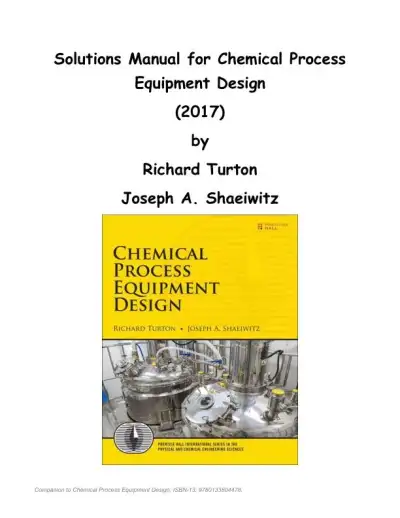 Textbook Guides
Chemical Process Equipment Design Solution Manual
Chemical Engineering
257 pagesMay 2025 Textbook Guides
Fundamental Concepts and Computations in Chemical Engineering Solution Manual
Chemical Engineering
47 pagesMay 2025 Textbook Guides
Solution Manual For Fluid Mechanics For Chemical Engineers With Microfluidics And Cfd, 2nd Edition
Chemical Engineering
549 pagesMay 2025 Textbook Guides
Solution Manual For Analysis, Synthesis And Design Of Chemical Processes, 4th Edition
Chemical Engineering
603 pagesMay 2025 Textbook Guides
Solution Manual For Introduction to Chemical Engineering Thermodynamics, 8th Edition
Chemical Engineering
6656 pagesMay 2025 Textbook Guides
Solution Manual for Analysis, Synthesis, and Design of Chemical Processes, 5th Edition
Chemical Engineering
634 pagesMay 2025
Study this document with CramX
Once it is in your library, every tool can work from it.