Economic Order Quantity and Economic Production Lot Size Analysis for Inventory Management
A study on inventory management, focusing on economic order quantity and economic production lot size analysis to optimize stock control.
Elijah Nelson
Contributor
4.3
37
7 months ago
Preview (2 of 2 Pages)
100%
Purchase to unlock
Page 1
Loading page ...
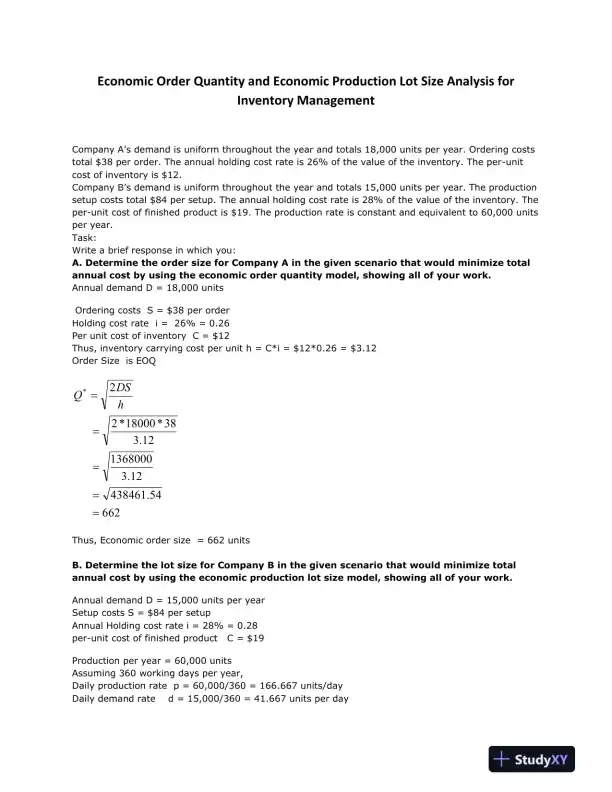
Economic Order Quantity and Economic Production Lot Size Analysis forInventory ManagementCompany A’s demand is uniform throughout the year and totals 18,000 units per year. Ordering coststotal $38 per order. The annual holding cost rate is 26% of the value of the inventory. The per-unitcost of inventory is $12.Company B’s demand is uniform throughout the year and totals 15,000 units per year. The productionsetup costs total $84 per setup. The annual holding cost rate is 28% of the value of the inventory. Theper-unit cost of finished product is $19. The production rate is constant and equivalent to 60,000 unitsper year.Task:Write a brief response in which you:A. Determine the order size for Company A in the given scenario that would minimize totalannual cost by using the economic order quantity model, showing all of your work.Annual demand D = 18,000 unitsOrdering costsS = $38 per orderHolding cost ratei =26% = 0.26Per unit cost of inventoryC = $12Thus, inventory carrying cost per unit h = C*i = $12*0.26 = $3.12Order Sizeis EOQ66254.43846112.3136800012.338*18000*22*=====hDSQThus,Economic order size= 662 unitsB. Determine the lot size for Company B in the given scenario that would minimize totalannual cost by using the economic production lot size model, showing all of your work.Annualdemand D= 15,000 units peryearSetupcosts S= $84 persetupAnnualHolding costrate i=28% =0.28per-unit cost of finished productC = $19Production per year = 60,000 unitsAssuming 360working days per year,Daily production ratep = 60,000/360 = 166.667 units/dayDaily demand rated = 15,000/360 = 41.667 units per day