

ENG215 Hang Up: It's Not Just Your Life
- English
- University of Toronto
- 10 pages
- Shared May 2025
Another version of a persuasive essay about distracted driving.
Preview 4 of 10 pages
See the first 4 pages exactly as they appear in the document.
Page 1 Read page 1 as text
Hang Up 1 Running head: HANG UP: IT'S NOT JUST YOUR LIFE Hang Up: It's Not Just Your Life Brad Gardner Michael Hunter ENG215 November 19 , 2014 In the essay "Hang up: It's not just your life," the author discusses the dangers of distracted driving, particularly focusing on the use of mobile devices while driving. Considering the disparities in laws across different states, the author argues for federal consistency in distracted driving regulations. Based on the evidence and arguments presented, what are the main reasons the author believes distracted drivi ng laws should be standardized nationwide? Do you agree or disagree with this position, and why? Use specific examples from the essay to support your viewpoint. Word Count Requirement: Your response should be between 700 and 800 words.
Page 2 Page 3 Read page 3 as text
Hang Up 2 HANG UP: IT'S NOT JUST YOUR LIFE Hang up: It's not just your life Although it appears to be a common sense notion, the differences in laws and regulations regarding the use of mobile devices while driving are not the same from state to state . No one person is a better - distracted driver than the next . Mobile device policies, regulations, and laws should not be any different from federal seat belt laws; make them consistent, not subjective. Every day we can make a change; make better choices, to make a difference in our lives and the lives of others. We can make a simple choice to hang up our cell phone before getting in our car and driving. We can choose not to accidently run over a young ch ild walking across the street on their way to school due to the distraction of a cell phone. It sounds simple enough to do; yet, every second, someone decides to take that child's life. They decide that it is more important to answer their phone or reply t o a text while driving over the well b eing of others. Distracted driving and its repercussions have been a growing concern since the first - day drivers began using mobile devices. The first cellular phones became available for consumer use in the mid - 80s. Widespread use was not marked for almost another decade. In the early 90s, less than 4.5 million people used cell phones. Over the last 15 or so years the population of cell phone users has spiked to over 230 million, according to statistics from the Insurance Information Group (cellp honesafety, 2013). With th e continuing rise in the number of mobile device users, it is only logical to infer that the dangers of distracted driving will continue to escalate. It is a serious problem for drivers, and there is a large discrepancy where our laws are concerned. The co nvenience of small hand - held devices should be given a great deal more attention than it is receiving.
Page 4 Read page 4 as text
Hang Up 3 HANG UP: IT'S NOT JUST YOUR LIFE With greater accessibility to technology; there also, should come a greater responsibility on properly using that technology. In today’s society, the use of mobile devices has become so common that over 97% of adults own a cell phone. ( Gibson , 2014 ). People have become tethered to their technology. The problem is not our dependency to this technology; but, how and where we choose to use this technology. Everyone should drive responsibly and be held accountable for their actions. There are already many distr actions inside and outside the vehicle; such as, eating, drinking, music, passengers, video billboards, or people holding those spinning signs on the side of the road. All someone has to do in order to recognize distractions is open their eyes. Or they can educate themselves to gain awareness about what distracted driving is and how to avoid it. Distracted drivers come in all sorts of shapes, sizes, and forms. Distracted driving is any activity that could divert a person's attention away from the primary task of driving. All distractions endanger driver, passenger, and bystander safety ( NH TSA, n.d.) . Drivers must constantly process the information going on around them from street signs to signals, to pedestrians and other vehicles. All of those could be considered a distraction; b ut, because text messaging requires visual, manual, and cognitive att ention from the driver, it is by fa r the most alarming distraction ( NH TSA, n.d.) . Operating a vehicle is more than turning the key , putting it in drive, and keeping it between the lines. In order to drive to safe ly, one need s to be aware of their surroundings, can anticipate to unexpected, and stay focused. According to the Centers for Disease Control and Prevention (CDC) there are three main types of distraction: (1) Visual – taking your eyes off the road, (2) Manual – taking your hands off the wheel, and (3) Cognitive – taking your mind off driving.
6 more pages in the full document
Unlock it once and it stays in your library, ready to chat with or turn into flashcards.
Unlock the full documentMore English study materials
See all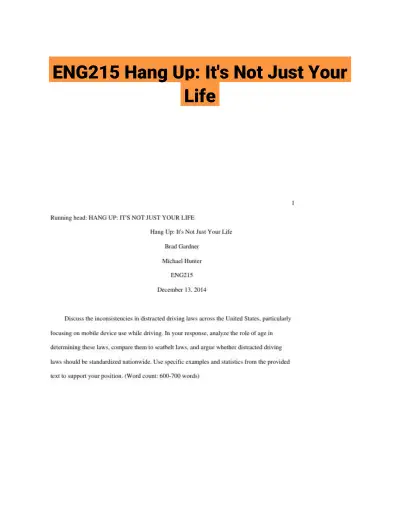 Solved Assignments
ENG215 Hang Up: It's Not Just Your Life
English
13 pagesMay 2025 Exam Guides
Technical Communication, 14th Edition Test Bank
English
83 pages153downloadsFeb 2025 Class Notes
The Longman Reader, 12th Edition Lecture Notes
English
118 pages137downloadsFeb 2025 Class Notes
Lecture Notes for The Reid Guide for College Writers, 12th Edition
English
138 pages131downloadsFeb 2025 Class Notes
Lecture Notes for Technical Communication, 15th Edition
English
350 pages113downloadsFeb 2025 Exam Guides
Grammar Matters, 1st Edition Test Bank
English
127 pages101downloadsFeb 2025 Textbook Guides
Solution Manual for Pearson Editing Exercises, The, 2nd Edition
English
22 pages100downloadsFeb 2025 Class Notes
Class Notes for Writing for the Mass Media, 9th Edition
English
151 pages90downloadsFeb 2025
Study this document with CramX
Once it is in your library, every tool can work from it.