

ENG302B: American Literature
- English
- Ashford University
- 4 pages
- Shared May 2025
A course assignment focused on American Literature, analyzing key works and themes in the context of U.S. cultural history.
Preview 2 of 4 pages
See the first 2 pages exactly as they appear in the document.
Page 1 Read page 1 as text
Graded Assignment ENG302 B : American Literature | Unit 2 | Lesson 13 : Unit Test © 200 9 K12 Inc. All rights reserved. Page 1 of 4 Copying or distributing without K12’s written consent is prohibited. Graded Assignment Unit Test, Part 2 : American Renaissance Answer the questions using complete sentences. You may use your text to support your answers. (1 5 points) 1. Compare and contrast Emerson’s poem “The Snow - Storm” with Emily Dickinson’s poem “It Sifts from Leaden Sieves.” In what way s are their depictions of the snowstorms similar and different? How do the differences affect the mood of each piece? Answer: Ralph Waldo Emerson’s "The Snow - Storm" and Emily Dickinson’s "It Sifts from Leaden Sieves" both address the theme of snowstorms, yet their portrayals differ significantly in style, tone, and mood, reflecting each poet’s unique perspective. While Emerson’s depiction of the snowstorm is grand, almost awe - inspiring, Dickinson’s is more intimate and focuses on the subtle yet powerful effects of the snow on nature. Similarities Both poems use the snowstorm as a metaphor for nature’s power, demonstrating how it transforms the landscape. Emerson and Dickinson describe the snow as a force of nature that shapes the environment in a distinct way, showing how it covers everything in its path. In Emerson’s poem, the snowstorm is described as something that “binds the earth in a white shroud,” and Dickinson also depicts the snow as a covering force, describing how it “sifts” and falls in a way that blankets the world. Both poems evoke a sense of transformation, where the ordinary is covered, reshaped, and changed by the snowstorm. Additionally, both poets convey the idea that the snowstorm is beyond human control. In Emerson’s poem, the storm is likened to a powerful force that creates “architectural grandeur” and operates without human interference, reinforcing the idea that nature can outpace and surpass human design. Dickinson similarly portrays the snow as “sifting” silently and steadily, emphasizing its quiet, unstoppable nature. The notion of nature’s authority is present in both works, even though it is conveyed through different lenses. Differences The tone and mood of the two poems differ significantly. Emerson’s "The Snow - Storm" is awe - inspiring and filled with grandeur. He uses vivid imagery to describe the snowstorm as a powerful, almost divine force that alters the world. Phrases such as “a great architect” and “a silver veil” evoke the snowstorm’s ability to create a new, elevated version of reality. Emerson’s poem sees the snowstorm as a positive force, something that reshapes the landscape into a thing of beauty and mystery. There is a sense of admiration for the storm’s power, and this leads to a mood of wonder and reverence. In contrast, Dickinson’s "It Sifts from Leaden Sieves" adopts a more intimate, observational tone. Her snowstorm is soft and quiet, almost meditative, and the mood is calm and subdued. Dickinson doesn’t focus on the power or the grandeur of the storm; rather, she emphasizes the gentle, insistent nature of the snow. The image of snow “sifting” from “leaden sieves” suggests a slow, steady, and controlled fall, where the storm is more about subtle accumulation than dramatic transformation. There is a quiet reverence in Dickinson’s poem, but it contrasts with Emerson’s more profound awe. The snow in Dickinson’s poem is less a grand force than a natural process that one can observe and feel, creating a quieter, more personal interaction with nature. Moreover, Emerson’s depiction of the snowstorm is somewhat detached, with the focus on how the snow shapes the external world, whereas Dickinson’s focus is more on the personal experience of the storm, describing how it Name: Date: Score
Page 2
2 more pages in the full document
Unlock it once and it stays in your library, ready to chat with or turn into flashcards.
Unlock the full documentMore English study materials
See all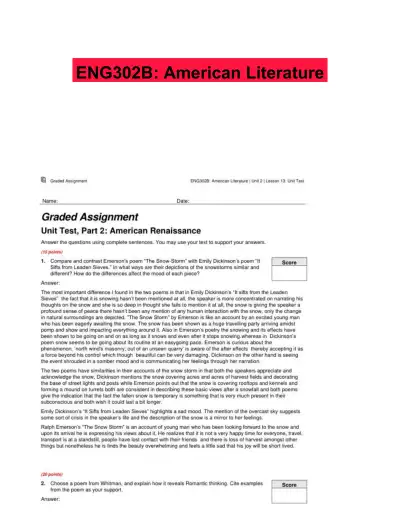 Solved Assignments
ENG302B: American Literature
English
2 pagesMay 2025 Exam Guides
Technical Communication, 14th Edition Test Bank
English
83 pages153downloadsFeb 2025 Class Notes
The Longman Reader, 12th Edition Lecture Notes
English
118 pages137downloadsFeb 2025 Class Notes
Lecture Notes for The Reid Guide for College Writers, 12th Edition
English
138 pages131downloadsFeb 2025 Class Notes
Lecture Notes for Technical Communication, 15th Edition
English
350 pages113downloadsFeb 2025 Exam Guides
Grammar Matters, 1st Edition Test Bank
English
127 pages101downloadsFeb 2025 Textbook Guides
Solution Manual for Pearson Editing Exercises, The, 2nd Edition
English
22 pages100downloadsFeb 2025 Class Notes
Class Notes for Writing for the Mass Media, 9th Edition
English
151 pages90downloadsFeb 2025
Study this document with CramX
Once it is in your library, every tool can work from it.