

IDEAS & Aims For College Writing, MLA Update Test Bank
- English
- 67 pages
- Shared May 2025
Perfect your exam skills with IDEAS & Aims For College Writing, MLA Update Test Bank, which features a range of MCQs and in-depth solutions.
Preview 16 of 67 pages
See the first 16 pages exactly as they appear in the document.
Page 1 Read page 1 as text
Test Bank to accompany I DEAS AND A IMS Tim Taylor Eastern Illinois University Linda Copeland St. Louis Community College
Page 2 Page 3 Read page 3 as text
TABLE OF CONTENTS Chapter 1 – What It Means to Be a College Student: Following the Codes 1 Chapter 2 – The Reading Process 3 Chapter 3 – Writing and the Process of Writing 7 Chapter 4 – Writing Paragraphs 10 Chapter 5 – Paragraphs Working Together: The Essay 14 Chapter 6 – Descriptive Writing 18 Chapter 7 – Reflective Writing 20 Chapter 8 – Informative Writing 22 Chapter 9 – Analytical Writing 24 Chapter 10 – Evaluative Writing 26 Chapter 11 – Persuasive Writing 28 Chapter 12 – Working with Sources 30 Chapter 13 – Documenting Sources 33 Chapter 14 – Style Matters 35 Chapter 15 – Handbook for Correcting Sentence Errors 38 ANSWER KEY 44
Page 4 Page 5 Read page 5 as text
1 Chapter 1: What It Means to Be a College Student: Following the Codes 1. Who demonstrates the best practices of an active learner? a. Stella must balance school with work, so she has to miss several classes. Because she’s a bit shy, she sits in the back and seldom asks questions. She gets all her work turned in on time and thinks she’s doing well enough that she doesn’t have to visit the writing center. b. Andy attends every class, but seldom takes notes because before any tests he plans to check the PowerPoints the teacher has posted on Blackboard. He plans to wait until he sees his midterm grade and go to the writing center if he needs to improve his grade. c. Shanesha attends every class and takes notes that she checks against the postings the teacher puts on Blackboard. She stops by her instructor’s office if she has questions about assignments and makes regular visits to the writing center. She keeps track of all her grades and looks for ways to improve. d. Devante sits near the back and does not ask questions, but he attends every class and always brings his text. He has to leave right after class to go to work, so he can’t visit the writing center, but he asks his sister to look over his papers when she can. He hopes he is doing well enough to pass the class. 2. Why is it important to demonstrate strong ethos in the classroom? a. Students who demonstrate good character have credibility and their ideas are more likely to be respected by their instructors and peers. b. Students who demonstrate strong ethos always get better grades. c. Students who demonstrate strong ethos are usually very popular and can make a lot of new friends on campus. d. Instructors will give extra credit to those who demonstrate good behavior. 3. Who demonstrates critical thinking? a. William plans to major in physical therapy because he read a newspaper article that predicted a high demand for individuals trained in that field. b. Before hiring a contractor to remodel her basement, Ava checked the company’s record with the Better Business Bureau, spoke with several former customers of the company, and compared the company’s work and rates to those of other local contractors. c. Jayden bought a pair of tennis shoes because the shoes are endorsed by a famous basketball player. d. After reading an advertisement on her Yahoo homepage, Ava decided to try a new weight- loss drug.
Page 6 Read page 6 as text
2 4. What is a college discourse community? a. It’s a club for people with a common interest. b. It is a group that explores better ways to communicate across the campus. c. It is a group that helps students with writing to meet the expectations of their professors across the various disciplines. d. It is a group formed around an academic discipline whose members share similar habits of thinking, problem solving, and communicating. 5. Which of the following writers is most likely to produce quality writing? a. Ali looks at the grade on his papers, but does not revise or edit them. He avoids writing except when he has to for his classes, and then he usually writes the paper the evening before it is due. b. Zoey starts on a paper as soon as it is assigned and follows a process of writing over several days. She looks over past papers, so she can avoid making the same mistakes. She enjoys putting her own individual take on the topics to make them more interesting for her readers. When not writing for her classes, Zoey keeps a journal, writing a little every day. c. Gary takes his time to do exactly what the assignment asks for and is always careful to meet the minimum page requirement on an assignment. He doesn’t really understand how prewriting and outlining will help him write better papers, so he usually starts with a draft and adds to it until it’s long enough. He goes to the writing center for advice on editing. d. Alexis does her best work when she’s interested in the topic, but if she doesn’t care for it, she does what is necessary to get the paper done and turned in on time. She has trouble with grammar and punctuation, so she lets her mother, who is a retired teacher, edit all of her papers. Once she writes a draft, she doesn’t like to make a lot of changes, trying to get everything just right the first time. 6. In analyzing a writing assignment, what should a writer be sure to consider carefully? a. The writer should note the topic, audience, and purpose and any special requirements the instructor has indicated, such as the use of outside sources, length, and due date. b. The topic is most important followed by the required length and due date. c. The writer should know whether or not the assignment requires outside research and how long the final paper should be. d. The writer should know what the teacher most enjoys about the subject and focus on getting that point across. It’s also important to know the special requirements like due date and page length.
Page 7 Read page 7 as text
3 Chapter 2: The Reading Process 1. Who practices the best active reading strategies? a. Rhea skims the reading and highlights the first sentence of every paragraph. She takes notes over the reading during class discussions. Usually she can understand what she reads without looking up the few words she doesn’t know. b. Austin likes to read the assignment right before class, so it will be fresh in his mind. He can usually find the thesis in the introduction and underlines it. If there’s time, he’ll look up words he doesn’t know. c. Leslie skims the reading first and then reads it more carefully a second time, highlighting the sentences that are major supports of the thesis. She looks up words she doesn’t know and marks passages that are unclear, so she can ask about them in class. d. Geoff reads the assignment once, but he takes his time and highlights what he thinks are important points. He knows the instructor will talk about the thesis and audience in class, so he’ll add that to his notes later. He circles words he doesn’t know to look up when he has time. 2. Why is it important to determine the thesis of what you are reading? a. The thesis presents the main point a writer wants to make about a subject and controls the action in a piece of writing. b. Always in the introduction, the thesis is a quick summary of the writing. c. It presents the writer’s major reasons and supporting details. d. The thesis lets the reader know the audience and context for a piece of writing. 3. A composition teacher assigns an article in which the author argues for strict laws to prevent drivers from using a hand-held cell phone while driving. Which of the following readers approaches this article as a believer? a. Lenn thinks the author is too old to be fair about the situation because older drivers have more trouble using a cell phone while driving. b. Robyn thinks the author should have used more relevant examples to make the article more interesting. c. Alex wonders if there are statistics to back up the author’s argument that using a cell phone while driving has led to more automobile accidents because none are given in the article. d. Nermina recalls one of her friends was in an accident because he was texting while driving and thinks the author of the article cites compelling research on the dangers of multi-tasking.
Page 8 Read page 8 as text
4 4. A teacher of a medical ethics class has assigned an article in which the authors argue that organ donors or their families should be paid for donated organs as a way to increase the availability of organs for transplant. Which of the following readers approach this article as a doubter? a. Veronica has an uncle who is on a transplant list waiting for a kidney and understands that there is a shortage of organ donors. b. Austin thinks the examples the authors use make a compelling case for doing more to increase organ donation. c. Desiree recalls reading that the World Health Organization is against paid organ donation because it victimizes the poor and vulnerable. d. Cassidy believes the author describes the problem in a way that interests even those readers who have no medical background or interest in organ transplants. 4. How can using the IDEAS template help you as a reader? a. It can help you read faster. b. It can help you understand confusing words and explanations. c. It can help you break down and analyze a writer’s work. d. It can help you improve your sentence skills. 5. How does a summary differ from a paraphrase? a. A summary may contain some quoted words and phrases. b. A summary must be documented. c. A summary should contain only the ideas and opinions found in the original work being summarized. d. A summary should contain only main ideas, typically reducing the original work by 50 percent.
Page 9 Read page 9 as text
5 Read and analyze the following paraphrases of the passage below from Chapter 1 of your textbook and determine if the paraphrases are plagiarized, too general, inaccurate, or acceptable. “Critical thinkers avoid bias and prejudice. Just as they evaluate outside evidence for relevancy and accuracy, critical thinkers question their own views and recognize their own potential for errors in judgment. While they understand the cliché “everyone has a right to an opinion,” critical thinkers know that all opinions are not equally valid. Some opinions are poorly formulated, weakly supported, or totally off base. Informed opinions are supported by ideas, facts, details, examples, and experiences. Thinking critically—the third principle in our college student’s code of behavior—is thinking that leads to an informed opinion.” Taken from Taylor and Copeland, IDEAS and Aims, page 7 6. Critical thinkers always test their own and others’ opinions for accuracy, relevancy, and strong support. They do this because they themselves may be impartial and others may have faulty opinions as well. This careful assessment gives critical thinkers their informed opinions (Taylor and Copeland 7) a. plagiarized b. too general c. inaccurate d. acceptable 7. Critical thinkers try to stay impartial by carefully looking at outside sources and even evaluating their own opinions in order to detect errors in judgment. No one has a right to an opinion that is not based on facts and other strong evidence. Critical thinkers always have the best opinions because they are supported with sufficient, accurate, and relevant evidence (Taylor and Copeland 7). a. plagiarized b. too general c. inaccurate d. acceptable
Page 10 Read page 10 as text
6 8. Critical thinkers avoid prejudice by evaluating outside evidence for accuracy and relevancy and questioning their own views for errors in judgment. They understand that others have opinions, but critical thinkers also know these opinions are not similarly valid. Some are poorly thought out, have weak support, or are totally off base. Informed opinions are well supported with thoughts, facts, illustrations, and personal experiences. Thinking critically is what leads to an informed opinion (Taylor and Copeland 7). a. plagiarized b. too general c. inaccurate d. acceptable 9. Critical thinkers are careful to assess both the evidence discovered through research and their own thoughts and opinions in order to detect faulty thinking caused by biased preconceptions. Although they respect others’ rights to opinions, critical thinkers understand that not all opinions are accurate or acceptable if they are not founded on strong support. Critical thinkers look for sufficient, accurate, and relevant support upon which to base their informed opinions (Taylor and Copeland 7). a. plagiarized b. too general c. inaccurate d. acceptable 10. Which of the following quotes from the William Cronon essay “‘Only Connect . . .’: the Goals of a Liberal Education” would be acceptable? a. According to teacher and scholar William Cronon, “A liberal education is about gaining the power and the wisdom, the generosity and the freedom to connect” (30). b. Cronon says the word free “goes all the way back to the Sanskrit word rodhati ” (27). c. “Liberal education is based on these values: it aspires to nurture the growth of human talent in the service of human freedom” (27). d. Cronon believes that liberally educated people “have the intellectual range and emotional generosity” to be open-minded about ways of looking at the world that differ from their own.
Page 11 Read page 11 as text
7 Chapter 3: Writing and the Process of Writing 1. Read this writing situation carefully and then determine which of the following correctly identifies the four parts of the writing situation. You want to sell your car, so you can use the money for a down payment on a new vehicle. You place an advertisement on Craig’s list. a. Your topic is why you want to sell your car, your audience is people looking for a car on Craig’s list, your purpose is to inform, and your genre is advertisement. b. Your topic is your car, your audience is people who use Craig’s list, your purpose is to persuade, and your genre is advertisement. c. Your topic is your car, your audience is people on Craig’s list who want to buy a car, and your genre is advertisement. d. Your topic is the best features of your car, your audience is people looking for a car on Craig’s list, your purpose is to persuade, and the genre is advertisement. 2. Read this writing situation carefully and then determine which of the following correctly identifies the four parts of the writing situation. Your chemistry teacher asks you to write a report that describes the results of a test for contaminants in the college’s drinking water. a. Your topic is a lab report, your audience is the college, your purpose is to inform, and your genre is report. b. Your topic is contaminants in the college drinking water, your audience is the college, your purpose is to persuade, and your genre is report. c. Your topic is contaminants in the college drinking water, your audience is your chemistry teacher, your purpose is to inform, and the genre is a report. d. Your topic is drinking water, your audience is your chemistry professor, your purpose is to persuade, and your genre is a report.
Page 12 Read page 12 as text
8 3. Which of the following is the formal definition of a thesis statement? a. A thesis statement is a generalization written in precise terms that presents a controlling idea about a subject. b. A thesis is the most general statement in an essay that lets the readers know the essay’s subject. c. A thesis lets the readers know the subject, audience, purpose, and genre of a piece of writing. d. A thesis is a general statement that comes at the end of the introduction and gives a summary of what the paper will cover. 4. Which of the following statements are generalizations that could be used as thesis statements in an essay? a. Virtual games can have educational and physical benefits for players. b. In 2012, 58 percent of Americans played video games, according to the Entertainment Software Association. c. The blue ring octopus, one of the most toxic creatures in the world, is found off the coast of Australia. d. Visitors to Australia should not swim in its coastal waters. e. Every summer I go fishing at Table Rock Lake. f. The best fishing in the state is at Table Rock Lake. 5. Which of the following thesis statements use precise terms to point readers in a clear direction? a. Survivor is my favorite reality show. b. Survivor continues to attract audiences with its exotic settings, casts of diverse characters, and suspense-building editing. c. A successful paintball adventure depends on the location, the equipment, and the competitors. d. Paintball is a lot of fun. e. A strict vegetarian diet requires precautions in order to avoid serious health problems. f. More and more people are becoming vegetarians.
Page 13 Read page 13 as text
9 6. What is an advantage of using the IDEAS template during the planning and prewriting stage of the writing process? a. It allows you to think of more information to put in your paper, so the process is faster. b. It helps you to focus on the essentials needed to successfully complete a writing assignment. c. If you use IDEAS, you can skip the prewriting part of the writing process. d. It can help you get all the work the writing process requires done in one sitting. 7. Although the writing process is recursive—meaning you can go back and repeat any of the steps as needed—what is the best way to follow the steps leading up to a final paper? a. prewriting, editing, organizing, drafting, and revising b. prewriting, organizing, drafting, revising, and editing. c. prewriting, organizing, drafting, editing, and revising d. prewriting, drafting, organizing, revising, and editing 8. On what stage of the writing process does Adelstein recommend you spend the most time? a. prewriting b. organizing c. drafting d. revising e. editing 9. Which of the following improvements is more likely to occur in “deep revision” rather than middle or surface revision? a. create whole new paragraphs and cut sections after revising thesis b. replace weak words c. add more concrete details d. make sentences less wordy 10. If your paper is returned with the comment “weak development,” what stages of the writing process should you focus more on when you write your next paper? a. prewriting and organizing b. drafting and editing c. drafting and revising d. prewriting and revising
Page 14 Read page 14 as text
10 Chapter 4: Writing Paragraphs 1. Which of the following statements are generalizations? a. Not all genetic mutations are harmful. b. A mutation of the CCR5 gene—called “delta 32”—makes one resistant to the HIV virus. c. Baseball players are among the most superstitious in sports. d. Running off the field, baseball players try to step on at least one base for good luck. e. Nearly all the insects chosen for plant pollination in Biosphere II went extinct while other less helpful species--such as cockroaches, crazy ants, and katydids--overran the facility. f. Many consider Biosphere II--the attempt to create an enclosed self-sustaining environment--a failure. 2. Which of the following statements are too broad to be effective topic sentences? a. The campus library has several resources to help students with writing research papers. b. Libraries help communities and schools in many ways. c. A chore chart can teach children responsibility. d. Raising children is a long process with ups and downs. e. Different situations require different styles of clothes. f. When going to a job interview, you should avoid four common mistakes in choosing what to wear. 3. Which of the following topic sentences present the most clearly stated controlling ideas? a. You need to know some things before taking an online course. b. Succeeding in an online course requires self-discipline, the ability to follow directions, and a commitment to meeting deadlines. c. Winning the state basketball championship was a great experience. d. Winning the state basketball championship brought pride and spirit back to my high school. e. When I almost flunked out my first year of college, my best friend gave me help and encouragement. f. When I almost flunked out my first semester of college, my best friend was there for me.
Page 15 Read page 15 as text
11 4. Identify the supporting detail that does not support the following topic sentence: Wild animals can use tools in clever and innovative ways. a. Jane Goodall observed chimpanzees pick and trim long blades of grass, which they then poked into termite mounds to retrieve the tasty insects. b. Jane Goodall is considered the world’s expert on chimpanzee behavior. c. Because the tasty ostrich egg has a shell too tough for them to peck open, Egyptian vultures have learned to throw rocks at the egg to crack it open. d. Orangutans braid vines together to make a stronger rope. 5. Identify the supporting detail that does not support the following topic sentence: Abraham Lincoln’s young son Tad could be a terror during the years he spent in the White House. a. He broke a large mirror with his ball and ruined a marble table top by running his ink- covered fingers over the top of it. b. Tad took tubes of paint from an artist who had come to paint Lincoln’s portrait and smeared the paint all over the walls while his father looked on smiling. c. Tad once drove a team of goats through the East Room of the White House. d. Tad loved money, but he could not understand the difference between the size of a coin and its value. He preferred larger coins over smaller gold coins that were more valuable. 6. Organize the following statements from most general to least general. 1. Joe even puts caring for his car over his relationships. 2. Joe’s treasures his Mustang more than anything else in his life. 3. He broke up with one girlfriend because going to visit her was putting too many miles on his precious Mustang. a. 1. Joe even puts caring for his car over his relationships. 3. He broke up with one girlfriend because going to visit her was putting too many miles on his precious Mustang. 2. Joe’s treasures his Mustang more than anything else in his life. b. 2. Joe’s treasures his Mustang more than anything else in his life. 1. Joe even puts caring for his car over his relationships. 3. He broke up with one girlfriend because going to visit her was putting too many miles on his precious Mustang.
Page 16 Read page 16 as text
12 c. 3. He broke up with one girlfriend because going to visit her was putting too many miles on his precious Mustang. 2. Joe’s treasures his Mustang more than anything else in his life. 1. Joe even puts caring for his car over his relationships. d. 2. Joe’s treasures his Mustang more than anything else in his life. 3. He broke up with one girlfriend because going to visit her was putting too many miles on his precious Mustang. 1. Joe even puts caring for his car over his relationships. 7. Organize the following statements from most general to least general. 1. Songwriters often base their songs on events in their own lives. 2. Graham Nash wrote “Our House” after he and Joni Mitchell returned home after brunch and shopping, and he started a fire while she put flowers in a vase she bought. 3. Even their most mundane activities can lead to a song. a. 3. Even their most mundane activities can lead to a song. 1. Songwriters often base their songs on events in their own lives. 2. Graham Nash wrote “Our House” after he and Joni Mitchell returned home after brunch and shopping, and he started a fire while she put flowers in a vase she bought. b. 2. Graham Nash wrote “Our House” after he and Joni Mitchell returned home after brunch and shopping, and he started a fire while she put flowers in a vase she bought. 1. Songwriters often base their songs on events in their own lives. 3. Even their most mundane activities can lead to a song. c. 3. Even their most mundane activities can lead to a song. 2. Graham Nash wrote “Our House” after he and Joni Mitchell returned home after brunch and shopping, and he started a fire while she put flowers in a vase she bought. 1. Songwriters often base their songs on events in their own lives. d. 1. Songwriters often base their songs on events in their own lives. 3. Even their most mundane activities can lead to a song. 2. Graham Nash wrote “Our House” after he and Joni Mitchell returned home after brunch and shopping, and he started a fire while she put flowers in a vase she bought.
51 more pages in the full document
Unlock it once and it stays in your library, ready to chat with or turn into flashcards.
Unlock the full documentMore English study materials
See all Textbook Guides
IDEAS & Aims For College Writing, MLA Update Solution Manual
English
311 pages56downloadsFeb 2025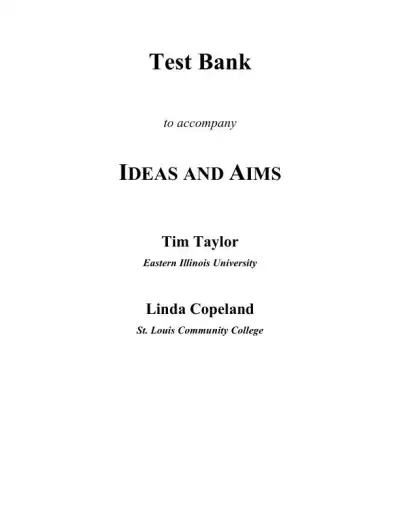 Exam Guides
Test Bank for IDEAS and Aims For College Writing, MLA Update, 1st Edition
English
67 pagesMay 2025 Exam Guides
Technical Communication, 14th Edition Test Bank
English
83 pages153downloadsFeb 2025 Class Notes
The Longman Reader, 12th Edition Lecture Notes
English
118 pages137downloadsFeb 2025 Class Notes
Lecture Notes for The Reid Guide for College Writers, 12th Edition
English
138 pages131downloadsFeb 2025 Class Notes
Lecture Notes for Technical Communication, 15th Edition
English
350 pages113downloadsFeb 2025 Exam Guides
Grammar Matters, 1st Edition Test Bank
English
127 pages101downloadsFeb 2025 Textbook Guides
Solution Manual for Pearson Editing Exercises, The, 2nd Edition
English
22 pages100downloadsFeb 2025
Study this document with CramX
Once it is in your library, every tool can work from it.