

Solution Manual for Along These Lines: Writing Paragraphs and Essays with Writing from Reading Strategies, MLA Update, 7th Edition
- English
- 199 pages
- Shared May 2025
Solution Manual for Along These Lines: Writing Paragraphs and Essays with Writing from Reading Strategies, MLA Update, 7th Edition helps you understand textbook content with detailed solutions and explanations for each problem.
Preview 16 of 199 pages
See the first 16 pages exactly as they appear in the document.
Page 1 Read page 1 as text
John Sheridan Biays, Professor Emeritus of English Broward College Carol Wershoven, Professor Emerita of English Palm Beach State College Along These Lines Writing Sentences and Paragraphs with Writing from Reading Strategies Seventh Edition Answer Key to accompany
Page 2 Page 3 Read page 3 as text
Along These Lines: Writing Sentences and Paragraphs Page 1 Exercise 1 Practice: Recognizing Action Verbs Underline the action verbs in the following sentences. 1. The mother hugged the child. 2. On Tuesday, traffic blocked the intersection. 3. The Web site loaded slowly. 4. Most old people remind me of my grandparents. 5. The pet store opens at 11:00 a .m . 6. Nick never goes to a gym on the weekends. 7. A city bus takes me to work in the morning. 8. Karen needs your help after school. Exercise 2 Practice: Recognizing Being Verbs Underline the being verbs in the following sentences. 1. My study habits were not effective. 2. The blueberry pie tastes delicious. 3. Your dog was a good and loyal friend. 4. Snapchatting seems fun. 5. Jade Beach is a popular gathering place for students. 6. Professor Duvale is a well-known blues musician. 7. Your plan for improvement sounds clear and reasonable. 8. The ocean looks magnificent today. Exercise 3 Collaborate: Writing Sentences with Specific Verbs With a partner or group, write two sentences using each of the verbs listed. Each sentence must have at least five words. When you have completed the exercise, share your answers with another group or with the class. The first one is done for you. 1. verb: dragged sentence 1: I dragged the heavy bag across the floor. sentence 2: Lori dragged herself to class on Friday morning. 2. verb: smells sentence 1: That apple pie smells delicious. sentence 2: Jack’s cologne smells like lime. Answers will vary. Possible answers are shown. CHAPTER 1 The Simple Sentence
Page 4 Read page 4 as text
Along These Lines: Writing Sentences and Paragraphs Page 2 3. verb: argues sentence 1: Gina argues with Rachel about money. sentence 2: My five-year-old argues with me about bedtime. 4. verb: seem sentence 1: You seem upset with me today. sentence 2: Brian and Dwayne seem satisfied with the deal. 5. verb: chatted sentence 1: We chatted online for two hours. sentence 2: The girls chatted in the hallway during break. 6. verb: wins sentence 1: Our team always wins the softball tournament. sentence 2: Tonight, some lucky person wins the raffle. 7. verb: was sentence 1: My father was a patient man. sentence 2: I was shy in high school. 8. verb: were sentence 1: Your sisters were my oldest friends. sentence 2: The houses were little white cottages. Exercise 4 Practice: Recognizing the Complete Verb: Main and Helping Verbs Underline the complete verb (both main and helping verbs) in each of the following sentences. 1. Caroline has studied Spanish since she was seven. 2. Did she build her snowman by herself? 3. I will be taking my final exams next week. 4. Annette should have apologized for being late. 5. Tina and Stan are paying for their son’s trip to Spain. 6. My little nephew can sing really funny songs. 7. By Friday, I must make a decision about surgery. 8. Does this class end at 4:00 p .m . ? Exercise 5 Collaborate: Writing Sentences with Helping Verbs Complete this exercise with a partner or group. First, ask one person to add at least one helping verb to the verb given. Then work together to write two sentences using the main verb and the helping verb(s). Appoint one spokes- person for your group to read all your sentences to the class. Notice how many combinations of main and helping verbs you hear. The first one is done for you.
Page 5 Read page 5 as text
Along These Lines: Writing Sentences and Paragraphs Page 3 1. verb: complained verb with helping verb(s): must have complained sentence 1: My supervisor must have complained about me. sentence 2: She must have complained twenty times yesterday. 2. verb: denying verb with helping verb(s): could be denying sentence 1: Jeff could be denying the truth about his son. sentence 2: You could be denying your role in the crime. 3. verb: forgive verb with helping verb(s): can forgive sentence 1: Avery can forgive her friend’s selfishness. sentence 2: I can forgive anything except cruelty. 4. verb: said verb with helping verb(s): might have said sentence 1: You might have said, “Thank you.” sentence 2: Inez might have said the wrong thing to James. 5. verb: given verb with helping verb(s): were given sentence 1: We were given the wrong bus tickets. sentence 2: All my brothers were given a good education. 6. verb: expecting verb with helping verb(s): are expecting sentence 1: You are expecting too much from me. sentence 2: My parents are expecting me to visit them often. 7. verb: broken verb with helping verb(s): have broken sentence 1: You have broken my heart too often. sentence 2: Those players have broken their team contracts. 8. verb: encourage verb with helping verb(s): should encourage sentence 1: You should encourage your children to read. sentence 2: We should encourage Mark to fight peer pressure. Answers will vary. Possible answers are shown.
Page 6 Read page 6 as text
Along These Lines: Writing Sentences and Paragraphs Page 4 Exercise 6 Practice: Recognizing Main Verbs Some of the sentences that follow have one main verb; some have more than one main verb. Underline all the main verbs in each sentence. 1. Every weekend, my brother drives to his girlfriend’s house, honks his car horn, and waits for her in his car. 2. Kansky and Stamos sell silver rings and leather belts at the flea market. 3. Alicia borrowed my clothes but rarely returned them. 4. My favorite place on campus has private study rooms. 5. Your mother called and invited us to lunch this weekend. 6. A drunk driver shattered one car’s taillight, smashed another’s front end, and skidded into a trash can. 7. Felice ordered a hamburger for lunch and cut it into small pieces. 8. Some of the animals in his paintings look like dragons or other fantastic creatures from an imaginary world. Exercise 7 Practice: Recognizing Verbs in a Selection from “The Tell-Tale Heart” This selection is from “The Tell-Tale Heart,” a horror story by Edgar Allan Poe. In it, an insane murderer has killed an old man and buried him under the floor. When the police arrive, they find nothing, but the murderer is con- vinced that he—and the police—can hear the old man’s heart beating under the floor. In this selection, the murderer describes what he feels as he hears the heart beat louder and louder. Underline all the verbs in the selection. Notice how a careful choice of verbs can make writing exciting and suspenseful. The officers were satisfied. My manner had convinced them. I was singularly at ease. They sat, and while I answered cheerfully, they chatted of familiar things. But, ere* long, I felt myself getting pale and wished them gone. My head ached, and I fancied* a ringing in my ears: but still they sat and still chatted. The ringing became more distinct—it continued and became more distinct: I talked more freely to get rid of the feeling: but it continued and gained definitiveness—until, at length,* I found that the noise was not within my ears. No doubt I now grew very pale—but I talked more fluently, and with a heightened voice. Yet the sound increased—and what could I do? . . . I gasped for breath—and yet the officers heard it not. I talked more quickly, more vehemently;* but the noise steadily increased. I arose and argued about trifles, in a high key and
Page 7 Read page 7 as text
Along These Lines: Writing Sentences and Paragraphs Page 5 with violent gesticulations,* but the noise steadily increased. Why would they not be gone? I paced the floor to and fro with heavy strides, as if excited to fury by the observation of the men—but the noise steadily increased. Oh God! What could I do? I foamed—I raved—I swore! . . . It grew louder—louder—louder! And still the men chatted pleasantly, and smiled. Was it possible they heard not? Almighty God! —no, no! They heard!—they suspected!—they knew! * ere: before * fancied: imagined * at length: after a time * vehemently: furiously * gesticulations: gestures Exercise 8 Practice: Recognizing Subjects in Sentences Underline the subjects in the following sentences. 1. The students like to sit outside in the sun. 2. Sylvia Jong might have gone to the wrong classroom. 3. Biology and algebra are difficult subjects for me. 4. An owl woke me in the middle of the night. 5. Lorraine and Pierre have family members in Haiti. 6. Smoking is becoming an expensive and socially unacceptable habit. 7. Greed and arrogance led Carter into a mess he could not get out of. 8. Peanuts can cause dangerous allergic reactions in some people. Exercise 9 Collaborate: Adding Subjects to Sentences Working with a partner or group, complete the following paragraph by add- ing subjects to the blank lines. Before you fill in the blanks, discuss your answers and try to come to an agreement about the worst movie, the worst music video, and so on. When you have completed the paragraph, share your answers with another group or with the class. This year has seen many achievements in the arts and entertainment, but it has also seen many creative disasters. On movie screens, there have been some terrible movies. Without a doubt, ___________________________ was the worst movie of the year. It should never have been made. On televi- sion, ___________________________ was the worst and also the most irritating show. Every time I see it, I want to turn it off or kick in the television screen. Answers will vary .
Page 8 Read page 8 as text
Along These Lines: Writing Sentences and Paragraphs Page 6 ___________________________ and ___________________________ take the prize for the worst actor and actress of the year. They should consider other careers. In the field of music, ___________________________ ranks as the least successful music video of the year. ___________________________ is the most annoying song because the radio played it far too often. Last, ___________________________ is the most annoying singer. Exercise 10 Practice: Recognizing Prepositional Phrases, Subjects, and Verbs Put parentheses around the prepositional phrases in the following sentences. Then underline the subjects and verbs, putting S above the subject and V above the verb. 1. Two of my family members graduated from Columbia High School in 2017. 2. The athlete ran across the track and flew over the finish line. 3. A bunch of chocolates and a card lay on the desk. 4. The girl with the long black hair was new to the neighborhood. 5. The mud on my shoes came from a deep puddle in front of the steps. 6. Nothing except a huge bowl of ice cream can soothe the pain of that algebra test. 7. The employees worked over a long weekend to complete the project behind the new building. 8. At one point, the troops were driving through dangerous territory without clear directions. Exercise 11 Collaborate: Writing Sentences with Prepositional Phrases Do this exercise with a partner. First, add one prepositional phrase to the core sentence. Then ask your partner to add a second prepositional phrase to the same sentence. For the next sentence, switch places. Let your partner add the first phrase; you add the second. Keep switching places throughout S ( ) V ( ) ( ) S V ( ) V ( ) S ( ) S V ( ) S ( ) V ( ) ) ( ) S ( ) V )( ) S ( ( ) V ) ( ) S V ( ) V ( ) ( ) S V ( ( ) ) ( )
Page 9 Read page 9 as text
Along These Lines: Writing Sentences and Paragraphs Page 7 the exercise. When you have completed the exercise, share your sentences (the ones with two prepositional phrases) with the class. The first one is done for you. 1. core sentence: Employees are concerned. Add one prepositional phrase: Employees are concerned about their paychecks. Add another prepositional phrase: Employees at the central plant are concerned about their paychecks. 2. core sentence: Eduardo studied. Add one prepositional phrase: Eduardo studied in the library. ___________________________________________________________ Add another prepositional phrase: Eduardo studied in the library until midnight. 3. core sentence: The lecture began. Add one prepositional phrase: The lecture began at noon. ___________________________________________________________ Add another prepositional phrase: The lecture began at noon in the auditorium. 4. core sentence: A man in black appeared. Add another prepositional phrase: A man in black appeared outside my bedroom window. Add another prepositional phrase: In my dreams, a man in black appeared outside my bedroom window. Exercise 12 Practice: Finding Prepositional Phrases, Subjects, and Verbs in Complicated Word Order Put parentheses around the prepositional phrases in the following sentences. Then underline the subjects and verbs, putting an S above each subject and a V above each verb. 1. Across the street from my grandmother’s store is an empty lot with cracked cement. 2. By a border of yellow daisies stood a black dog with a yellow collar. 3. Behind all Mario’s tattoos and muscles hid a shy man with a longing for approval. Answers will vary. Possible answers are shown. TEACHING TIP Tell students to (1) identify the prepositional phrases and then (2) pretend that the phrases do not appear. By doing so, they can easily spot the subjects and verbs. ( )( )V ( ) S ( )( ) V S ( ) ( ) V S ( ) ( )
Page 10 Read page 10 as text
Along These Lines: Writing Sentences and Paragraphs Page 8 4. Inside her desk is a new tablet in a zippered case. 5. From somewhere in the darkened room came the loud sound of someone snoring happily. 6. Among the stuff for sale on the table is a faded photograph of someone fishing in a boat. 7. Through the halls echoed the sound of happy parents waiting to greet their children. 8. Beyond the horizon is a new adventure. Exercise 13 Practice: Recognizing Subjects and Verbs in Questions and Here is(are), There is(are) Word Order Underline the subjects and verbs in the following sentences, putting an S above each subject and a V above each verb. 1. There is somebody with a barking dog next door. 2. Have we driven off the main road and missed the right exit? 3. Do you expect an answer to that question? 4. Here is our chance for a quick snack. 5. Would Ms. Sung like a gift card for her birthday? 6. Over on the next block there are a barber shop and a shoe store. 7. There was a long line at the concert. 8. Can I borrow your calculator for the test? Exercise 14 Practice: Correcting Problems with Infinitive or -ing Verb Forms Most—but not all—of the following sentences are faulty; an -ing verb or an infinitive may be taking the place of a main verb. Correct the sentences that have errors. 1. Nobody in the store paying attention to the customers. 2. A lack of quality jobs in our state sending many people into debt. ( )V S ( ) ( ) ( ) ( ) S V ( )( ( ) ( ) ( ) ) V S ( ) V S ( ) V S V S V V V S V V S V S V V S V S V Answers will vary. Possible answers are shown. was is V S S ( ) V S ( ) ( )
Page 11 Read page 11 as text
Along These Lines: Writing Sentences and Paragraphs Page 9 3. Maggie’s talent for putting people at ease was a real asset in her volunteer work at the free clinic near the edge of town. 4. In the middle of a cold winter, I wondering about a move to Florida. 5. For me, the unpleasant parts of the field trip to be the hot weather and the lack of cell service. 6. As the plane touched down, I thinking about the fun of the days ahead. 7. A tropical storm with strong winds and heavy rain is going to ruin our weekend plans. 8. Joshua to graduate this May. Exercise 15 Practice: Finding Subjects and Verbs: A Comprehensive Exercise Underline the subjects and verbs in the following sentences, putting an S above each subject and a V above each verb. 1. My sisters like to study together. 2. Behind all the noise is a thoughtful young man with a deep respect for women. 3. Keith didn’t always want a career in marketing. 4. Matt hoped to send a text to his daughter before the game. 5. Didn’t you ever think about the risks of buying a car you never drove? 6. There are a few problems with ordering shoes online. 7. Deep love and constant patience helped my parents to survive my father’s deployment. 8. Where did you and Tina go after the party? Exercise 16 Practice: Finding Subjects and Verbs: A Comprehensive Exercise Underline the subjects and verbs in the following sentences, putting an S above each subject and a V above each verb. was are going began plans INSTRUCTOR’S NOTE The underlining does not extend to the “ n ’ t ” in items 3 and 5 because not is not a part of the verb. S V V S S V V S V V S V V S S S V V S S V
Page 12 Read page 12 as text
Along These Lines: Writing Sentences and Paragraphs Page 10 1. In the back of the garage was a pair of basketball shoes. 2. In the summer, Wallace drives to the mountains and hikes along the streams. 3. The Cuban coffee and pastries at Max’s restaurant attracted customers from across the city. 4. Without Christine’s help, Jamie might never have gotten the chance to meet Margo. 5. Below street level is an underground mall with thirty shops and seven restaurants. 6. Paul’s dedication to his job has made him a valuable employee. 7. There was a gold border around the rim of the mug. 8. Jeff’s cat leaped onto my lap and became a purring machine. Exercise 17 Collaborate: Creating Your Own Text Do this exercise with a partner or a group. Following is a list of rules you have just studied. Write two examples for each rule. When your group has completed the examples for each rule, trade your group’s completed exer- cise with another group’s and check their examples while they check yours. The first rule has been done for you. Rule 1: The verb in a sentence can express some kind of action. example 1: My cousin studies biology in college. example 2: Yesterday the rain destroyed the rose bushes. Rule 2: The verb in a sentence can express some state of being. example 1: Your solution to the problem seems practical. example 2: The room smelled like pine needles. Rule 3: The verb in a sentence can consist of more than one word. example 1: The roof must have collapsed under the weight. example 2: Billy stumbled and fell into the ditch. Rule 4: There can be more than one subject in a sentence. example 1: Elena and her mother drove to Jackson. example 2: The boy and his dog jumped into the pond. S V S V V S S V S V V V S S V V S S V V Answers will vary. Possible answers are shown.
Page 13 Read page 13 as text
Along These Lines: Writing Sentences and Paragraphs Page 11 Rule 5: If you take out the prepositional phrases, it is easier to identify the subject of a sentence because nothing in a prepositional phrase can be the subject of a sentence. (Write sentences containing at least one prepositional phrase. Put parentheses around the prepo- sitional phrases.) example 1: The man (in the restaurant) smiled (at me). example 2: Nothing (in that box) (of clothes) is worth saving. Rule 6: Not all sentences have the simple word order of first subject, then verb. (Give examples of sentences with more complicated word order.) example 1: Here is your money. example 2: From upstairs came a scream and a thud. Rule 7: Words like not, never, often, always , and ever are not verbs. (Write sentences using one of those words, but put a V above the correct verb.) example 1: My sister always sets her alarm. example 2: Stacy will not agree to your plan. Rule 8: An -ing verb form by itself or an infinitive ( to preceding the verb) cannot be a main verb. (Write sentences with -ing verb forms or infinitives, but put a V above the main verb.) example 1: Steve hopes to graduate this fall. example 2: Your sister is thinking of you. Exercise 18 Connect: Recognizing Subjects and Verbs in a Paragraph Underline the subjects and verbs in the following paragraph, putting an S above each subject and a V above each verb. A major event in our town is the annual weekend of hot rod racing. From every part of the state come thousands of people. Neighboring states also send their share of competitors and spectators. During this weekend there are huge economic benefits to our town. Many visitors arrive in their campers. Consequently, the local campgrounds fill with every kind of recreational vehicle. Other racing fans stay at nearby hotels and motels. Everyone in town for the races needs to eat, too. During this weekend, the restaurants and supermarkets in our town never complain about a lack of business. Other places sell souvenirs. There are shirts, caps, cups, stickers, bandanas, and flags for sale in every service station, drug store, and superstore. Visitors, merchants, and hotelkeepers love race weekend. In addition, V V V V V V S V V S S V V S S V S V S V S V S S V S V V S S S S V
Page 14 Read page 14 as text
Along These Lines: Writing Sentences and Paragraphs Page 12 many local residents love this time, too. Thousands of old timers in town have never missed a visit to the races. Without the fun and action of this event, our town would be a sad place. Chapter Test The Simple Sentence Underline the subjects and verbs in the following sentences, putting an S above each subject and a V above each verb. 1. With the help of good friends and a loving family, a person will always find a way to handle difficult times. 2. Shouldn’t Maria take the job at her sister’s start-up company? 3. From the back of the audience came the most bizarre laughter I have ever heard. 4. Without a penny in his pocket, my grandfather arrived in America and found work. 5. Ticks have been making life miserable for people in the Northeast. 6. Beyond the bustling city center are abandoned apartment buildings and empty shops in a state of decay. 7. Do you think that computers will be obsolete one day? 8. After a few minutes of under the car, the mechanic went to his truck, grabbed his tools, and started the long process of fixing my car. S V S V V S V V S V V S V V S S V V S V V S S S V S V V V
Page 15 Read page 15 as text
Along These Lines: Writing Sentences and Paragraphs Page 13 Exercise 1 Practice: Recognizing Compound Sentences and Adding Commas Add commas only where they are needed in the following sentences. 1. Dave ran toward the lake but I chose to walk. 2. The man behind the counter said there would be a sale next week and suggested returning then. 3. At the end of the month, Rory pays all her bills for she fears getting into debt. 4. I have a bunch of notebooks and essays from freshman year but I don’t want to throw them away in case I can use them again. 5. I had a really good meal there last time but won’t return because of poor service. 6. My boyfriend had to travel for work so I spent the weekend with family. 7. I always remind my little brother to charge his cell phone for he often forgets to do it. 8. The dog was not exactly friendly nor was it aggressive. Exercise 2 Practice: More on Recognizing Compound Sentences and Adding Commas Add commas only where they are needed in the following sentences. 1. We took the shortcut to the restaurant and Bill knew the way. 2. My next car will be a truck but I don’t want it to be too big or loud. 3. Coffee gives my life purpose in the morning yet I don’t drink it after lunch. 4. Lee said he will not be coming to practice or the game. 5. The dog was barking at the door so Tony went to let her in. 6. My son loves to eat pizza and pasta for his birthday dinner but no one else in the family wants to mix those two foods. 7. I will never swim in that lake again for the news just reported about an alligator seen near it. 8. Pat loves to watch boxing so I got him tickets to a match this weekend. Exercise 3 Collaborate: Writing and Punctuating Compound Sentences Working with a partner or a group, write the compound sentences described as follows. Be sure to punctuate them correctly. When you have completed the exercise, share your answers with another group or with the class. , , , , , , , CHAPTER 2 Beyond the Simple Sentence: Coordination , , , , , ,
Page 16 Read page 16 as text
Along These Lines: Writing Sentences and Paragraphs Page 14 1. Write a compound sentence using the coordinating conjunction for . I will call you later, for I am busy right now. 2. Write a compound sentence using the coordinating conjunction and . The wind was strong, and the rain beat against the windows. 3. Write a compound sentence using the coordinating conjunction nor . My supervisor did not praise me, nor did she offer me a raise. 4. Write a compound sentence using the coordinating conjunction but . You can buy a ticket, but you can’t get a good seat. 5. Write a compound sentence using the coordinating conjunction or . I can take my car, or we can go in your truck. 6. Write a compound sentence using the coordinating conjunction yet . Jerry was angry, yet he did not raise his voice. 7. Write a compound sentence using the coordinating conjunction so . Brian’s favorite team is playing, so he is going to the game. Exercise 4 Practice: Recognizing Compound Sentences and Adding Semicolons Add semicolons only where they are needed in the following sentences. 1. I went to café for some coffee I drank it at the counter. 2. Dave is a terrible cook he eats at the deli for most of his meals. 3. Tomorrow something good better happen there has been nothing but problems today. 4. Anita’s unwillingness to relocate will harm her chances at a promotion most new sales people are very flexible about location. 5. The weekend at the lake was joyful all my closest friends showed up. 6. You should try taking the bus paying for parking is really expensive. 7. My coach said it was okay to miss practice but would not let me play in the game. 8. My dad locked the restaurant early there was a severe weather warning issued by the National Weather Service. Exercise 5 Practice: More on Recognizing Compound Sentences and Adding Semicolons Add semicolons only where they are needed in the following sentences. 1. Steve has a really loud voice I can hear him from across the cafeteria. 2. Kelsey never pays attention during class she thinks her phone is more important than her instructor. Answers will vary. Possible answers are shown. ; ; ; ; ; ; ; ; ;
183 more pages in the full document
Unlock it once and it stays in your library, ready to chat with or turn into flashcards.
Unlock the full documentMore English study materials
See all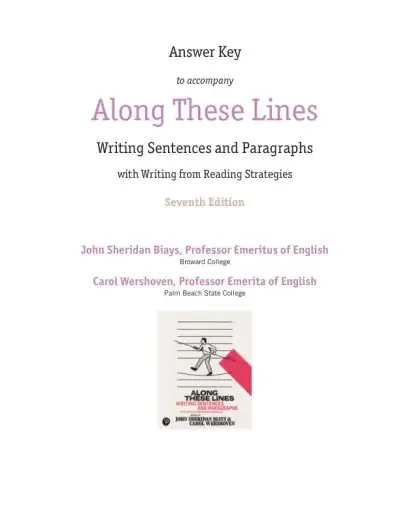 Textbook Guides
Solution Manual for Along These Lines: Writing Sentences and Paragraphs, 7th Edition
English
199 pagesMay 2025 Exam Guides
Test Bank for Along These Lines: Writing Sentences and Paragraphs, 7th Edition
English
154 pagesMay 2025 Exam Guides
Test Bank for Along These Lines: Writing Paragraphs and Essays, 8th Edition
English
164 pagesMay 2025 Exam Guides
Technical Communication, 14th Edition Test Bank
English
83 pages153downloadsFeb 2025 Class Notes
The Longman Reader, 12th Edition Lecture Notes
English
118 pages137downloadsFeb 2025 Class Notes
Lecture Notes for The Reid Guide for College Writers, 12th Edition
English
138 pages131downloadsFeb 2025 Class Notes
Lecture Notes for Technical Communication, 15th Edition
English
350 pages113downloadsFeb 2025 Exam Guides
Grammar Matters, 1st Edition Test Bank
English
127 pages101downloadsFeb 2025
Study this document with CramX
Once it is in your library, every tool can work from it.