
Bond Valuation And Stock Return Calculations: A Comprehensive Financial Analysis

Get financial valuation insights with this solved assignment.

Emily Jackson
Contributor
4.6
53
10 months ago
Preview (7 of 21 Pages)
100%
Log in to unlock

Page 1

Bond Valuation And Stock Return Calculations: A Comprehensive Financial Analysis - Page 1 preview image

Loading page ...

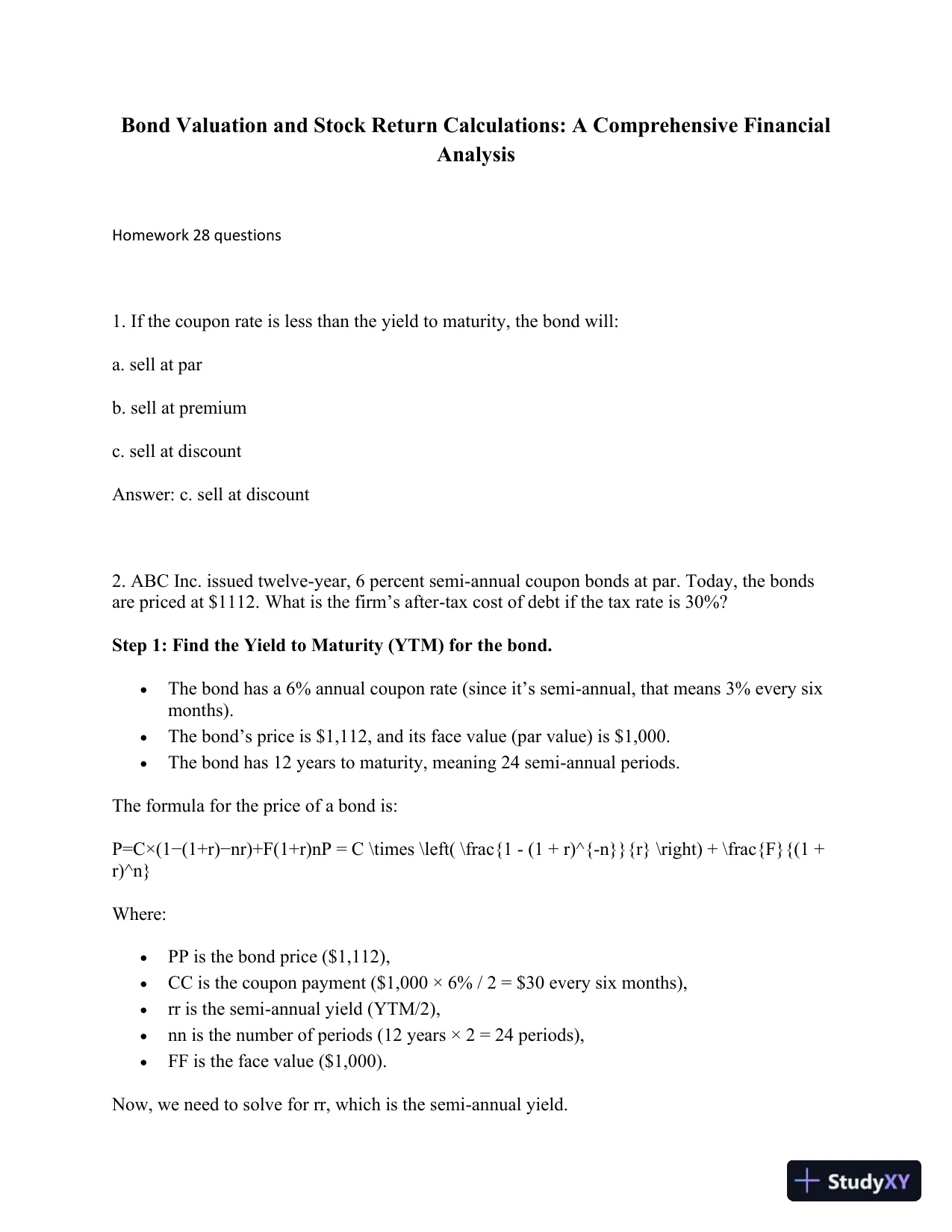
Bond Valuation and Stock Return Calculations: A Comprehensive FinancialAnalysisHomework 28 questions1.If the coupon rate is less than the yield to maturity, the bond will:a. sell at parb. sell at premiumc. sell at discountAnswer: c. sell atdiscount2. ABC Inc. issued twelve-year, 6 percent semi-annual coupon bonds at par. Today, the bondsare priced at $1112. What is the firm’s after-tax cost of debt if the tax rate is 30%?Step 1: Find the Yield to Maturity (YTM) for the bond.The bondhas a 6% annual coupon rate (since it’s semi-annual, that means 3% every sixmonths).The bond’s price is $1,112, and its face value (par value) is $1,000.The bond has 12 years to maturity, meaning 24 semi-annual periods.The formula for the price of a bond is:P=C×(1−(1+r)−nr)+F(1+r)nP = C\times\left(\frac{1-(1 + r)^{-n}}{r}\right) +\frac{F}{(1 +r)^n}Where:PP is the bond price ($1,112),CC is the coupon payment ($1,000 × 6% / 2 = $30 every six months),rris the semi-annual yield (YTM/2),nn is the number of periods (12 years × 2 = 24 periods),FF is the face value ($1,000).Now, we need to solve for rr, which is the semi-annual yield.

Page 2

Bond Valuation And Stock Return Calculations: A Comprehensive Financial Analysis - Page 2 preview image

Loading page ...

Page 3

Bond Valuation And Stock Return Calculations: A Comprehensive Financial Analysis - Page 3 preview image

Loading page ...

After trying different semi-annual rates, we find that the semi-annual yield that matches the bondprice of $1,112 is approximately1.5%per period.The annual yield to maturity (YTM) is1.5% × 2 = 3%.Step 2: Calculate the after-tax cost of debt.The after-tax cost of debt is calculated using the formula:After-taxcostofdebt=YTM×(1−Taxrate)\text{After-tax cost of debt} =\text{YTM}\times (1-\text{Tax rate})Given:YTM = 3% (annual),Tax rate = 30% (or 0.30).So:After-taxcostofdebt=3%×(1−0.30)=3%×0.70=2.10%\text{After-tax cost of debt} = 3\%\times(1-0.30) = 3\%\times 0.70 = 2.10\%Final Answer:The firm’s after-tax cost of debt is2.10%.3.You have observed the following returns on ABC's stocks over the last six years:3.3%, 5.4%, 18.9%,-12.1%, 3.5%,-8.8%What is thegeometric average returns on thestock over this six-year period.To calculate the geometric average return over a period, we use the following formula:Geometricaveragereturn=(∏i=1n(1+Ri))1n−1\text{Geometric average return} =\left(\prod_{i=1}^{n} (1 + R_i)\right)^{\frac{1}{n}}-1Where:RiR_i is the return in each period,nn is the number of periods (6 years in this case),The product symbol (∏\prod) indicates multiplying all the terms together.Step 1: Convert percentages to decimals.

Page 4

Bond Valuation And Stock Return Calculations: A Comprehensive Financial Analysis - Page 4 preview image

Loading page ...

The returns given are:3.3% = 0.0335.4% = 0.05418.9% = 0.189-12.1% =-0.1213.5% = 0.035-8.8% =-0.088Step 2: Apply the formula.Geometricaveragereturn=((1+0.033)×(1+0.054)×(1+0.189)×(1−0.121)×(1+0.035)×(1−0.088))16−1\text{Geometric average return} =\left( (1 + 0.033)\times (1 + 0.054)\times (1 + 0.189)\times (1-0.121)\times (1 + 0.035)\times (1-0.088)\right)^{\frac{1}{6}}-1=(1.033×1.054×1.189×0.879×1.035×0.912)16−1=\left( 1.033\times 1.054\times 1.189\times0.879\times 1.035\times 0.912\right)^{\frac{1}{6}}-1Step 3: Multiply the terms inside the parentheses.=(1.033×1.054×1.189×0.879×1.035×0.912)=1.01875= (1.033\times 1.054\times 1.189\times0.879\times 1.035\times 0.912) = 1.01875Step 4: Take the 6th root.Geometricaveragereturn=(1.01875)16−1\text{Geometric average return} =(1.01875)^{\frac{1}{6}}-1 =1.0031−1=0.0031= 1.0031-1 = 0.0031Step 5: Convert to percentage.Geometricaveragereturn=0.0031×100=0.31%\text{Geometric average return} = 0.0031\times100 = 0.31\%Final Answer:The geometric average return on the stock over the six-year period is0.31%.4.Suppose that today's stock price is $52.8. If the required rate on equity is 12.2%andthe growth rate is 7.1%, compute the expected dividend (i.e. compute D1)To calculate the expected dividend (D1D_1) using the Dividend Discount Model (DDM), we canuse the following formula:P0=D1r−gP_0 =\frac{D_1}{r-g}

Page 5

Bond Valuation And Stock Return Calculations: A Comprehensive Financial Analysis - Page 5 preview image

Loading page ...

Where:P0P_0 is the current stock price ($52.8),D1D_1 is the expected dividend next year (what we're solving for),rr is the required rate of return on equity (12.2% or 0.122),gg is the growth rate of the dividend (7.1% or 0.071).Step 1: Rearrange the formula to solve for D1D_1:D1=P0×(r−g)D_1 = P_0\times (r-g)Step 2: Plug in the given values:D1=52.8×(0.122−0.071)D_1 = 52.8\times (0.122-0.071) D1=52.8×0.051D_1 = 52.8\times0.051Step 3: Perform the multiplication:D1=2.6928D_1 = 2.6928Final Answer:The expected dividend (D1D_1) is$2.69.5.TheABC Co. has $1,000 face value stock outstanding with a market price of $1,017.2.The stock pays interest annually, matures in11 years, and has a yield to maturity of 9.9percent. What is the annual coupon amount?To find the annual coupon amount, we can use the formula for the price of a bond:P0=C×(1−(1+r)−nr)+F(1+r)nP_0 = C\times\left(\frac{1-(1 + r)^{-n}}{r}\right) +\frac{F}{(1 + r)^n}Where:P0P_0 = Price of the bond = $1,017.2CC = Annual coupon payment (what we're solving for)rr = Yield to maturity (YTM) = 9.9% or 0.099nn = Number of years to maturity = 11FF = Face value of the bond = $1,000Step 1: Rearrange the formula to solve for CC:

Page 6

Bond Valuation And Stock Return Calculations: A Comprehensive Financial Analysis - Page 6 preview image

Loading page ...

P0=C×(1−(1+r)−nr)+F(1+r)nP_0 = C\times\left(\frac{1-(1 + r)^{-n}}{r}\right) +\frac{F}{(1 + r)^n} C=P0−F(1+r)n1−(1+r)−nrC =\frac{P_0-\frac{F}{(1 +r)^n}}{\frac{1-(1 + r)^{-n}}{r}}Step 2: Plug in the known values:C=1,017.2−1,000(1+0.099)111−(1+0.099)−110.099C =\frac{1,017.2-\frac{1,000}{(1 +0.099)^{11}}}{\frac{1-(1 + 0.099)^{-11}}{0.099}}Step 3: Calculate the components:1.(1+0.099)11=(1.099)11≈3.238(1 + 0.099)^{11} = (1.099)^{11}\approx 3.2382.1,0003.238≈308.4\frac{1,000}{3.238}\approx 308.43.(1+0.099)−11≈0.3084(1 + 0.099)^{-11}\approx 0.30844.1−0.3084=0.69161-0.3084 = 0.69165.0.69160.099≈6.99\frac{0.6916}{0.099}\approx 6.99Step 4: Now, calculate CC:C=1,017.2−308.46.99=708.86.99≈101.3C =\frac{1,017.2-308.4}{6.99} =\frac{708.8}{6.99}\approx 101.3Final Answer:The annual coupon amount is$101.3.6.Abondthatsellsforlessthanfacevalueiscalledas:a. par value bondb.perpetuityc. premium bondd. debenturee. discount bondAnswer: c.premium bond

Page 7

Bond Valuation And Stock Return Calculations: A Comprehensive Financial Analysis - Page 7 preview image

Loading page ...

7.ThecommonstockofABCIndustriesisvaluedat$26.7ashare.Thecompanyincreasestheirdividendby7.4percentannuallyandexpectstheirnextdividendtobe$2.56.Whatistherequiredrateofreturnonthisstock?Required rate of return on the stock: Using theDividend Discount Model (DDM):P0=D1r−gP_0 =\frac{D_1}{r-g}Where:P0=26.7P_0 = 26.7 (stock price)D1=2.56D_1 = 2.56 (next dividend)g=7.4%g = 7.4\% (growth rate)Solving for rr (required rate of return):26.7=2.56r−0.07426.7 =\frac{2.56}{r-0.074} r−0.074=2.5626.7=0.0959r-0.074 =\frac{2.56}{26.7} =0.0959 r=0.0959+0.074=0.1699or16.99%r = 0.0959 + 0.074 = 0.1699\text{ or } 16.99\%Answer: 16.99%8.Suppose the real rate is 5.65% and the inflation rate is5.02%. Solve for the nominalrate.Nominal rate: Using theFisher equation:(1+rnominal)=(1+rreal)×(1+rinflation)(1 + r_{nominal}) = (1 + r_{real})\times (1 + r_{inflation})(1+rnominal)=(1+0.0565)×(1+0.0502)(1 + r_{nominal}) = (1 + 0.0565)\times (1 + 0.0502)(1+rnominal)=1.0565×1.0502=1.1106(1 + r_{nominal}) = 1.0565\times 1.0502 = 1.1106rnominal=1.1106−1=0.1106or11.06%r_{nominal} = 1.1106-1 = 0.1106\text{ or } 11.06\%Answer: 11.06%9. If you receive $1,691 at the end of each year for thefirst three years and $7,769 atthe end of each year for the next three years. What is the net present value of this cashflow stream? Assume interest rate is 10.2%.Net Present Value (NPV): The cash flows are:For years 1 to 3: $1,691For years 4 to 6: $7,769Discount rate = 10.2%NPV = ∑(CF(1+r)t)\sum\left(\frac{CF}{(1 + r)^t}\right)For years 1-3:
Preview Mode

This document has 21 pages. Sign in to access the full document!