
Solved Assignments
Comprehensive Analysis of Corporate Financial Statements and Accounting Choices
- Finance
- 15 pages
- Shared May 2025
Analyzes financial statements.
Preview · 5 of 15 pages
100%
Page 1
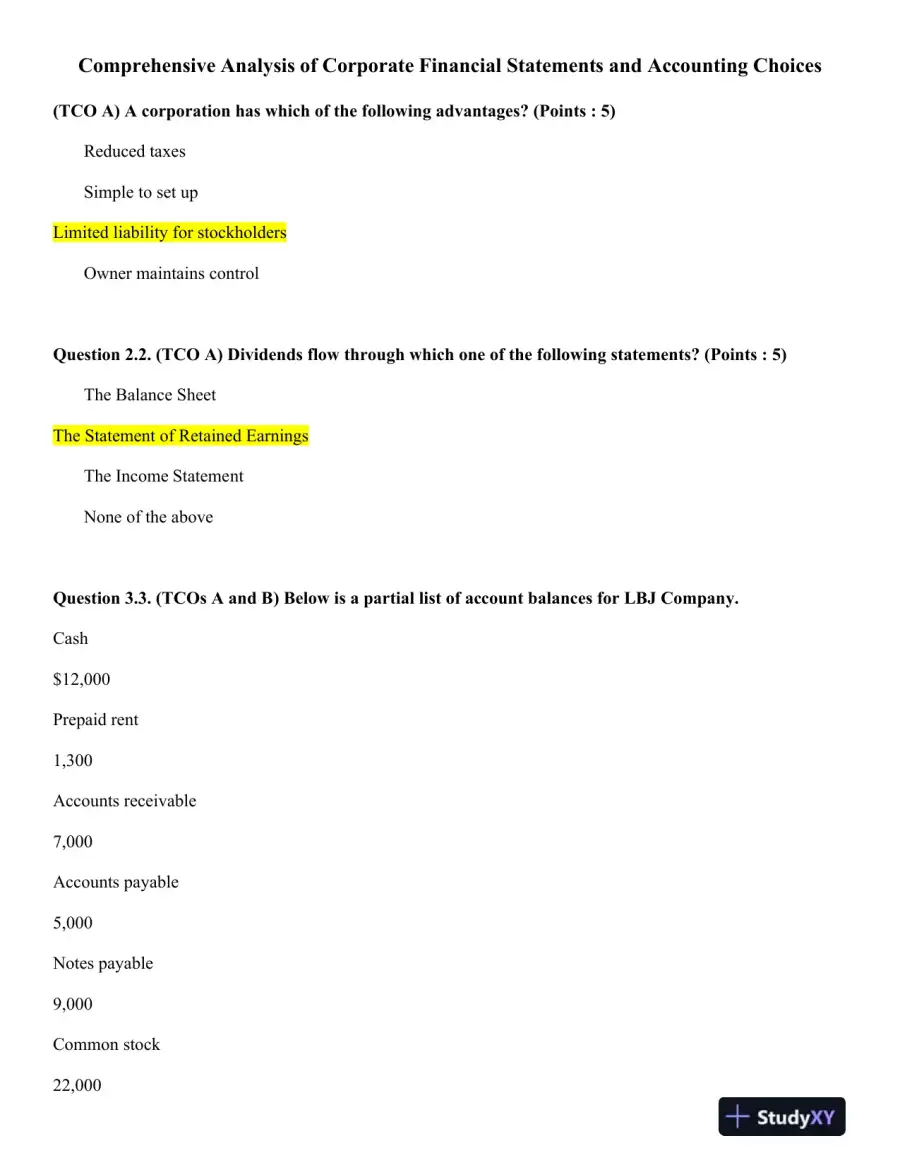 Comprehensive Analysis of Corporate Financial Statements and Accounting Choices(TCO A) A corporation has which of the following advantages? (Points : 5)Reduced taxesSimple to set upLimited liability for stockholdersOwner maintains controlQuestion 2.2. (TCO A) Dividends flow through which one of the following statements? (Points : 5)The Balance SheetThe Statement of Retained EarningsThe Income StatementNone of the aboveQuestion 3.3. (TCOs A and B) Below is a partial list of account balances for LBJ Company.Cash$12,000Prepaid rent1,300Accounts receivable7,000Accounts payable5,000Notes payable9,000Common stock22,000
Page 2

Page 3
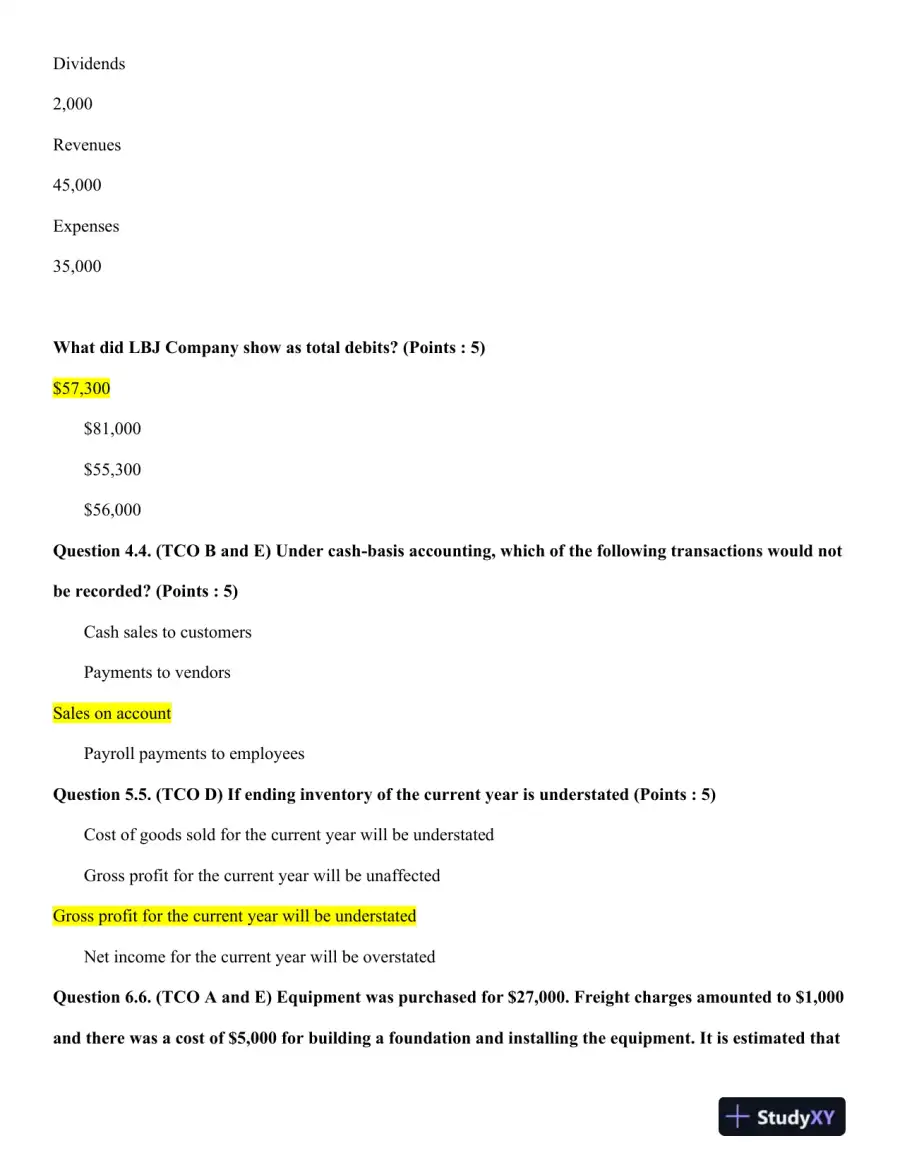 Dividends2,000Revenues45,000Expenses35,000Whatdid LBJ Company show as total debits? (Points : 5)$57,300$81,000$55,300$56,000Question 4.4. (TCO B and E) Under cash-basis accounting, which of the following transactions would notbe recorded? (Points : 5)Cash sales to customersPayments to vendorsSales on accountPayroll payments to employeesQuestion 5.5. (TCO D) If ending inventory of the current year is understated (Points : 5)Cost of goods sold for the current year will be understatedGross profit for the current year will be unaffectedGross profit for the current year will be understatedNet income for the current year will be overstatedQuestion 6.6. (TCO A and E) Equipment was purchased for $27,000. Freight charges amounted to $1,000and there was a cost of $5,000 for building a foundation and installing the equipment. It is estimated that
Page 4
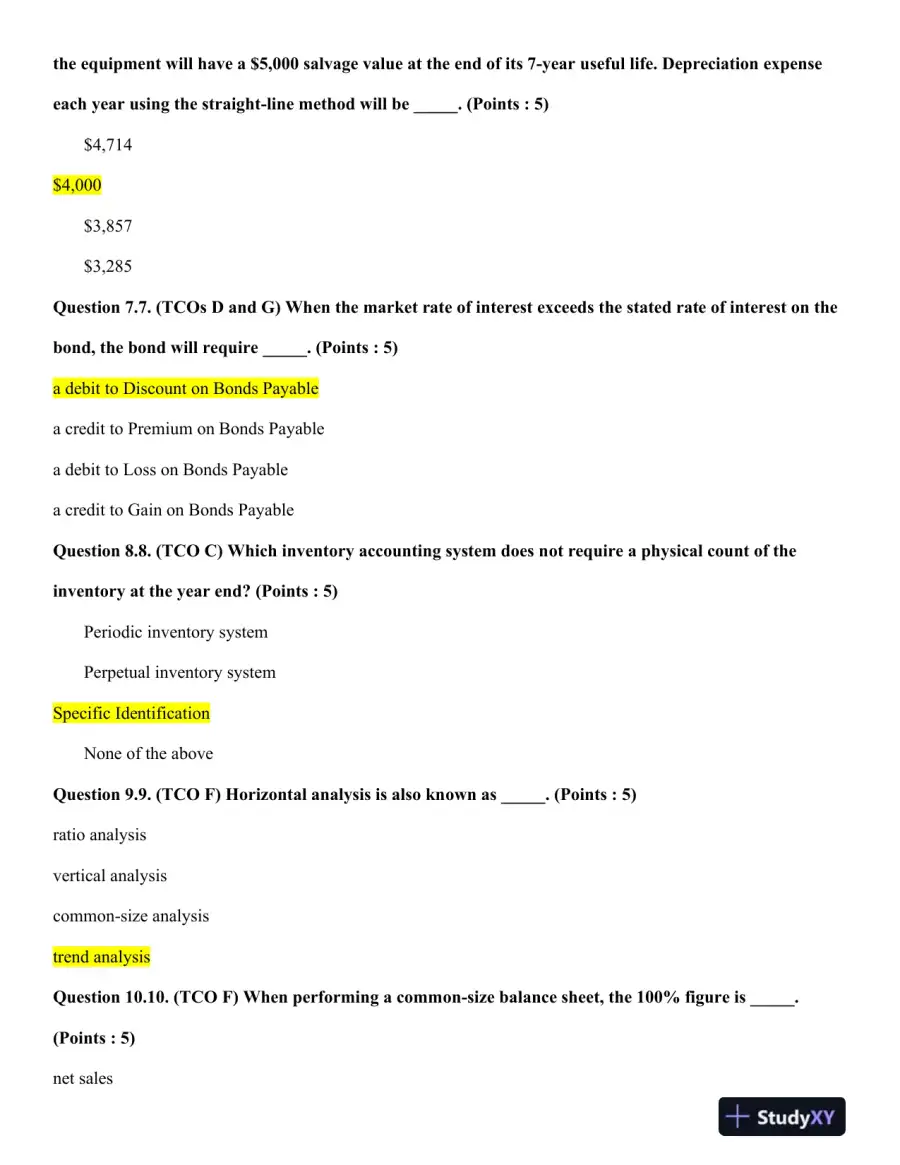 the equipment will have a $5,000 salvage value at the end of its 7-year useful life. Depreciation expenseeach year using the straight-line method will be _____. (Points : 5)$4,714$4,000$3,857$3,285Question 7.7. (TCOs D and G) When the market rate of interest exceeds the stated rate of interest on thebond, the bond will require _____. (Points : 5)a debit to Discount on Bonds Payablea credit to Premium on Bonds Payablea debit to Loss on Bonds Payablea credit to Gain on Bonds PayableQuestion 8.8. (TCO C) Which inventory accounting system does not require a physical count of theinventory at the year end?(Points : 5)Periodic inventory systemPerpetual inventory systemSpecific IdentificationNone of the aboveQuestion 9.9. (TCO F) Horizontal analysis is also known as _____. (Points : 5)ratio analysisvertical analysiscommon-size analysistrend analysisQuestion 10.10. (TCO F) When performing a common-size balance sheet, the 100% figure is _____.(Points : 5)net sales
Page 5
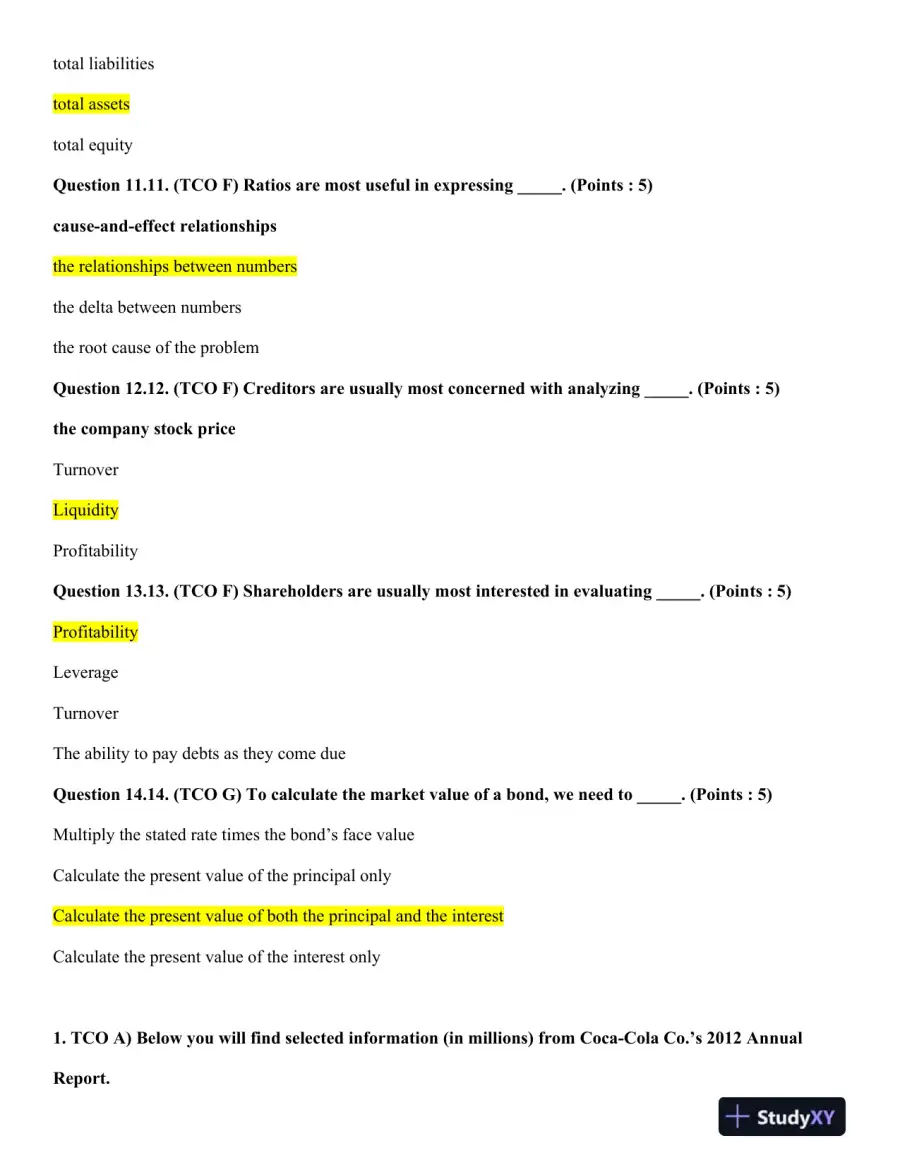 total liabilitiestotal assetstotal equityQuestion 11.11. (TCO F) Ratios are most useful in expressing _____. (Points : 5)cause-and-effect relationshipsthe relationships between numbersthe delta between numbersthe root cause of the problemQuestion 12.12. (TCO F) Creditors are usually most concerned with analyzing _____. (Points : 5)the company stock priceTurnoverLiquidityProfitabilityQuestion 13.13. (TCO F) Shareholders are usually most interested in evaluating _____. (Points : 5)ProfitabilityLeverageTurnoverTheability to pay debts as they come dueQuestion 14.14. (TCO G) To calculate themarket value of a bond, we need to _____. (Points : 5)Multiplythe stated rate times the bond’s face valueCalculatethe present value of the principal onlyCalculatethe present value of both the principal and the interestCalculatethe present value of the interest only1.TCO A) Below you will find selected information (in millions) from Coca-Cola Co.’s 2012 AnnualReport.
10 more pages in the full document
Unlock it once and it stays in your library, ready to chat with or turn into flashcards.
Unlock the full documentMore Finance study materials
See all Textbook Guides
Solution Manual For Investments, 12th Edition
Finance
314 pages161downloadsFeb 2025 Exam Guides
Test Bank for Principles of Managerial Finance, 8th Edition
Finance
851 pages158downloadsFeb 2025 Textbook Guides
Solution Manual for Financial Institutions Management: A Risk Management Approach, 8th Edition
Finance
486 pages154downloadsFeb 2025 Exam Guides
Test Bank for Principles of Managerial Finance, Arab World Edition
Finance
373 pages148downloadsFeb 2025 Textbook Guides
Multinational Financial Management, Study Guide, 6th Edition Solution Manual
Finance
278 pages146downloadsFeb 2025 Textbook Guides
Financial Markets and Institutions, 7th Edition Solution Manual
Finance
194 pages136downloadsFeb 2025 Certification Guides
Wiley Finra Series 3 Exam Review (2019)
Finance
253 pages131downloadsFeb 2025 Exam Guides
Test Bank For Essentials of Investments, 8th Edition
Finance
368 pages130downloadsFeb 2025
Study this document with CramX
Once it is in your library, every tool can work from it.