
Solved Assignments
CONTINUING CASE: CORY AND TISHA DUMONT
- Finance
- 7 pages
- Shared May 2025
A case study on financial planning and investment strategies for Cory and Tisha Dumont.
Preview · 3 of 7 pages
100%
Page 1
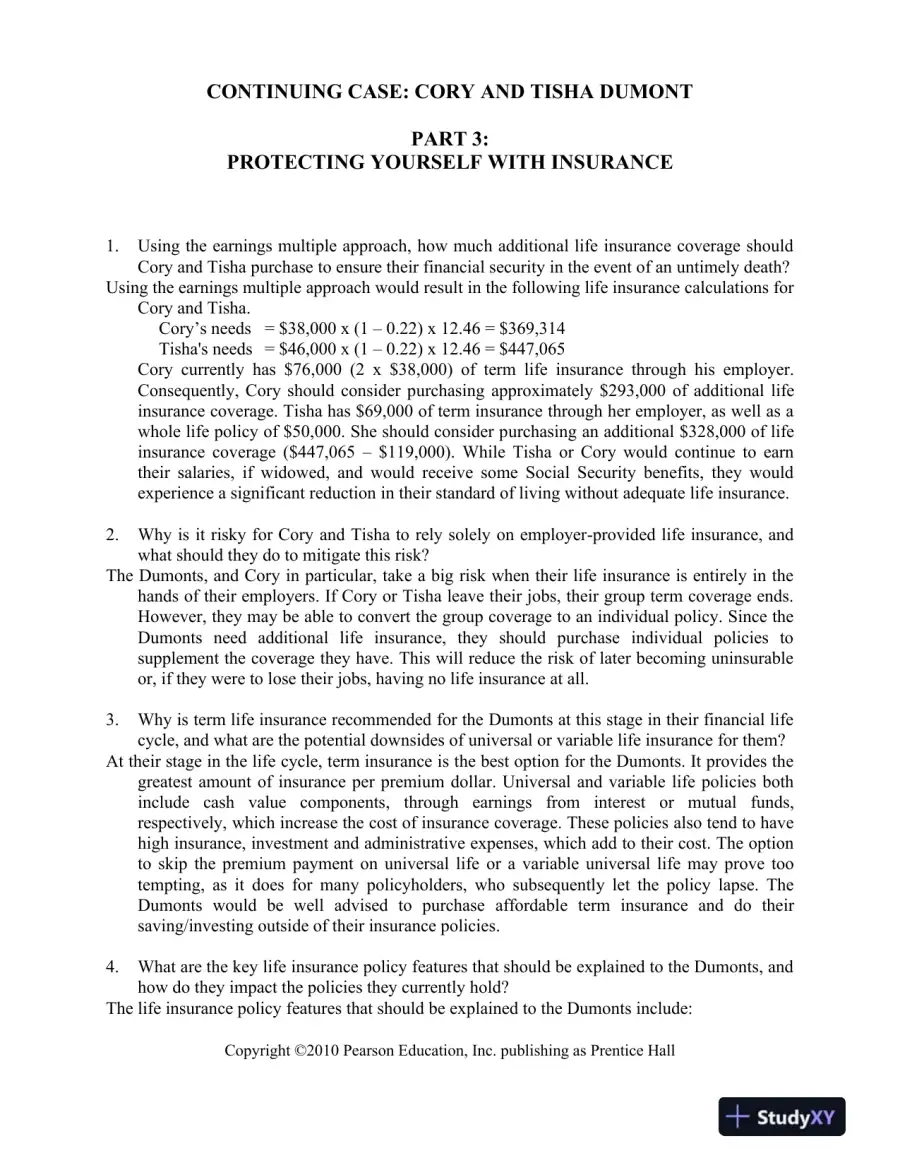 Copyright ©2010 Pearson Education, Inc. publishing as Prentice HallCONTINUING CASE: CORY AND TISHA DUMONTPART 3:PROTECTING YOURSELF WITH INSURANCE1.Using the earnings multiple approach, how much additional life insurance coverage shouldCory and Tisha purchase to ensure their financial security in the event of an untimely death?Using the earnings multiple approachwould result in the following life insurance calculations forCory and Tisha.Cory’s needs= $38,000 x (1–0.22) x 12.46 = $369,314Tisha's needs= $46,000x (1–0.22) x 12.46 = $447,065Cory currently has $76,000 (2 x $38,000) ofterm life insurance through his employer.Consequently, Cory should consider purchasing approximately $293,000of additional lifeinsurance coverage. Tisha has $69,000 of term insurance through her employer, as well as awhole life policy of $50,000. She should consider purchasing an additional $328,000of lifeinsurance coverage ($447,065–$119,000). While Tisha or Cory would continue to earntheir salaries, if widowed, and would receive some Social Security benefits, they wouldexperience asignificant reductionin their standard of living without adequate life insurance.2.Why is it risky for Cory and Tisha to rely solely on employer-provided life insurance, andwhat should they do to mitigate this risk?The Dumonts, and Cory in particular, take a big risk when their life insurance is entirely in thehands of their employers. If Cory or Tisha leave their jobs, their group term coverage ends.However, they may be able to convert the group coverage to an individual policy. Since theDumontsneedadditionallifeinsurance,theyshouldpurchaseindividualpoliciestosupplement the coverage they have. This will reduce the risk of later becoming uninsurableor, if they were to lose their jobs, having no life insurance at all.3.Why is term life insurance recommended for the Dumonts at this stage in their financial lifecycle, and what are the potential downsides of universal or variable life insurance for them?At their stage in the life cycle, term insurance is the best option for the Dumonts. It provides thegreatest amount of insurance per premium dollar. Universal and variable life policies bothincludecashvaluecomponents,throughearningsfrominterestormutualfunds,respectively, whichincrease the cost of insurance coverage. These policies also tend to havehighinsurance,investment and administrative expenses, which add to their cost. The optionto skip the premium payment on universal lifeor a variable universal lifemay prove tootempting, as it does for many policyholders, who subsequently let the policy lapse. TheDumonts would be well advised to purchaseaffordableterm insurance and do theirsaving/investing outside of their insurance policies.4.What are the key life insurance policy features that should be explained to the Dumonts, andhow do they impact the policies they currently hold?The life insurance policy features that should be explained to the Dumonts include:
Page 2

Page 3
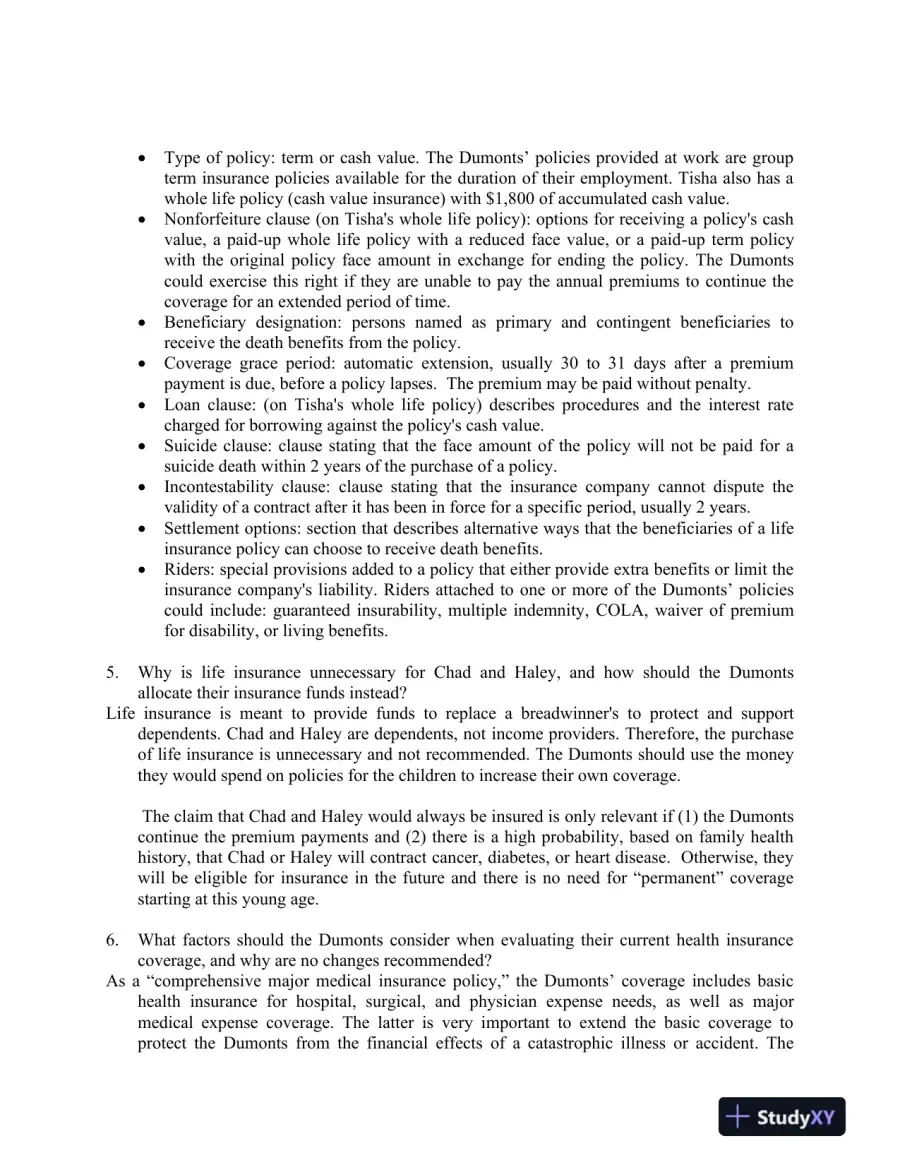 •Type of policy: term or cash value. The Dumonts’ policies provided at work are groupterm insurance policies available for the duration of their employment. Tisha also has awhole life policy (cash value insurance) with $1,800 of accumulated cash value.•Nonforfeiture clause(on Tisha's whole life policy): options for receiving a policy's cashvalue, a paid-up whole life policy with a reduced face value, or a paid-up term policywith the original policy faceamount in exchange for endingthe policy. The Dumontscould exercise this right if they are unable to pay the annual premiums to continue thecoveragefor an extended period of time.•Beneficiary designation: persons named as primary and contingent beneficiaries toreceive the death benefits from the policy.•Coverage grace period: automatic extension, usually 30 to 31 days after a premiumpayment is due, before a policy lapses.The premium may be paid without penalty.•Loan clause: (on Tisha's whole life policy) describes procedures and the interest ratecharged for borrowing against the policy's cash value.•Suicide clause: clause stating that the face amount of the policy will not be paid for asuicide death within 2 years of the purchase of a policy.•Incontestability clause: clause stating that the insurance company cannot dispute thevalidity of a contract after it has been in force for a specific period, usually 2 years.•Settlement options: section that describes alternative ways that the beneficiaries of a lifeinsurance policy can choose to receive death benefits.•Riders: special provisions added to a policy that either provide extra benefits or limit theinsurance company's liability. Riders attached to one or more of the Dumonts’ policiescould include: guaranteed insurability, multiple indemnity,COLA, waiver of premiumfor disability,or living benefits.5.Why is life insurance unnecessary for Chad and Haley, and how should the Dumontsallocate their insurance funds instead?Life insurance is meant to provide funds to replace a breadwinner's to protect and supportdependents. Chad and Haley are dependents, notincome providers. Therefore, the purchaseof life insurance is unnecessary and not recommended. The Dumonts should use the moneythey would spend on policies for the children to increase their own coverage.The claim that Chad and Haley would always be insured isonly relevantif (1) the Dumontscontinue the premium payments and (2) there is a high probability, based on family healthhistory, that Chad or Haley will contract cancer, diabetes, or heart disease. Otherwise, theywill be eligible for insurance in the future and there is no need for “permanent” coveragestarting at this young age.6.What factors should the Dumonts consider when evaluating their current health insurancecoverage, and why are no changes recommended?As a “comprehensive major medical insurance policy,” the Dumonts’ coverage includes basichealth insurance for hospital, surgical, and physician expense needs, as well as majormedical expense coverage. The latter is very important to extend the basic coverage toprotect the Dumonts from the financial effects of a catastrophic illness or accident. The
4 more pages in the full document
Unlock it once and it stays in your library, ready to chat with or turn into flashcards.
Unlock the full documentMore Finance study materials
See all Textbook Guides
Solution Manual For Investments, 12th Edition
Finance
314 pages161downloadsFeb 2025 Exam Guides
Test Bank for Principles of Managerial Finance, 8th Edition
Finance
851 pages158downloadsFeb 2025 Textbook Guides
Solution Manual for Financial Institutions Management: A Risk Management Approach, 8th Edition
Finance
486 pages154downloadsFeb 2025 Exam Guides
Test Bank for Principles of Managerial Finance, Arab World Edition
Finance
373 pages148downloadsFeb 2025 Textbook Guides
Multinational Financial Management, Study Guide, 6th Edition Solution Manual
Finance
278 pages146downloadsFeb 2025 Textbook Guides
Financial Markets and Institutions, 7th Edition Solution Manual
Finance
194 pages136downloadsFeb 2025 Certification Guides
Wiley Finra Series 3 Exam Review (2019)
Finance
253 pages131downloadsFeb 2025 Exam Guides
Test Bank For Essentials of Investments, 8th Edition
Finance
368 pages130downloadsFeb 2025
Study this document with CramX
Once it is in your library, every tool can work from it.