
Solved Assignments
Exploring Key Financial Theories: Capital Structure, Investment Strategies, Mergers & Acquisitions, and Market Efficiency
- Finance
- 41 pages
- Shared May 2025
An exploration of essential financial theories related to capital structure, investment strategies, and market efficiency.
Preview · 13 of 41 pages
100%
Page 1
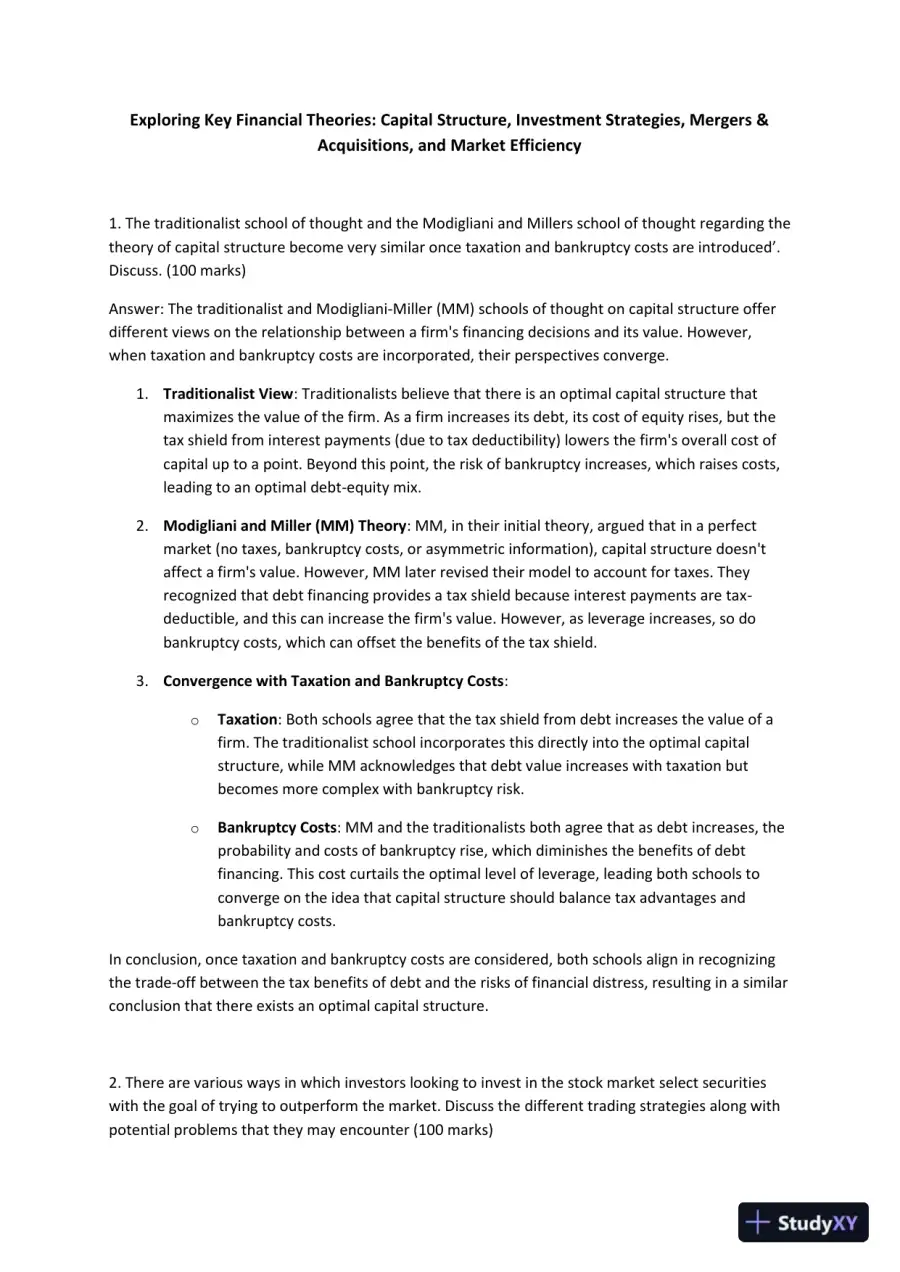 Exploring Key Financial Theories: Capital Structure, Investment Strategies, Mergers &Acquisitions, and Market Efficiency1. The traditionalist school of thought and the Modigliani and Millers school ofthought regarding thetheory of capitalstructure become very similar oncetaxation and bankruptcy costs are introduced’.Discuss.(100 marks)Answer:The traditionalist and Modigliani-Miller (MM) schools of thought on capital structure offerdifferent views on the relationship between a firm's financing decisions and its value. However,when taxation and bankruptcy costs are incorporated, their perspectives converge.1.Traditionalist View: Traditionalists believe that there is an optimal capital structure thatmaximizes the value of the firm. As a firm increases its debt, its cost of equity rises, but thetax shield from interest payments (due to tax deductibility) lowers the firm's overall cost ofcapital up to a point. Beyond this point, the risk of bankruptcy increases, which raises costs,leading to an optimal debt-equity mix.2.Modigliani and Miller (MM) Theory: MM, in their initial theory, argued that in a perfectmarket (no taxes, bankruptcy costs, or asymmetric information), capital structure doesn'taffect a firm's value. However, MM later revised their model to account for taxes. Theyrecognized that debt financing provides a tax shield because interest payments are tax-deductible, and this can increase the firm's value. However, as leverage increases, so dobankruptcy costs, which can offset the benefits of the tax shield.3.Convergence with Taxation and Bankruptcy Costs:oTaxation: Both schools agree that the tax shield from debt increases the value of afirm. The traditionalist school incorporates this directly into the optimal capitalstructure, while MM acknowledges that debt value increases with taxation butbecomes more complex with bankruptcy risk.oBankruptcy Costs: MM and the traditionalists both agree that as debt increases, theprobability and costs of bankruptcy rise, which diminishes the benefits of debtfinancing. This cost curtails the optimal level of leverage, leading both schools toconverge on the idea that capital structure should balance tax advantages andbankruptcy costs.In conclusion, once taxation and bankruptcy costs are considered, both schools align in recognizingthe trade-off between the tax benefits of debt and the risks of financial distress, resulting in a similarconclusion that there exists an optimal capital structure.2. There are various ways in which investors looking to invest in the stock marketselect securitieswith the goal of trying to outperform the market. Discuss thedifferent trading strategies along withpotential problems that they mayencounter(100 marks)
Page 2

Page 3
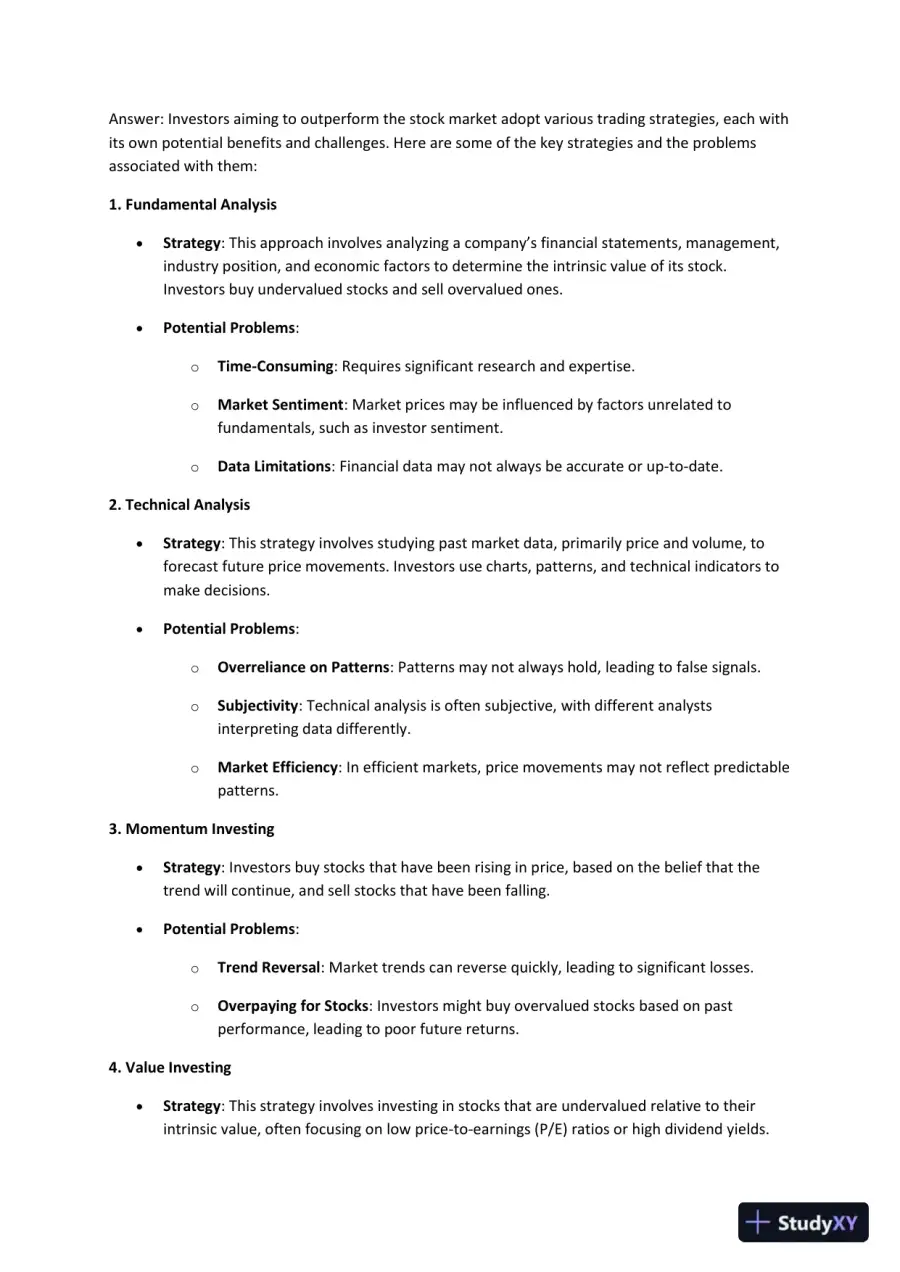 Answer:Investors aiming to outperform the stock market adopt various trading strategies, each withits own potential benefits and challenges. Here are some of the key strategies and the problemsassociated with them:1. Fundamental Analysis•Strategy: This approach involves analyzing acompany’s financial statements, management,industry position, and economic factors to determine the intrinsic value of its stock.Investors buy undervalued stocks and sell overvalued ones.•Potential Problems:oTime-Consuming: Requires significant research and expertise.oMarket Sentiment: Market prices may be influenced by factors unrelated tofundamentals, such as investor sentiment.oData Limitations: Financial data may not always be accurate or up-to-date.2. Technical Analysis•Strategy: This strategy involves studying past market data, primarily price and volume, toforecast future price movements. Investors use charts, patterns, and technical indicators tomake decisions.•Potential Problems:oOverreliance on Patterns: Patterns may not always hold,leading to false signals.oSubjectivity: Technical analysis is often subjective, with different analystsinterpreting data differently.oMarket Efficiency: In efficient markets, price movements may not reflect predictablepatterns.3. Momentum Investing•Strategy: Investors buy stocks that have been rising in price, based on the belief that thetrend will continue, and sell stocks that have been falling.•Potential Problems:oTrend Reversal: Market trends can reverse quickly, leading to significant losses.oOverpaying for Stocks: Investors might buy overvalued stocks based on pastperformance, leading to poor future returns.4. Value Investing•Strategy: This strategy involves investing in stocks that are undervalued relative to theirintrinsic value, often focusing on low price-to-earnings (P/E) ratios or high dividend yields.
Page 4
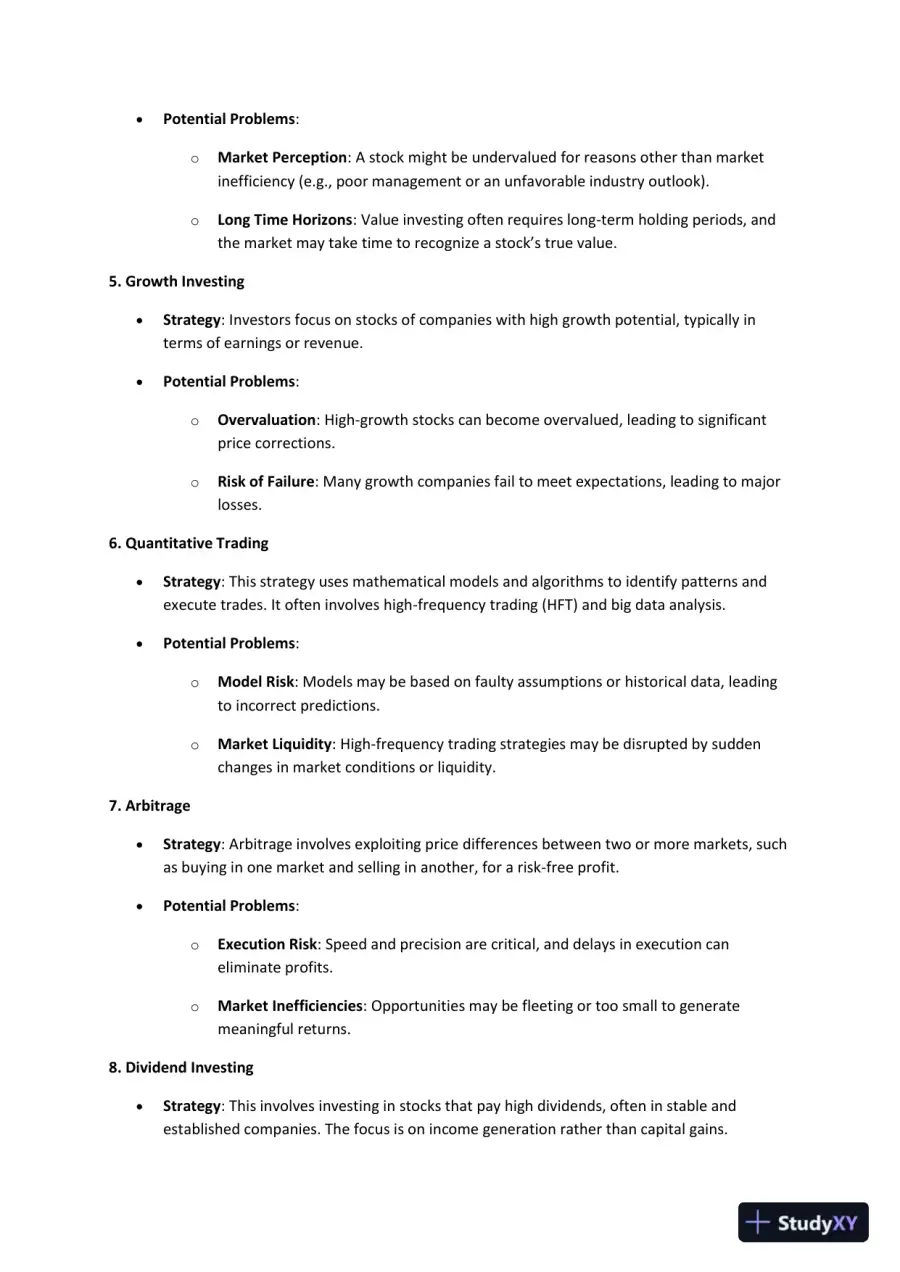 •Potential Problems:oMarket Perception: A stock might be undervalued for reasons other than marketinefficiency (e.g., poor management or an unfavorable industry outlook).oLong Time Horizons: Value investing often requires long-term holding periods, andthe market may take time to recognize a stock’s true value.5. Growth Investing•Strategy: Investors focus on stocks of companies with high growth potential, typically interms of earnings or revenue.•Potential Problems:oOvervaluation: High-growth stocks can become overvalued, leading to significantprice corrections.oRisk of Failure: Many growth companies fail to meet expectations, leading to majorlosses.6. Quantitative Trading•Strategy: This strategy uses mathematical models and algorithms to identify patterns andexecute trades. It often involves high-frequency trading (HFT) and big data analysis.•Potential Problems:oModel Risk: Models may be based on faulty assumptions orhistorical data, leadingto incorrect predictions.oMarket Liquidity: High-frequency trading strategies may be disrupted by suddenchanges in market conditions or liquidity.7. Arbitrage•Strategy: Arbitrage involves exploiting price differences between two or more markets, suchas buying in one market and selling in another, for a risk-free profit.•Potential Problems:oExecution Risk: Speed and precision are critical, and delays in execution caneliminate profits.oMarket Inefficiencies: Opportunities may be fleeting or too small to generatemeaningful returns.8. Dividend Investing•Strategy: This involves investing in stocks that pay high dividends, often in stable andestablished companies. The focus is on income generation rather than capital gains.
Page 5
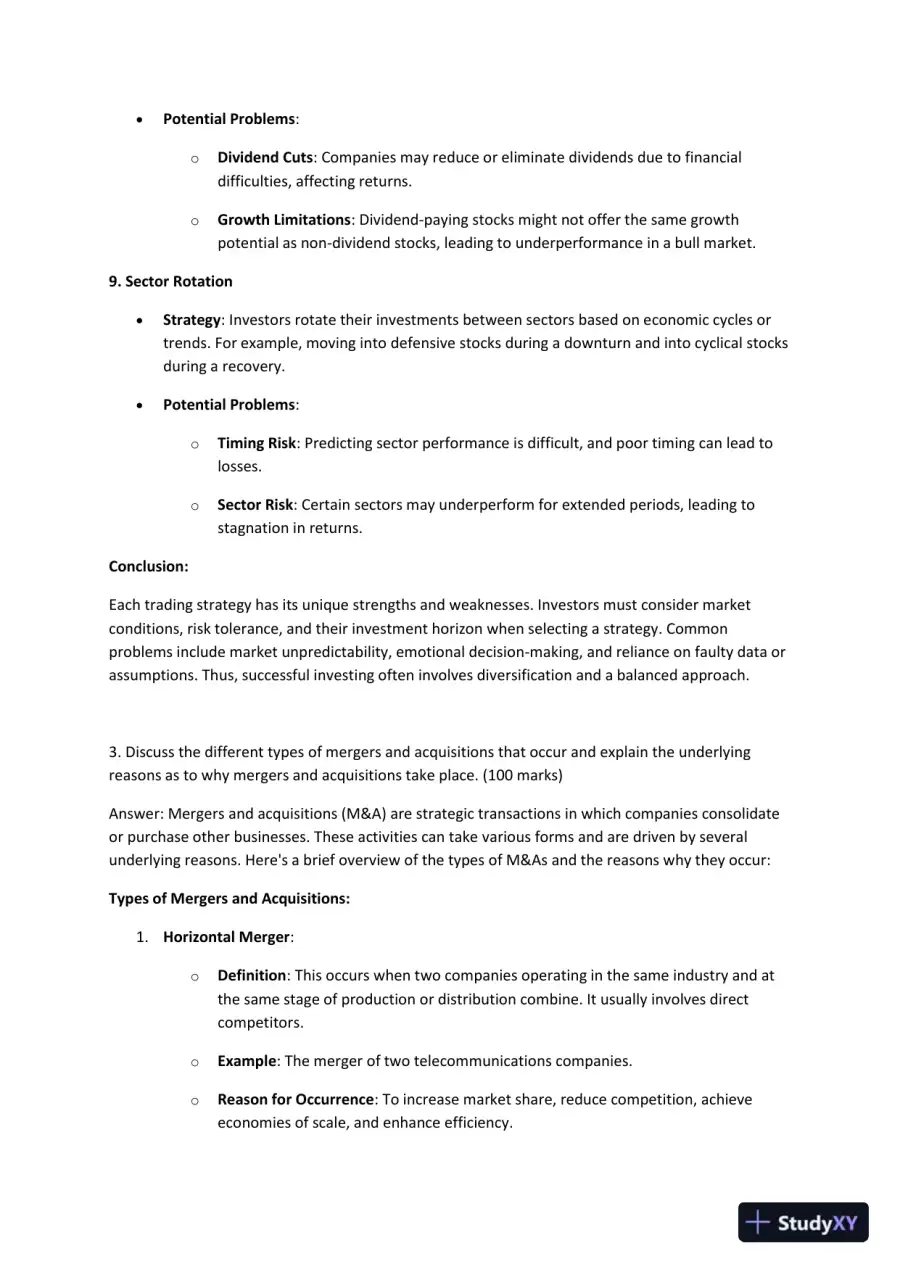 •Potential Problems:oDividend Cuts: Companies may reduce or eliminate dividends due to financialdifficulties, affecting returns.oGrowth Limitations: Dividend-paying stocks might not offer the same growthpotential as non-dividend stocks, leading to underperformance in a bull market.9. Sector Rotation•Strategy: Investors rotate their investments between sectors based on economic cycles ortrends. For example, moving into defensive stocks during a downturn and into cyclical stocksduring a recovery.•Potential Problems:oTiming Risk: Predicting sector performance is difficult, and poor timing can lead tolosses.oSector Risk: Certain sectors may underperform for extended periods, leading tostagnation in returns.Conclusion:Each trading strategy has its unique strengths and weaknesses. Investors must consider marketconditions, risk tolerance, and their investment horizon when selecting a strategy. Commonproblems include market unpredictability, emotional decision-making, and reliance on faulty data orassumptions. Thus, successful investing often involves diversification and a balanced approach.3. Discuss the different types of mergers and acquisitions that occur and explainthe underlyingreasons as to why mergers and acquisitions take place.(100 marks)Answer:Mergers and acquisitions (M&A) are strategic transactions in which companies consolidateor purchase other businesses. These activities can take various forms and are driven by severalunderlying reasons. Here's a brief overview of the types of M&As and the reasons why they occur:Types of Mergers and Acquisitions:1.Horizontal Merger:oDefinition: This occurs when two companies operating in the same industry and atthe same stage of production or distribution combine. It usually involves directcompetitors.oExample: The merger of two telecommunications companies.oReason for Occurrence: To increase market share, reduce competition, achieveeconomies of scale, and enhance efficiency.
Page 6
 2.Vertical Merger:oDefinition: A vertical merger occurs when a company acquires or merges withanother company that operates at a different level within the same industry supplychain. This can be either an upstream (supplier) or downstream (distributor) merger.oExample: A car manufacturer acquiring a parts supplier or a retailer merging with alogistics company.oReason for Occurrence: To control the supply chain, reduce costs, ensure a stablesupply of inputs, or improve distribution efficiency.3.Conglomerate Merger:oDefinition: This type of merger happens between companies that operate incompletely different industries or sectors. It’s essentially a diversification strategy.oExample: A technology company merging with a food production company.oReason for Occurrence: To diversify the risk by expanding into new industries ormarkets, reducing dependency on one sector, and creating new growthopportunities.4.Market Extension Merger:oDefinition: This occurs when two companies that sell the same products or servicesmerge, but in different markets or geographical regions.oExample: A company operating in North America merges with a company operatingin Europe, both selling the same product.oReason for Occurrence: To expand market reach, increase customer base, andenhance growth by entering new geographic or market segments.5.Product Extension Merger:oDefinition: This involves two companies merging to expand their product lines. Theytypically operate in the same market but offer different products that complementeach other.oExample: A company producing soft drinks merging with a company thatmanufactures snacks.oReason for Occurrence: To create a broader range of products for customers, cross-sell to existing clients, and gain access to complementary technology or resources.6.Reverse Merger:oDefinition: In a reverse merger, a private company acquires a publicly tradedcompany, enabling the private company to become publicly listed withoutundergoing an initial public offering (IPO).
Page 7
 oExample: A private tech startup merges with an inactive public shell company togain access to the stock market.oReason for Occurrence: To avoid the costs and time delays associated with atraditional IPO, gain public exposure, and increase market access.Reasons for Mergers and Acquisitions:1.Economies of Scale:oBy merging or acquiring anothercompany, firms can achieve cost efficienciesthrough larger production volumes, reduced overhead, and better utilization ofresources. This reduces the cost per unit of production and increases profitability.2.Synergies:oM&A can create synergies, wherethe combined value of the merged entitiesexceeds the sum of their individual values. This includes operational synergies, suchas shared technologies, skills, or resources, and financial synergies, such as improvedcash flow management.3.Market Share Expansion:oCompanies pursue M&As to increase their market share, reduce competition, andachieve greater influence over pricing and market dynamics. Larger market shareoften translates to stronger bargaining power with suppliers and customers.4.Diversification:oFirms may merge or acquire other businesses to diversify their product offerings,markets, or geographic presence, thereby reducing dependence on a single sourceof revenue. Diversification helps mitigate risks in volatile industries or markets.5.Access to New Technologies or Expertise:oCompanies may acquire firms that have advanced technology or specializedknowledge, enabling them to innovate, improve their products or services, and staycompetitive in the market. Acquiring intellectual property or talent can also be amajor driver of M&A activity.6.Financial Motives:oM&As can also be driven by financial reasons, such as tax benefits, access to cheaperfinancing, or better capital structure. For example, a highly profitable company mayacquire a loss-making company to offset its taxable income with the acquiredcompany's losses (tax loss carryforward).7.Global Expansion:
Page 8
 oCompanies seeking international expansion often engage in M&As to enter foreignmarkets quickly. Acquiring a local company provides immediate access todistribution channels, established brand presence, and local expertise, which canhelp navigate regulatory and cultural barriers.8.Strategic Repositioning:oFirms may merge or acquire others as part of a strategy to reposition themselves inthe market. This could involve moving into a more profitable industry, changing thecompany’s product mix, or responding to competitive threats by strengthening theirposition.9.Defensive Strategy:oM&As can be used as a defense against hostile takeovers. A company may acquireanother firm to block a competitor from gaining a strong position in the market or toprevent a takeover attempt by becoming larger and more difficult to acquire.10.Tax Benefits:oSometimes, companies pursue M&A to gain tax advantages, such as utilizing tax losscarryforwards from the acquired company or obtaining access to tax incentives indifferent regions or sectors.Conclusion:Mergers and acquisitions are driven by a variety of strategic, financial, and operational motivations.While M&A transactions offer opportunities for growth, diversification, and enhanced competitiveadvantage, they also come with challenges such as integration difficulties, cultural clashes, andregulatory scrutiny. The success of a merger or acquisition largely depends on careful planning,execution, and alignment of strategic goals between the involved companies.1. In order for a stock market to fulfil its role as an efficient allocator of resources itis essential thatit is efficient. Discuss.Answer:For a stock market to fulfill its role as an efficient allocator of resources, it must functionefficiently. This efficiency ensures that capital is directed to its most productive uses, facilitatingeconomic growth and optimal resource allocation. Here's a discussion on how stock marketefficiency contributes to this role:1. Efficient Price Discovery:•Role in Resource Allocation: An efficient stock market enables accurate price discovery,where stock prices reflect all available information about acompany’s prospects, financialhealth, and market conditions. When prices are accurate, investors can make informeddecisions, directing capital to companies with the best growth potential or value.
Page 9
 •Efficiency: In an efficient market, stock prices adjust quickly to new information, ensuringthat capital is allocated to companies that will use it most productively. Investors cancompare companies based on their market value and prospects, thus directing resourcestowards firms with the highest return on investment.2. Liquidity and Market Participation:•Role in Resource Allocation: For an economy to efficiently allocate resources, there must bea liquid market where investors can easily buy and sell securities. This liquidity makes iteasier for businesses to raise capital and for investors to exit their investments when needed.•Efficiency: Efficient markets provide investors with the flexibility to enter and exit positionsquickly, encouraging more participation. When investors can liquidate their holdings withoutsignificant delays or costs, capital flows to where it is most needed, enhancing economicproductivity.3. Risk Assessment and Diversification:•Role in Resource Allocation: An efficient market enables investors to assess the risk ofdifferent investments accurately. When risks are properly priced, it allows investors to makemore informed choices about where to allocate their capital based on their risk tolerance.•Efficiency: In an efficient market, diverse investment options are available, facilitating thespreading of risk. Investors can diversify their portfolios to reduce exposure to risk, leadingto a more stable and resilient allocation of resources across the economy. Companies withdifferent risk profiles can attract different types of investors, ensuring capital is directed toprojects based on expected returns and risk levels.4. Encouraging Innovation and Competition:•Role in Resource Allocation: An efficient stock market ensures that the companies which aremost innovative or have the most competitive potential receive sufficient funding. Investorsare more likely to invest in firms that promise the best returns, which often includes firmsthat innovate or outperform competitors.•Efficiency: Capital flowing to innovative firms ensures that they can continue developingnew products, technologies, or services that contribute to economic growth. When the stockmarket is efficient, competition is encouraged, pushing companies to innovate in order toattract investment.5. Transparency and Information Flow:•Role in Resource Allocation: An efficient stock market provides transparency and ensuresthat all participants have access to the same information. This level playing field enables fairdecision-making and helps allocate resources based on accurate data about a company'sperformance and prospects.•Efficiency: When information is freely available and accurate, capital is directed towardsfirms with strong fundamentals and away from poorly managed or underperforming ones.
Page 10
 This improves the overall productivity of the economy by ensuring that resources areallocated to firms with sound management and growth prospects.6. Minimizing Information Asymmetry:•Role in Resource Allocation: Efficient stock markets reduce information asymmetry, whereone party has more or better information than another. In inefficient markets, companieswith less information may struggle to attract capital, while those with insider informationmay benefit unfairly.•Efficiency: By reducing information asymmetry, an efficient stock market ensures thatcapital flows to firms based on merit rather than access to privileged information. This helpsmaintain fairness in the allocation of resources and ensures that investments are made incompanies with real potential, not just those with inside knowledge.7. Market Efficiency and the Cost of Capital:•Role in Resource Allocation: An efficient market helps companies to raise capital at a faircost. When the market is efficient, the cost of capital reflects the true risk and returnexpectations of investors. Companies that are better managed or more profitable will facelower costs of capital, enabling them to invest in projects that enhance productivity andgrowth.•Efficiency: If a stock market is efficient, firms can raise capital at lower interest rates or morefavorable terms, increasing their ability to fund new projects, expand, and create jobs.Capital allocation thus becomes more efficient, supporting growth in the economy.Conclusion:In summary, an efficient stock market plays a critical role in the economy by ensuring the properallocation of resources. It provides accurate price signals, liquidity, access to information, and amechanism for assessing risk, all of which are essential for directing capital to the most productivesectors and companies. When the market functions efficiently, capital is allocated based on merit,innovation, and performance, leading to economic growth, competitive markets, and a moreefficient economy overall. An inefficient market, on the other hand, distorts resource allocation,leading to mispriced risks, reduced liquidity, and potentially less productive investment decisions.2. Companies should gear up as much as possible in order to benefit from theadvantages of cheaperdebt therebymaximising shareholder wealth. Discuss.Answer:The idea that companies should "gear up" or increase their leverage (debt) as much aspossible to benefit from cheaper debt and maximize shareholder wealth is rooted in the trade-offtheory of capital structure. This theory suggests that the optimal capital structure involves balancingthe benefits of debt (such as the tax shield) with the costs of debt (such as bankruptcy risk). Here’s adiscussion on this idea:Benefits of High Leverage (Gearing Up)
Page 11
 1.Tax Shield:oBenefit: Debt financing provides a tax advantage because interest payments on debtare tax-deductible. This reduces the company’s taxable income, which can lead to alower overall tax burden. The savings from these tax shields can increase thecompany’s cash flow, potentially leading to higher profitability and, in turn, greatershareholder wealth.oMaximizing Shareholder Wealth: As debt increases, the company can reduce its taxliabilities, which boosts net income and enhances returns toshareholders,particularly in a high-tax environment.2.Lower Cost of Capital:oBenefit: Debt is generally cheaper than equity because interest payments are fixedand, in many cases, lower than the expected return on equity. As a result, a higherproportion of debt in the capital structure can reduce the company’s weightedaverage cost of capital (WACC), which may enhance the company’s valuation.oMaximizing Shareholder Wealth: A lower WACC increases the company’s valuation,which can lead to higher stock prices and greater wealth for shareholders.3.Increased Return on Equity (ROE):oBenefit: High leverage can amplify returns to equity holders, particularly when thecompany generates returns on its investments that exceed the cost of debt. This isknown as financial leverage. By using debt, companies can boost their returns onequity, benefiting shareholders.oMaximizing Shareholder Wealth: If the return on assets (ROA) exceeds the interestrate on debt, leverage amplifies the profitability for equity holders, leading to higherdividends and share price appreciation.Risks and Downsides of High Leverage (Gearing Up)While the benefits are clear, there are significant risks associated with excessive leverage that cannegate the potential advantages:1.Bankruptcy Risk:oRisk: High leverage increases the risk of financial distress and bankruptcy. If acompany cannot meet its debt obligations (interest payments or principalrepayments), it may face bankruptcy, which could lead to loss of shareholder value,asset liquidation, or even dissolution of the company.oImpact on Shareholder Wealth: The threat of bankruptcy or liquidation canundermine shareholder wealth. In extreme cases, shareholders might lose theirentire investment if the company is forced into bankruptcy.2.Increased Financial Risk:
Page 12
 oRisk: High debt levels increase the company's financial risk. The need to meet fixeddebt obligations (interest payments) regardless of business performance createspressure, especially during periods of economic downturns or operational difficulties.This can reduce the company’s ability to invest in growth opportunities or weathereconomic volatility.oImpact on Shareholder Wealth: If the company is unable to generate sufficientreturns to service its debt, it could lead to decreased profitability, lower stock prices,and potentially dividend cuts, eroding shareholder wealth.3.Higher Cost of Debt in the Future:oRisk: If a company becomes highly leveraged, lenders may view it as a higher risk,which could lead to higher interest rates on future debt issuances. This increases thecompany’s future debt servicing costs and can squeeze profit margins, making itharder to deliver returns to shareholders.oImpact on Shareholder Wealth: The rising cost of debt could lead to lowerprofitability, slower growth, and reduced cash flow, which can harm shareholdervalue in the long run.4.Reduced Flexibility:oRisk: A highly leveraged company may face restrictions on its operational andfinancial flexibility. Debt covenants may impose limitations onbusiness activities,such as taking on more debt, making investments, or paying dividends. This canreduce the company's ability to capitalize on growth opportunities.oImpact on Shareholder Wealth: The company's capacity to reinvest in the business,pursue new projects, or return value to shareholders could be constrained,potentially leading to lower growth and diminished shareholder returns.Optimal Capital Structure and Balance:•Trade-off Theory: The trade-off theory suggests that there is an optimal level of leveragethat balances the tax benefits of debt with the costs of financial distress. Companies shouldnot aim to maximize debt to the point of risking bankruptcy or excessive financial strain.Instead, they should find a balance where the marginal benefit of the tax shield equals themarginal cost of bankruptcy.•Agency Theory: This theory suggests that shareholders and managers may have differentincentives, especially in highly leveraged companies. Managers may take on excessive risk tobenefit from tax shields or higher returns, which may not always align with shareholderinterests. This potential conflict can undermine the goal of maximizing shareholder wealth.Conclusion:While increasing leverage (gearing up) can provide significant benefits, such as tax shields, lowercapital costs, and higher returns on equity, it also introduces substantial risks, including bankruptcy,
Page 13
 financial distress, and reduced operational flexibility. Companies should not simply "gear up" asmuch as possible but instead should aim for an optimal capital structure that balances theadvantages of debt with the associated risks. The key to maximizing shareholder wealth lies infinding the right level of leverage that maximizes the firm’s value without exposing it to excessivefinancial risk.3. Risk management is essential for the success of any company. Discuss.Answer:Risk management is a critical aspect of a company’s strategy and overall success. It involvesidentifying, assessing, and prioritizing risksfollowed by the application of resources to minimize ormitigate those risks. A well-executed risk management strategy ensures that a company cannavigate uncertainties, capitalize on opportunities, and maintain its long-term stability and growth.Here’s a detailed discussion on why risk management is essential for the success of any company:1. Identifying and Mitigating Potential Threats•Importance: Every business faces internal and external risks that can potentially harm itsoperations. These could range from financial risks (e.g., currency fluctuations, interest rates),operational risks (e.g., supply chain disruptions), market risks (e.g., competitive pressures),and compliance risks (e.g., regulatory changes).•How It Supports Success: By identifying these risks early, a company can put in placemitigation strategies, reducing the likelihood of negative outcomes. For example, a companycan use hedging strategies to protect against currency fluctuations, or diversify its suppliersto mitigate supply chain risks.•Outcome: This proactive approach minimizes the impact of unexpected events and allowsthe company to continue its operations without major disruptions, thereby safeguarding itsprofitability and sustainability.2. Enhancing Decision-Making and Strategic Planning•Importance: Effective risk management provides decision-makers with critical informationabout potential risks, allowing them to make better-informed decisions. It helps companiesunderstand the possible consequences of their actions, whether in terms of expansion, newproduct launches, or entering new markets.•How It Supports Success: With a solid understanding of the risks, management can prioritizeresources more efficiently, ensuring they are not overexposed to risky ventures that mightnot align with the company’s risk appetite. It helps in setting realistic goals, determining risktolerance, and pursuing strategies that balance risk and reward.•Outcome: Sound decision-making and strategic planning ensure that the company’sresources are used effectively, reducing the likelihood of costly mistakes and enhancing thecompany’s chances for growth and profitability.3. Protecting Company Assets and Reputation
28 more pages in the full document
Unlock it once and it stays in your library, ready to chat with or turn into flashcards.
Unlock the full documentMore Finance study materials
See all Textbook Guides
Solution Manual For Investments, 12th Edition
Finance
314 pages161downloadsFeb 2025 Exam Guides
Test Bank for Principles of Managerial Finance, 8th Edition
Finance
851 pages158downloadsFeb 2025 Textbook Guides
Solution Manual for Financial Institutions Management: A Risk Management Approach, 8th Edition
Finance
486 pages154downloadsFeb 2025 Exam Guides
Test Bank for Principles of Managerial Finance, Arab World Edition
Finance
373 pages148downloadsFeb 2025 Textbook Guides
Multinational Financial Management, Study Guide, 6th Edition Solution Manual
Finance
278 pages146downloadsFeb 2025 Textbook Guides
Financial Markets and Institutions, 7th Edition Solution Manual
Finance
194 pages136downloadsFeb 2025 Certification Guides
Wiley Finra Series 3 Exam Review (2019)
Finance
253 pages131downloadsFeb 2025 Exam Guides
Test Bank For Essentials of Investments, 8th Edition
Finance
368 pages130downloadsFeb 2025
Study this document with CramX
Once it is in your library, every tool can work from it.