
Solved Assignments
Financial Analysis and Strategic Memo for Peyton Approved: A Six-Month Review and Future Growth Proposal
- Finance
- 11 pages
- Shared May 2025
Financial analysis and strategic memo.
Preview · 4 of 11 pages
100%
Page 1
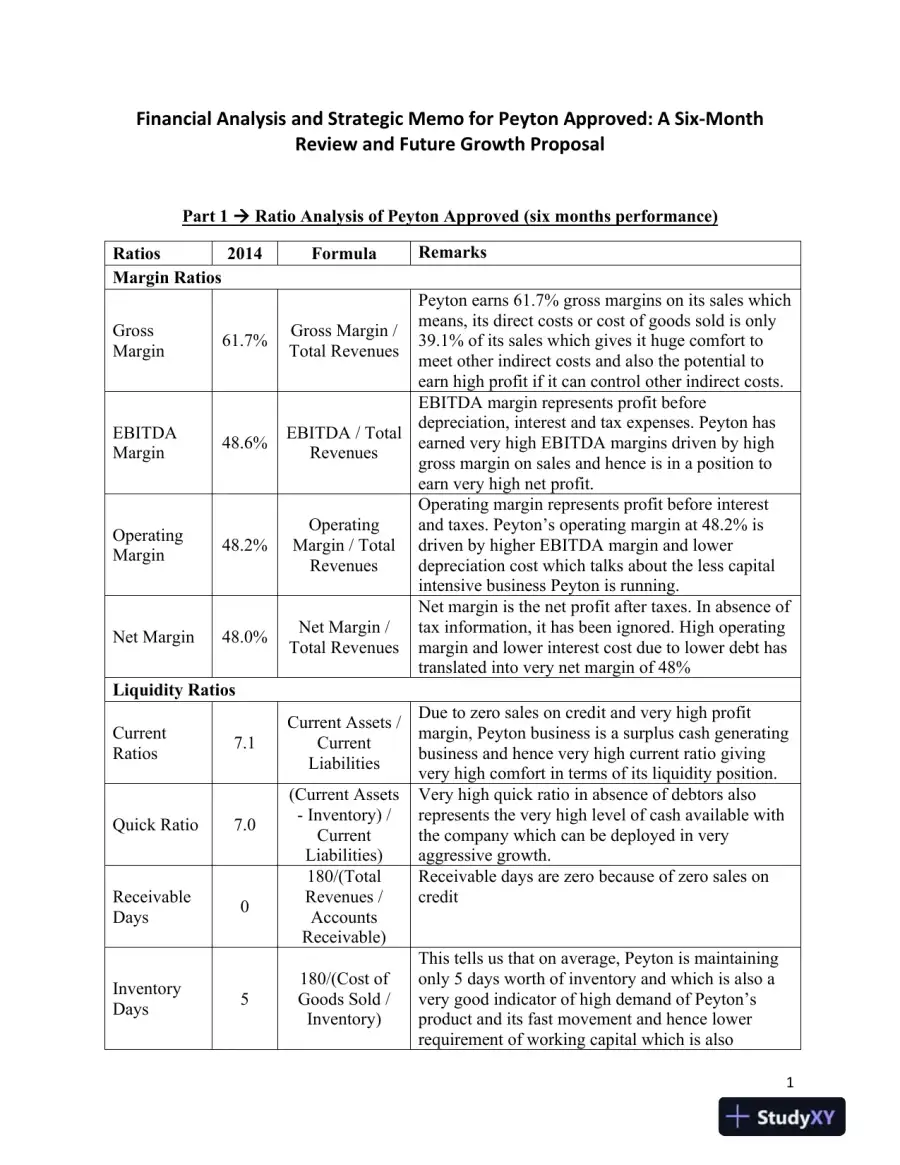 1Financial Analysis and Strategic Memo for Peyton Approved: A Six-MonthReview and Future Growth ProposalPart 1Ratio Analysis of Peyton Approved(six months performance)Ratios2014FormulaRemarksMargin RatiosGrossMargin61.7%Gross Margin /Total RevenuesPeyton earns 61.7% gross margins on its sales whichmeans, its direct costs or cost of goods sold is only39.1% of its sales which gives it huge comfort tomeet other indirect costs and also the potential toearn high profit if it can control other indirect costs.EBITDAMargin48.6%EBITDA / TotalRevenuesEBITDA margin represents profit beforedepreciation, interest and tax expenses. Peyton hasearned very high EBITDA margins driven by highgross margin on sales and hence is in aposition toearn very high net profit.OperatingMargin48.2%OperatingMargin / TotalRevenuesOperating margin represents profit before interestand taxes. Peyton’s operating margin at 48.2% isdriven by higher EBITDA margin and lowerdepreciation cost which talks about the less capitalintensive business Peyton is running.Net Margin48.0%Net Margin /Total RevenuesNet margin is the net profit after taxes. In absence oftax information, it has been ignored. High operatingmargin and lower interest cost due to lower debt hastranslated into very net margin of 48%Liquidity RatiosCurrentRatios7.1Current Assets /CurrentLiabilitiesDue to zero sales on credit and very high profitmargin, Peyton business is a surplus cash generatingbusiness and hence veryhighcurrent ratio givingvery high comfort in terms of its liquidity position.Quick Ratio7.0(Current Assets-Inventory) /CurrentLiabilities)Very high quick ratio in absence of debtors alsorepresents the very high level of cash available withthe company which can be deployed in veryaggressive growth.ReceivableDays0180/(TotalRevenues /AccountsReceivable)Receivable days are zero because of zero sales oncreditInventoryDays5180/(Cost ofGoods Sold /Inventory)This tells us that on average, Peyton is maintainingonly5days worthof inventory and which is also avery good indicator of high demand of Peyton’sproduct and its fast movement and hence lowerrequirement of working capital which is also
Page 2

Page 3
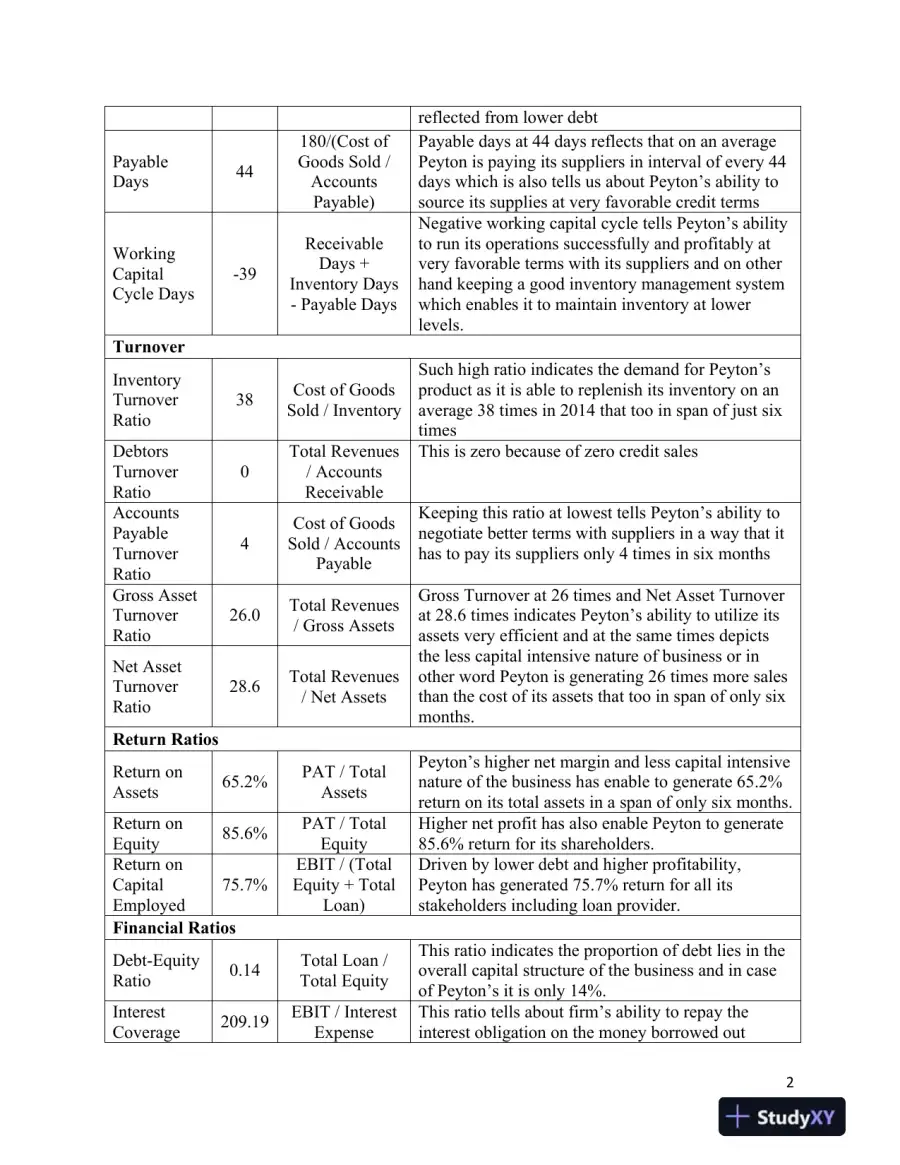 2reflected from lower debtPayableDays44180/(Cost ofGoods Sold /AccountsPayable)Payable days at44days reflects that on an averagePeyton is paying its suppliers in intervalof every 44days which is also tells us about Peyton’s ability tosource its supplies at very favorable credit termsWorkingCapitalCycle Days-39ReceivableDays +Inventory Days-Payable DaysNegative working capital cycle tells Peyton’s abilityto run its operations successfully and profitably atvery favorable terms with its suppliers and on otherhand keeping a good inventory management systemwhich enables it to maintain inventory at lowerlevels.TurnoverInventoryTurnoverRatio38Cost of GoodsSold / InventorySuch high ratio indicates the demand for Peyton’sproduct as it is able to replenish its inventory on anaverage 38 times in 2014 that too in span of just sixtimesDebtorsTurnoverRatio0Total Revenues/ AccountsReceivableThis is zero because of zero credit salesAccountsPayableTurnoverRatio4Cost of GoodsSold / AccountsPayableKeeping thisratio at lowest tells Peyton’s ability tonegotiate better terms with suppliers in a way that ithas to pay its suppliers only 4 times in six monthsGross AssetTurnoverRatio26.0Total Revenues/ Gross AssetsGross Turnover at 26 times and NetAsset Turnoverat 28.6 times indicates Peyton’s ability to utilize itsassets very efficient and at the same times depictsthe less capital intensive nature of business or inother word Peyton is generating 26 times more salesthan the cost of its assets that too in span of only sixmonths.Net AssetTurnoverRatio28.6Total Revenues/ Net AssetsReturn RatiosReturn onAssets65.2%PAT / TotalAssetsPeyton’s higher net margin and less capital intensivenature of the business has enable togenerate 65.2%return on its total assets in a span of only six months.Return onEquity85.6%PAT / TotalEquityHigher net profit has also enable Peyton to generate85.6% return for its shareholders.Return onCapitalEmployed75.7%EBIT / (TotalEquity + TotalLoan)Driven by lower debt and higher profitability,Peyton has generated 75.7% return for all itsstakeholders including loan provider.Financial RatiosDebt-EquityRatio0.14Total Loan /Total EquityThis ratio indicates theproportion of debt lies in theoverall capital structure of the business and in caseof Peyton’s it is only 14%.InterestCoverage209.19EBIT / InterestExpenseThis ratio tells about firm’s ability to repay theinterest obligation on the money borrowed out
Page 4
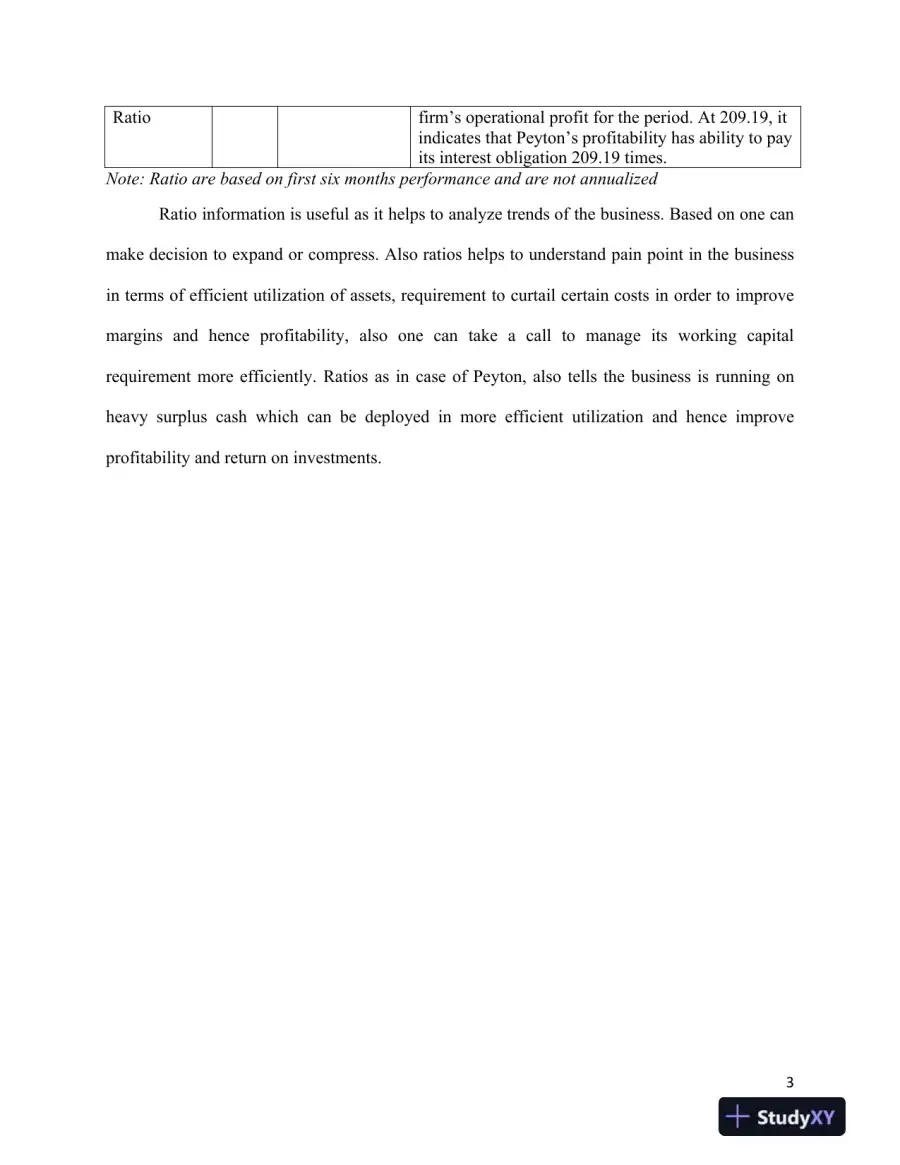 3Ratiofirm’s operational profit for the period. At 209.19, itindicates that Peyton’s profitability has ability to payits interest obligation 209.19 times.Note:Ratio are based on first six months performance and are not annualizedRatio information is useful as it helps to analyze trends of the business. Based on one canmake decision to expand or compress. Also ratios helps to understand pain point in the businessin termsofefficient utilization of assets, requirement to curtail certain costs in order to improvemargins and hence profitability, also one can take a call to manage its working capitalrequirement more efficiently. Ratios as in case of Peyton, also tells the business is running onheavy surplus cash which can be deployed in more efficient utilization and hence improveprofitability and return on investments.
7 more pages in the full document
Unlock it once and it stays in your library, ready to chat with or turn into flashcards.
Unlock the full documentMore Finance study materials
See all Textbook Guides
Solution Manual For Investments, 12th Edition
Finance
314 pages161downloadsFeb 2025 Exam Guides
Test Bank for Principles of Managerial Finance, 8th Edition
Finance
851 pages158downloadsFeb 2025 Textbook Guides
Solution Manual for Financial Institutions Management: A Risk Management Approach, 8th Edition
Finance
486 pages154downloadsFeb 2025 Exam Guides
Test Bank for Principles of Managerial Finance, Arab World Edition
Finance
373 pages148downloadsFeb 2025 Textbook Guides
Multinational Financial Management, Study Guide, 6th Edition Solution Manual
Finance
278 pages146downloadsFeb 2025 Textbook Guides
Financial Markets and Institutions, 7th Edition Solution Manual
Finance
194 pages136downloadsFeb 2025 Certification Guides
Wiley Finra Series 3 Exam Review (2019)
Finance
253 pages131downloadsFeb 2025 Exam Guides
Test Bank For Essentials of Investments, 8th Edition
Finance
368 pages130downloadsFeb 2025
Study this document with CramX
Once it is in your library, every tool can work from it.