
Solved Assignments
Financial Forecasting and Pro Forma Analysis
- Finance
- 9 pages
- Shared May 2025
A detailed study of financial forecasting, pro forma analysis, and corporate fund management.
Preview · 3 of 9 pages
100%
Page 1
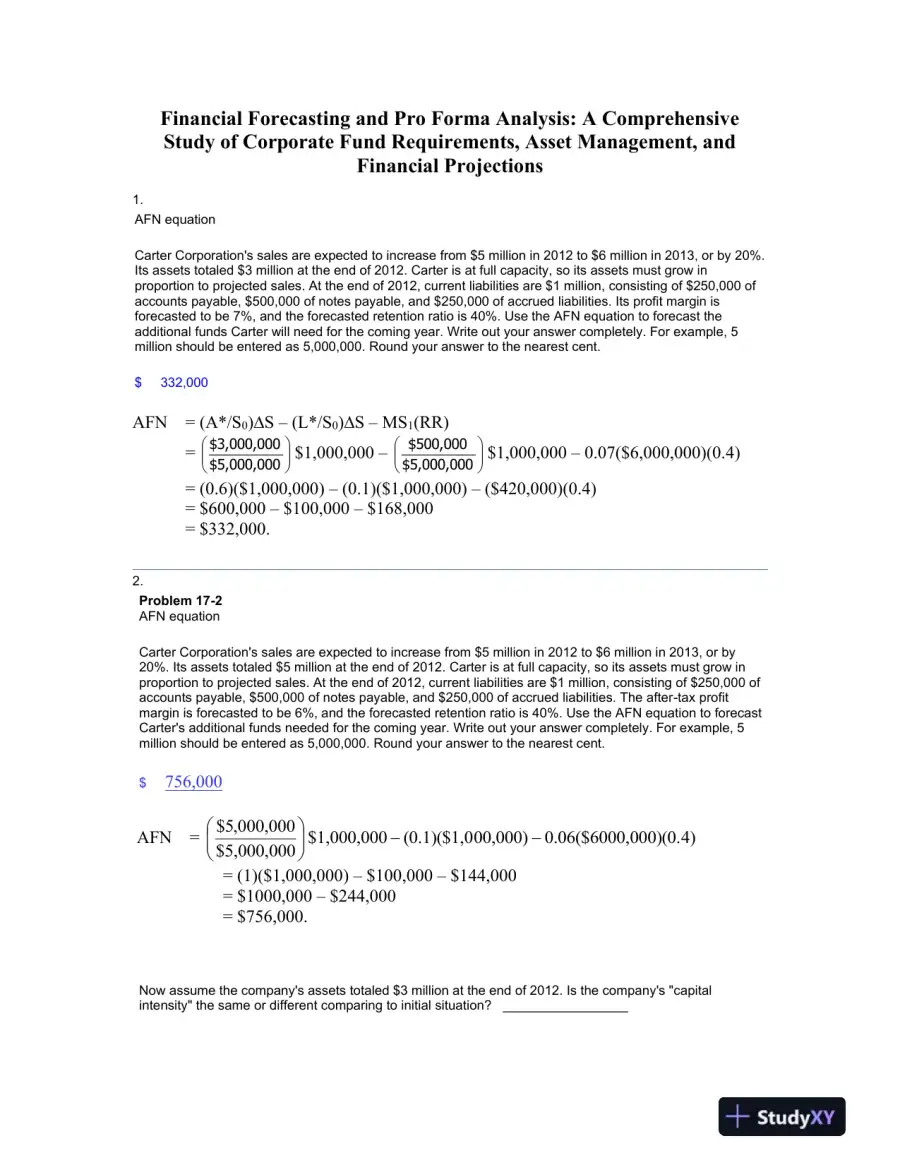 Financial Forecasting and Pro Forma Analysis: A ComprehensiveStudy of Corporate Fund Requirements, Asset Management, andFinancial Projections1.AFN equationCarter Corporation's sales are expected to increase from $5 million in 2012 to $6 million in 2013, or by 20%.Its assets totaled $3 million at the end of 2012. Carter is at full capacity, so its assets must grow inproportion to projected sales. At the end of 2012, current liabilities are $1 million, consisting of $250,000 ofaccounts payable, $500,000 of notes payable, and $250,000 of accrued liabilities. Its profit margin isforecasted to be 7%, and the forecasted retention ratio is 40%. Use the AFN equation to forecast theadditional funds Carter will need for the coming year. Write out your answer completely. For example, 5million should be entered as 5,000,000. Round your answer to the nearest cent.$332,000AFN= (A*/S0)S–(L*/S0)S–MS1(RR)=$5,000,000$3,000,000$1,000,000–$5,000,000$500,000$1,000,000–0.07($6,000,000)(0.4)= (0.6)($1,000,000)–(0.1)($1,000,000)–($420,000)(0.4)= $600,000–$100,000–$168,000= $332,000.2.Problem 17-2AFN equationCarter Corporation's sales are expected to increase from $5 million in 2012 to $6 million in 2013, or by20%. Its assets totaled $5 million at the end of 2012. Carter is at full capacity, so its assets must grow inproportion to projected sales. At the end of 2012, current liabilities are $1 million, consisting of $250,000 ofaccounts payable, $500,000 of notes payable, and $250,000 of accrued liabilities. The after-tax profitmargin is forecasted to be 6%, and the forecasted retention ratio is 40%. Use the AFN equation to forecastCarter's additional funds needed for the coming year. Write out your answer completely. For example, 5million should be entered as 5,000,000. Round your answer to the nearest cent.$756,000AFN=)40,000)(0.006($06.000,000)(0.1)($1,0$1,000,000$5,000,000,000,0005$−−= (1)($1,000,000)–$100,000–$144,000= $1000,000–$244,000= $756,000.Now assume the company's assets totaled $3 million at the end of 2012. Is the company's "capitalintensity" the same or different comparing to initial situation?_________________
Page 2

Page 3
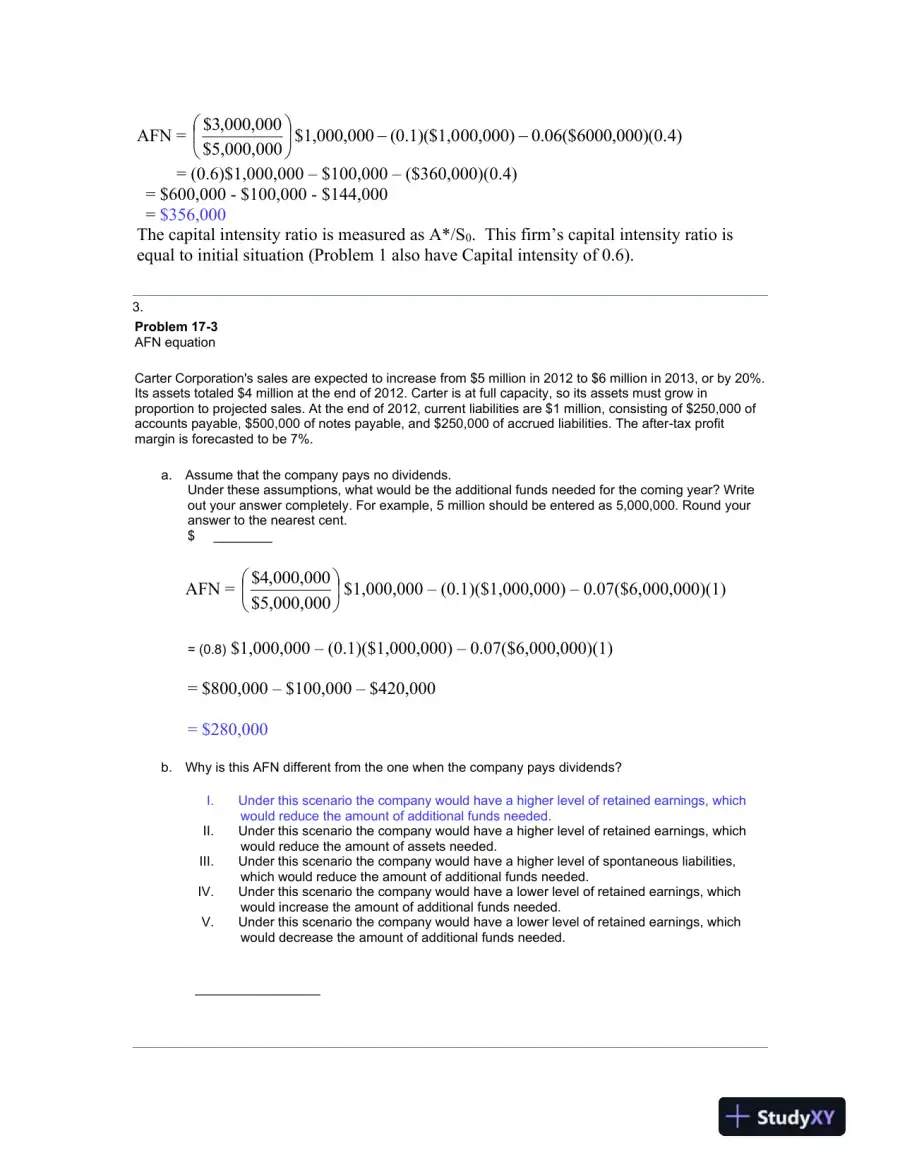 AFN =)4,000)(0.0006($06.000,000)(0.1)($1,0$1,000,000$5,000,000,000,0003$−−= (0.6)$1,000,000–$100,000–($360,000)(0.4)= $600,000-$100,000-$144,000=$356,000The capital intensity ratio is measured as A*/S0. This firm’s capital intensity ratio isequalto initial situation(Problem 1 also have Capital intensityof 0.6).3.Problem 17-3AFN equationCarter Corporation's sales are expected to increase from $5 million in 2012 to $6 million in 2013, or by 20%.Its assets totaled $4 million at the end of 2012. Carter is at full capacity, so its assets must grow inproportion to projected sales. At the end of 2012, current liabilities are $1 million, consisting of $250,000 ofaccounts payable, $500,000 of notes payable, and $250,000 of accrued liabilities. The after-tax profitmargin is forecasted to be 7%.a.Assume that the company pays no dividends.Under these assumptions, what would be the additional funds needed for the coming year? Writeout your answer completely. For example, 5 million should be entered as 5,000,000. Round youranswer to the nearest cent.$________AFN=$5,000,000,000,0004$$1,000,000–(0.1)($1,000,000)–0.07($6,000,000)(1)= (0.8)$1,000,000–(0.1)($1,000,000)–0.07($6,000,000)(1)=$800,000–$100,000–$420,000= $280,000b.Why is this AFN different from the one when the company pays dividends?I.Under this scenario the company would have a higher level of retained earnings, whichwould reduce the amount of additional funds needed.II.Under this scenario the company would have a higher level of retained earnings, whichwould reduce the amount of assets needed.III.Under this scenario the company would have a higher level of spontaneous liabilities,which would reduce the amount of additional funds needed.IV.Under this scenario the company would have a lower level of retained earnings, whichwould increase the amount of additional funds needed.V.Under this scenario the company would have a lower level of retained earnings, whichwould decrease the amount of additional funds needed._________________
6 more pages in the full document
Unlock it once and it stays in your library, ready to chat with or turn into flashcards.
Unlock the full documentMore Finance study materials
See all Textbook Guides
Solution Manual For Investments, 12th Edition
Finance
314 pages161downloadsFeb 2025 Exam Guides
Test Bank for Principles of Managerial Finance, 8th Edition
Finance
851 pages158downloadsFeb 2025 Textbook Guides
Solution Manual for Financial Institutions Management: A Risk Management Approach, 8th Edition
Finance
486 pages154downloadsFeb 2025 Exam Guides
Test Bank for Principles of Managerial Finance, Arab World Edition
Finance
373 pages148downloadsFeb 2025 Textbook Guides
Multinational Financial Management, Study Guide, 6th Edition Solution Manual
Finance
278 pages146downloadsFeb 2025 Textbook Guides
Financial Markets and Institutions, 7th Edition Solution Manual
Finance
194 pages136downloadsFeb 2025 Certification Guides
Wiley Finra Series 3 Exam Review (2019)
Finance
253 pages131downloadsFeb 2025 Exam Guides
Test Bank For Essentials of Investments, 8th Edition
Finance
368 pages130downloadsFeb 2025
Study this document with CramX
Once it is in your library, every tool can work from it.