
Solved Assignments
Financial Management and Investment Analysis: Concepts, Calculations, and Evaluations
- Finance
- 8 pages
- Shared May 2025
An assignment on financial management and investment evaluation.
Preview · 3 of 8 pages
100%
Page 1
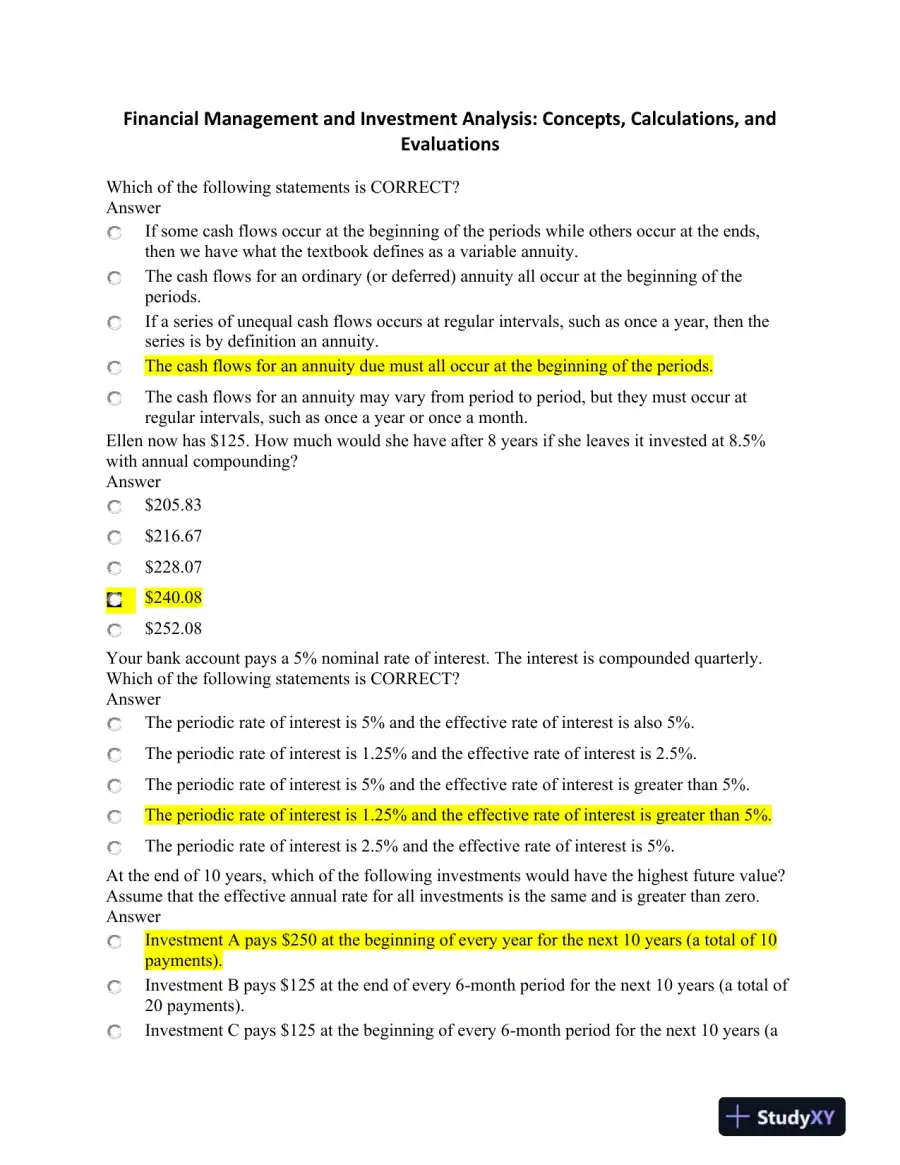 Financial Management and Investment Analysis: Concepts, Calculations, andEvaluationsWhich of the following statements is CORRECT?AnswerIf some cash flows occur at the beginning of the periods while others occur at the ends,then we have whatthe textbook defines as a variable annuity.The cash flows for an ordinary (or deferred) annuity all occur at the beginning of theperiods.If a series of unequal cash flows occurs at regular intervals, such as once a year, then theseries is by definition an annuity.The cash flows for an annuity due must all occur at the beginning of the periods.The cash flows for an annuity may vary from period to period, but they must occur atregular intervals, such as once a year or once amonth.Ellen now has $125. How much would she have after 8 years if she leaves it invested at 8.5%with annual compounding?Answer$205.83$216.67$228.07$240.08$252.08Your bank account pays a 5% nominal rate of interest. Theinterest is compounded quarterly.Which of the following statements is CORRECT?AnswerThe periodic rate of interest is 5% and the effective rate of interest is also 5%.The periodic rate of interest is 1.25% and the effective rate ofinterest is 2.5%.The periodic rate of interest is 5% and the effective rate of interest is greater than 5%.The periodic rate of interest is 1.25% and the effective rate of interest is greater than 5%.The periodic rate of interest is 2.5%and the effective rate of interest is 5%.At the end of 10 years, which of the following investments would have the highest future value?Assume that the effective annual rate for all investments is the same and is greater than zero.AnswerInvestment A pays $250 at the beginning of every year for the next 10 years (a total of 10payments).Investment B pays $125 at the end of every 6-month period for the next 10 years (a total of20 payments).Investment C pays $125 at the beginning of every 6-month period for the next 10 years (a
Page 2

Page 3
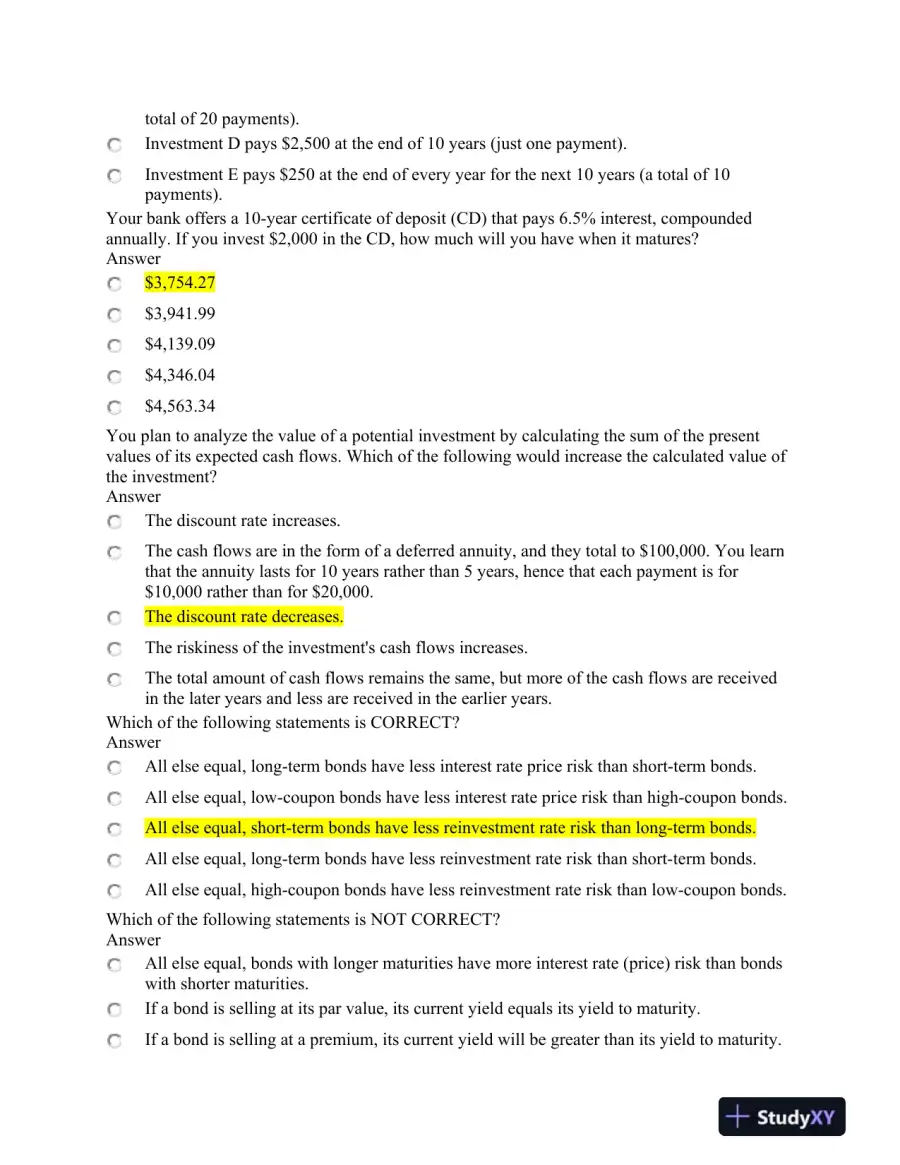 total of 20 payments).Investment D pays $2,500 at the end of 10 years (just one payment).Investment E pays $250 at the end of every year for the next 10 years (a total of 10payments).Your bank offers a 10-year certificate of deposit (CD) that pays 6.5% interest, compoundedannually. If you invest $2,000 in the CD, how much will you have when it matures?Answer$3,754.27$3,941.99$4,139.09$4,346.04$4,563.34You plan toanalyze the value of a potential investment by calculating the sum of the presentvalues of its expected cash flows. Which of the following would increase the calculated value ofthe investment?AnswerThe discount rate increases.The cash flows are in the form of a deferred annuity, and they total to $100,000. You learnthat the annuity lasts for 10 years rather than 5 years, hence that each payment is for$10,000 rather than for $20,000.The discount rate decreases.The riskiness of theinvestment's cash flows increases.The total amount of cash flows remains the same, but more of the cash flows are receivedin the later years and less are received in the earlier years.Which of the following statements is CORRECT?AnswerAll else equal, long-term bonds have less interest rate price risk than short-term bonds.All else equal, low-coupon bonds have less interest rate price risk than high-coupon bonds.All else equal, short-term bonds have less reinvestment rate riskthan long-term bonds.All else equal, long-term bonds have less reinvestment rate risk than short-term bonds.All else equal, high-coupon bonds have less reinvestment rate risk than low-coupon bonds.Which of the following statements is NOT CORRECT?AnswerAll else equal, bonds with longer maturities have more interest rate (price) risk than bondswith shorter maturities.If a bond is selling at its par value, its current yield equals its yield to maturity.If a bond is selling at apremium, its current yield will be greater than its yield to maturity.
5 more pages in the full document
Unlock it once and it stays in your library, ready to chat with or turn into flashcards.
Unlock the full documentMore Finance study materials
See all Textbook Guides
Solution Manual For Investments, 12th Edition
Finance
314 pages161downloadsFeb 2025 Exam Guides
Test Bank for Principles of Managerial Finance, 8th Edition
Finance
851 pages158downloadsFeb 2025 Textbook Guides
Solution Manual for Financial Institutions Management: A Risk Management Approach, 8th Edition
Finance
486 pages154downloadsFeb 2025 Exam Guides
Test Bank for Principles of Managerial Finance, Arab World Edition
Finance
373 pages148downloadsFeb 2025 Textbook Guides
Multinational Financial Management, Study Guide, 6th Edition Solution Manual
Finance
278 pages146downloadsFeb 2025 Textbook Guides
Financial Markets and Institutions, 7th Edition Solution Manual
Finance
194 pages136downloadsFeb 2025 Certification Guides
Wiley Finra Series 3 Exam Review (2019)
Finance
253 pages131downloadsFeb 2025 Exam Guides
Test Bank For Essentials of Investments, 8th Edition
Finance
368 pages130downloadsFeb 2025
Study this document with CramX
Once it is in your library, every tool can work from it.