
Exam Guides
Financial Management: Principles and Applications 13th Edition Test Bank
- Finance
- 788 pages
- Shared May 2025
Financial Management: Principles and Applications 13th Edition Test Bank is an easy-to-use exam guide, packed with the most commonly asked test questions.
Preview · 16 of 788 pages
100%
Page 1
 1Financial Management: Principles & Applications, 13e(Titman)Chapter 1Getting Started-Principles of Finance1) Which of the following statements best represents what finance is about?A) How political, social, and economic forces affect corporationsB) Maximizing profitsC) The study of how people and businesses make investment decisions and how to finance thosedecisions.D) Reducing riskAnswer: CDiff: 1AACSB: 6. Reflective thinkingQuestion Status: Previous editionObjective: 1.1 Understand the importance of finance and identify the three primary businessdecisions that financial managers make.Keywords: what is finance?Principles: Principle 3: Cash flows are the source of value2) From a financial point of view, a company that decides to develop new product is makingA) a financing decision.B) an investment decision.C) a capital structure decision.D) a cash flow decision.Answer: BDiff: 1AACSB: 6. Reflective thinkingQuestion Status: Previous editionObjective: 1.1 Understand the importance of finance and identify the three primary businessdecisions that financial managers make.Keywords: what is finance?Principles: Principle 3: Cash flows are the source of value3) Working capital management refers toA) long-term financing decisions.B) the management of cash flows.C) investing in product development.D) capital structure.Answer: BDiff: 2AACSB: 7. Application of knowledgeQuestion Status: Previous editionObjective: 1.1 Understand the importance of finance and identify the three primary businessdecisions that financial managers make.Keywords: capital structurePrinciples: Principle 3: Cash flows are the source of value
Page 2

Page 3
 24) Finance managers need to interact constantly withA) marketing managers.B) accounting staff.C) management information systems staff.D) all of the above.Answer: DDiff: 2AACSB: 6. Reflective thinkingQuestion Status: Previous editionObjective: 1.1 Understand the importance of finance and identify the three primary businessdecisions that financial managers make.Keywords: what is finance?Principles: Principle 3: Cash flows are the source of value5) The personal decision to take a year off from work to obtain a graduate degree in business isprimarily a(n)________ decision.A) socialB) financialC) ethicalD) investmentAnswer: DDiff: 2AACSB: 6. Reflective thinkingQuestion Status: RevisedObjective: 1.1 Understand the importance of finance and identify the three primary businessdecisions that financial managers make.Keywords: what is finance?Principles: Principle 3: Cash flows are the source of value6) The area of finance that deals with long-term investment decisions is known asA) capital structure.B) working capital management.C) financial strategy.D) capital budgeting.Answer: DDiff: 2AACSB: 6. Reflective thinkingQuestion Status: Previous editionObjective: 1.1 Understand the importance of finance and identify the three primary businessdecisions that financial managers make.Keywords: what is finance?Principles: Principle 3: Cash flows are the source of value
Page 4
 37) Capital structure refers to the financing of long-term investments.Answer: TRUEDiff: 1AACSB: 6. Reflective thinkingQuestion Status: Previous editionObjective: 1.1 Understand the importance of finance and identify the three primary businessdecisions that financial managers make.Keywords: what is finance?Principles: Principle 3: Cash flows are the source of value8) Financial decisions can be difficult because the cost of investments can be estimated withgreater confidence than future payoffs.Answer: TRUEDiff: 2AACSB: 6. Reflective thinkingQuestion Status: Previous editionObjective: 1.1 Understand the importance of finance and identify the three primary businessdecisions that financial managers make.Keywords: what is finance?Principles: Principle 3: Cash flows are the source of value9) What are the three basic questions addressed by the study of investments?Answer:1. What investments should the firm undertake?2. How should the firm fund these investments?3. How can the firm best manage cash flows in its day to day operations?Diff: 2AACSB: 6. Reflective thinkingQuestion Status: Previous editionObjective: 1.1 Understand the importance of finance and identify the three primary businessdecisions that financial managers make.Keywords: what is finance?Principles: Principle 3: Cash flows are the source of value10) Which of the following is NOT an advantage of the sole proprietorship?A) Limited liabilityB) No time limit imposed on its existenceC) No legal requirements for starting the businessD) None of the aboveAnswer: ADiff: 2AACSB: 6. Reflective thinkingQuestion Status: Previous editionObjective: 1.2 Identify the differences between the three major legal forms of business.Keywords: proprietorshipsPrinciples: Principle 2: There Is a Risk-Return Tradeoff
Page 5
 411) What is the chief disadvantage of the sole proprietorship as a form of business organizationwhen compared to the corporate form?A) Sole proprietorships are subject to double taxation of profits.B) The cost of formation.C) Inadequate profit sharing.D) Owners have unlimited liability.Answer: DDiff: 2AACSB: 6. Reflective thinkingQuestion Status: Previous editionObjective: 1.2 Identify the differences between the three major legal forms of business.Keywords: proprietorshipsPrinciples: Principle 2: There Is a Risk-Return Tradeoff12) Which of the following is NOT true for limited partnerships?A) Only limited partners can manage the business.B) One general partner must exist who has unlimited liability.C) Only the name of general partners can appear in the name of the firm.D) Limited partners may sell their interest in the company.Answer: ADiff: 2AACSB: 6. Reflective thinkingQuestion Status: Previous editionObjective: 1.2 Identify the differences between the three major legal forms of business.Keywords: partnershipsPrinciples: Principle 2: There Is a Risk-Return Tradeoff13) The true owners of the corporation are theA) holders of debt issues of the firm.B) preferred stockholders.C) board of directors of the firm.D) common stockholders.Answer: DDiff: 1AACSB: 6. Reflective thinkingQuestion Status: Previous editionObjective: 1.2 Identify the differences between the three major legal forms of business.Keywords: corporationPrinciples: Principle 2: There Is a Risk-Return Tradeoff
Page 6
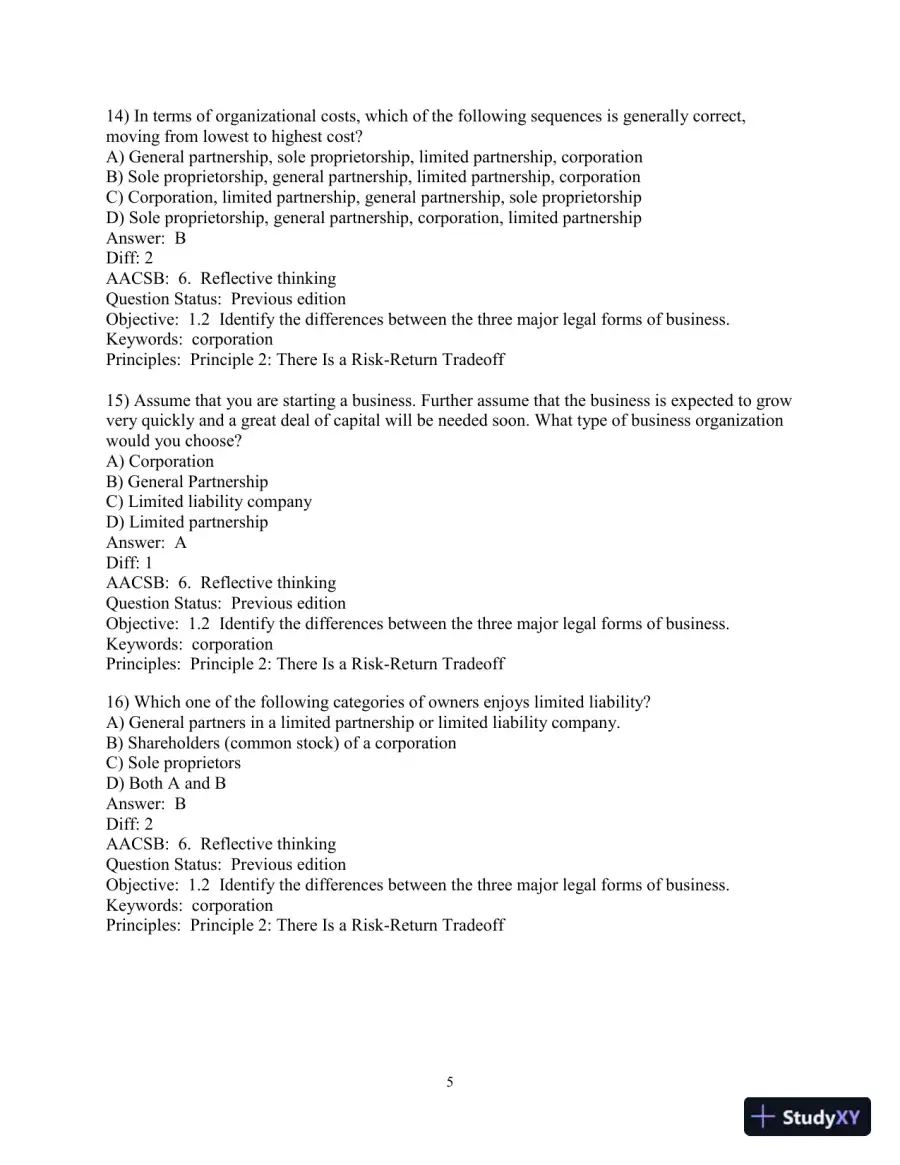 514) In terms of organizational costs, which of the following sequences is generally correct,moving from lowest to highest cost?A) General partnership, sole proprietorship, limited partnership, corporationB) Sole proprietorship, general partnership, limited partnership, corporationC) Corporation, limited partnership, general partnership, sole proprietorshipD) Sole proprietorship, general partnership, corporation, limited partnershipAnswer: BDiff: 2AACSB: 6. Reflective thinkingQuestion Status: Previous editionObjective: 1.2 Identify the differences between the three major legal forms of business.Keywords: corporationPrinciples: Principle 2: There Is a Risk-Return Tradeoff15) Assume that you are starting a business. Further assume that the business is expected to growvery quickly and a great deal of capital will be needed soon. What type of business organizationwould you choose?A) CorporationB) General PartnershipC) Limited liability companyD) Limited partnershipAnswer: ADiff: 1AACSB: 6. Reflective thinkingQuestion Status: Previous editionObjective: 1.2 Identify the differences between the three major legal forms of business.Keywords: corporationPrinciples: Principle 2: There Is a Risk-Return Tradeoff16) Which one of the following categories of owners enjoys limited liability?A) General partners in a limited partnership or limited liability company.B) Shareholders (common stock) of a corporationC) Sole proprietorsD) Both A and BAnswer: BDiff: 2AACSB: 6. Reflective thinkingQuestion Status: Previous editionObjective: 1.2 Identify the differences between the three major legal forms of business.Keywords: corporationPrinciples: Principle 2: There Is a Risk-Return Tradeoff
Page 7
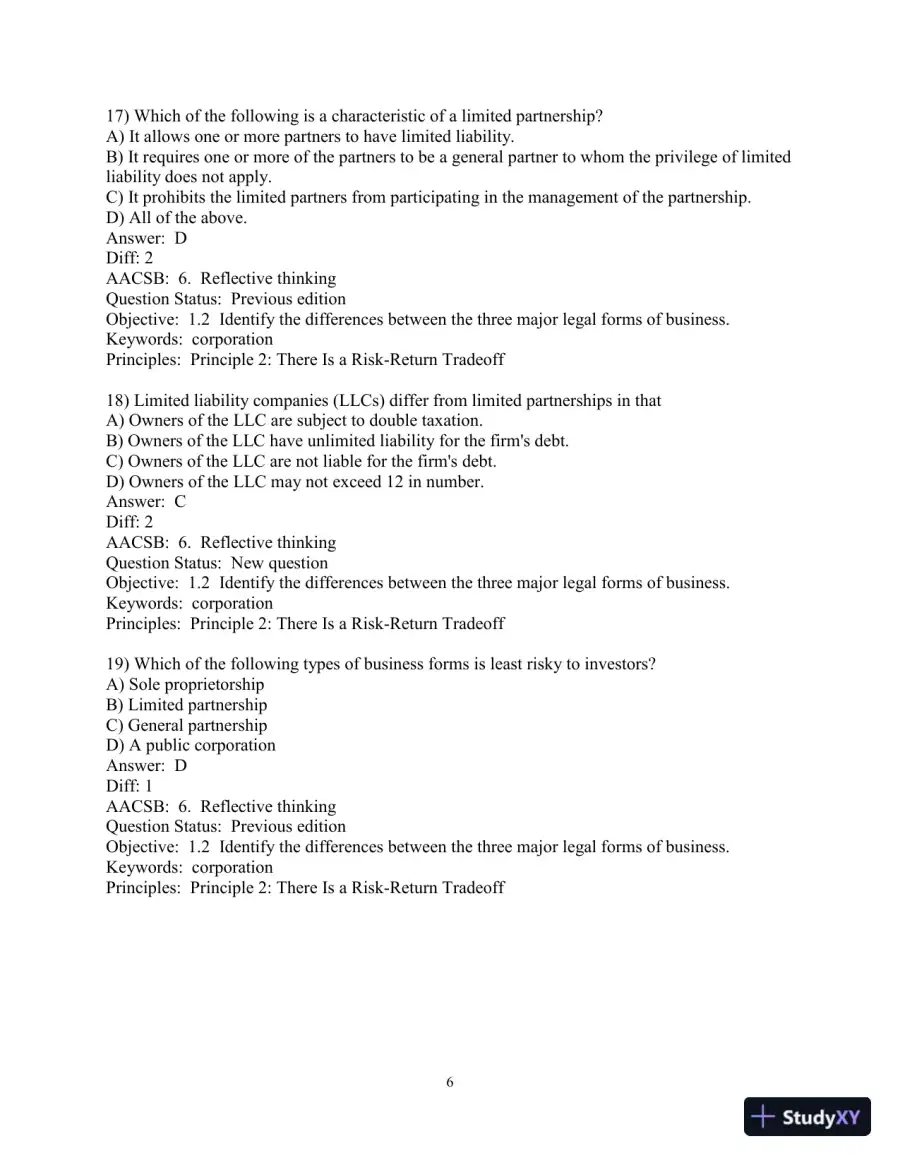 617) Which of the following is a characteristic of a limited partnership?A) It allows one or more partners to have limited liability.B) It requires one or more of the partners to be a general partner to whom the privilege of limitedliability does not apply.C) It prohibits the limited partners from participating in the management of the partnership.D) All of the above.Answer: DDiff: 2AACSB: 6. Reflective thinkingQuestion Status: Previous editionObjective: 1.2 Identify the differences between the three major legal forms of business.Keywords: corporationPrinciples: Principle 2: There Is a Risk-Return Tradeoff18) Limited liability companies (LLCs) differ from limited partnerships in thatA) Owners of the LLC are subject to double taxation.B) Owners of the LLC have unlimited liability for the firm's debt.C) Owners of the LLC are not liable for the firm's debt.D) Owners of the LLC may not exceed 12 in number.Answer: CDiff: 2AACSB: 6. Reflective thinkingQuestion Status: New questionObjective: 1.2 Identify the differences between the three major legal forms of business.Keywords: corporationPrinciples: Principle 2: There Is a Risk-Return Tradeoff19) Which of the following types of business forms is least risky to investors?A) Sole proprietorshipB) Limited partnershipC) General partnershipD) A public corporationAnswer: DDiff: 1AACSB: 6. Reflective thinkingQuestion Status: Previous editionObjective: 1.2 Identify the differences between the three major legal forms of business.Keywords: corporationPrinciples: Principle 2: There Is a Risk-Return Tradeoff
Page 8
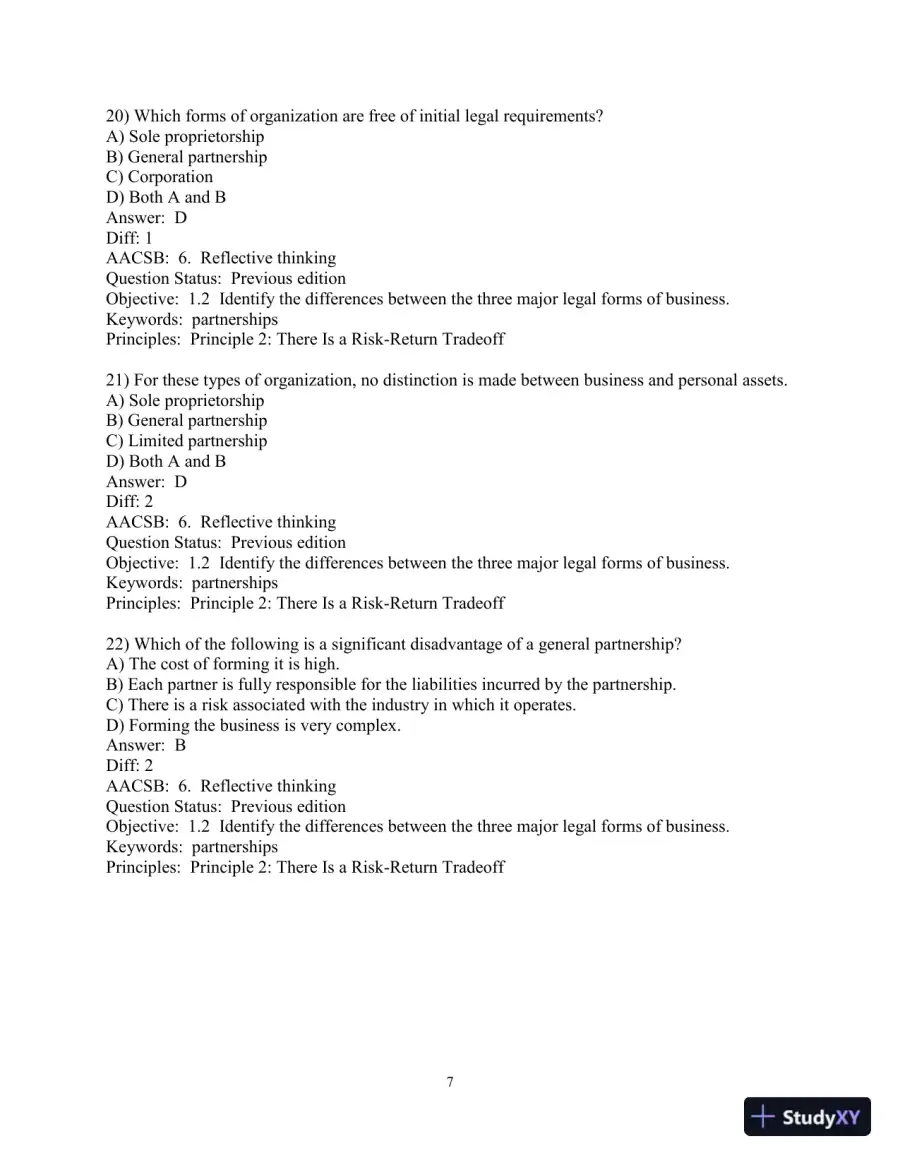 720) Which forms of organization are free of initial legal requirements?A) Sole proprietorshipB) General partnershipC) CorporationD) Both A and BAnswer: DDiff: 1AACSB: 6. Reflective thinkingQuestion Status: Previous editionObjective: 1.2 Identify the differences between the three major legal forms of business.Keywords: partnershipsPrinciples: Principle 2: There Is a Risk-Return Tradeoff21) For these types of organization, no distinction is made between business and personal assets.A) Sole proprietorshipB) General partnershipC) Limited partnershipD) Both A and BAnswer: DDiff: 2AACSB: 6. Reflective thinkingQuestion Status: Previous editionObjective: 1.2 Identify the differences between the three major legal forms of business.Keywords: partnershipsPrinciples: Principle 2: There Is a Risk-Return Tradeoff22) Which of the following is a significant disadvantage of a general partnership?A) The cost of forming it is high.B) Each partner is fully responsible for the liabilities incurred by the partnership.C) There is a risk associated with the industry in which it operates.D) Forming the business is very complex.Answer: BDiff: 2AACSB: 6. Reflective thinkingQuestion Status: Previous editionObjective: 1.2 Identify the differences between the three major legal forms of business.Keywords: partnershipsPrinciples: Principle 2: There Is a Risk-Return Tradeoff
Page 9
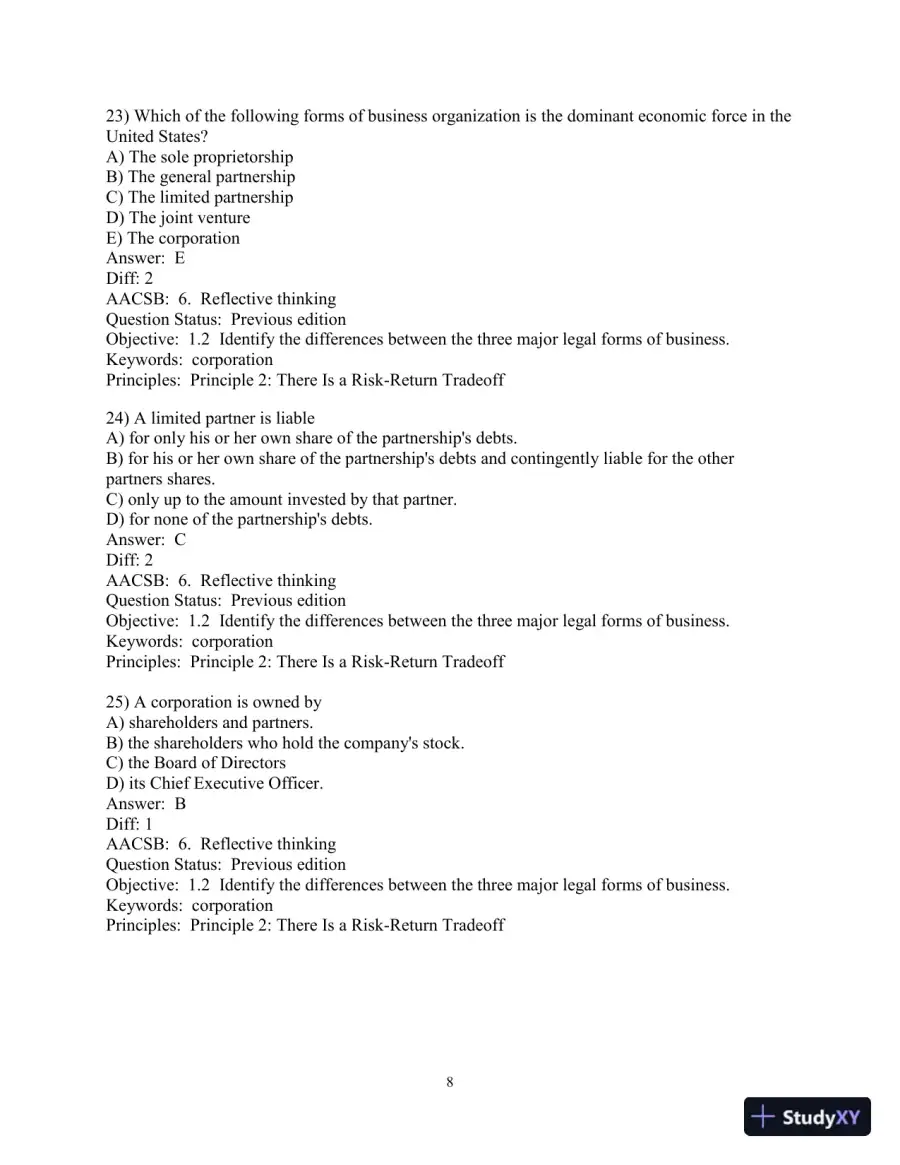 823) Which of the following forms of business organization is the dominant economic force in theUnited States?A) The sole proprietorshipB) The general partnershipC) The limited partnershipD) The joint ventureE) The corporationAnswer: EDiff: 2AACSB: 6. Reflective thinkingQuestion Status: Previous editionObjective: 1.2 Identify the differences between the three major legal forms of business.Keywords: corporationPrinciples: Principle 2: There Is a Risk-Return Tradeoff24) A limited partner is liableA) for only his or her own share of the partnership's debts.B) for his or her own share of the partnership's debts and contingently liable for the otherpartners shares.C) only up to the amount invested by that partner.D) for none of the partnership's debts.Answer: CDiff: 2AACSB: 6. Reflective thinkingQuestion Status: Previous editionObjective: 1.2 Identify the differences between the three major legal forms of business.Keywords: corporationPrinciples: Principle 2: There Is a Risk-Return Tradeoff25) A corporation is owned byA) shareholders and partners.B) the shareholders who hold the company's stock.C) the Board of DirectorsD) its Chief Executive Officer.Answer: BDiff: 1AACSB: 6. Reflective thinkingQuestion Status: Previous editionObjective: 1.2 Identify the differences between the three major legal forms of business.Keywords: corporationPrinciples: Principle 2: There Is a Risk-Return Tradeoff
Page 10
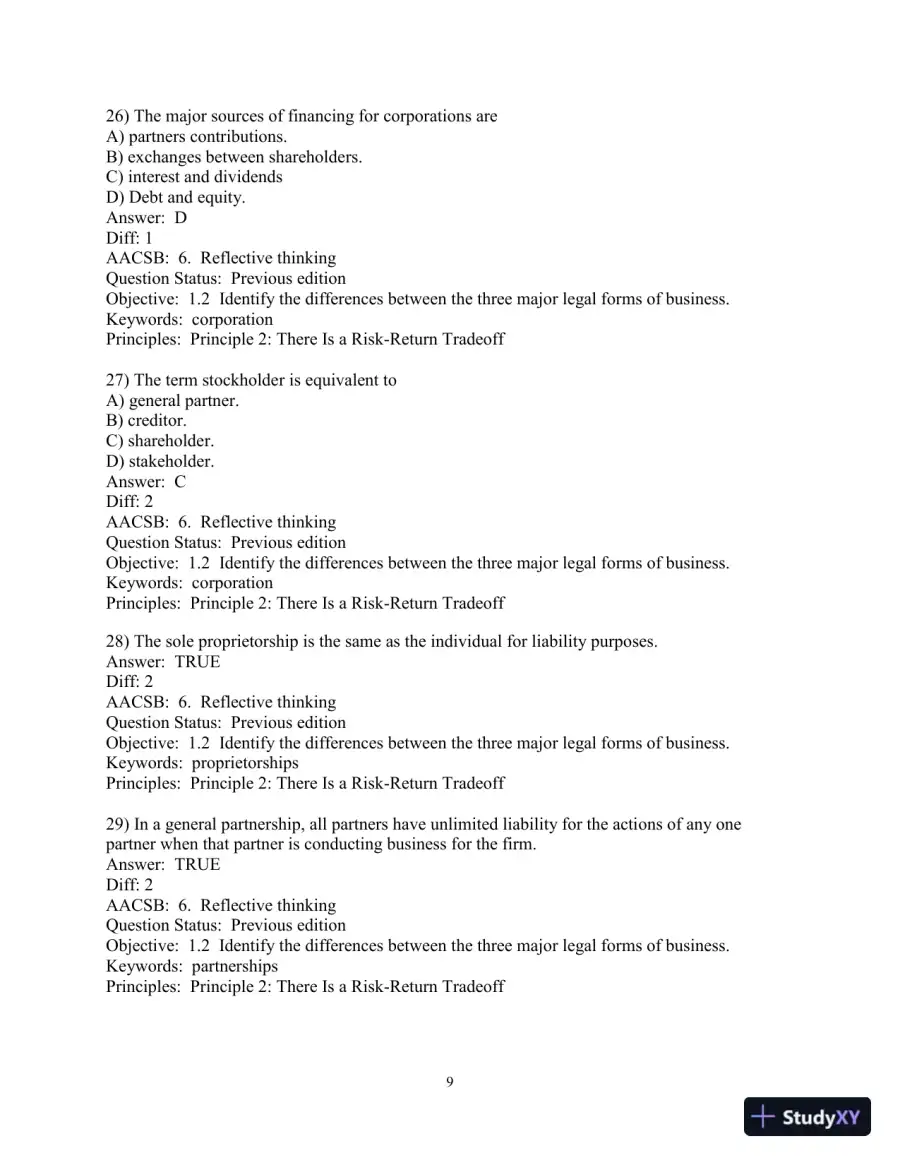 926) The major sources of financing for corporations areA) partners contributions.B) exchanges between shareholders.C) interest and dividendsD) Debt and equity.Answer: DDiff: 1AACSB: 6. Reflective thinkingQuestion Status: Previous editionObjective: 1.2 Identify the differences between the three major legal forms of business.Keywords: corporationPrinciples: Principle 2: There Is a Risk-Return Tradeoff27) The term stockholder is equivalent toA) general partner.B) creditor.C) shareholder.D) stakeholder.Answer: CDiff: 2AACSB: 6. Reflective thinkingQuestion Status: Previous editionObjective: 1.2 Identify the differences between the three major legal forms of business.Keywords: corporationPrinciples: Principle 2: There Is a Risk-Return Tradeoff28) The sole proprietorship is the same as the individual for liability purposes.Answer: TRUEDiff: 2AACSB: 6. Reflective thinkingQuestion Status: Previous editionObjective: 1.2 Identify the differences between the three major legal forms of business.Keywords: proprietorshipsPrinciples: Principle 2: There Is a Risk-Return Tradeoff29) In a general partnership, all partners have unlimited liability for the actions of any onepartner when that partner is conducting business for the firm.Answer: TRUEDiff: 2AACSB: 6. Reflective thinkingQuestion Status: Previous editionObjective: 1.2 Identify the differences between the three major legal forms of business.Keywords: partnershipsPrinciples: Principle 2: There Is a Risk-Return Tradeoff
Page 11
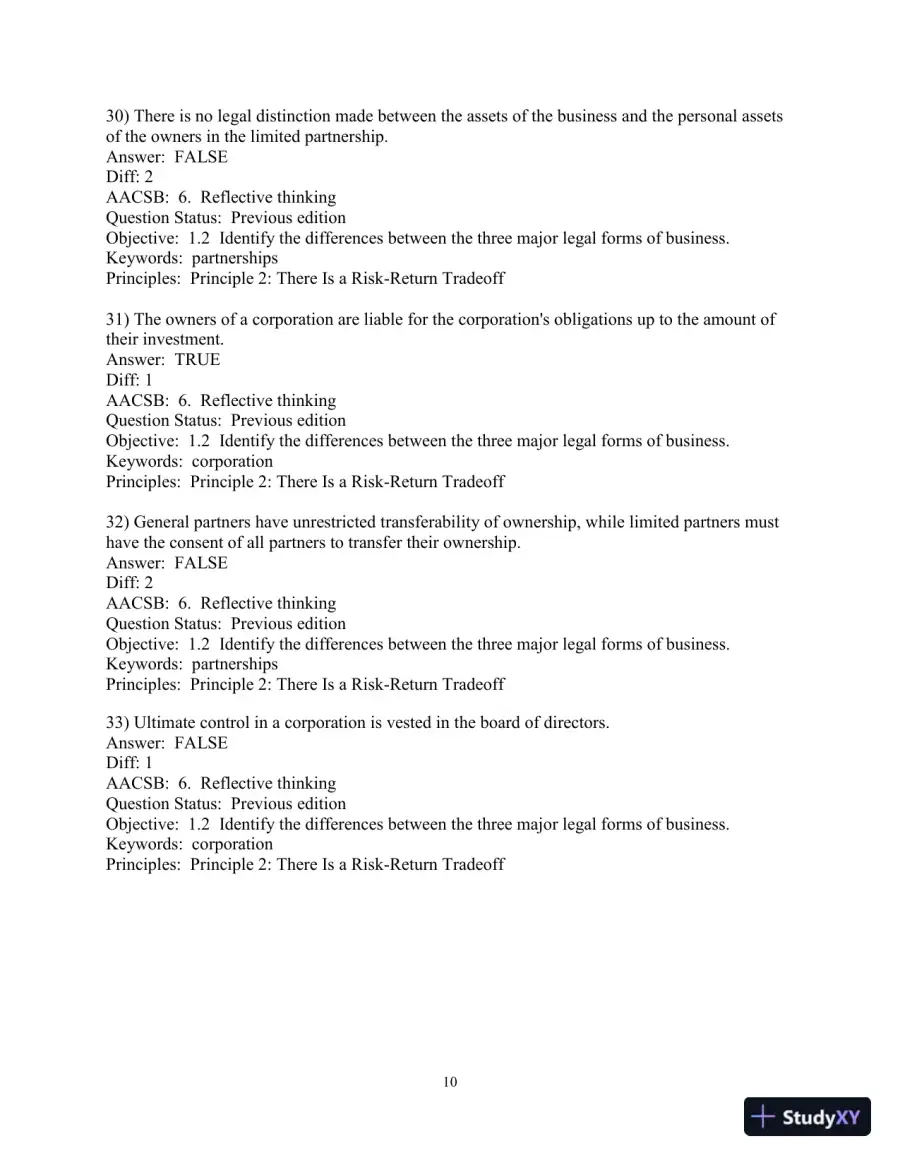 1030) There is no legal distinction made between the assets of the business and the personal assetsof the owners in the limited partnership.Answer: FALSEDiff: 2AACSB: 6. Reflective thinkingQuestion Status: Previous editionObjective: 1.2 Identify the differences between the three major legal forms of business.Keywords: partnershipsPrinciples: Principle 2: There Is a Risk-Return Tradeoff31) The owners of a corporation are liable for the corporation's obligations up to the amount oftheir investment.Answer: TRUEDiff: 1AACSB: 6. Reflective thinkingQuestion Status: Previous editionObjective: 1.2 Identify the differences between the three major legal forms of business.Keywords: corporationPrinciples: Principle 2: There Is a Risk-Return Tradeoff32) General partners have unrestricted transferability of ownership, while limited partners musthave the consent of all partners to transfer their ownership.Answer: FALSEDiff: 2AACSB: 6. Reflective thinkingQuestion Status: Previous editionObjective: 1.2 Identify the differences between the three major legal forms of business.Keywords: partnershipsPrinciples: Principle 2: There Is a Risk-Return Tradeoff33) Ultimate control in a corporation is vested in the board of directors.Answer: FALSEDiff: 1AACSB: 6. Reflective thinkingQuestion Status: Previous editionObjective: 1.2 Identify the differences between the three major legal forms of business.Keywords: corporationPrinciples: Principle 2: There Is a Risk-Return Tradeoff
Page 12
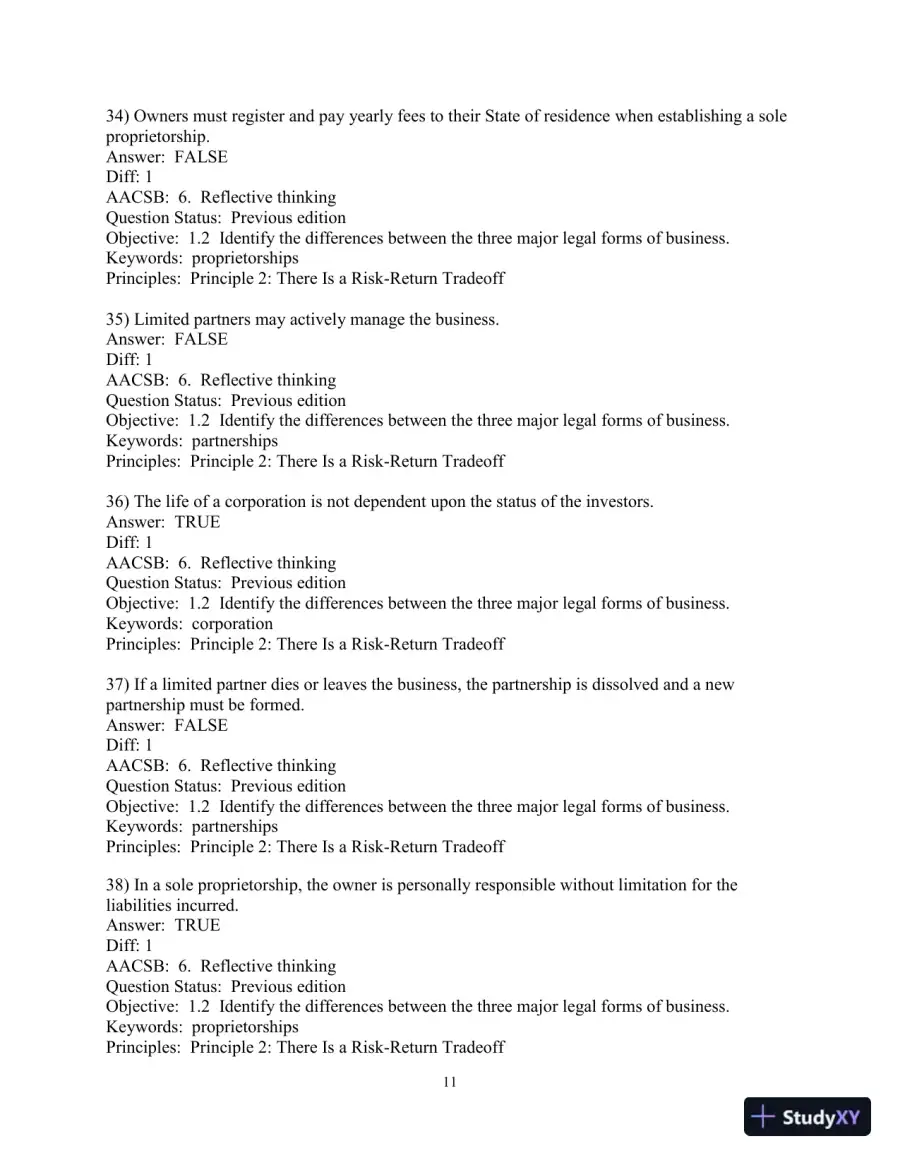 1134) Owners must register and pay yearly fees to their State of residence when establishing a soleproprietorship.Answer: FALSEDiff: 1AACSB: 6. Reflective thinkingQuestion Status: Previous editionObjective: 1.2 Identify the differences between the three major legal forms of business.Keywords: proprietorshipsPrinciples: Principle 2: There Is a Risk-Return Tradeoff35) Limited partners may actively manage the business.Answer: FALSEDiff: 1AACSB: 6. Reflective thinkingQuestion Status: Previous editionObjective: 1.2 Identify the differences between the three major legal forms of business.Keywords: partnershipsPrinciples: Principle 2: There Is a Risk-Return Tradeoff36) The life of a corporation is not dependent upon the status of the investors.Answer: TRUEDiff: 1AACSB: 6. Reflective thinkingQuestion Status: Previous editionObjective: 1.2 Identify the differences between the three major legal forms of business.Keywords: corporationPrinciples: Principle 2: There Is a Risk-Return Tradeoff37) If a limited partner dies or leaves the business, the partnership is dissolved and a newpartnership must be formed.Answer: FALSEDiff: 1AACSB: 6. Reflective thinkingQuestion Status: Previous editionObjective: 1.2 Identify the differences between the three major legal forms of business.Keywords: partnershipsPrinciples: Principle 2: There Is a Risk-Return Tradeoff38) In a sole proprietorship, the owner is personally responsible without limitation for theliabilities incurred.Answer: TRUEDiff: 1AACSB: 6. Reflective thinkingQuestion Status: Previous editionObjective: 1.2 Identify the differences between the three major legal forms of business.Keywords: proprietorshipsPrinciples: Principle 2: There Is a Risk-Return Tradeoff
Page 13
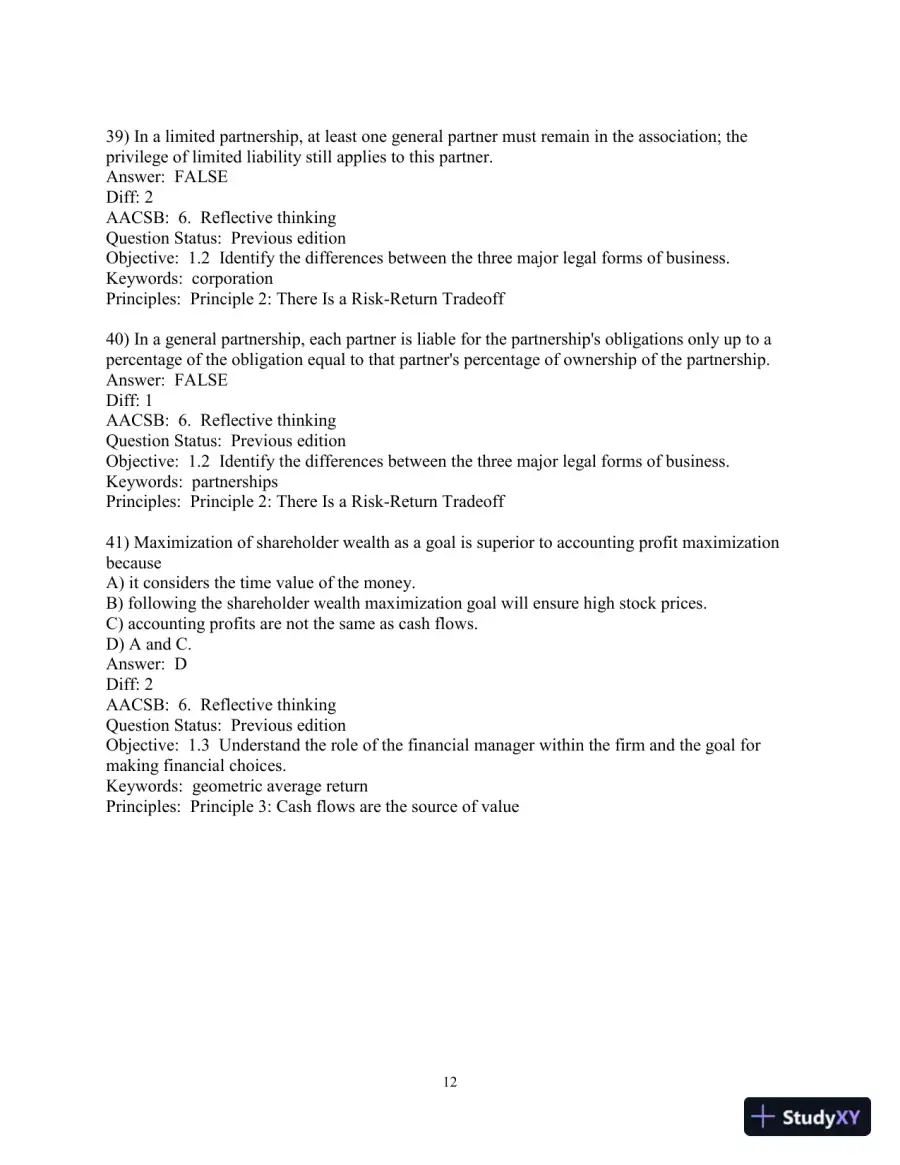 1239) In a limited partnership, at least one general partner must remain in the association; theprivilege of limited liability still applies to this partner.Answer: FALSEDiff: 2AACSB: 6. Reflective thinkingQuestion Status: Previous editionObjective: 1.2 Identify the differences between the three major legal forms of business.Keywords: corporationPrinciples: Principle 2: There Is a Risk-Return Tradeoff40) In a general partnership, each partner is liable for the partnership's obligations only up to apercentage of the obligation equal to that partner's percentage of ownership of the partnership.Answer: FALSEDiff: 1AACSB: 6. Reflective thinkingQuestion Status: Previous editionObjective: 1.2 Identify the differences between the three major legal forms of business.Keywords: partnershipsPrinciples: Principle 2: There Is a Risk-Return Tradeoff41) Maximization of shareholder wealth as a goal is superior to accounting profit maximizationbecauseA) it considers the time value of the money.B) following the shareholder wealth maximization goal will ensure high stock prices.C) accounting profits are not the same as cash flows.D) A and C.Answer: DDiff: 2AACSB: 6. Reflective thinkingQuestion Status: Previous editionObjective: 1.3 Understand the role of the financial manager within the firm and the goal formaking financial choices.Keywords: geometric average returnPrinciples: Principle 3: Cash flows are the source of value
Page 14
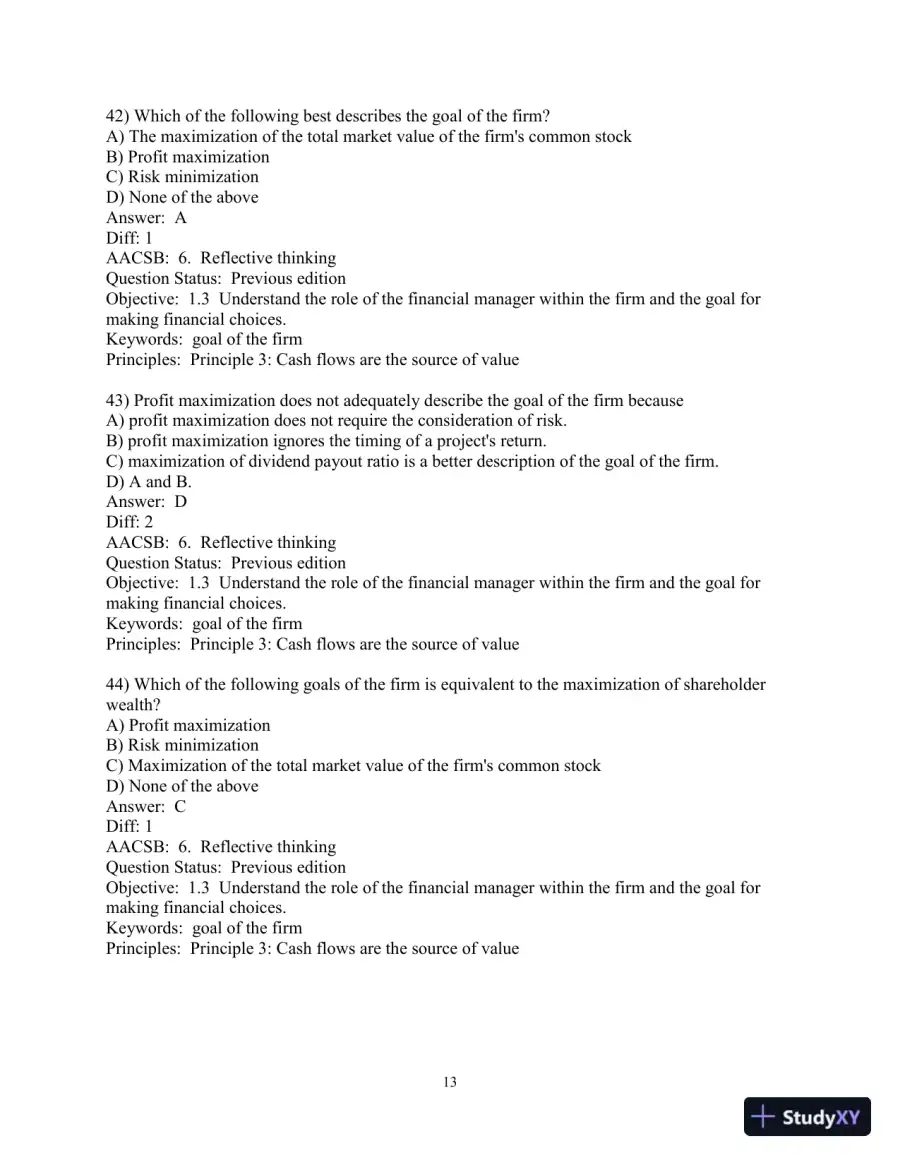 1342) Which of the following best describes the goal of the firm?A) The maximization of the total market value of the firm's common stockB) Profit maximizationC) Risk minimizationD) None of the aboveAnswer: ADiff: 1AACSB: 6. Reflective thinkingQuestion Status: Previous editionObjective: 1.3 Understand the role of the financial manager within the firm and the goal formaking financial choices.Keywords: goal of the firmPrinciples: Principle 3: Cash flows are the source of value43) Profit maximization does not adequately describe the goal of the firm becauseA) profit maximization does not require the consideration of risk.B) profit maximization ignores the timing of a project's return.C) maximization of dividend payout ratio is a better description of the goal of the firm.D) A and B.Answer: DDiff: 2AACSB: 6. Reflective thinkingQuestion Status: Previous editionObjective: 1.3 Understand the role of the financial manager within the firm and the goal formaking financial choices.Keywords: goal of the firmPrinciples: Principle 3: Cash flows are the source of value44) Which of the following goals of the firm is equivalent to the maximization of shareholderwealth?A) Profit maximizationB) Risk minimizationC) Maximization of the total market value of the firm's common stockD) None of the aboveAnswer: CDiff: 1AACSB: 6. Reflective thinkingQuestion Status: Previous editionObjective: 1.3 Understand the role of the financial manager within the firm and the goal formaking financial choices.Keywords: goal of the firmPrinciples: Principle 3: Cash flows are the source of value
Page 15
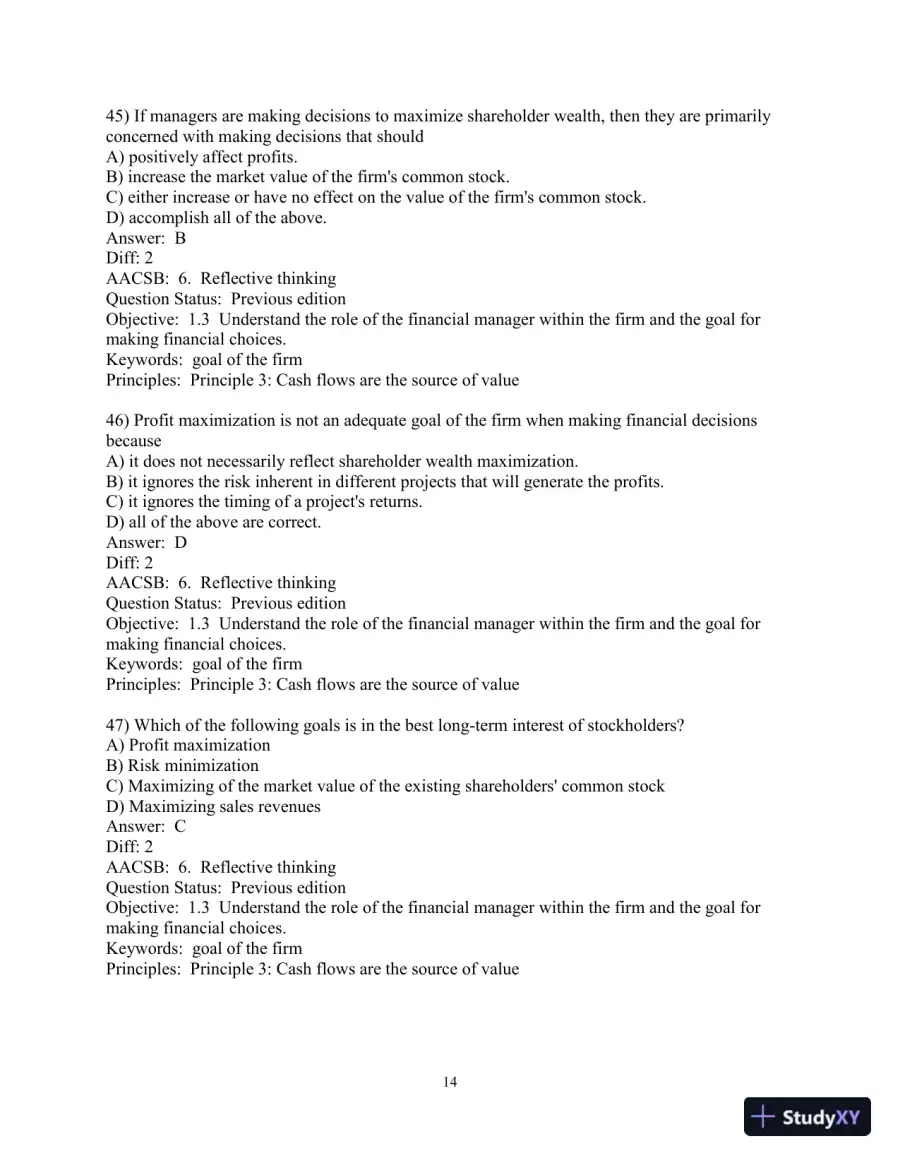 1445) If managers are making decisions to maximize shareholder wealth, then they are primarilyconcerned with making decisions that shouldA) positively affect profits.B) increase the market value of the firm's common stock.C) either increase or have no effect on the value of the firm's common stock.D) accomplish all of the above.Answer: BDiff: 2AACSB: 6. Reflective thinkingQuestion Status: Previous editionObjective: 1.3 Understand the role of the financial manager within the firm and the goal formaking financial choices.Keywords: goal of the firmPrinciples: Principle 3: Cash flows are the source of value46) Profit maximization is not an adequate goal of the firm when making financial decisionsbecauseA) it does not necessarily reflect shareholder wealth maximization.B) it ignores the risk inherent in different projects that will generate the profits.C) it ignores the timing of a project's returns.D) all of the above are correct.Answer: DDiff: 2AACSB: 6. Reflective thinkingQuestion Status: Previous editionObjective: 1.3 Understand the role of the financial manager within the firm and the goal formaking financial choices.Keywords: goal of the firmPrinciples: Principle 3: Cash flows are the source of value47) Which of the following goals is in the best long-term interest of stockholders?A) Profit maximizationB) Risk minimizationC) Maximizing of the market value of the existing shareholders' common stockD) Maximizing sales revenuesAnswer: CDiff: 2AACSB: 6. Reflective thinkingQuestion Status: Previous editionObjective: 1.3 Understand the role of the financial manager within the firm and the goal formaking financial choices.Keywords: goal of the firmPrinciples: Principle 3: Cash flows are the source of value
Page 16
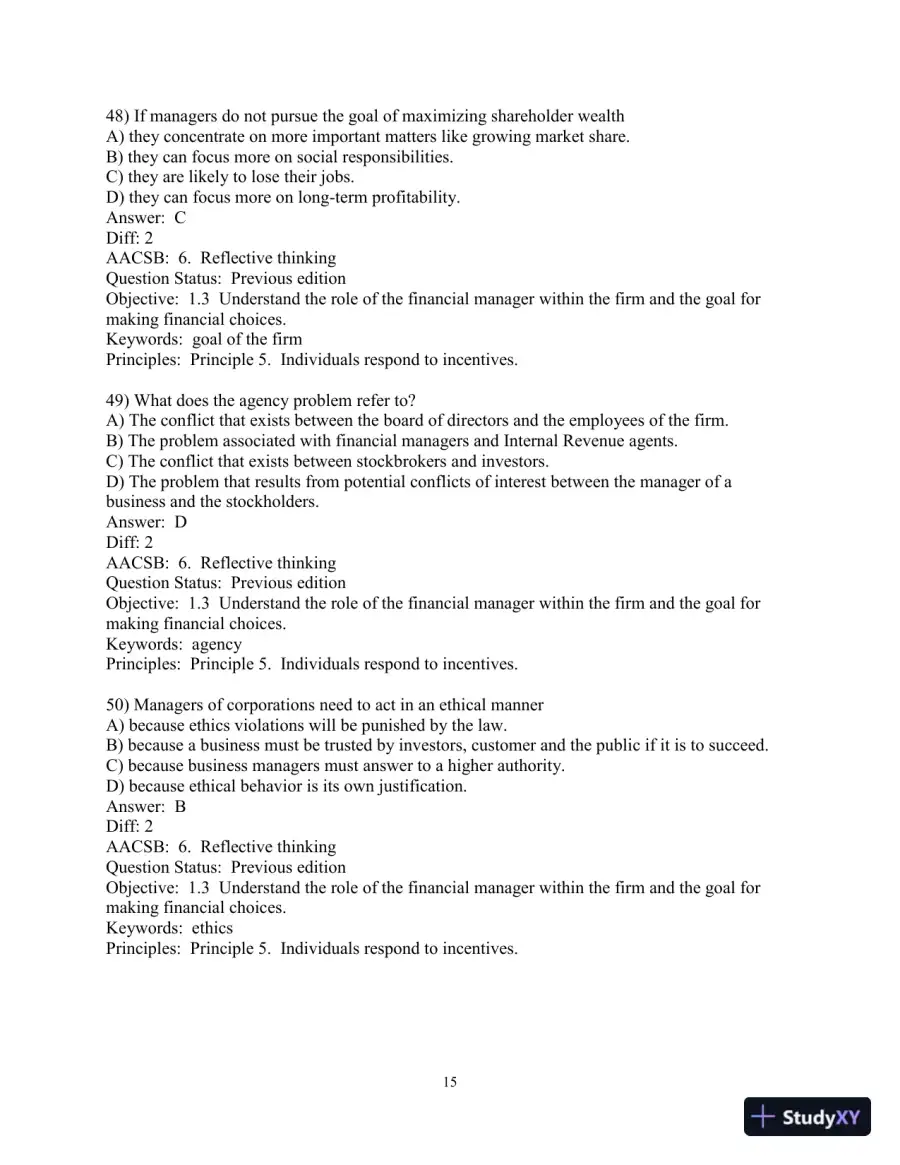 1548) If managers do not pursue the goal of maximizing shareholder wealthA) they concentrate on more important matters like growing market share.B) they can focus more on social responsibilities.C) they are likely to lose their jobs.D) they can focus more on long-term profitability.Answer: CDiff: 2AACSB: 6. Reflective thinkingQuestion Status: Previous editionObjective: 1.3 Understand the role of the financial manager within the firm and the goal formaking financial choices.Keywords: goal of the firmPrinciples: Principle 5. Individuals respond to incentives.49) What does the agency problem refer to?A) The conflict that exists between the board of directors and the employees of the firm.B) The problem associated with financial managers and Internal Revenue agents.C) The conflict that exists between stockbrokers and investors.D) The problem that results from potential conflicts of interest between the manager of abusiness and the stockholders.Answer: DDiff: 2AACSB: 6. Reflective thinkingQuestion Status: Previous editionObjective: 1.3 Understand the role of the financial manager within the firm and the goal formaking financial choices.Keywords: agencyPrinciples: Principle 5. Individuals respond to incentives.50) Managers of corporations need to act in an ethical mannerA) because ethics violations will be punished by the law.B) because a business must be trusted by investors, customer and the public if it is to succeed.C) because business managers must answer to a higher authority.D) because ethical behavior is its own justification.Answer: BDiff: 2AACSB: 6. Reflective thinkingQuestion Status: Previous editionObjective: 1.3 Understand the role of the financial manager within the firm and the goal formaking financial choices.Keywords: ethicsPrinciples: Principle 5. Individuals respond to incentives.
772 more pages in the full document
Unlock it once and it stays in your library, ready to chat with or turn into flashcards.
Unlock the full documentMore Finance study materials
See all Textbook Guides
Solution Manual For Investments, 12th Edition
Finance
314 pages161downloadsFeb 2025 Exam Guides
Test Bank for Principles of Managerial Finance, 8th Edition
Finance
851 pages158downloadsFeb 2025 Textbook Guides
Solution Manual for Financial Institutions Management: A Risk Management Approach, 8th Edition
Finance
486 pages154downloadsFeb 2025 Exam Guides
Test Bank for Principles of Managerial Finance, Arab World Edition
Finance
373 pages148downloadsFeb 2025 Textbook Guides
Multinational Financial Management, Study Guide, 6th Edition Solution Manual
Finance
278 pages146downloadsFeb 2025 Textbook Guides
Financial Markets and Institutions, 7th Edition Solution Manual
Finance
194 pages136downloadsFeb 2025 Certification Guides
Wiley Finra Series 3 Exam Review (2019)
Finance
253 pages131downloadsFeb 2025 Exam Guides
Test Bank For Essentials of Investments, 8th Edition
Finance
368 pages130downloadsFeb 2025
Study this document with CramX
Once it is in your library, every tool can work from it.