

Fundamentals of Investing 13th Edition Test Bank
- Finance
- 539 pages
- Shared February 2025
- 120 downloads
Don't just study—practice smarter with Fundamentals of Investing 13th Edition Test Bank, the perfect test prep tool.
Preview 31 of 539 pages
See the first 31 pages exactly as they appear in the document.
Page 1 Read page 1 as text
1 Fundamentals of Investing, 13e (Smart) Chapter 1 The Investment Environment 1.1 Learning Goal 1 1) A non-interest bearing checking account is still considered an investment. Answer: FALSE Learning Outcome: F-12 Discuss the implications of systematic risk in financial markets and its role in shaping investment choices AACSB: 3 Analytical thinking Question Status: Previous Edition Learning Goal: Learning Goal 1 2) Land and buildings are examples of real property investments. Answer: TRUE Learning Outcome: F-12 Discuss the implications of systematic risk in financial markets and its role in shaping investment choices AACSB: 3 Analytical thinking Question Status: Previous Edition Learning Goal: Learning Goal 1 3) Since 1900, the average return on stocks has exceeded the average return on savings accounts by more than 6 percentage points. Answer: TRUE Learning Outcome: F-12 Discuss the implications of systematic risk in financial markets and its role in shaping investment choices AACSB: 3 Analytical thinking Question Status: Previous Edition Learning Goal: Learning Goal 1 4) A United States Savings Bond is an example of an investment as defined in the text. Answer: TRUE Learning Outcome: F-12 Discuss the implications of systematic risk in financial markets and its role in shaping investment choices AACSB: 3 Analytical thinking Question Status: Previous Edition Learning Goal: Learning Goal 1 5) Most sources of investment information are in print format, expensive, and difficult to access. Answer: FALSE Learning Outcome: F-12 Discuss the implications of systematic risk in financial markets and its role in shaping investment choices AACSB: 3 Analytical thinking Question Status: New Question Learning Goal: Learning Goal 1
Page 2 Page 3 Read page 3 as text
2 6) Which of the following is NOT an investment as defined in the text? A) a certificate of deposit issued by a bank B) a new automobile C) a United States Saving Bond D) a mutual fund held in a retirement account Answer: B Learning Outcome: F-12 Discuss the implications of systematic risk in financial markets and its role in shaping investment choices AACSB: 3 Analytical thinking Question Status: Previous Edition Learning Goal: Learning Goal 1 7) Stocks are a(n) ________ investment representing ________ of a business. A) direct; ownership B) direct; debt C) indirect; ownership D) indirect; debt Answer: A Learning Outcome: F-12 Discuss the implications of systematic risk in financial markets and its role in shaping investment choices AACSB: 3 Analytical thinking Question Status: Previous Edition Learning Goal: Learning Goal 1 8) An exchange traded fund that invests in the stocks of large corporations is an example of A) direct investment. B) indirect investment. C) derivative investment. D) tangible investment. Answer: B Learning Outcome: F-12 Discuss the implications of systematic risk in financial markets and its role in shaping investment choices AACSB: 3 Analytical thinking Question Status: Previous Edition Learning Goal: Learning Goal 1 9) Which of the following has declined in recent years? A) direct ownership of stock by individual investors B) the percentage of foreign stocks held in typical portfolios C) institutional ownership of common stocks D) the timeliness of information available to investors Answer: A Learning Outcome: F-12 Discuss the implications of systematic risk in financial markets and its role in shaping investment choices AACSB: 3 Analytical thinking Question Status: Previous Edition Learning Goal: Learning Goal 1
Page 4 Read page 4 as text
3 10) Debt represents funds loaned in exchange for A) dividend income and the repayment of the loan principal. B) dividend income and an ownership interest in the firm. C) interest income and a partial ownership interest in the firm. D) interest income and the repayment of the loan principal. Answer: D Learning Outcome: F-12 Discuss the implications of systematic risk in financial markets and its role in shaping investment choices AACSB: 3 Analytical thinking Question Status: Previous Edition Learning Goal: Learning Goal 1 1.2 Learning Goal 2 1) Institutional investors manage money for businesses and nonprofit organizations, but not for individuals. Answer: FALSE Learning Outcome: F-01 Describe the different financial markets and the role of the financial managers AACSB: 8 Application of knowledge (Able to translate knowledge of business and management into practice) Question Status: Previous Edition Learning Goal: Learning Goal 2 2) Institutional investors are individuals who invest indirectly through financial institutions. Answer: FALSE Learning Outcome: F-01 Describe the different financial markets and the role of the financial managers AACSB: 8 Application of knowledge (Able to translate knowledge of business and management into practice) Question Status: Previous Edition Learning Goal: Learning Goal 2 3) Banks and insurance companies are examples of institutional investors. Answer: TRUE Learning Outcome: F-01 Describe the different financial markets and the role of the financial managers AACSB: 8 Application of knowledge (Able to translate knowledge of business and management into practice) Question Status: Previous Edition Learning Goal: Learning Goal 2
Page 5 Read page 5 as text
4 4) In the financial markets, individuals are net demanders of funds. Answer: FALSE Learning Outcome: F-01 Describe the different financial markets and the role of the financial managers AACSB: 8 Application of knowledge (Able to translate knowledge of business and management into practice) Question Status: Previous Edition Learning Goal: Learning Goal 2 5) The government is generally A) not involved in the financial markets. B) the owner of the financial market. C) a supplier of funds to the financial market. D) a demander of funds in the financial market. Answer: D Learning Outcome: F-01 Describe the different financial markets and the role of the financial managers AACSB: 8 Application of knowledge (Able to translate knowledge of business and management into practice) Question Status: Previous Edition Learning Goal: Learning Goal 2 6) On a net basis, funds in the financial markets are generally supplied by A) individuals. B) both individuals and business firms. C) business firms. D) the government. Answer: A Learning Outcome: F-01 Describe the different financial markets and the role of the financial managers AACSB: 8 Application of knowledge (Able to translate knowledge of business and management into practice) Question Status: Previous Edition Learning Goal: Learning Goal 2
Page 6 Read page 6 as text
5 7) A forum in which suppliers and demanders of funds make financial transactions is called a financial A) institution. B) bank. C) instrument. D) market. Answer: D Learning Outcome: F-01 Describe the different financial markets and the role of the financial managers AACSB: 8 Application of knowledge (Able to translate knowledge of business and management into practice) Question Status: Previous Edition Learning Goal: Learning Goal 2 8) Which of the following are true concerning institutional investors? I. Institutional investors are professionals who manage money for other people. II. Banks, insurance companies and mutual funds are all institutional investors. III. Institutional investors are individuals who invest indirectly through financial institutions. IV. Institutional investors invest large sums of money. A) I and II only B) I, II and IV only C) II, III and IV only D) I, II, III and IV Answer: B Learning Outcome: F-01 Describe the different financial markets and the role of the financial managers AACSB: 8 Application of knowledge (Able to translate knowledge of business and management into practice) Question Status: Previous Edition Learning Goal: Learning Goal 2 9) Which of the following is NOT traded in the securities markets? A) stocks B) bonds C) derivatives D) real estate Answer: D Learning Outcome: F-01 Describe the different financial markets and the role of the financial managers AACSB: 8 Application of knowledge (Able to translate knowledge of business and management into practice) Question Status: New Question Learning Goal: Learning Goal 2
Page 7 Read page 7 as text
6 10) Describe the major differences between individual and institutional investors. Answer: Individual investors manage their own funds to achieve individual goals such as increasing financial security or financing a comfortable retirement. Institutional investors such as mutual funds and insurance companies manage funds for individuals who lack the time or expertise to invest individually and for other institutions such as universities or charities. Learning Outcome: F-01 Describe the different financial markets and the role of the financial managers AACSB: 8 Application of knowledge (Able to translate knowledge of business and management into practice) Question Status: Previous Edition Learning Goal: Learning Goal 2 1.3 Learning Goal 3 1) Bond investors lend their money for a fixed period of time and receive interest. Answer: TRUE Learning Outcome: F-01 Describe the different financial markets and the role of the financial managers AACSB: 8 Application of knowledge (Able to translate knowledge of business and management into practice) Question Status: Previous Edition Learning Goal: Learning Goal 3 2) A collection of securities designed to meet an investment goal is called a portfolio. Answer: TRUE Learning Outcome: F-01 Describe the different financial markets and the role of the financial managers AACSB: 8 Application of knowledge (Able to translate knowledge of business and management into practice) Question Status: Previous Edition Learning Goal: Learning Goal 3 3) If the value of a common stock increases the value of an option to buy that stock should also increase. Answer: TRUE Learning Outcome: F-01 Describe the different financial markets and the role of the financial managers AACSB: 8 Application of knowledge (Able to translate knowledge of business and management into practice) Question Status: Previous Edition Learning Goal: Learning Goal 3
Page 8 Read page 8 as text
7 4) An option to purchase common stock is a type of derivative security. Answer: TRUE Learning Outcome: F-01 Describe the different financial markets and the role of the financial managers AACSB: 8 Application of knowledge (Able to translate knowledge of business and management into practice) Question Status: New Question Learning Goal: Learning Goal 3 5) Bonds represent a lower level of risk than do stocks in the same company. Answer: TRUE Learning Outcome: F-01 Describe the different financial markets and the role of the financial managers AACSB: 8 Application of knowledge (Able to translate knowledge of business and management into practice) Question Status: Previous Edition Learning Goal: Learning Goal 3 6) Exchange traded funds are similar to mutual funds, but are traded like stocks. Answer: TRUE Learning Outcome: F-01 Describe the different financial markets and the role of the financial managers AACSB: 8 Application of knowledge (Able to translate knowledge of business and management into practice) Question Status: Previous Edition Learning Goal: Learning Goal 3 7) Mutual funds invest in diversified portfolios of securities. Answer: TRUE Learning Outcome: F-01 Describe the different financial markets and the role of the financial managers AACSB: 8 Application of knowledge (Able to translate knowledge of business and management into practice) Question Status: Previous Edition Learning Goal: Learning Goal 3 8) Bond prices rise as interest rates decline. Answer: TRUE Learning Outcome: F-01 Describe the different financial markets and the role of the financial managers AACSB: 8 Application of knowledge (Able to translate knowledge of business and management into practice) Question Status: Previous Edition Learning Goal: Learning Goal 3
Page 9 Read page 9 as text
8 9) Bond interest and stock dividends are different ways of distributing a corporation's earnings to its owners. Answer: FALSE Learning Outcome: F-01 Describe the different financial markets and the role of the financial managers AACSB: 8 Application of knowledge (Able to translate knowledge of business and management into practice) Question Status: Previous Edition Learning Goal: Learning Goal 3 10) Which of the following is an example of a tangible asset? A) bonds B) mutual funds C) real estate D) stocks Answer: C Learning Outcome: F-01 Describe the different financial markets and the role of the financial managers AACSB: 8 Application of knowledge (Able to translate knowledge of business and management into practice) Question Status: Previous Edition Learning Goal: Learning Goal 3 11) Which one of the following would be the most liquid investment? A) stock B) Series EE bond C) money market mutual fund D) real estate Answer: C Learning Outcome: F-01 Describe the different financial markets and the role of the financial managers AACSB: 8 Application of knowledge (Able to translate knowledge of business and management into practice) Question Status: Previous Edition Learning Goal: Learning Goal 3
Page 10 Read page 10 as text
9 12) Which of the following investments represents partial ownership of a corporation? A) bonds B) mutual funds C) commercial paper D) common stock Answer: D Learning Outcome: F-01 Describe the different financial markets and the role of the financial managers AACSB: 8 Application of knowledge (Able to translate knowledge of business and management into practice) Question Status: Previous Edition Learning Goal: Learning Goal 3 13) Investors seeking a diversified, professionally managed portfolio of securities can purchase shares of A) preferred stock. B) convertible securities. C) insurance policies. D) mutual funds. Answer: D Learning Outcome: F-01 Describe the different financial markets and the role of the financial managers AACSB: 8 Application of knowledge (Able to translate knowledge of business and management into practice) Question Status: Previous Edition Learning Goal: Learning Goal 3 14) One feature that mutual funds and exchange traded funds have in common is A) they trade continuously throughout the trading day. B) their portfolios are always based on one of the major market indexes. C) they invest in broadly diversified portfolios of securities. D) investors purchase share from the funds managers rather than from other investors. Answer: C Learning Outcome: F-01 Describe the different financial markets and the role of the financial managers AACSB: 8 Application of knowledge (Able to translate knowledge of business and management into practice) Question Status: New Question Learning Goal: Learning Goal 3
Page 11 Read page 11 as text
10 15) Briefly describe three advantages of investing in mutual funds or exchange traded funds. Answer: The investor does not need to spend a great deal of time researching individual securities. Small investors easily achieve diversification by investing indirectly in a broad portfolio of securities. The funds are managed by professionals who presumably have expertise in making investment decisions. Learning Outcome: F-01 Describe the different financial markets and the role of the financial managers AACSB: 8 Application of knowledge (Able to translate knowledge of business and management into practice) Question Status: New Question Learning Goal: Learning Goal 3 1.4 Learning Goal 4 1) Earning a high rate of return with little or no risk is a realistic investment goal. Answer: FALSE Learning Outcome: F-01 Describe the different financial markets and the role of the financial managers AACSB: 8 Application of knowledge (Able to translate knowledge of business and management into practice) Question Status: Previous Edition Learning Goal: Learning Goal 4 2) Under current tax laws, most taxpayers will pay a lower tax rate on capital gains than on dividends. Answer: FALSE Learning Outcome: F-01 Describe the different financial markets and the role of the financial managers AACSB: 8 Application of knowledge (Able to translate knowledge of business and management into practice) Question Status: Previous Edition Learning Goal: Learning Goal 4 3) Under current tax laws, most taxpayers will pay a lower tax rate on capital gains than on income from wages. Answer: TRUE Learning Outcome: F-01 Describe the different financial markets and the role of the financial managers AACSB: 8 Application of knowledge (Able to translate knowledge of business and management into practice) Question Status: Previous Edition Learning Goal: Learning Goal 4
Page 12 Read page 12 as text
11 4) Investors can postpone or avoid income taxes by investing through Individual Retirement Accounts. Answer: TRUE Learning Outcome: F-01 Describe the different financial markets and the role of the financial managers AACSB: 8 Application of knowledge (Able to translate knowledge of business and management into practice) Question Status: Previous Edition Learning Goal: Learning Goal 4 5) Short-term capital gains are taxed at the taxpayer's marginal tax rate. Answer: TRUE Learning Outcome: F-01 Describe the different financial markets and the role of the financial managers AACSB: 8 Application of knowledge (Able to translate knowledge of business and management into practice) Question Status: Previous Edition Learning Goal: Learning Goal 4 6) To qualify for long-term capital gains rates, a stock must be held for at least 12 months. Answer: TRUE Learning Outcome: F-01 Describe the different financial markets and the role of the financial managers AACSB: 8 Application of knowledge (Able to translate knowledge of business and management into practice) Question Status: Previous Edition Learning Goal: Learning Goal 4 7) Retirement plans, such as a 401(k), allow employees to defer taxes on the plan contributions until such time as the funds are withdrawn from the retirement plan. Answer: TRUE Learning Outcome: F-01 Describe the different financial markets and the role of the financial managers AACSB: 8 Application of knowledge (Able to translate knowledge of business and management into practice) Question Status: Previous Edition Learning Goal: Learning Goal 4 8) You should spend money on housing, clothing and basic insurance before investing. Answer: TRUE Learning Outcome: F-01 Describe the different financial markets and the role of the financial managers AACSB: 8 Application of knowledge (Able to translate knowledge of business and management into practice) Question Status: Previous Edition Learning Goal: Learning Goal 4
Page 13 Read page 13 as text
12 9) Which of the following represent investment goals? I. saving for major expenditures such as a house or education II. sheltering income from taxes III. increasing current income IV. saving funds for retirement A) I and IV only B) III and IV only C) I, III and IV only D) I,,II, III and IV Answer: D Learning Outcome: F-01 Describe the different financial markets and the role of the financial managers AACSB: 8 Application of knowledge (Able to translate knowledge of business and management into practice) Question Status: Previous Edition Learning Goal: Learning Goal 4 10) In selecting investments consistent with your goals, you should consider A) rates of return and taxes only. B) the pre-tax rate of return only. C) annual dividends and taxes only. D) risks, returns, and taxes. Answer: D Learning Outcome: F-01 Describe the different financial markets and the role of the financial managers AACSB: 8 Application of knowledge (Able to translate knowledge of business and management into practice) Question Status: Previous Edition Learning Goal: Learning Goal 4 11) Sarah purchased a stock one year ago at a price of $32 a share. In the past year, she has received four quarterly dividends of $0.75 each. Today she sold the stock for $38 a share. Her capital gain per share is A) $3.00. B) $6.00. C) $(6.00). D) $9.00. Answer: B Learning Outcome: F-01 Describe the different financial markets and the role of the financial managers AACSB: 8 Application of knowledge (Able to translate knowledge of business and management into practice) Question Status: Previous Edition Learning Goal: Learning Goal 3
Page 14 Read page 14 as text
13 12) A well-conceived investment policy statement will specify A) the investor's current age and economic situation. B) the investor's preference for frequent or infrequent trading. C) the types of investments the investor is willing to consider. D) all of the above. Answer: D Learning Outcome: F-01 Describe the different financial markets and the role of the financial managers AACSB: 8 Application of knowledge (Able to translate knowledge of business and management into practice) Question Status: New Question Learning Goal: Learning Goal 4 13) Beginning investors with small amounts to invest should A) avoid stock investments completely. B) invest all of their money in one high quality stock. C) buy mutual funds or exchange traded funds (ETFs). D) buy a portfolio of very low priced stocks (penny stocks). Answer: C Learning Outcome: F-01 Describe the different financial markets and the role of the financial managers AACSB: 8 Application of knowledge (Able to translate knowledge of business and management into practice) Question Status: Previous Edition Learning Goal: Learning Goal 4 14) Research indicates that investors who closely monitor their portfolios and trade quickly in response to minor fluctuations in price A) outperform those who hold investments for the long-term and trade infrequently. B) underperform those who hold investments for the long-term and trade infrequently. C) earn rates of return similar to those who hold investments for the long-term and trade infrequently. D) be more highly educated and in higher income brackets than those who hold investments for the long term and trade infrequently. Answer: B Learning Outcome: F-01 Describe the different financial markets and the role of the financial managers AACSB: 8 Application of knowledge (Able to translate knowledge of business and management into practice) Question Status: New Question Learning Goal: Learning Goal 4
Page 15 Read page 15 as text
14 Table 1.2 Use the following tax rates and income brackets for 2015 to answer the following question(s). 15) In 2015, John and Nicole earned a combined taxable income of $148,800 from employment plus $1,000 in long term capital gains and they file a joint tax return. What is their total federal income tax? Round to the nearest dollar. A) $37,150 B) $29,063 C) $29,593 D) $28,963 Answer: B Learning Outcome: F-01 Describe the different financial markets and the role of the financial managers AACSB: 8 Application of knowledge (Able to translate knowledge of business and management into practice) Question Status: New Question Learning Goal: Learning Goal 4 16) Josh earned $82,500 in taxable income, all from wages and interest, and files an individual tax return. What is the amount of Josh's taxes for the year 2015? Round to the nearest dollar. A) $13,750 B) $16,481 C) $18,425 D) $12,285 Answer: B Learning Outcome: F-01 Describe the different financial markets and the role of the financial managers AACSB: 8 Application of knowledge (Able to translate knowledge of business and management into practice) Question Status: New Question Learning Goal: Learning Goal 4
Page 16 Read page 16 as text
15 17) For a taxpayer in the 25% marginal tax bracket, a long-term capital gain realized in 2015 will be taxed at A) 5%. B) 10%. C) 15%. D) 25%. Answer: C Learning Outcome: F-01 Describe the different financial markets and the role of the financial managers AACSB: 8 Application of knowledge (Able to translate knowledge of business and management into practice) Question Status: Revised Learning Goal: Learning Goal 4 18) Andrew and Jennifer are in the 25% marginal tax bracket. Three years ago they purchased 100 shares of stock at $20 a share. In 2015, they sold the 100 shares for $29 a share. What is the amount of federal income tax they owe as a result of this sale? A) $135 B) $165 C) $225 D) $435 Answer: A Learning Outcome: F-01 Describe the different financial markets and the role of the financial managers AACSB: 8 Application of knowledge (Able to translate knowledge of business and management into practice) Question Status: Revised Learning Goal: Learning Goal 4 19) Michelle and Patrick are in the 28% marginal tax bracket. They bought 100 shares of DJN stock at $45 per share and sold them 4 years later in 2015 at $22 per share? By how much did their loss reduce their taxes in the year when they sold the stock? A) $0 B) $644 C) $345 D) $1,260 Answer: B Learning Outcome: F-01 Describe the different financial markets and the role of the financial managers AACSB: 8 Application of knowledge (Able to translate knowledge of business and management into practice) Question Status: New Question Learning Goal: Learning Goal 4
Page 17 Read page 17 as text
16 20) Under current tax law, dividend income is taxed at the same rate as A) ordinary income. B) short-term capital gains. C) long-term capital gains. D) interest income. Answer: C Learning Outcome: F-01 Describe the different financial markets and the role of the financial managers AACSB: 8 Application of knowledge (Able to translate knowledge of business and management into practice) Question Status: Previous Edition Learning Goal: Learning Goal 4 21) Both the holding period to qualify and the tax rate on long-term capital gains A) are subject to political pressure and occasionally change. B) are very stable and have not changed since the 1960s. C) are phased out on incomes over $388,351. D) are adjusted for inflation every year. Answer: A Learning Outcome: F-01 Describe the different financial markets and the role of the financial managers AACSB: 8 Application of knowledge (Able to translate knowledge of business and management into practice) Question Status: Previous Edition Learning Goal: Learning Goal 4 22) Tax planning A) guides investment activities to maximize after-tax returns over the long term for an acceptable level of risk. B) ignores the source of income and concentrates solely on the amount of income. C) is primarily done by individuals with incomes below $200,000. D) is limited to reviewing income for the current year and determining how to minimize current taxes. Answer: A Learning Outcome: F-01 Describe the different financial markets and the role of the financial managers AACSB: 8 Application of knowledge (Able to translate knowledge of business and management into practice) Question Status: Previous Edition Learning Goal: Learning Goal 4
Page 18 Read page 18 as text
17 23) Speculative and growth oriented investments are least appropriate for A) young investors. B) middle-aged investors. C) retired investors. D) high income investors. Answer: C Learning Outcome: F-01 Describe the different financial markets and the role of the financial managers AACSB: 8 Application of knowledge (Able to translate knowledge of business and management into practice) Question Status: Previous Edition Learning Goal: Learning Goal 4 24) Investors seeking to increase their wealth as quickly as possible would invest in A) corporate bonds and preferred stock. B) large company stocks with high dividends. C) smaller companies pursuing rapid growth. D) government bonds and low-risk income stocks. Answer: C Learning Outcome: F-01 Describe the different financial markets and the role of the financial managers AACSB: 8 Application of knowledge (Able to translate knowledge of business and management into practice) Question Status: Previous Edition Learning Goal: Learning Goal 4 25) Discuss the relationship between stock prices and investors' beliefs about the business cycle. Answer: Stock prices tend to anticipate the economic conditions that investors expect in the future. When they believe that economic conditions will deteriorate and profits will decline, stock prices fall. When they expect an improving economy and higher corporate profits, stock prices rise. Learning Outcome: F-01 Describe the different financial markets and the role of the financial managers AACSB: 8 Application of knowledge (Able to translate knowledge of business and management into practice) Question Status: Previous Edition Learning Goal: Learning Goal 4
Page 19 Read page 19 as text
18 26) What are some of the important prerequisites to investing? Answer: Before entering into risky investments, individuals need to provide for the necessities of life such as housing, transportation, and taxes. They should have liquid assets available to meet unforeseen emergencies such as job loss, auto repairs or dental treatments. They should also have insurance for catastrophic events involving health or property. Learning Outcome: F-01 Describe the different financial markets and the role of the financial managers AACSB: 8 Application of knowledge (Able to translate knowledge of business and management into practice) Question Status: Previous Edition Learning Goal: Learning Goal 4 27) Discuss the general investment philosophy and the types of investments preferred by investors in each phase of the life cycle. Answer: Learning Outcome: F-01 Describe the different financial markets and the role of the financial managers AACSB: 8 Application of knowledge (Able to translate knowledge of business and management into practice) Question Status: Previous Edition Learning Goal: Learning Goal 4
Page 20 Read page 20 as text
19 1.5 Learning Goal 5 1) U.S. Treasury Bills mature in 1 year or less. Answer: TRUE Learning Outcome: F-01 Describe the different financial markets and the role of the financial managers AACSB: 8 Application of knowledge (Able to translate knowledge of business and management into practice) Question Status: Previous Edition Learning Goal: Learning Goal 5 2) Liquidity is the ability to convert an investment into cash quickly with little or no loss of value. Answer: TRUE Learning Outcome: F-01 Describe the different financial markets and the role of the financial managers AACSB: 8 Application of knowledge (Able to translate knowledge of business and management into practice) Question Status: Previous Edition Learning Goal: Learning Goal 5 3) Short-term investments generally provide liquidity, safety, and a high rate of return. Answer: FALSE Learning Outcome: F-01 Describe the different financial markets and the role of the financial managers AACSB: 8 Application of knowledge (Able to translate knowledge of business and management into practice) Question Status: Previous Edition Learning Goal: Learning Goal 5 4) Money market accounts, certificates of deposit, bonds and commercial paper are all forms of short-term investment vehicles. Answer: FALSE Learning Outcome: F-01 Describe the different financial markets and the role of the financial managers AACSB: 8 Application of knowledge (Able to translate knowledge of business and management into practice) Question Status: Previous Edition Learning Goal: Learning Goal 5
Page 21 Read page 21 as text
20 5) The primary risk associated with a short-term investment is A) purchasing power risk. B) default risk. C) interest rate risk. D) economic risk. Answer: A Learning Outcome: F-01 Describe the different financial markets and the role of the financial managers AACSB: 8 Application of knowledge (Able to translate knowledge of business and management into practice) Question Status: Previous Edition Learning Goal: Learning Goal 5 6) Short-term investments I. provide liquidity. II. fill an important part of most investment programs. III. provide a high rate of return with low risk. IV. provide resources for emergencies. A) I and IV only B) II and IV only C) I, II and IV only D) I, II, III and IV Answer: C Learning Outcome: F-01 Describe the different financial markets and the role of the financial managers AACSB: 8 Application of knowledge (Able to translate knowledge of business and management into practice) Question Status: Previous Edition Learning Goal: Learning Goal 5 7) Federal insurance protects passbook savings accounts and money market deposit accounts (MMDAs) up to A) $100,000. B) $150,000. C) $250,000. D) $1,000,000. Answer: C Learning Outcome: F-01 Describe the different financial markets and the role of the financial managers AACSB: 8 Application of knowledge (Able to translate knowledge of business and management into practice) Question Status: Previous Edition Learning Goal: Learning Goal 5
Page 22 Read page 22 as text
21 8) Beginning in 2010, the amount protected by the Federal Deposit Insurance Corporation in non-interest bearing checking accounts is A) zero. B) $100,000. C) unlimited. D) $250,000. Answer: C Learning Outcome: F-01 Describe the different financial markets and the role of the financial managers AACSB: 8 Application of knowledge (Able to translate knowledge of business and management into practice) Question Status: Previous Edition Learning Goal: Learning Goal 5 9) Since 2010, the interest rate on passbook accounts and certificates of deposit has A) been less than the rate of inflation. B) has closely tracked the rate of inflation. C) exceeded the rate of inflation by 1.5% on average. D) fluctuated widely. Answer: A Learning Outcome: F-01 Describe the different financial markets and the role of the financial managers AACSB: 8 Application of knowledge (Able to translate knowledge of business and management into practice) Question Status: New Question Learning Goal: Learning Goal 5 10) Which one of the following has the lowest level of risk? A) commercial paper B) money market mutual fund account C) banker's acceptance D) U.S. Treasury bill Answer: D Learning Outcome: F-01 Describe the different financial markets and the role of the financial managers AACSB: 8 Application of knowledge (Able to translate knowledge of business and management into practice) Question Status: Previous Edition Learning Goal: Learning Goal 5
Page 23 Read page 23 as text
22 1.6 Learning Goal 6 1) Certified Financial Planners typically manage institutional portfolios. Answer: FALSE Learning Outcome: F-01 Describe the different financial markets and the role of the financial managers AACSB: 8 Application of knowledge (Able to translate knowledge of business and management into practice) Question Status: New Question Learning Goal: Learning Goal 6 2) A major goal of corporate financial management is to increase the value of the firm to investors. Answer: TRUE Learning Outcome: F-01 Describe the different financial markets and the role of the financial managers AACSB: 8 Application of knowledge (Able to translate knowledge of business and management into practice) Question Status: Previous Edition Learning Goal: Learning Goal 6 3) Stringent regulations and vigorous enforcement have all but eliminated unethical behavior by financial professionals in recent years. Answer: FALSE Learning Outcome: F-01 Describe the different financial markets and the role of the financial managers AACSB: 8 Application of knowledge (Able to translate knowledge of business and management into practice) Question Status: Previous Edition Learning Goal: Learning Goal 6 4) Insurance companies invest the premiums and fees collected from customers in order to neutralize the risks assumed from their clients. Answer: TRUE Learning Outcome: F-01 Describe the different financial markets and the role of the financial managers AACSB: 8 Application of knowledge (Able to translate knowledge of business and management into practice) Question Status: Previous Edition Learning Goal: Learning Goal 6
Page 24 Read page 24 as text
23 5) Chartered Financial Analyst (CFA) is a degree offered by several prestigious business schools. Answer: FALSE Learning Outcome: F-01 Describe the different financial markets and the role of the financial managers AACSB: 8 Application of knowledge (Able to translate knowledge of business and management into practice) Question Status: Previous Edition Learning Goal: Learning Goal 6 6) Typical responsibilities of financial professionals in a corporate setting include I. managing cash and short-term investments. II. evaluating investment opportunities. III. working one on one with individuals to formulate plans for reaching their financial goals. IV. interacting with financial markets to find sources of external financing such as debt and equity. A) I and IV only B) I, II and IV only C) II, III and IV only D) I, II, III and IV Answer: B Learning Outcome: F-01 Describe the different financial markets and the role of the financial managers AACSB: 8 Application of knowledge (Able to translate knowledge of business and management into practice) Question Status: Previous Edition Learning Goal: Learning Goal 6
Page 25 Read page 25 as text
24 7) Jobs in which of the following fields require an understanding of the investment environment? I. commercial banking II. corporate finance III. financial planning IV. insurance A) I and IV only B) I, II and IV only C) II, III and IV only D) I, II, III and IV Answer: D Learning Outcome: F-01 Describe the different financial markets and the role of the financial managers AACSB: 8 Application of knowledge (Able to translate knowledge of business and management into practice) Question Status: Previous Edition Learning Goal: Learning Goal 6 8) A major function of investment banking firms is A) providing loans to investors. B) providing financial planning services to wealthy individuals. C) assisting businesses when they issue stocks and bonds. D) developing investment strategies to neutralize risk. Answer: C Learning Outcome: F-01 Describe the different financial markets and the role of the financial managers AACSB: 8 Application of knowledge (Able to translate knowledge of business and management into practice) Question Status: Previous Edition Learning Goal: Learning Goal 6 9) Which of the following has set an outstanding example of ethical behavior in the financial professions? A) Bernard Madoff of Madoff Securities B) Hank Greenberg of AIG C) Ramalinga Raju of Satyam Computers D) none of the above Answer: D Learning Outcome: F-01 Describe the different financial markets and the role of the financial managers AACSB: 8 Application of knowledge (Able to translate knowledge of business and management into practice) Question Status: Previous Edition Learning Goal: Learning Goal 6
Page 26 Read page 26 as text
25 10) In the U.S., the most prestigious designation for financial planners is A) CFP. B) CPA. C) ING. D) SIPC. Answer: A Learning Outcome: F-01 Describe the different financial markets and the role of the financial managers AACSB: 8 Application of knowledge (Able to translate knowledge of business and management into practice) Question Status: Previous Edition Learning Goal: Learning Goal 6 11) Briefly describe three different career paths that require a strong background in investments. Answer: Students may discuss any of the following career paths. Answers will vary. Responsibilities of commercial bankers may include portfolio management, managing short- term securities, and advising individuals as personal bankers. Corporate financial managers must raise external fuds through the debt and equity markets, manage short-term investments, and understand investor expectations for their business. Financial planners assist individuals in choosing the investments that will help them meet their short and long term goals. The insurance industry employs professionals to invest and manage the large sums collected from premiums. Within the investment management industry, professionals may work as securities analysts, fund managers, or retail brokers. Learning Outcome: F-01 Describe the different financial markets and the role of the financial managers AACSB: 8 Application of knowledge (Able to translate knowledge of business and management into practice) Question Status: Previous Edition Learning Goal: Learning Goal 6
Page 27 Read page 27 as text
1 Fundamentals of Investing, 13e (Smart) Chapter 2 Securities Markets and Transactions 2.1 Learning Goal 1 1) Stocks, bonds and mutual fund shares are bought and sold in the capital market. Answer: TRUE Learning Outcome: F-01 Describe the different financial markets and the role of the financial managers AACSB: 8 Application of knowledge (Able to translate knowledge of business and management into practice) Question Status: Previous Edition Learning Goal: Learning Goal 1 2) Capital markets deal exclusively in stock. Money markets deal exclusively in debt instruments. Answer: FALSE Learning Outcome: F-01 Describe the different financial markets and the role of the financial managers AACSB: 8 Application of knowledge (Able to translate knowledge of business and management into practice) Question Status: Previous Edition Learning Goal: Learning Goal 1 3) Primary markets deal in the stocks of larger, well-known companies; secondary markets deal in the stocks of smaller, less well-known companies. Answer: FALSE Learning Outcome: F-01 Describe the different financial markets and the role of the financial managers AACSB: 8 Application of knowledge (Able to translate knowledge of business and management into practice) Question Status: Previous Edition Learning Goal: Learning Goal 1 4) Short-term securities are bought and sold in the A) capital market. B) primary market. C) money market. D) stock market. Answer: C Learning Outcome: F-01 Describe the different financial markets and the role of the financial managers AACSB: 8 Application of knowledge (Able to translate knowledge of business and management into practice) Question Status: Previous Edition Learning Goal: Learning Goal 1
Page 28 Read page 28 as text
2 5) The governmental agency that oversees the capital markets is the A) Federal Trade Commission. B) Federal Reserve. C) Securities and Exchange Commission. D) Fair Trade and Banking Agency. Answer: C Learning Outcome: F-01 Describe the different financial markets and the role of the financial managers AACSB: 8 Application of knowledge (Able to translate knowledge of business and management into practice) Question Status: Previous Edition Learning Goal: Learning Goal 1 6) Stocks purchased in the secondary market are purchased A) directly from the issuing corporation. B) from other investors. C) from small, little-known brokerages. D) indirectly through financial institutions. Answer: B Learning Outcome: F-01 Describe the different financial markets and the role of the financial managers AACSB: 8 Application of knowledge (Able to translate knowledge of business and management into practice) Question Status: Previous Edition Learning Goal: Learning Goal 1 7) Stocks and bonds are traded in A) securities and exchange commissions. B) money markets. C) federal trade commissions. D) capital markets. Answer: D Learning Outcome: F-01 Describe the different financial markets and the role of the financial managers AACSB: 8 Application of knowledge (Able to translate knowledge of business and management into practice) Question Status: Previous Edition Learning Goal: Learning Goal 1
Page 29 Read page 29 as text
3 8) The primary market tends to be more active when A) the economy is slowing and stock prices are falling. B) the economy is expanding and stock prices are rising. C) interest rates are rising. D) early in the calendar year. Answer: B Learning Outcome: F-01 Describe the different financial markets and the role of the financial managers AACSB: 8 Application of knowledge (Able to translate knowledge of business and management into practice) Question Status: New Question Learning Goal: Learning Goal 1 2.2 Learning Goal 2 1) Underwriters are responsible for promoting and facilitating the sale of securities. Answer: TRUE Learning Outcome: F-01 Describe the different financial markets and the role of the financial managers AACSB: 8 Application of knowledge (Able to translate knowledge of business and management into practice) Question Status: Previous Edition Learning Goal: Learning Goal 2 2) The preliminary version of a prospectus is called a red herring. Answer: TRUE Learning Outcome: F-01 Describe the different financial markets and the role of the financial managers AACSB: 8 Application of knowledge (Able to translate knowledge of business and management into practice) Question Status: Previous Edition Learning Goal: Learning Goal 2 3) The purpose of the "quiet period" a company must observe from the time it files a registration statement with the SEC until after an IPO is complete is to assure that all investors receive the same information. Answer: TRUE Learning Outcome: F-01 Describe the different financial markets and the role of the financial managers AACSB: 8 Application of knowledge (Able to translate knowledge of business and management into practice) Question Status: New Question Learning Goal: Learning Goal 2
Page 30 Read page 30 as text
4 4) IPOs are typically underpriced so that the price rises during the first few days of trading. Answer: TRUE Learning Outcome: F-01 Describe the different financial markets and the role of the financial managers AACSB: 8 Application of knowledge (Able to translate knowledge of business and management into practice) Question Status: Previous Edition Learning Goal: Learning Goal 2 5) IPOs are relatively safe investments. Answer: FALSE Learning Outcome: F-01 Describe the different financial markets and the role of the financial managers AACSB: 8 Application of knowledge (Able to translate knowledge of business and management into practice) Question Status: Previous Edition Learning Goal: Learning Goal 2 6) The price of stock sold in an IPO is set by bids submitted in the month before trading begins. Answer: FALSE Learning Outcome: F-01 Describe the different financial markets and the role of the financial managers AACSB: 8 Application of knowledge (Able to translate knowledge of business and management into practice) Question Status: New Question Learning Goal: Learning Goal 2 7) Which one of the following statements concerning the primary market is correct? A) A transaction in the primary market is between two private stockholders. B) The first public sale of a company's stock in the primary market is called a seasoned new issue. C) The first public sale of a company's stock is called an IPO. D) A rights offering is a direct sale of stock to an institution that participates in the primary market. Answer: C Learning Outcome: F-01 Describe the different financial markets and the role of the financial managers AACSB: 8 Application of knowledge (Able to translate knowledge of business and management into practice) Question Status: Previous Edition Learning Goal: Learning Goal 2
Page 31 Read page 31 as text
5 8) A rights offering is the A) initial offering of securities to the public. B) offering of new securities to current shareholders on a pro-rata basis. C) sale of newly issued shares of stock to the general public. D) sale of securities directly to a select group of investors. Answer: B Learning Outcome: F-01 Describe the different financial markets and the role of the financial managers AACSB: 8 Application of knowledge (Able to translate knowledge of business and management into practice) Question Status: Previous Edition Learning Goal: Learning Goal 2 9) IPO activity tends to peak when stock prices A) have fallen sharply. B) have risen sharply. C) are volatile and unstable. D) Stock prices have relatively little influence on IPO activity. Answer: B Learning Outcome: F-01 Describe the different financial markets and the role of the financial managers AACSB: 8 Application of knowledge (Able to translate knowledge of business and management into practice) Question Status: New Question Learning Goal: Learning Goal 2 10) The document that describes the issuer of a security's management and financial position is known as a A) balance sheet. B) 10-K report. C) prospectus. D) red herring. Answer: C Learning Outcome: F-01 Describe the different financial markets and the role of the financial managers AACSB: 8 Application of knowledge (Able to translate knowledge of business and management into practice) Question Status: Previous Edition Learning Goal: Learning Goal 2
508 more pages in the full document
Unlock it once and it stays in your library, ready to chat with or turn into flashcards.
Unlock the full documentMore Finance study materials
See all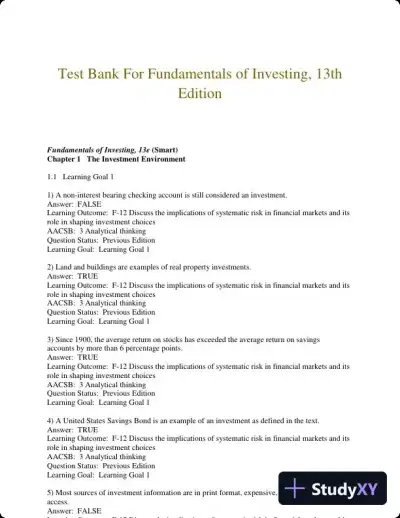 Exam Guides
Test Bank For Fundamentals of Investing, 13th Edition
Finance
539 pages124downloadsFeb 2025 Exam Guides
Test Bank For Fundamentals of Investing, 14th Edition
Finance
513 pagesMay 2025 Textbook Guides
Solution Manual For Investments, 12th Edition
Finance
314 pages161downloadsFeb 2025 Exam Guides
Test Bank for Principles of Managerial Finance, 8th Edition
Finance
851 pages158downloadsFeb 2025 Textbook Guides
Solution Manual for Financial Institutions Management: A Risk Management Approach, 8th Edition
Finance
486 pages154downloadsFeb 2025 Exam Guides
Test Bank for Principles of Managerial Finance, Arab World Edition
Finance
373 pages148downloadsFeb 2025 Textbook Guides
Multinational Financial Management, Study Guide, 6th Edition Solution Manual
Finance
278 pages146downloadsFeb 2025 Textbook Guides
Financial Markets and Institutions, 7th Edition Solution Manual
Finance
194 pages136downloadsFeb 2025
Study this document with CramX
Once it is in your library, every tool can work from it.