

Personal Finance 6th Canadian Edition Test Bank
- Finance
- 761 pages
- Shared May 2025
Get exam-ready with Personal Finance 6th Canadian Edition Test Bank, featuring clear concepts, step-by-step solutions, and study tips from experts.
Preview 16 of 761 pages
See the first 16 pages exactly as they appear in the document.
Page 1 Read page 1 as text
1 Student: ___________________________________________________________________________ 1. Personal financial planning has the main goal of: A. Savings and investing for future needs. B. Reducing a person's tax liability. C. Managing money to achieve personal economic satisfaction. D. Spending to achieve financial objectives. E. Savings, spending, and borrowing based on current needs. 2. The first step of the financial planning process is to A. develop financial goals. B. implement the financial plan. C. determine your current personal and financial situation. D. evaluate and revise your actions. E. create a financial plan of action. 3. Opportunity cost refers to: A. money needed for major consumer purchases. B. the trade - off of a decision. C. the amount paid for taxes when a purchase is made. D. current interest rates. E. evaluating different alternatives for financial decisions. 4. Increased consumer spending will usually cause: A. lower consumer prices. B. reduced employment levels. C. lower tax revenues. D. lower interest rates. E. higher employment levels.
Page 2 Page 3 Read page 3 as text
5. The uncertainty associated with decision making is referred to as: A. opportunity cost. B. selection of alternatives. C. financial goals. D. personal values. E. risk. 6. Some savings and investment choices have the potential for higher earnings. However, these may also be difficult to convert to cash when you need the funds. This problem refers to: A. Inflation risk B. Interest rate risk C. Income risk D. Personal risk E. Liquidity risk 7. The financial planning process concludes with efforts to: A. develop financial goals. B. create a financial plan of action. C. analyze your current personal and financial situation. D. implement the financial plan. E. revaluate and revise your actions. 8. Changes in income, values, and family situation make it necessary to: A. develop financial goals B. implement the financial plan. C. evaluate and revise your actions. D. analyze your current personal and financial situation. E. create a financial plan of action.
Page 4 Read page 4 as text
9. As Jeanne Taillefer plans to set aside funds for her young children's college education, she is setting a(n) ____________ goal. A. intermediate B. short term C. long - term D. intangible E. durable 10. ____________ goals relate to personal relationships, health, and education. A. Short - term B. Intangible - purchase C. Consumable - product D. Durable - product E. Intermediate 11. Brad Opper has a goal of "saving $50 a month for vacation." Brad's goal lacks A. measurable terms. B. a realistic perspective. C. specific actions. D. a tangible end. E. a time frame. 12. Which of the following goals would be the easiest to implement and measure its accomplishment? A. "Reduce our debt payments." B. "Save funds for an annual vacation." C. "Save $100 a month to create a $4,000 emergency fund." D. "Clear credit card debt E. "Invest $2,000 a year for retirement."
Page 5 Read page 5 as text
13. The present value of a future amount will decrease if _________________. I. the discount rate increases II. the amount occurs closer in time III. the compounding frequency increases IV. inflation increases A. I and II only B. I and III only C. II and III only D. III and IV only E. I, III and IV only 14. Higher prices are likely to result from: A. increased spending by consumers. B. increased production by business. C. lower interest rates. D. lower demand by consumers E. an increase in the supply of a product. 15. Who is most likely to benefit by inflation? A. retired people B. lenders C. borrowers D. low - income consumers E. government 16. Higher consumer prices are likely to be accompanied by: A. lower union wages. B. lower interest rates. C. lower production costs. D. higher interest rates. E. higher exports.
Page 6 Read page 6 as text
17. Increased consumer spending will usually cause: A. lower consumer prices. B. reduced employment levels. C. lower tax revenues. D. higher employment levels. E. lower interest rates. 18. Higher interest rates can be caused by: A. a lower money supply. B. an increase in the money supply. C. a decrease in consumer borrowing. D. lower government spending. E. increased saving and investing by consumers. 19. The changing cost of money is referred to as ____________ risk. A. interest - rate B. inflation C. economic D. trade - off E. personal 20. A risk premium associated with interest rates refers to: A. higher earnings due to uncertainty. B. lower consumer prices. C. the opportunity cost of borrowing D. a loan with a short maturity. E. expected lower inflation.
Page 7 Read page 7 as text
21. Assume the following future values will be received at the end of each year. What is the interest rate if the future value of these amounts at the end of year 3 is equal to $2,393? Yr. 1 = $500; Yr. 2 = $750; Yr. 3 = $1,000 A. 6.5% B. 6.8% C. 7.0% D. 8.0% E. 8.9% 22. The stages that an individual goes through based on age, financial needs, and family situation is called the: A. adult life cycle. B. budgeting procedure. C. personal economic cycle. D. financial planning process E. tax planning process. 23. Assume your uncle will pay you $100 for each of the next two years and $200 in years 3 and these amounts will be paid at year end. Assume the interest rate is 10% for the first two years and 12% for the next two (years 3 and 4). What is your uncle's promise worth in today's dollars? (Round your answer) A. $317 B. $342 C. $453 D. $512 E. $600 24. The main economic influence that determines prices is: A. the stock market. B. supply and demand. C. employment. D. government spending. E. interest rates
Page 8 Read page 8 as text
25. Reduced funds available for investment in our economy could result from A. expanded savings by consumers. B. higher imports than exports. C. reduced spending for consumer goods. D. higher exports than imports. E. higher opportunity costs. 26. Which of the following would cause prices to drop? A. a demand for higher wages B. increased production by business C. increased taxes on business D. a reduction in the money supply E. high levels of demand by customers 27. An example of a personal opportunity cost would be: A. lost wages due to continuing as a full time student B. higher earnings on savings that must be kept on deposit a minimum of six months. C. time comparing several brands of personal computers D. Interest lost by using savings to make a purchase E. having to pay a tax penalty due to not having enough withheld from your monthly salary. 28. The time value of money refers to: A. personal opportunity costs such as time lost on an activity. B. financial decisions that require borrowing funds from a financial institution. C. changes in interest rates due to changes in the supply and demand for money in our economy. D. increases in an amount of money as a result of interest. E. changing demographic trends in our society.
Page 9 Read page 9 as text
29. The amount of simple interest is determined by multiplying the amount in savings by the: A. annual interest rate. B. time period. C. number of months in a year. D. time period and number of months. E. annual interest rate and the time period. 30. What is the future value of $20,000 received in 10 years if it is invested at 6% compounded annually for the next six years and 5%, compounded semi - annually for the remaining four years? A. $25,000 B. $31,000 C. $32,772 D. $34,567 E. $38,817 31. If a person deposited $100 a month for 5 years earning 9 percent, this would involve what type of computation? A. simple interest B. future value of a single amount C. future value of a series of deposits D. present value of a single amount E. present value of a series of deposits 32. Which type of computation would a person use to determine current value of a desired amount for the future? A. simple interest B. future value of a single amount C. future value of a series of deposits D. present value of a single amount E. present value of a series of deposits
Page 10 Read page 10 as text
33. Future value calculations consider: A. compounding. B. add - on interest. C. discounting D. simple interest. E. an annuity. 34. If you put $1,000 in a saving account and make no further deposits, what type of calculation would provide you with the value of the account in 20 years? A. future value of a single amount B. simple interest C. present value of a single amount D. present value of a series of deposits E. future value of a series of deposits 35. An individual invests $10,000 at a rate of 5% per annum. What will be its value in 10 years' time? A. $15,000 B. $15,853 C. $16,289 D. $18,000 E. $19,000 36. A major activity in the planning component of financial planning is A. selecting insurance coverage. B. evaluating investment alternatives. C. gaining occupational training and experience. D. allocating current resources for spending. E. establishing a line of credit.
Page 11 Read page 11 as text
37. Liquidity refers to A. the earnings on savings. B. the risk of an investment. C. the ease of converting a financial resource into cash. D. the amount of insurance coverage a person has. E. a person's inability to pay his or her debts. 38. The problem of bankruptcy is associated with poor decisions in the ______________ component of financial planning. A. financial goals B. saving C. planning D. restructuring debt E. liquidity 39. A question associated with the saving component of financial planning is: A. Is your will current? B. Do you have an adequate emergency fund? C. Is your investment program appropriate to your income and tax situation? D. Do you have a realistic budget for your current financial situation? E. Are your transportation expenses minimized through careful planning? 40. When an individual makes a purchase without considering the financial consequences of that purchase, they are ignoring the ________________ aspect of financial planning. A. Borrowing B. Risk Management C. Spending D. Retirement and Estate Planning E. Obtaining
Page 12 Read page 12 as text
41. The major function of a financial plan is to: A. reduce taxes. B. increase savings. C. achieve financial goals. D. improve your credit rating. E. obtain adequate insurance protection. 42. Dani Roy wants to travel after she retires as well as pay off the balance of the loan she has on the home that she owns. Which step in the financial planning process does this situation demonstrate? A. Determining her current financial situation B. Developing her financial goals C. Identifying alternative courses of action D. Evaluating her alternatives E. Implementing her financial plan 43. Which of the following is usually considered a long - term financial strategy? A. creating a budget B. using savings to pay off a loan early C. renting an apartment to save for the purchase of a home D. investing in a growth mutual fund to accumulate retirement funds E. purchasing life insurance to cover current needs of dependents 44. You wish to accumulate $15,000 within five years. How much would you have to save each year for five years to attain your goal? Assume an annual interest rate of 4%. Savings occur at the end of each year. A. $2,662 B. $2,769 C. $2,905 D. $3,000 E. $3,500
Page 13 Read page 13 as text
45. Your goal is to pay down your student loan in 3 years. The balance today is $9,434. If you are charged a rate of 9%, compounded monthly, what will be your monthly, end - of - period payment? A. $527 B. $406 C. $300 D. $262 E. $193 46. The second step of the financial planning process is to A. develop financial goals. B. implement the financial plan. C. determine your current personal and financial situation. D. evaluate and revise your actions. E. create a financial plan of action. 47. Decreased consumer spending will usually cause: A. lower consumer prices. B. reduced employment levels. C. lower tax revenues. D. lower interest rates. E. higher employment levels. 48. Anne has a goal of "saving some money month for vacation next summer." Anne's goal lacks A. measurable terms. B. a realistic perspective. C. specific actions. D. a tangible end. E. a time frame.
Page 14 Read page 14 as text
49. Assume the following future values will be received at the end of each year. What is the interest rate if the future value of these amounts at the end of year 3 is equal to $2,006? Yr. 1 = $400; Yr. 2 = $500; Yr. 3 = $1,000 A. 6.5% B. 6.8% C. 7.0% D. 8.0% E. 8.9% 50. Assume your friend will pay you $200 for each of the next two years and $400 in years 3 and these amounts will be paid at year end. Assume the interest rate is 10% for the first two years and 12% for the next two (years 3 and 4). What is your friend's promise worth in today's dollars? (Round your answer) A. $1,000 B. $951 C. $906 D. $831 E. $600 51. Time value of money calculations consider: A. present value. B. interest rate. C. payment D. time period. E. all of the above. 52. An individual invests $5,000 at a rate of 5% per annum. What will be its value in 10 years' time? A. $7,500 B. $7,927 C. $8,144 D. $9,000 E. $9,542
Page 15 Read page 15 as text
53. Your goal is to pay down your student loan in 3 years. The balance today is $9,434. If you are charged a rate of 4%, compounded monthly, what will be your monthly, end - of - period payment? A. $262 B. $406 C. $279 D. $377 E. $300 54. Your goal is to accumulate in 4 years $5,000. If you can earn a rate of 4%, compounded monthly, what will be your end of month monthly payment need to be to reach this goal? A. $96 B. $104 C. $124 D. $262 E. $300 55. Financial planning does not have specific techniques that will be effective for every individual and household. True False 56. Analyzing your current financial position is a part of the first stage of the financial planning process. True False 57. Developing financial goals is the first step in the financial planning process. True False 58. Risks associated with most financial decisions are fairly easy to measure. True False 59. The financial planning process is complete once you implement your financial plan. True False 60. Intermediate goals are usually achieved within the next year or so. True False
Page 16 Read page 16 as text
61. Planning to buy a house is an example of a durable product goal. True False 62. Household size is a major influence on personal financial planning decisions. True False 63. Simple interest is the interest computed based on the principle, excluding previously earned interest. True False 64. Increased demand for a product or service will usually result in lower prices for the item. True False 65. Inflation reduces the buying power of money. True False 66. Lenders benefit less than borrowers in times of high inflation. True False 67. When prices are increasing at a rate of 6 percent, the cost of products would double in about 12 years. True False 68. A decrease in the demand for a product or service may result in a decrease in wages for people producing that item. True False 69. Higher inflation usually results in lower interest rates. True False 70. Opportunity costs refer to time, money, and other resources that are given up when a decision is made. True False
745 more pages in the full document
Unlock it once and it stays in your library, ready to chat with or turn into flashcards.
Unlock the full documentMore Finance study materials
See all Textbook Guides
Solution Manual For Investments, 12th Edition
Finance
314 pages161downloadsFeb 2025 Exam Guides
Test Bank for Principles of Managerial Finance, 8th Edition
Finance
851 pages158downloadsFeb 2025 Textbook Guides
Solution Manual for Financial Institutions Management: A Risk Management Approach, 8th Edition
Finance
486 pages154downloadsFeb 2025 Exam Guides
Test Bank for Principles of Managerial Finance, Arab World Edition
Finance
373 pages148downloadsFeb 2025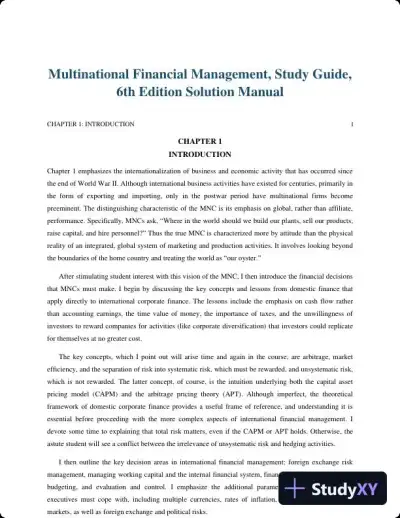 Textbook Guides
Multinational Financial Management, Study Guide, 6th Edition Solution Manual
Finance
278 pages146downloadsFeb 2025 Textbook Guides
Financial Markets and Institutions, 7th Edition Solution Manual
Finance
194 pages136downloadsFeb 2025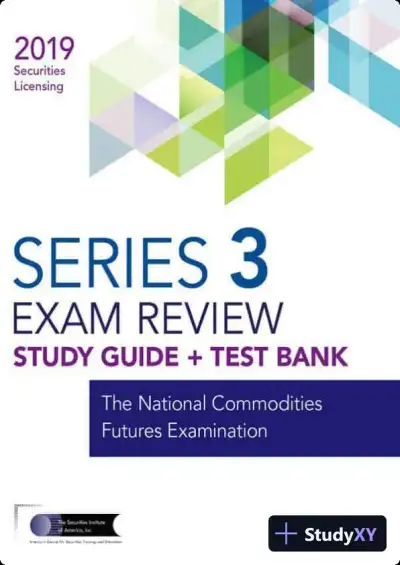 Certification Guides
Wiley Finra Series 3 Exam Review (2019)
Finance
253 pages131downloadsFeb 2025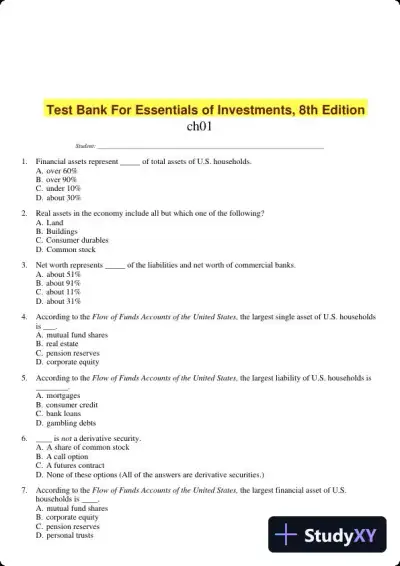 Exam Guides
Test Bank For Essentials of Investments, 8th Edition
Finance
368 pages130downloadsFeb 2025
Study this document with CramX
Once it is in your library, every tool can work from it.