
Textbook Guides
Solution Manual for Arbitrage Theory in Continuous Time, 2nd Edition
- Finance
- 106 pages
- Shared May 2025
Need help with textbook problems? Solution Manual for Arbitrage Theory in Continuous Time, 2nd Edition is the perfect solution, providing comprehensive answers to every question.
Preview · 16 of 106 pages
100%
Page 1
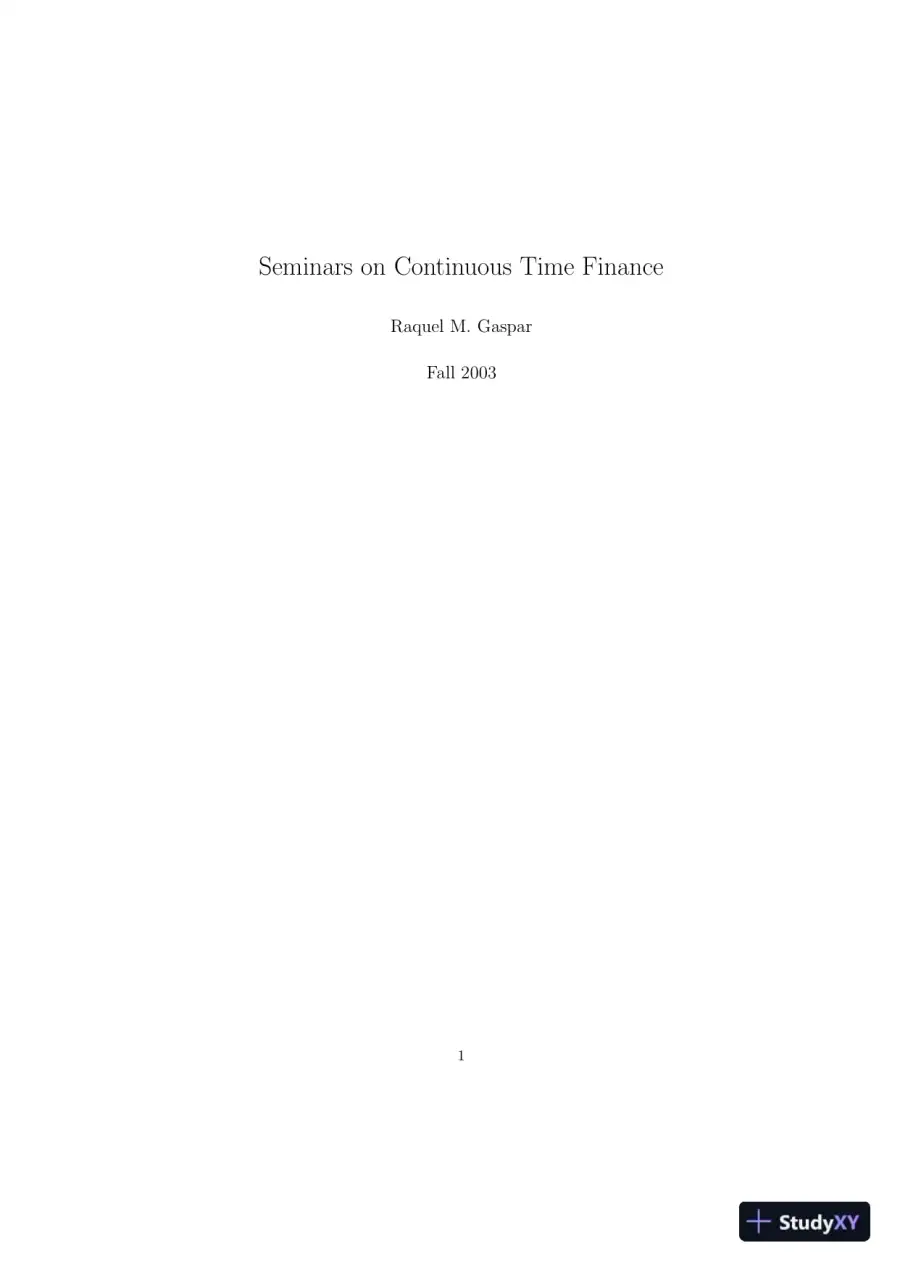 Seminars on Continuous Time FinanceRaquel M. GasparFall 20031
Page 2

Page 3
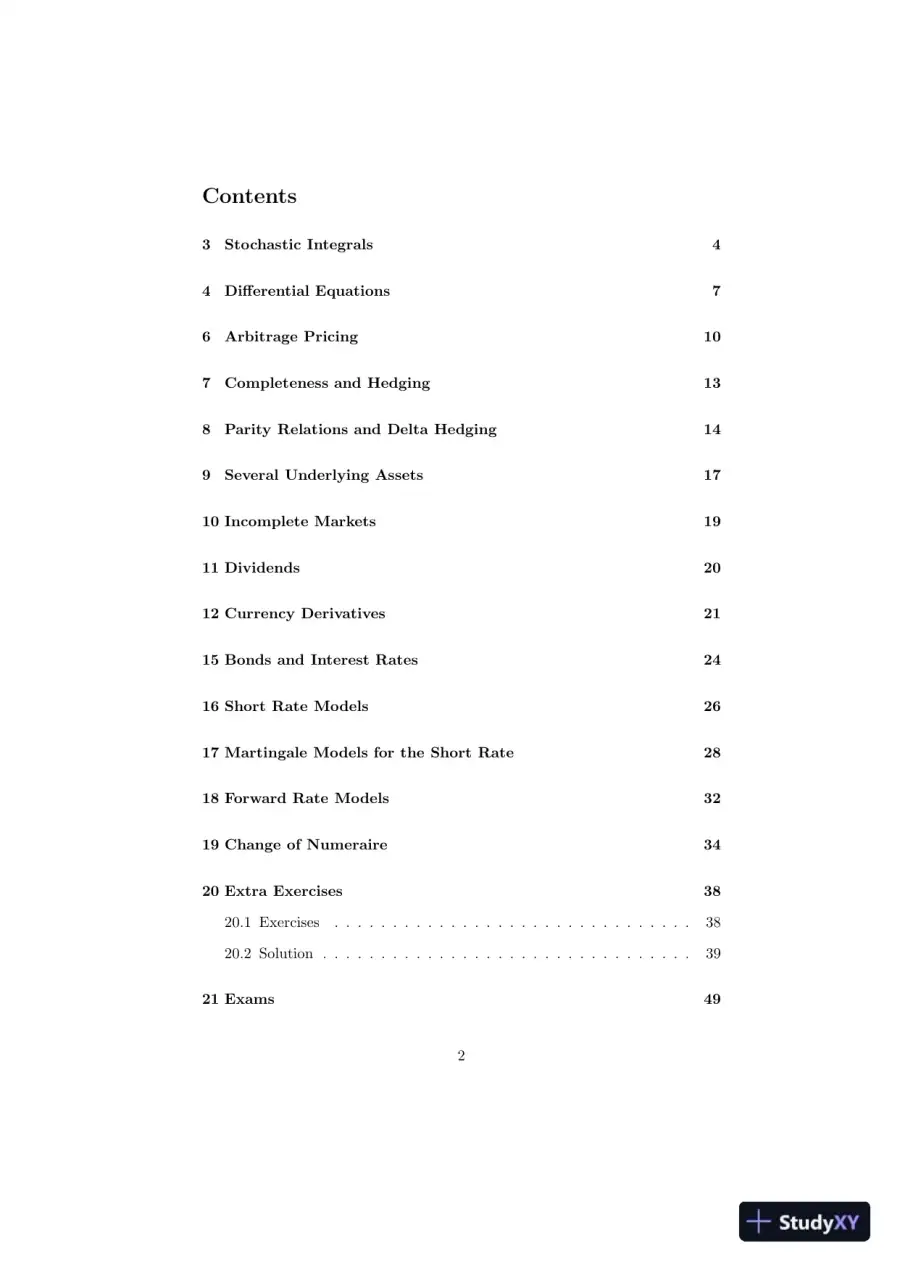 Contents3Stochastic Integrals44Differential Equations76Arbitrage Pricing107Completeness and Hedging138Parity Relations and Delta Hedging149Several Underlying Assets1710 Incomplete Markets1911 Dividends2012 Currency Derivatives2115 Bonds and Interest Rates2416 Short Rate Models2617 Martingale Models for the Short Rate2818 Forward Rate Models3219 Change of Numeraire3420 Extra Exercises3820.1 Exercises. . . . . . . . . . . . . . . . . . . . . . . . . . . . . . .3820.2 Solution. . . . . . . . . . . . . . . . . . . . . . . . . . . . . . . .3921 Exams492
Page 4
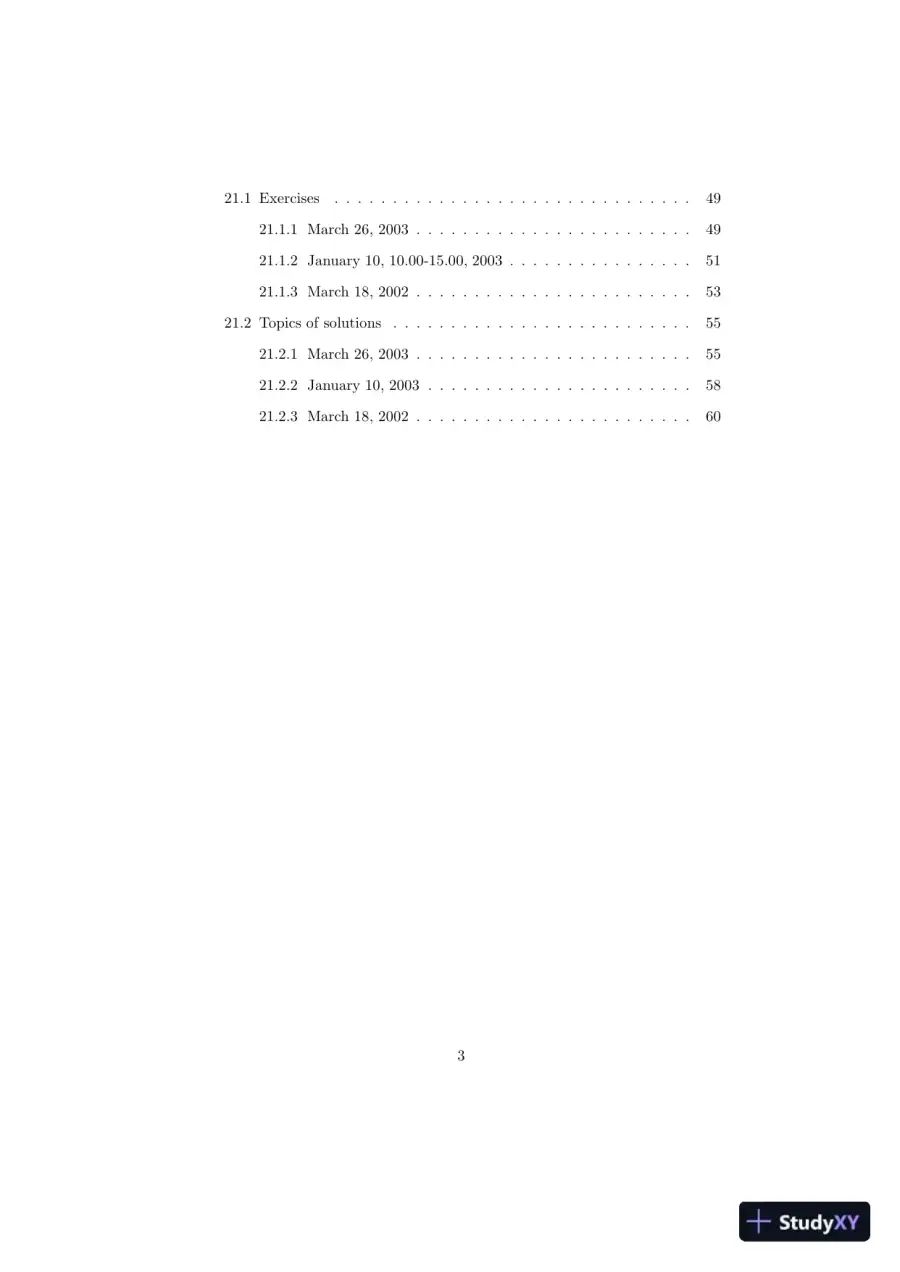 21.1 Exercises. . . . . . . . . . . . . . . . . . . . . . . . . . . . . . .4921.1.1March 26, 2003 . . . . . . . . . . . . . . . . . . . . . . . .4921.1.2January 10, 10.00-15.00, 2003 . . . . . . . . . . . . . . . .5121.1.3March 18, 2002 . . . . . . . . . . . . . . . . . . . . . . . .5321.2 Topics of solutions. . . . . . . . . . . . . . . . . . . . . . . . . .5521.2.1March 26, 2003 . . . . . . . . . . . . . . . . . . . . . . . .5521.2.2January 10, 2003 . . . . . . . . . . . . . . . . . . . . . . .5821.2.3March 18, 2002 . . . . . . . . . . . . . . . . . . . . . . . .603
Page 5
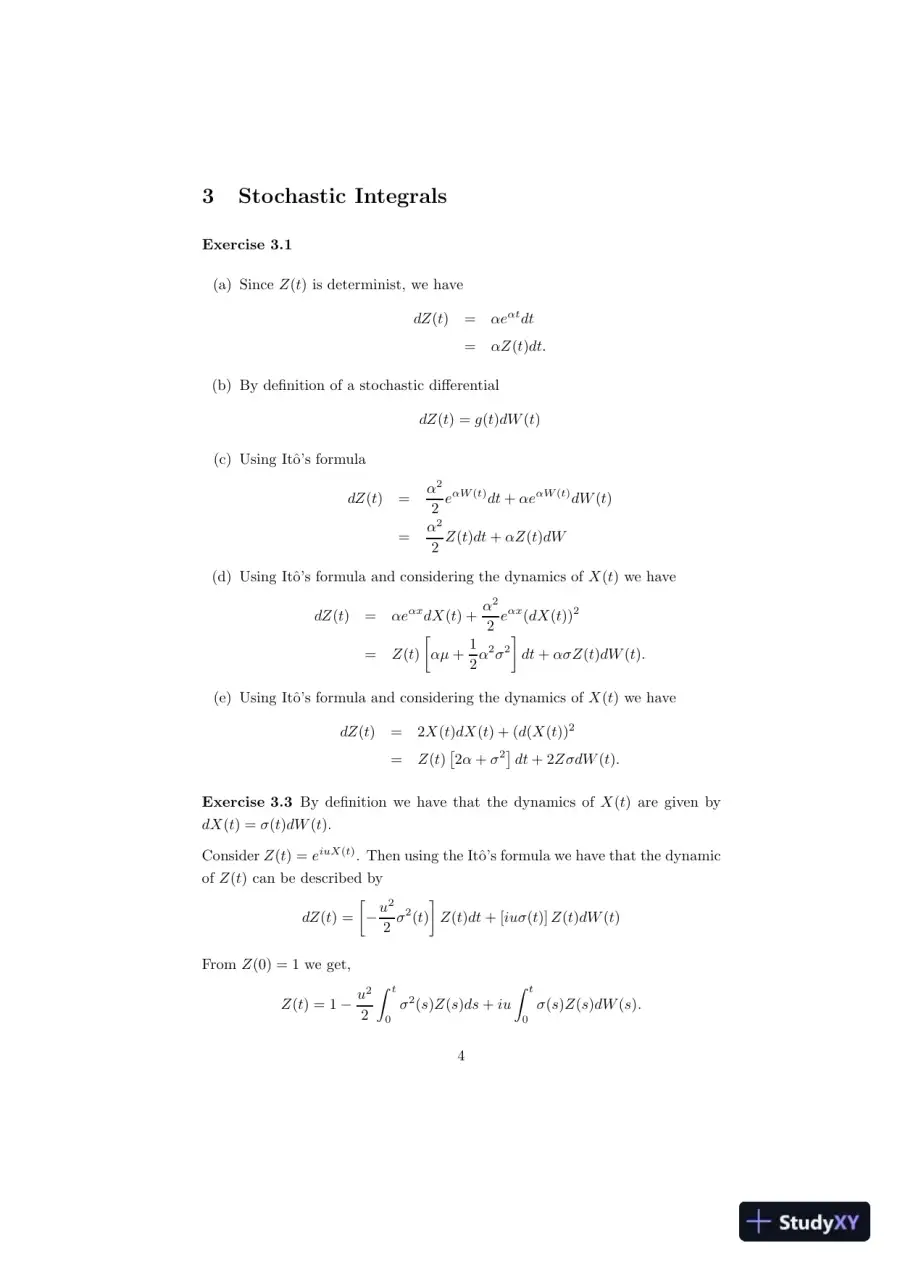 3Stochastic IntegralsExercise 3.1(a) SinceZ(t) is determinist, we havedZ(t)=αeαtdt=αZ(t)dt.(b) By definition of a stochastic differentialdZ(t) =g(t)dW(t)(c) Using Itˆo’s formuladZ(t)=α22eαW(t)dt+αeαW(t)dW(t)=α22Z(t)dt+αZ(t)dW(d) Using Itˆo’s formula and considering the dynamics ofX(t) we havedZ(t)=αeαxdX(t) +α22eαx(dX(t))2=Z(t)[αμ+ 12α2σ2]dt+ασZ(t)dW(t).(e) Using Itˆo’s formula and considering the dynamics ofX(t) we havedZ(t)=2X(t)dX(t) + (d(X(t))2=Z(t)[2α+σ2]dt+ 2ZσdW(t).Exercise 3.3By definition we have that the dynamics ofX(t) are given bydX(t) =σ(t)dW(t).ConsiderZ(t) =eiuX(t). Then using the Itˆo’s formula we have that the dynamicofZ(t) can be described bydZ(t) =[−u22σ2(t)]Z(t)dt+ [iuσ(t)]Z(t)dW(t)FromZ(0) = 1 we get,Z(t) = 1−u22∫t0σ2(s)Z(s)ds+iu∫t0σ(s)Z(s)dW(s).4
Page 6
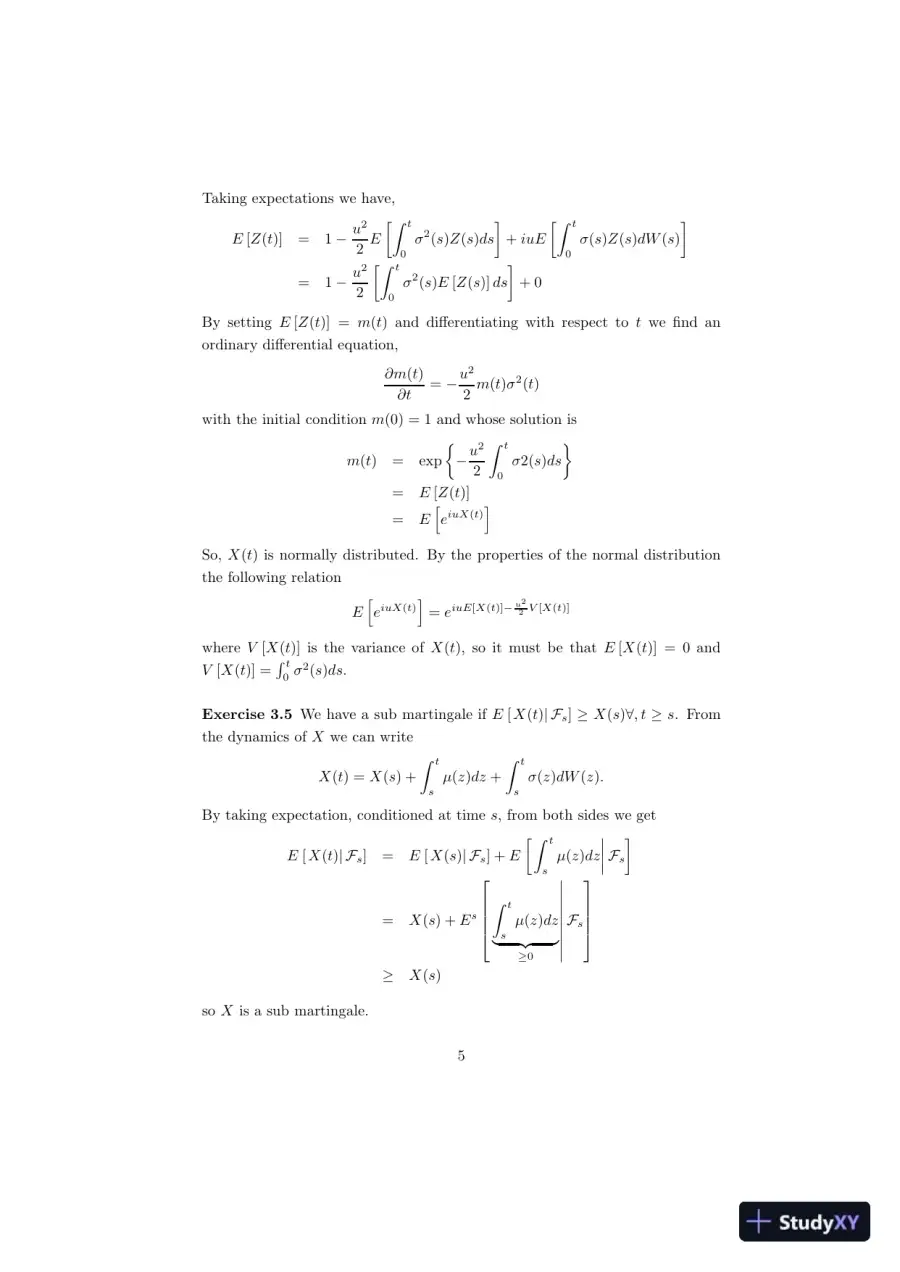 Taking expectations we have,E[Z(t)]=1−u22E[∫t0σ2(s)Z(s)ds]+iuE[∫t0σ(s)Z(s)dW(s)]=1−u22[∫t0σ2(s)E[Z(s)]ds]+ 0By settingE[Z(t)] =m(t) and differentiating with respect totwe find anordinary differential equation,∂m(t)∂t=−u22m(t)σ2(t)with the initial conditionm(0) = 1 and whose solution ism(t)=exp{−u22∫t0σ2(s)ds}=E[Z(t)]=E[eiuX(t)]So,X(t) is normally distributed. By the properties of the normal distributionthe following relationE[eiuX(t)]=eiuE[X(t)]−u22V[X(t)]whereV[X(t)] is the variance ofX(t), so it must be thatE[X(t)] = 0 andV[X(t)] =∫t0σ2(s)ds.Exercise 3.5We have a sub martingale ifE[X(t)| Fs]≥X(s)∀, t≥s. Fromthe dynamics ofXwe can writeX(t) =X(s) +∫tsμ(z)dz+∫tsσ(z)dW(z).By taking expectation, conditioned at times, from both sides we getE[X(t)| Fs]=E[X(s)| Fs] +E[ ∫tsμ(z)dz∣∣∣∣Fs]=X(s) +Es∫tsμ(z)dz︸︷︷︸≥0∣∣∣∣∣∣∣∣∣Fs≥X(s)soXis a sub martingale.5
Page 7
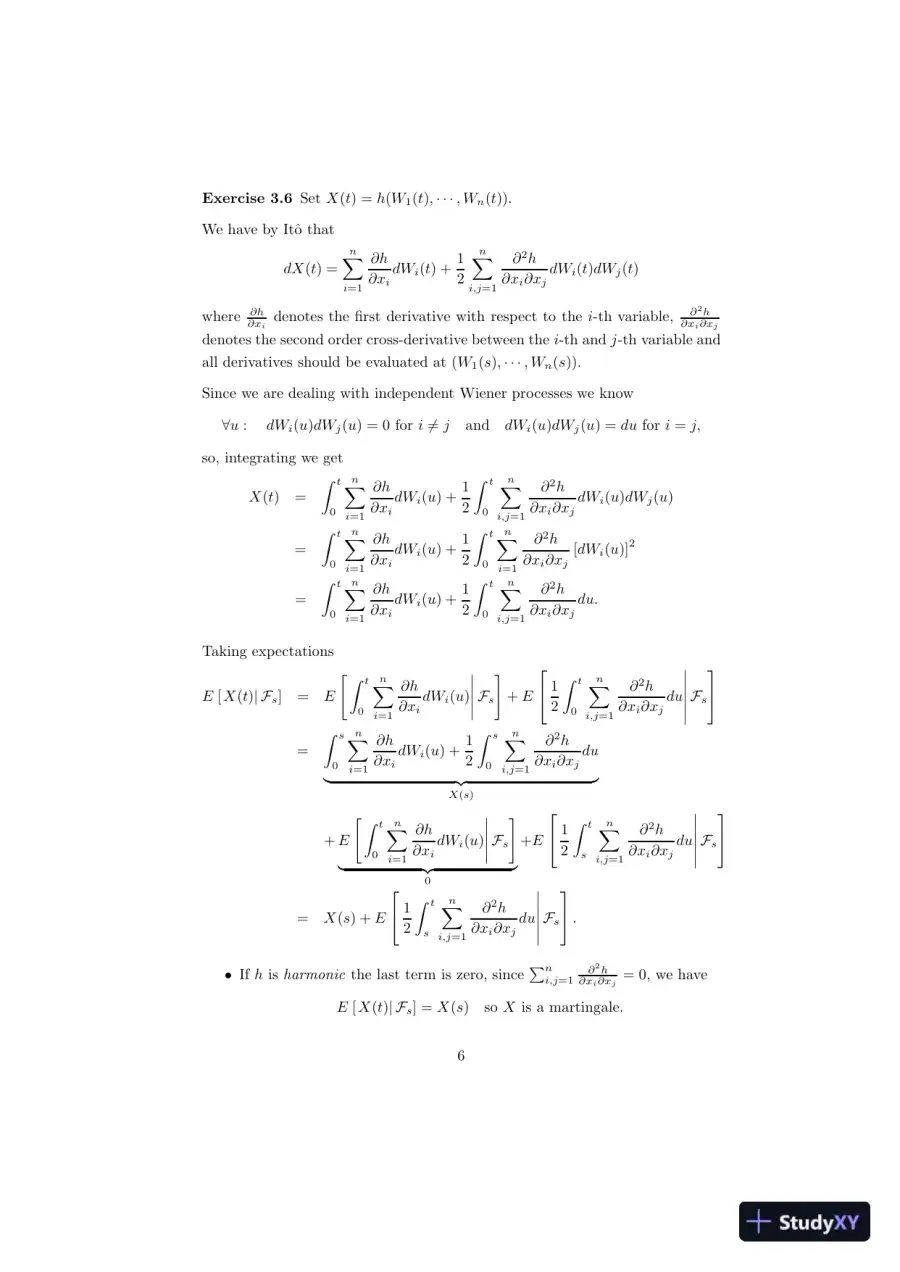 Exercise 3.6SetX(t) =h(W1(t),· · ·, Wn(t)).We have by Itˆo thatdX(t) =n∑i=1∂h∂xidWi(t) + 12n∑i,j=1∂2h∂xi∂xjdWi(t)dWj(t)where∂h∂xidenotes the first derivative with respect to thei-th variable,∂2h∂xi∂xjdenotes the second order cross-derivative between thei-th andj-th variable andall derivatives should be evaluated at (W1(s),· · ·, Wn(s)).Since we are dealing with independent Wiener processes we know∀u:dWi(u)dWj(u) = 0 fori6=janddWi(u)dWj(u) =dufori=j,so, integrating we getX(t)=∫t0n∑i=1∂h∂xidWi(u) + 12∫t0n∑i,j=1∂2h∂xi∂xjdWi(u)dWj(u)=∫t0n∑i=1∂h∂xidWi(u) + 12∫t0n∑i=1∂2h∂xi∂xj[dWi(u)]2=∫t0n∑i=1∂h∂xidWi(u) + 12∫t0n∑i,j=1∂2h∂xi∂xjdu.Taking expectationsE[X(t)| Fs]=E[ ∫t0n∑i=1∂h∂xidWi(u)∣∣∣∣∣Fs]+E12∫t0n∑i,j=1∂2h∂xi∂xjdu∣∣∣∣∣∣Fs=∫s0n∑i=1∂h∂xidWi(u) + 12∫s0n∑i,j=1∂2h∂xi∂xjdu︸︷︷︸X(s)+E[ ∫t0n∑i=1∂h∂xidWi(u)∣∣∣∣∣Fs]︸︷︷︸0+E12∫tsn∑i,j=1∂2h∂xi∂xjdu∣∣∣∣∣∣Fs=X(s) +E12∫tsn∑i,j=1∂2h∂xi∂xjdu∣∣∣∣∣∣Fs.•Ifhisharmonicthe last term is zero, since∑ni,j=1∂2h∂xi∂xj= 0, we haveE[X(t)| Fs] =X(s)soXis a martingale.6
Page 8
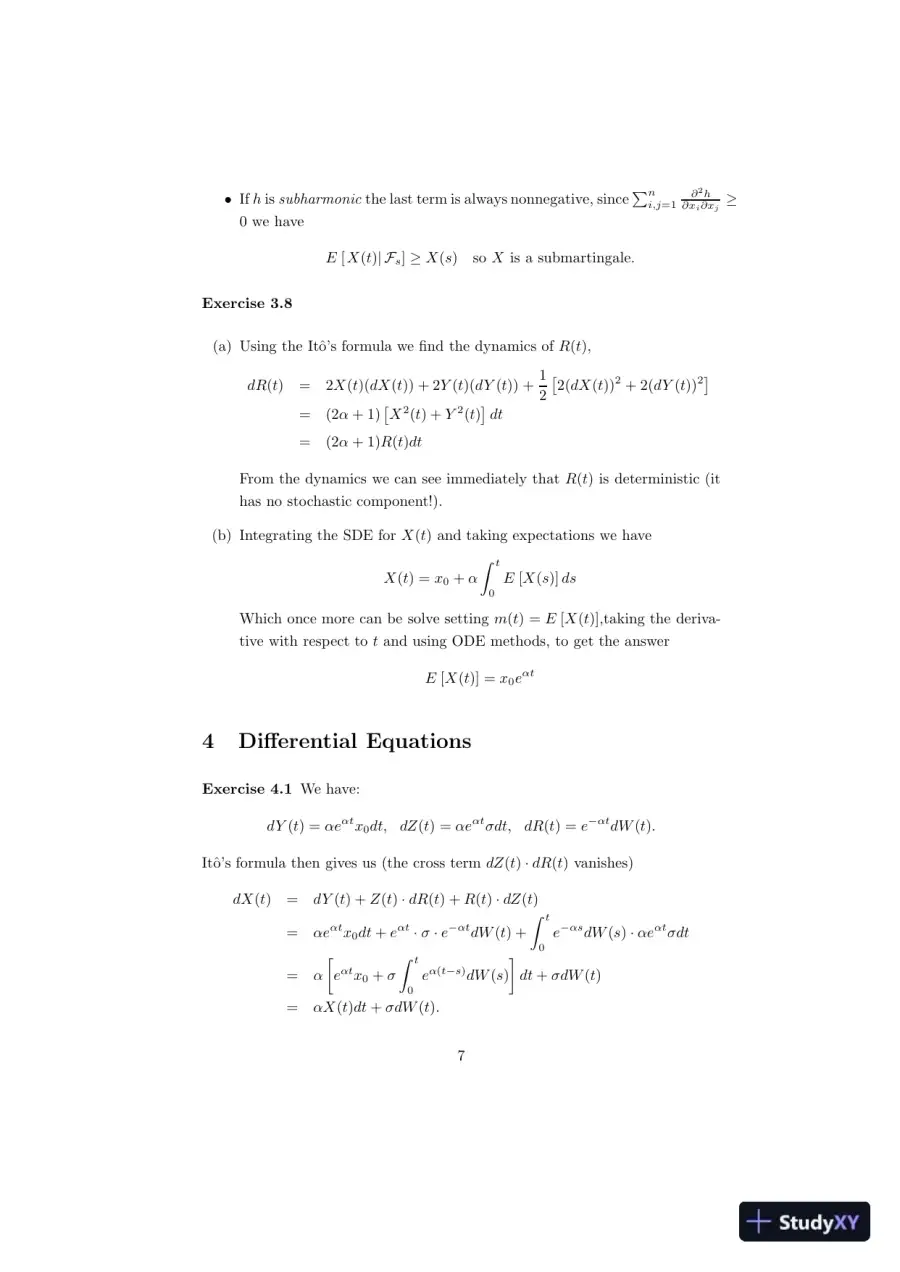 •Ifhissubharmonicthe last term is always nonnegative, since∑ni,j=1∂2h∂xi∂xj≥0 we haveE[X(t)| Fs]≥X(s)soXis a submartingale.Exercise 3.8(a) Using the Itˆo’s formula we find the dynamics ofR(t),dR(t)=2X(t)(dX(t)) + 2Y(t)(dY(t)) + 12[2(dX(t))2+ 2(dY(t))2]=(2α+ 1)[X2(t) +Y2(t)]dt=(2α+ 1)R(t)dtFrom the dynamics we can see immediately thatR(t) is deterministic (ithas no stochastic component!).(b) Integrating the SDE forX(t) and taking expectations we haveX(t) =x0+α∫t0E[X(s)]dsWhich once more can be solve settingm(t) =E[X(t)],taking the deriva-tive with respect totand using ODE methods, to get the answerE[X(t)] =x0eαt4Differential EquationsExercise 4.1We have:dY(t) =αeαtx0dt,dZ(t) =αeαtσdt,dR(t) =e−αtdW(t).Itˆo’s formula then gives us (the cross termdZ(t)·dR(t) vanishes)dX(t)=dY(t) +Z(t)·dR(t) +R(t)·dZ(t)=αeαtx0dt+eαt·σ·e−αtdW(t) +∫t0e−αsdW(s)·αeαtσdt=α[eαtx0+σ∫t0eα(t−s)dW(s)]dt+σdW(t)=αX(t)dt+σdW(t).7
Page 9
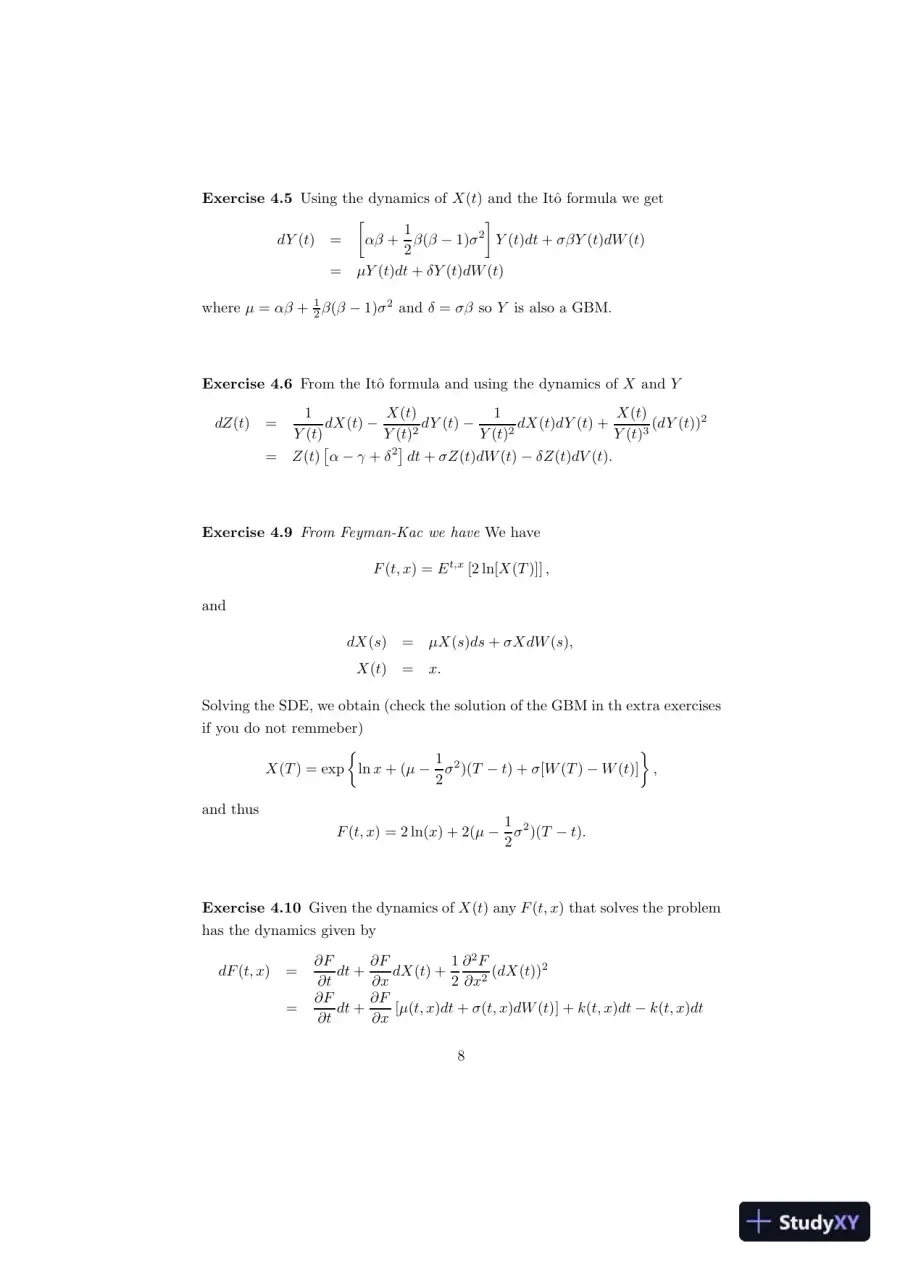 Exercise 4.5Using the dynamics ofX(t) and the Itˆo formula we getdY(t)=[αβ+ 12β(β−1)σ2]Y(t)dt+σβY(t)dW(t)=μY(t)dt+δY(t)dW(t)whereμ=αβ+12β(β−1)σ2andδ=σβsoYis also a GBM.Exercise 4.6From the Itˆo formula and using the dynamics ofXandYdZ(t)=1Y(t)dX(t)−X(t)Y(t)2dY(t)−1Y(t)2dX(t)dY(t) +X(t)Y(t)3(dY(t))2=Z(t)[α−γ+δ2]dt+σZ(t)dW(t)−δZ(t)dV(t).Exercise 4.9From Feyman-Kac we haveWe haveF(t, x) =Et,x[2 ln[X(T)]],anddX(s)=μX(s)ds+σXdW(s),X(t)=x.Solving the SDE, we obtain (check the solution of the GBM in th extra exercisesif you do not remmeber)X(T) = exp{lnx+ (μ−12σ2)(T−t) +σ[W(T)−W(t)]},and thusF(t, x) = 2 ln(x) + 2(μ−12σ2)(T−t).Exercise 4.10Given the dynamics ofX(t) anyF(t, x) that solves the problemhas the dynamics given bydF(t, x)=∂F∂t dt+∂F∂x dX(t) + 12∂2F∂x2(dX(t))2=∂F∂t dt+∂F∂x[μ(t, x)dt+σ(t, x)dW(t)] +k(t, x)dt−k(t, x)dt8
Page 10
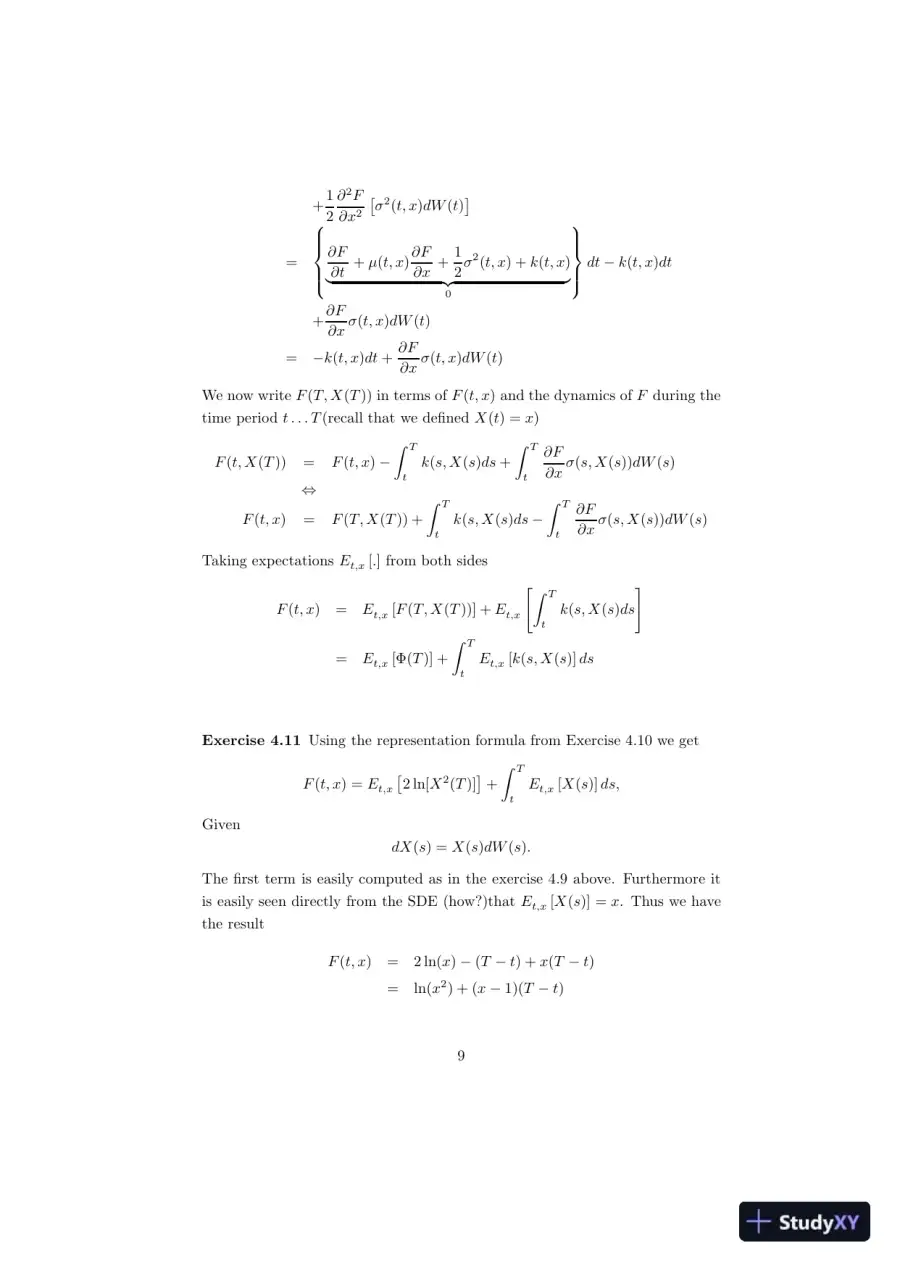 + 12∂2F∂x2[σ2(t, x)dW(t)]=∂F∂t+μ(t, x)∂F∂x+ 12σ2(t, x) +k(t, x)︸︷︷︸0dt−k(t, x)dt+∂F∂x σ(t, x)dW(t)=−k(t, x)dt+∂F∂x σ(t, x)dW(t)We now writeF(T, X(T)) in terms ofF(t, x) and the dynamics ofFduring thetime periodt . . . T(recall that we definedX(t) =x)F(t, X(T))=F(t, x)−∫Ttk(s, X(s)ds+∫Tt∂F∂x σ(s, X(s))dW(s)⇔F(t, x)=F(T, X(T)) +∫Ttk(s, X(s)ds−∫Tt∂F∂x σ(s, X(s))dW(s)Taking expectationsEt,x[.] from both sidesF(t, x)=Et,x[F(T, X(T))] +Et,x[∫Ttk(s, X(s)ds]=Et,x[Φ(T)] +∫TtEt,x[k(s, X(s)]dsExercise 4.11Using the representation formula from Exercise 4.10 we getF(t, x) =Et,x[2 ln[X2(T)]]+∫TtEt,x[X(s)]ds,GivendX(s) =X(s)dW(s).The first term is easily computed as in the exercise 4.9 above. Furthermore itis easily seen directly from the SDE (how?)thatEt,x[X(s)] =x. Thus we havethe resultF(t, x)=2 ln(x)−(T−t) +x(T−t)=ln(x2) + (x−1)(T−t)9
Page 11
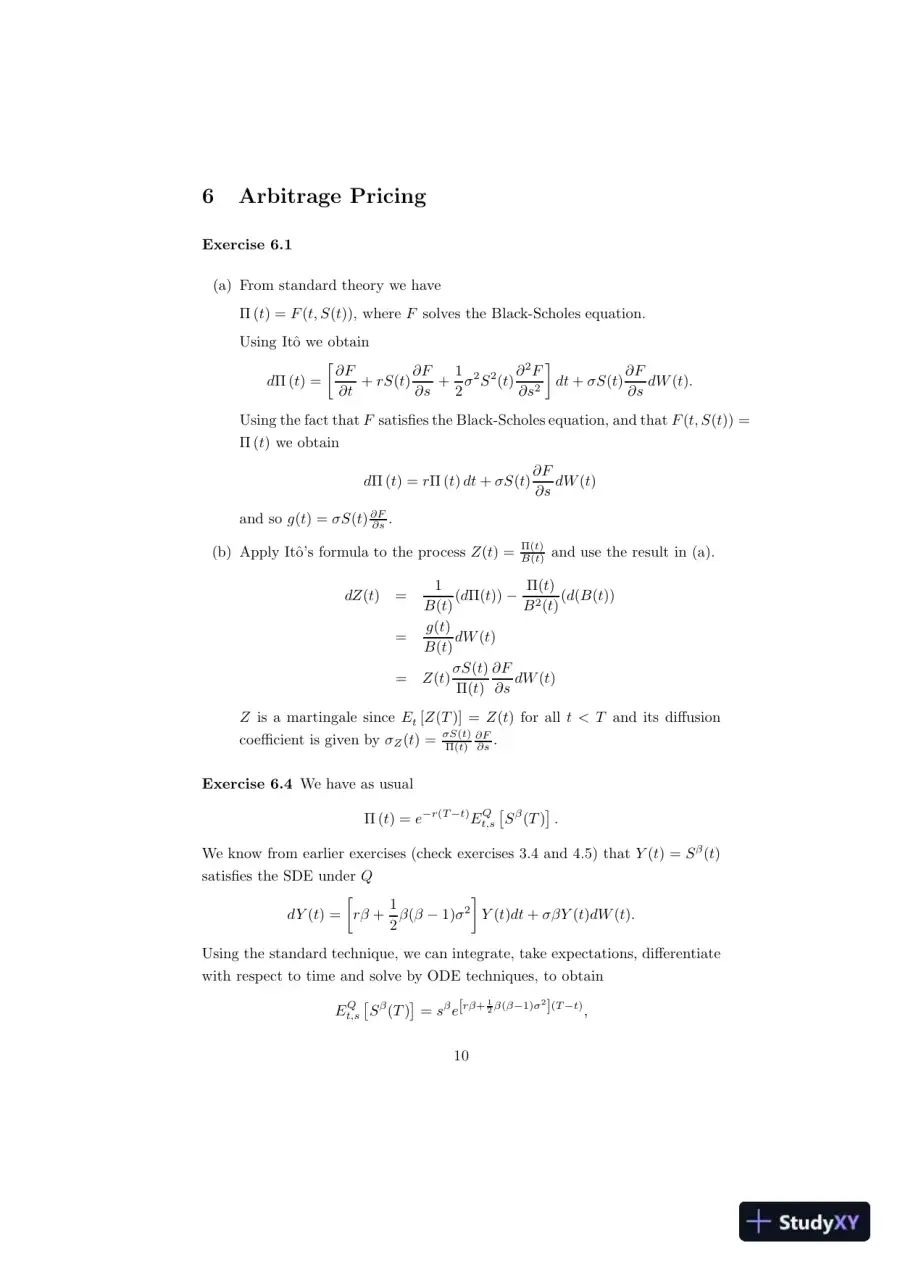 6Arbitrage PricingExercise 6.1(a) From standard theory we haveΠ (t) =F(t, S(t)),whereFsolves the Black-Scholes equation.Using Itˆo we obtaindΠ (t) =[∂F∂t+rS(t)∂F∂s+ 12σ2S2(t)∂2F∂s2]dt+σS(t)∂F∂s dW(t).Using the fact thatFsatisfies the Black-Scholes equation, and thatF(t, S(t)) =Π (t) we obtaindΠ (t) =rΠ (t)dt+σS(t)∂F∂s dW(t)and sog(t) =σS(t)∂F∂s.(b) Apply Itˆo’s formula to the processZ(t) =Π(t)B(t)and use the result in (a).dZ(t)=1B(t) (dΠ(t))−Π(t)B2(t) (d(B(t))=g(t)B(t)dW(t)=Z(t)σS(t)Π(t)∂F∂s dW(t)Zis a martingale sinceEt[Z(T)] =Z(t) for allt < Tand its diffusioncoefficient is given byσZ(t) =σS(t)Π(t)∂F∂s.Exercise 6.4We have as usualΠ (t) =e−r(T−t)EQt,s[Sβ(T)].We know from earlier exercises (check exercises 3.4 and 4.5) thatY(t) =Sβ(t)satisfies the SDE underQdY(t) =[rβ+ 12β(β−1)σ2]Y(t)dt+σβY(t)dW(t).Using the standard technique, we can integrate, take expectations, differentiatewith respect to time and solve by ODE techniques, to obtainEQt,s[Sβ(T)]=sβe[rβ+12β(β−1)σ2](T−t),10
Page 12
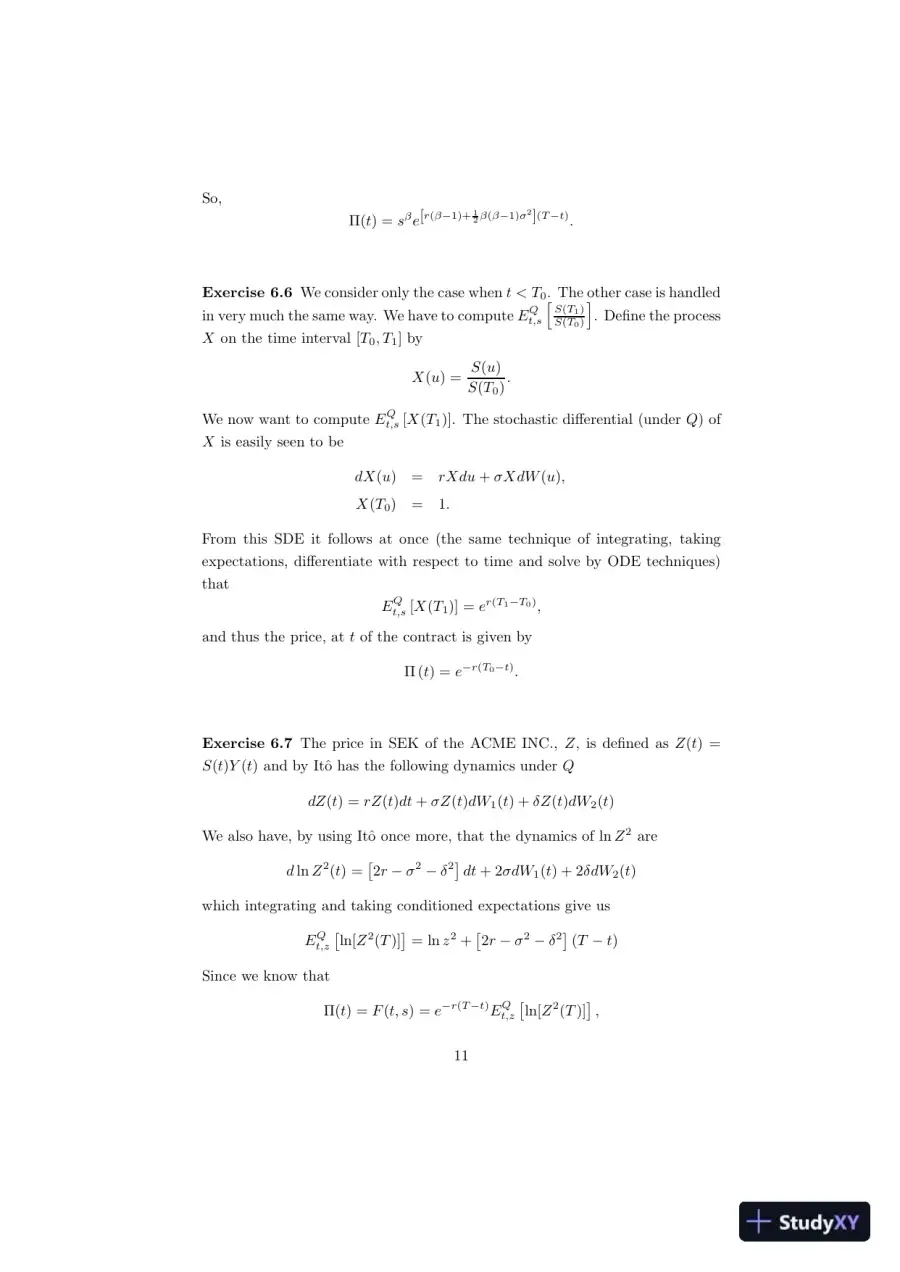 So,Π(t) =sβe[r(β−1)+12β(β−1)σ2](T−t).Exercise 6.6We consider only the case whent < T0. The other case is handledin very much the same way. We have to computeEQt,s[S(T1)S(T0)]. Define the processXon the time interval [T0, T1] byX(u) =S(u)S(T0).We now want to computeEQt,s[X(T1)]. The stochastic differential (underQ) ofXis easily seen to bedX(u)=rXdu+σXdW(u),X(T0)=1.From this SDE it follows at once (the same technique of integrating, takingexpectations, differentiate with respect to time and solve by ODE techniques)thatEQt,s[X(T1)] =er(T1−T0),and thus the price, attof the contract is given byΠ (t) =e−r(T0−t).Exercise 6.7The price in SEK of the ACME INC.,Z, is defined asZ(t) =S(t)Y(t) and by Itˆo has the following dynamics underQdZ(t) =rZ(t)dt+σZ(t)dW1(t) +δZ(t)dW2(t)We also have, by using Itˆo once more, that the dynamics of lnZ2aredlnZ2(t) =[2r−σ2−δ2]dt+ 2σdW1(t) + 2δdW2(t)which integrating and taking conditioned expectations give usEQt,z[ln[Z2(T)]]= lnz2+[2r−σ2−δ2](T−t)Since we know thatΠ(t) =F(t, s) =e−r(T−t)EQt,z[ln[Z2(T)]],11
Page 13
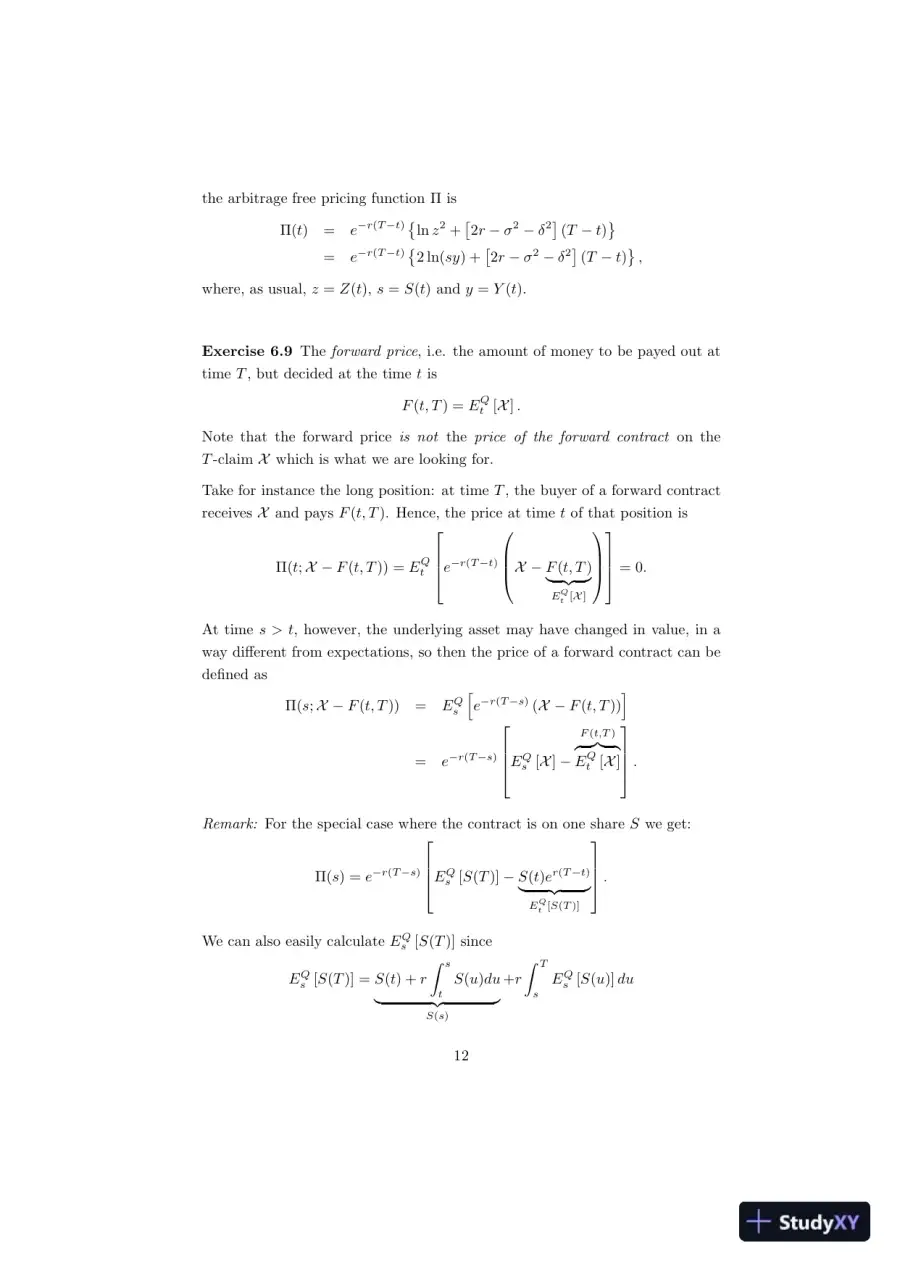 the arbitrage free pricing function Π isΠ(t)=e−r(T−t){lnz2+[2r−σ2−δ2](T−t)}=e−r(T−t){2 ln(sy) +[2r−σ2−δ2](T−t)},where, as usual,z=Z(t),s=S(t) andy=Y(t).Exercise 6.9Theforward price, i.e. the amount of money to be payed out attimeT, but decided at the timetisF(t, T) =EQt[X].Note that the forward priceis nottheprice of the forward contracton theT-claimXwhich is what we are looking for.Take for instance the long position: at timeT, the buyer of a forward contractreceivesXand paysF(t, T). Hence, the price at timetof that position isΠ(t;X −F(t, T)) =EQte−r(T−t)X −F(t, T)︸︷︷︸EQt[X]= 0.At times > t, however, the underlying asset may have changed in value, in away different from expectations, so then the price of a forward contract can bedefined asΠ(s;X −F(t, T))=EQs[e−r(T−s)(X −F(t, T))]=e−r(T−s)EQs[X]−F(t,T)︷︸︸︷EQt[X].Remark:For the special case where the contract is on one shareSwe get:Π(s) =e−r(T−s)EQs[S(T)]−S(t)er(T−t)︸︷︷︸EQt[S(T)].We can also easily calculateEQs[S(T)] sinceEQs[S(T)] =S(t) +r∫stS(u)du︸︷︷︸S(s)+r∫TsEQs[S(u)]du12
Page 14
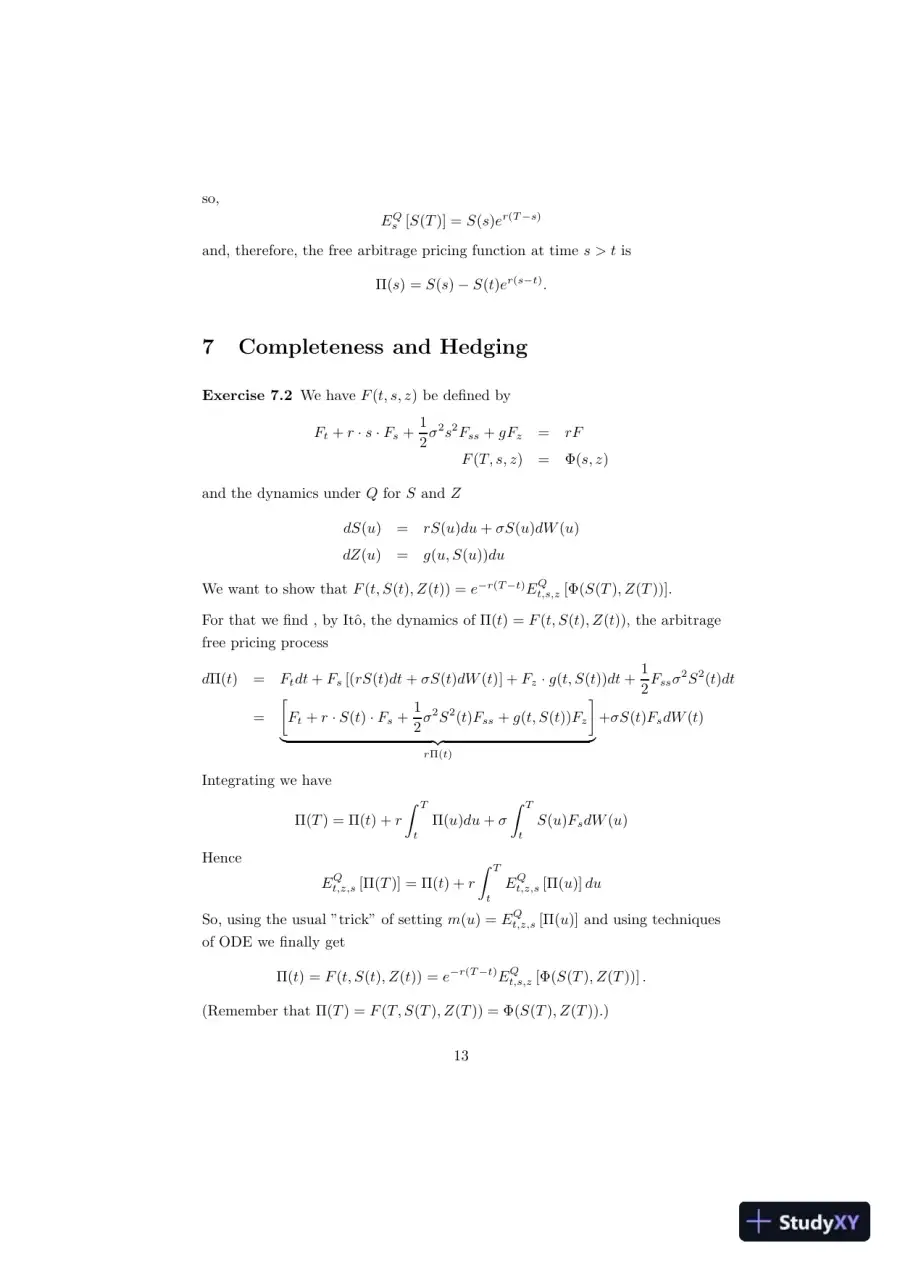 so,EQs[S(T)] =S(s)er(T−s)and, therefore, the free arbitrage pricing function at times > tisΠ(s) =S(s)−S(t)er(s−t).7Completeness and HedgingExercise 7.2We haveF(t, s, z) be defined byFt+r·s·Fs+ 12σ2s2Fss+gFz=rFF(T, s, z)=Φ(s, z)and the dynamics underQforSandZdS(u)=rS(u)du+σS(u)dW(u)dZ(u)=g(u, S(u))duWe want to show thatF(t, S(t), Z(t)) =e−r(T−t)EQt,s,z[Φ(S(T), Z(T))].For that we find , by Itˆo, the dynamics of Π(t) =F(t, S(t), Z(t)), the arbitragefree pricing processdΠ(t)=Ftdt+Fs[(rS(t)dt+σS(t)dW(t)] +Fz·g(t, S(t))dt+ 12Fssσ2S2(t)dt=[Ft+r·S(t)·Fs+ 12σ2S2(t)Fss+g(t, S(t))Fz]︸︷︷︸rΠ(t)+σS(t)FsdW(t)Integrating we haveΠ(T) = Π(t) +r∫TtΠ(u)du+σ∫TtS(u)FsdW(u)HenceEQt,z,s[Π(T)] = Π(t) +r∫TtEQt,z,s[Π(u)]duSo, using the usual ”trick” of settingm(u) =EQt,z,s[Π(u)] and using techniquesof ODE we finally getΠ(t) =F(t, S(t), Z(t)) =e−r(T−t)EQt,s,z[Φ(S(T), Z(T))].(Remember that Π(T) =F(T, S(T), Z(T)) = Φ(S(T), Z(T)).)13
Page 15
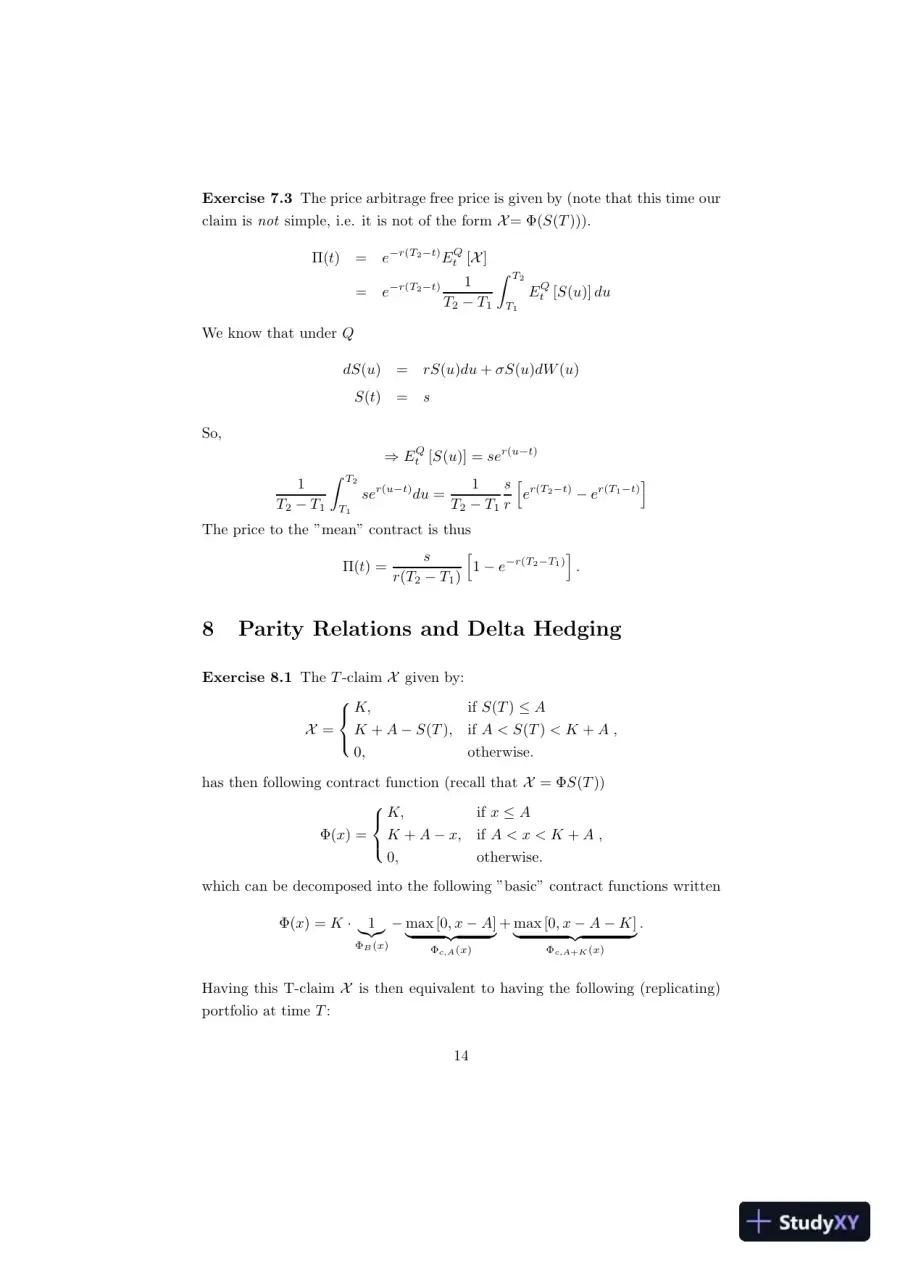 Exercise 7.3The price arbitrage free price is given by (note that this time ourclaim isnotsimple, i.e. it is not of the formX= Φ(S(T))).Π(t)=e−r(T2−t)EQt[X]=e−r(T2−t)1T2−T1∫T2T1EQt[S(u)]duWe know that underQdS(u)=rS(u)du+σS(u)dW(u)S(t)=sSo,⇒EQt[S(u)] =ser(u−t)1T2−T1∫T2T1ser(u−t)du=1T2−T1sr[er(T2−t)−er(T1−t)]The price to the ”mean” contract is thusΠ(t) =sr(T2−T1)[1−e−r(T2−T1)].8Parity Relations and Delta HedgingExercise 8.1TheT-claimXgiven by:X=K,ifS(T)≤AK+A−S(T),ifA < S(T)< K+A0,otherwise.,has then following contract function (recall thatX= ΦS(T))Φ(x) =K,ifx≤AK+A−x,ifA < x < K+A0,otherwise.,which can be decomposed into the following ”basic” contract functions writtenΦ(x) =K·1︸︷︷︸ΦB(x)−max [0, x−A]︸︷︷︸Φc,A(x)+ max [0, x−A−K]︸︷︷︸Φc,A+K(x).Having this T-claimXis then equivalent to having the following (replicating)portfolio at timeT:14
Page 16
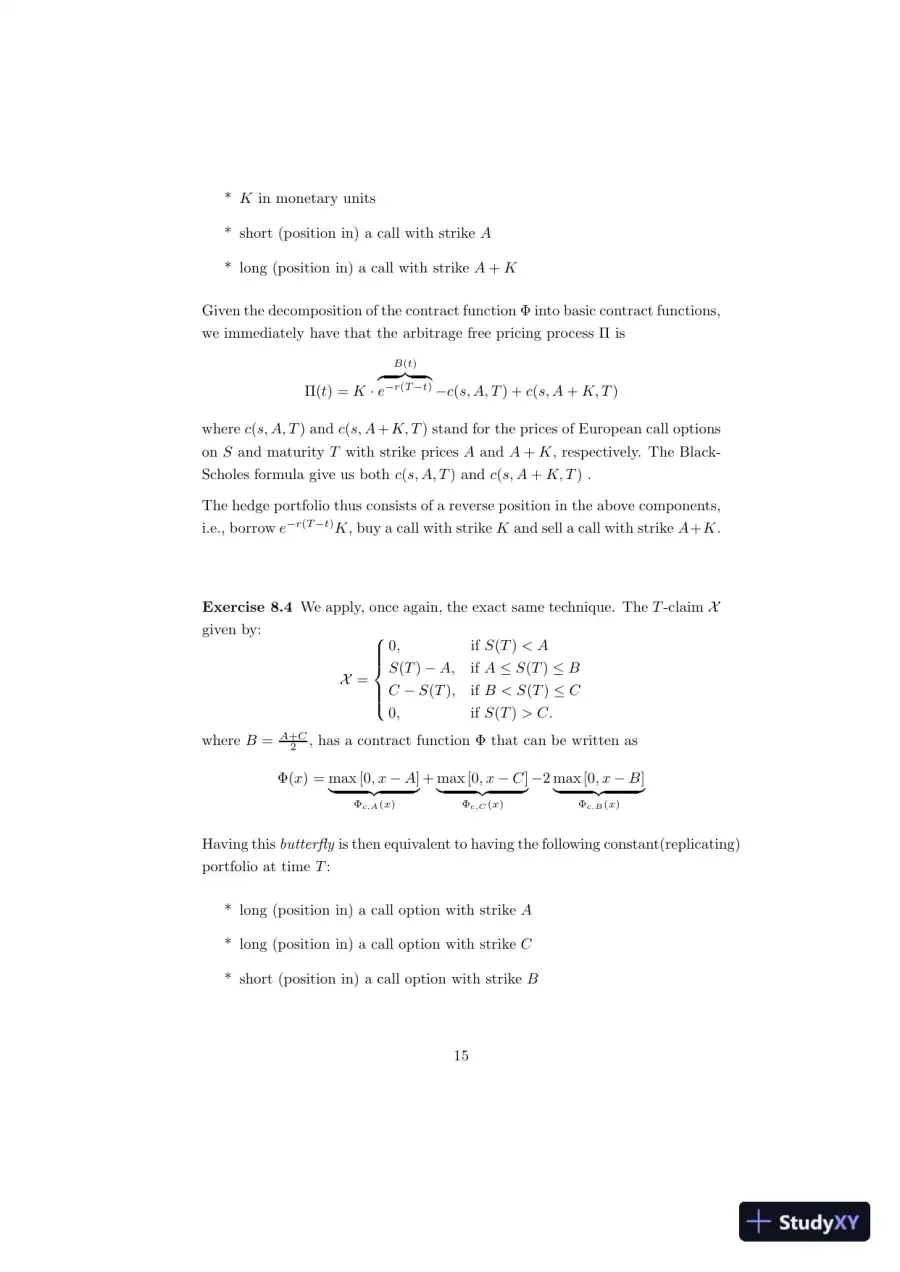 *Kin monetary units* short (position in) a call with strikeA* long (position in) a call with strikeA+KGiven the decomposition of the contract function Φ into basic contract functions,we immediately have that the arbitrage free pricing process Π isΠ(t) =K·B(t)︷︸︸︷e−r(T−t)−c(s, A, T) +c(s, A+K, T)wherec(s, A, T) andc(s, A+K, T) stand for the prices of European call optionsonSand maturityTwith strike pricesAandA+K, respectively. The Black-Scholes formula give us bothc(s, A, T) andc(s, A+K, T) .The hedge portfolio thus consists of a reverse position in the above components,i.e., borrowe−r(T−t)K, buy a call with strikeKand sell a call with strikeA+K.Exercise 8.4We apply, once again, the exact same technique. TheT-claimXgiven by:X=0,ifS(T)< AS(T)−A,ifA≤S(T)≤BC−S(T),ifB < S(T)≤C0,ifS(T)> C.whereB=A+C2, has a contract function Φ that can be written asΦ(x) = max [0, x−A]︸︷︷︸Φc,A(x)+ max [0, x−C]︸︷︷︸Φc,C(x)−2 max [0, x−B]︸︷︷︸Φc,B(x)Having thisbutterflyis then equivalent to having the following constant(replicating)portfolio at timeT:* long (position in) a call option with strikeA* long (position in) a call option with strikeC* short (position in) a call option with strikeB15
90 more pages in the full document
Unlock it once and it stays in your library, ready to chat with or turn into flashcards.
Unlock the full documentMore Finance study materials
See all Textbook Guides
Solution Manual For Investments, 12th Edition
Finance
314 pages161downloadsFeb 2025 Exam Guides
Test Bank for Principles of Managerial Finance, 8th Edition
Finance
851 pages158downloadsFeb 2025 Textbook Guides
Solution Manual for Financial Institutions Management: A Risk Management Approach, 8th Edition
Finance
486 pages154downloadsFeb 2025 Exam Guides
Test Bank for Principles of Managerial Finance, Arab World Edition
Finance
373 pages148downloadsFeb 2025 Textbook Guides
Multinational Financial Management, Study Guide, 6th Edition Solution Manual
Finance
278 pages146downloadsFeb 2025 Textbook Guides
Financial Markets and Institutions, 7th Edition Solution Manual
Finance
194 pages136downloadsFeb 2025 Certification Guides
Wiley Finra Series 3 Exam Review (2019)
Finance
253 pages131downloadsFeb 2025 Exam Guides
Test Bank For Essentials of Investments, 8th Edition
Finance
368 pages130downloadsFeb 2025
Study this document with CramX
Once it is in your library, every tool can work from it.