
Textbook Guides
Solution Manual For Corporate Finance: A Focused Approach, 7th Edition
- Finance
- 476 pages
- Shared May 2025
Solution Manual For Corporate Finance: A Focused Approach, 7th Edition helps you break down challenging textbook sections for easy learning.
Preview · 16 of 476 pages
100%
Page 1
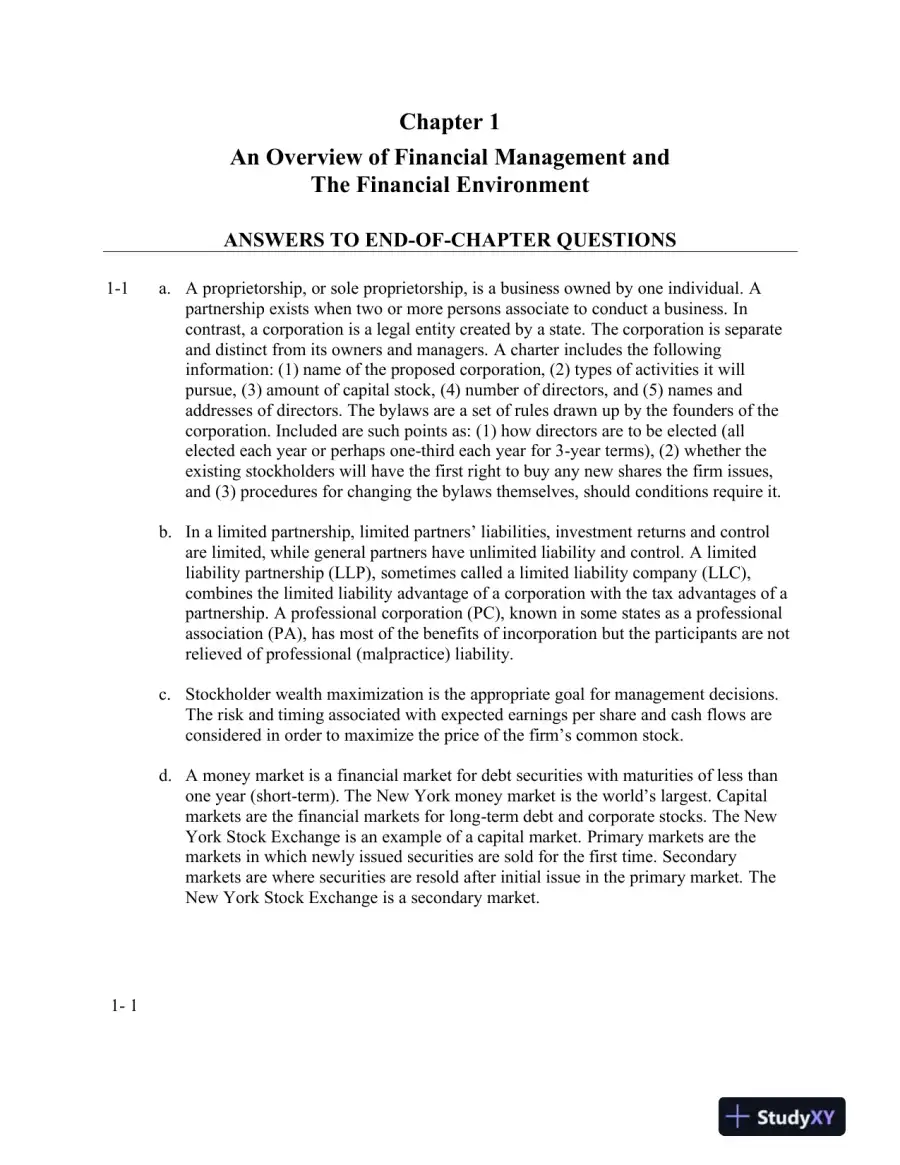 1-1Chapter 1An Overview ofFinancial ManagementandThe Financial EnvironmentANSWERS TO END-OF-CHAPTER QUESTIONS1-1a.A proprietorship, or sole proprietorship, is a business owned by one individual.Apartnership exists when two ormore persons associate to conduct a business.Incontrast, a corporation is a legal entity created by a state.The corporation is separateand distinct from its owners and managers.Acharterincludes the followinginformation: (1) name of the proposed corporation, (2) types of activities it willpursue, (3) amount of capital stock, (4) number of directors, and (5) names andaddresses of directors.The bylaws are a set of rules drawn up by the founders of thecorporation. Included are such points as: (1) how directors are to be elected (allelected each year or perhaps one-third each year for 3-year terms), (2) whether theexisting stockholders will have the first right to buy any new shares the firm issues,and (3) procedures for changing the bylaws themselves, should conditions require it.b.In a limited partnership, limited partners’ liabilities, investment returns and controlare limited, while general partners have unlimited liability and control.A limitedliability partnership (LLP),sometimes called a limited liability company (LLC),combines the limited liability advantage of a corporation with the tax advantages of apartnership.A professional corporation (PC), known in some states as a professionalassociation (PA), has most of the benefits of incorporation but the participants are notrelieved of professional (malpractice) liability.c.Stockholder wealth maximization is the appropriate goal for management decisions.The risk and timing associated with expected earnings per share and cash flows areconsidered in order to maximize the price of the firm’s common stock.d.A money market is a financial market for debt securities with maturities of less thanone year (short-term).The New York money market is the world’s largest.Capitalmarkets are the financial markets for long-term debt and corporate stocks.The NewYork Stock Exchange is an example of a capital market.Primary markets are themarkets in which newly issued securities are sold for the first time.Secondarymarkets are where securities are resold after initial issue in the primary market.TheNew York Stock Exchange is a secondary market.
Page 2

Page 3
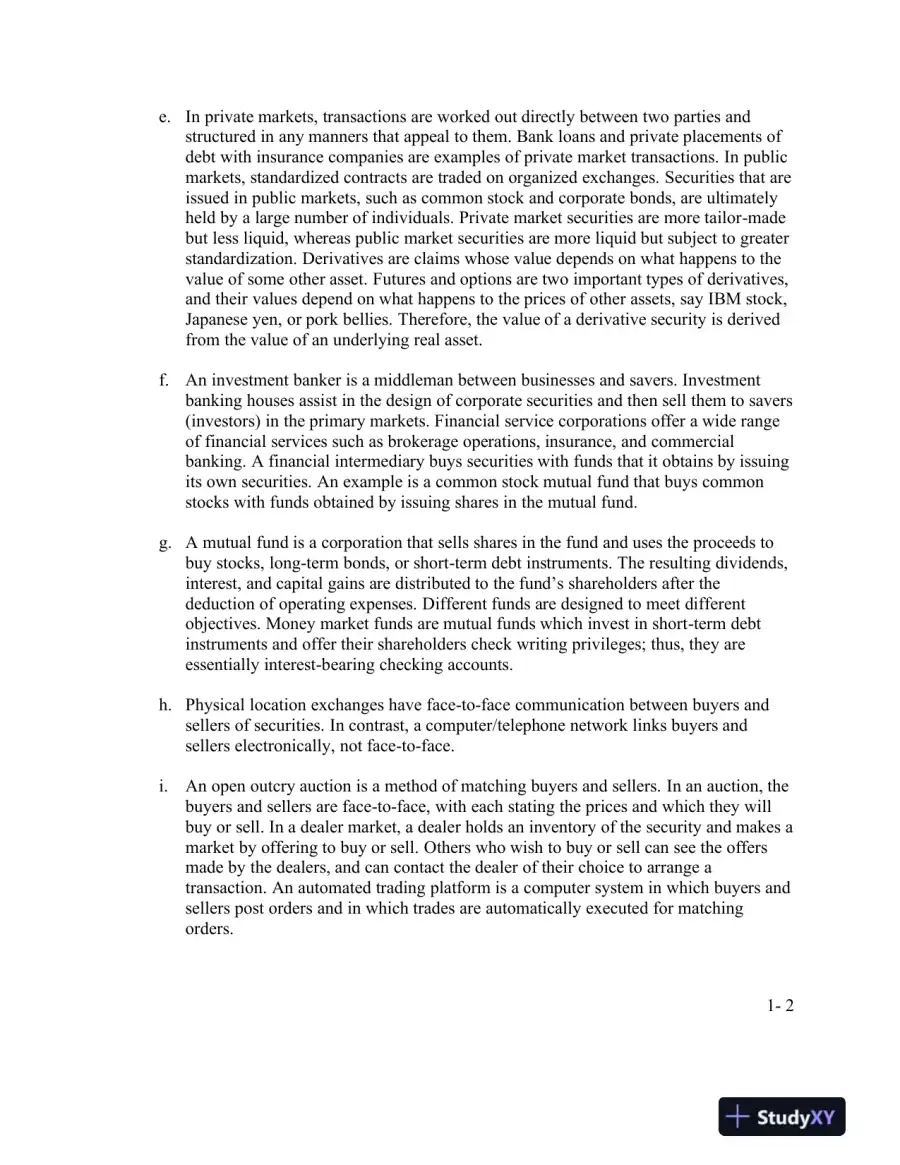 1-2e.In private markets, transactions are worked out directly between two parties andstructured in any mannersthat appeal to them.Bank loans and private placements ofdebt with insurance companies are examples of private market transactions.In publicmarkets, standardized contracts are traded on organized exchanges.Securities that areissued in public markets, such as common stock and corporate bonds, are ultimatelyheld by a large number of individuals.Private market securities are more tailor-madebut less liquid, whereas public market securities are more liquid but subject to greaterstandardization.Derivatives are claims whose value depends on what happens to thevalue of some other asset.Futures and options are two important types of derivatives,and their values depend on what happens to the prices of other assets, say IBM stock,Japanese yen, or pork bellies.Therefore, the value of a derivative security is derivedfrom the value of an underlying real asset.f.An investment banker is a middleman between businesses and savers. Investmentbanking houses assist in the design of corporate securities and then sell them to savers(investors) in the primary markets. Financial service corporations offer a wide rangeof financial services such as brokerage operations, insurance, and commercialbanking.A financial intermediary buys securities with funds that it obtains by issuingits own securities.An example is a common stock mutual fund that buys commonstocks with funds obtained by issuing shares in the mutual fund.g.A mutual fund is a corporation that sells shares in the fund and uses the proceeds tobuy stocks,long-term bonds, or short-term debt instruments.The resulting dividends,interest, and capital gains are distributed to the fund’s shareholders after thededuction of operating expenses.Different funds are designed to meet differentobjectives. Money market funds are mutual funds which invest in short-term debtinstruments and offer their shareholders check writing privileges; thus, they areessentially interest-bearing checking accounts.h.Physical location exchangeshave face-to-facecommunication between buyers andsellers of securities.In contrast, acomputer/telephone network links buyers andsellerselectronically, not face-to-face.i.An open outcry auction is a method of matching buyers and sellers.In an auction, thebuyers and sellers are face-to-face, with each stating the prices and which they willbuy or sell.In a dealer market, a dealer holds an inventory of the security and makes amarket by offering to buy or sell.Others who wish to buy or sell can see the offersmade by the dealers, and can contact the dealer of their choice to arrange atransaction.An automated trading platform is a computer system in which buyers andsellers post ordersand in which trades are automatically executed for matchingorders.
Page 4
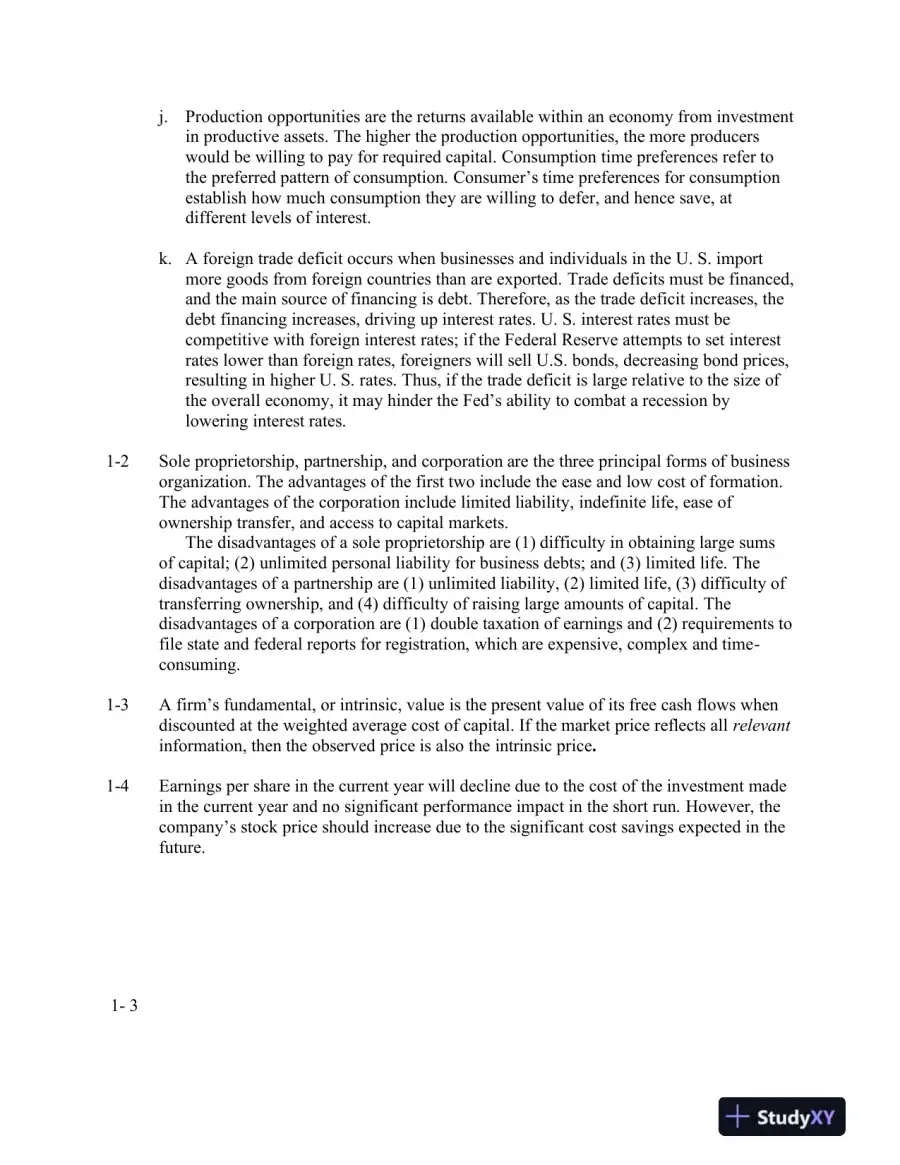 1-3j.Production opportunities are the returns available within an economy from investmentin productive assets.The higher the production opportunities, the more producerswould be willing to pay for required capital.Consumption time preferences refer tothe preferred pattern of consumption.Consumer’s time preferences for consumptionestablish how much consumption they are willing to defer, and hence save, atdifferent levels of interest.k.A foreign trade deficit occurs when businesses and individuals in the U. S. importmore goods from foreign countries than are exported.Trade deficits must be financed,and the main source of financing is debt. Therefore, as the trade deficit increases, thedebt financing increases, driving up interest rates.U. S. interest rates must becompetitive with foreign interest rates; if the Federal Reserve attempts to set interestrates lower than foreign rates, foreigners will sell U.S. bonds, decreasing bond prices,resulting in higher U. S. rates.Thus, if the trade deficit is large relative to the size ofthe overall economy, it may hinder the Fed’s ability to combat a recession bylowering interest rates.1-2Sole proprietorship, partnership, and corporation are the three principal forms of businessorganization.The advantages of the first two include the ease and low cost of formation.The advantages of the corporation include limited liability, indefinite life, ease ofownership transfer, and access to capital markets.The disadvantages of a sole proprietorship are (1) difficulty in obtaining large sumsof capital; (2) unlimited personal liability for business debts; and (3) limited life.Thedisadvantages of a partnership are (1) unlimited liability, (2) limited life, (3) difficulty oftransferring ownership, and (4) difficulty of raising large amounts of capital.Thedisadvantages of a corporation are (1) double taxation of earnings and (2) requirements tofile state and federal reports for registration, which are expensive, complex and time-consuming.1-3A firm’s fundamental, or intrinsic, value is the present value of its free cash flows whendiscounted at the weighted average cost of capital.If the market price reflects allrelevantinformation, then the observed price is also theintrinsic price.1-4Earnings per share in the current year will decline due to the cost of the investment madein the current year and no significant performance impact in the short run.However, thecompany’s stock price should increase due to the significant cost savings expected in thefuture.
Page 5
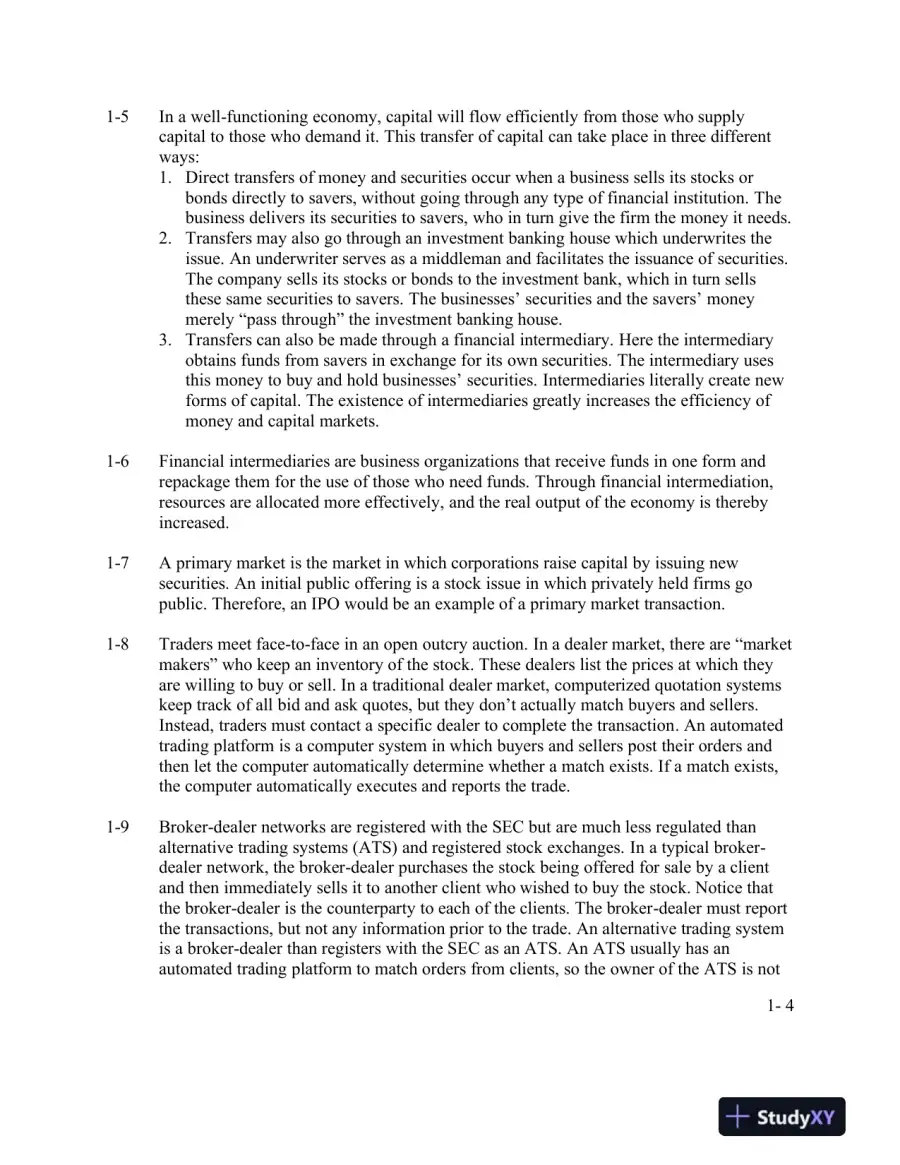 1-41-5In a well-functioning economy, capital will flow efficiently from those who supplycapital to those who demand it.This transfer of capital can take place in three differentways:1.Direct transfers of money and securities occur when a business sells its stocks orbonds directly to savers, without going through any type of financial institution.Thebusiness delivers its securities to savers, who in turn give the firm the money it needs.2.Transfers may also go through an investment banking house which underwrites theissue.An underwriter serves as a middleman and facilitates the issuance of securities.The company sells its stocks or bonds to the investment bank, which in turn sellsthese same securities to savers.The businesses’ securities and the savers’ moneymerely “pass through” the investment banking house.3.Transfers can also be made through a financial intermediary.Here the intermediaryobtains fundsfrom savers in exchange for itsown securities.The intermediary usesthis money to buy and hold businesses’ securities.Intermediaries literally create newforms of capital.The existence of intermediaries greatly increases the efficiency ofmoney and capital markets.1-6Financial intermediaries are business organizations that receive funds in one form andrepackage them for the use of those who need funds.Through financial intermediation,resources are allocated more effectively, and the real output of the economy is therebyincreased.1-7A primary market isthe market in which corporations raise capital by issuing newsecurities.An initial public offering is a stock issue in which privately held firms gopublic.Therefore, an IPO would be an example of a primary market transaction.1-8Traders meetface-to-facein an open outcry auction.In a dealer market, there are “marketmakers” who keep an inventory of the stock. These dealers list the prices at which theyare willing to buy or sell. In a traditional dealer market, computerized quotation systemskeep track of all bid and ask quotes, but they don’t actually match buyers and sellers.Instead, traders must contact a specific dealer to complete the transaction.An automatedtrading platformisa computer system in which buyers and sellers post their orders andthen let the computer automatically determine whether a match exists. If a match exists,the computer automaticallyexecutes and reports the trade.1-9Broker-dealer networks are registered with the SEC but are much less regulated thanalternativetrading systems (ATS) and registered stock exchanges.In a typical broker-dealer network, the broker-dealer purchases the stock being offered for sale by a clientand then immediately sells it to another client who wished to buy the stock. Notice thatthe broker-dealer is the counterparty to each of the clients. The broker-dealer must reportthe transactions, but not any information prior to the trade. An alternative trading systemis a broker-dealer than registers with the SEC as an ATS. An ATS usually has anautomated trading platform to match orders from clients, so the owner of the ATS is not
Page 6
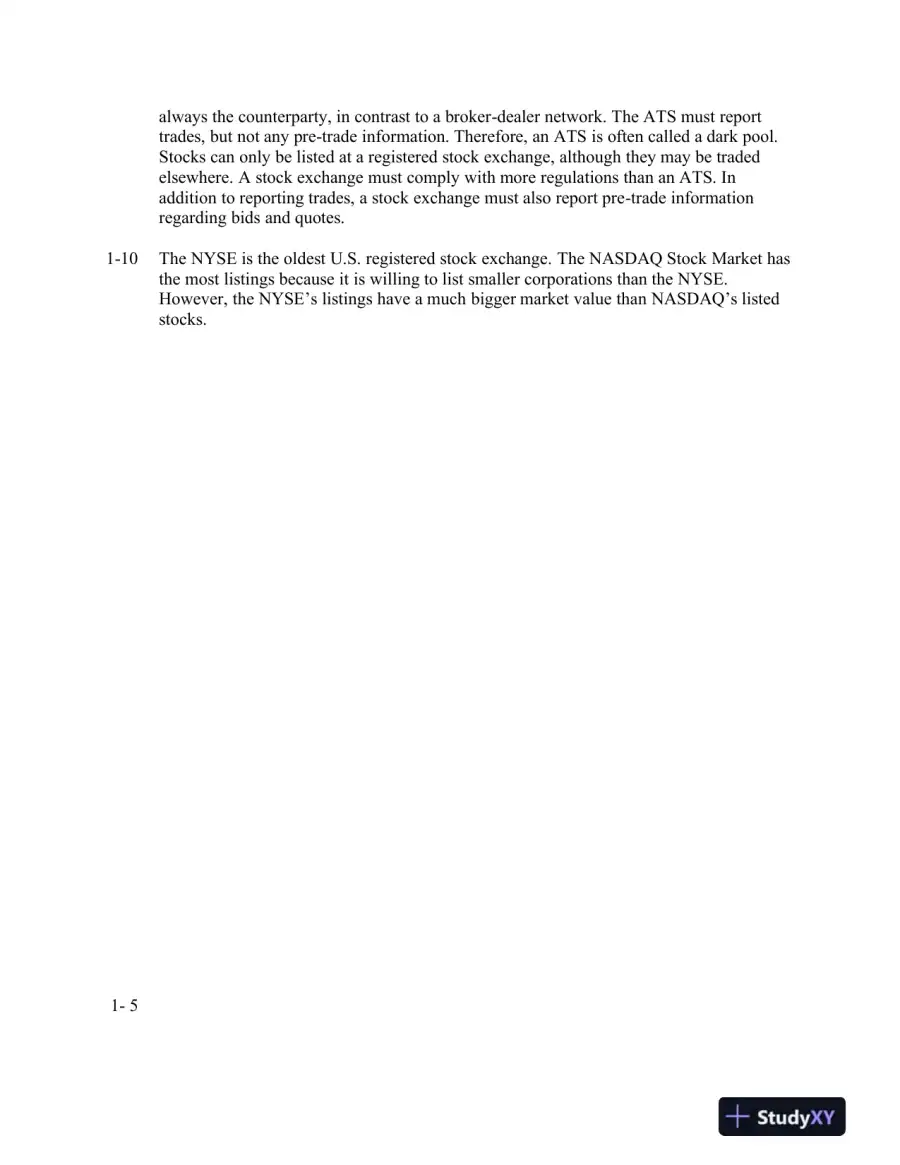 1-5always the counterparty, in contrast to a broker-dealer network. The ATS must reporttrades, but not any pre-trade information. Therefore, an ATS is often called a dark pool.Stocks can only be listed at aregistered stock exchange, although they may be tradedelsewhere. A stock exchange must comply with more regulations than an ATS. Inaddition to reporting trades, a stock exchange must also report pre-trade informationregarding bids and quotes.1-10The NYSE is the oldest U.S. registered stock exchange.The NASDAQ Stock Market hasthe most listings because it is willing to list smaller corporations than the NYSE.However,the NYSE’s listings have a muchbigger market valuethan NASDAQ’s listedstocks.
Page 7
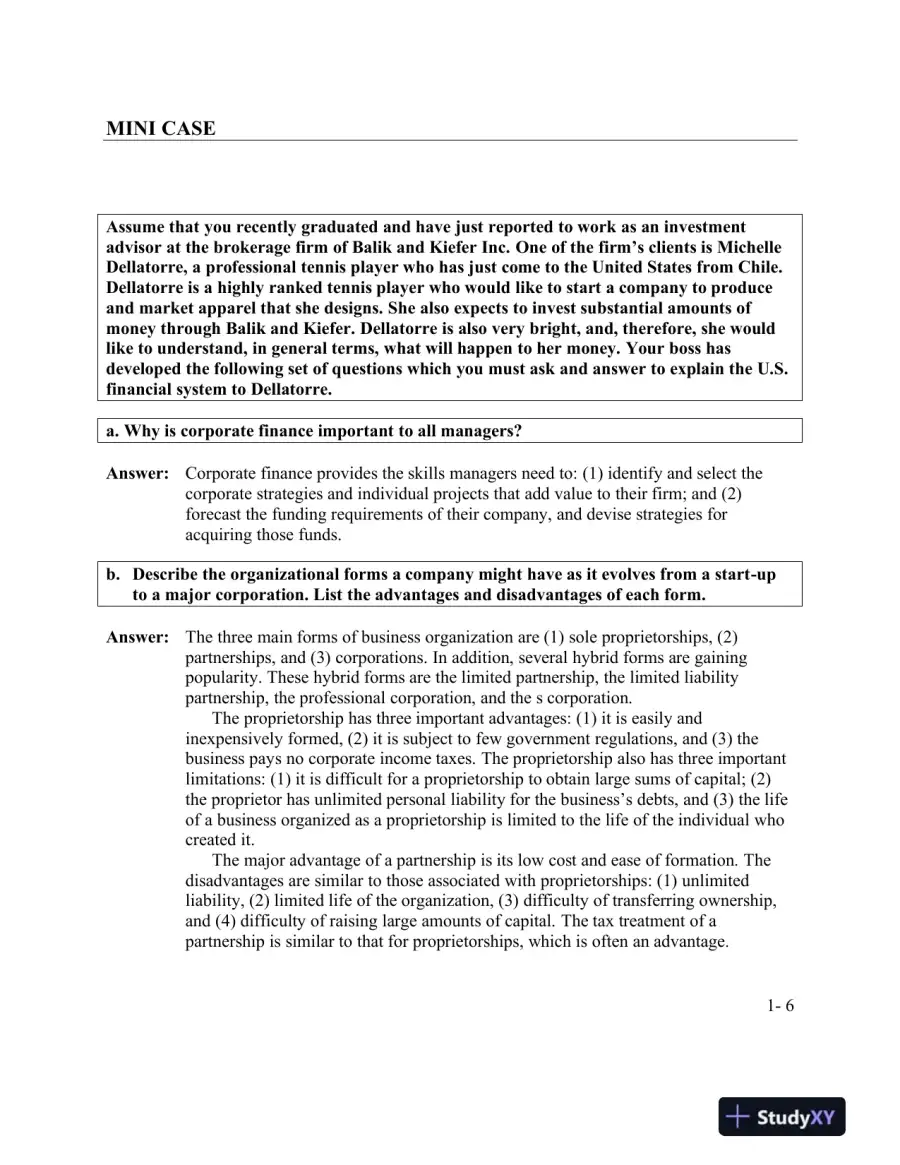 1-6MINI CASEAssume that you recently graduated and have just reported to work as an investmentadvisor at the brokerage firm of Balik and Kiefer Inc.One of the firm’s clients is MichelleDellatorre, a professional tennis player who has just come to the United States from Chile.Dellatorre is a highly ranked tennis player who would like to start a company to produceand market apparel that she designs.She also expects to invest substantial amounts ofmoney through Balik and Kiefer.Dellatorre is also very bright, and, therefore, she wouldlike to understand,in general terms,what will happen to her money.Your boss hasdeveloped the following set of questions which you must ask and answer to explain the U.S.financial system to Dellatorre.a. Why is corporate finance important to all managers?Answer:Corporate finance provides the skills managers need to:(1)identify and select thecorporate strategies and individual projects that add value to their firm; and (2)forecast the funding requirements of their company, and devise strategies foracquiring those funds.b.Describe the organizational forms a company might have as it evolves from a start-upto a major corporation. List the advantages and disadvantages of each form.Answer:The three main forms of business organization are (1) sole proprietorships, (2)partnerships, and (3) corporations.In addition, several hybrid forms are gainingpopularity.These hybrid forms are the limited partnership, the limited liabilitypartnership, the professional corporation, and the s corporation.Theproprietorship has three important advantages: (1) it is easily andinexpensively formed, (2) it is subject to few government regulations, and (3) thebusiness pays no corporate income taxes.The proprietorship also has three importantlimitations: (1) it is difficult for a proprietorship to obtain large sums of capital; (2)the proprietor has unlimited personal liability for the business’s debts, and (3) the lifeof a business organized as a proprietorship is limited to the life of the individual whocreated it.The major advantage of a partnership is its low cost and ease of formation.Thedisadvantages are similar to those associated with proprietorships: (1) unlimitedliability, (2) limited life of the organization, (3) difficulty of transferring ownership,and (4) difficulty of raising large amounts of capital.The tax treatment of apartnership is similar to that for proprietorships, which is often an advantage.
Page 8
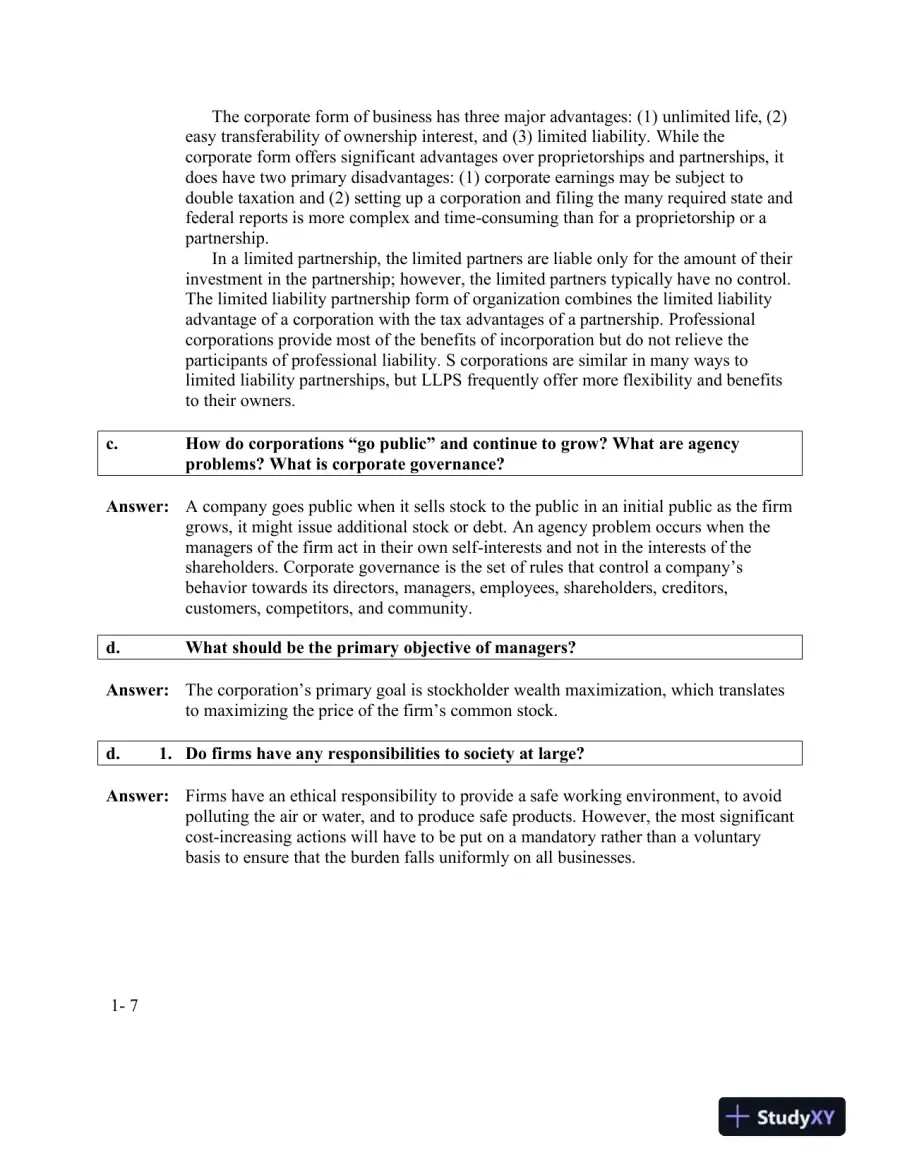 1-7The corporate form of business has three major advantages: (1) unlimited life, (2)easy transferability of ownership interest, and (3) limited liability.While thecorporate form offers significant advantages over proprietorships and partnerships, itdoes have two primary disadvantages: (1) corporate earnings may be subject todouble taxation and (2) setting up a corporation and filing the many required state andfederal reports is more complex and time-consuming than for a proprietorship or apartnership.In a limited partnership, the limited partners are liable only for the amount of theirinvestment in the partnership; however, the limited partners typically have no control.The limited liability partnership form of organization combines the limited liabilityadvantage of a corporation with the tax advantages of a partnership.Professionalcorporations provide most of the benefits of incorporation but do not relieve theparticipants of professional liability.S corporations are similar in many ways tolimited liability partnerships, but LLPS frequently offer more flexibility and benefitsto their owners.c.How do corporations “go public” and continue to grow? What are agencyproblems?What is corporate governance?Answer:A company goes public when it sells stock to the public in an initial public as the firmgrows, it might issueadditional stock or debt. An agency problem occurs when themanagers ofthe firm act in their own self-interests and not in the interests of theshareholders.Corporate governanceis the set of rules that control a company’sbehavior towards its directors, managers, employees, shareholders, creditors,customers, competitors, and community.d.What should be the primary objective of managers?Answer:The corporation’s primary goal is stockholder wealth maximization, which translatestomaximizing the price of the firm’s common stock.d.1.Do firms have any responsibilities to society at large?Answer:Firms have an ethical responsibility to provide a safe working environment, to avoidpolluting the air or water, and to producesafe products.However, the most significantcost-increasing actions will have to be put on a mandatory rather than a voluntarybasis to ensure that the burden falls uniformly on all businesses.
Page 9
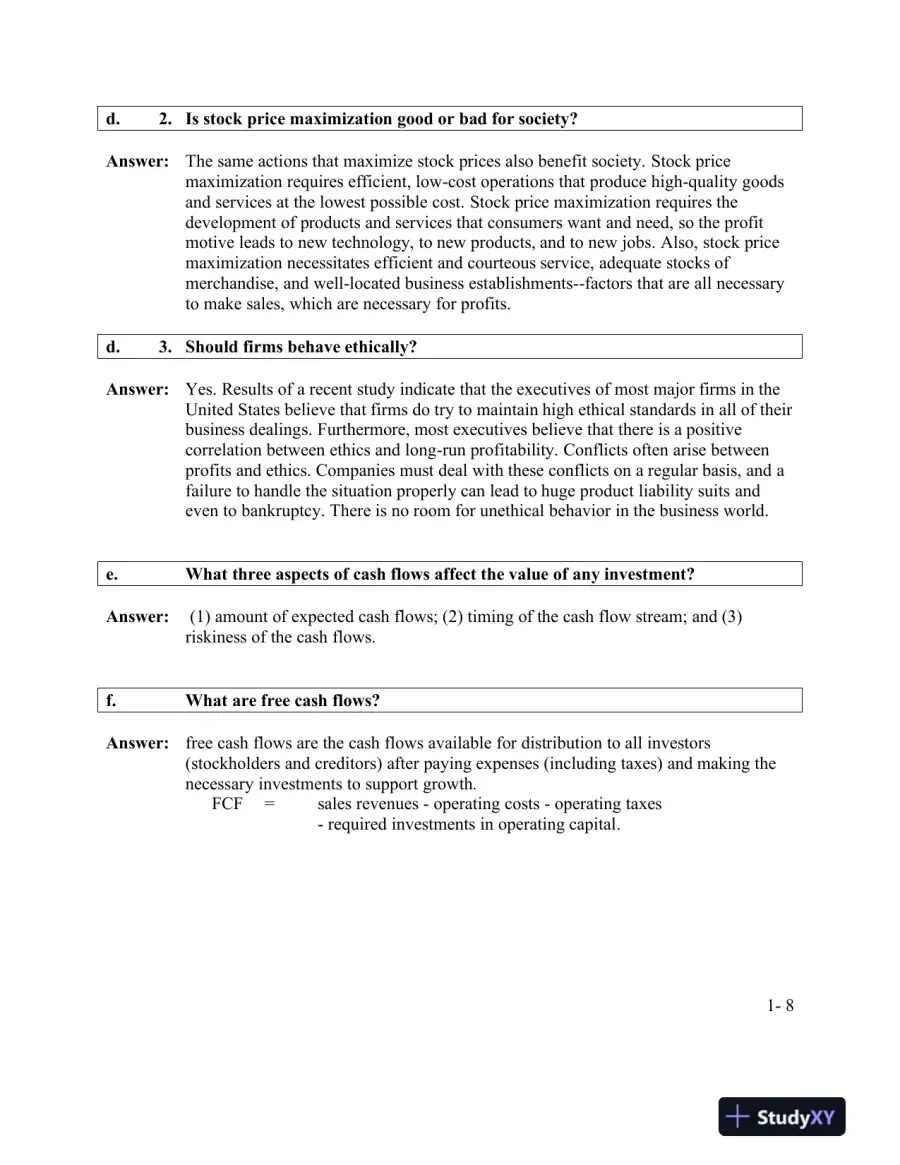 1-8d.2.Is stock price maximization good or bad for society?Answer:The same actions that maximize stock prices also benefit society.Stock pricemaximization requires efficient, low-cost operations that produce high-quality goodsand services at the lowest possible cost.Stock price maximization requires thedevelopment of products and services that consumers want and need,so the profitmotive leads to new technology, to new products, and to new jobs.Also, stock pricemaximization necessitates efficient and courteous service, adequate stocks ofmerchandise, and well-located business establishments--factors that are all necessaryto make sales, which are necessary for profits.d.3.Should firms behave ethically?Answer:Yes.Results of a recent study indicate that the executives of most major firms in theUnited States believe that firms do try to maintain high ethical standards in all of theirbusiness dealings.Furthermore, most executives believe that there is a positivecorrelation between ethics and long-run profitability.Conflicts often arise betweenprofits and ethics.Companies must deal with these conflicts on a regular basis, andafailure to handle the situation properly can lead to huge product liability suitsandeven to bankruptcy.There is no room for unethical behavior in the business world.e.What three aspects of cash flows affect the value of any investment?Answer:(1) amount of expected cash flows; (2) timing of the cash flow stream; and (3)riskiness of the cash flows.f.What are free cash flows?Answer:free cash flows are thecash flows available for distribution to all investors(stockholders and creditors) after paying expenses (including taxes) and making thenecessaryinvestments to support growth.FCF=sales revenues-operating costs-operating taxes-required investments in operating capital.
Page 10
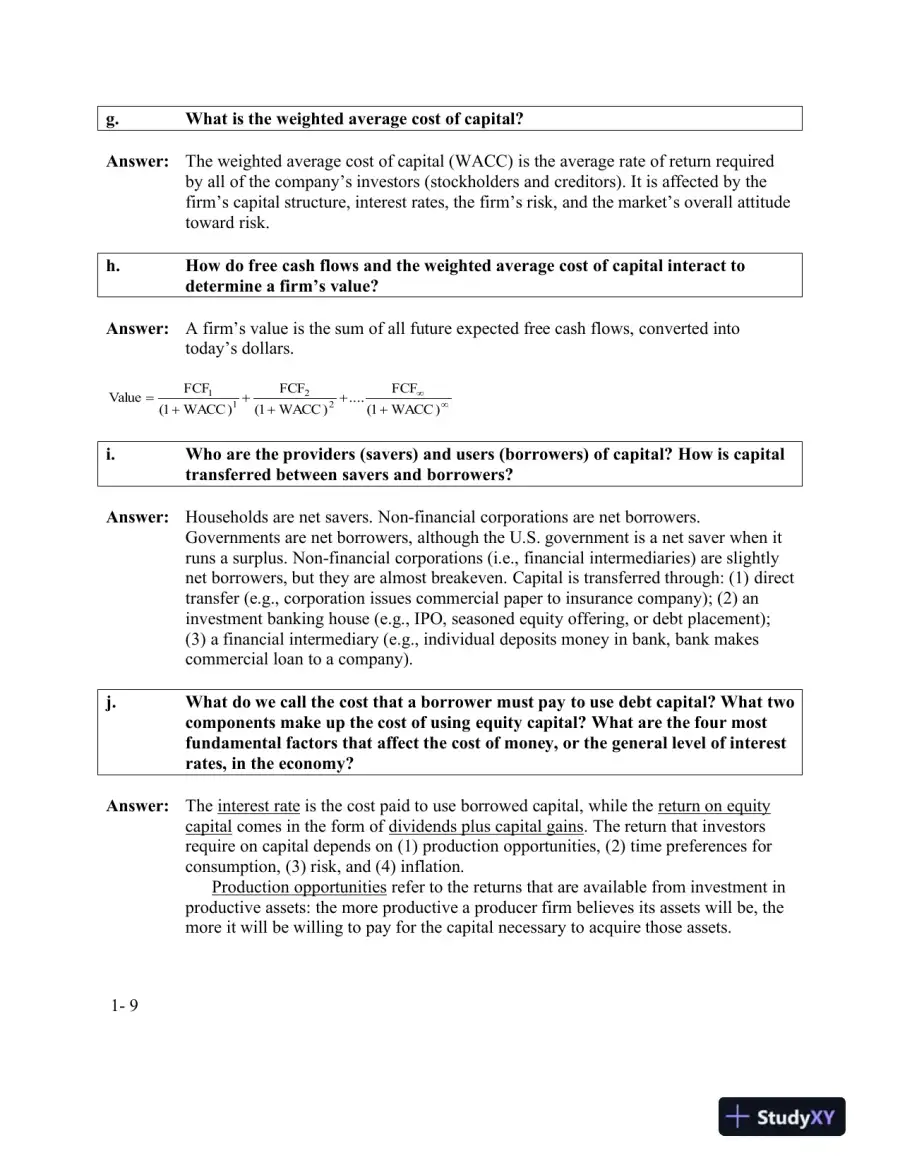 1-9g.What is the weighted average cost of capital?Answer:The weighted average cost of capital (WACC) is the average rate of return requiredby all of the company’s investors (stockholders andcreditors). It is affected by thefirm’s capital structure, interest rates, the firm’s risk, and the market’s overall attitudetoward risk.h.How do free cash flows and the weighted average cost of capital interact todetermine a firm’s value?Answer:A firm’s value is the sum of all future expected free cash flows, converted intotoday’s dollars.+++++=)WACC1(FCF....)WACC1(FCF)WACC1(FCFValue2211i.Who are the providers (savers) and users (borrowers) of capital?How is capitaltransferred between savers andborrowers?Answer:Households are net savers.Non-financial corporations are net borrowers.Governments are net borrowers, although the U.S. government is a net saver when itruns a surplus.Non-financial corporations (i.e., financial intermediaries) are slightlynet borrowers, but they are almost breakeven.Capital is transferred through: (1)directtransfer (e.g., corporation issues commercial paper to insurance company); (2) aninvestment banking house (e.g., IPO, seasoned equity offering, or debt placement);(3) a financial intermediary (e.g., individual deposits money in bank, bank makescommercial loan to a company).j.What do we call thecostthat a borrower must payto usedebt capital? Whattwocomponents make up the cost of usingequity capital?What are the four mostfundamental factors that affect the cost of money, or the general level of interestrates, in the economy?Answer:Theinterest rateis thecostpaidto useborrowed capital, while thereturn on equitycapitalcomes in the form ofdividends plus capital gains.The return that investorsrequire on capital depends on (1) production opportunities, (2) time preferences forconsumption, (3) risk, and (4) inflation.Production opportunitiesrefer to the returns that are available from investment inproductive assets:the more productive a producer firm believes its assets will be, themore it will be willing to pay for the capital necessary to acquire those assets.
Page 11
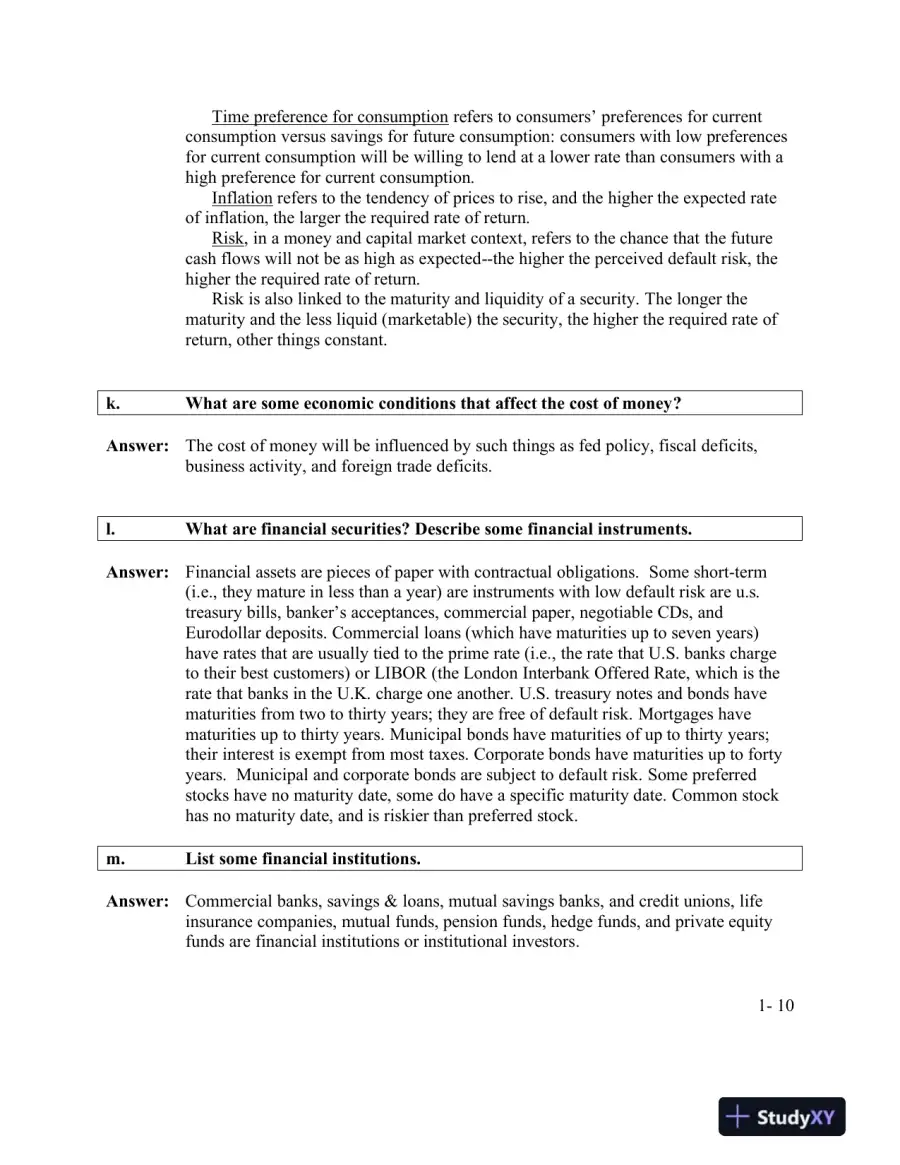 1-10Time preference for consumptionrefers to consumers’ preferences for currentconsumption versus savings for future consumption:consumers with low preferencesfor current consumption will be willing to lend at a lower rate than consumers with ahigh preference for current consumption.Inflationrefers to the tendency of prices to rise, and the higher the expected rateof inflation, the larger the required rate of return.Risk, in a money and capital market context, refers to the chance thatthe futurecash flows will not be as high as expected--the higher the perceived default risk, thehigher the required rate of return.Risk is also linked to the maturity and liquidity of a security.The longer thematurity and the less liquid (marketable) the security, the higher the required rate ofreturn, other things constant.k.What are some economic conditions that affect the cost of money?Answer:The cost of money will be influenced by such things as fed policy, fiscal deficits,business activity, and foreign trade deficits.l.What are financialsecurities?Describe some financial instruments.Answer:Financial assets are pieces of paper with contractual obligations.Some short-term(i.e., they mature in less than a year) are instruments with low default risk are u.s.treasury bills, banker’s acceptances, commercial paper, negotiable CDs, andEurodollar deposits.Commercial loans (which have maturities up to seven years)have rates that are usually tied to the prime rate (i.e., the rate that U.S. banks chargeto their best customers) or LIBOR (the London Interbank Offered Rate, which is therate that banks in the U.K. charge one another.U.S. treasury notes and bonds havematurities from two to thirty years; they are free of default risk.Mortgages havematurities up to thirty years.Municipal bonds have maturities of up to thirty years;their interest is exempt from most taxes.Corporate bonds have maturities up to fortyyears.Municipal and corporate bonds are subject to default risk.Some preferredstocks have no maturity date, some do have a specific maturity date.Common stockhas no maturity date, and is riskier than preferred stock.m.List some financialinstitutions.Answer:Commercial banks, savings & loans, mutual savings banks, and credit unions, lifeinsurance companies, mutual funds, pension funds, hedge funds, and private equityfundsare financialinstitutions or institutional investors.
Page 12
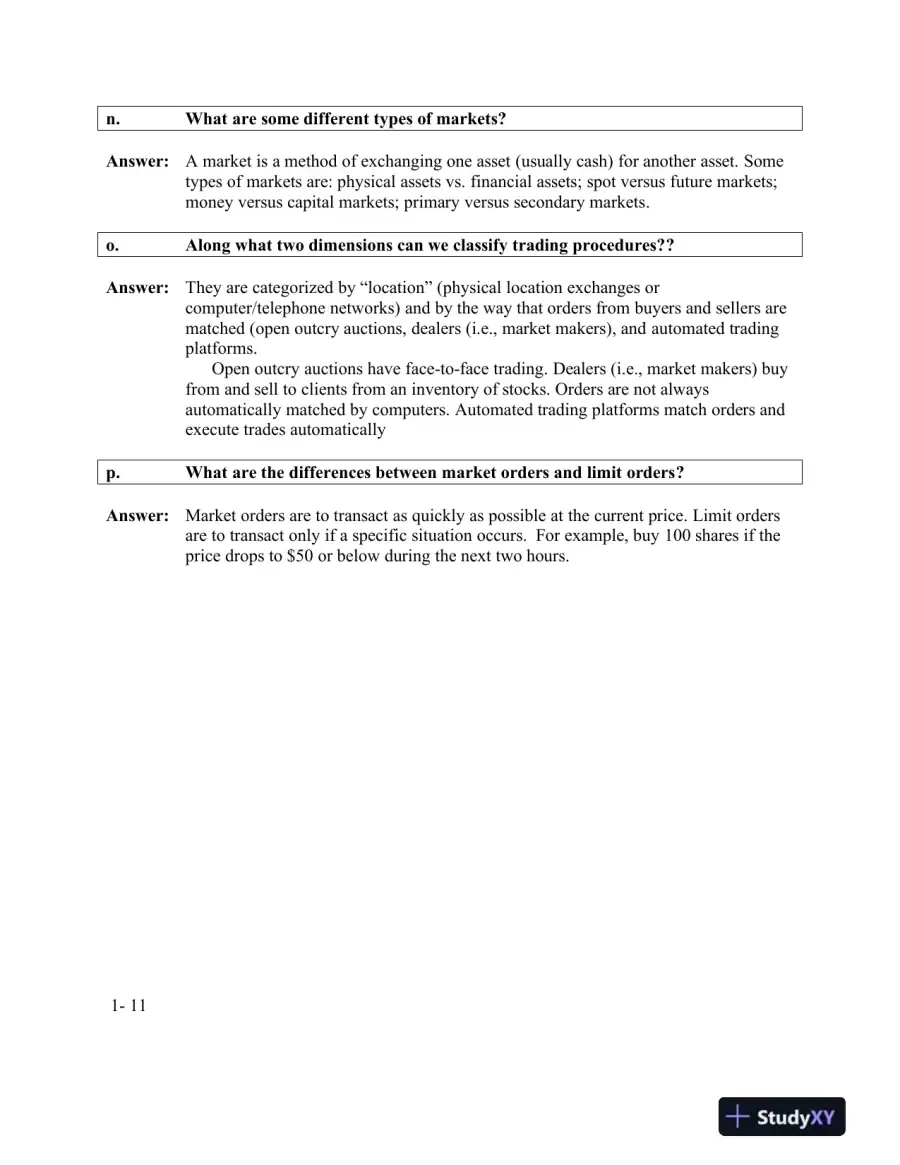 1-11n.What are some different types of markets?Answer:A market is a method of exchanging one asset(usually cash) for another asset.Sometypes of markets are: physical assets vs. financial assets; spot versus future markets;money versus capital markets; primary versus secondary markets.o.Along what two dimensions can we classify trading procedures??Answer:They are categorizedby “location” (physical location exchanges orcomputer/telephone networks) and by the way that orders from buyers and sellers arematched (open outcry auctions, dealers (i.e., market makers), andautomated tradingplatforms.Open outcry auctions haveface-to-face trading.Dealers (i.e., market makers) buyfrom and sell to clients from an inventory of stocks. Orders are not alwaysautomatically matched by computers.Automated trading platforms match orders andexecute trades automaticallyp.What are the differences between market orders and limit orders?Answer:Marketorders are to transact as quickly as possible atthecurrent price.Limitordersare to transact only ifaspecific situation occurs. For example, buy100 sharesiftheprice drops to $50 or below during the next two hours.
Page 13
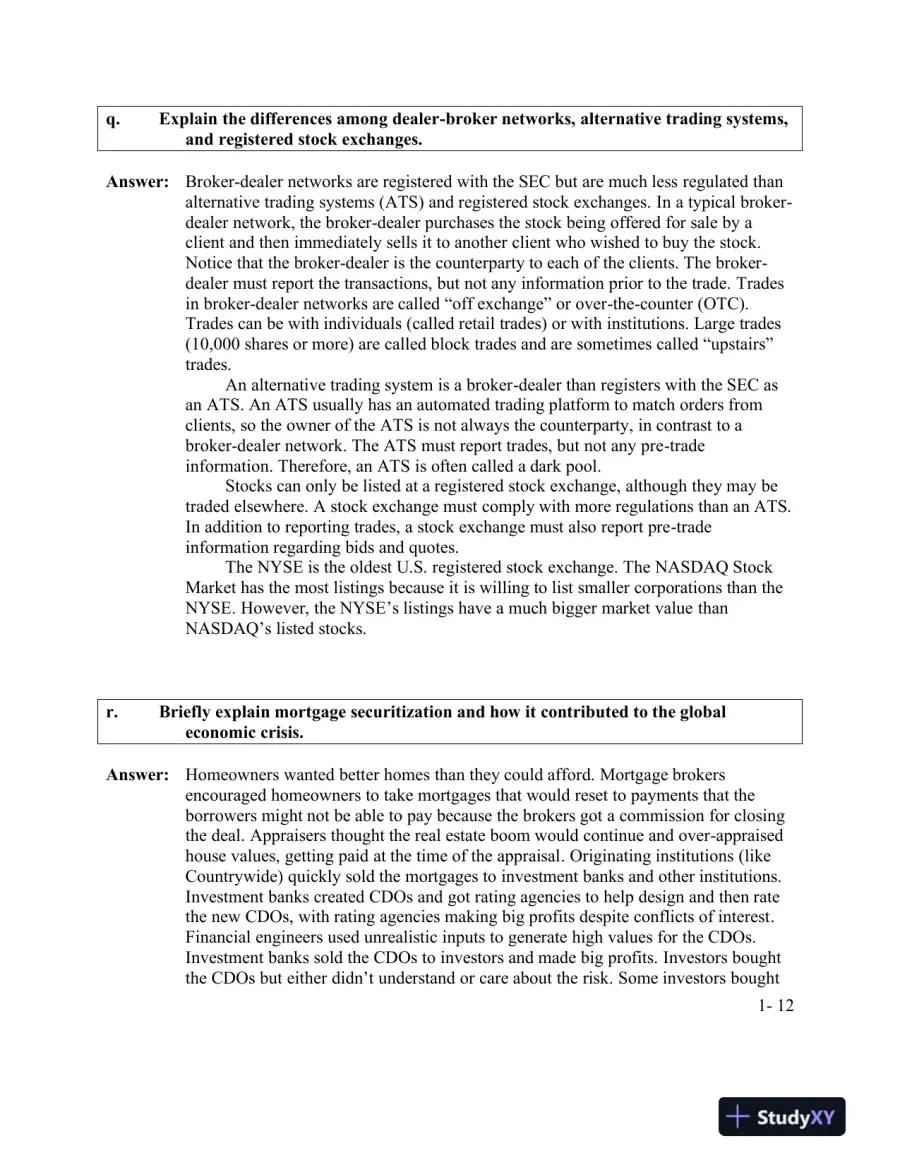 1-12q.Explain the differences among dealer-broker networks, alternative trading systems,and registered stock exchanges.Answer:Broker-dealer networks are registered with the SEC but are much lessregulated thanalternativetrading systems (ATS) and registered stock exchanges.In a typical broker-dealer network, the broker-dealer purchases the stock being offered for sale by aclient and then immediately sells it to another client who wished to buy the stock.Notice that the broker-dealer is the counterparty to each of the clients. The broker-dealer must report the transactions, but not any information prior to the trade.Tradesin broker-dealer networks are called “off exchange” or over-the-counter (OTC).Trades can be with individuals (called retail trades) or with institutions. Large trades(10,000 shares or more) are called block trades and are sometimes called “upstairs”trades.An alternative trading system is a broker-dealer than registers with the SEC asan ATS. An ATS usually has an automated trading platform to match orders fromclients, so the owner of the ATS is not always the counterparty, in contrast to abroker-dealer network. The ATS must report trades, but not any pre-tradeinformation. Therefore, an ATS is often called a dark pool.Stocks can only be listed at a registered stock exchange, although they may betraded elsewhere. A stock exchange must comply with more regulations than an ATS.In addition to reporting trades, a stock exchange must also report pre-tradeinformation regarding bids and quotes.The NYSE is the oldest U.S. registered stock exchange. The NASDAQ StockMarket has the most listings because it is willing to list smaller corporations than theNYSE. However,the NYSE’s listings have a much bigger market valuethanNASDAQ’s listed stocks.r.Briefly explain mortgage securitization and how it contributed to the globaleconomic crisis.Answer:Homeowners wanted better homesthan they could afford.Mortgage brokersencouraged homeowners to take mortgages that would reset to payments that theborrowers might not be able to pay because the brokers got a commission for closingthe deal.Appraisers thought the real estate boom would continue and over-appraisedhousevalues, getting paid at the time of the appraisal.Originating institutions(likeCountrywide)quickly sold the mortgages to investment banks and other institutions.Investment bankscreated CDOs andgot rating agencies to help design and then ratethenewCDOs, with rating agencies making big profits despite conflicts of interest.Financial engineers used unrealistic inputs to generate high values for the CDOs.Investment banks sold the CDOs to investors and made big profits.Investorsboughtthe CDOs but eitherdidn’t understand or care about the risk.Some investors bought
Page 14
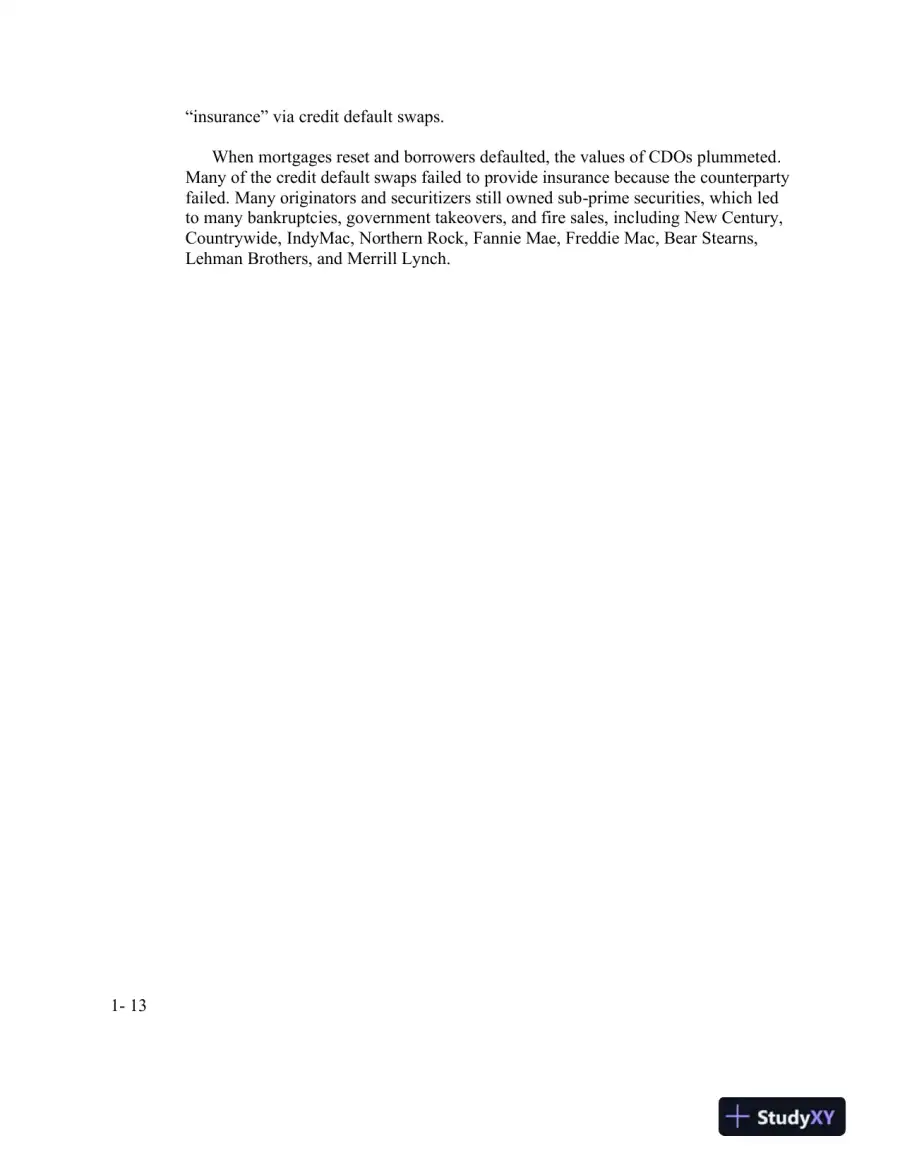 1-13“insurance” via credit default swaps.When mortgages reset and borrowers defaulted, the values of CDOs plummeted.Many of the credit default swaps failed to provide insurance because the counterpartyfailed. Many originators and securitizers still owned sub-prime securities, which ledto many bankruptcies, government takeovers, and fire sales, including New Century,Countrywide, IndyMac, Northern Rock, Fannie Mae, Freddie Mac, Bear Stearns,Lehman Brothers, and Merrill Lynch.
Page 15
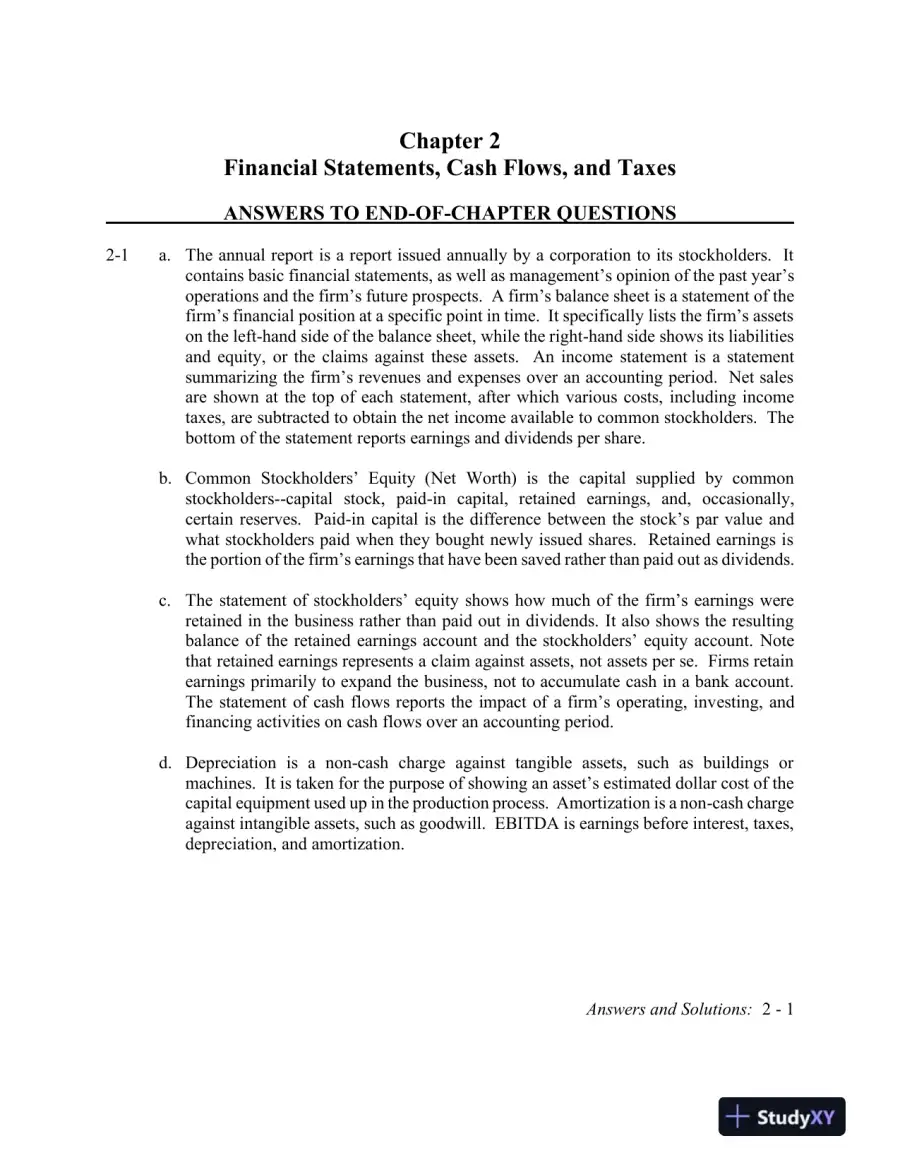 Answers and Solutions:2-1Chapter2Financial Statements, Cash Flows, and TaxesANSWERS TO END-OF-CHAPTER QUESTIONS2-1a.The annual report is a report issued annually by a corporation to its stockholders.Itcontains basic financial statements, as well as management’s opinion of the past year’soperations and the firm’s future prospects. A firm’s balance sheet is a statement of thefirm’s financial position at a specific point in time. It specifically lists the firm’s assetson the left-hand side of the balance sheet, while the right-hand side shows its liabilitiesand equity, or the claims against these assets.An incomestatement is a statementsummarizing the firm’s revenues and expenses over an accounting period.Net salesare shown at the top of each statement, after which various costs, including incometaxes, are subtracted to obtain the net income available to common stockholders. Thebottom of the statement reports earnings and dividends per share.b.Common Stockholders’ Equity (Net Worth) is the capital supplied by commonstockholders--capitalstock,paid-incapital, retainedearnings,and,occasionally,certain reserves.Paid-in capital is the difference between the stock’s par value andwhat stockholders paid when they bought newly issued shares.Retained earnings isthe portion of the firm’s earnings that have been saved rather than paidout as dividends.c.The statement ofstockholders’ equityshows how much of the firm’s earnings wereretained in the business rather than paid out in dividends.It also shows the resultingbalance of the retained earnings account and the stockholders’ equity account.Notethat retained earnings represents a claim against assets, not assets per se. Firms retainearnings primarily to expand the business, not to accumulate cash in a bank account.The statement of cash flows reports the impact of a firm’s operating, investing, andfinancing activities on cash flows over an accounting period.d.Depreciation is a non-cash charge against tangible assets, such as buildings ormachines. It is taken for the purpose of showing an asset’s estimated dollar cost of thecapital equipment used up in the production process. Amortization is a non-cash chargeagainst intangible assets, such as goodwill. EBITDA is earnings before interest, taxes,depreciation, and amortization.
Page 16
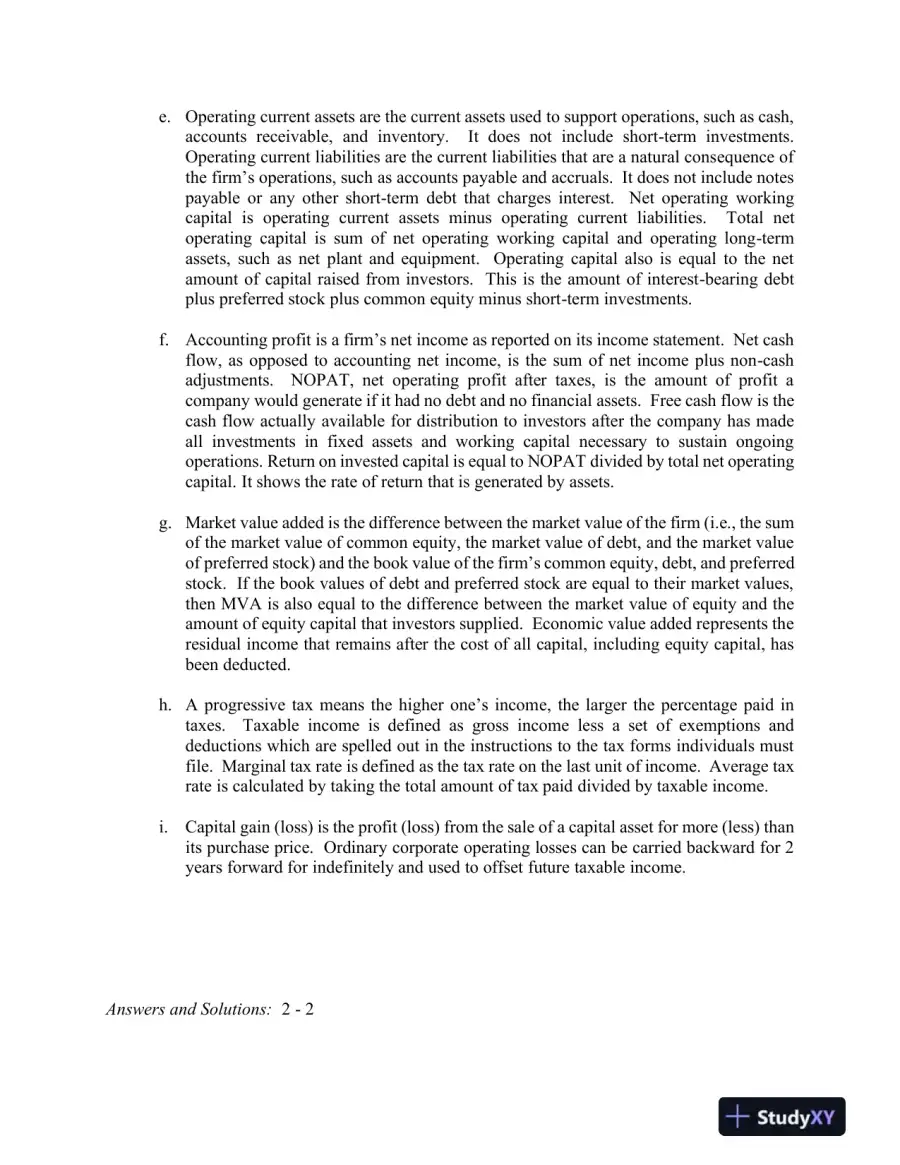 Answers and Solutions:2-2e.Operating current assets are the current assets used to support operations, such as cash,accounts receivable, and inventory.It does not include short-term investments.Operating current liabilities are the current liabilities that are a natural consequence ofthe firm’s operations, such as accounts payable and accruals. It does not include notespayable or any other short-term debt that charges interest.Net operating workingcapital is operating current assets minus operating current liabilities.Total netoperating capital is sum of net operating working capital and operating long-termassets, such as net plant and equipment.Operating capital also is equal to the netamount of capital raised from investors.This is the amount of interest-bearing debtplus preferred stock plus common equity minus short-term investments.f.Accounting profit is a firm’s net income as reported on its income statement. Net cashflow, as opposed to accounting net income, is the sum of net income plus non-cashadjustments.NOPAT, net operating profit after taxes, is the amount of profit acompany would generate if it had no debt and no financial assets. Free cash flow is thecash flow actually available for distribution to investors after the company has madeall investments in fixed assets and working capital necessary to sustain ongoingoperations.Return on invested capital is equal to NOPAT divided by total net operatingcapital. It shows the rate of return that is generated by assets.g.Market value added is the difference between the market value of the firm (i.e., the sumof the market value of common equity, the market value of debt, and the market valueof preferred stock) and the book value of the firm’s common equity, debt, and preferredstock. If the book values of debt and preferred stock are equal to their market values,then MVA is also equal to the difference between the market value of equity and theamount of equity capital that investors supplied. Economic value added represents theresidual income that remains after the cost of all capital, including equity capital, hasbeen deducted.h.A progressive tax means the higher one’s income, the larger the percentage paid intaxes.Taxable income is defined as gross income less a set of exemptions anddeductions which are spelled out in the instructions to the tax forms individuals mustfile. Marginal tax rate is defined as the tax rate on the last unit of income. Average taxrate is calculated by taking the total amount of tax paid divided by taxable income.i.Capital gain (loss) is the profit (loss) from the sale of a capital asset for more (less) thanits purchase price. Ordinary corporate operating losses can be carried backward for 2years forward forindefinitely and usedto offsetfuturetaxable income.
460 more pages in the full document
Unlock it once and it stays in your library, ready to chat with or turn into flashcards.
Unlock the full documentMore Finance study materials
See all Textbook Guides
Solution Manual For Investments, 12th Edition
Finance
314 pages161downloadsFeb 2025 Exam Guides
Test Bank for Principles of Managerial Finance, 8th Edition
Finance
851 pages158downloadsFeb 2025 Textbook Guides
Solution Manual for Financial Institutions Management: A Risk Management Approach, 8th Edition
Finance
486 pages154downloadsFeb 2025 Exam Guides
Test Bank for Principles of Managerial Finance, Arab World Edition
Finance
373 pages148downloadsFeb 2025 Textbook Guides
Multinational Financial Management, Study Guide, 6th Edition Solution Manual
Finance
278 pages146downloadsFeb 2025 Textbook Guides
Financial Markets and Institutions, 7th Edition Solution Manual
Finance
194 pages136downloadsFeb 2025 Certification Guides
Wiley Finra Series 3 Exam Review (2019)
Finance
253 pages131downloadsFeb 2025 Exam Guides
Test Bank For Essentials of Investments, 8th Edition
Finance
368 pages130downloadsFeb 2025
Study this document with CramX
Once it is in your library, every tool can work from it.