
CramX Logo
Study Notes For Corporate Finance: Core Principles and Applications, 5th Edition - Document preview page 1

Study Notes For Corporate Finance: Core Principles and Applications, 5th Edition - Page 1

Document preview content for Study Notes For Corporate Finance: Core Principles and Applications, 5th Edition

Study Notes For Corporate Finance: Core Principles and Applications, 5th Edition

Prepare for exams efficiently with Study Notes For Corporate Finance: Core Principles and Applications, 5th Edition, offering detailed revision notes that focus on key concepts and chapters.

David Brown
Contributor
5.0
0
12 months ago
Preview (16 of 302 Pages)
100%
Log in to unlock
Page 1 of 16
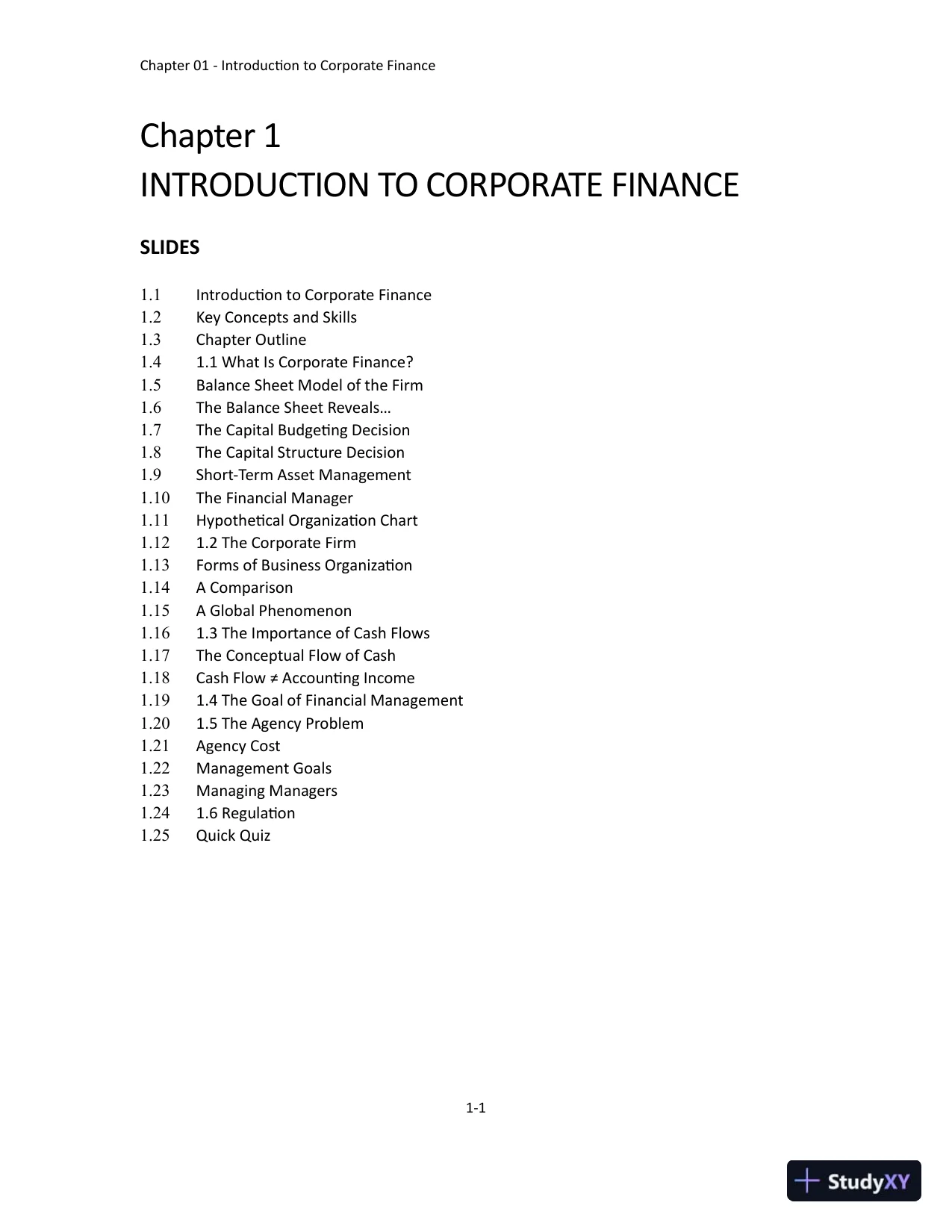
Study Notes For Corporate Finance: Core Principles and Applications, 5th Edition - Page 1 preview imageChapter 01-Introductionto Corporate Finance1-1Chapter 1INTRODUCTION TO CORPORATE FINANCESLIDES1.1Introduction to Corporate Finance1.2Key Concepts and Skills1.3Chapter Outline1.41.1 What Is Corporate Finance?1.5Balance Sheet Model of the Firm1.6The Balance Sheet Reveals…1.7The CapitalBudgeting Decision1.8The Capital Structure Decision1.9Short-Term Asset Management1.10The Financial Manager1.11Hypothetical Organization Chart1.121.2 The Corporate Firm1.13Forms of Business Organization1.14A Comparison1.15A Global Phenomenon1.161.3 The Importance of CashFlows1.17The Conceptual Flow of Cash1.18Cash Flow ≠ Accounting Income1.191.4 The Goal of Financial Management1.201.5 The Agency Problem1.21Agency Cost1.22Management Goals1.23Managing Managers1.241.6 Regulation1.25QuickQuiz
Page 2 of 16
Study Notes For Corporate Finance: Core Principles and Applications, 5th Edition - Page 2 preview image
Page 3 of 16
Study Notes For Corporate Finance: Core Principles and Applications, 5th Edition - Page 3 preview imageChapter 01-Introduction to CorporateFinance1-2Copyright © 2018McGraw-Hill Education.All rights reserved. No reproduction or distribution without the prior written consent ofCHAPTER WEB SITESSectionWeb Address1.1CFO.com Website: www.cfo.com1.2Incorporate Website: www.incorporate.com1.4Business Ethics Website: www.business-ethics.comEnd-of-chapter materialNYSE Website: www.nyse.comNasdaq Website: www.nasdaq.comBizFilings Website: www.bizfilings.comCHAPTER ORGANIZATION1.1What Is Corporate Finance?The Balance Sheet Model of the FirmThe Financial Manager1.2The Corporate FirmTheSoleProprietorshipThePartnershipTheCorporationA Corporation by Another Name…1.3The Importance of Cash Flows1.4The Goal of Financial ManagementPossible GoalsThe Goal of Financial ManagementA More General Goal1.5The Agency Problem and Control of theCorporationAgency RelationshipsManagement GoalsDo Managers Act in the Stockholders’ Interests?Stakeholders1.6RegulationThe Securities Act of 1933 and the Securities Exchange Act of 1934
Page 4 of 16
Study Notes For Corporate Finance: Core Principles and Applications, 5th Edition - Page 4 preview imageChapter 01-Introduction to CorporateFinance1-3Copyright © 2018McGraw-Hill Education.All rights reserved. No reproduction or distribution without the prior written consent ofANNOTATED CHAPTER OUTLINESlide 1.1Chapter 1 Title SlideSlide 1.2Key Concepts and SkillsSlide 1.3Chapter OutlinePowerPoint Note:If there is a slide that you do not wish to include in your presentation, chooseto hide the slide under the “Slide Show” menu, instead of deleting it. If you decide that youwouldlike to use that slide at a later date, you can just unhide it.PowerPoint Note:Be sure to check out the notes that accompanysome ofthe slides on the“Notes Pages” within PowerPoint.Slide 1.4What isCorporate Finance?Corporate finance addresses several important questions:1.Economic resources are required to establish and maintain a firm2.Funds enable materials and processes for delivering salable goods andservices3.Funds are essential for assembling a workforce4.Funds are required to purchase long-lived assets such as equipment andbuildings5.The balance sheet offers insight into the array of decisions, activities andobjectives of the financial managerSlide 1.5Balance Sheet Model of the FirmThe Balance Sheet presents a picture of the firm at a point in time, and itprovides a model which reveals the three basic questions that corporate financemanagers must answer.Slide 1.6The Balance Sheet Reveals……the top three concerns of corporate finance:1.What long term investments should thefirm choose?2.How should the firm raise funds for the selected investments?3.How should current assets be managed and financed?Slide 1.7The Capital Budgeting Decision
Page 5 of 16
Study Notes For Corporate Finance: Core Principles and Applications, 5th Edition - Page 5 preview imageChapter 01-Introduction to CorporateFinance1-4Copyright © 2018McGraw-Hill Education.All rights reserved. No reproduction or distribution without the prior written consent ofLong-term investment decisions determine the level of fixed assets.Slide 1.8The Capital Structure DecisionFinancing policy determines the liabilities and equity side of the balance sheet.Slide 1.9Short-Term Asset ManagementShort-term asset management choices (e.g., conservative versus aggressive)affect the level of net working capital.Slide 1.10TheFinancial ManagerThe firm’s three main financial concerns are usually handled by a top officer andaides:1.V.P. or Chief Financial Officer–ordinarilyacts as a financial strategist,coordinator and authority dedicated tomaking decisions that increasethe value of the firm2.Treasurer–concerned with cash flow, capital expenditures and capitalstructure3.Controller–concerned with accounting, information systems, and taxesSlide 1.11Hypothetical Organization ChartThe Chief Financial Officer (CFO) or Vice-President of Finance coordinates theactivities of the treasurer and the controller.The controller handles cost and financial accounting, taxes,and informationsystems(i.e., data processing).The treasurer handles cashand creditmanagement, financial planning,andcapital expenditures.Slide 1.12The Corporate Firm
Page 6 of 16
Study Notes For Corporate Finance: Core Principles and Applications, 5th Edition - Page 6 preview imageChapter 01-Introduction to CorporateFinance1-5Copyright © 2018McGraw-Hill Education.All rights reserved. No reproduction or distribution without the prior written consent ofAlthough many forms of business organizations exist, the corporate form is thestandard by which we address most large scale problems, especially raising largequantities of funds. This approach, however, does not imply that the methodswe develop are inappropriate for other business types.Slide 1.13Forms of Business OrganizationA.TheSole ProprietorshipA business owned by one personAdvantages include ease of start-up, lower regulation, single ownerkeeps all the profits, and taxed once as personal income.Disadvantages include limited life, limited equity capital, unlimitedliability and low liquidity.B.ThePartnershipAbusiness with multiple owners, but not incorporatedGeneral partnership–all partners share in gains or losses; all haveunlimited liability for all partnership debts.Limited partnership–one or more general partners run the businessand have unlimited liability. A limited partner’s liability is limitedtohis or her contribution to the partnership,and they cannot help inrunning the business.Advantages include more equity capital than is available to a soleproprietorship, relatively easy to start (although written agreementsare essential), and income taxed once at personal tax rate.Disadvantages include unlimited liability for general partners,dissolution of partnership when one partner dies or wishes to sell,andlow liquidity.Lecture Tip: Recent years have seenresurgence in the importance of privateequity funds in the financing of firms. A discussion of this industry may increasestudent interest and facilitate a practical example oflimitedpartnerships, whichis the primary structure employed by these entities.C.TheCorporationA distinct legal entitycomposed of one or more owners
Page 7 of 16
Study Notes For Corporate Finance: Core Principles and Applications, 5th Edition - Page 7 preview imageChapter 01-Introduction to CorporateFinance1-6Copyright © 2018McGraw-Hill Education.All rights reserved. No reproduction or distribution without the prior written consent ofSlide 1.14A ComparisonCorporations account for the largest volume of business (in dollar terms) in theU.S.Advantages include limited liability, unlimited life, separation of ownershipand management (ability to own shares in several companies without having towork for all of them), liquidity, and ease of raising capital.Disadvantages include separation of ownership and management (agency costs)and double taxation.Recenttax laws reduce the level of double taxation, but ithas not been eliminated.Lecture Tip:Although the corporate form of organization has the advantage oflimited liability, it has the disadvantage of double taxation.A small business of75 or fewer stockholders is allowed by the IRS to form an S Corporation.The SCorp. organizational form provides limited liability but allows pretax corporateprofits to be distributed on a pro rata basis to individual shareholders, who areonly obligated to pay personal income taxes on the income.A similar form oforganization is the limited liabilitycorporation, or LLC.LLC’s are a hybrid form oforganization that falls between partnerships and corporations.Investors in LLC’shave the protection of limited liability, but they are taxed like partnerships.LLC’sfirst appeared in Wyoming in 1977 and have skyrocketed since. They areespecially beneficial for small and medium sized businesses such as law firms ormedical practices.Slide 1.15A Global PhenomenonCorporations exist around the world under a variety of names. Table 1.2listsseveral well-known companies, along with the type of company in the originallanguage.Slide 1.16The Importance of Cash FlowsLecture Tip:It is essential at this early stage to assure that students understandthat finance examines both accounting income and cash flow.It is criticallyimportant for students to understand that a firmcannotsustain itself unless itproduces a positive cash flow.If the firm is to prosper, it must purchase assets that produce more cash thanthey cost and finance itself using the least costly means of doing so. Successfulfirms produce more cash than they use.
Page 8 of 16
Study Notes For Corporate Finance: Core Principles and Applications, 5th Edition - Page 8 preview imageChapter 01-Introduction to CorporateFinance1-7Copyright © 2018McGraw-Hill Education.All rights reserved. No reproduction or distribution without the prior written consent ofSlide 1.17TheConceptual Flow of CashThe purpose of this slide is to provide a graphical representation of theinterconnectedness of the three goals of financial management.It will beimportant for students to appreciate that it is the capital structure than enablescapital spending. Capital spending in turn enables the production and sales thatproduce the cash flow necessary to make a return to investors, pay creditors,andadd to the treasure of the business.Slide 1.18Cash Flow ≠ Accounting IncomeLecture Tip:Now is the best time to assure students are comfortable with thedistinction between accounting income and cash flow.It may be useful to refer toExample 1.1 in the text to drive the point home.Slide 1.19The Goal of Financial ManagementA.Possible GoalsProfit Maximization–this is an imprecise goal.Do we want to maximizelong-runor short-run profits?Do we want to maximize accounting profitsor somemeasure of cash flow?Because of the different possible interpretations, thisshould not be the main goal of the firm.Other possible goals that students might suggest include minimizing costs ormaximizingmarket share. Both have potential problems.We can minimize costsby not purchasing new equipment today, but that may damage the long-runviability of the firm.Manydot.comcompanies got into trouble in the late1990’sbecause their goalwas to maximize market share.They raised substantialamounts of capital in IPOs and then used the money on advertising to increasethe number of “hits” on their site. However, many firms failed to translate those“hits” into enough revenue to meet expenses,and they quickly ranout ofcapital.The stockholders of these firms were not happy. Stock prices felldramatically,and it became difficult for these firms to raise additional funds. Infact, many of these companies have gone out of business.B.The Goal of Financial ManagementFrom a stockholder (owner) perspective, the goal of buying the stock is to gainfinancially.Thus,the goal of financial management in a corporation is tomaximize the current value per share of the existing stock.
Page 9 of 16
Study Notes For Corporate Finance: Core Principles and Applications, 5th Edition - Page 9 preview imageChapter 01-Introduction to CorporateFinance1-8Copyright © 2018McGraw-Hill Education.All rights reserved. No reproduction or distribution without the prior written consent ofLecture Tip:The late Roberto Goizueta, former chairman and CEO of the Coca-Cola Company, wrote an essay entitled “Why Share-Owner Value?” thatappeared in the firm’s 1996 annual report.It is an excellent introduction to thegoal of financial management at any level.It may also be useful to discuss howMr. Goizueta’s vision transferred to the stock market’s valuation of the company.A subsequentarticlealsoillustrates the difference in strategy between Coca-Colaand Pepsi-Coduring Mr. Goizueta’s tenure: “How Coke is Kicking Pepsi’s Can,”Fortune, October 28, 1996.Coke focused on soft drinks while Pepsi-Co diversified into other areas. Pepsi-Co’sgoal was to double revenues every 5 years, while Mr. Goizueta focused on returnon investment and stock price. The article states that Goizueta "has createdmore wealth forstockholders than any other CEO in history.” In mid-1996, Pepsi-Co sold at 23 times earnings withareturn on equity of about 23% and Coke soldat 36 times earnings with a return on equity of around 55%. The article goes onto discuss the differing strategies in more detail.It provides a nice validation ofMr. Goizueta’s remarks in his letter to the shareholders.Consider obtaining recent estimates for return on equity and the PE ratio forboth companies to see how things have changed.This can be used to discusshow company strategies and performance change over time, including thechallenges these companies face as consumers become more health conscious.Lecture Tip:The validity of this goalassumes “investor rationality.” In otherwords, investors in the aggregate prefer more dollars to fewer and less risk tomore. Rational investors will act as risk-aversereturn-seekers in making theirpurchase and sale decisions and, given different levels of risk aversion andwealth preferences, the only single goal suitable for all shareholders is themaximization of their wealth (which is represented by their holdingsof the firm’scommon stock).Lecture Tip:For those interested in behavioral finance, this may be an opportunetime to discuss outside influences that impact share price, many of which arebeyond the control of the firm.C.A More General GoalThe more general goal is to maximize the market value of owners’ equity.Many students think this means that firms should do “anything” to maximizestockholder wealth.It is important to point out that unethical behavior does notultimately benefit owners.
Page 10 of 16
Study Notes For Corporate Finance: Core Principles and Applications, 5th Edition - Page 10 preview imageChapter 01-Introduction to CorporateFinance1-9Copyright © 2018McGraw-Hill Education.All rights reserved. No reproduction or distribution without the prior written consent ofEthics Note:Any number of ethical issues can be introduced for discussion. Oneparticularly good opener to this topic that many students can relate to is theissue oftheresponsibility of the managers and stockholders of tobacco firms. Isit ethical to sell a product that is known to be addictive and dangerous to thehealth of the user even when used as intended? Is the fact that the product islegal relevant? Do recent court decisions against the companies matter? Whatabout the way companies choose to market their product? Are these issuesrelevant to financial managers?Slide 1.20The Agency ProblemThe agency relationship arises when a principal hires an agent to represent theirinterest.Stockholders (principals) hire managers (agents) to run a company.The agency problem is defined by a situation in which there is a conflict ofinterest between a principal and agent.Lecture Tip:This topic also lends itself well to an ethics discussion that could beinitiated on a wide variety of potential conflicts.Slide1.21Agency CostAgency cost is simply the cost of the conflict of interestFor example, if owners want to make a large risky investment in order to harvestlong-term profits, managers may object because their short-term objectives areput at risk.If managers prevail, any foregone long-term cash flow is the agency cost.Slide 1.22ManagementGoalsDirectagencycosts–compensation and perquisites for managementIndirectagencycosts–cost of monitoring and sub-optimal decisionsLecture Tip:In the early 1980s, the Burlington Northern Railroad sought to selloff real estate with a value of approximately $778 million. The firm was enjoinedfrom doing so, however, by restrictions written into covenants of the firm’s bondsin 1896. These wereverylong-term bonds with an additional fifty years tomaturity. They also were not callable and did not include a sinking fundprovision. Management found it necessary to negotiate with the bondholders to
Page 11 of 16
Study Notes For Corporate Finance: Core Principles and Applications, 5th Edition - Page 11 preview imageChapter 01-Introduction to CorporateFinance1-10Copyright © 2018McGraw-Hill Education.All rights reserved. No reproduction or distribution without the prior written consent ofrelease some of the value tied up in the real property originally used to securethese bonds. Following a great deal of legal wrangling, the bondholders settledfor payments totaling $35.5 million. Lawyers for the bondholders settled foranother $3.4 million. In other words, the cost of addressing thisstockholder/bondholder conflict was nearly $40 million–and this doesn’t includethe opportunity cost of management time spent on this issue instead of runningthe business. For further discussion of this case, see “Bond Covenants andForegone Opportunities” by Gene Laber, in the Summer1992 issue ofFinancialManagement.Ethics Note:When shareholders elect a board of directors to oversee thecorporation, the election serves as a control mechanism for management.Theboard of directors bears legal responsibility for corporate actions. However, thisresponsibility is to the corporation itself and not necessarily to the stockholders.Although it happened several years ago,the following examplestill makes for aninteresting discussion of directors’ and managers’ duties:In 1986, Ronald Perelman engaged in an unsolicited takeover offer for Gillette.Gillette’s management filed litigation against Perelman and subsequentlyentered into a standstill agreement with Perelman.This action eliminated thepremium that Perelman offered shareholders for their stock in Gillette.A group of shareholders filed litigation against the board of directors inresponse to its actions.It was subsequently discovered that Gillette had enteredinto standstill agreements with ten additional companies.When questionedregarding the rejection of Perelman’s offer, management responded that therewere projects on line that could not be discussed (later revealed to be the“Sensor” razor, which was one of the most profitable new ventures in Gillette’shistoryup to that time).Thus, despite appearances, management’s actions mayhave been in the best interests of the firm, and this case indicates thatmanagement may consider factors other than the bid when considering a tenderoffer.Slide 1.23Managing ManagersManagerial compensation can be used to encourage managers to act in the bestinterest of stockholders. One commonly cited tool is stock options. The idea isthat if management has an ownership interest in the firm, they will be morelikely to try to maximize owner wealth.Lecture Tip:Stern Stewart & Company developed a tool called EVA®,whichmeasures how much “economic value” is being added to a corporation bymanagement decisions. According to Stern-Stewart’s analysis,companies that
Page 12 of 16
Study Notes For Corporate Finance: Core Principles and Applications, 5th Edition - Page 12 preview imageChapter 01-Introduction to CorporateFinance1-11Copyright © 2018McGraw-Hill Education.All rights reserved. No reproduction or distribution without the prior written consent oftie management compensation to EVA®significantly outperform competitorsthat do not.Thisexample illustratesthat carefully crafted compensationpackagesmayreduce the conflict between management and stockholders.Lecture Tip:According to The National Center for Employee Ownership, broadbased stock option plans increased dramatically, not only for technology firms,but also for non-tech firms such as Starbucks and the Gap.They report that anestimated7.2 employees held stock options down from its peak in 2001,when the number was about 30% higher. They attribute the decline tochanges in accounting rules and shareholder concerns about ownership dilution.The decline may also be related to the fact that severalfirms have beenembroiled in option backdating scandals. As such, the use of options in recentyears has fallen, giving way to restricted shares.Stockholders technically have control of the firm, and dissatisfied shareholderscan oust management via proxy fights, takeovers(e.g., Carl Icahn), etc.However,this is easier said than done.Staggered elections for board members often makeit difficult to remove the board that appoints management.Poison pills andother anti-takeover mechanisms make hostile takeovers difficult to accomplish.Further, the cost of a proxy fight can be prohibitive, with the 2002 HP/Compaqbattle costing over $100 million.Reports indicated thatDuPontspent $15 millionon its proxy fight with Nelson Peltz in 2015.Lecture Tip:A discussion of the rise of activist investors would also stimulateclass discussion.The classic proxy battle betweenDuPontand activist investorNelson Peltz would be a good example.Peltz's Trian Fund Management soughtfour seats on the board but ultimately all 12 of the directors backed byDuPont’smanagement were elected in May 2015.Despite the loss, the Wall Street Journalreported in December 2015 thatDow ChemicalCo.andDuPontCo.announcedplans to mergein a transaction valuedat $120 billion before splitting up intothree separate companies.They noted that the plan originated withmanagement butmanagementworked with activist investorNelson Peltztoexecute the deal.The merger was seen as a victory for activist investors.Stakeholders are other groups, besides stockholders, that have a vested interestin the firm and potentially have claims on the firm’s cash flows.Stakeholders caninclude creditors, employees,customers, and the government.Lecture Tip:A good practitioner-oriented discussion of the impact ofstakeholders on decision-making is found in a 1987Wall Street Journalarticle byCharles Exley, Jr., then-chairman and president of NCR Corp. The thrust of Mr.Exley’s comments is that giving more consideration to the interests of non-stockholderstakeholders is good businessand results in the decentralization of
Page 13 of 16
Study Notes For Corporate Finance: Core Principles and Applications, 5th Edition - Page 13 preview imageChapter 01-Introduction to CorporateFinance1-12Copyright © 2018McGraw-Hill Education.All rights reserved. No reproduction or distribution without the prior written consent ofmanagement. Frequently, a discussion of stakeholder interests (as opposed to adiscussion exclusively geared toward stockholder interests) leads to a betterunderstanding of the nature of the corporate form of organization, the role ofthe corporation in society (and the question of “corporatesocial responsibility”), as well as the role of contracting in the labor and financialmarkets.A good thing to noteisthat culture influences the goal of the firm.TheUS andUK are examples of countries/regions where shareholder wealth maximization isparamount.In countries like Germany and Japan the interests of employees andcustomers are given emphasis.Ethics Note:A discussion of stakeholder interests leads very nicely into adiscussion of ethical decision making.Theories of ethical behaviorfocus on therights of all parties affected by a decision, not just one or two. The “utilitarian”model defines an action as acceptable if it maximizes the benefit, or minimizesthe harm, to stakeholders in the aggregate. The “golden rule” model deems adecision ethical if all stakeholders are treated as the decision maker would wishto be treated.Finally, the Kantian “basic rights” model defines acceptable actionsas those that minimize the violation of stakeholders’ rights.Lecture Tip:The antitrust case against Microsoft can generate a healthydiscussion of ethical behavior, innovation and the government’s role inmonitoring business practices. The basic idea behind the case is that: (1)Microsoft stifled competition by imposing stiff penalties on computermanufacturers that chose to install operating systems other than Windows onsome of their machines; (2) Microsoft tried to put Netscape out of business byincorporating Internet Explorerinto the operating system; and(3)Microsoft hasan unfair advantage in the applications programming area because theirprogrammers have access to the source code for the operating system.Therewere other issues as well, but these were the major ones.The judge in the caseoriginally found that Microsoft did violate antitrust laws and that they continuedto operate in a monopolistic fashion.He ordered the break-up of Microsoft intoan “operating system” company andan “applications” company. The judge alsoordered that Microsoft allow programmers from the company’s competitors tocome to a secured location and view the source code for Microsoft Windows.Microsoft contended that this would allow other companies to determine thedirection that Microsoft is moving with their software and eliminate thecompetitive advantage that their research and development has afforded thecompany. The case was appealed and Microsoft was still found in violation ofantitrust laws, but not to the extent found in the original case.
Page 14 of 16
Study Notes For Corporate Finance: Core Principles and Applications, 5th Edition - Page 14 preview imageChapter 01-Introduction to CorporateFinance1-13Copyright © 2018McGraw-Hill Education.All rights reserved. No reproduction or distribution without the prior written consent ofThe Final Judgment was issued on November 12, 2002 and hadthe followingcomponents: (1) Microsoft cannot retaliate against an Original EquipmentManufacturer (OEM) if the OEM “is or is contemplating developing, distributing,promoting, using, selling or licensing any software that competes with MicrosoftPlatform Software” or ships a computerwith more than one operating system;(2) Microsoft must publish and use a consistent licensing agreement schedulewith all covered OEMs; (3) Microsoft cannot restrictOEMs from sellingcomputers that include competing products, display competing product icons onthe desktop, and launch competing products when a Microsoft application wouldnormally be launched; (4) Microsoft must allow Independent Software Vendors(ISVs), Independent Hardware Vendors (ISDs), Internet Access Providers (IAPs),Internet Content Providers (ICPs) and OEMs access to Windows OperatingSystem Product source code as necessary to develop products that will workeffectively with the operating system–these companies must demonstrate whythey need access and they are limited to access to that code that is required for“interoperating” with the operating system;and(5) Microsoft is not required todisclose any intellectual property rights related to security or that is designed toprevent software piracy.The Final Judgment called for the appointment ofatechnical committee that willassist in the enforcement and compliance with the judgment and Microsoft wasrequired to appoint an internal compliance officer to make sure that allemployees of the firm understand and comply with the judgment. Reports oncompliance are routinely filed with the Department of Justice and can be found,along with the Final Judgment,attheU.S. Department of Justive website(http://www.usdoj.gov/atr/cases/ms_index.htm).Slide 1.24RegulationRegulation of financial activities arises from two substantial sources:Antitrust legislation governing issuance of securities andcreating the SEC; and,Sarbanes Oxley that requires increased reporting requirements and personalconsequences for non-compliance.Slide 1.25Quick Quiz
Page 15 of 16
Study Notes For Corporate Finance: Core Principles and Applications, 5th Edition - Page 15 preview imageChapter 02-Financial Statementsand Cash Flow2-1Chapter 2FINANCIAL STATEMENTS AND CASH FLOWSLIDES2.1Chapter 2 Title Slide2.2Key Concepts and Skills2.3Chapter Outline2.42.1 The Balance Sheet2.5Take Notice!(on the following Balance Sheet)2.6U.S. Composite Corporation Balance Sheet (in $millions)2.7Balance Sheet Analysis2.8Accounting Liquidity2.9Debt versus Equity2.10Value versus Cost2.112.2 The Income Statement2.12U.S.C.C. Income Statement 2017OperationsSection(in $millions)2.13U.S.C.C. Income Statement 2017Non-operatingSection(in $millions)2.14U.S.C.C. Income Statement 2017Net Income(in $millions)2.15Income Statement Analysis2.16GAAP2.17Noncash Items2.18Time and Costs2.19Costs and Purpose2.202.3 Taxes2.21Marginal versus Average Tax Rates2.222.4 Net Working Capital2.23U.S.C.C. Balance SheetNet Working Capital2.242.5 Financial Cash Flow2.25U.S.C.C. Financial Cash Flow:OCF2.26U.S.C.C. Financial Cash Flow: Capital Spending2.27U.S.C.C. Financial Cash Flow: Net Working Capital2.28U.S.C.C. Financial Cash Flow: cash Flow to Creditors2.29U.S.C.C. Financial Cash Flow: Cash Flow to Stockholders2.30U.S.C.C. Financial Cash Flow:Reconciliation2.312.5 The Statement of Cash Flows2.32U.S.C.C. Cash Flow from Operating Activities2.33U.S.C.C. Cash Flow from Investing activities2.34U.S.C.C. Cash Flow from Financing activities2.35U.S.C.C. Statement of Cash Flows
Page 16 of 16
Study Notes For Corporate Finance: Core Principles and Applications, 5th Edition - Page 16 preview imageChapter 02-Financial Statementsand Cash Flow2-22.36Quick Quiz2.37Sources of InformationCHAPTER WEB SITESSectionWeb Address2.1Yahoo Finance Website: finance.yahoo.com2.1CNN Money Website: money.cnn.com2.1SEC Website: www.sec.gov2.1FASB Website: www.fasb.org2.3IRS Website: www.irs.govEnd-of-chapter materialYahoo Finance Website:finance.yahoo.comCoca-Cola Website: www.coca-cola.comCooper Tires Website: www.coopertires.comCHAPTER ORGANIZATION2.1The Balance SheetAccounting LiquidityDebt versus EquityValue versus Cost2.2The Income StatementGenerally Accepted Accounting PrinciplesNoncash ItemsTime and Costs2.3TaxesCorporate Tax RatesAverage versus Marginal Tax Rates2.4Net Working Capital2.5Cash Flow of the Firm2.6The Accounting Statement of Cash FlowsCash Flow from Operating Activities
Preview Mode

This document has 302 pages. Sign in to access the full document!