
Certification Guides
Wiley Finra Series 3 Exam Review (2019)
- Finance
- 253 pages
- Shared February 2025
- 131 downloads
Wiley Finra Series 3 Exam Review (2019) helps you master complex topics with simplified explanations.
Preview · 31 of 253 pages
100%
Page 1

Page 2

Page 3
 WILEY SECURITIES LICENSING SERIESThis series includes the following titles:Wiley Securities Industry Essentials Exam Review 2019Wiley Series 3 Securities Licensing Exam Review 2019 + Test Bank:The National Commodities Futures ExaminationWiley Series 4 Securities Licensing Exam Review 2019 + Test Bank:The Registered Options Principal ExaminationWiley Series 6 Securities Licensing Exam Review 2019 + Test Bank:The Investment Company and Variable Contracts Products RepresentativeExaminationWiley Series 7 Securities Licensing Exam Review 2019 + Test Bank:The General Securities Representative ExaminationWiley Series 9 Securities Licensing Exam Review 2019 + Test Bank:The General Securities Sales Supervisor Examination—Option ModuleWiley Series 10 Securities Licensing Exam Review 2019 + Test Bank:The General Securities Sales Supervisor Examination—General ModuleWiley Series 24 Securities Licensing Exam Review 2019 + Test Bank:The General Securities Principal ExaminationWiley Series 26 Securities Licensing Exam Review 2019 + Test Bank: TheInvestment Company and Variable Contracts Products Principal ExaminationWiley Series 57 Securities Licensing Exam Review 2019 + Test Bank:The Securities Trader ExaminationWiley Series 63 Securities Licensing Exam Review 2019 + Test Bank:The Uniform Securities Agent State Law ExaminationWiley Series 65 Securities Licensing Exam Review 2019 + Test Bank:The Uniform Investment Adviser Law ExaminationWiley Series 66 Securities Licensing Exam Review 2019 + Test Bank:The Uniform Combined State Law ExaminationWiley Series 99 Securities Licensing Exam Review 2019 + Test Bank:The Operations Professional ExaminationFor more on this series, visit the website at www.securitiesCE.com.2
Page 4
 WILEY SERIES 3 SECURITIES LICENSINGEXAM REVIEW 2019 + TEST BANK3
Page 5
 The National Commodities Futures ExaminationThe Securities Institute of America, Inc.4
Page 6
 Cover Design: WileyCover Image: © Jumpeestudio/iStock.comCopyright © 2019 by The Securities Institute of America, Inc. All rights reserved.Published by John Wiley & Sons, Inc., Hoboken, New Jersey.Previous editions published by The Securities Institute of America, Inc.Published simultaneously in Canada.No part of this publication may be reproduced, stored in a retrieval system, or transmitted in any form or by any means, electronic,mechanical, photocopying, recording, scanning, or otherwise, except as permitted under Section 107 or 108 of the 1976 UnitedStates Copyright Act, without either the prior written permission of the Publisher, or authorization through payment of theappropriate per-copy fee to the Copyright Clearance Center, Inc., 222 Rosewood Drive, Danvers, MA 01923, (978) 750-8400, fax(978) 646-8600, or on the Web at www.copyright.com. Requests to the Publisher for permission should be addressed to thePermissions Department, John Wiley & Sons, Inc., 111 River Street, Hoboken, NJ 07030, (201) 748-6011, fax (201) 748-6008, oronline at www.wiley.com/go/permissions.Limit of Liability/Disclaimer of Warranty: While the publisher and author have used their best efforts in preparing this book, theymake no representations or warranties with respect to the accuracy or completeness of the contents of this book and specificallydisclaim any implied warranties of merchantability or fitness for a particular purpose. No warranty may be created or extended bysales representatives or written sales materials. The advice and strategies contained herein may not be suitable for your situation.You should consult with a professional where appropriate. Neither the publisher nor author shall be liable for any loss of profit orany other commercial damages, including but not limited to special, incidental, consequential, or other damages.For general information on our other products and services or for technical support, please contact our Customer Care Departmentwithin the United States at (800) 762-2974, outside the United States at (317) 572-3993, or fax (317) 572-4002.Wiley publishes in a variety of print and electronic formats and by print-on-demand. Some material included with standard printversions of this book may not be included in e-books or in print-on-demand. If this book refers to media such as a CD or DVD thatis not included in the version you purchased, you may download this material at http://booksupport.wiley.com. For moreinformation about Wiley products, visit www.wiley.com.ISBN 978-1-119-55255-0 (Paperback)ISBN 978-1-119-55257-4 (ePDF)ISBN 978-1-119-55260-4 (ePub)5
Page 7
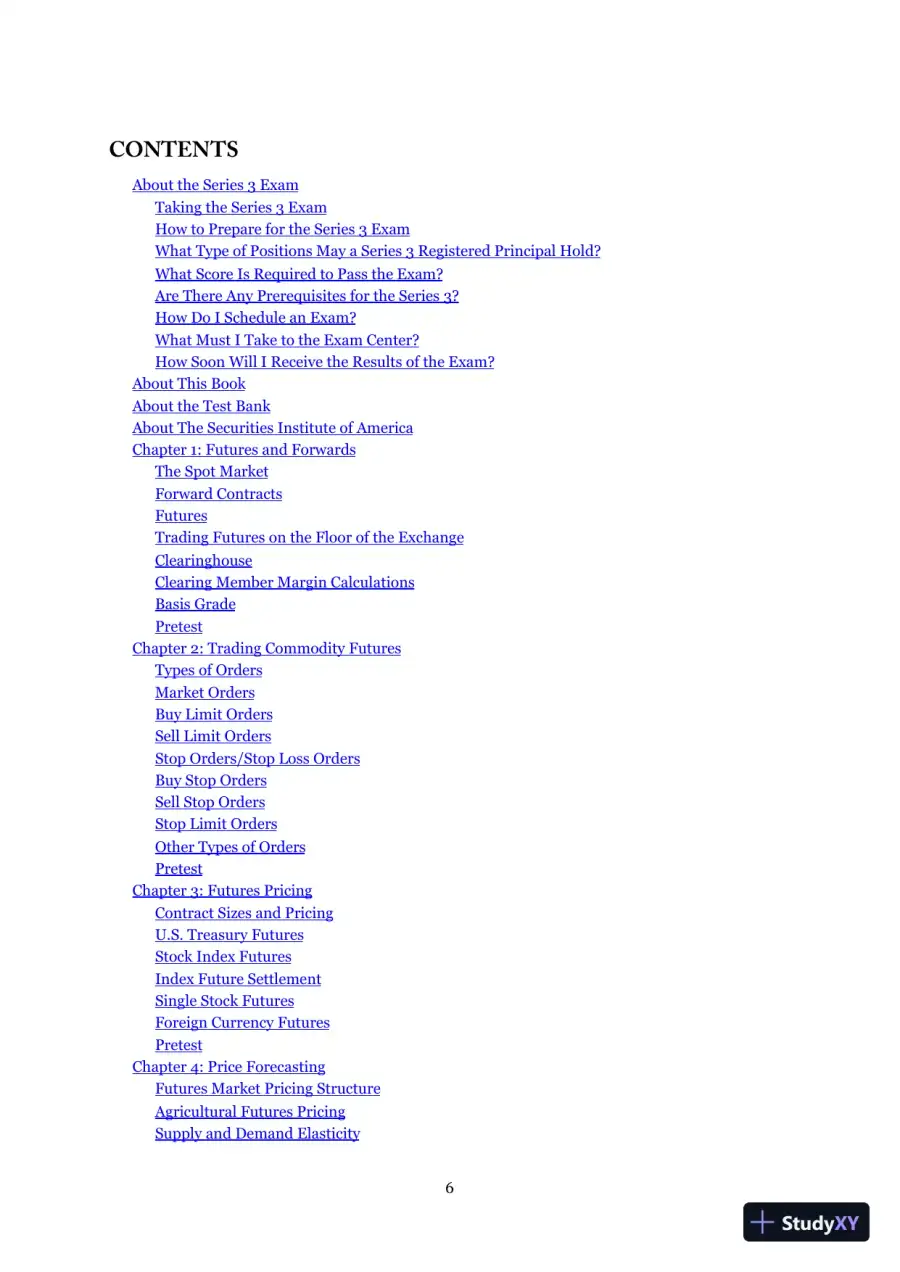 CONTENTSAbout the Series 3 ExamTaking the Series 3 ExamHow to Prepare for the Series 3 ExamWhat Type of Positions May a Series 3 Registered Principal Hold?What Score Is Required to Pass the Exam?Are There Any Prerequisites for the Series 3?How Do I Schedule an Exam?What Must I Take to the Exam Center?How Soon Will I Receive the Results of the Exam?About This BookAbout the Test BankAbout The Securities Institute of AmericaChapter 1: Futures and ForwardsThe Spot MarketForward ContractsFuturesTrading Futures on the Floor of the ExchangeClearinghouseClearing Member Margin CalculationsBasis GradePretestChapter 2: Trading Commodity FuturesTypes of OrdersMarket OrdersBuy Limit OrdersSell Limit OrdersStop Orders/Stop Loss OrdersBuy Stop OrdersSell Stop OrdersStop Limit OrdersOther Types of OrdersPretestChapter 3: Futures PricingContract Sizes and PricingU.S. Treasury FuturesStock Index FuturesIndex Future SettlementSingle Stock FuturesForeign Currency FuturesPretestChapter 4: Price ForecastingFutures Market Pricing StructureAgricultural Futures PricingSupply and Demand Elasticity6
Page 8
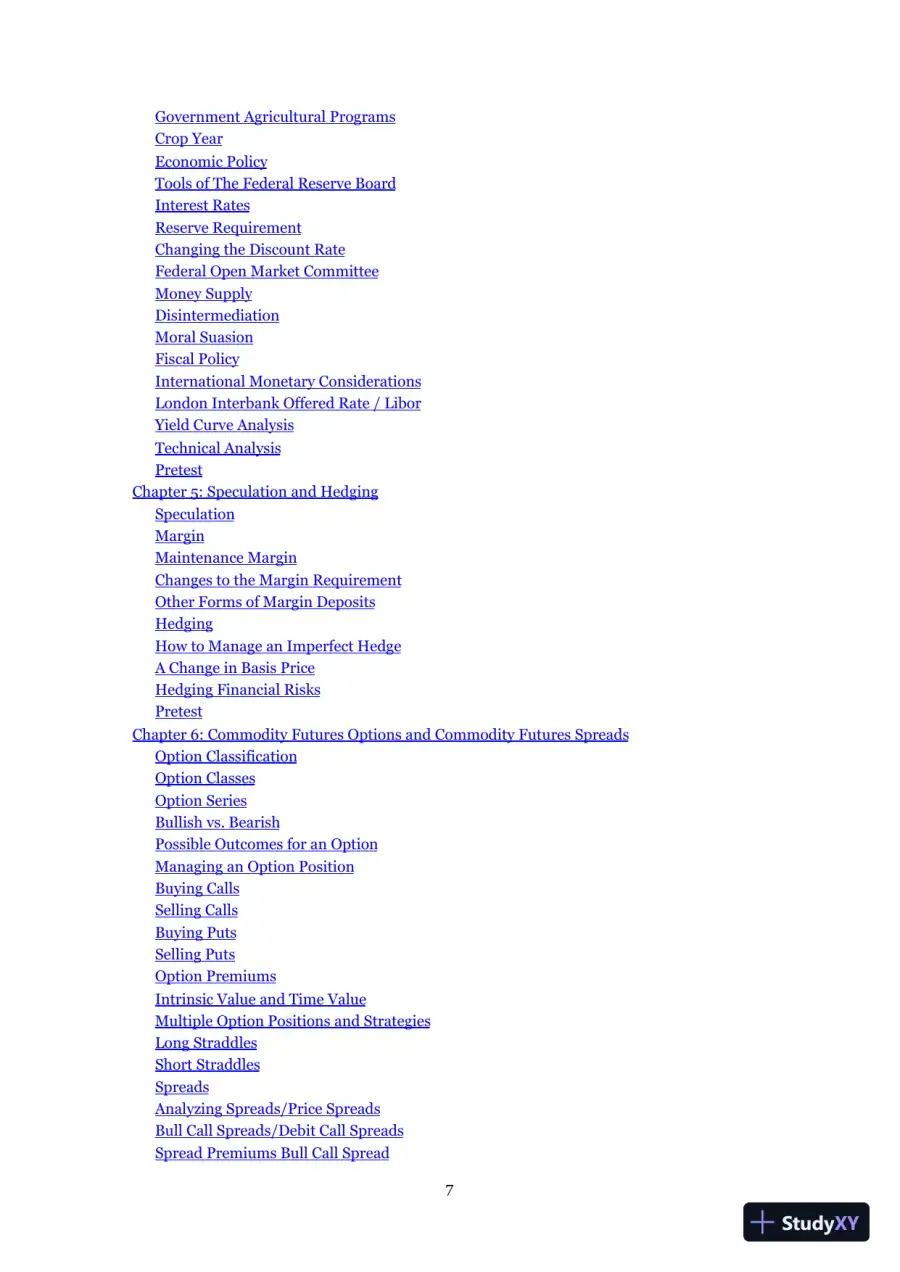 Government Agricultural ProgramsCrop YearEconomic PolicyTools of The Federal Reserve BoardInterest RatesReserve RequirementChanging the Discount RateFederal Open Market CommitteeMoney SupplyDisintermediationMoral SuasionFiscal PolicyInternational Monetary ConsiderationsLondon Interbank Offered Rate / LiborYield Curve AnalysisTechnical AnalysisPretestChapter 5: Speculation and HedgingSpeculationMarginMaintenance MarginChanges to the Margin RequirementOther Forms of Margin DepositsHedgingHow to Manage an Imperfect HedgeA Change in Basis PriceHedging Financial RisksPretestChapter 6: Commodity Futures Options and Commodity Futures SpreadsOption ClassificationOption ClassesOption SeriesBullish vs. BearishPossible Outcomes for an OptionManaging an Option PositionBuying CallsSelling CallsBuying PutsSelling PutsOption PremiumsIntrinsic Value and Time ValueMultiple Option Positions and StrategiesLong StraddlesShort StraddlesSpreadsAnalyzing Spreads/Price SpreadsBull Call Spreads/Debit Call SpreadsSpread Premiums Bull Call Spread7
Page 9
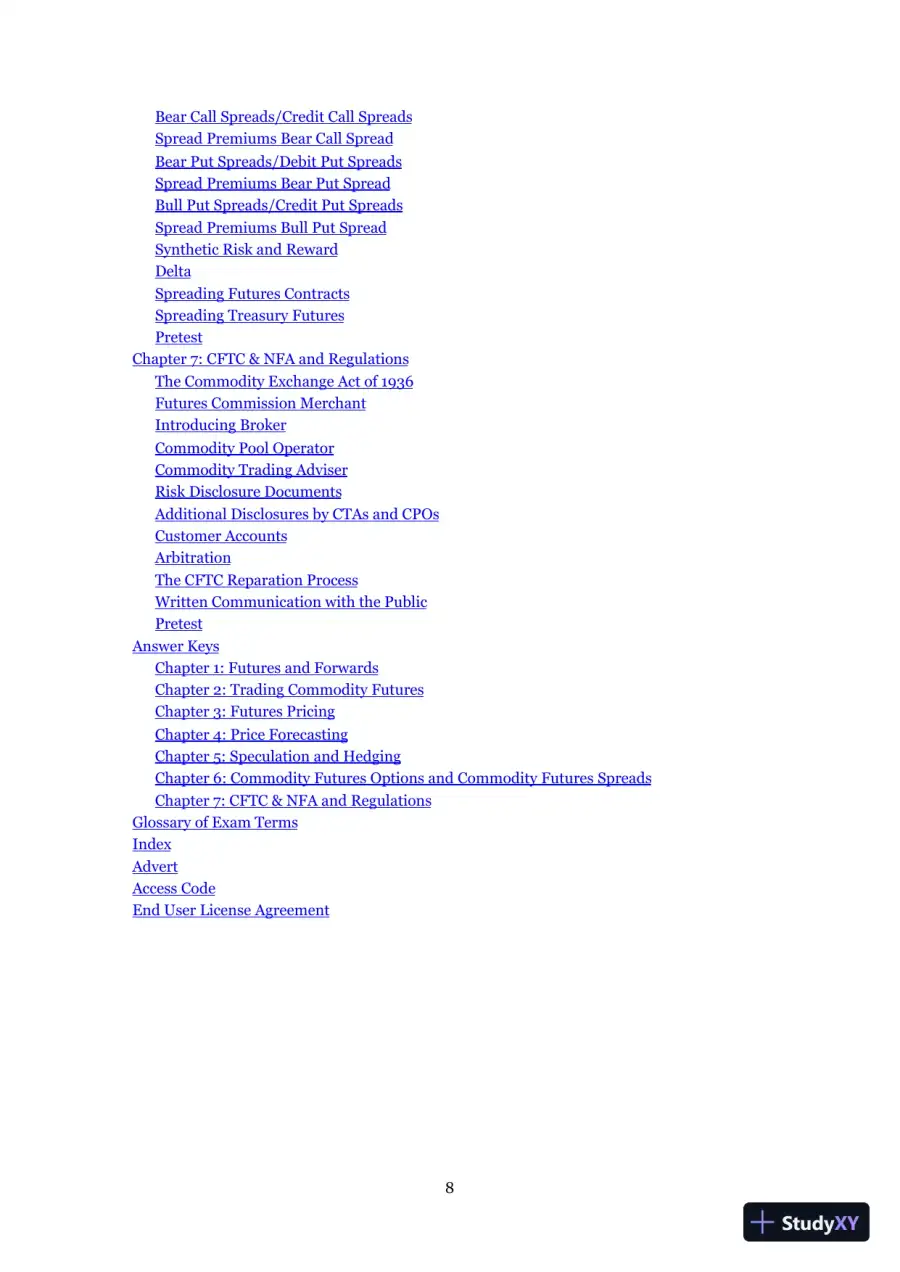 Bear Call Spreads/Credit Call SpreadsSpread Premiums Bear Call SpreadBear Put Spreads/Debit Put SpreadsSpread Premiums Bear Put SpreadBull Put Spreads/Credit Put SpreadsSpread Premiums Bull Put SpreadSynthetic Risk and RewardDeltaSpreading Futures ContractsSpreading Treasury FuturesPretestChapter 7: CFTC & NFA and RegulationsThe Commodity Exchange Act of 1936Futures Commission MerchantIntroducing BrokerCommodity Pool OperatorCommodity Trading AdviserRisk Disclosure DocumentsAdditional Disclosures by CTAs and CPOsCustomer AccountsArbitrationThe CFTC Reparation ProcessWritten Communication with the PublicPretestAnswer KeysChapter 1: Futures and ForwardsChapter 2: Trading Commodity FuturesChapter 3: Futures PricingChapter 4: Price ForecastingChapter 5: Speculation and HedgingChapter 6: Commodity Futures Options and Commodity Futures SpreadsChapter 7: CFTC & NFA and RegulationsGlossary of Exam TermsIndexAdvertAccess CodeEnd User License Agreement8
Page 10
 9
9Page 11
 10
10Page 12
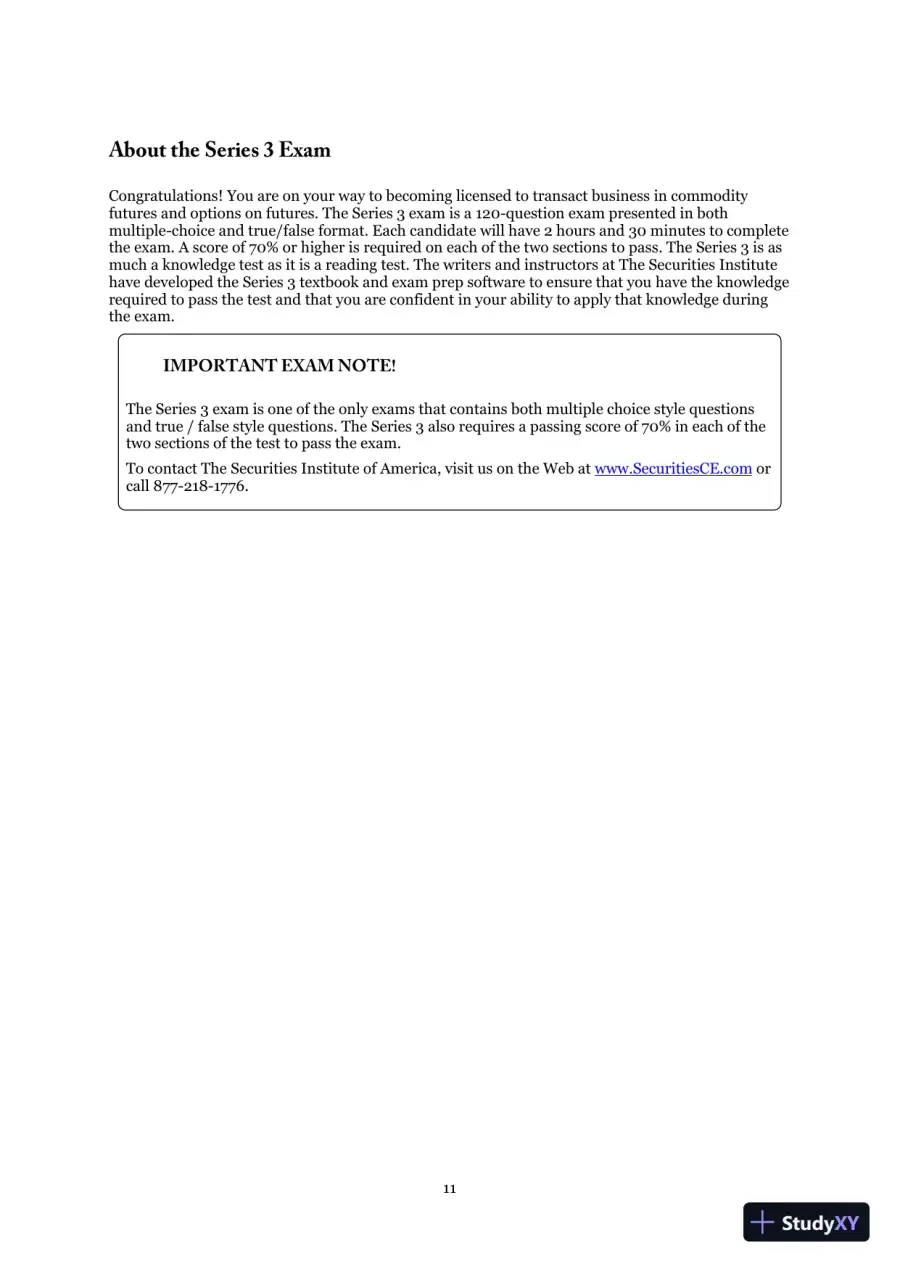 About the Series 3 ExamCongratulations! You are on your way to becoming licensed to transact business in commodityfutures and options on futures. The Series 3 exam is a 120-question exam presented in bothmultiple-choice and true/false format. Each candidate will have 2 hours and 30 minutes to completethe exam. A score of 70% or higher is required on each of the two sections to pass. The Series 3 is asmuch a knowledge test as it is a reading test. The writers and instructors at The Securities Institutehave developed the Series 3 textbook and exam prep software to ensure that you have the knowledgerequired to pass the test and that you are confident in your ability to apply that knowledge duringthe exam.IMPORTANT EXAM NOTE!The Series 3 exam is one of the only exams that contains both multiple choice style questionsand true / false style questions. The Series 3 also requires a passing score of 70% in each of thetwo sections of the test to pass the exam.To contact The Securities Institute of America, visit us on the Web at www.SecuritiesCE.com orcall 877-218-1776.11
Page 13
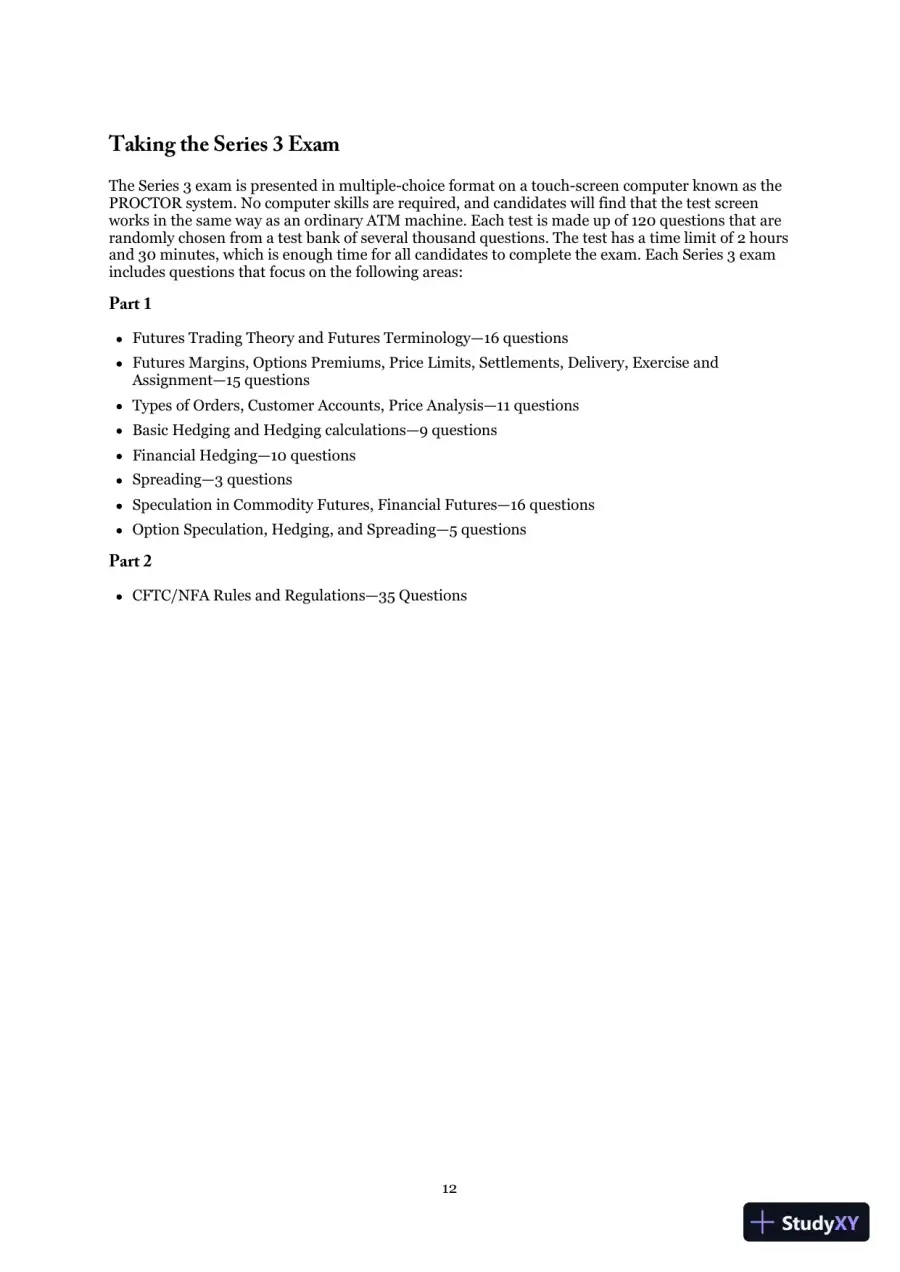 Taking the Series 3 ExamThe Series 3 exam is presented in multiple-choice format on a touch-screen computer known as thePROCTOR system. No computer skills are required, and candidates will find that the test screenworks in the same way as an ordinary ATM machine. Each test is made up of 120 questions that arerandomly chosen from a test bank of several thousand questions. The test has a time limit of 2 hoursand 30 minutes, which is enough time for all candidates to complete the exam. Each Series 3 examincludes questions that focus on the following areas:Part 1Futures Trading Theory and Futures Terminology—16 questionsFutures Margins, Options Premiums, Price Limits, Settlements, Delivery, Exercise andAssignment—15 questionsTypes of Orders, Customer Accounts, Price Analysis—11 questionsBasic Hedging and Hedging calculations—9 questionsFinancial Hedging—10 questionsSpreading—3 questionsSpeculation in Commodity Futures, Financial Futures—16 questionsOption Speculation, Hedging, and Spreading—5 questionsPart 2CFTC/NFA Rules and Regulations—35 Questions12
Page 14
 How to Prepare for the Series 3 ExamFor most candidates, the combination of reading the textbook and taking as many practice questionsas they can proves to be enough to successfully complete the exam. It is recommended that youspend at least 60 to 70 hours preparing for the exam by reading the textbook, underlining keypoints, and completing as many practice questions as possible. We recommend that studentsschedule the exam no more than 1 week after completing their Series 3 exam prep.Test-Taking TipsRead the full question before answering.Identify what the question is asking.Identify key words and phrases.Watch out for hedge clauses, such asexceptandnot.Eliminate wrong answers.Identify synonymous terms.Be wary of changing answers.13
Page 15
 What Type of Positions May a Series 3 Registered Principal Hold?Individuals who have passed the Series 3 exam may register as an associated person with an NFAmember and may transact business in futures contracts. Individuals who have passed the Series 3exam may apply for NFA membership as associated persons of any of the following:Sole proprietorFutures commission merchant (FCM)Retail foreign exchange dealer (RFED)Introducing broker (IB)Commodity pool operator (CPO)Commodity trading advisor (CTA)14
Page 16
 What Score Is Required to Pass the Exam?A score of 70% or higher is needed in each of the two sections to pass the Series 3 exam.15
Page 17
 Are There Any Prerequisites for the Series 3?There are no prerequisites for the Series 3 exam.16
Page 18
 How Do I Schedule an Exam?Ask your firm's compliance department to schedule the exam for you or to provide a list of testcenters in your area. You are NOT required to be sponsored by a Financial Industry RegulatoryAuthority (FINRA) member firm prior to making an appointment. The Series 3 exam may be takenany day that the exam center is open.17
Page 19
 What Must I Take to the Exam Center?A picture ID is required. All other materials will be provided, including a calculator and scratchpaper.18
Page 20
 How Soon Will I Receive the Results of the Exam?The exam will be graded as soon as you answer your final question and hit the “Submit for Grading”button. It will take only a few minutes to get your results. Your grade will appear on the computerscreen, and you will be given a paper copy by the exam center.19
Page 21
 About This BookThe writers and instructors at The Securities Institute have developed the Series 3 textbook andexam prep software to ensure that you have the knowledge required to pass the test, and to makesure that you are confident in the application of the knowledge during the exam. The writers andinstructors at The Securities Institute are subject matter experts as well as Series 3 test experts. Weunderstand how the test is written and our proven test-taking techniques can dramatically improveyour results.Each chapter includes notes, tips, examples, and case studies with key information; hints for takingthe exam; and additional insight into the topics. Each chapter ends with a practice test to ensure youhave mastered the concepts before moving onto the next topic.20
Page 22
 About the Test BankThis book is accompanied by a test bank of more than 150 questions to further reinforce theconcepts and information presented here. The access card in the back of this book includes the URLand PIN code you can use to access the test bank. This test bank provides a small sample of thequestions and features that are contained in the full version of the Series 3 exam prep software.If you have not purchased the full version of the exam prep software with this book, we highlyrecommend it to ensure that you have mastered the knowledge required for your Series 3 exam. Topurchase the exam prep software for this exam, visit The Securities Institute of America online atwww.SecuritiesCE.com or call 877-218-1776.21
Page 23
 About The Securities Institute of AmericaThe Securities Institute of America, Inc. helps thousands of securities and insurance professionalsbuild successful careers in the financial services industry every year.Our securities training options include:Classroom trainingPrivate tutoringInteractive online video training classesState-of-the-art exam preparation softwarePrinted textbooksReal-time tracking and reporting for managers and training directorsAs a result, you can choose a securities training solution that matches your skill level, learning style,and schedule. Regardless of the format you choose, you can be sure that our securities trainingcourses are relevant, tested, and designed to help you succeed. It is the experience of our instructorsand the quality of our materials that make our courses requested by name at some of the largestfinancial services firms in the world.To contact The Securities Institute of America, visit us on the Web at www.SecuritiesCE.com or call877-218-1776.22
Page 24
 CHAPTER 1Futures and ForwardsINTRODUCTIONWhile commodity futures contracts are seen by many market participants as strictly financialinstruments, commodity futures contracts are truly an evolution of market efficiency.Commodity futures contracts have allowed the producer and user of commodities to operatetheir business more efficiently and to manage risk associated with changing prices.23
Page 25
 The Spot MarketBefore the development of financial instruments and contracts, commodities were bought and soldin cash transactions. The transactions between the producer or seller of the commodity and the useror buyer of the commodity took place in the cash or spot market. In the spot market the producer ofthe commodity would bring his crop to the marketplace and sell the wheat or corn to any buyer withcash in hand. The spot market gets its name from the fact that the commodity is delivered and paidfor “on the spot.” The producer of the commodity who has the commodity on hand is said to be longthe cash commodity. If the grower of corn has 100,000 bushels of corn stored in their silo, thefarmer (producer) is said to be long 100,000 bushels of cash corn. The user of the commodity whodoes not have the commodity on hand but who needs to acquire the cash commodity in order toproduce their product or to conduct their business is said to be short the cash commodity. A growerof cattle who needs the corn to feed his cattle would be considered to be short cash corn because thegrower does not have the corn on hand and needs the corn to conduct his business and to feed hiscattle. Alternatively, someone who has a contractual obligation to deliver the underlying cashcommodity but who does not own the cash commodity would also be considered to be short the cashcommodity. If a U.S. exporter has contracted to deliver 50,000 bushels of corn to a cattle grower inMexico in 120 days but has not acquired the 50,000 bushels of corn, the exporter would beconsidered to be short cash.24
Page 26
 Forward ContractsThe first advancement in commodity trading was the development of cash forward contracts orforwards. Forward contracts are privately negotiated contracts for the purchase and sale of acommodity or financial instrument. The first forward contracts were developed for agriculturalcommodities like wheat and corn. The establishment of forward contracts allowed the buyer andseller of commodities to lock in prices for a delivery date in the future. The forward contract gaveboth parties the ability to manage their businesses more efficiently. Farmers could now grow cropsknowing that they had locked in a sale price for the crop. The forward contract also allowed thefarmer to sell their crop without having to haul it to market, hoping there were buyers waiting withcash in hand. The buyer or users of the commodities through the use of a forward contract nowknew that they had locked in the supply of the commodity to meet their demand at a set price. Bothparties to the forward contract have an obligation to perform under the contract. The buyer isobligated to accept delivery of and pay for the commodity at the agreed-upon time and location. Theseller is obligated to deliver the stated amount and quality of the commodity at the agreed-upontime and location. Because the terms and conditions for each forward contract are negotiated on anindividual basis, it is extremely difficult to find another party to take over the obligation under thecontract should circumstances change between the contract date and the delivery date. There is nosecondary market for forward contracts. Another drawback to the forward contract is counterpartyor performance risk. The individual counterparty risk is borne by both parties to the forwardcontract. For the seller or producer of the commodity it is the risk that the buyer will not be able tomake payment or take delivery. For the buyer of the commodity the counterparty risk is that thefarmer may not be able to produce or deliver the commodity. If one party defaults on theirobligation to perform under a forward contract there is no entity to step in to ensure that the otherparty is made whole. In modern financial markets, forwards are often used in the currency marketsby corporations and banks doing business internationally. If a corporation knows that it needs tomake a payment for a purchase in foreign currency 3 months from now, the corporation can arrangeto purchase the currency from a bank the day before the payment is due.25
Page 27
 FuturesAs the use of forward contracts evolved, the need to offset obligations through a secondary marketand to eliminate counterparty risk led to the development of commodity futures contracts. Futures,like forwards, are a two-party contract. The specific terms and conditions of the contracts arestandardized and set by the exchanges on which the futures contracts trade. The contract amount,delivery date, and type of settlement vary between the different types of futures contracts. Manyfutures contracts are an agreement for the delivery of a specific amount of a commodity at a specificplace and time such as 5,000 bushels of wheat during the delivery period of the contract month.Futures began to trade for commodities such as wheat and gold and over the years have expanded toinclude financial futures such as futures on Treasury securities and most recently single stockfutures. The standardized contract terms allows for a very liquid secondary market. Thecounterparty risk has been eliminated through performance guarantees. So even if one party to acontract defaults and does not meet their obligation, the other party will be made whole. Investorsand hedgers can establish both long and short positions in commodity futures contracts. A personwho has purchased the futures contract is long the contract, and until the buyer executes anoffsetting sale the contract remains open. Alternatively a person who has sold the futures contract toopen the position is considered to be short the futures contract, and until the seller closes out thecontract with an offsetting purchase the contract remains open.The Role of the Futures ExchangeThe futures exchange at the most basic level provides a centralized location where buyers and sellerscome together to transact business in futures. The exchange provides a centralized location whereproducers and users of commodities can lock in prices, manage their business, and hedge their risks.A farmer can lock in a sales price for his corn production by selling corn futures. A baking companymay lock in a price for wheat by purchasing wheat futures. By engaging in futures transactions, theproducer of corn and the buyer of wheat have both hedged their risk and can now operate theirbusinesses more efficiently and without immediate concern over large price swings. The use offutures contracts has resulted in a reduction in business risk and commodity costs. These costsavings are passed along to the economy as buyers of the finished product enjoy the lower prices forfinished goods like a loaf of bread. Additionally, because futures reduce the business risk to theproducers and users of commodities, these companies are now able to obtain credit at lower rates. Alender reviewing the loan application of a farmer who grows corn will be more confident in makingthe loan if the lender knows that the farmer has locked in a sale price for his product. Finally, theexchange provides a place for risk capital to speculate on the direction of various commodities.These speculators provide a significant level of liquidity to the marketplace and make it easier forproducers and users to hedge their business risk in the underlying cash commodity. Thesespeculators are willing to assume the risk that producers and users want to eliminate.26
Page 28
 Trading Futures on the Floor of the ExchangeOnly individuals who own a membership on the exchange may conduct business on the floor of theexchange. A firm must be associated with an individual who owns a membership to qualify as amember firm. Futures exchanges, like other exchanges, are self-regulatory organizations and areresponsible for establishing rules for their members and ensuring members adhere to just andequitable trade practices. The futures exchanges have the authority to investigate members andassess fines and penalties if the exchange finds that a member has violated its rules. The exchangeestablishes the margin requirements that must be deposited to establish a position for each futurescontract. This is known asoriginal margin. The exchange also establishes the minimum amount ofequity or margin that must be maintained to continue to hold the position. This is known asminimum maintenance margin. Futures trading on the floor of the exchange takes place in thefuturespitfor the specific contract. For a long time trades for futures contracts were not allowed totake place away from the pit or outside the ring. While many securities listed on a stock exchangealso trade in the over-the–counter (OTC) market, futures contracts were not traded OTC or off thefloor. All trades were executed on the floor of the exchange in the pits. As the trades occur, the floorreporter would report the trades to the tape for dissemination to the marketplace. The report to thetape would be sent throughout the world to interested parties who transact business in futurescontracts, much the same as a trade in the stock of an NYSE-listed company is disseminated. Ordersfor each type of futures contract would be directed to the pit for execution. Floor brokers and floortraders would come together in an open outcry market to announce their respective bids and offersfor the contracts. A floor broker is an employee of a member organization and will execute orders forthe member's customers and for the member's own account. A floor trader is a member of theexchange who trades for his or her own account. Floor traders are also known as locals or scalpers.These members stand in the pit to trade futures contracts for their own profit and loss. Some localswill simply day trade to make the spread on the contract or try to earn a quick profit on a small movein the price of the contract. The practice of day trading on small moves is the origin of the termscalper. Other floor traders will take positions overnight or for longer periods of time. These floortraders are known as position traders. Floor traders are not obligated to take on positions nor arethey required to buy or sell in the absence of orders or if the spread in the contract price becomesexcessive. The exchange's floor committee sets the rules for trading futures on the floor of theexchange and will resolve trading disputes between members. The CME Group which owns theChicago Mercantile Exchange, the NYMEX, CBOT, and the KCBOT now allows approved firms todisplay bids and offers for contracts “on the screen” through CME globex electronic tradingplatform. Orders executed by firms with technology trading privileges will clear through theexchange as a futures contract.27
Page 29
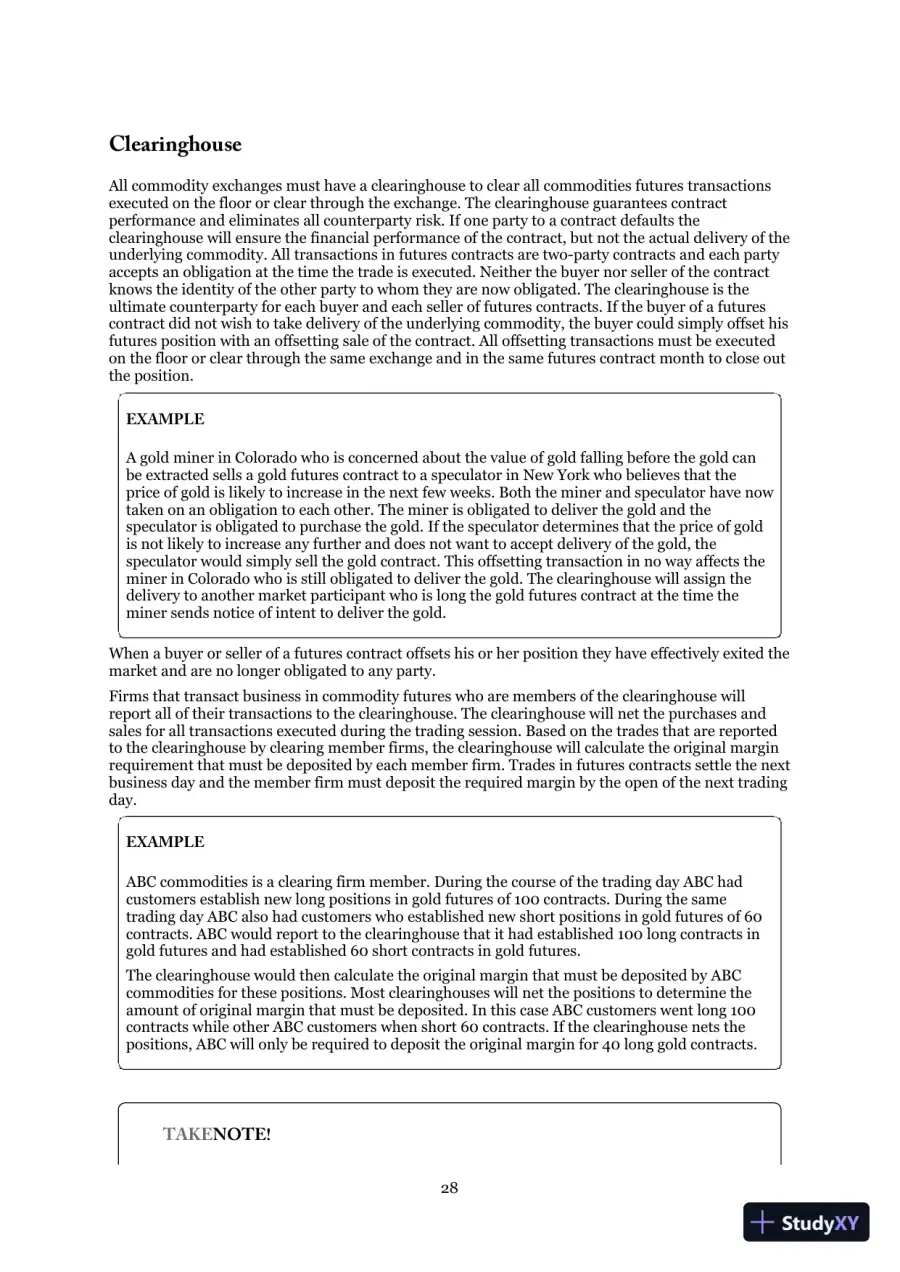 ClearinghouseAll commodity exchanges must have a clearinghouse to clear all commodities futures transactionsexecuted on the floor or clear through the exchange. The clearinghouse guarantees contractperformance and eliminates all counterparty risk. If one party to a contract defaults theclearinghouse will ensure the financial performance of the contract, but not the actual delivery of theunderlying commodity. All transactions in futures contracts are two-party contracts and each partyaccepts an obligation at the time the trade is executed. Neither the buyer nor seller of the contractknows the identity of the other party to whom they are now obligated. The clearinghouse is theultimate counterparty for each buyer and each seller of futures contracts. If the buyer of a futurescontract did not wish to take delivery of the underlying commodity, the buyer could simply offset hisfutures position with an offsetting sale of the contract. All offsetting transactions must be executedon the floor or clear through the same exchange and in the same futures contract month to close outthe position.EXAMPLEA gold miner in Colorado who is concerned about the value of gold falling before the gold canbe extracted sells a gold futures contract to a speculator in New York who believes that theprice of gold is likely to increase in the next few weeks. Both the miner and speculator have nowtaken on an obligation to each other. The miner is obligated to deliver the gold and thespeculator is obligated to purchase the gold. If the speculator determines that the price of goldis not likely to increase any further and does not want to accept delivery of the gold, thespeculator would simply sell the gold contract. This offsetting transaction in no way affects theminer in Colorado who is still obligated to deliver the gold. The clearinghouse will assign thedelivery to another market participant who is long the gold futures contract at the time theminer sends notice of intent to deliver the gold.When a buyer or seller of a futures contract offsets his or her position they have effectively exited themarket and are no longer obligated to any party.Firms that transact business in commodity futures who are members of the clearinghouse willreport all of their transactions to the clearinghouse. The clearinghouse will net the purchases andsales for all transactions executed during the trading session. Based on the trades that are reportedto the clearinghouse by clearing member firms, the clearinghouse will calculate the original marginrequirement that must be deposited by each member firm. Trades in futures contracts settle the nextbusiness day and the member firm must deposit the required margin by the open of the next tradingday.EXAMPLEABC commodities is a clearing firm member. During the course of the trading day ABC hadcustomers establish new long positions in gold futures of 100 contracts. During the sametrading day ABC also had customers who established new short positions in gold futures of 60contracts. ABC would report to the clearinghouse that it had established 100 long contracts ingold futures and had established 60 short contracts in gold futures.The clearinghouse would then calculate the original margin that must be deposited by ABCcommodities for these positions. Most clearinghouses will net the positions to determine theamount of original margin that must be deposited. In this case ABC customers went long 100contracts while other ABC customers when short 60 contracts. If the clearinghouse nets thepositions, ABC will only be required to deposit the original margin for 40 long gold contracts.TAKENOTE!28
Page 30
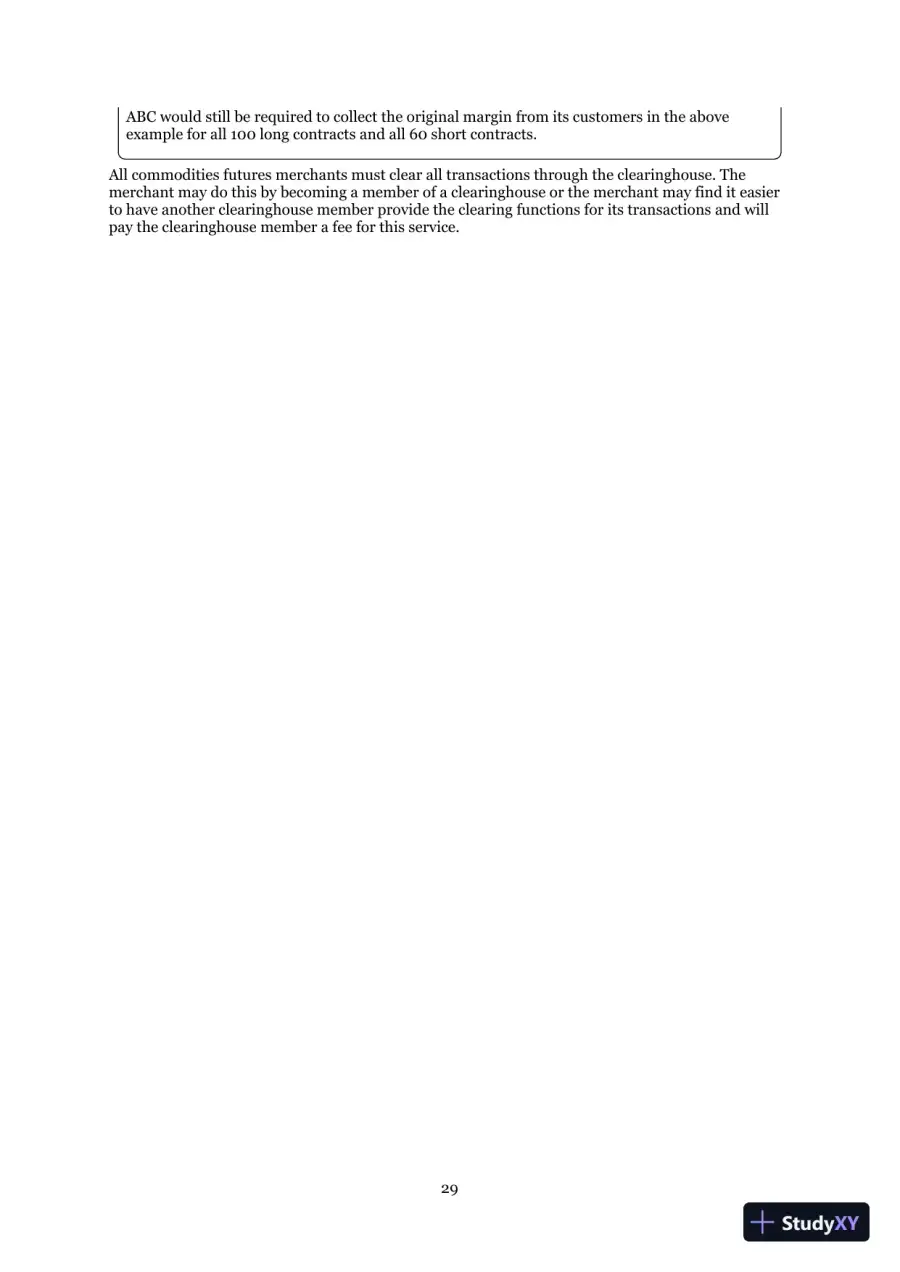 ABC would still be required to collect the original margin from its customers in the aboveexample for all 100 long contracts and all 60 short contracts.All commodities futures merchants must clear all transactions through the clearinghouse. Themerchant may do this by becoming a member of a clearinghouse or the merchant may find it easierto have another clearinghouse member provide the clearing functions for its transactions and willpay the clearinghouse member a fee for this service.29
Page 31
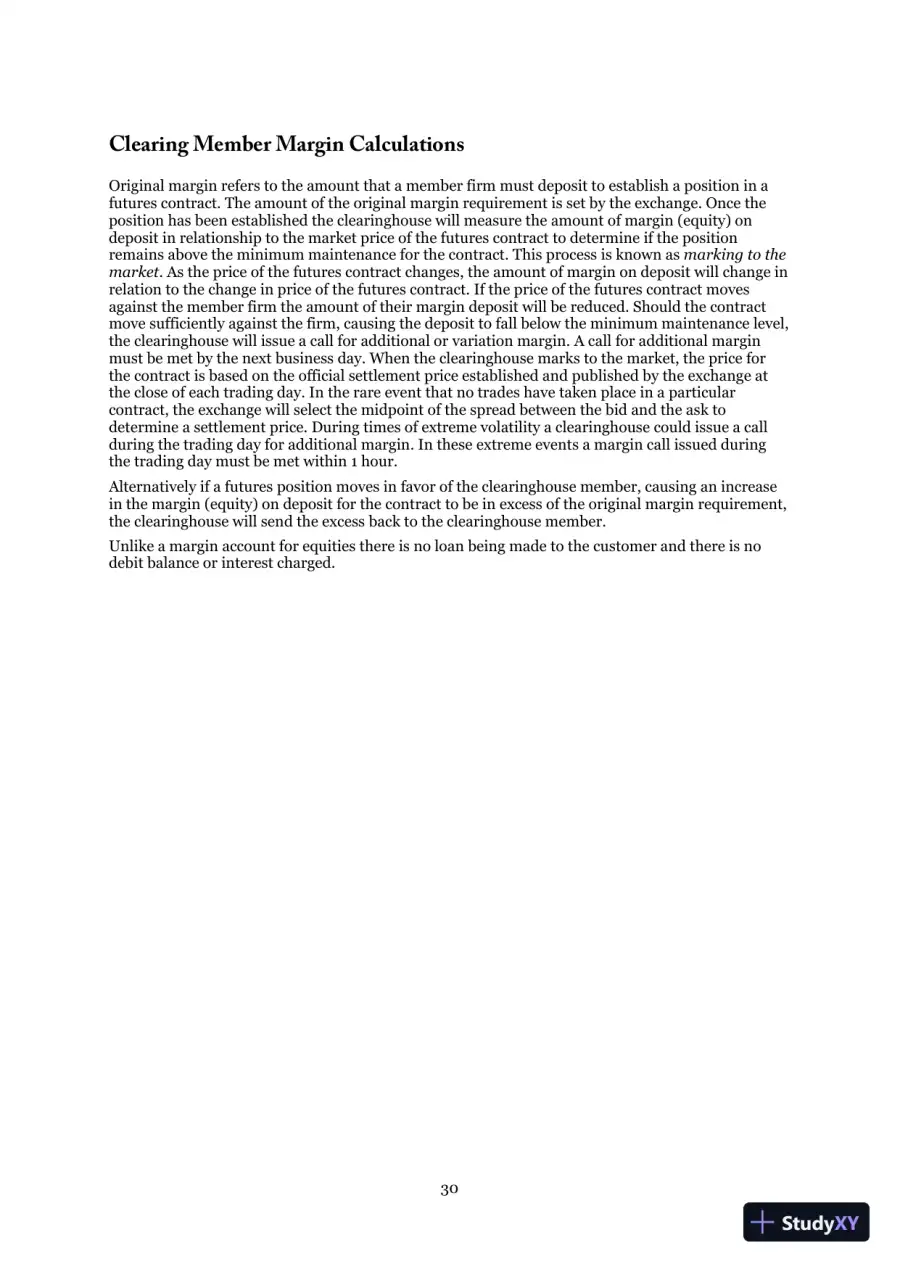 Clearing Member Margin CalculationsOriginal margin refers to the amount that a member firm must deposit to establish a position in afutures contract. The amount of the original margin requirement is set by the exchange. Once theposition has been established the clearinghouse will measure the amount of margin (equity) ondeposit in relationship to the market price of the futures contract to determine if the positionremains above the minimum maintenance for the contract. This process is known asmarking to themarket. As the price of the futures contract changes, the amount of margin on deposit will change inrelation to the change in price of the futures contract. If the price of the futures contract movesagainst the member firm the amount of their margin deposit will be reduced. Should the contractmove sufficiently against the firm, causing the deposit to fall below the minimum maintenance level,the clearinghouse will issue a call for additional or variation margin. A call for additional marginmust be met by the next business day. When the clearinghouse marks to the market, the price forthe contract is based on the official settlement price established and published by the exchange atthe close of each trading day. In the rare event that no trades have taken place in a particularcontract, the exchange will select the midpoint of the spread between the bid and the ask todetermine a settlement price. During times of extreme volatility a clearinghouse could issue a callduring the trading day for additional margin. In these extreme events a margin call issued duringthe trading day must be met within 1 hour.Alternatively if a futures position moves in favor of the clearinghouse member, causing an increasein the margin (equity) on deposit for the contract to be in excess of the original margin requirement,the clearinghouse will send the excess back to the clearinghouse member.Unlike a margin account for equities there is no loan being made to the customer and there is nodebit balance or interest charged.30
222 more pages in the full document
Unlock it once and it stays in your library, ready to chat with or turn into flashcards.
Unlock the full documentMore Finance study materials
See all Textbook Guides
Solution Manual For Investments, 12th Edition
Finance
314 pages161downloadsFeb 2025 Exam Guides
Test Bank for Principles of Managerial Finance, 8th Edition
Finance
851 pages158downloadsFeb 2025 Textbook Guides
Solution Manual for Financial Institutions Management: A Risk Management Approach, 8th Edition
Finance
486 pages154downloadsFeb 2025 Exam Guides
Test Bank for Principles of Managerial Finance, Arab World Edition
Finance
373 pages148downloadsFeb 2025 Textbook Guides
Multinational Financial Management, Study Guide, 6th Edition Solution Manual
Finance
278 pages146downloadsFeb 2025 Textbook Guides
Financial Markets and Institutions, 7th Edition Solution Manual
Finance
194 pages136downloadsFeb 2025 Exam Guides
Test Bank For Essentials of Investments, 8th Edition
Finance
368 pages130downloadsFeb 2025 Exam Guides
Test Bank For Fundamentals of Investing, 13th Edition
Finance
539 pages124downloadsFeb 2025
Study this document with CramX
Once it is in your library, every tool can work from it.