
QQuestionMathematics
QuestionMathematics
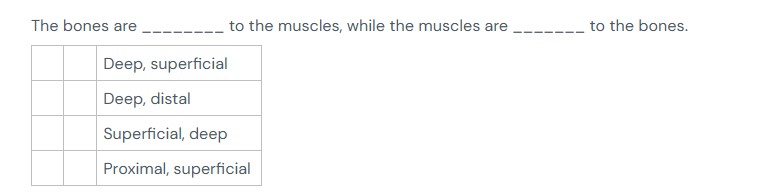
The bones are $\qquad$ to the muscles, while the muscles are $\qquad$ to the bones.
| | Deep, superficial |
| :-- | :-- |
| | Deep, distal |
| | Superficial, deep |
| | Proximal, superficial |
Attachments
10 months agoReport content
Answer
Full Solution Locked
Sign in to view the complete step-by-step solution and unlock all study resources.
Step 1:: Identify the relationship between bones and muscles in each case.
In the given table, there are four combinations of relationships between bones and muscles: deep-superficial, deep-distal, superficial-deep, and proximal-superficial. We will analyze each relationship and provide an example for each.
Step 2:: Analyze the deep-superficial relationship.
In the deep-superficial relationship, deep structures (in this case, bones) are located closer to the center of the body or the point of origin, while superficial structures (muscles) are located closer to the surface. An example of this relationship is the relationship between the scapula (shoulder blade) and the trapezius muscle. The scapula is a bone located deep to the trapezius muscle, which is a superficial muscle in the back.
Step 3:: Analyze the deep-distal relationship.
In the deep-distal relationship, deep structures (bones) are located closer to the center of the body or the point of origin, while distal structures are located further away from the center. An example of this relationship is the relationship between the humerus (upper arm bone) and the brachioradialis muscle. The humerus is a bone located deep to the brachioradialis muscle, which is a muscle in the forearm.
Step 4:: Analyze the superficial-deep relationship.
In the superficial-deep relationship, superficial structures (muscles) are located closer to the surface, while deep structures (bones) are located closer to the center of the body or the point of origin. An example of this relationship is the relationship between the ribcage and the external oblique muscle. The ribcage is a bone located deep to the external oblique muscle, which is a muscle in the abdominal wall.
Step 5:: Analyze the proximal-superficial relationship.
In the proximal-superficial relationship, proximal structures (bones) are located closer to the center of the body or the point of origin, while superficial structures (muscles) are located closer to the surface. An example of this relationship is the relationship between the femur (thigh bone) and the rectus femoris muscle. The femur is a bone located proximal to the rectus femoris muscle, which is a muscle in the front of the thigh.
Final Answer
The relationships between bones and muscles described in the table are: 1. Deep-superficial: The scapula is located deep to the trapezius muscle. 2. Deep-distal: The humerus is located deep to the brachioradialis muscle. 3. Superficial-deep: The ribcage is located deep to the external oblique muscle. 4. Proximal-superficial: The femur is located proximal to the rectus femoris muscle.
Need Help with Homework?
Stuck on a difficult problem? We've got you covered:
- Post your question or upload an image
- Get instant step-by-step solutions
- Learn from our AI and community of students