

2024-2025 NBCE - Part 1 Practice test with Answers (336 Solved Questions)
- National Board of Chiropractic Examiners
- 85 pages
- Shared February 2025
- 120 downloads
Study smarter with 2024-2025 NBCE - Part 1 Practice test with Answers, using real past exam questions for effective revision.
Preview 26 of 85 pages
See the first 26 pages exactly as they appear in the document.
Page 1 Read page 1 as text
NBCE - Part 1 Practice Test – 100% GUARANTEED PASS 2024/2025 Where is not a location of stratified cuboidal epithelium? a. layer o f ovaries b. layer of testes c. ducts of sweat glands d. Gallbladder gallbladder Which is not true of stratified squamous epithelium? a. can be wet b. can be dry c. is located in the mouth, cornea and esophagus d. is located in the anal mucus membrane is located in the anal mucus membrane Which breaks down nucleic acids, carbohydrates, and proteins? a. mitochondria b. lysosomes c. ribosomes d. golgi bodies B. lysosomes __________________ neurons are the most common type in the human body? a. unipolar
Page 2 Page 3 Read page 3 as text
b. bipolar c. multipolar d. axillary C. Multip olar Mycetoma a. tumor of the brain b. tumor of the striated muscle c. tumor of the smooth muscle d. fungus ball tumor d. Fungus Ball tumor The is about 25 micrometers in length making it the longest. a. stereocilia b. ciliac. c. flagella d. microvilli c. Flagella The Islands of Langerhans are cells in the____ that____. a. pancreas, regulate sugar metabolism b. liver. make insulin c. liver, regulate sugar metabolism d. gallbladder, regulate sugar metabolism a. pancreas, regulate sugar metabolism Which is no t a location of simple cuboidal epithelium? a. Bowman's capsule of kidney b. ducts of glands c. surface of ovaries d. thyroid
Page 4 Read page 4 as text
a. Bowman's capsule of kidney A biceps curl would be an example of a(n) _ _ _ _ contraction. a. eccentric b. concentric c. isometr ic d. isotonic b. concentric Eccentric and concentric contractions are types of isotonic contractions. However, choice (b.) is the most correct and specific answer. Which muscle moves the mandible from side to side? a. temporalis b. masseter c. medial pter ygoid d. lateral pterygoid d. lateral pterygoid The SCM is innervated by cranial nerve_ _ _ a. IV b. VII c. XI d. IX c. XI Lambdoidal suture also known as the and the - - - - - suture is located between the frontal and parietal bones. a. coronal suture, co ronal b. occipital suture, coronal c. squamous suture, sagittal d. sagittal suture, occipital
Page 5 Read page 5 as text
b. occipital suture, coronal The humeroulnar joint is characterized as a ______________type. a. pivot b. gliding c. hinge d. saddle c. hinge Costa is an anatomica l term meaning a. space b. bone c. rib d. long rib the long thoracic nerve innervates the _________ muscle: damage to this nerve will cause winging scapula a. scapular notch b. acromion c. serratus anterior d. rhomboid major c. serratus anterior Which is n ot found in the scapula? a. scapular notch b. acromion c. coracoid process d. conoid tubercle d. conoid tubercle
Page 6 Read page 6 as text
which is not located on the clavicle? a. costal tuberosity b. conoid tubercle c. coracoid process d. sternal extremity c. coracoid process the olecranon can found in the __________________ a. radius b. humerus c. ulna d. capitulum c. ulna The ulna does not have a(n) a. coronoid process b. olecranon c. nutrient foramina d. intertubercular sulcus d. intertubercular sulcus The scaphoid is found dire ctly distal to the _ _ _ _ , which is wider near the a. radius, wrist b. radius, elbow c. ulnar, wrist d. ulnar, elbow a. radius, wrist
Page 7 Read page 7 as text
The main storage form of glucose in animals is a. starch b. glycogen c. lipids d. proteins. b. glycogen All of the fol lowing processes increase blood sugar levels except: a. glycogenolysis b. glycogenesis c. gluconeogenesis d. glucogenesis b. glycogenesis all of the following are considered low energy compounds except: a. NADH b. AMP c. ADP d. NADP a. NADH The breakdown o f glycogen is called _ _ _ _ _. a. glycogenolysis b. glyconeogenesis c. glycogenesis d. glycolysis a. glycogenolysis Glucose plus fructose make which of the following disaccharides? a. sucrose b. lactose
Page 8 Read page 8 as text
c. maltose d. isomaltose a. sucrose The protein port ion of an enzyme is called a. apoprotein b. holoenzyme c. coenzyme A d. cofactor a. apoprotein Without vitamin _ _ _ _ collagen will not form in the body. a. Vitamin A b. Vitamin B c. Vitamin C d. Vitamin D c. Vitamin C Which of the following is the most a bundant plasma protein? a. albumin b. immunoglobulin c. gamma globulin d. T lymphocyte a. albumin Glucose - I - phosphate plus _ _ _ _ gives glucose - 6 - phosphate. a. debranching enzyme b. glycogen phosphorylase c. phosphoglucomutase d. pyruvate
Page 9 Read page 9 as text
The coenzyme of pantothenic acid (BS) is a.FAD b. NADP c. Coenzyme A d. FMN c. Coenzyme A Beriberi is associated with a _ _ _ _ _ deficiency. a. riboflavin b. thiamine c. niacin d. pantothenic acid b. thiamine All of the following associated with a folic acid deficiency e xcept: a. cheilosis b. megaloblastic anemia c. tropical sprue d. lack of conversion of serine to glycine a. cheilosis How many ATP are yielded in the aerobic form of glycolysis? a. 36 b. 32 c. 24 d. 2 a. 36 Gluconeogenesis _ _ _ _ blood sugar; this process takes _ _ _ ATP. a. lowers, 36 b. lowers, 4
Page 10 Read page 10 as text
c. raises, 6 d. raises, 2 c. raises, 6 Which ofthe following lowers blood sugar levels? a. insulin b. cortisol c. glucagon d. flavin ring a. insulin Phosphorylation first occurs in step _ _ _ of glycolysis. a. 1 b.4 c. 10 d. 8 a. 1 Which is the phosphate donor in steps 1 and 3? A. NAD B. ATP C. DNA D. RNA B. ATP Glucose 6 - phosphate is converted to fructose 6 - phosphate by use of the enzyme in the process of_ _ _ _ _ a. phosphoglucoisomerase, oxidation b. enolase, oxidation c. phosphoglucoisomerase, glycolysis d. enolase, glycolysis
Page 11 Read page 11 as text
c. phosphoglucoisomerase, glycolysis __________________ is the enzyme used in the last step of glycolysis. a. enolase b. pyruvate kinase c. hexokinase d. aldolase b. pyruvate kinase 40. The aerobic form of glycolysis produces _ _ _ molecules of ATP and the anaerobic form produces a. 2, 2 b. 32,5 c. 6,24 d. 36,2 d. 36,2 A total of 4 ADP molecules in steps 7 and 10 of glycolysis are converted to 4 - - - molecules. a. cAMP b. NADH c. NAD d. ATP d. ATP Two pyruvate molecules are formed in the process of glycolysis. What enzyme is responsible for the 10th step of this process? a. pyruvate kinase b. phosphoglycerate kinase
Page 12 Read page 12 as text
c. PFK - 1 d. hexokinase a. pyruvate kinase n glycolysis, a _ _ _ _ carbon molecule of glucose is split into _ _ _ molecules of pyruvic acid. a. 5, 3 b. 10, 3 c. 3, 4 d. 6, 2 d. 6, 2 2 - Phosphoglycerate is converted to phosphoenolpyruvate by the _______________ help of the enzyme in this_______________ stage of glycolysis. a. pho sphoglycerate mutase, 5th b. enolase, 9th c. pyruvate kinase, 10th d. enolase, 6th b. enolase, 9th The breakdown of glycogen is called _ _ _ _ a. glycogenolysis b. glycolysis c. oxidation d. gluconeogenesis a. glycogenolysis Which ofthe following will lowe r blood sugar levels? a. glycogenolysis b. gluconeogenesis
Page 13 Read page 13 as text
c. glycolysis d. glucogenesis c. glycolysis Who discovered penicillin? a. Salk b. Sabin c. Fleming d. Semmelweis c. Fleming Subacute bacterial endocarditis is caused by which of the following organ isms? a. S. aureus b. S.pyogenes c. S. viridans d. S. agalactiae c. S. viridans All of the following are true of endotoxins except: a. are released by gram negative organisms b. are released when the cell ceases to live c. are composed of lipopolysaccharid es d. are released usually by gram positive organisms d. are released usually by gram positive organisms Which causes urinary tract infections in 17 year old girls? a. S. epidermidis b. S. saprophyticus c. staphylococcus aureus d. streptococcus viridans
Page 14 Read page 14 as text
b. S. saprophyticus Which causes dental caries? a. S. epidermidis b. S. saprophyticus c. streptococcus mutans d. staphylococcus aureus c. streptococcus mutans Nematodes are a. tapeworms b. roundworms c. bacteria d. protozoa b. roundworms Flukes are classifie d under a. trematodes b. tapeworms c. cestodes d. nematodes a. trematodes The coenzyme of pyridoxine is: a. coenzyme A b. pyridoxal phosphate c. THF d. TPP pyridoxal phosphate (PLP)
Page 15 Read page 15 as text
B9 is and its coenzymeis____ a. biotin, biotin b. thiamin, thiamine pyroph osphate c. niacin, NADP d. folic acid, tetrahydrofolate d. folic acid, tetrahydrofolate Which vitamin can be made from tryptophan in the body? a. thiamine b. niacin c. riboflavin d. biotin b. niacin Which ofthe following is not an antioxidant? a. selenium b. copper c. Vitamin A d. Vitamin E b. copper all of the following are true regarding vitamin C in humans except: a. It can be made from glucose. b. Vitamin C aids in the absorption of iron. c. Helps in the making of collagen d. Vitamins C is involved with hydroxlation reactions. a. It can be made from glucose. Which vitamin B3 coenzyme is involved with fatty acid synthesis? a. FMN b. TPP
Page 16 Read page 16 as text
c. FAD d. NADP d. NADP The active coenzymes of riboflavin are ____ and _ _ _ a. FMN, FAD b.NAD, NADP c. TPP, FAD d. Coen zyme A, NAD a. FMN, FAD Which of the following proteins does not have a branched chain? a. valine b. tryptophan c. leucine d. isoleucine b. tryptophan which is involved in decarboxylation reactions that is not the yellow vitamin? a. biotin b. thiamine c. r iboflavin d. niacin b. thiamine The coenzyme of thiamine is a.FAD b.FM c. coenzyme A d. thiamine pyrophosphate
Page 17 Read page 17 as text
d. thiamine pyrophosphate Which vitamin contains the isoalloxazine ring system? a. thiamine b. niacin c. vitamin C d. riboflavin d. riboflavin pa ntothenic acid contains sulfur. Which other vitamin also contains sulfur? a. thiamine b. niacin c. riboflavin d. Vitamin C a. thiamine d. Vitamin C 66. Which of the following is not true of pyridoxine? a. it is needed in protein metabolism b. deficiency wi ll cause convulsions in infants c. pyridoxamine phosphate is its coenzyme d. deficiency will cause pernicious anemia d. deficiency will cause pernicious anemia All of the following are essential amino acids except: a. valine b. phenylalanine c. lysine d. t yrosine d. tyrosine
Page 18 Read page 18 as text
All o f the following have branched chains except: a. valine b. phenylalanine c. leucine d. isoleucine b. phenylalanine Which is notc omposed of collagen? a. hydroxylysine b. hydroxyproline c. omithine d. glycine c. omithine 70. Which i s a non - essential amino acid? a. valine b. serine c. arginine d. histidine b. serine This vitamin helps in the formation of purines and when this vitamin is deficient it will cause megaloblastic anemia? a. pyridoxine b. folic acid c. pantothenic acid d. th iamine b. folic acid Glucose and fructose will form a. cellobiose
Page 19 Read page 19 as text
b. isomaltose c. sucrose d. maltose c. sucrose The oxidation of glucose is referred to as _ _ _ _ _ a. glycolysis b. glycogenesis c. cellular respiration d. glycogenolysis c. cellular respir ation Which ofthe following is not an essential fatty acid? a. arachidonic b. linolenic c. linoleic d. phospholipid d. phospholipid Which makes up the majority of the plant starch we have in our diet? a. cellulose b. amylose c. amylopectin d. glycogen c. a mylopectin Amylopectin is in a a. alpha 1 - 4 linkage b. branched beta 1 - 4 linkage c. beta 1 - 6 linkage d. branched alpha 1 - 6 linkage
Page 20 Read page 20 as text
d. branched alpha 1 - 6 linkage Biotin in the vitamin and coenzyme form performs which kind of reaction? a. carboxylation b. hy droxylation c. oxidation d. decarboxylation a. carboxylation _______________________ is not a mucopolysaccharide? a. cellobiose b. heparin c. hyaluronic acid d. chondroitin sulfate a. cellobiose Insulin a. will raise blood sugar levels b. will lower blood sugar levels c. is a steroid hormone d. is made in the kidney b. will lower blood sugar levels The filum terminale. a has pia mater only b. has dura mater only c. is considered leptomeninx d. is the cauda equina a has pia mater only
Page 21 Read page 21 as text
The _ _ _ enlargement h as the largest diameter of the spinal cord. a. lumbar b. sacral c. thoracic d. cervical d. cervical Pressure and light touch are functions of this ascending (sensory) tract? a. spinotectal b. medial lemniscus c. anterior spinothalamic d. fasciculus cuneatu s c. anterior spinothalamic 83. Which sense does not go through the thalamus? a. sight b. hearing c. smell d. taste c. smell 84. What tract is responsible for 2 point discrimination? a. lateral spinothalamic b. fasciculus cuneatus c. spinotectal d. posteri or spinocerebellar b. fasciculus cuneatus The Tectum is located in the a. Pons b. Midbrain
Page 22 Read page 22 as text
c. Medulla d. Small Intestine Midbrain All of the following are associated with an upper motor neuron lesion except: a. spastic paralysis b. increased muscle tone c. no pathological reflexes b. increased muscle tone The _ _ _ tract helps to make muscles flex but does not aid in extensor movements. a. vestibulospinal b. rubrospinal c. tectospinal d. anterior spinothalamic b. rubrospinal Frederick's ataxia is associated with damage to the a. medial lemniscus b. lateral spinothalamic c. posterior spinocerebellar d. spinotectal c. posterior spinocerebellar Pain and temperature is a function of the tract. a. medial lemniscus b. lateral spinothalamic tract c. spinotectal d. reticulospinal tract
Page 23 Read page 23 as text
b. lateral spinothalamic tract All of the following are effects of lower motor neuron lesions except: a. flaccid paralysis b. hyperreflexia c. hyporeflexia d. absent pathological reflexes b. hyperreflexia The parietal lobe is supplied directly by which vessel? a. posterior cerebral artery b. middle cerebral artery c. carotid artery d. anterior cerebral artery d. anterior cerebral artery Which is not part of the parasympathetic system? a. cranial nerves 11 and 12 b. cranial nerves 3 and 7 c. sacral nerves S2 - S4 d. cranial nerve 9 and I0 a. cranial nerves 11 and 12 Respiratory alkalosis can be caused by which ofthe following? a. kidney failure b. prolonged vomiting c. oxygen deficiency d. diabetes mellitus The oculomotor nerve is cranial nerve _ _ _ and synapses at the _ _ _ ganglion. a. 4, ciliary
Page 24 Read page 24 as text
b. 7, otic c. 3, ciliary d. 2, otic c. 3, ciliary Cranial nerve _ _ _ _ synapses at the Otic ganglion. a . 2 b. 5 c. 9 d. 10 c. 9 All of the following are ascending tracts except: a. spinotectal b. tectospinal c. posterior spinocerebellar d. medial lemniscus b. tectospinal Which ofthe following is involved with parasitic infections? a. IgG b. lgE c. lgA d.IgM b. lgE Which of the following is the heaviest antibody and the first one to appear in th e fetus? a. IgA b. IgE
Page 25 Read page 25 as text
c. IgG d. IgM d. IgM The most abundant antibody in a normal healthy adult is: a. IgA b. lgE c. IgD d. IgG d. IgG Antibodies received from an animal to a human would be labeled as which type of immunity? a. natural active b. acquired active c. acquired passive d. natural passive c. acquired passive Antibodies passed from mother to infant would be which form of immunity? a. acquired passive b. acquired active c. natural active d. natural passive d. natural passive Which type of antibody is generally found in the mucous membranes of the body? a. IgE b. IgM
Page 26 Read page 26 as text
c. IgA d. IgD c. IgA Which type of hypersensitive reaction 1s most likely involved with IgE antibodies? a. cell mediated b. immune complex c. cytotoxic d. anaphylaxis d. anaphylaxis Whi ch type of granulocyte fights parasitic infections? a. neutrophil b. basophil L c. lymphocyte d. eosinophil d. eosinophil The first step in municipal water treatment is: a. chlorination b. flocculation c. filtration d. flash mix d. flash mix The last ste p in municipal water treatment is: a. flocculation
59 more pages in the full document
Unlock it once and it stays in your library, ready to chat with or turn into flashcards.
Unlock the full documentMore National Board of Chiropractic Examiners study materials
See all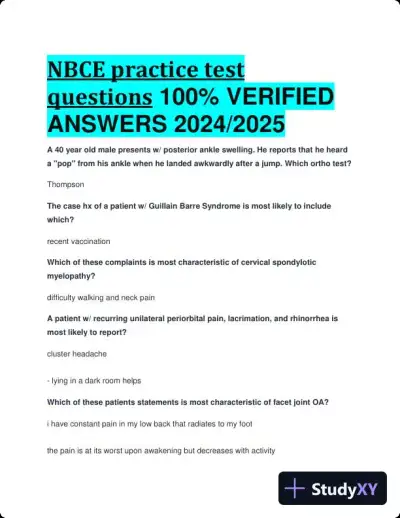
Study this document with CramX
Once it is in your library, every tool can work from it.