

2021 NURS6630 Walden University Psychopharmacologic Midterm Exam With Answers (76 Solved Questions)
- Nursing
- Walden University
- 18 pages
- Shared May 2025
2021 NURS6630 Walden University Psychopharmacologic Midterm Exam With Answers enhances your preparation by providing detailed past exams with explanations.
Preview 6 of 18 pages
See the first 6 pages exactly as they appear in the document.
Page 1 Read page 1 as text
NURS 6630 Midterm Exam Question1 1 out of 1 points When an unstable patient asks why it is necessary to add medications to his current regimen, the PMHNP’s best response would be: Selected Answer: C. “M any psychiatric illnesses involve several dys-functioning neurotransmitter systems in the brain. Often, a single medication may only effect one or two of the dys-functioning systems. The addition of another medication can work with the current medication in stabilizing multiple neurotransmitter systems and help to alleviate your symptoms.” Question 2 0 out of 1 points The PMHNP is meeting with a new mother who would like to begin taking medication again to treat her bipolar depression; she is breastfeeding her 2-month old daughter. The PMHNP recognizes that which of the following medications is contraindicated for this patient? Selected Answer: C. Lithium (Lithobid) Question 3 1 out of 1 points Mr. Gordon is a middle-aged client who was started on antidepressant monotherapy for depression. After beginning this medication, the PMHNP noticed that this client seemed to swing into a hypomanic episode. What can the PMHNP infer from this behavior change? Selected Answer: A. This client may have Bipolar III disorder Question 4 1 out of 1 points A patient presents with frequent episodes of mania. Which statement describes an appropriate treatment approach for this patient? Selected Answer: B. “The patient could benefit from an
Page 2 Page 3 Read page 3 as text
anticonvulsant.” Question 5 1 out of 1 points The student inquires about antipsychotic medications. Which response by the PMHNP describes the factors that contribute to reduced risk of extrapyramidal symptoms (EPS) for patients who take antipsychotics? Selected Answer: B. Those that are potent D2 antagonists with 5HT2A antagonism properties Question 6 1 out of 1 points After ordering flumazenil (Rumazicon) the PMHNP cautions the staff to monitor for which possible effect? Selected Answer: D. All of the above Question 7 1 out of 1 points The PMHNP is caring for a patient who is taking antipsychotics heard the psychiatrist tell the patient that the patient would be placed on a different antipsychotic agent called an atypical antipsychotic . What neurotransmitters will this new medication work on? Selected Answer: A. dopamine and serotonin Question 8 1 out of 1 points While genes have potential to modify behavior, behavior can also modify genes. How do genes impact this process? Selected Answer: B. Changes made to proteins lead to changes in behavior. Question 9 1 out of 1 points Mrs. Schwartzman is a 52-year-old client with schizophrenia and no established history of depression. When meeting with the PMHNP, she presents with apathy and withdrawn social behavior, and she reports a loss of joy from enjoyable activities since starting her new medication. What does
Page 4 Read page 4 as text
the PMHNP infer from this encounter with the client? Selected Answer: C. The new medication is blocking D2 receptors in the mesolimbic system Question 10 1 out of 1 points A nursing student is seeking clarification on the use of anticonvulsants to treat depression and is unclear about most effective outcomes. Which of the following agents does the PMHNP convey as having uncertain outcomes? Selected Answer: B. Gabapentin (Neurontin) Question 11 1 out of 1 points As it relates to G-protein linked receptors, what does the PMHNP understand about medications that are used in practice? Selected Answer: A. Most medications that act on G-protein linked receptors have antagonistic traits. Question 12 1 out of 1 points A patient is seeking pharmacological treatment for smoking cessation. Which drug class does the PMHNP prescribe to the patient? Selected Answer: D. Varenicline (Chantix) Question 13 1 out of 1 points The PMHNP is caring for a patient with schizophrenia and is considering a variety of treatment approaches. The PHMNP selects a viable treatment that is consistent with the “dopamine hypothesis of schizophrenia.” What action does the PMHNP anticipate this treatment having on the patient? Selected Answer: B.
Page 5 Read page 5 as text
Hyperactivity in the mesolimbic dopamine pathway mediates the positive symptoms of schizophrenia. Question 14 1 out of 1 points Though medications have the ability to target neurotransmitter release into the synapse by the presynaptic neuron it is not always necessary. The PMHNP understands that this is because: Selected Answer: C. Neurotransmitters can spread by diffusion. Question 15 1 out of 1 points A patient is being prescribed a sedating antidepressant, but is concerned about weight gain. Which medication is most likely to be prescribed to addresses the patient’s concerns? Selected Answer: D. trazadone (Oleptro) Question 16 1 out of 1 points The PMHNP is caring for several patients who present with various symptoms and health issues. For which patient does the PMHNP prescribe pregabalin (Lyrica)? Selected Answer: B. Patient with partial seizures Question 17 1 out of 1 points Which statement about neurotransmitters and medications is true? Selected Answer: B. Several psychiatric medications have been developed after discoveries of endogenous neurotransmitters and defining their function in the brain . Question 18 1 out of 1 points A patient is prescribed 50 mg of desvenlafaxine to take every other day for major depressive disorder. What does the PMHNP
Page 6 Read page 6 as text
understand about this patient? Selected Answer: C. The patient has severe renal impairment. Question 19 0 out of 1 points A patient with schizophrenia is given an inverse agonist that acts on the receptor 5HT and neurotransmitter serotonin. What is the rationale for prescribing a medication such as this? Selected Answer: A. To promote the availability of serotonin Question 20 1 out of 1 points A patient who was prescribed an MAO inhibitor is learning about dietary modifications. Which statement made by the PMHNP demonstrates proper teaching of the food-drug interactions for MAO inhibitors? Selected Answer: A. “You must avoid soy products, such as tofu.” Question 21 1 out of 1 points The PMHNP evaluates the patient for “fear conditioning” when he asks: Selected Answer: A. Have you ever experienced any type of trauma? Question 22 0 out of 1 points The PMHNP recognizes that which patient would be contraindicated for antidepressant monotherapy? Selected Answer: A. Patient with a bipolar I designation
12 more pages in the full document
Unlock it once and it stays in your library, ready to chat with or turn into flashcards.
Unlock the full documentMore Nursing study materials
See all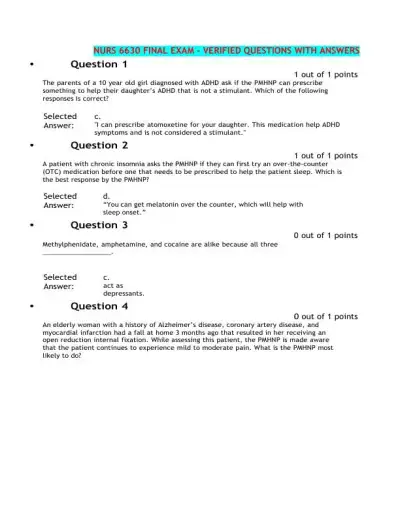 Past Exams
2021 NURS6630 Psychopathology Final Exam With Answers (76 Solved Questions)
Nursing
15 pagesMay 2025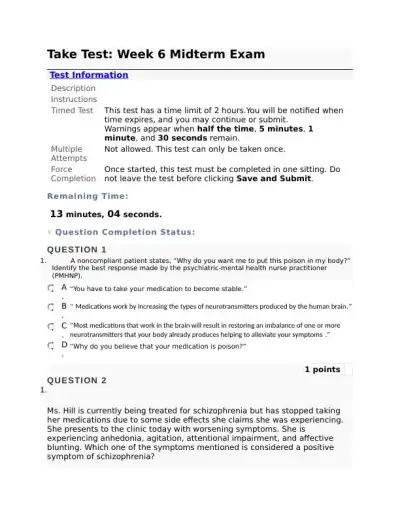 Past Exams
NURS6630 Mental Health Mid term Exam Final Week 6 With Answers (75 Solved Questions)
Nursing
40 pagesMay 2025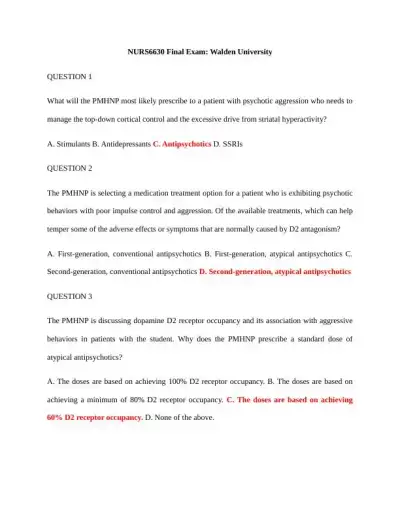 Past Exams
NURS6630 Pharmacology Final Exam With Answers (76 Solved Questions)
Nursing
26 pagesMay 2025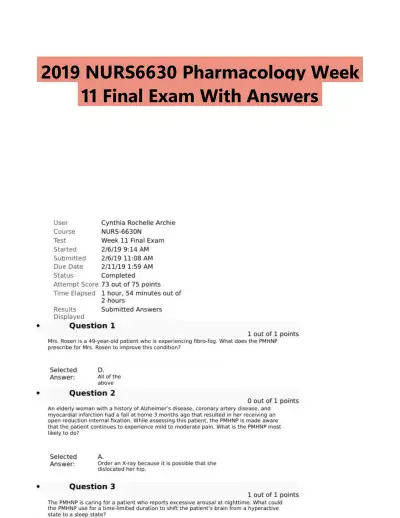 Past Exams
2019 NURS6630 Pharmacology Week 11 Final Exam With Answers (76 Solved Questions)
Nursing
19 pagesMay 2025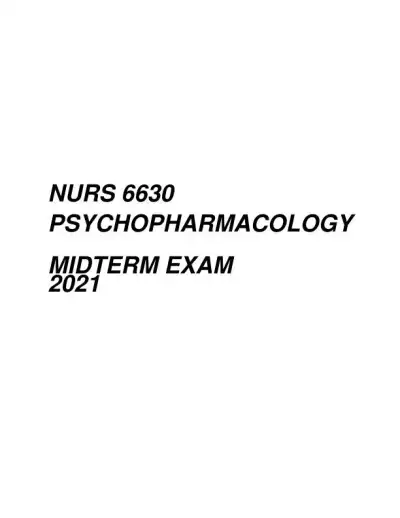 Past Exams
2021 NURS6630 Psychopharmacology Midterm Exam With Answers (75 Solved Questions)
Nursing
17 pagesMay 2025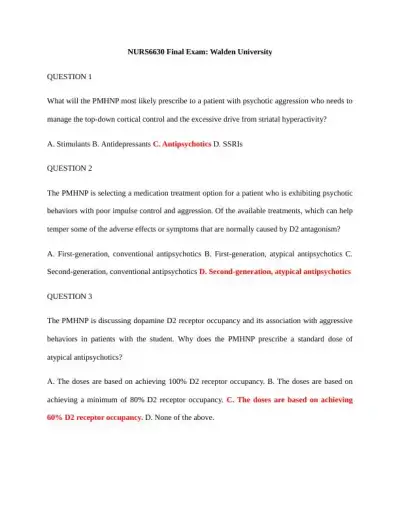 Past Exams
2020 NURS6630 Walden University Pharmacology Final Exam Version 1 With Answers (76 Solved Questions)
Nursing
26 pagesMay 2025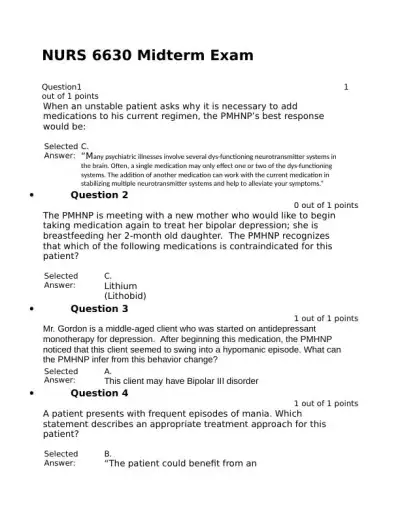 Past Exams
2021 NURS6630 Walden University Psychopathology Mid term Exam With Answers (76 Solved Questions)
Nursing
18 pagesMay 2025 Exam Guides
Test Bank for Critical Care Nursing: Diagnosis and Management, 9th Edition (Chapters 1-27)
Nursing
299 pages167downloadsFeb 2025
Study this document with CramX
Once it is in your library, every tool can work from it.