

NR599 Nursing Informatics For Advanced Practice Final Exam Study Guide Week 8 With Answers (25 Solved Questions)
- Nursing
- Chamberlain College of Nursing
- 12 pages
- Shared May 2025
Review actual exam-style questions with NR599 Nursing Informatics For Advanced Practice Final Exam Study Guide Week 8 With Answers, a comprehensive past exam resource.
Preview 4 of 12 pages
See the first 4 pages exactly as they appear in the document.
Page 1 Read page 1 as text
NR 599 Week 8 Final Exam Study Guide Nursing Informatics For Advanced Practice (Chamberlain University) NR 599 Week 8 Final Exam Study Guide Nursing Informatics For Advanced Practice (Chamberlain University) lOMoARcPSD|6879242
Page 2 Page 3 Read page 3 as text
NR 599 Week 8 Final Exam Study Guide NR 599 Nursing Informatics for Advanced Practice Midterm General principles of Nursing Informatics Scientific synthesis of information in nursing Concepts: computer, cognitive, information Knowledge Wisdom Scientific Underpinning The Foundation of Knowledge Model Computer science Cognitive science Information science Standard Terminology Informatics Competencies Information literacy Health literacy Meaningful Use Patient-centered Information Systems Clinical Decision Support Systems Electronic Medical Records Human-Technology Interface Health Information Technology Alarm fatigue Digital natives Information Literacy Competency Standards for Nursing HITECH Act TIGER-based Nursing Informatics Competencies Model Midterm Feedback Workarounds are ways invented by users to bypass the system to accomplish a task; usually indicate a poor fit of the system or technology to the workflow or user; devised methods to beat a system that does not function appropriately or is not suited to the task it was developed to assist with (McGonigle & Mastrian,
Page 4 Read page 4 as text
2018, p. 584). Workarounds negate expected practice protocols and are rarely necessary or appropriate means to ensure patient safety. Longevity is defined as usability beyond the immediate clinical encounter (McGonigle & Mastrian, 2018, p. 570). o HITCH ACT- become meaningful users of EHR. o American Recovery and Reinvestment Act of 2009 Communication systems improve productivity to promote interaction among healthcare providers and between providers and patients. Healthcare professionals overwhelmingly recognize the value of these systems to promote data and information processing. Examples of communication systems include call light systems, wireless telephones, pagers, email, and instant messaging, which have traditionally been forms of communication targeted at clinicians (McGonigle & Mastrian, 2018, p. 190). A major barrier to widespread adoption of educational opportunities for patients among American healthcare providers is the fact that reimbursement mechanisms for electronic health care interventions are inadequate or nonexistent. The goal of the interactive behavior change technology is to improve communication between patients and healthcare providers and to provide educational interventions that promote better disease management between office visits (McGonigle & Mastrian, 2018, p. 335). Once the technology is integrated into the organization, biomedical engineers can become valuable partners in promoting patient safety through appropriate use of these technologies. For example, in one organization, the biomedical engineers helped to revamp processes associated with the new technology alarm systems after they discovered several key issues: slow response times to legitimate alarms and multiple false alarms (promoting alarm fatigue) created by alarm parameters that were too sensitive. Strategies for addressing these issues included improving the nurse call system by adding Voice over Internet Protocol telephones that wirelessly receive alarms directly from technology equipment carried by all nurses, thus reducing response times to alarms ; feeding alarm data into a reporting database for further analysis; and encouraging nurses to round with physicians to provide input into alarm parameters that were too sensitive and were generating multiple false alarms (McGonigle & Mastrian, 2018, p. 297). This deluge of information available via computers must be mastered and organized by the us. er if knowledge is to emerge. Discernment and the ability to critique and filter this information must also be present to facilitate the further development of wisdom (McGonigle & Mastrian, 2018, p.53). Nurses have historically gathered and recorded data, albeit in a paper record. There is no doubt that nursing experiences build knowledge and skill in nursing practice, but paper-based documentation has hindered the ability to share knowledge and to aggregate experiences to build new knowledge (McGonigle & Mastrian, 2018, p. 106). Healthcare providers need to embrace the Internet as a source of health information for patient education and health literacy. Patients are increasingly turning there for instant information about their health maladies. Health-related blogs (short for weblog, an online journal) and electronic patient and parent support groups are also proliferating at an astounding rate. Clinicians need to be prepared to arm patients with the skills required to identify credible websites. They also need to participate in the development of well-designed, easy-to-use health education tools. (McGonigle & Mastrian, 2018, p. 330). Patients are occasionally interested in interacting with others who have the same or similar conditions, and some healthcare organizations are providing the information necessary to help them connect. This so- called peer-to-peer support is especially popular with patients who have cancer diagnoses, diabetes, and other chronic and debilitating conditions (McGonigle & Mastrian, 2018, p. 328). Final Ethical decision making Bioethical standards lOMoARcPSD|6879242
8 more pages in the full document
Unlock it once and it stays in your library, ready to chat with or turn into flashcards.
Unlock the full documentMore Nursing study materials
See all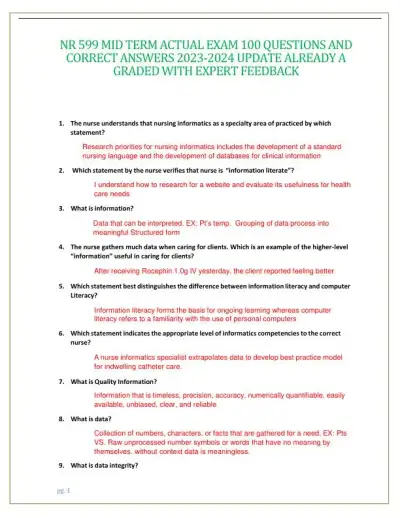 Past Exams
2023-2024 NR599 MIS Midterm Sample Exam With Answers (85 Solved Questions)
Business Management
12 pagesMay 2025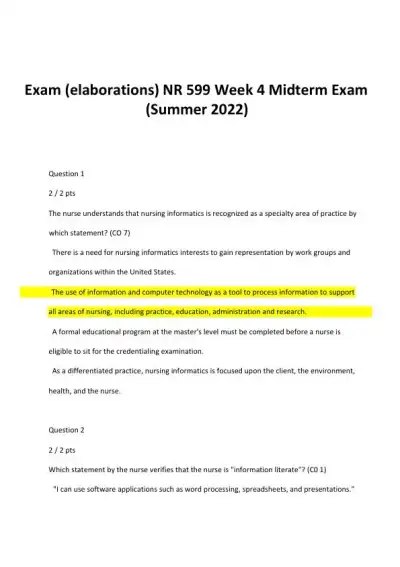 Past Exams
2022 NR599 Prairie State College MIS Midterm Exam Week 4 With Answers (15 Solved Questions)
Business Management
8 pagesMay 2025 Past Exams
2023 NR599 MIS Midterm Exam Week 4 With Answers (85 Solved Questions)
Business Management
7 pagesMay 2025 Past Exams
2023 NR599 Management Information System Final Exam With Answers (18 Solved Questions)
Business Management
8 pagesMay 2025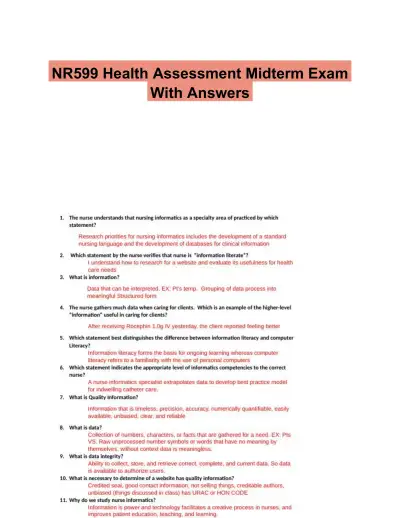 Past Exams
NR599 Health Assessment Midterm Exam With Answers (85 Solved Questions)
Medicine
6 pagesMay 2025 Past Exams
2022 NR599 Prairie State College Nursing as A Profession Midterm Exam Summer Week 4 With Answers (15 Solved Questions)
Nursing
9 pagesMay 2025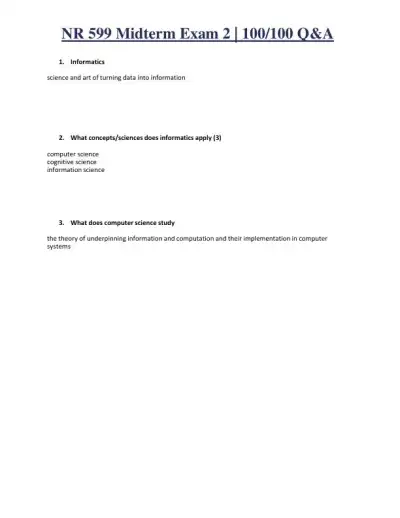 Past Exams
NR599 Computer Science Midterm Exam 2 With Answers (109 Solved Questions)
Information Technology
26 pagesMay 2025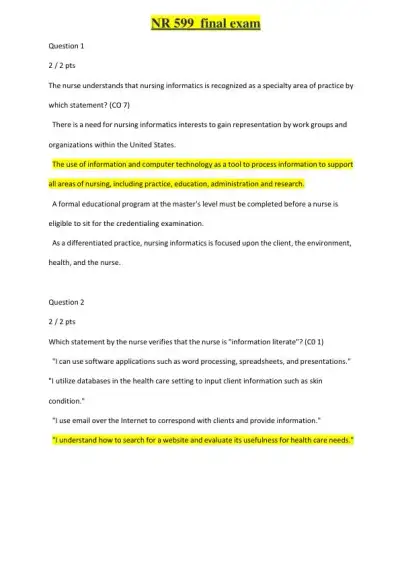 Past Exams
NR599 Nursing Informatics Final Exam With Answers (15 Solved Questions)
Nursing
8 pagesMay 2025
Study this document with CramX
Once it is in your library, every tool can work from it.