
Managing Quality: Integrating the Supply Chain, 6th Edition Solution Manual

Managing Quality: Integrating the Supply Chain, 6th Edition Solution Manual makes solving textbook questions easier with expertly crafted solutions.

Ava Martinez
Contributor
4.6
115
about 1 year ago
Preview (31 of 262 Pages)
100%
Log in to unlock

Page 1

Managing Quality: Integrating the Supply Chain, 6th Edition Solution Manual - Page 1 preview image

Loading page ...

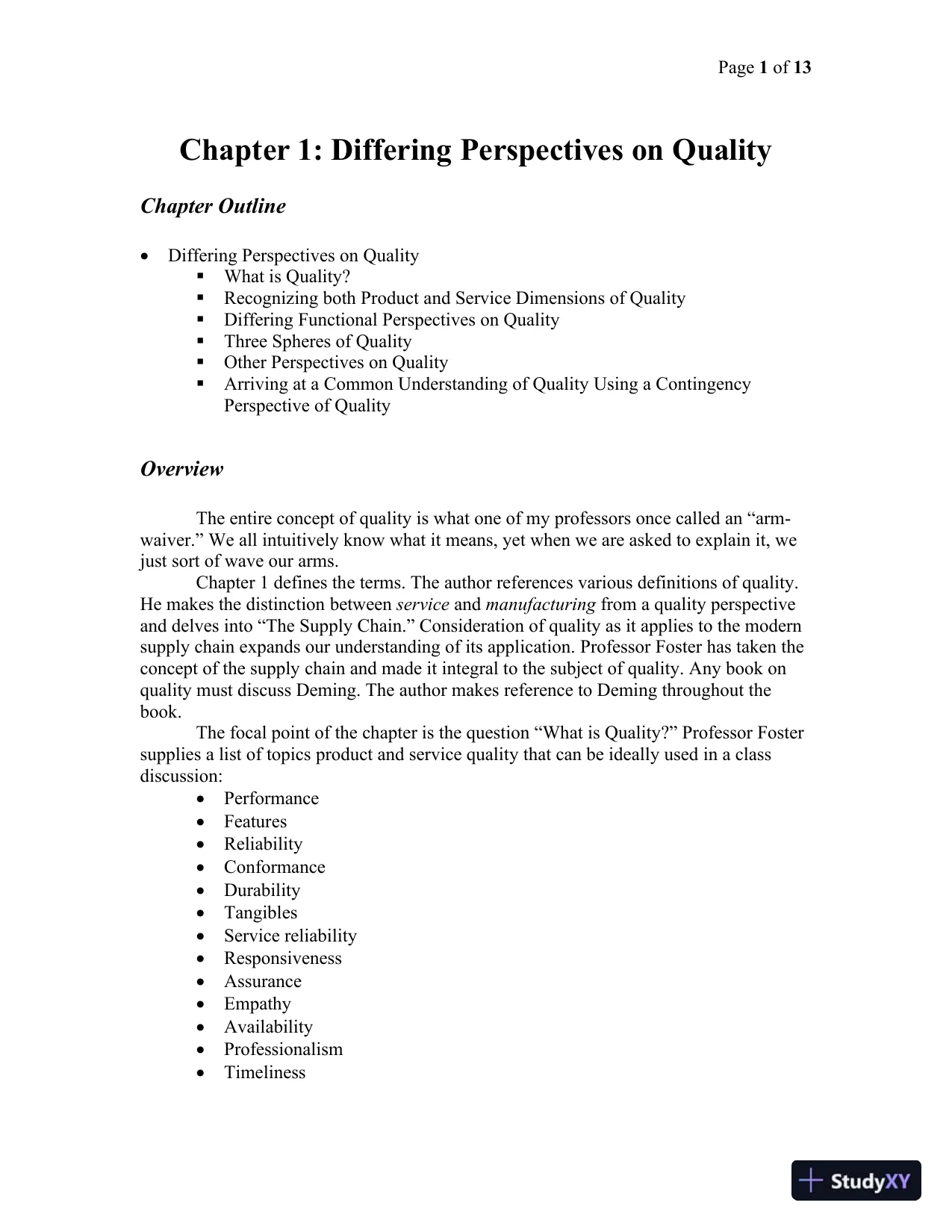
Page1of13Chapter 1:Differing Perspectives on QualityChapter OutlineDiffering Perspectives on QualityWhat is Quality?Recognizing both Product and Service Dimensions of QualityDiffering Functional Perspectives on QualityThree Spheres of QualityOtherPerspectives on QualityArriving at a Common Understanding of QualityUsing a ContingencyPerspective of QualityOverviewThe entire concept of quality is what one of my professors once called an “arm-waiver.We all intuitively know what it means, yet when we are asked to explain it,wejust sort of wave our arms.Chapter1defines the terms. The author references various definitions of quality.He makes the distinction betweenserviceandmanufacturingfrom a quality perspectiveand delves into “The Supply Chain.Consideration of quality as it applies to the modernsupply chain expands our understanding of its application.ProfessorFoster has taken theconcept of thesupplychain and made it integral to the subject of quality. Any book onquality must discuss Deming. Theauthor makes reference to Deming throughout thebook.The focal point of the chapter is the question “What is Quality?ProfessorFostersupplies a list of topicsproduct and service qualitythat can be ideally used in a classdiscussion:PerformanceFeaturesReliabilityConformanceDurabilityTangiblesService reliabilityResponsivenessAssuranceEmpathyAvailabilityProfessionalismTimeliness

Page 2

Managing Quality: Integrating the Supply Chain, 6th Edition Solution Manual - Page 2 preview image

Loading page ...

Page 3

Managing Quality: Integrating the Supply Chain, 6th Edition Solution Manual - Page 3 preview image

Loading page ...

Page2of13The author looks at quality fromdifferent perspectives. This list is also an excellentstarting point for class discussion:Supply chainEngineeringOperationsStrategic managementMarketingFinancialHuman resourcesFigure1-1A Global Supply Chain ModelSource:Foster, S. Thomas; Sampson, Scott E.; Wallin, Cynthia; Webb, ScottW,Managing Supply Chain And Operations: An Integrative Approach, 1st Ed., © 2016, p.15. Reprinted and Electronically reproducedby permission of Pearson Education, Inc., NewYork,NY.Chapter1willideally fit into a standard 100-minute class period.

Page 4

Managing Quality: Integrating the Supply Chain, 6th Edition Solution Manual - Page 4 preview image

Loading page ...

Page3of13Discussion Questions1. Why isqualitya difficult term to define? How can we improve our understandingof quality?This is an ideal question to open the discussion of the topic ofquality. Ask the class todefinequalityand record their comments. You will typically find a myriad of answers,but there should be a common theme among them.2. Briefly discuss Garvin’s eight dimensions of quality. Is Garvin’s multidimensionalapproach a step forward in improving our understanding of quality? Whyor whynot?Garvin lists the following:PerformanceFeaturesReliabilityConformanceDurabilityServiceabilityAestheticsPerceived qualityUsing Garvin’s terminology, these terms identify five different aspects of quality. Onemight say, “Quality is in the eye of the consumer.”

Page 5

Managing Quality: Integrating the Supply Chain, 6th Edition Solution Manual - Page 5 preview image

Loading page ...

Page4of133. Is there a difference between service quality and product quality?If so, what arethe implications of these differences for a manager of a service business, such as arestaurant or a retail store?Service quality suggests an achievement in a level of customer service and is moresubjective than the definition of product quality that is related to a tangibleproduct.Service quality is more difficult to define because of its numerous customer variations,andit istherefore more difficult to achieve quality success based on this wide latitude ofcustomer opinion. You can demonstrate this in class buy surveying,for example,theservice quality of a major brand (e.g.,AT&T, Verizon, etc.) and then surveying theopinions of the class regarding one or more service quality dimensions.4. Define the concept of empathy.On page 6,the concept of empathy is discussed:Finally, consumers of services desireempathyfrom the service provider. In other words, the customer desires caring,individualized attention from the service firm.The author’sdiscussion of empathy usesthe relationship between a waiter and customer.You might extend this conversation by asking for other examples. Does empathy enterinto a manufacturing situation? Dilbert’s Pointy-Haired-Manager is an excellent tool forthis discussion.5. Why is communication within an organization an important part of the qualityimprovement process?On page 6,the author says:It is difficult to devise a coherent strategic plan relating toquality when communication is imprecise.Think about the people involved. Do the marketer, engineer, order processor,andmanager all speak the “same language?Communication enables planning. In amultidimensional environment,communication becomes more difficult simply due todifferent backgrounds. How do you make this happen? What are the priorities that mustbe shared?6. Compare and contrast theengineering perspective and marketing perspective ofquality?How could an overemphasis on the engineering perspective work to thedisadvantage of a business organization?The textbook (page 13) says:The marketer focuses on the perceived quality of productsand services as opposed to the engineering based conformance definition of quality. Thequestion then asks whether the engineering approach could be self-defeating.This is pretty mucha follow-up to question 5. Do the communications styles andbackgroundsinfluence the marketer and the engineer? What are the goals of the

Page 6

Managing Quality: Integrating the Supply Chain, 6th Edition Solution Manual - Page 6 preview image

Loading page ...

Page5of13engineer? What are the goals of the marketer? Do they coincide or conflict?What shouldthe goals be in an efficiently run organization?7. Describe the “systems view” that underlies modern quality management thinking.Which ofthe perspectives of quality discussed inChapter 1 is most closely alignedwith the systems view?Some discussion questionsmight be:A.What is the systems view?B.What do the approaches have in common?C.How are the approaches different?D.How do the different approaches affect the ultimate consumer?This diagram depicts the basic approach to planning.

Page 7

Managing Quality: Integrating the Supply Chain, 6th Edition Solution Manual - Page 7 preview image

Loading page ...

Page6of138. Why is planning an important part of the quality process? How could a firm’squality management initiatives be adversely affected if planning was not apart ofthe process?Refer back to the question on communication (question 5).You might review Garvin’slist:PerformanceFeaturesReliabilityConformanceDurabilityServiceabilityAestheticsPerceived qualityWhich of these are the most dependent upon planning? Are any of themunaffected byplanning? Does poor planning adversely affect any of these items more than others?9. Research has shown that quality is still a major concern of the majority of CEOsin American corporations. Is this level of concern about quality warranted? Pleaseexplain your answer.A discussion about the competition between American and foreign products would beproductive. How has the automotive industry been affected by the apparent quality orlack of quality of foreign cars? Have other industries been affected in this manner? Hasthe movement of our nation from manufacturing to service been affected by quality,either actual or perceived?10. What is meant by the phrasecost of quality? How can this phrase help a firmaddress its quality concerns?The articleQuality Strategy at GEcontains the following statement:GE denied that suchproblems forced GE to adopt its new quality program. “We are not in trouble,” they said,citing the robust profits. But they conceded that “the time wasted, the money wasted, infield fixes, in quality problems, in working things out, across corporate America, acrossthe world, is enormous.”Does this give you any insight into the attitudes at GE after Welch’s departure? Whatother aspects that have been discussed apply here? Look at the American automobileindustry again. Is the comparison that is being made between GE and the Americanautomobile industry valid? How does long-range planning affect quality in cases likethese?

Page 8

Managing Quality: Integrating the Supply Chain, 6th Edition Solution Manual - Page 8 preview image

Loading page ...

Page7of1311. What are the major differences between traditional human resourcemanagement and total quality human resourcemanagement? How does totalquality human resource management transcend traditional human resourcemanagement in regard to providing an environment that is supportive of qualityconcerns?The tablebelow lays out the question succinctly. This table should be an excellentspringboard forin-classdiscussion.HRM versus TQHRMTraditional HRMTQHRMProcess characteristicsUnilateral roleConsulting roleCentralizationDecentralizationPullReleaseAdministrativeDevelopmentalContent characteristicsNomotheticPluralisticCompartmentalizedHolisticWorker-orientedSystem-orientedPerformance measuresSatisfaction measuresJob-basedPerson-baseSOURCE:Adapted from R. Cardy and G. H. Dobbins, “Human Resources Management in a Total QualityEnvironment,”Journal of Quality Management1, 1 (1996):3.12. Describe the three spheres of quality. How do these spheres provide another wayto place the field of quality in perspective?

Page 9

Managing Quality: Integrating the Supply Chain, 6th Edition Solution Manual - Page 9 preview image

Loading page ...

Page8of13Notice the three qualitydescriptors:ManagementAssuranceControlHow do they differ? How are they the same? Notice that the Venn diagram above showsoverlap. What are the implications of the overlapped areas? Where does qualitymanagement end and where does qualityassurance begin? How does quality control fitinto the picture?13. Discuss the value-added perspective on quality. What are the implications of thisperspective for the manager of a business organization?A value-added activity can be pinpointed by asking, “Would this activity matter to thecustomer?” In other words, in most cases, a value-added activity will have economicvalue to the customer.Looking back at the GE example that is discussed in question 10:How does value added enter into the discussion?Look at our consumer goods: does the concept of value added influence yourpurchasing decisions?Can you actually identify a value-added component?Is value added more obvious by it presence or absence?More generally, how is quality a value-added item? Getting back to the automobileindustry, how did the influx of Japanese cars in the1960s reflect on the concept ofquality adding value to a product?14. How does contingency theory inform decision making when implementingimprovement efforts?Page19states:Contingency theorypresupposes that there is no theory or method foroperating a business that can be applied in all instancesA company that defines part of its mission as "valuing and satisfying our customersthroughpersonalized service" likely will pursue a different technological approachtoward its customers than a company with the mission of "applying technology to solvecustomer problems."The contingency approach to quality also helps settle the different perceptions concerningthe definition of quality, for example:Do you as a consumer feel that quality is not as important in a lower priceditem?When a product has been on the market for an extended period of time, do you

Page 10

Managing Quality: Integrating the Supply Chain, 6th Edition Solution Manual - Page 10 preview image

Loading page ...

Page9of13still observe quality?Do you have different expectations of quality for a high priced item than youdo for an inexpensive item? Why?Do you have the same expectation of quality on similarly priced items basedupontheir use or application,for example,food vs. clothing?15. Should a firm consider the law of diminishing marginal returns when striving toimprove quality? Why or why not?Onpage 14,the statement is made that there is a point where the continued quest forquality becomes uneconomical. Figure 1-6illustrates this concept.Is there a subtleproblem here? How might the quality of one product affect the perception of overallproduct quality? How does the cost of quality affect other products when the cost ofquality on another product has proven uneconomical? In that situation, what choicesexist? Can you think of any examples?16. Are the perspectives of quality independent ofone another? If not, describe waysin which they are interrelated.This chapter is namedDiffering Perspectives on Quality. Does the author make the point?List the perspectives and identify the differences and similarities. Are there any trends orcommon points? On what are these perspectives based?Given the preceding questions,what conclusions can you make?17. How can an understanding of the multiple dimensions of quality lead toimproved product and service designs?As identified earlier, Garvin identified eight dimensions of quality:PerformanceFeaturesReliabilityConformanceDurabilityServiceabilityAestheticsPerceived qualityDo they apply differently to products or services? How does each of these dimensionsdirectly apply to a product or a service?18. What is your concept of quality? Is it multidimensional, or does it focus on asingle dimension such as features, reliability, or conformance? Explain your answer.

Page 11

Managing Quality: Integrating the Supply Chain, 6th Edition Solution Manual - Page 11 preview image

Loading page ...

Page10of13Do you react differently as a consumer or a supplier? Can you use these attitudes inbusiness? As we havediscussed,marketing and manufacturing approach quality fromdifferent perspectives. What are the common points? How does management deal withthe differences or the similarities?19. Describe an instance in which you and a coworker (or superior) perceived theneeds of a customer very differently. How did your differences in perceptioninfluence how each of you wanted to meet your customer’s needs?What aspects of quality made the most difference to you or your co-worker?Does yoursuperior view quality in the same manner as you do? Why? In the class environment, doyour needs and expectations differ fromthat ofyour instructors? Does the question ofquality differforyouandyour instructors?

Page 12

Managing Quality: Integrating the Supply Chain, 6th Edition Solution Manual - Page 12 preview image

Loading page ...

Page11of13Case Study1-1:FedEx: Managing Quality Day and NightThis cast studyprovides insight into the unique problems faced by a service-basedcompany. Central to this discussion are three questions that the company asks itsemployees:1.What do you need from me?2.What do you do with what I give you?3.Are there any gaps between what I give you and what I need?This case also introduces the topic of Quality Improvement Process(QIP). This might bea good time to set the tone of future lectures. This case study might be an excellent onetouseearly in the semester.Case Questions:1. What is FedEx’s “common language” of quality? Is it important for a company toestablish a “common language” of quality? If so, why?How does Fedex’s three-pronged “People-Service-Profit” reflect quality?How doesFedex’s twelve component “Service Quality Indicator” reduce communicationsdifficulties.2. There are several different perspectives of quality, including the operationsperspective, the strategic perspective, the marketing perspective, the financialperspective, the HR perspective, and the systems perspective. Which of theseperspectives are being emphasized by FedEx? Why?Does the “commonlanguage” allow personnel to cross boundaries? Does inclusion ofmanagement in the teams affect the concept of quality? The SQI is a cross-functionaltool. How does this affect the situation? The case states that the SQI“ensures theinvolvement of frontline employees, support personnel, and managers from all parts ofthe corporation when needed.Do the employee incentives assist this as well?3. Is FedEx’s level of emphasis on quality appropriate? Why or why not?Who is FedEx’s competition? Is quality a focal point in this industry? How does thecustomer measure quality? What specific attributes do the customers use to judgequality?

Page 13

Managing Quality: Integrating the Supply Chain, 6th Edition Solution Manual - Page 13 preview image

Loading page ...

Page12of13Case Study1-2:Granite Rock Company: Achieving Quality throughEmployeesThis case presents quality through the management perspective. A strategy for using thiscase mightbe to ask the students to list the specific steps taken by Management toaddress the quality issue. The case also discusses the individual employees IPDP, theIndividual Personal Development Plan.It might be interesting to contrast this approachwith both Managing by Objectives (MBO) and Managing by Exception (MBE). Theseare two methods of management that have gained a major foothold in industry and couldyield a good discussion.Case Questions:1. Rather than focusing on human resource management (HRM) as a means ofsupporting its quality initiatives, Granite Rock could have chosen another area as itsfocal point (i.e., marketing, operations, information systems, and so on). How does afocus on HRM support a company’s quality initiatives?This statement might be the key:The managers at Granite Rock knew that a resultingdecline in customer satisfaction was inevitable and responded to this self-assessment bydeciding it needed to become more customer focused. …As explained by CEO BruceWoolpert, you can’t have employees out telling customers “yes” unless everyone else inthe company knows how to follow up on “yes.”How does the focus on individual employee growth fit within the guidelines of HRM?2. Discuss the different components of Granite Rock’s HRM initiatives. How caneach of these components support the company’s quality efforts?The list of initiativesmight include:EmployeetrainingIndividual Personal Training Plan (IDPD)Atmosphere of trust between management and rank-and-fileWinning the Malcolm Baldrige National Quality AwardWhile on the surface these might seem to be independent items, how aretheyrelated inactuality? What is the effect ofthese items on the individual employee?3. Discuss CEO Woolpert’s feelings about communication with the customers(paragraph 2). What happens when others in the company don’t know what hasbeen promised to the customer? How can quality managementhelp to overcome thissituation?The key sentence in this paragraph is:As explained by CEO Bruce Woolpert, you can’thave employees out telling customers “yes” unless everyone else in the company knowshow to follow up on “yes.”

Page 14

Managing Quality: Integrating the Supply Chain, 6th Edition Solution Manual - Page 14 preview image

Loading page ...

Page13of13While there had been discussion of the impact that management has upon quality, if theemployees do not feel empowered,quality will suffer. Do the actions that are directlyaimed at the employees affect quality? This communication is perhaps the core of thetopic.Websites of Interesthttp://www.nist.gov/baldrige/--The home site for the Baldridge National QualityProgramhttp://www.asq.org/learn-about-quality/quality-tools.html--American Society forQualityhttp://www.thecqi.org/--Chartered Quality Institutehttp://www.managementhelp.org/plan_dec/mbo/mbo.htm--A detailed look atManagement by Objectiveshttp://www.ge.com/en/company/companyinfo/quality/whatis.htm--An overview of SixSigma from GE’s perspective

Page 15

Managing Quality: Integrating the Supply Chain, 6th Edition Solution Manual - Page 15 preview image

Loading page ...

Page1of13Chapter 2: Quality TheoryChapter OutlineQuality TheoryWhat is Theory?LeadingContributors to Quality TheoryW. Edward DemingJoseph M. DuranKaoru IshikawaArmand FeigenbaumPhilip CrosbyGenichi TaguchiTheRest of thePackViewing Quality from aContingency PerspectiveResolving the Differences in Quality Approaches: An Integrative ApproachOverviewWhen the author discusses theory, he is not being philosophical; rather hediscusses the major “players” and their contributions to the subject.On page 26, the pointis made that “there is not a unified theory explaining quality improvement.” The authoralso makes a statement that quality improvement is positively linked to employee morale.He linksqualityimprovement to the classic Theory X approach to management(andTheoryZ for that matter).

Page 16

Managing Quality: Integrating the Supply Chain, 6th Edition Solution Manual - Page 16 preview image

Loading page ...

Page2of13Discussion Questions1. Define theory. Why are theories important for managing quality in the supplychain?The author states that in order for a theory to be complete, it has to answer thesequestions:What?How?Why?Who?Where?When?How doespracticerelatetotheory? You might also ask how this relates to the classicdefinition of theory that we have studied in other disciplines.The model the text presents is illustrated in Figure 2-1. A positive correlation is presentedbetween Quality Improvement andWorkerMorale. To verify the model, we conductstatistical research. This will either prove or disprove the theory.2. Describe the differences between induction and deduction. If you developed atheory based solely on your experiences of quality practices in businessorganizations, would you be basing your theory on induction or deduction? Why?On page 25, the text discusses a Morale Check at a Chicago-based company just after theCubs won the World Series. Morale is found to be positive. Students must decide: is thisinductive or deductive? What are examples ofinductive and deductive theory from theclass’s perspective. If one looks at the classic theoriesEvolution,Relatively, Theory X,Y,and Zaretheyindividually inductive or deductive?

Page 17

Managing Quality: Integrating the Supply Chain, 6th Edition Solution Manual - Page 17 preview image

Loading page ...

Page3of13If the theory is generated by observation and experience, the theory is inductive. If thetheory is developed through the Scientific method,it is deductive. Does the fact that inthe case the Cubs just won the World Series apply? Does this make the theory deductiveor inductive?3. Do you believe that the development of a unified theory of quality management ispossible? What is a unified theory?On page 26, “A Closer Look at Quality-The ProductThat is Quality” looks at thedifferent approaches to quality. As you discuss the key players, this might be a goodquestion to keep going on the side.Einstein spent most of his later life searching for a unified theory in physics. He failed.Do unified theories exist in any discipline? What would the implications be if there was aunified theory for quality management? If you contrast the approaches of the majorplayers, do they all take the same approach? Does the fact that we are dealing with peopleaffect this situation?4. Why do managers need to be cautious about purchasing material (e.g., courses,workbooks, videos, and so on) on quality management from trainers andconsultants? How would you go about selecting this type of material?In the quoted article,The Product That is Quality,the statement is made that,Withineach approach, corporate managers are confronted by a numbing maze of acronyms andbuzzwords. There is TQC, TQM, fishbone diagramming, cause and effect, poka yoke, bigQ, and little q.Anentireindustry has sprung upjustto provide material to supportquality initiatives.The Juran Institute sells a $15,000 do-it-yourself kit complete with 16videotapes, 10 workbooks, a leader’s manual, overhead transparencies, and afive-daycourse to teachsomeone how to run the tapes.Harvard’s Garvin observes that all of the BaldrigeAwardwinners had developed theirown approach to quality. The mosteffective way to develop a solid quality approach is tohave it developed in-house.5. Briefly describe the contributions W. Edwards Deming made to the field ofquality management. Why do you believe he is the most influential quality expert?Deming outlined 14 points formanagement:

Page 18

Managing Quality: Integrating the Supply Chain, 6th Edition Solution Manual - Page 18 preview image

Loading page ...

Page4of13In the 1950s,Japanese-made products were frequently called inferior, tinny,and shoddy.Today, names such as Toyota and Sony are equated with high-quality manufacturing.Deming stressed that consumers are well served by insisting that service and productproviders deliver high quality. He believed that the more consumers demand high-qualityproducts and services, the more firms will continually aspire to higher levels ofperformance. As opposed to 20 years ago, consumers now expect high-quality products ata reasonable cost.6. Deming believed poor quality was not the fault of workers but resulted from poormanagement of the system for quality improvement. Do you agree with Deming’sstand on this issue? Why or why not?Answers here will vary. Some things to consider: Deming raises the topic of “continual,never-ending improvement.” How does this place the responsibility for quality on theshoulders of management? What does this philosophy say about Deming’s generalapproach to management? A key motivator in our culture is looking for the source of theproblem. Deming places the problem in managements lap.How do today’s management philosophies either support or deny this approach? Thinkabout Theory X and Y. Research Ouchi’s Theory Z. Also consider Maslow’shierarchy ofneeds. Is there commonality in thesephilosophies?7. Deming was not an advocate of mass inspection as a means of ensuring productquality. Please explain Deming’s beliefs in this area.Taken out of context, the statement is curious. However,from page 29, we read:“Eliminate the need for inspection on a mass basis by building quality into the product inthe first place.”Is Deming discussing the place that quality must have in the general context of theprocess? Is quality a feature that you add on at the end of the process? How revolutionaryis this statement? How does the popular literature about management address thisattitude? If you tie this back to the discussion of Jack Welch inChapter1,the importanceof visionary leadership is identified. Goldratt1discusses thetheory ofconstraints. He saysthatconstraints, or bottlenecks, affect the flow of product through the system. Canqualitybe a constraint?8. Select one of Deming’s 14 points for management and describe how this pointcould have resulted in quality improvements in a business or volunteer organizationwith which you have been involved.Every successful manager can point to failures in hisor herpast. The difference betweena successful manager and an unsuccessful manager is how he or she reacts to those1http://www.goldratt.com/

Page 19

Managing Quality: Integrating the Supply Chain, 6th Edition Solution Manual - Page 19 preview image

Loading page ...

Page5of13failures. Although this concept is seldom discussed, writers like Deming and Juran aresharing the remedies, either made or observed, to past failures.The success of these writers is based upon the fact that they can help the new manageravoid the common, but not obvious,pitfalls. Any person who has had a position ofauthority should be able to read Demings list and identify a mistake that was maderelating to each one. This should prove to be a fascinating classroom session, especially ifthe professor joins in the discussion and adds his or her own experiences.9. Briefly describe the contributions that Joseph M. Juran made to the field ofquality management. What do you believe was Juran’s most significantcontribution?Juran discusses three processes: planning, control, and improvement. He states that theseprocesses are sequential:first planning, then control,andthenimprovement. Juran’semphasis is on continued improvementcontrol, notbreakthrough. Juran uses Pareto’slaw, the 80%/20% rule,to identify the quality problems.10. Is the concept of scientific management compatible with employeeempowerment? Why or why not?Frederick W. Taylor launched scientific management. It separated planning fromexecution.Taylor gave the planning function to managers and engineers. He limitedsupervisors and workers to the function of executing the plans. The result of the “TaylorRevolutionwas centralizing the quality function. How does this approach fit within theframework established by Deming? Taylor published his treatise in 1911. How has theculture of the workplace evolved since then?11. Does the phrase “quality is the responsibility of the quality department” reflect ahealthy perspective of quality management? Please explain your answer.This revolves around the question,Whose job is quality?By centralizing quality,Taylor removed it from the day-to-day operation of the company. As the topic of qualityis removed from the production floor, what is management’s response going to be? If welook back at Juran, is this now a control or a breakthrough function? Why?Taylor notes that by delegating quality to the quality manager, the line supervisors andmanagers could devote their own time to other matters. As they did so, they becameprogressively less and less informed about quality. When a quality problem developed,management lackedthe expertise needed to choose a proper course of action.

Page 20

Managing Quality: Integrating the Supply Chain, 6th Edition Solution Manual - Page 20 preview image

Loading page ...

Page6of1312. Briefly describe the Japanese quality revolution following World War II. Whatcan modern day managers learn from studying the history of this era?After the war, the industrial leaders in Japan turned their attention toward improving thequality of Japanese manufactured goods. The quality revolution in Japan was initiatedthrough the following steps:They sent teams abroad to learn how foreign countries achieved quality.They translated foreign literature into Japanese.They invited Deming to lecture in Japan and listened carefully to Deming's viewson quality.To the credit of the Japanese people, they implemented what they learned about qualitymanagement, andin many cases,eventually improved on what they learned.The resultwas a virtual quality revolution in Japan in the years following World War II.13. What was Joseph Juran’s primary contribution to quality thinking in America?Discuss Juran’s three-step process to improving quality.Juran’s three-step process was:PlanningControlImprovementThis three-step process emphasized control overbreakthrough. This was a major steptowards ongoing quality improvement, rather than mass inspections. This approachmoved the process of quality to the lowest possible level.14.Hothouse qualityrefers to those quality programs that receive a lot of hoopla andno follow-through. Provide several examples of management practices that can leadto hothouse quality. How can hothouse quality be avoided?Management practices that are focused on achieving short-term objectives and/orimmediate results are susceptible to hothouse quality. Hothouse quality programs oftenpromise dramatic increases in performance over a relatively short period of time.Consistently productive decisionmakers typically see this as an unrealistic goal, andavoid these types of programs. Less successful decision makers and decisionmakersdesperate to see quality improvement quickly may be more prone to investigate theseprograms.

Page 21

Managing Quality: Integrating the Supply Chain, 6th Edition Solution Manual - Page 21 preview image

Loading page ...

Page7of1315. Compare and contrast Deming’s, Juran’s, and Crosby’s perspectives of qualitymanagement. What are the major similarities and differences between theirperspectives?Deming addressed the entire process and focused primarilyonthe assertion that poorquality is not the fault of the worker, but is the fault of the system. Deming also stronglyopposed the creation of quality inspection departments. He felt thatquality should not bethe responsibility of the quality inspection departments. It should be built into theproduct.Juran's work focuses on the idea that organizational quality problems are largely theresult of insufficient and ineffective planning for quality. In addition, Juran fleshed outmany of the implementation issues involved with quality through his trilogy.Crosby made two key points in his arguments about the responsibility of the qualitydepartment, and not the individual worker. Crosby has enjoyed the most commercialsuccess of the three. First, he argued that quality, as a managed process, could be a sourceof profit for an organization. Second, Crosby adopted a "zero defects" approach to qualitymanagement, and emphasized the behavioral and motivational aspects of qualityimprovement rather than statistical approaches.Similarities: All three menwere very passionate about the role of quality in businessorganizations, and felt that quality is a process that must be deliberately managed. Inaddition, all three of them saw quality as the focal point for organizational performanceand effectiveness.Differences: Deming and Juran were more statistically oriented in their approach thanCrosby. Theeachemphasized different aspects of quality management in theirapproaches. Crosby's zero defects approach probably goes further than would beadvocated by Deming or Juran. Crosby was also more prolific than Deming and Juran interms of the production of quality-related materials (e.g., videos, workbooks, lectureseries, etc.).16. Describe Taguchi’s perspective of ideal quality. Does this perspective havepractical applications? If you were a manager, would you consider using theTaguchi method? Why?Table 2-4 on page 37provides an overview of the Taguchi method.

Page 22

Managing Quality: Integrating the Supply Chain, 6th Edition Solution Manual - Page 22 preview image

Loading page ...

Page8of13Taguchi accomplishes these steps by emphasizing a three-fold approach to quality:The definition of qualityThe quality loss functionThe concept of robustdesignA key element of the Taguchi concept is that of robust design. This states that productsand services should be designed so that they are inherently defect-free and of highquality. Taguchi sets his target high. The overall effect of this is desirable andaccomplishable.17. Why do you think that reengineering programs have such a high failure rate?Can you think of ways to improve the success rate of reengineering programs?Reengineering bypasses the analysis and design steps and tries to piggybackonthe pastsuccesses of others. Reengineering programs have experienced a high failure rateprimarily because they tend to oversimplify extremely complex organizational issues,andas a result, do not focus managers on the attention to detail and analysis that is necessaryto effect meaningful (and effective) organizational change. Reengineering programswould probably be more successful if they were combined with more traditionalandwell-founded approaches to effective organizational change.18. Describe how the contingency perspective helps us understand why a singleapproach to quality management may never emerge.The text states that firms that are successful in quality do not adopt a blanket “Demingapproach to quality.” These firms utilize the applicable approaches that help themimprove. The author discusses this as thecontingency perspective.The direction is that different quality problems mandate different quality improvementapproaches. On page 40,the author states:From your own perspective, you need to makecorrect quality-related decisions. In doing this, you should consider the different qualityexperts in this chapter and choose those concepts and approaches that make sense foryou.19. How can a philosophy of quality improvement help a firm in its overall efforts ofimproving the quality of its products and services?The one common element of all theseapproaches is that quality cannot be an adjunct tothe process. Quality must be an integral part of the development. For this to happen, aphilosophy of quality improvement must be ingrained into the corporate culture. Thepoint is made that quality starts in the design phase and continues through the productmanufactureAny major change to a corporate culture must have full support from top management.Quality is not any different.

Page 23

Managing Quality: Integrating the Supply Chain, 6th Edition Solution Manual - Page 23 preview image

Loading page ...

Page9of1320. Do you believe that CEOs and business managers should be skeptical about thequality movement, or should they embrace the quality movement and try to involvetheir firms in as many quality initiatives as possible? Please explain your answer.The key to this question may be the phrase "as many quality initiatives as possible." Anyprojectrequires planning. The moreof aneffect a project will have on a firm, the morecareful the planning must be.Integrating a quality program is no exception. Every part ofthe firm is affected. Poor planning can be disastrous.

Page 24

Managing Quality: Integrating the Supply Chain, 6th Edition Solution Manual - Page 24 preview image

Loading page ...

Page10of13Case 2-1:Rheaco, Inc.:Making a Quality TurnaboutbyAsking for AdviceDiscussion Questions:1. Many companies fail in their efforts to improve quality without ever having askedfor advice. In your opinion, what are some of the reasons that inhibit firms fromasking for timely advice? If you were a manager at Rheaco, would you have soughtout an agency like the ARRI?Many companies get into “firefightingmode.” They are so busy solving immediateproblems that no one has time to dig into the cause of the problems.Many of Deming’s 14 points speak to this problem:Adopting a new philosophy (point2),driving out fear (point8), and remove barriers topride (point12), all seem to be based onpoint7,improveleadership. The problem is thatsometimes leadership does not realize that they are theroadblocks.Firms can be insulated.Cultures can be stagnant. One solution isensuring thatmanagement participates in professional organizations. Another solution might beencouraging employees to continue their education and bring in ideas from their classes.A firm suchasARRI can be in the vanguard of conceptual development. The majorproblem is finding out that they exist.2. Discuss ARRI’s recommendations to Rheaco. How did these recommendationshelp Rheaco improve its product quality?First, AARI helped Rheaco develop an Enterprise Excellence Plan, which acted as aroadmap for Rheaco's improvement efforts. Consistent with this effort, AARI helpedRheaco implement several standard quality improvement programs, including cellularmanufacturing, just-in-time inventory control, total quality management, and employeeempowerment. Through this process, AARI worked in partnership with Rheaco toimplement the recommended initiatives and to gradually turn over the change process toRheaco itself.Other improvements were made, particularly in the areas of shipping andreceiving, inventory control, and human resource management. Collectively, thesechanges had a profound influence on Rheaco's ability to improve its product quality.

Page 25

Managing Quality: Integrating the Supply Chain, 6th Edition Solution Manual - Page 25 preview image

Loading page ...

Page11of13A key statementismade on page 46:After ARRI had been working with Rheaco for aperiod of time, the company started identifying and correcting problem on its own, whichis exactly what is supposed tohappen.People want to succeed. In an environment wheresuccess is rewarded,people will thriveand bring the company along with them.3. ARRI’s initial evaluation of Rheaco indicated that Rheaco’s employees, despitethe company’s difficulties, had an overall positive attitude. Do you believe that thisfactor contributed to ARRI’s ability to provide Rheaco advice?Why or why not?Most students will say that the attitude of Rheaco's employees was a significant factor inAARI's ability to provide Rheaco advice. As discussed in Chapter 1, it is impossible toimplement quality without the commitment and action of employees. Because Rheaco'semployees had a positive attitude, the company started its quality improvement effortswith one major obstacle already overcome. It would have been much more difficult forRheaco to accomplish what it did if it would have had to first convince its employees thatit was doing the right thing.However, it is important to understand why the employees’ morale was positive in thefirst place? How does management style enter into this? Could this enterprisehavebeenpossible if management did not establish apositive environment? Figure 2.6 on page 44identifies the role of leadership.In this diagram, everything revolves aroundleadership.

Page 26

Managing Quality: Integrating the Supply Chain, 6th Edition Solution Manual - Page 26 preview image

Loading page ...

Page12of13Case 2-2: Has Disney Developed a Theory of Quality GuestServicesManagement?Discussion Questions:1. Is Disney’s level of emphasis on anticipating the behavior of its guestsappropriate, or does the company expend too much effort in this area? Explain youranswer.Before Disneyland, carnivals had a reputation as being seedy and unscrupulous. WaltDisney saw the need for a family-friendly wholesome theme park. In fact, Disneylandwas the very first theme park. Thesuccess of Disneyland and Disneyworld justifies theprocess.All successful theme parks have followed the Disney model. Deming’s 14 pointscontinuously emphasizes the value of customer satisfaction. The guest is the customer.2. Is it appropriate to think in terms of developing a “theory” of howguests willbehave in a theme park or any other setting? If so, why?On page 26the text discusses this topic thusly:The text goesonto discuss this topic in A Closer Look At Quality2-1:

Page 27

Managing Quality: Integrating the Supply Chain, 6th Edition Solution Manual - Page 27 preview image

Loading page ...

Page13of13Is there a difference between the waythemeparks anticipate their guests’ behavior andthe way a supermarket arranges their shelving display to optimize sales?3. Think about the last time that you visited a theme park. Were your expectationsmet? Didyou have a sense that the operator of the park attempts to “anticipate” thebehavior of the guests? If so, provide some specific examples.This question can best be answered on a personal basis. What experiences did the classhave at theme parks? Theme parks are not inexpensive places. Was the general consensusthat value was there? Will they return? Who is the audience that the theme parktargets:parents, children, or subsections of the population?An interesting aspect is the question: Why was Disneyland, Paris not as successful asother Disney efforts?

Page 28

Managing Quality: Integrating the Supply Chain, 6th Edition Solution Manual - Page 28 preview image

Loading page ...

Page1of15Chapter 3:Global Supply Chain Quality and InternationalQuality StandardsChapter OutlineManaging Quality for the Multinational FirmQuality Improvement:oThe American WayoThe Japanese WayoThe European WayoThe Chinese WayISO 9000:2008AreQuality Approaches Influenced By Culture?OverviewThe task of managing quality is affected by increased globalization. This chapterdiscusses the opportunities and obstacles created by globalization. The differencesbetween regions of the world also include discussions of various quality approaches thathave been developed in those regions and the awards that act as quality barometers withineach.In an increasingly globalizing economy, it is important to understand theapproaches that various nations use to improve quality. It is clear that the trend is towardgreater participation in a global economy. As a result, the worker of the future will needto adapt to approaches having roots in other cultures.

Page 29

Managing Quality: Integrating the Supply Chain, 6th Edition Solution Manual - Page 29 preview image

Loading page ...

Page2of15In this chapter, the global economy was discussedand the role quality plays inthat world economy. We considered different quality models from different regions.From an integrative perspective, it is reasonable to borrow from all these models ifithelpsafirm perform better. The underlying theme in the chapter is the importance oflearning from other cultures to compete effectively.Discussion Questions1.What are the advantages or disadvantages of licensing as a means of gainingaccess to foreign markets?Through licensing, a firmexpands its market and retains earnings made in a foreignmarket. With markets as large as China, this is a considerable amount. A licensor mayalso have an existing marketing establishment and existing contacts. The cultural aspectsare also worth considering: a product’s name or logo might well be considered offensivein a foreign market. A good example is the Chevrolet Nova. In Spanish,“nova” means“doesn’t go.” A local partner would observe the problem.However, the disadvantages can be large also. The firm shares its profits with a foreignfirm, rather than selling the product or service itself in the foreign country.2. What are the advantages and disadvantages of globalization? Provide an exampleof a firm that has engaged in globalization. What are some of the potentialadvantages and disadvantages of globalization for this particular organization?The primary advantage of globalization is that a firm retains all of the profits from thesale of its products or services in a foreign country. This is a significant advantage whenone thinks about the potential of a foreign market like China, which has over one billionpotential consumers.As Figure 3-2illustrates, the physical environment, the technical environment,and thesocial environment affect quality. These factors are dependent upon the local culture to agreat degree.

Page 30

Managing Quality: Integrating the Supply Chain, 6th Edition Solution Manual - Page 30 preview image

Loading page ...

Page3of15The primary disadvantage of globalization is that it is complicated and forces a firm to,inessence,"set up shop" in a foreign country. By going abroad, a firm significantly changesthe physical environment, the task environment, and the societal environment in whichitoperates. This may result in a number of challenges, ranging from becoming familiarwith a foreign culture to determining how to get the raw materials that a firm needs tomanufacture its product to a foreign destination. IBM is an example of a company thatengages in globalization. IBM manufactures products in many countries of the world.The major advantage to globalization for IBM is that it vastly increases the number ofpotential customers for its computer hardware products. However,IBM’s dark-suitculture may be considered foreign in many parts of the world.3. What motivates U.S. firms to compete for the Malcolm Baldrige Award? Howcould a firm benefit from participating in the Baldrige competition, even if it did notapply for the award?Malcolm Baldrige was Secretary of Commerce from 1981 until his death in July 1987.Baldrigewas a proponent of quality management as a key tothe U.S.’s prosperity andlong-term strength. He took a personal interest in the quality improvement act that waseventually named after him and helped draft one of the early versions. In recognition ofhis contributions, Congress named the award in his honor.1As Figure 3-5 on page56illustrates, the BaldrigeAward recognizes the interrelationship between the various facetsof the organization.1http://www.nist.gov/public_affairs/factseet/baldfaqs

Page 31

Managing Quality: Integrating the Supply Chain, 6th Edition Solution Manual - Page 31 preview image

Loading page ...

Page4of15There is great prestige in winning the BaldrigeAward. Firms that do not win the awardbut receive a site visit from Baldrige examiners often include in their company brochuresand other promotional materialamention of themselves as being "Baldrige Qualified."The Baldrige Award, or even being Baldrige Qualified, helps firms attract high-qualitysuppliers, customers, and other stakeholders.The attention to qualityfrombeing involved in the BaldrigeAward helps a firm establisha culture of quality and helps a firm rally its employees aroundquality improvementefforts.4. Category 3 of the Baldrige criteria focuses on the importance of the customer inassessing the quality of the products and services that a firm sells. Why do you thinkthe authors of the Baldrige criteria included this category? How is the customerimportant in assessing the quality of the products and services that a company sells?Ishikawa’s second point is:The first step in quality is to know the requirements of thecustomer.Deming, Juran, Feigenbaum and Parasuraman, Zeithamel, and Berryalldirectlyaddress the customer. Figure 2-5 directly placesCustomer Role” at thecore ofqualitymanagement
Preview Mode

This document has 262 pages. Sign in to access the full document!