
Class Notes
Operations Management: Creating Value Along The Supply Chain, 1st Canadian Edition Lecture Notes
- Operations Management
- 161 pages
- Shared May 2025
Get clear and concise explanations with Operations Management: Creating Value Along The Supply Chain, 1st Canadian Edition Lecture Notes, covering all critical points from lectures.
Preview · 16 of 161 pages
100%
Page 1
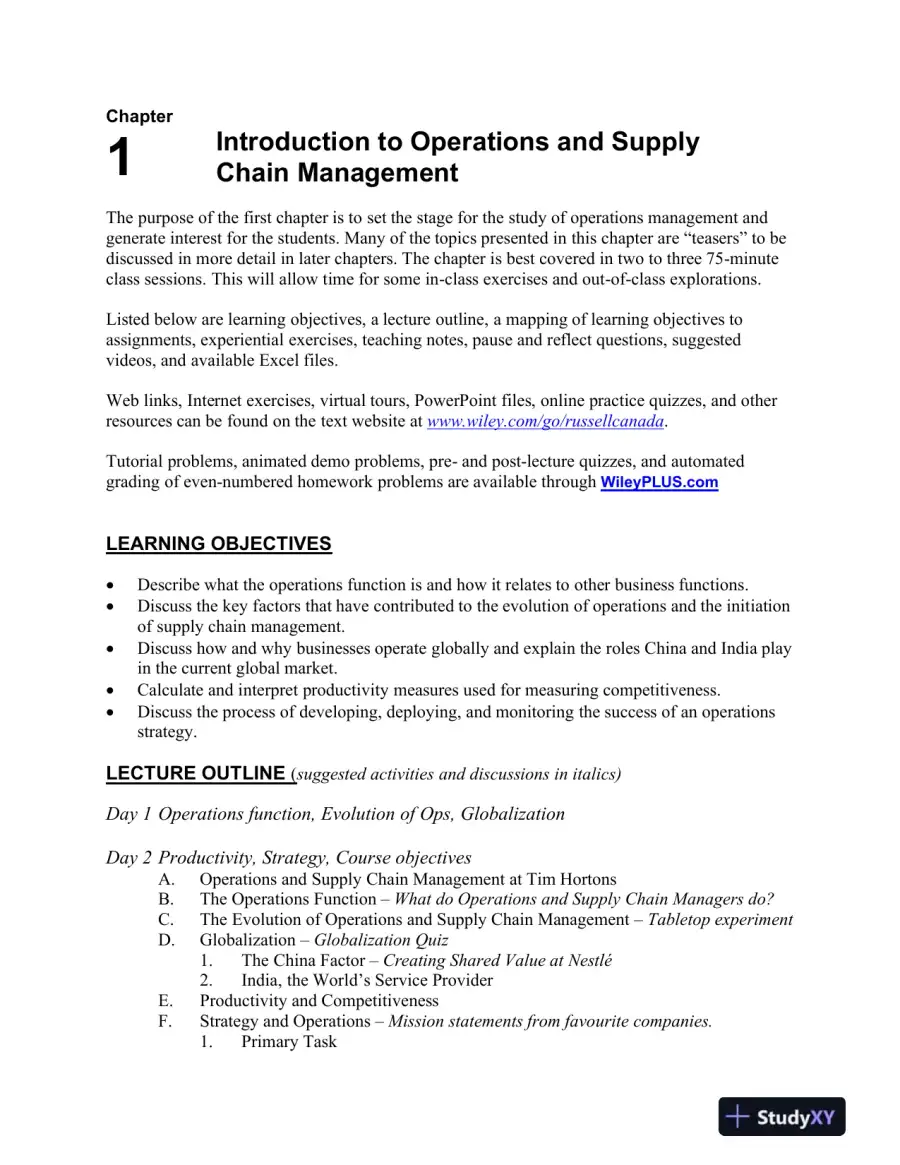 Chapter1Introduction to Operationsand SupplyChainManagementThe purpose of the first chapter is to set the stage for the study of operations management andgenerate interest for the students. Many of the topics presented in this chapter are“teasers” to bediscussed in more detail in later chapters. The chapter is best covered in two to three 75-minuteclass sessions. This will allow time for some in-class exercises and out-of-class explorations.Listed below are learning objectives, a lecture outline,a mapping of learning objectives toassignments, experiential exercises,teaching notes, pause and reflect questions, suggestedvideos, and available Excel files.Weblinks, Internetexercises, virtual tours, PowerPoint files,onlinepractice quizzes, and otherresources can be found on the textwebsite atwww.wiley.com/go/russellcanada.Tutorial problems, animated demo problems, pre-andpost-lecture quizzes, and automatedgrading of even-numbered homework problems are available throughWileyPLUS.comLEARNING OBJECTIVESDescribe what the operations function is and how it relates to other business functions.Discuss the key factors that have contributed to the evolution of operations and the initiationof supply chain management.Discuss how and whybusinesses operate globally and explain the roles China and India playin the current global market.Calculate and interpret productivity measures used for measuring competitiveness.Discuss the process of developing, deploying, and monitoring the success of an operationsstrategy.LECTURE OUTLINE(suggested activitiesand discussionsin italics)Day 1Operations function, Evolution of Ops, GlobalizationDay 2Productivity, Strategy, Course objectivesA.Operations and Supply Chain ManagementatTim HortonsB.The Operations Function–What do Operations and Supply Chain Managers do?C.The Evolution of Operations and Supply Chain Management–Tabletop experimentD.Globalization–Globalization Quiz1.The China Factor–Creating Shared Value at Nestlé2.India,the World’sServiceProviderE.Productivity and CompetitivenessF.Strategy and Operations–Mission statements from favourite companies.1.Primary Task
Page 2

Page 3
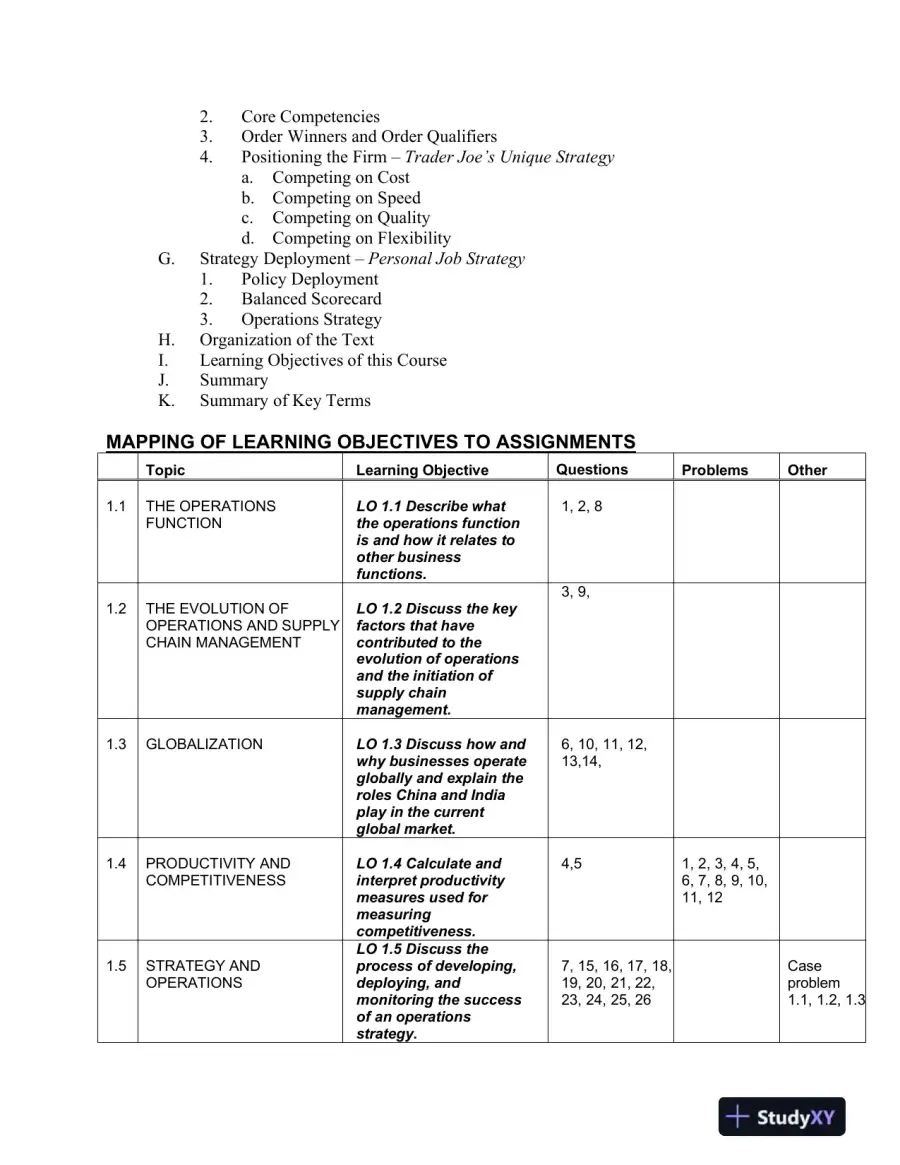 2.Core Competencies3.Order Winners and Order Qualifiers4.Positioning the Firm–Trader Joe’s Unique Strategya.Competing on Costb.Competing on Speedc.Competing on Qualityd.Competing on FlexibilityG.StrategyDeployment–Personal Job Strategy1.Policy Deployment2.Balanced Scorecard3.Operations StrategyH.Organization of the TextI.Learning Objectives of this CourseJ.SummaryK.Summary of Key TermsMAPPING OF LEARNING OBJECTIVES TOASSIGNMENTSTopicLearning ObjectiveQuestionsProblemsOther1.1THE OPERATIONSFUNCTIONLO 1.1 Describe whatthe operations functionis and how it relates toother businessfunctions.1, 2, 81.2THE EVOLUTION OFOPERATIONS ANDSUPPLYCHAIN MANAGEMENTLO 1.2 Discuss the keyfactors that havecontributed to theevolution of operationsand the initiation ofsupply chainmanagement.3, 9,1.3GLOBALIZATIONLO 1.3 Discuss how andwhy businesses operateglobally andexplain theroles China and Indiaplay in the currentglobal market.6, 10, 11, 12,13,14,1.4PRODUCTIVITY ANDCOMPETITIVENESSLO 1.4 Calculate andinterpret productivitymeasures used formeasuringcompetitiveness.4,51, 2, 3, 4, 5,6, 7, 8,9, 10,11, 121.5STRATEGY ANDOPERATIONSLO 1.5 Discuss theprocess of developing,deploying, andmonitoring the successof an operationsstrategy.7, 15, 16, 17, 18,19, 20, 21, 22,23, 24, 25, 26Caseproblem1.1,1.2,1.3
Page 4
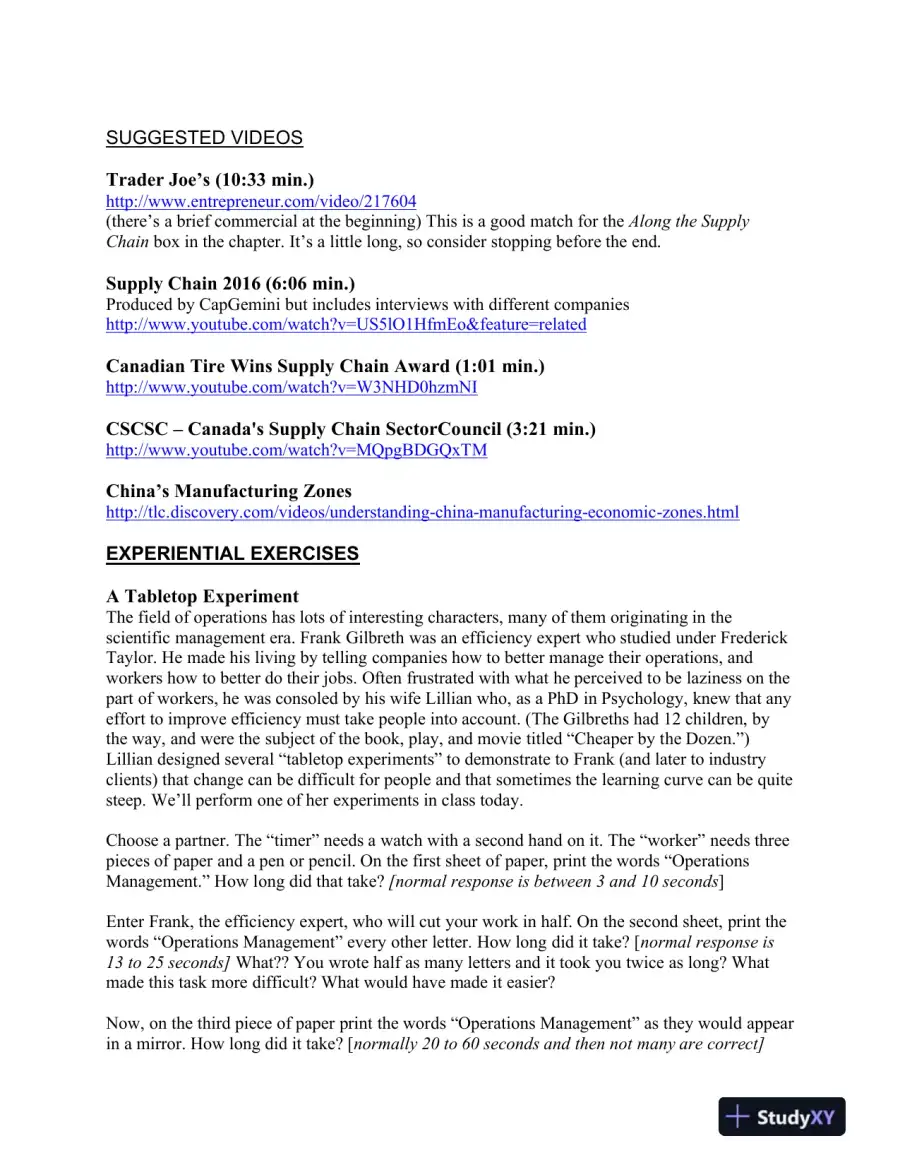 SUGGESTEDVIDEOSTrader Joe’s (10:33min.)http://www.entrepreneur.com/video/217604(there’s a brief commercial at the beginning) This is a good match for theAlong the SupplyChainbox in the chapter.It’s a little long, so consider stopping before the end.Supply Chain 2016 (6:06 min.)Produced by CapGemini but includes interviews with different companieshttp://www.youtube.com/watch?v=US5lO1HfmEo&feature=relatedCanadian Tire Wins Supply Chain Award (1:01min.)http://www.youtube.com/watch?v=W3NHD0hzmNICSCSC–Canada's Supply Chain SectorCouncil (3:21 min.)http://www.youtube.com/watch?v=MQpgBDGQxTMChina’s Manufacturing Zoneshttp://tlc.discovery.com/videos/understanding-china-manufacturing-economic-zones.htmlEXPERIENTIAL EXERCISESA Tabletop ExperimentThe field of operations has lots of interesting characters, many of them originating in thescientific management era. Frank Gilbreth was an efficiency expert who studiedunder FrederickTaylor. He made his living by telling companies how to better manage their operations, andworkers how to better do their jobs. Often frustrated with what he perceived to be laziness on thepart of workers, he was consoled by his wife Lillian who, as a PhD in Psychology, knew that anyeffort to improve efficiency must take people into account. (The Gilbreths had 12 children, bythe way, and were the subject of the book, play, and movie titled “Cheaper by the Dozen.”)Lillian designed several “tabletop experiments” to demonstrate to Frank (and later to industryclients) that change can be difficult for people and that sometimes the learning curve can be quitesteep. We’ll perform one of her experiments in class today.Choose a partner. The “timer” needs a watch with a second hand on it. The “worker” needs threepieces of paper and a pen or pencil. On the first sheet of paper, print the words “OperationsManagement.” How long did that take?[normal response is between 3 and 10 seconds]Enter Frank, the efficiency expert, who will cut your work in half. On the second sheet, print thewords “Operations Management” every other letter. How long did it take? [normal response is13 to 25 seconds]What?? You wrote half as many letters and it took you twice as long? Whatmade this task more difficult? What would have made it easier?Now, on the third piece of paper print the words “Operations Management” as they would appearina mirror. How long did it take? [normally 20 to 60 seconds and then not many are correct]
Page 5
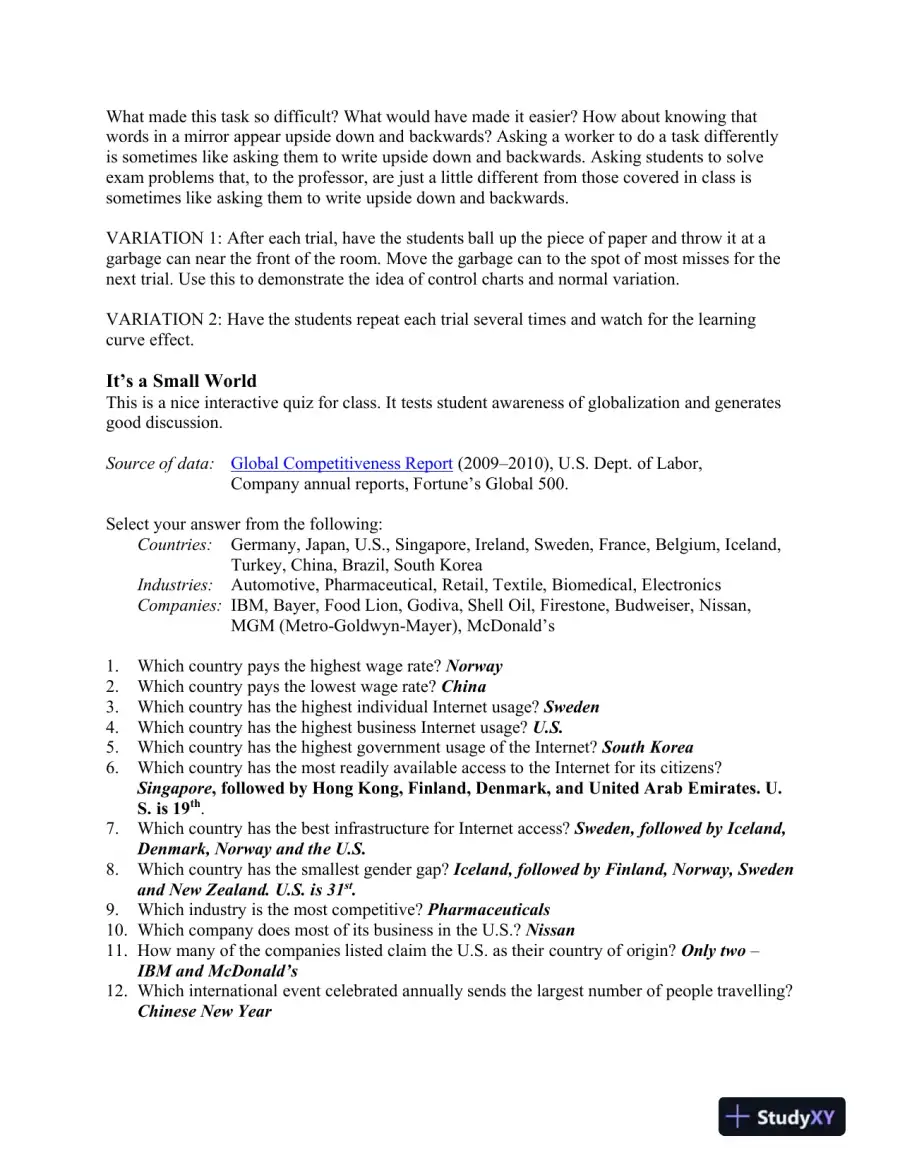 What made this task so difficult? What would have made it easier? How about knowing thatwords in a mirror appear upside down and backwards? Asking a worker to do a task differentlyis sometimes like asking them to write upside down and backwards. Asking students to solveexam problems that, to the professor, are just a little different from those covered in class issometimes like asking them to write upside down and backwards.VARIATION 1:After each trial, have the students ball up the piece of paper and throw it at agarbagecan near the front of the room. Move thegarbagecan to the spot of most misses for thenext trial. Use this to demonstrate the idea of control charts and normal variation.VARIATION 2:Have the students repeat each trial several times and watch for the learningcurve effect.It’s a Small WorldThis is a nice interactive quiz for class. It tests student awareness of globalization and generatesgood discussion.Source of data:Global Competitiveness Report(2009–2010), U.S. Dept.of Labor,Company annual reports, Fortune’s Global 500.Select your answer from the following:Countries:Germany, Japan, U.S., Singapore, Ireland, Sweden, France, Belgium, Iceland,Turkey,China, Brazil, South KoreaIndustries:Automotive, Pharmaceutical, Retail, Textile, Biomedical, ElectronicsCompanies:IBM, Bayer, Food Lion, Godiva, Shell Oil, Firestone, Budweiser,Nissan,MGM(Metro-Goldwyn-Mayer), McDonald’s1.Which country pays the highest wage rate?Norway2.Which country pays the lowest wage rate?China3.Which country has the highest individual Internet usage?Sweden4.Which country has the highestbusiness Internet usage?U.S.5.Which country has the highest government usage of the Internet?South Korea6.Which country has the most readily available access to the Internet for its citizens?Singapore,followed by Hong Kong, Finland,Denmark, and United Arab Emirates.U.S. is 19th.7.Which country has the best infrastructure for Internet access?Sweden,followed by Iceland,Denmark, Norway and the U.S.8.Which country has the smallest gender gap?Iceland,followed by Finland, Norway, Swedenand New Zealand. U.S. is 31st.9.Which industry is the most competitive?Pharmaceuticals10.Which company does most of its business in the U.S.?Nissan11.How many of the companies listed claim the U.S. as their country of origin?Only two–IBMandMcDonald’s12.Which international event celebrated annually sends the largest number of people travelling?Chinese New Year
Page 6
 TEACHING NOTESTeaching Note1—Operations is the “real work” of the enterpriseOperations is about the “real work” of the enterprise or the organization.There are otherfunctions—marketing, accounting, human resources, etc.—but goods are produced and servicesare delivered by the operations function.That’s what makes it the “hub” of most organizations.Ask students to identify some of their favourite products and discuss what they know about howthey are made. Or bring several common products to class and explain to the students how theyare made.Teaching Note 2—Students need their curiosity developedTry to get students curious—by reading theWall Street Journal, the financial section of the dailynewspaper, or by watching the evening news.Even the daily comics haveinsightful connectionsto the world of operations.Undergraduate students frequently do not have good knowledge of“who owns whom” in the corporate world, and have limited knowledge of technologies andmanufacturing processes.Bring to class a stack of magazines or newspapers and have the students look for articles relatedto operations management.Often at the beginning of a semester,Fortune, BusinessWeekortheWall Street Journalwill send complementary copies for you to distribute. What types of topicsare discussed?Teaching Note 3—Connect OM to student majors from the outsetOne of the difficulties of teaching OM to business students in general, is connecting the contentof OM to students’ individual majors.Begin immediately to show how the issues of operationsare connected to marketing (product design), to accounting (cost accounting), informationsystems (databases that allow just-in-time, MRP, CAD/CIM, e-commerce, and highlycustomized products), finance (capital budgeting, process choices, location), economics(supply/demand, capacity, scale economies), human resources (job design, performancemeasures), and, of course, management itself (operations as a source of sustainable advantage).Try these questions for class discussion or for an assignment.Consider the contents of the textbook for a course you are currently taking in your major field.Scan its chapter titles, its index, and its contents for areas in common with operations.(Forexample, if you are a marketing major, does your marketing text discuss facility location orproduct quality?)Why should it matter to you how goods and services are produced? Of what value is this courseto your major or future career plans?Teaching Note 4—Take advantage of student work experiencesMany of today’s undergraduates are working while they attend school.Many have workexperience, even if they are not currently working.These students’ work-related experiences areoften very useful in exploring various operations topics, including the “nine primary topics.”Engage students in dialog about the operations aspects of their workplaces.
Page 7
 Teaching Note 5—Take advantage of student consumer experiencesStudents, even if they have no work experience, have substantial consumer experiences.Thesecan be mined for their connection to operations.Some obvious cases involve aspects of productdesign (features and quality), service quality (timeliness and accuracy), layout, capacity, andlocation (clustering).Teaching Note 6—Make Input-Output definition of Operations ManagementinteractiveDiscuss the input-process-output view of the Operations Management in the context of e.g.,manufacturing and location. Then ask what are input, process,and output inanothercontexte.g.,healthcare.PAUSE AND REFLECTThese questions can be used to generate discussion during class, or as a post to a discussionboard or forum for online participation.1.What constitutesoperationsfor your university, an organization of which you are a member,or your place of business?2.Why is globalization seen as a panacea to world problems by some and an instigator ofproblems by others? What responsibilities should corporations have toward the country inwhich they operate? To their country of origin?3.What are the consequences of outsourcing production? The benefits? Is there a point atwhich too much outsourcing is dangerous? How do you view outsourcing as a consumer? Asan employee?4.From your travels (domestically or internationally), what differences have you encounteredin the goods or services provided? Think about how companies doing business in differentcountries need to adjust their operations.5.As an employee, a student or a consumer, what aspects of operations do you encounter?How do they relate to the nine “primary topics” in operations discussed in the chapter?6.Look for articles related to operations management in your local newspaper,Wall StreetJournalor favouritebusiness magazine. What types of topics are discussed?
Page 8
 EXCEL HOMEWORK FILESExcel homework solution files are available for download on the text website(www.wiley.com/go/russellcanada)for problems 1-1 to 1-10. These are for instructors only. Youelect whether to share these with students.EXCEL FILES FOR STUDENTSExhibit 1.1–Multifactor Productivity ExampleBalanced Scorecard.xls–Balanced Scorecard Worksheet
Page 9
 Supplement1Operational Decision-Making Tools:Decision AnalysisThe Excel files, web links, Internet exercises, and virtual tours can be found on the text’s websiteatwww.wiley.com/go/russellcanada.LEARNING OBJECTIVESAppropriately use a variety of quantitative decision analysis techniques.LECTURE OUTLINEA.DecisionAnalysis1.Decision-Making without Probabilitiesa.Maximaxb.Maximinc.Minimax Regretd.Hurwicz Solutione.Equal Likelihood Solution2.Decision Analysis with Excel3.Decision-making with Probabilitiesa.Expected Valueb.Expected Value of Perfect Informationc.Sequential Decision TreesB.SummaryC.Summary of Key FormulasD.Summary of Key TermsMAPPING LEARNING OBJECTIVES TO ASSIGNMENTSTopicLearning ObjectiveQuestionsProblemsOtherS1.1DECISIONANALYSIS WITHAND WITHOUTPROBABILITIESLOS1.1 Appropriatelyuse a variety ofquantitative decisionanalysis techniques.All (1 through 35)Case ProblemS1.1, S1.2, S1.3Excel FilesExhibit S1.1.xlsExample S1.1–Decision-Making CriteriaExhibit S1.2.xlsExample S1.2–Decision-Making CriteriaExhibit S1.3.xlsExample S1.3–Expected Value
Page 10
 TEACHING NOTESTeaching Note 1—Determine students’ quantitative backgroundPrior exposure to decision analysis in astatistics class or a quantitative methods class, somecontent may be review.The instructor may want to discover the extent of prior knowledge of thissubject.Teaching Note 2—Clarifying uncertainty and riskStudents often fail to grasp the distinction between decision making under uncertainty anddecision making under risk.Uncertainty means there are no probabilities in use; the choice ofdecision making criteria is based on the decision maker’s philosophy.For example, an optimisticdecision maker would use the maximax criterion.Risk means that there are probabilities in use.There are two issues here.One is that the uncertainty criteria no longer apply.Second is thatexpected value now rules as the criterion.Teaching Note 3—When to use decision treesanddecision tablesSome problems can only be solved with decision tables; others can only be solved with decisiontrees.Some problems can be solved by either technique.If there’s more than one decision, a treeis required.If there’s only one decision, AND the states of nature and probabilities are the samefrom one decision alternative to another, then a table can be used. If states of nature and/orprobabilities change from one decision alternative to another, a tree is required.Teaching Note 4—Quantitative techniques have widespread useImpress on the students that quantitative techniques provide a logical, systematic approach todecision making.As such, they are valuable in that they teach them a way in which to approachproblems of allkinds.Although the students may not immediately perceive the relevance ofthese techniques, the techniques are still beneficial in that they teach students a logical approachto solving problems.The approach to decision making as described in this section generallyfollows what is known as the "scientific" approach to problem solving.Teaching Note 5—Affordable computers make quantitative methods more popularIt is a good time to note that, because of the advances in computer technology, quantitativetechniques are growing in popularity.Point out that20years ago the applicability of models andtechniques was somewhat limited because often no means were available to solve large, complexproblems and computing systems were expensive.The rapidadvances in computer technologyhave now made such computation not only possible, but also widespread because of the low cost.Even the smallest businesses now have the computing ability and inexpensive software to usethese techniques.This is also a good time to mention the use of Excel and other software in thetext, if it is going to be used.PAUSE AND REFLECT1.Think of a decision you’ve had to make recently. It could be what university to attend, orwhich major or choose.We usually think in terms of alternatives, but not necessarily instates of nature. What states of nature would affect a decision on your major? What wouldthe return be in such an example? Which part of the decision making process is the most
Page 11
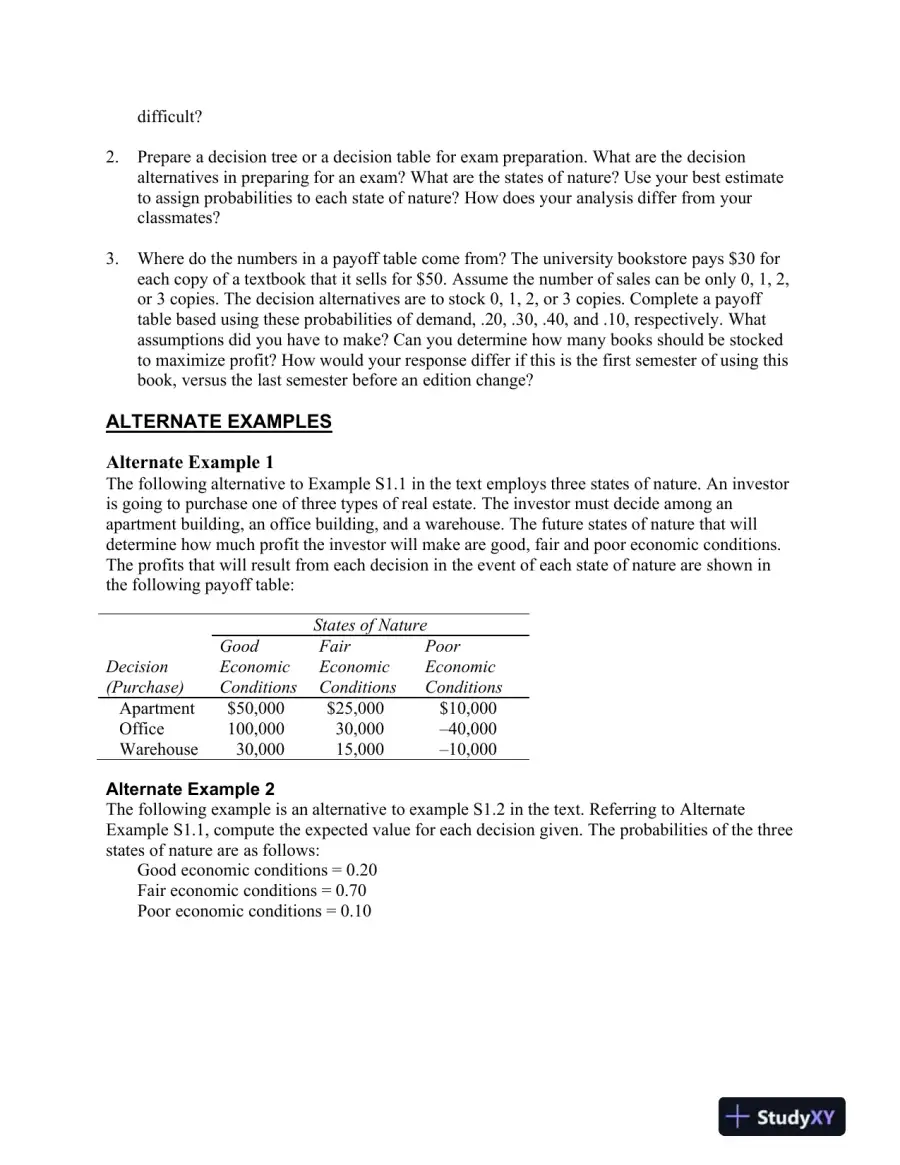 difficult?2.Prepare a decision tree or a decision table for exam preparation.What are the decisionalternativesin preparing for an exam?What are the states of nature?Use your best estimateto assignprobabilitiestoeach state of nature?How does your analysis differ from yourclassmates?3.Where do the numbers in a payoff table come from?The university bookstore pays $30 foreach copy of atextbook that it sells for $50.Assume the number of sales can be only 0, 1, 2,or 3 copies.The decision alternatives are to stock 0, 1, 2, or 3 copies.Complete a payofftable based using theseprobabilitiesof demand,.20, .30, .40, and .10,respectively. Whatassumptions did you have to make? Can you determine how many books should be stockedto maximize profit? How would your response differ if this is the first semester of using thisbook, versus the last semester before an edition change?ALTERNATE EXAMPLESAlternate Example 1The following alternative to Example S1.1 in the text employs three states of nature.An investorisgoing to purchase one of three types of real estate.The investor must decide among anapartment building, an office building, and a warehouse.The future states of nature that willdetermine how much profit the investor will make are good, fair and poor economic conditions.The profits that will result from each decision in the event of each state of nature are shown inthe following payoff table:States of NatureDecision(Purchase)GoodEconomicConditionsFairEconomicConditionsPoorEconomicConditionsApartment$50,000$25,000$10,000Office100,00030,000–40,000Warehouse30,00015,000–10,000Alternate Example 2The following exampleis an alternative to example S1.2 in the text.Referring to AlternateExample S1.1, compute the expected value for each decision given.The probabilities of the threestates of nature are as follows:Good economic conditions = 0.20Fair economic conditions =0.70Poor economic conditions =0.10
Page 12
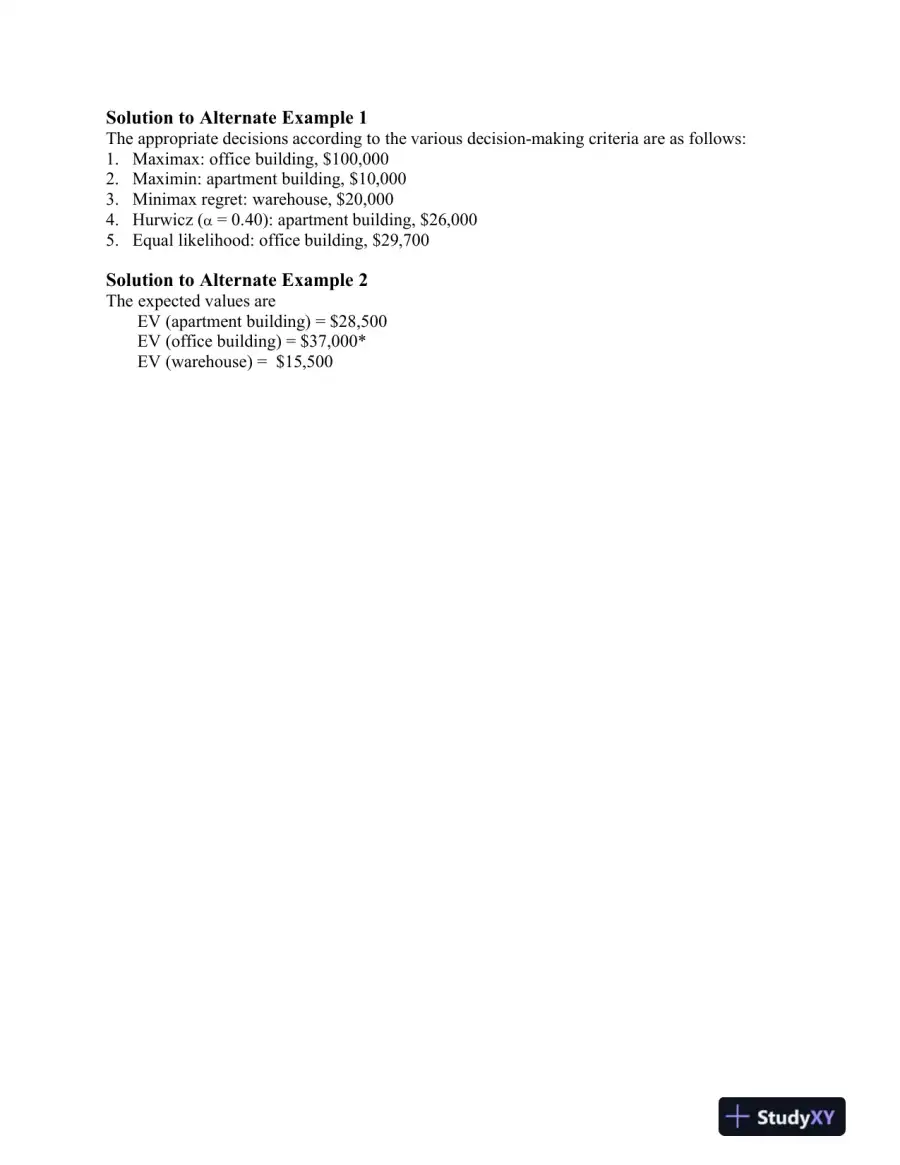 Solution to AlternateExample 1The appropriate decisions according to the various decision-making criteria are as follows:1.Maximax:office building, $100,0002.Maximin:apartment building, $10,0003.Minimax regret:warehouse, $20,0004.Hurwicz (= 0.40):apartment building, $26,0005.Equal likelihood:office building, $29,700SolutiontoAlternate Example 2The expected values areEV (apartment building) = $28,500EV (office building) =$37,000*EV (warehouse) =$15,500
Page 13
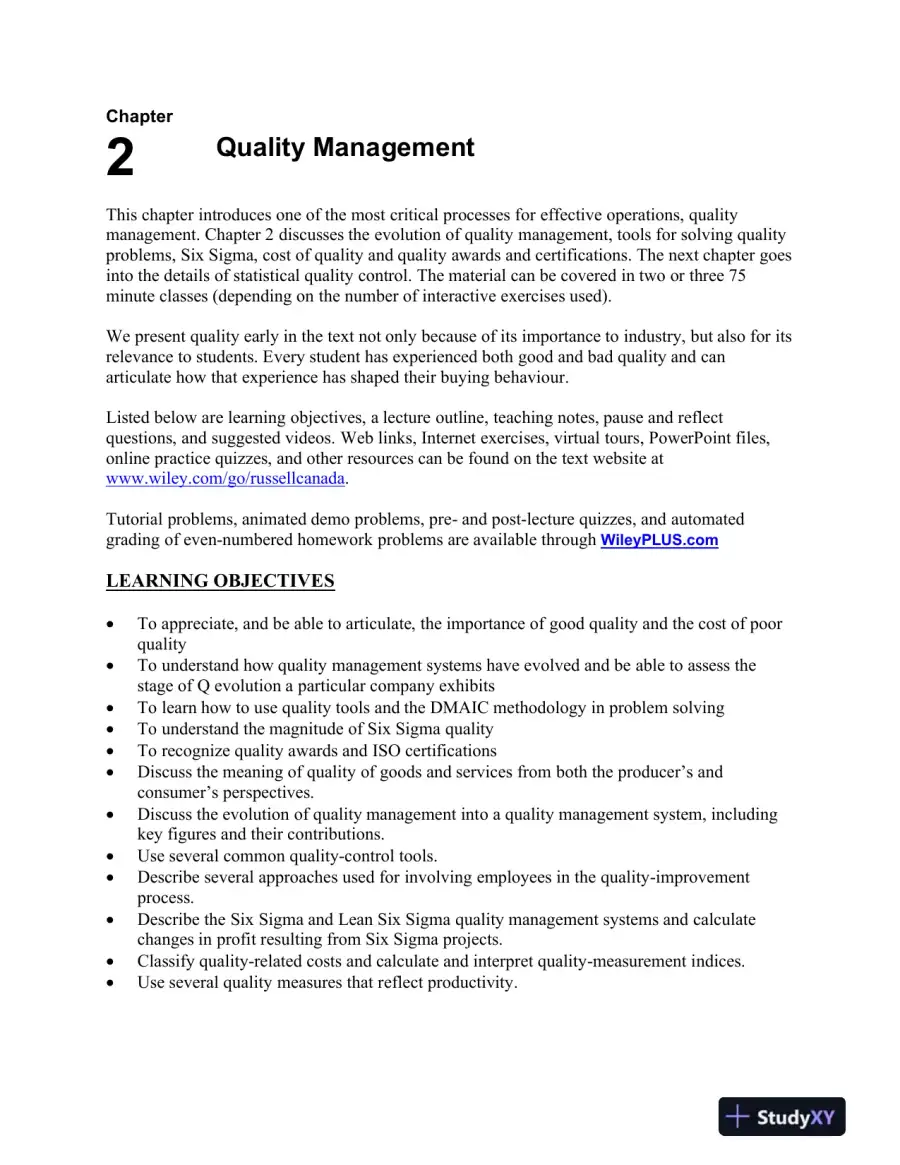 Chapter2Quality ManagementThis chapter introduces one of the most critical processes for effective operations, qualitymanagement. Chapter 2 discusses the evolution of quality management, tools for solving qualityproblems,Six Sigma, cost of quality and quality awards and certifications. The next chapter goesinto the details of statistical quality control.The material can be covered in two or three 75minute classes (depending on the number of interactive exercises used).We present quality early in the textnot onlybecause of its importance to industry, but also for itsrelevance to students. Every student has experienced both good and bad quality and canarticulate how that experience has shaped their buying behaviour.Listed below are learning objectives, a lecture outline, teaching notes, pause and reflectquestions,andsuggested videos.Web links, Internetexercises,virtualtours, PowerPoint files,online practice quizzes, and other resources can be found on the textwebsite atwww.wiley.com/go/russellcanada.Tutorial problems, animated demo problems, pre-and post-lecture quizzes, and automatedgrading of even-numbered homework problems are available throughWileyPLUS.comLEARNING OBJECTIVESTo appreciate, and be able to articulate, theimportance of good quality and the cost of poorqualityTo understand how quality management systems have evolved and be able toassess thestage of Q evolution a particular company exhibitsTo learn how to use quality toolsand the DMAIC methodologyin problem solvingTo understand the magnitude ofSix SigmaqualityTo recognize quality awards and ISO certificationsDiscuss the meaning of quality of goods and services from both the producer’s andconsumer’s perspectives.Discuss the evolution of quality management into a quality management system, includingkey figures and their contributions.Use several common quality-control tools.Describe several approaches used for involving employees in the quality-improvementprocess.Describe the Six Sigma and Lean Six Sigma quality management systems and calculatechanges in profit resulting from Six Sigma projects.Classify quality-related costs and calculate and interpret quality-measurement indices.Use several quality measures that reflect productivity.
Page 14
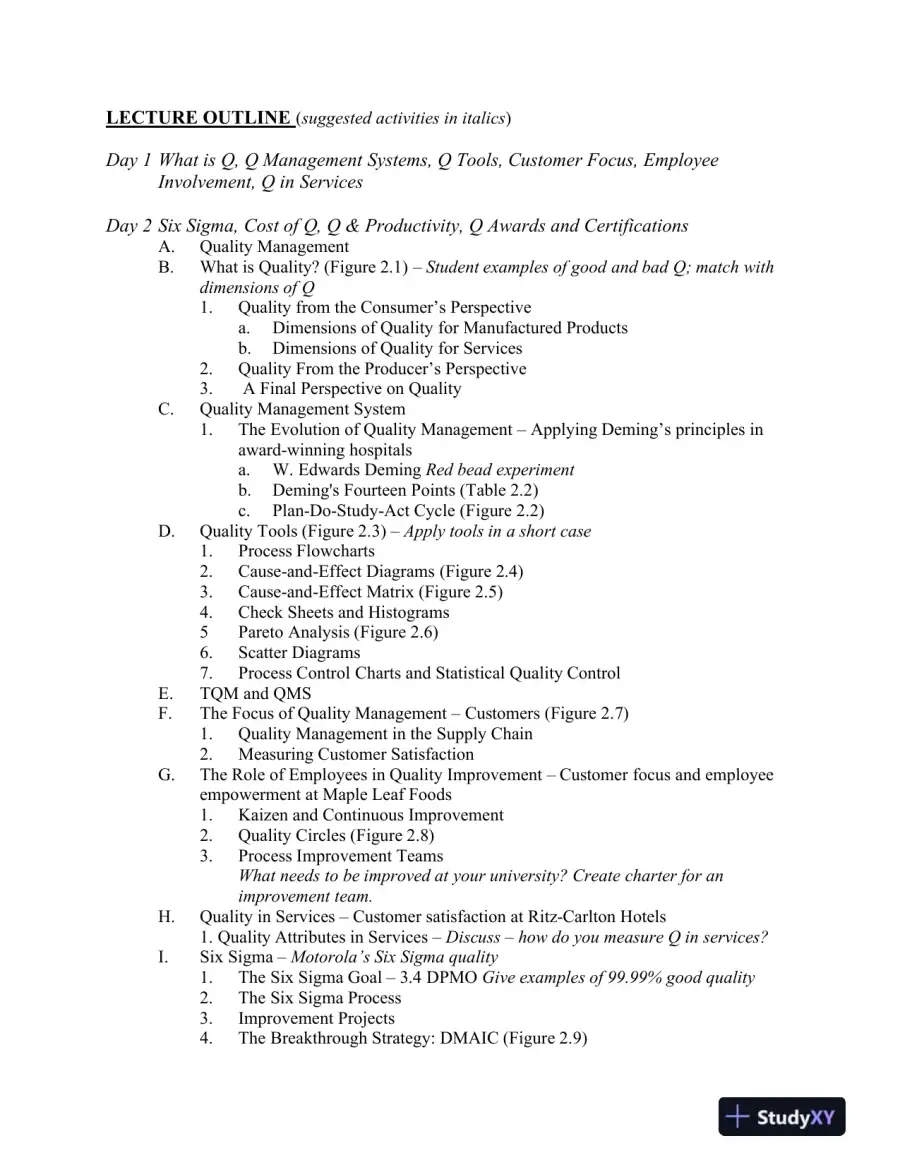 LECTURE OUTLINE(suggested activities in italics)Day 1What is Q, Q Management Systems, Q Tools, Customer Focus, EmployeeInvolvement,Q in ServicesDay 2Six Sigma,Cost of Q, Q &Productivity, Q Awards and CertificationsA.Quality ManagementB.What isQuality?(Figure 2.1)–Student examples of good and bad Q; match withdimensions of Q1.Quality from the Consumer’s Perspectivea.Dimensions of QualityforManufactured Productsb.Dimensions of QualityforServices2.Quality From the Producer’s Perspective3.A Final Perspectiveon QualityC.Quality ManagementSystem1.The Evolution ofQuality Management–Applying Deming’s principles inaward-winning hospitalsa.W. Edwards DemingRed bead experimentb.Deming's Fourteen Points(Table 2.2)c.Plan-Do-Study-Act Cycle(Figure2.2)D.Quality Tools (Figure 2.3)–Apply tools in a short case1.Process Flowcharts2.Cause-and-Effect Diagrams(Figure 2.4)3.Cause-and-Effect Matrix (Figure 2.5)4.Check Sheets and Histograms5Pareto Analysis (Figure 2.6)6.Scatter Diagrams7.Process Control Charts and StatisticalQualityControlE.TQM and QMSF.TheFocus of Quality Management–Customers (Figure 2.7)1.Quality Management in the Supply Chain2.Measuring Customer SatisfactionG.The Role of Employeesin Quality Improvement–Customer focus and employeeempowerment at Maple Leaf Foods1.Kaizen and Continuous Improvement2.Quality Circles(Figure 2.8)3.Process Improvement TeamsWhat needs to be improved at your university? Create charter for animprovement team.H.Quality in Services–Customer satisfaction at Ritz-Carlton Hotels1. Quality Attributes in Services–Discuss–how do you measure Q in services?I.Six Sigma–Motorola’s Six Sigma quality1.The Six Sigma Goal–3.4 DPMOGive examples of 99.99% good quality2.The Six Sigma Process3.Improvement Projects4.The Breakthrough Strategy: DMAIC(Figure 2.9)
Page 15
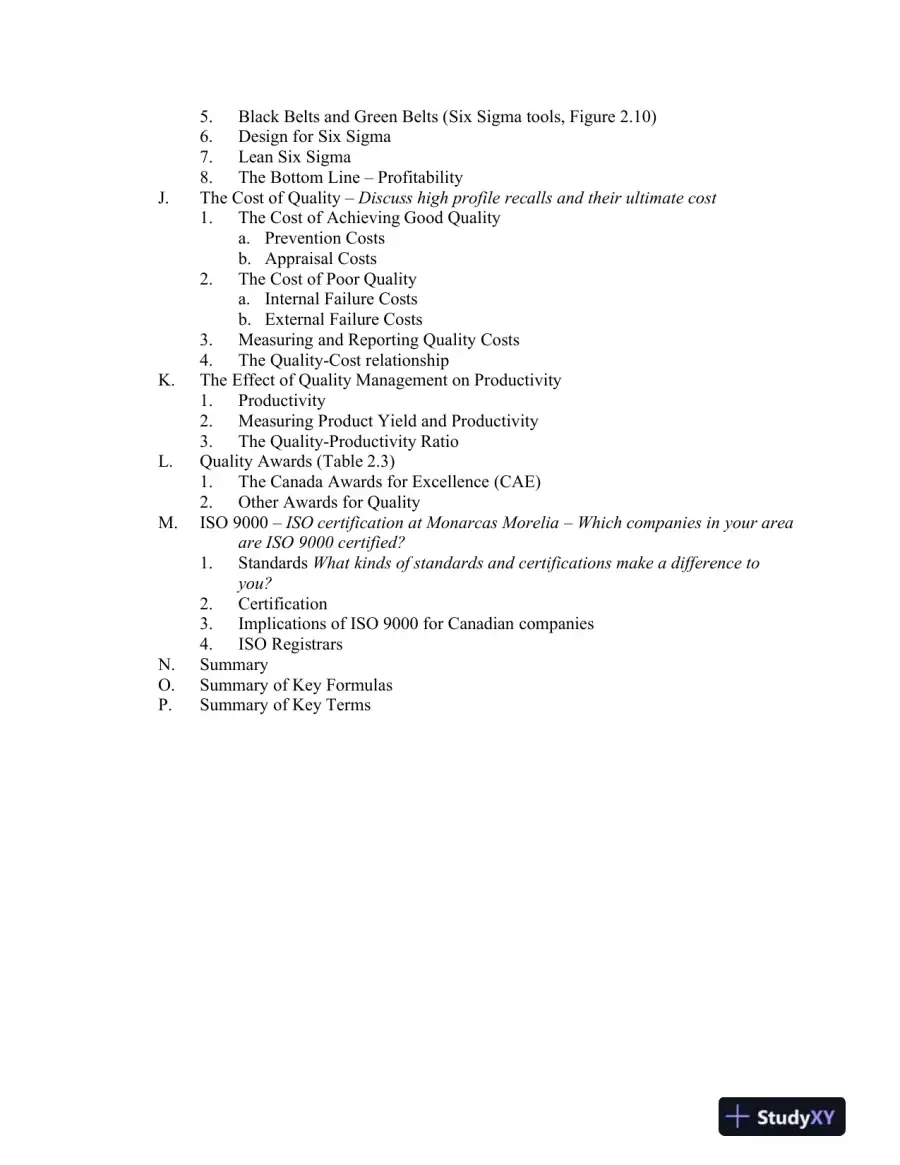 5.Black Belts and Green Belts(Six Sigma tools,Figure 2.10)6.Design for Six Sigma7.Lean Six Sigma8.The Bottom Line–ProfitabilityJ.TheCost of Quality–Discuss high profile recalls and their ultimate cost1.The Cost of Achieving Good Qualitya.Prevention Costsb.Appraisal Costs2.The Cost of Poor Qualitya.Internal Failure Costsb.External Failure Costs3.Measuringand Reporting Quality Costs4.The Quality-Cost relationshipK.The Effect of Quality Management on Productivity1.Productivity2.Measuring Product Yield and Productivity3.The Quality-Productivity RatioL.Quality Awards(Table2.3)1.TheCanadaAwards for Excellence(CAE)2.Other Awards for QualityM.ISO 9000–ISO certification at Monarcas Morelia–Which companies in your areaare ISO 9000 certified?1.StandardsWhat kinds of standards and certifications make a difference toyou?2.Certification3.Implications of ISO 9000 forCanadiancompanies4.ISO RegistrarsN.SummaryO.Summary of Key FormulasP.Summary of Key Terms
Page 16
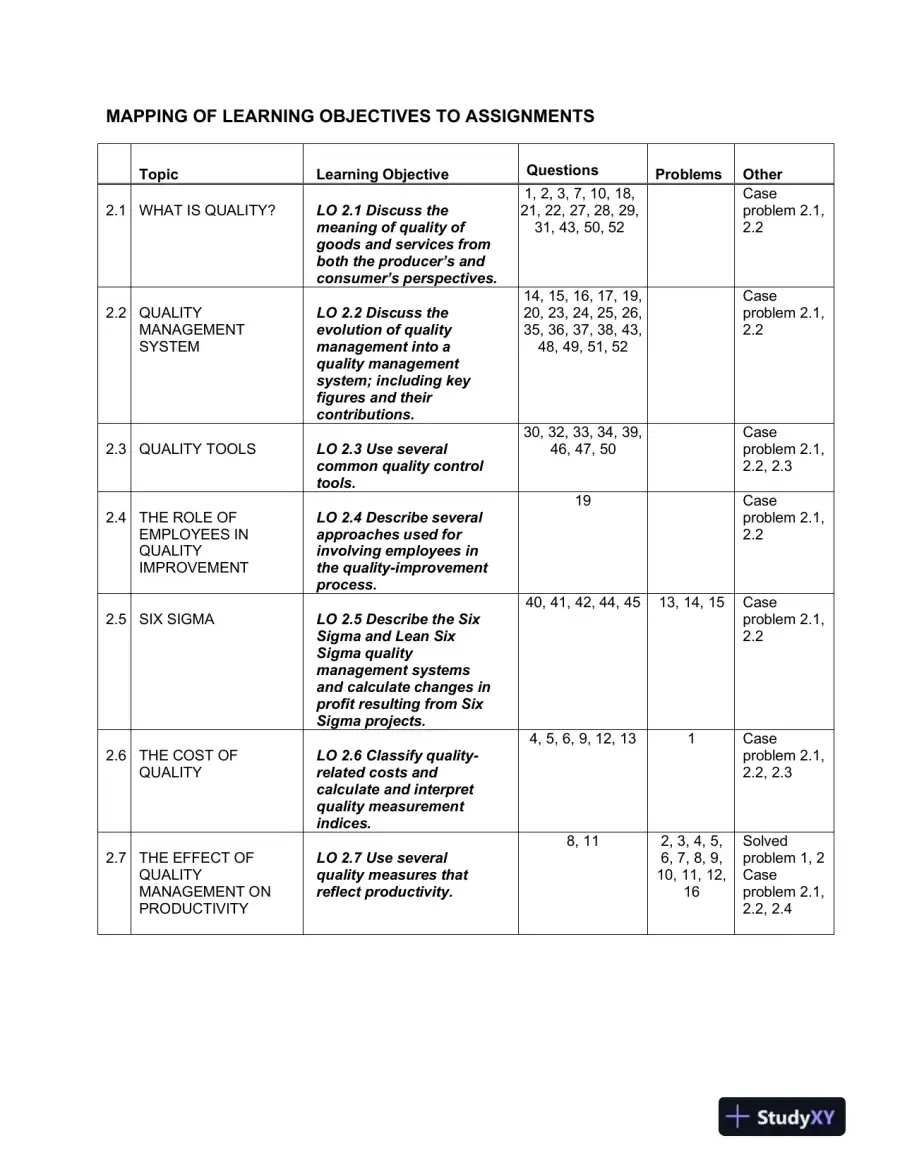 MAPPING OF LEARNING OBJECTIVES TO ASSIGNMENTSTopicLearning ObjectiveQuestionsProblemsOther2.1WHAT IS QUALITY?LO 2.1 Discuss themeaning of quality ofgoods and services fromboth the producer’s andconsumer’s perspectives.1, 2, 3, 7, 10, 18,21, 22, 27, 28, 29,31, 43, 50, 52Caseproblem 2.1,2.22.2QUALITYMANAGEMENTSYSTEMLO 2.2 Discuss theevolution of qualitymanagement into aquality managementsystem; including keyfigures and theircontributions.14, 15, 16, 17, 19,20, 23, 24, 25, 26,35, 36, 37, 38, 43,48, 49, 51, 52Caseproblem 2.1,2.22.3QUALITY TOOLSLO 2.3 Use severalcommon quality controltools.30, 32, 33, 34, 39,46, 47, 50Caseproblem 2.1,2.2, 2.32.4THE ROLE OFEMPLOYEES INQUALITYIMPROVEMENTLO 2.4 Describe severalapproaches used forinvolving employees inthe quality-improvementprocess.19Caseproblem 2.1,2.22.5SIX SIGMALO 2.5 Describe the SixSigma and Lean SixSigma qualitymanagement systemsand calculate changes inprofit resulting from SixSigma projects.40, 41, 42, 44, 4513, 14, 15Caseproblem 2.1,2.22.6THE COST OFQUALITYLO 2.6 Classify quality-related costs andcalculate and interpretqualitymeasurementindices.4, 5, 6, 9, 12, 131Caseproblem 2.1,2.2, 2.32.7THE EFFECT OFQUALITYMANAGEMENT ONPRODUCTIVITYLO 2.7 Use severalquality measures thatreflect productivity.8, 112, 3, 4, 5,6, 7, 8, 9,10, 11, 12,16Solvedproblem 1, 2Caseproblem 2.1,2.2, 2.4
145 more pages in the full document
Unlock it once and it stays in your library, ready to chat with or turn into flashcards.
Unlock the full documentMore Operations Management study materials
See all Textbook Guides
Operations Management: Creating Value Along The Supply Chain, 1st Canadian Edition Solution Manual
Operations Management
506 pagesMay 2025 Textbook Guides
Solution Manual for Operations and Supply Chain Management, 14th Edition
Operations Management
342 pages133downloadsFeb 2025 Textbook Guides
Managing Quality: Integrating the Supply Chain, 6th Edition Solution Manual
Operations Management
262 pages115downloadsFeb 2025 Textbook Guides
Operations Management, (Mcgraw-hill Education Operations and Decision Sciences) 1st Edition Solution Manual
Operations Management
153 pages91downloadsFeb 2025 Textbook Guides
Solution Manual For Matching Supply with Demand: An Introduction to Operations Management, 4th Edition
Operations Management
76 pages36downloadsFeb 2025 Solved Assignments
Analyzing the Production Constraints for Ozark Furniture Company
Operations Management
2 pagesMay 2025 Textbook Guides
Solution Manual for Introduction to Materials Management, 8th Edition
Operations Management
44 pagesMay 2025 Class Notes
PROCESS DESIGNS AND SUPPLY CHAINS PART 2 - OPS/571
Operations Management
7 pagesMay 2025
Study this document with CramX
Once it is in your library, every tool can work from it.