
Operations Management for MBAs, 5th Edition Solution Manual

Operations Management for MBAs, 5th Edition Solution Manual helps you stay ahead with clear explanations and well-organized study materials.

Michael Davis
Contributor
4.7
45
11 months ago
Preview (16 of 195 Pages)
100%
Log in to unlock

Page 1

Operations Management for MBAs, 5th Edition Solution Manual - Page 1 preview image

Loading page ...

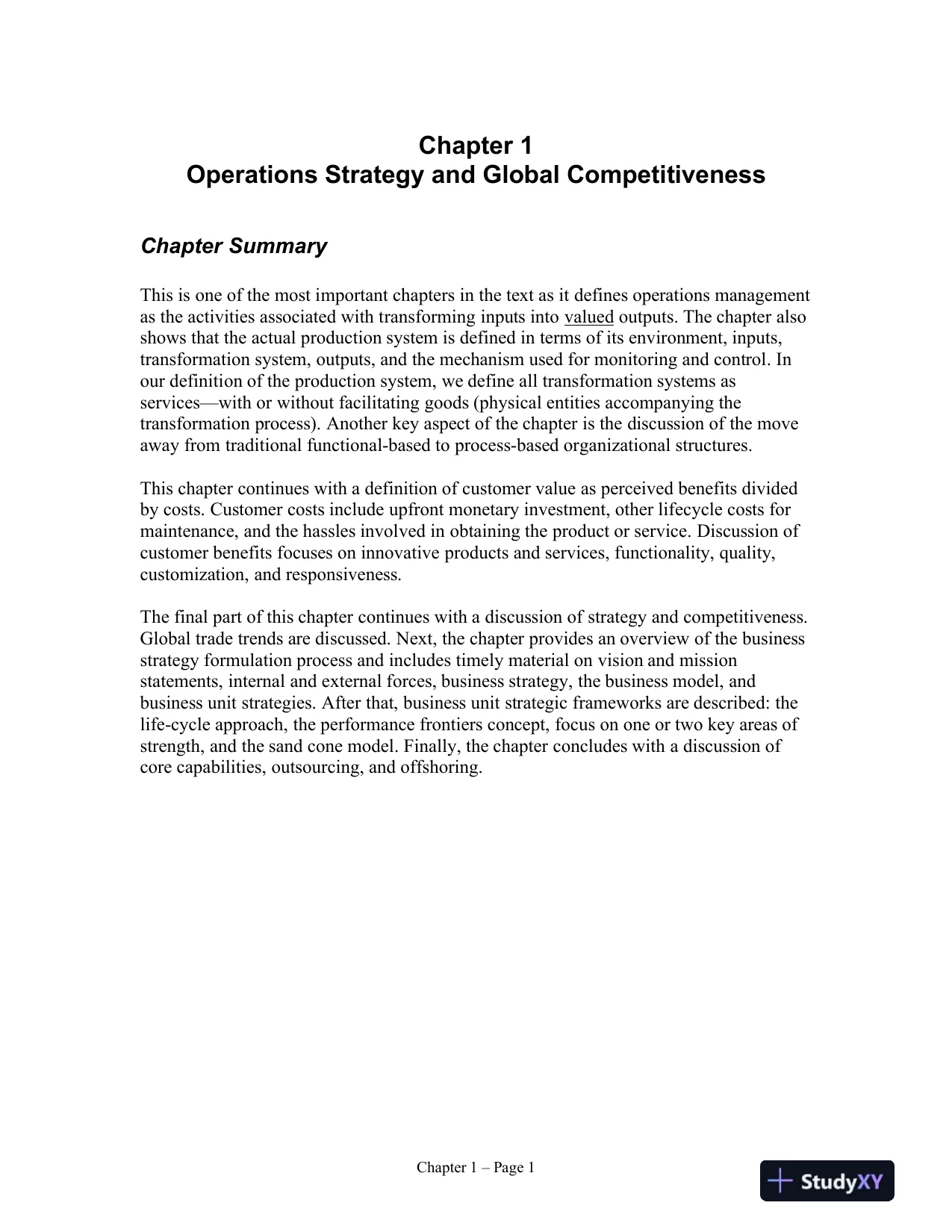
Chapter 1Page1Chapter 1OperationsStrategy and Global CompetitivenessChapter SummaryThis is one of the most important chapters in the text as it defines operations managementas the activities associated with transforming inputs intovaluedoutputs.The chapter alsoshows that the actual production system is defined in terms of its environment, inputs,transformation system, outputs, and the mechanism used for monitoring and control.Inour definition of the production system, we define all transformation systems asserviceswith or without facilitating goods (physical entities accompanying thetransformation process).Another key aspect of the chapter is thediscussion of the moveaway from traditional functional-basedtoprocess-based organizational structures.This chapter continueswitha definition ofcustomer valueas perceived benefits dividedby costs.Customer costs include upfront monetary investment, other lifecycle costs formaintenance, and the hassles involved in obtaining the product or service.Discussion ofcustomer benefits focuses on innovative products and services, functionality, quality,customization, and responsiveness.Thefinal part of this chaptercontinues with a discussion ofstrategyandcompetitiveness.Global trade trends are discussed.Next,the chapter provides an overview of the businessstrategy formulation process and includes timely material on vision and missionstatements,internal and external forces, business strategy, the business model, andbusiness unit strategies.After that,business unitstrategic frameworks are described:thelife-cycle approach, the performance frontiers concept, focus on one or two key areas ofstrength,andthe sand cone model.Finally, the chapter concludes with a discussion ofcore capabilities, outsourcing, and offshoring.

Page 2

Operations Management for MBAs, 5th Edition Solution Manual - Page 2 preview image

Loading page ...

Page 3

Operations Management for MBAs, 5th Edition Solution Manual - Page 3 preview image

Loading page ...

Chapter 1Page2Discussion OutlineI.IntroductionII.OperationsA.Systems PerspectiveB.InputsC.TransformationProcessesD.OutputsE.ControlF.Operations ActivitiesG.Trends in OperationsIII.Customer ValueA.CostsB.BenefitsC.InnovativenessD.FunctionalityE.Quality1.QualityDimensions2.Quality’sBenefits andCosts3.Evolution ofQuality: Japan vs. AmericaF.Customization1.Flexibility2.Mass customizationG.Example: Hewlett-PackardH.ResponsivenessIV.Strategy and CompetitivenessA.GlobalTrendsB.StrategyC.Strategic Frameworks1.TheLifeCycle2.PerformanceFrontiers3.Focus4.The Sand ConeD.Core Capabilities

Page 4

Operations Management for MBAs, 5th Edition Solution Manual - Page 4 preview image

Loading page ...

Chapter 1Page3Chapter Teaching TipsThere are a number of ways to introduce the course material.Many MBA students workat companies that have recently initiated a Lean/Six Sigma project, have outsourcedprocesses to suppliers in low-wage countries, or have implemented an EnterpriseResource Planning system.Therefore, students naturally should be inquisitive aboutoperations management and the aforementioned topics.One approach is to have the students read cases prior to first class.“Wyatt EarpTheBuffalo Hunter” case is a short, but interesting case, that touches upon many aspects ofoperations strategy.A second case, “American Outsourcing” discusses the outsourcing ofmanufacturing and service jobs from the United States to Mexico, China, and India.Citations for these cases can be found at the end of these notes.Another useful approach for illustrating the importance of operations management is tohave students read theHarvard Business Reviewarticle “Fast Heat: How Korea Won theMicrowave War (January/February 1989).The article emphasizes a number of importantthemes including:A strong production orientation.Samsung emphasized production overmarketing.Design done with manufacturing in mind.Measures like payback and return on investment were not used.The customer should never be kept waiting.Engineers travel, not just the sales force.Anotherapproach is to start with a movie or video that illustrates the operations activitiesof some firm or organization and use this to lead to a discussion of the operationsfunction.Then, the instructor can introduce the topics of global competiveness and strategy byaskingstudents for the slogans of firms they are familiar with (e.g., "Everyday lowpricesalways!").From this, the number of areas of strength that are in the operationsarea can be counted.Typically,80-90% will fall in the operations area indicating itsstrategic importance.The discussion can then move to the Chinese successes in worldmarkets and American firms' often typical lack of attention to operational activities.

Page 5

Operations Management for MBAs, 5th Edition Solution Manual - Page 5 preview image

Loading page ...

Chapter 1Page4Illustrative Answers to Expand Your Understanding Questions1.Services are typically more customized than products and thus less subject torepetitive automation, which could increase their efficient production.Second, thetechnology of service production is nowhere as advanced as that for products.Last,because services cannot be stored, this makes their timely production more expensive.2.Some other differences will be pointed out in future chapters.These include the lowbarriers to entry for service businesses, the (typically) reduced capital required for aservice, the infinite variability of a service, etc.3.Services do seem to be protected because of their high provider-customer interaction,which is difficult for foreign firms to offer due to distance, language, culture, andother such matters.It is commonly believed that, because services have less foreigncompetition, domestic firms are better at providing services than products.This isprobably a great fallacy, as anyone who has experienced service offerings in multipleforeign countries can tell you.4.The Japanese work more diligently in designing and planning their operations andexert less effort in controlling them.In fact, much of their design efforts are directedtoward eliminating the need to control their work, for example, by making errors ormistakes more obvious and easily corrected.They thus offer better designed outputsand also spend less on correcting, counting, monitoring, and controlling those outputswith the result that they are often more competitive in global markets.5.A manufacturer would see that the physical product was only a part of the totalpackage being sold to satisfy a customer, and that a service provider might consideradding a facilitating good to their offerings to enhance the service.6.Previous problems with acquisitions have been due to attempts to grow for purelyfinancial reasons instead of good business reasons; essentially playing a financialgame.Wise acquisitions are conducted slowly, with long and intensive analysis, andbring true synergy to the firm's existing products, services, distribution network, orother (and frequently multiple) aspects of their focus.7.As the U.S. trade deficit increases, U.S. dollars will accumulate overseas.Onepotential adverse effect is a run on the U.S. currency.A gradual devaluation of thedollar should, in theory, make U.S. exports cheaper and U.S. imports more expensive,thereby reducing the trade deficit.Some experts have estimated that the dollar isovervalued by about 40%; however, in 1987 a coordinated effort among the U.S. andthe central banks of many of the developed nations was able to cut the value of thedollar by 50% against some currencies without a serious impact on the economy.8.The text notes that other areas of focus may lie outside the operations function, suchas in marketing or finance.However,even in operations there may be a focus on the

Page 6

Operations Management for MBAs, 5th Edition Solution Manual - Page 6 preview image

Loading page ...

Chapter 1Page5distribution system, purchasing capabilities (especially for difficult-to-obtainmaterials), or the use of advanced technologies.9.China possesses a core capability of cheap, abundant labor.India possesses a corecapability of abundant and skilled, English-speaking labor.Japan has always had astrong capability in teamwork and execution, while the U.S. has always been knownfor its creativity, innovativeness, and flexibility.10.Obviously, the student will have to choose a point of reference to determine if anaction is ethical, a topic worth discussion all by itself.That is, the student can look atthe action from the view of the one taking the action, from the oneaffectedby theaction, or from a disinterested observer.Whose laws are relevant: home country,foreign country, both?11.The cost savings largely arise from the discipline required to produce quickly: Fewererrors, fewer operations, smoother processes, less labor, fewer inventories.Othersavings also accrue to fast response, however, such as less time for engineeringchanges to the product and, more important, less time for the customer to requestchanges, or even cancel the order!Last, though not a cost, faster response meansfaster revenue generation too.12.One example of a company that has moved the performance frontier of its industry isSouthwest AirlinesSouthwest offers delivery speed, dependability, and low costs.A second example would be Dell in entering the market for plasma televisions byoffering televisions with high quality at a cost lower than competitors’ prices.13.In Japan, protectionism was used to nurture infant industries and protect them fromforeign competition until they could compete on their own.In particular, after WWII,Japan began to emphasize product and process quality.At the same time, U.S.producers, believing that they already manufactured the world’s best products,emphasized marketing of those products.The American proficiency in marketingenables U.S. producers to continue to sell products/services that in some cases are oflower quality than those sold by Japanese producers.The Japanese emphasis onengineering enables their producers to introduce products faster, to improve processesmore dramatically, etc.14.Based on Figure1.6, we would expect between 1/5 and 3/5 of the reduction in theresponse time, with an average of ½.Since a cut by a factor of ten means a 90%reduction, we would thus expect a unit cost reduction between 18% and 54%, with anaverage of 45%.15.With the increasing trend of offshoring, workers in the U.S. should expect that theywill be forced to accept lower wages, will lose their jobs, and/or they will need toprepare themselves for new jobs demanding core capabilities not found offshore.However, the cost of living should also decrease with lower prices forgoodsandperhaps some services also.Yet, some economists who have always favored free

Page 7

Operations Management for MBAs, 5th Edition Solution Manual - Page 7 preview image

Loading page ...

Chapter 1Page6trade for the improved overall efficiency of global production are now worried thatthe great majority of the fruits of that efficiency may accrue to the owners of thebusinesses instead of the public.16.Wal-Mart’s order winners are price and product variety.Wal-Mart’s qualifiersinclude quality and delivery reliability.Toyota’s order winners are quality,innovation, product reliability, and performance.Toyota’s qualifiers include price anddelivery reliability.BMW’s order winners include performance and innovation whileBMW’s qualifiers include quality and delivery reliability.Sony’s order winnersinclude innovation and performance.Sony’s qualifiers include price and deliveryreliability.17.Given the recent trends in products and services, i.e. consumers demanding betterperformance on all competitive dimensions, one could make a valid argument for useof the Sand Cone model over the focus strategy because companies must be able todeliver multiple core capabilities.18.We donot see more mass customization in products and services because someproducts and services do not lend themselves to this practice.Examples includecommodities such as sugar, delivery of electricity, gas, chemicals, flour, etc.Inaddition, companies must develop the ability to deliver high quality outputs at lowcost and at the same time increase flexibility.APPLY YOUR UNDERSTANDINGIncident 1:Taracare,Inc.Teaching Tips for CaseThis case is designed to illustrate the problem of sub-optimization.The case can also beused to demonstrate how individual components of a system interact and/or the rolesplayed by various functional departments.In addition, the case can be referred to whenthe topic of strategy is discussed in the next chapter.For example, the case can bediscussed in conjunction with the strategy formulation process to demonstrate how avision and mission statement might help align the decisions being made in differentfunctional areas.In addition, appropriate core competencies for Taracare can beidentified and discussed.1.On the surface, it might appear as though outdoor furniture and replacement windowshave very little in common.Therefore, it might be argued that Jorge made a mistakein hiring a new manufacturing manager without the proper qualifications.Thus, somestudents may argue that Alfredo be given some period of time to familiarize himselfwith the operations of the new production facility.However, the evidence in the case

Page 8

Operations Management for MBAs, 5th Edition Solution Manual - Page 8 preview image

Loading page ...

Chapter 1Page7suggests that Jorge is not overly concerned with the plant’s performance and that thepressure for improvement is coming from Alfredo himself.On the other hand, itshould be noted that in actuality both products do have much in common.Forexample, both products are assembled from extruded aluminum.Second, aluminumand glass are key raw materials of both products.Finally, both products are sold tosimilar customers.Thus, to the contrary, it would appear that Alfredo’s previousexperience does qualify him for the position at Taracare (assuming he performed wellin his previous position).2.Given Alfredo’s responsibility and concern for meeting delivery commitments andproduct quality he would likely make recommendations such as the following:Have the purchasing agent consult with someone in production before switchingsuppliers to determine the impact on operations of such a switch.Include someone from production on product design teams.Get the accounting and financepeopleoff his back so he can do his job.3.Given Jorge’s background in sales, it is reasonable to assume that this is the area withwhich he is most concerned.The evidence in the case certainly supports this view.For example, Jorge’s first initiative was to triple the sales force.Also, he did not seemto be overly concerned with production’s performance:Rather than address the issues Alfredo raised in the meeting, he deferred themto be resolved at a later date.He gave no indication that he believed the issues were important and that hewould deal with the issues (“ThenperhapsI will call a meeting…”)In actuality, it appeared that he was inclined to dismiss the problem (“… ourproduction is no worse than our competitors…“we don’t expect you to solveall our problems overnight…”“Keep up the good work…”“send me thatmemo at yourearliest convenience” notas soon as possible).Although Jorge may be giving sales his highest priority, it is a reasonable assumptionthat his real objective is to maximize his wealth.Clearly, the way to do this is bymaximizing Taracare’s profits given his 75 percent stake.Thus, given Jorge’sprevious experience and background in sales, it is not surprising that he has chosen tofocus his efforts on the sales function.For Alfredo to get Jorge to buy into improving operations, he first needs todemonstrate the connection between operations and Taracare’s profits.Jorge mustrecognize that maximizing profits is his primary objective and that each functionalarea contributes to this objective.Based on this broader perspective, Alfredo candemonstrate that optimizing one area can negativelyaffectthe overall organization.The issues he raised in the meeting can be used to demonstrate this point (e.g., buyingcheaper raw materials that ultimately cost the company more, designing products thatare difficult to produce, and so on).Employing a broader system perspective, Jorgecan consider the way each functional area can best contribute to the overallorganizational goals.

Page 9

Operations Management for MBAs, 5th Edition Solution Manual - Page 9 preview image

Loading page ...

Chapter 1Page8Discussion Outline for CaseI.The Current SituationA.Discuss Alfredo Diaz's primary concernsB.Discuss Jorge Gonzalez’s reaction to Alfredo’s concernsC.These are really symptoms of larger problemD.The real problem is sub-optimizationII.Jorge’s ApproachA.Sales backgroundB.Most likely interested in maximizing his wealthC.Seems to be focusing on what he knows bestIII.Need Systems ApproachA.Goal of entire organization (system) needs to be made clearB.Each functional area must consider how it can contribute to theaccomplishment of the overall organizational goalIncident 2: Izmir National University (INU)Teaching Tips for CaseThis case illustrates the importance that a well-defined strategy plays in helpingcoordinate and guide employees.In addition, the case provides students with anopportunity to develop a strategic planning process for the Business School to reinforcetheir understanding of the hierarchical nature of strategic planning.Instructors have agreat deal of flexibility in terms of the level of detail they wish to go into.For example,instructors that want to go into more detail can require the students to develop a visionand mission statement for the Business School.This exercise can be significantlyenhanced by asking the students to search the Web for existing Business Schoolvision/mission statements and then having the students evaluate and critique thesestatements in terms of the language used and what their reaction would be to thestatements if they were a student, faculty member, or company that recruited studentsfrom the school.The case also exposes students to the difficulty of measuring productivity, especially inorganizations that produce multiple outputs and where one or more of these outputs is anintangible service.

Page 10

Operations Management for MBAs, 5th Edition Solution Manual - Page 10 preview image

Loading page ...

Chapter 1Page91.The variety of goals and concerns expressed by the professors indicates an absence ofa well-defined strategy.This can be illustrated by discussing the lack of consistencyin the faculty’s comments.For example, one docent/professorcommented,“researchis our primary mission” while anotherstated“there is far too much emphasis placedon research.”Another way to illustrate this is to list the wide range of prioritiesexpressed by the professors.The suggestions made by the professors range fromimproving student/teacher ratios to getting a Ph.D. program approved to increasingthe travel budget to getting better secretarial support to allowing professors more timefor consulting.Thus, the comments suggest that the professors are pursuing their ownpersonal objectives and not supporting a common university or school-wide strategy.After making this point, the instructor may want to spend some time discussing thelikely outcomes and problems associated with not having a well-defined strategy atINU.2.As the leader of a university operating division, one primary role of a Dekan(administrative head, dean) is to ensure that the actions and decisions made at theschool level are consistent with and support the overall university strategy.Of course,this may be complicated by the absence of a well-defined overall university strategyor one that has not been effectively communicated.It is quite likely that this is thecase at INU given its short existence and overwhelming success.Administrators maysimply feel that INU is doing fine without having a formal strategic plan.At any rate, the first step for the Dekan is to determine what the university’s overallmission and strategy is.If it turns out that the university does not have a well-definedmission, the Dekan can use this to the Business School’s advantage by convincing thePresident and Provost of the need for a university strategy and then proactivelyhelping formulate the strategy so that the Business School’s interests are reflected inthe strategy.Once the Dekan has a good understanding of the overall university mission andstrategy, she can initiate an effort to develop a strategic plan for the Business School.To ensure buy-in and commitment to the school’s strategic plan, the Dekan shouldinclude as many of the professors in the process as possible.Perhaps she may decideto chair a committee composed of several of the full professors, a couple of thedocents, one or two staffers, one or more business professionals, and perhaps even astudent or two to begin drafting a vision/mission statement and strategic plan for theBusiness School.In formulating a vision/mission statement that supports theuniversity’s mission, the committee needs to consider the school’s strengths andweaknesses, its resources, its culture, the environment, and the desires of its facultyand other stakeholders.Further, given the small size of the Business School, it wouldbe highly desirable to get feedback from all faculty members.One way to accomplishthis would be to invite all faculty members and staff to periodic meetings to solicittheir reactions and input to the vision/mission statement as it is being drafted.After the vision/mission statement has been developed, the committee can turn itsattention to developing a strategic plan for achieving the school’s mission.One key

Page 11

Operations Management for MBAs, 5th Edition Solution Manual - Page 11 preview image

Loading page ...

Chapter 1Page10component of the strategic plan is the identification of the school’s core competenciesand how these competencies will be developed on an ongoing basis.In addition, thecommittee needs to determine how the strategic planning process will be continued inthe future.One option would be to have the Dekan serve as the chair of a Prioritiesand Goals Committee.Faculty could be selected or elected to serve on this committeefor a specified term.The committee could develop a list of priorities at the beginningof each year and meet periodically during the year to assess the school’s progress.3.There are a number of ways the productivity of the Business School could bemeasured.Potential partial productivity measures include:Total Student Credit Hours Taught/Professor and Instructor SalariesTotal Student Credit Hours Taught/Full Time Faculty EquivalentsGrants Received/Full Time Faculty EquivalentsPapers Published/Full Time Faculty EquivalentsThe ability to develop a multifactor productivity measure is extremely difficult giventhe absence of a common monetary unit with which to express the various outputs in,such as Euros or Yeni Lira (Turkish currency).For example, there is no easy way tocombine total student credit hours taught and papers published into a meaningfulmeasure of output.Therefore, more than likely, the Business School will need todevelop a number of partial productivity measures including separate ones fortracking teaching productivity and research productivity.Of course, the problem isstill complicated by qualitative differences that exist in the inputs and outputs.Forexample, not all journal publications are equal.Journal publications can differ interms of the rigor of the research, the impact the paper has on research, the impact thepaper has on practice, the number of pages in the article, and the respectability of thejournal the paper is published in.As another example, how does teaching a 5-hoursurvey course with 250 undergraduate students compare to teaching an advanced 5-hour graduate class with 20 students?Alternatively,for that matter, how doesteaching a Principles of Management course compare to teaching the Statisticscourse, assuming an equal number of students?The impact that a 10% raise will have on productivity is also difficult to assess.According to the first partial productivity measure above, increasing salaries whileholding everything else constant would appear to lower productivity.On the otherhand, if the second partial productivity measure is used, the raise in salaries wouldappear to have no effect on productivity.Inactuality,assessing the change inproductivity is again influenced by a number of qualitative factors.For example,although the first partial productivity measure appears to indicate a reduction inproductivity, it does not allow for the fact that the professors may become moreeffective over time and that the students learn more as a result.In addition, themeasure does not consider the fact that once a teacher preps a course the first time,teaching the same course requires less effort and therefore the professor may havemore time to devote to other activities.In other words, once a professor preps acourse, considerably less effort is typically required to teach the course at a later date.

Page 12

Operations Management for MBAs, 5th Edition Solution Manual - Page 12 preview image

Loading page ...

Chapter 1Page11Discussion Outline for CaseI.The Current SituationA.Discuss what the faculty comments tell you about INU’s strategy1.Comments often contradictory and lack consistency2.Professors pursuing own objectives not supporting school’s or university’sobjectivesB.Major problem is there appears to be no well defined or articulated strategyII.What Should the Dekan DoA.Dekan’s Role1.As leader of Business School, he must formulate vision and mission forschool2.Dekan’s vision and mission must support overall university strategyB.Developing a Vision/Mission Statement1.How much and who should be involvedC.Developing Strategic Plan1.Core competenciesD.Developing Strategic Planning ProcessIII.Measuring Productivity at the Business SchoolA.Partial MeasuresB.Multifactor MeasuresC.Difficulties1.No aggregate measure of output2.Qualitative differences difficult to account forD.Effect of 10% Raise on Productivity1.Different measures give different results2.Influence of qualitative factorsE.Productivity Measures Should be Tracked Over Time

Page 13

Operations Management for MBAs, 5th Edition Solution Manual - Page 13 preview image

Loading page ...

Chapter 1Page12Suggested Cases/ReadingsCase: Wyatt EarpThe Buffalo Hunter (F. Robert Jacobs, Irwin/McGraw-Hill, 1998)This case discusses Wyatt Earp’s innovations in operations to hunt and hide buffalos.Issuesdiscussed in this case touch upon process choice, capacity, quality control, compensation, work structuring,and organizational structure.This case also lends itself well to a lively discussion of sustainablecompetitive advantage and sustainable operations management.Case: American Outsourcing (2005) (Hvd 9-705-037)This case includes a review of the Mexican Maquilodoras, special economic areas in China, andservice outsourcing to India.The case also considers General Electric’s outsourcing of jobs to thesecountries.Case: Copeland Corporation (A) (Hvd. 9-686-088, TN 5-688-074))Perhaps the penultimate operations strategy case, this situation describes the typical plantproducing everything for everyone in one mixed up mess.A new manager arrives and begins to focusproduction by moving particular types of jobs to other plants and thereby obtains tremendousimprovements in quality, productivity, market share, volumes, and margins.Focus is by product in somecases and by process in others.Finally, the original plant is left and a decision about how to focus itsproduction remains.Case: Intel Systems Group (Hvd. 9-691-040, TN 5-692-034))The Intel Systems group is facing a shift from producing large customized computer systems insmall batches to small standardized desktop systems in very large batch sizes.The case provides studentswith the opportunity to analyze this shift on both product development and manufacturing.Case also lendsitself to an analysis of issues related to handing off products from product design to process design tomanufacturing.Case: Taco Bell (Hvd. 9-692-058, TN 5-692-091 and 5-196-073)This excellent case involves issues of layout, quality, labor staffing, product design, andinformation systems, all coordinated with a unique strategy driven from the top.Moreover, the strategy ismisleading to an outside observer and is only successful because of its totally integrated nature.Richenough to do some quantitative data analysis also.Case: The Great Nuclear Fizzle at Old B&W (H.B. Meyers,Fortune, Nov. 1969)This article provides an excellent illustration of the many potential problems of applying the sameproduction strategy to a new product that appears to be simply the next evolutionary step of the currentproduct.The article has no numbers to analyze but on the other hand can be read in class in a short period.Thus, it can be discussed en masse or by dividing the class into small groups and having group leadersaddress one of the many relevant issues.Note: this case is particularly appropriate for a first meeting of theterm when the class has not yet had an assignment to prepare.Case: Eli Lilly and Company: Manufacturing Process Technology Strategy (1991) (Hvd 9-692-056,TN 5-692-109)Case can be used to illustrate the stages of operational effectiveness framework, the link betweenoperations strategy and product development, and the importance of developing a manufacturing capability.Case: Eli Lilly and Company: The Flexible Facility Decision (1993) (Hvd 9-694-074, TN 5-696-041)Key issues concerns whether Lilly should continue to build highly specialized facilities or developmore flexible facilities that can produce a wider range of outputs.Case provides students with opportunitiesto perform discounted cash flow analysis and breakeven analysis.Case also ties in nicely with performancefrontier framework.Case can be combined with Eli Lilly and Company (9-692-056) to create module ontechnology and facilities strategies.

Page 14

Operations Management for MBAs, 5th Edition Solution Manual - Page 14 preview image

Loading page ...

Chapter 1Page13Case: McDonald’s Corporation (Hvd 9-693-028, TN 5-693-106)Addresses challenges to McDonald’s operational strategy resulting from growing range ofproducts.Also addresses issues related to the development of a corporate environmental strategy andprovides students with an opportunity to analyze environmental management issues.Case: Nucleon, Inc. (Hvd 9-692-041, TN 5-692-095)Case addresses key strategic issue, namely, whether a R&D intensives start-up shouldmanufacture its products in-house or outsource.Case lends ties in very nicely with topic of corecompetencies/capabilities.Case also provides students to perform discounted cash flow analysis of theoptions.Case: Whistler Corporation (A) (Hvd 9-690-011, TN 5-692-108)This case also ties in nicely with topic of core competencies/capabilities.Whistler previouslyachieved competitive success through R&D and marketing but is encountering problems because ofweaknesses in manufacturing.Students must first determine the basis on which Whistler should choose tocompete.Once this decision is made, more detailed analysis of the options on the table can be undertaken.A (B) case is also available (9-692-072)Case:Managing Orthopaedics at Rittenhouse Medical (Hvd 607152)This case presents an overview ofanorthopaedics department at a medical center that is running aprivate business practice and an academic faculty practice.The case lends itself to discussion of operationalfocus within a service setting.Case: Daewoo Shipbuilding and Marine Engineering (Hvd 609018)This case discusses the ability of a major Korean shipbuilder to develop its learning capability.The firm is faced with a competitive threat from Chinese competitors and must decide what parts of itsoperations to outsource.Case:New Balance Athletic Shoe, Inc. (Hvd 606094)This case analyzes aspects of NewBalance’s strategy of employing domestic manufacturing whenmost of its competitors outsource production to Asian suppliers.The case requires that students determinewhich aspects of its operations strategy New Balance should change.Reading:Plant and Service Tours in Operations Management(R. Schmenner, Pearson CustomPublishing, 2004)This paperback book contains a nice variety of both manufacturing and service facility toursfeaturing job shops, assembly lines, mass services, professional services, etc.Does an excellent job ofgiving students who are less experienced in the variety of ways that production can be organized someinsight into what we mean by each.Reading: Welcome to the Experience Economy(B. J. Pine, II and J. Gilmore,Harvard BusinessReview, July-Aug. 1998, pp. 97-105, Reprint # 98407)This article describes the evolution of the economy from one of products to services toexperiences and what it means for both providers as well as consumers.Prognosticates about the future ofservices in terms of experiences.Reading: A Glossary of TOM Terms (Hvd. 9-687-019)This brief 4-page note introduces the student to terms such as cycle time, bottleneck, capacity,utilization, throughput time, lot size, run time, etc.Reading: Fast Heat: How Korea Won the Microwave War (I.C. Magaziner and M. Patinkin,HarvardBusiness Review, Jan.-Feb. 1989, pp. 83-92, Reprint # 89114)Although the microwave was invented in the U.S., Korea's Samsung is now the largest producer ofmicrowave ovens.A story of world-class competition and how third-world countries are winning markets.

Page 15

Operations Management for MBAs, 5th Edition Solution Manual - Page 15 preview image

Loading page ...

Chapter 1Page14Reading: Deep Change: How Operational Innovation Can Transform Your Company (M. Hammer,Harvard Business Review, April 2004, pp. 84-93)This article focuses on breakthrough operational innovations and the strategic, marketplace, andoperational benefits that result from those innovations.Reading: Manufacturing Strategy: At the Intersection of Two Paradigm Shifts (R.H. Hayes and G.P.Pisano,Production and Operations Management, 5(1), 1996, pp. 25-41)Nice overview of the evolution of manufacturing strategy.Also discusses performance frontierframework.Reading: Competing Through Manufacturing and The New Manufacturing Paradigm: IsManufacturing Strategy Passe?(K.B. Clark,Production and Operations Management, 5(1), 1996, pp.42-58)Nice discussion of performance frontiers and advanced manufacturing systems.Readings: What Really Makes Factories Flexible?(D.M. Upton,Harvard Business Review, Reprint95410) and The Management of Manufacturing Flexibility (California Management Review, Winter1994, pp. 72-89)Two excellent articles on flexibility.Reading: ManufacturingMissing Link in Corporate Strategy (W. Skinner, Harvard BusinessReview, May-June 1969, pp. 136-145, Reprint # 69312)Probably THE classic operations strategy article.Old but still valuable.Reading: The Focused Factory (W. Skinner,Harvard Business Review, May-June 1974, pp. 113-121,Reprint # 74308)Probably the second classic article.Details the original conception of “focus.”Reading: A Strategic Approach to Evaluating Manufacturing Performance (P.R. Richardson,Interfaces, Nov.-Dec. 1985, pp. 15-27)An excellent analysis of the different forms of operations strategies and the actions that managersshould take to implement these strategies.Reading: Beyond Products: Services-Based Strategy (J.B. Quinn et al.,Harvard Business Review,Mar.-Apr. 1990, pp. 58-67, Reprint # 90212)Describes the process of identifying a firm’s competitive strength(s) and focusing on that whileoutsourcing everything else.Reading: The Icarus Paradox: How Exceptional Companies Bring About Their Own Downfall (D.Miller,Business Horizons, Jan.-Feb. 1992, pp. 24-35)The article insightfully illustrates how four different types of competitive strengths can easily turninto four different types of competitive liabilities.Examples of such firms are given and guidelines to avoidthese perils of success are described.Reading: Mass Customization at Hewlett-Packard: The Power of Postponement (E. Feitzinger andH. L. Lee,Harvard Business Review, Mar.-Apr. 1997, pp. 116-121, Reprint # 97101)Describes the power of the concept of postponing the addition of product differentiatingcharacteristics until as late as possible in the supply chain.This allows the producer to achieve themarketing benefits of customization while still reaping the cost benefits of high-volume, standardizedproduction.Reading: Innovation and Efficiency: It Is Possible to Have It All (M. Sarkees and J. Hulland,Business Horizons, Jan.-Feb., 2009, pp. 45-55).This article discusses a strategy of pursuing both innovation and efficiency simultaneously.Theauthors provide the results of a cross-industry survey of marketing managers in U.S. firms to support theviability of this strategy.

Page 16

Operations Management for MBAs, 5th Edition Solution Manual - Page 16 preview image

Loading page ...

Chapter 1Page15Reading: Process Completeness: Strategies for Aligning Service Systems with Customers’ ServiceNeeds(G. Piccoli, M. Brohman, R. Watson, and A. Parasuraman,Business Horizons, July-Aug.,2009, pp. 367-376).This article discusses developing strategies for service businesses.The authors argue that thosestrategies should strive to achieve process completeness, i.e., linking the service system to the customer’sexpectations.Reading: Going “Purple”: Can Military Jointness Principles Provide a Key to MoreSuccessfulIntegration at the Marketing-Manufacturing Interface?(M. Douglas and D. Strutton,BusinessHorizons, May-June, 2009, pp. 251-263).This article discusses the U.S. armed services’ ability to integrate quickly the strategies, strengths,and capabilities of two or more branches of the armed services.The authors provide a methodology for afirm’smarketing and manufacturing functions to use this same type of integration to meet the globalchallenges they face.
Preview Mode

This document has 195 pages. Sign in to access the full document!