
Textbook Guides
Operations Management: Processes And Supply Chains, 12th Edition Solution Manual
- Operations Management
- 648 pages
- Shared May 2025
With Operations Management: Processes And Supply Chains, 12th Edition Solution Manual, you can tackle your textbook assignments with confidence, knowing you have the correct answers.
Preview · 16 of 648 pages
100%
Page 1
 Krajewski OperationsManagement : Processesand Supply Chains12eLee KrajewskiManoj MalhotraLarry RitzmanSolutionsManual (Download only)for Operations Management: Pro-cesses and Supply Chains
Page 2

Page 3
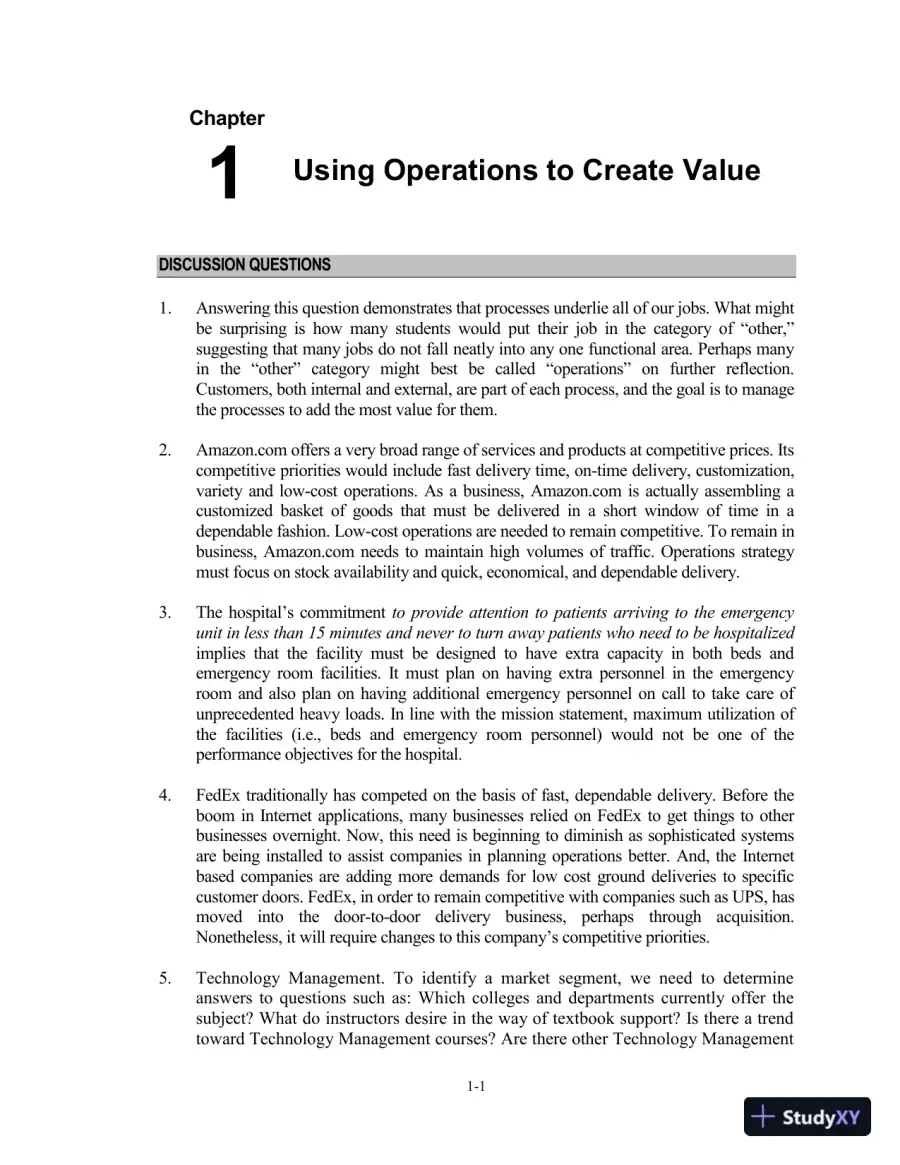 1-1Chapter1Using Operations toCreate ValueDISCUSSION QUESTIONS1.Answering this question demonstrates that processes underlie all of our jobs. What mightbe surprising is how manystudents would put their job in the category of “other,”suggesting that many jobs do not fall neatly into any one functional area. Perhaps manyin the “other” category mightbestbe called “operations” on furtherreflection.Customers, both internal and external, are part of each process, and the goal is to managethe processes to add the most value for them.2.Amazon.com offers a very broad range of services and products at competitive prices. Itscompetitive priorities would include fast delivery time, on-time delivery, customization,variety and low-cost operations. As a business, Amazon.com is actually assembling acustomized basket of goods that must be delivered in a short window of time in adependable fashion. Low-cost operations are needed to remain competitive. To remain inbusiness, Amazon.com needs to maintain highvolumes of traffic. Operations strategymust focus on stock availability and quick, economical, and dependable delivery.3.The hospital’s commitmentto provide attention to patients arriving to the emergencyunit in less than 15 minutes and never to turn away patients who need to be hospitalizedimplies that the facility must be designed to have extra capacity in both beds andemergency room facilities. It must plan on having extra personnel in the emergencyroom and also plan on having additional emergencypersonnel on call to take care ofunprecedented heavy loads. In line with the mission statement, maximum utilization ofthe facilities (i.e., beds and emergency room personnel) would not be one of theperformance objectives for the hospital.4.FedEx traditionally has competed on the basis of fast, dependable delivery. Before theboom in Internet applications, many businesses relied on FedEx to get things to otherbusinesses overnight. Now, this need is beginning to diminish as sophisticated systemsare being installed to assist companies in planning operations better. And, theInternetbased companies are adding more demands for low cost ground deliveries to specificcustomer doors. FedEx, in order to remain competitive with companies such as UPS, hasmovedintothedoor-to-doordeliverybusiness,perhapsthroughacquisition.Nonetheless, it will require changes to this company’s competitive priorities.5.Technology Management. To identify a market segment, we need to determineanswers to questions such as: Which colleges and departments currently offer thesubject? What do instructors desire in the way of textbook support? Is there a trendtoward Technology Management courses? Are there other Technology Management
Page 4
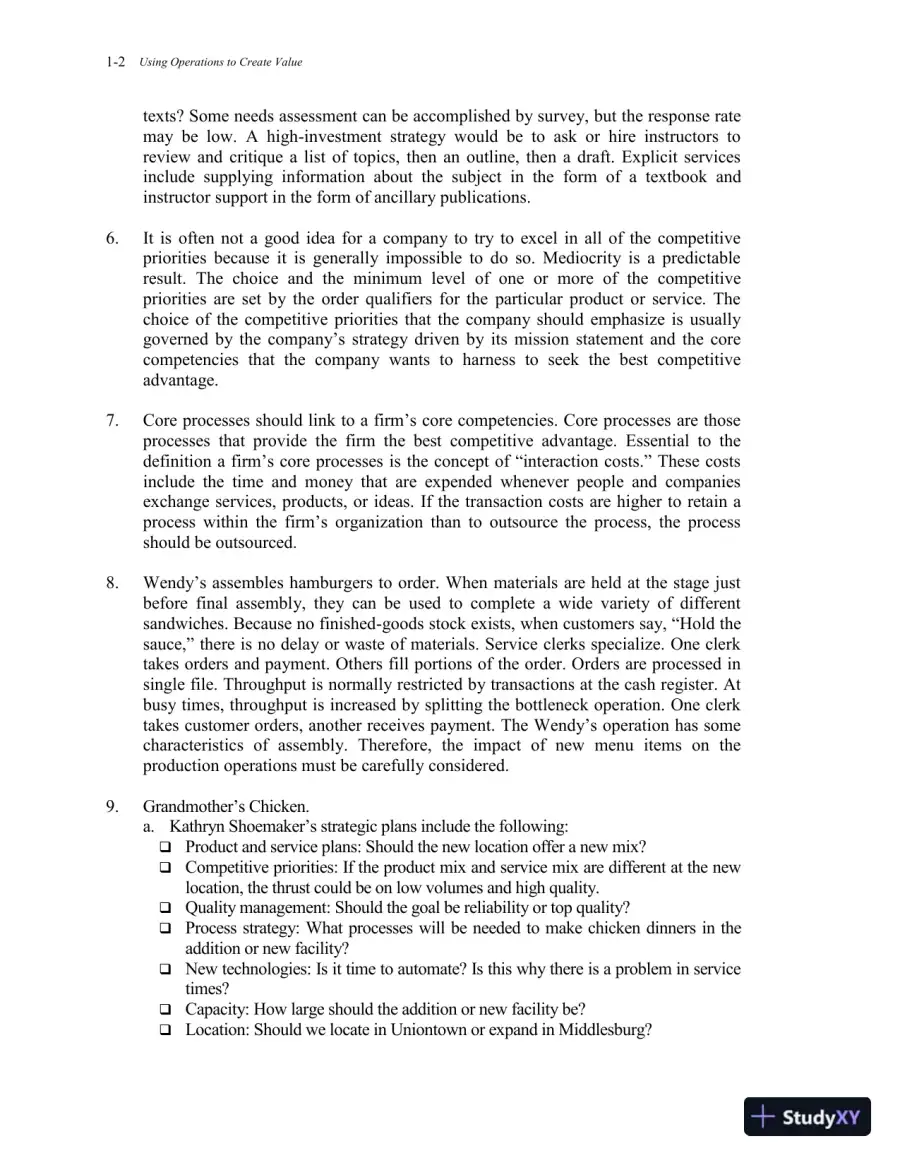 Using Operations to Create Value1-2texts? Some needs assessment can be accomplished by survey,but theresponse ratemay be low. A high-investment strategy would be to ask or hire instructors toreview and critique a list of topics, then an outline, then a draft. Explicit servicesinclude supplying information about the subject in theform of a textbook andinstructor support in the form of ancillary publications.6.It is often not a good idea for a company to try to excel in all of the competitivepriorities because it is generally impossible to do so. Mediocrity is a predictableresult. The choice and the minimum level of one or more of the competitivepriorities are set by the order qualifiers for the particular product or service. Thechoice of the competitive priorities that the company should emphasize is usuallygoverned by the company’s strategy driven by its mission statement and the corecompetencies that the company wants to harness to seek the best competitiveadvantage.7.Core processes should link to a firm’s core competencies. Core processes are thoseprocesses that provide the firm the best competitive advantage. Essential to thedefinition a firm’s core processes is the concept of “interaction costs.” These costsinclude the time and money that are expended whenever people and companiesexchange services, products, or ideas.If the transaction costs are higher to retain aprocess within the firm’s organization than to outsource the process, the processshould be outsourced.8.Wendy’s assembles hamburgers to order. When materials are held at the stage justbefore final assembly, they can be used to complete a wide variety of differentsandwiches. Because no finished-goods stock exists, when customers say, “Hold thesauce,” there is no delay or waste of materials. Service clerks specialize. One clerktakes orders and payment. Others fill portions of the order. Orders are processed insingle file. Throughput is normally restricted by transactions at the cash register. Atbusy times, throughput is increased by splitting the bottleneck operation. One clerktakes customer orders, another receives payment. The Wendy’s operation has somecharacteristics of assembly. Therefore, the impact of new menu items on theproduction operations must be carefully considered.9.Grandmother’s Chicken.a.Kathryn Shoemaker’s strategic plans include the following:Product and service plans: Should the new location offer a new mix?Competitive priorities: If the product mix and service mix are different at the newlocation, the thrustcould be on low volumes and high quality.Quality management: Should the goal be reliability or top quality?Process strategy: What processes will be needed to make chicken dinners in theaddition or new facility?New technologies: Is it time to automate? Is this why there is a problem in servicetimes?Capacity: How large should the addition or new facility be?Location: Should we locate in Uniontown or expand in Middlesburg?
Page 5
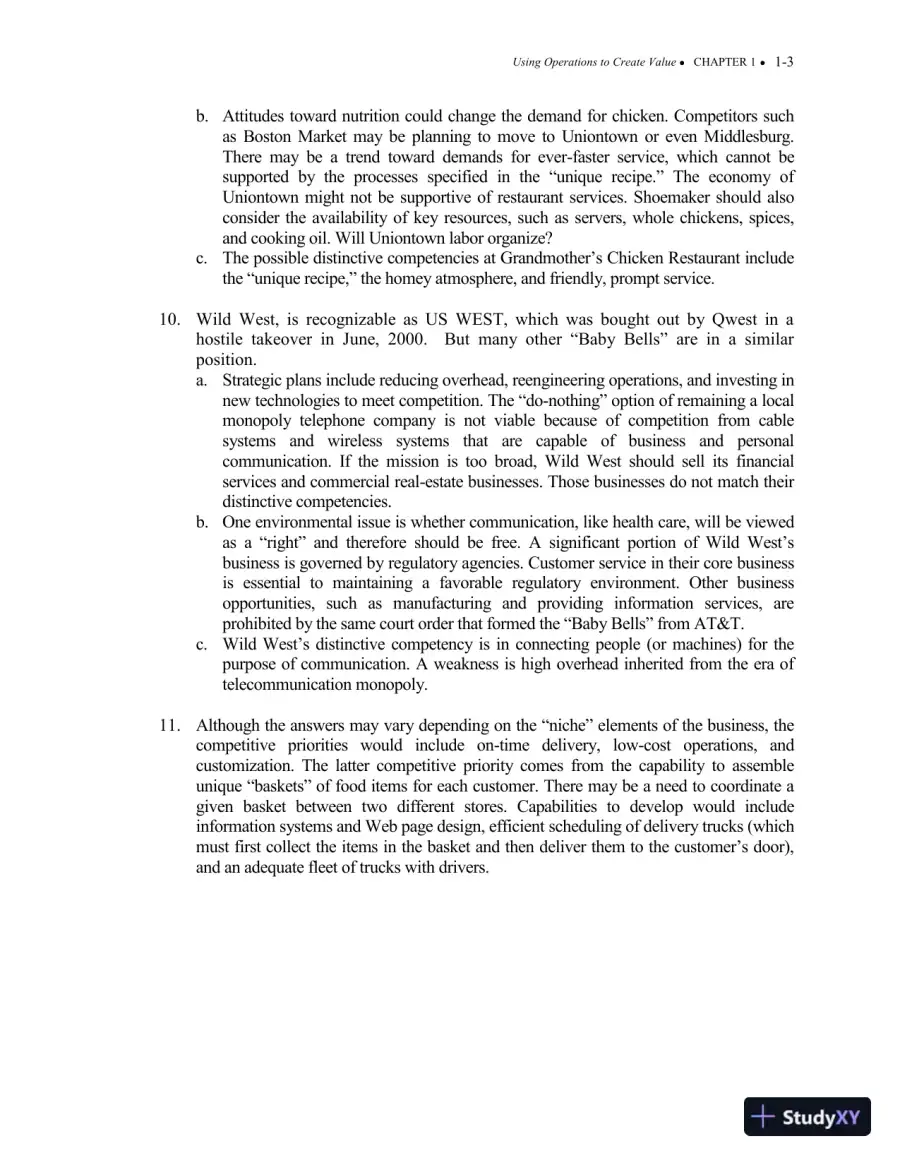 Using Operations to Create ValueCHAPTER 11-3b.Attitudes toward nutrition could change the demand for chicken. Competitors suchas Boston Market may be planning to move to Uniontown or even Middlesburg.There may be a trend toward demands for ever-faster service, which cannot besupported by the processes specified in the “unique recipe.” The economy ofUniontown might not be supportive of restaurant services. Shoemaker should alsoconsider the availability of key resources, such as servers, whole chickens, spices,and cooking oil. Will Uniontown labor organize?c.The possible distinctive competencies at Grandmother’s Chicken Restaurant includethe “unique recipe,” the homey atmosphere, and friendly, prompt service.10.WildWest, is recognizable as US WEST, which was bought out by Qwest in ahostile takeover in June, 2000.But many other “Baby Bells” are in a similarposition.a.Strategic plans include reducing overhead, reengineering operations, andinvesting innew technologies to meet competition. The “do-nothing” option of remaining a localmonopoly telephone company is not viable because of competition from cablesystemsandwirelesssystemsthatarecapableofbusinessandpersonalcommunication. If the mission is too broad, Wild West should sell its financialservices and commercial real-estate businesses. Those businesses do not match theirdistinctive competencies.b.One environmental issue is whether communication, like health care, will be viewedas a “right” and therefore should be free. A significant portion of Wild West’sbusiness is governed by regulatory agencies. Customer service in their core businessis essential to maintaining a favorable regulatory environment. Other businessopportunities,suchasmanufacturing andproviding informationservices,areprohibited by the same court order that formed the “Baby Bells” from AT&T.c.Wild West’s distinctive competency is in connecting people (or machines) for thepurpose of communication. A weakness is high overhead inherited from the era oftelecommunication monopoly.11.Although the answers may vary depending on the “niche” elements of the business, thecompetitiveprioritieswouldincludeon-timedelivery,low-costoperations,andcustomization. The latter competitive priority comes from the capability to assembleunique “baskets” of food items for each customer. There may be a need to coordinate agiven basket between two different stores. Capabilities to develop would includeinformation systems and Web page design, efficient scheduling of delivery trucks (whichmust first collect the items in the basket and then deliver them to the customer’s door),and an adequate fleet of trucks with drivers.
Page 6
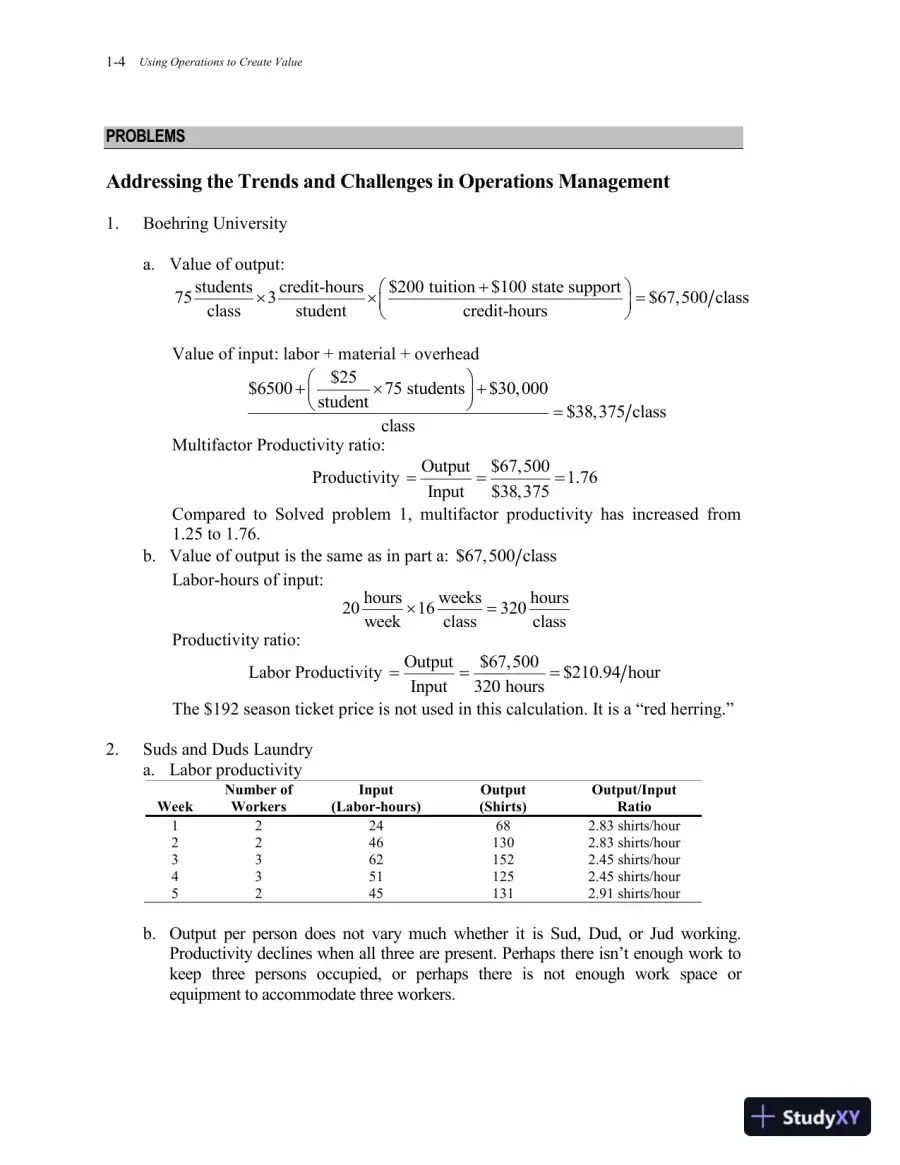 Using Operations to Create Value1-4PROBLEMSAddressing theTrendsand Challengesin Operations Management1.Boehring Universitya.Value of output:studentscredit-hours$200 tuition$100 state support753$67,500 classclassstudentcredit-hoursValue of input: labor + material + overhead$25$650075 students$30,000student$38,375 classclassMultifactor Productivity ratio:ProductivityOutput$67,5001.76Input$38,375Compared to Solved problem 1, multifactor productivity has increased from1.25 to 1.76.b.Value of output is the same as in part a:$67,500 classLabor-hours of input:2016320hoursweekweeksclasshoursclassProductivity ratio:Labor ProductivityOutput$67,500$210.94 hourInput320 hoursThe $192 season ticket price is not used in this calculation. It is a “red herring.”2.Suds and Duds Laundrya.Labor productivityWeekNumber ofWorkersInput(Labor-hours)Output(Shirts)Output/InputRatio1224682.83 shirts/hour22461302.83 shirts/hour33621522.45 shirts/hour43511252.45 shirts/hour52451312.91 shirts/hourb.Output per person does not vary much whether it is Sud, Dud, or Jud working.Productivity declines when all three are present. Perhaps there isn’t enough work tokeep three persons occupied, or perhaps there is not enough workspace orequipment to accommodate three workers.
Page 7
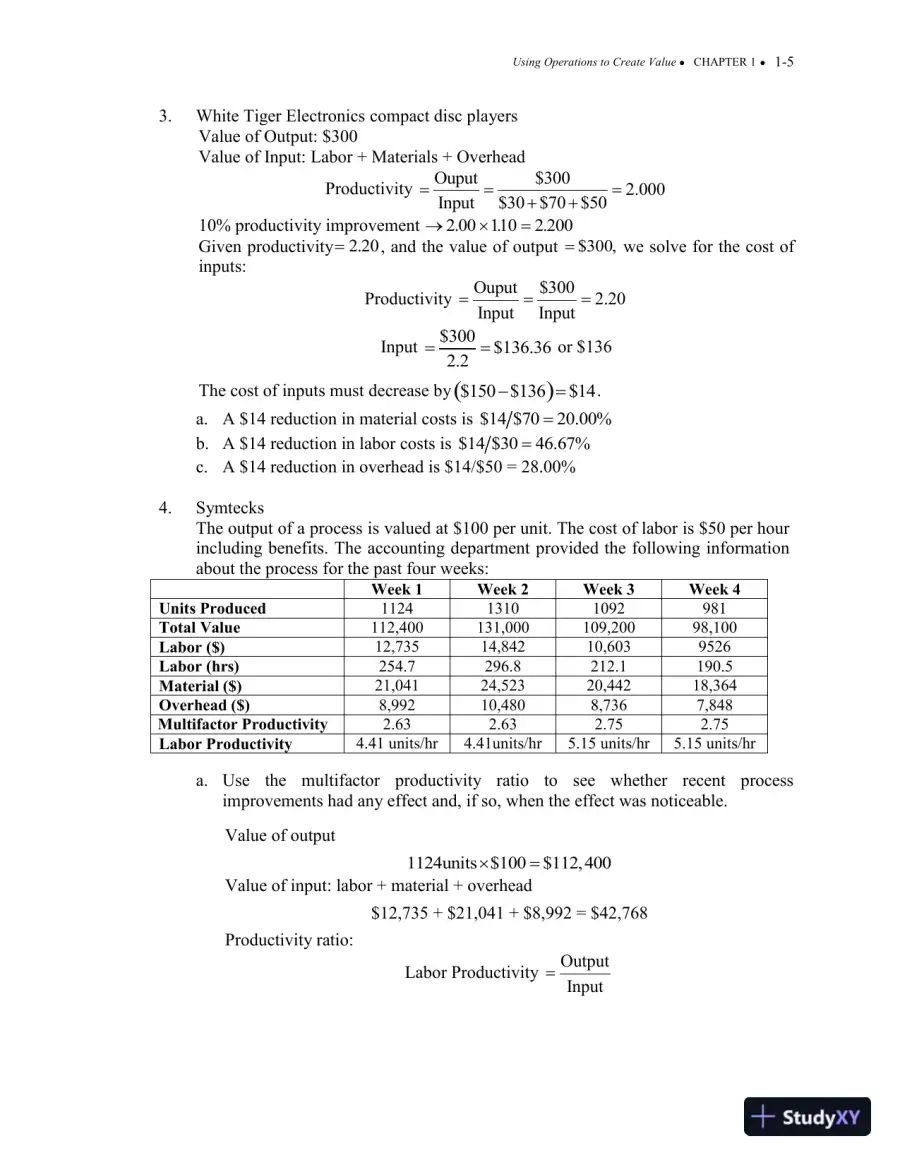 Using Operations to Create ValueCHAPTER 11-53.White Tiger Electronicscompact disc playersValue of Output: $300Value of Input: Labor + Materials + OverheadProductivityOuput$3002.000Input$30$70$5010% productivity improvement2 001102 200...Givenproductivity2 20., and the value of output$300,we solve for the cost ofinputs:ProductivityOuput$3002.20InputInputInput$300$136.362.2or $136Thecost of inputs must decrease by$150$136$14.a.A $14 reduction in material costs is$14 $7020.00%b.A $14 reduction in labor costs is$14 $3046.67%c.A $14 reduction in overhead is $14/$50 = 28.00%4.SymtecksThe output of a process is valued at $100 per unit. The cost of labor is $50 per hourincluding benefits. The accounting department provided the following informationabout the process for the past four weeks:Week 1Week 2Week 3Week 4Units Produced112413101092981Total Value112,400131,000109,20098,100Labor ($)12,73514,84210,6039526Labor (hrs)254.7296.8212.1190.5Material ($)21,04124,52320,44218,364Overhead ($)8,99210,4808,7367,848Multifactor Productivity2.632.632.752.75Labor Productivity4.41 units/hr4.41units/hr5.15 units/hr5.15 units/hra.Usethemultifactorproductivityratiotoseewhetherrecentprocessimprovements had any effect and, if so, when the effect was noticeable.Value of output1124units$100$112, 400Value of input: labor + material + overhead$12,735 + $21,041 + $8,992 = $42,768Productivity ratio:Labor ProductivityOutputInput
Page 8
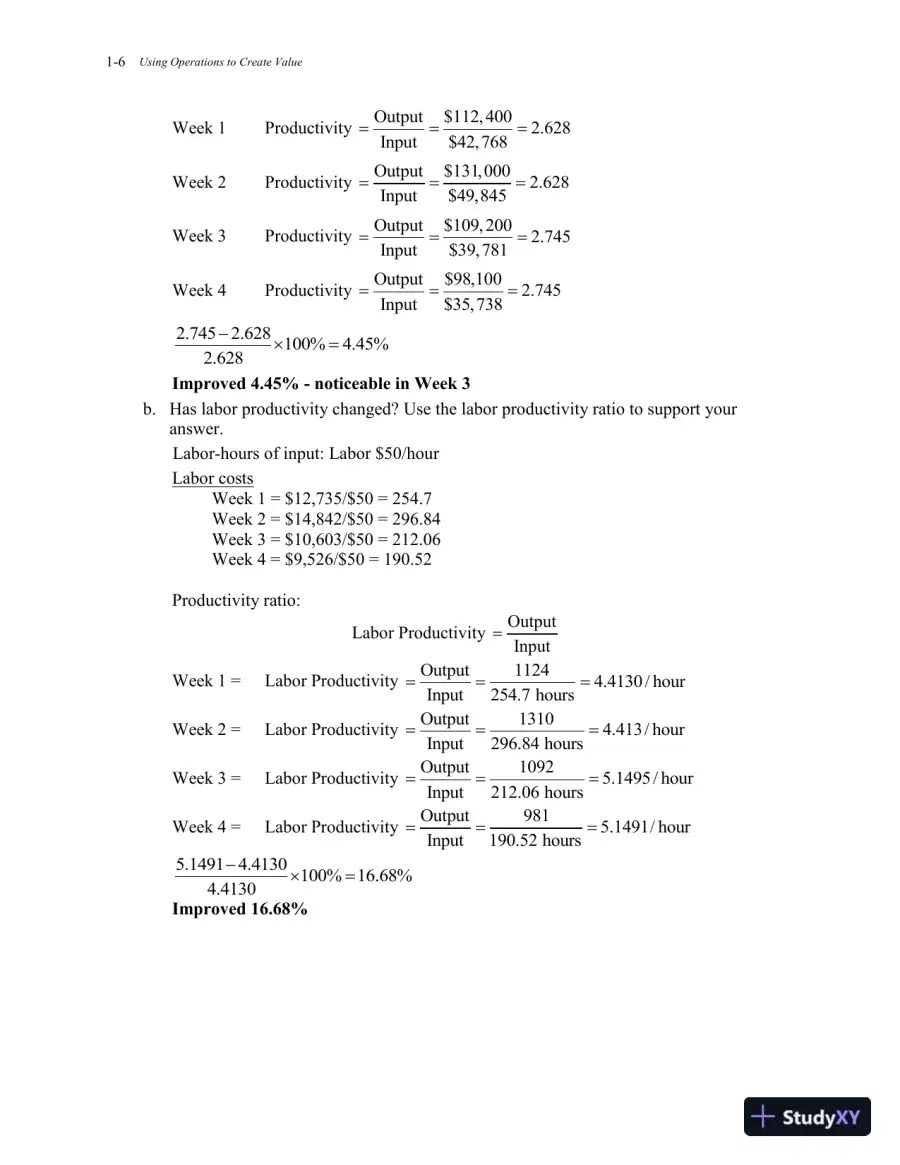 Using Operations to Create Value1-6Week 1ProductivityOutput$112, 4002.628Input$42,768Week 2ProductivityOutput$131, 0002.628Input$49,845Week 3ProductivityOutput$109, 2002.745Input$39,781Week 4ProductivityOutput$98,1002.745Input$35,7382.7452.628100%4.45%2.628Improved 4.45%-noticeable in Week 3b.Has labor productivity changed? Use the labor productivity ratio to support youranswer.Labor-hours of input: Labor $50/hourLabor costsWeek 1 = $12,735/$50 = 254.7Week 2 = $14,842/$50 = 296.84Week 3 = $10,603/$50 = 212.06Week 4 = $9,526/$50 = 190.52Productivity ratio:Labor ProductivityOutputInputWeek 1 =Labor ProductivityOutput11244.4130 / hourInput254.7 hoursWeek 2 =Labor ProductivityOutput13104.413/ hourInput296.84 hoursWeek 3 =Labor ProductivityOutput10925.1495 / hourInput212.06 hoursWeek 4 =Labor ProductivityOutput9815.1491/ hourInput190.52 hours5.14914.4130100%16.68%4.4130Improved 16.68%
Page 9
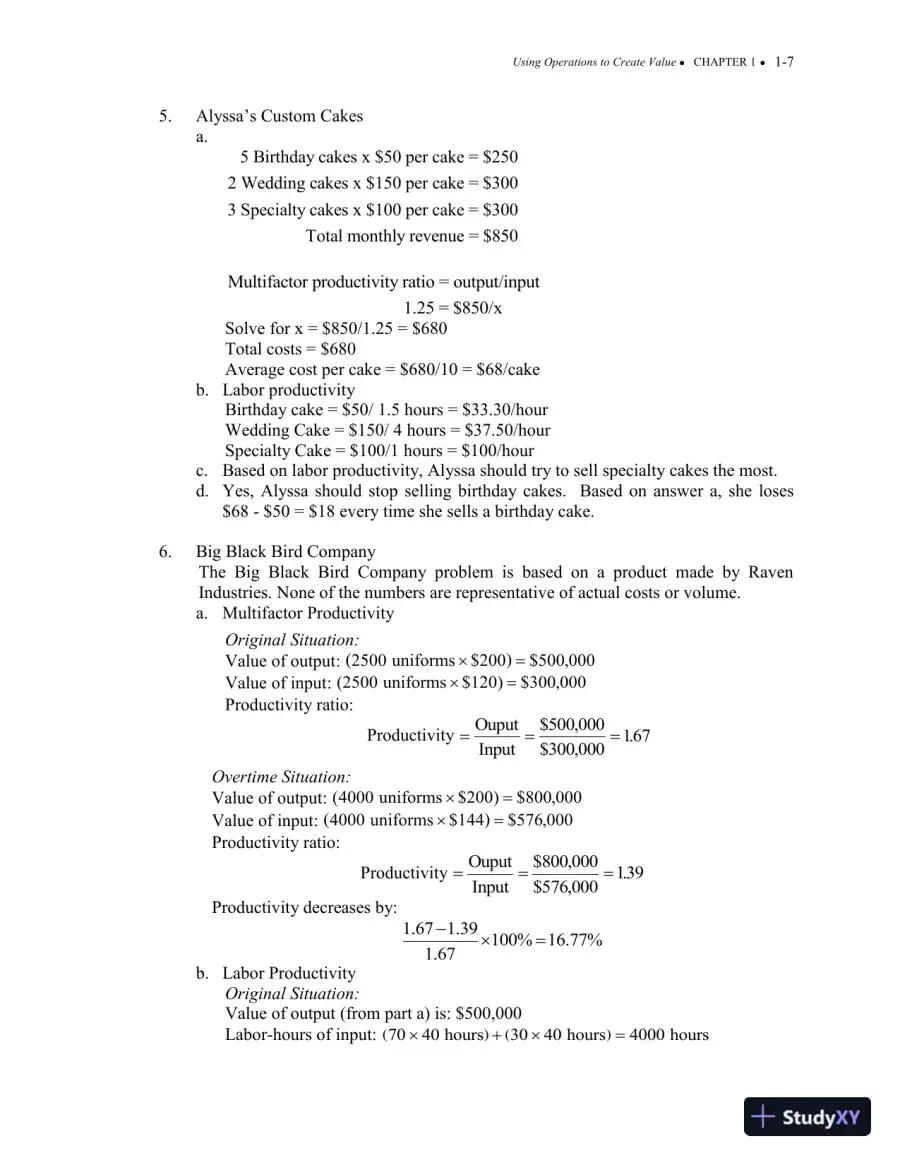 Using Operations to Create ValueCHAPTER 11-75.Alyssa’s Custom Cakesa.5 Birthday cakes x $50 per cake = $2502 Wedding cakes x $150 per cake = $3003 Specialty cakes x $100 per cake = $300Total monthly revenue = $850Multifactor productivity ratio = output/input1.25 = $850/xSolve for x = $850/1.25 = $680Total costs = $680Average cost per cake = $680/10 = $68/cakeb.Labor productivityBirthday cake = $50/ 1.5 hours = $33.30/hourWedding Cake = $150/ 4 hours = $37.50/hourSpecialty Cake = $100/1 hours = $100/hourc.Based on labor productivity, Alyssa should try to sell specialty cakes the most.d.Yes, Alyssa should stop selling birthday cakes.Based on answer a, she loses$68-$50 = $18 everytime she sells a birthday cake.6.Big Black Bird CompanyThe Big Black Bird Company problem is based on a product made by RavenIndustries. None of the numbers are representative of actual costs or volume.a.Multifactor ProductivityOriginal Situation:Value of output:2500000uniforms$200 $500,Value of input:2500000uniforms$120 $300,Productivity ratio:ProductivityOuputInput$500,$300,.000000167Overtime Situation:Value of output:4000000uniforms$200 $800,Value of input:4000000uniforms$144 $576,Productivity ratio:ProductivityOuputInput$800,$576,.000000139Productivity decreases by:1.671.39100%16.77%1.67b.Labor ProductivityOriginal Situation:Value of output (from part a) is: $500,000Labor-hours of input:704030404000hourshourshours
Page 10
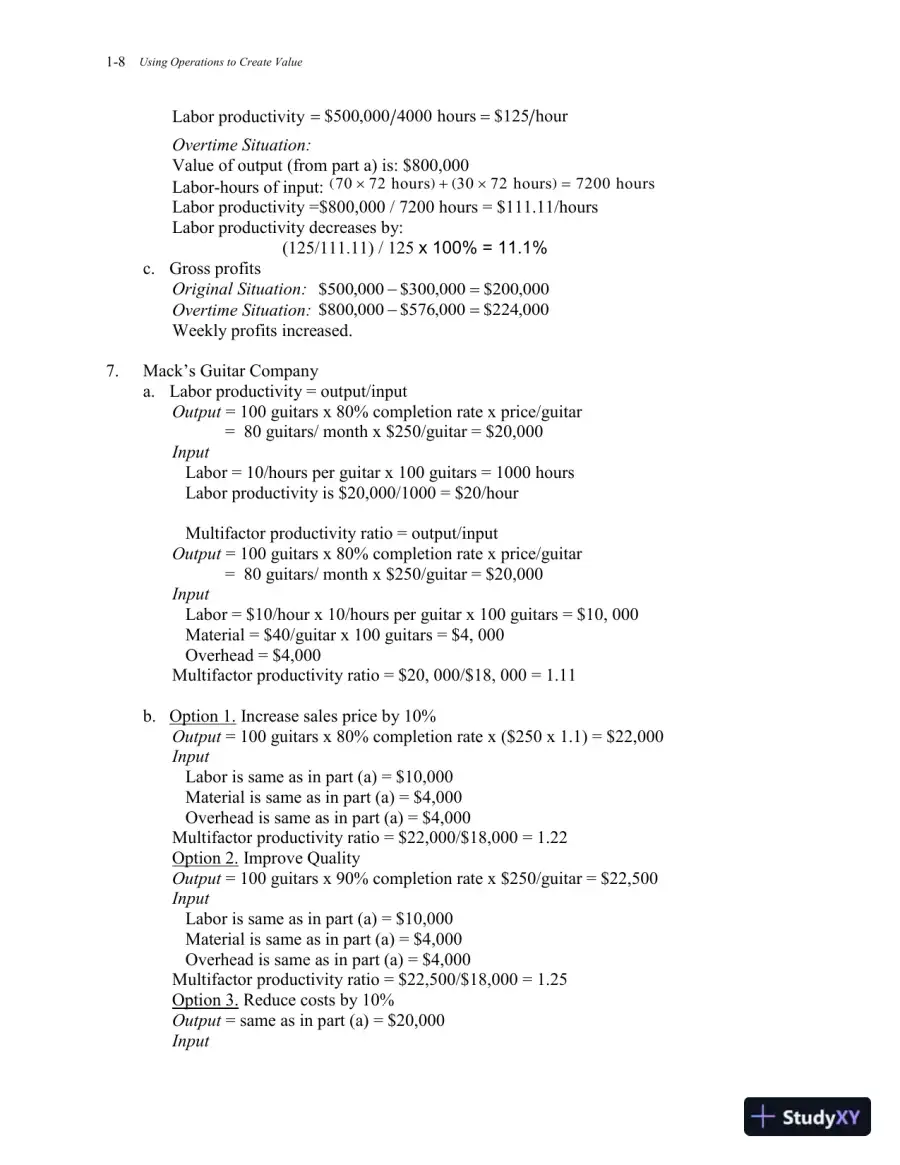 Using Operations to Create Value1-8Labor productivity$500,$125000 4000 hourshourOvertime Situation:Value of output (from part a) is: $800,000Labor-hours of input:707230727200hourshourshoursLabor productivity=$800,000 / 7200 hours = $111.11/hoursLabor productivity decreases by:(125/111.11)/125x 100% = 11.1%c.Gross profitsOriginal Situation:$500,$300,$200,000000000Overtime Situation:$800,$576,$224,000000000Weekly profits increased.7.Mack’s Guitar Companya.Labor productivity = output/inputOutput= 100 guitars x 80% completion rate x price/guitar=80 guitars/ month x $250/guitar = $20,000InputLabor = 10/hours per guitar x 100 guitars = 1000 hoursLabor productivity is $20,000/1000 = $20/hourMultifactor productivity ratio = output/inputOutput= 100 guitars x 80% completion rate x price/guitar=80 guitars/ month x $250/guitar = $20,000InputLabor = $10/hour x 10/hours per guitar x 100 guitars = $10, 000Material = $40/guitar x 100 guitars = $4, 000Overhead = $4,000Multifactor productivity ratio = $20, 000/$18, 000 = 1.11b.Option 1.Increase sales price by 10%Output= 100 guitars x 80% completion rate x ($250 x 1.1) = $22,000InputLabor is same as in part (a) = $10,000Material is same as in part (a)= $4,000Overhead is same as in part (a) = $4,000Multifactor productivity ratio = $22,000/$18,000 = 1.22Option 2.Improve QualityOutput= 100 guitars x 90% completion rate x $250/guitar = $22,500InputLabor is same as in part (a) = $10,000Material is same as in part (a)= $4,000Overhead is same as in part (a) = $4,000Multifactor productivity ratio = $22,500/$18,000 = 1.25Option 3.Reduce costs by 10%Output= same as in part (a) = $20,000Input
Page 11
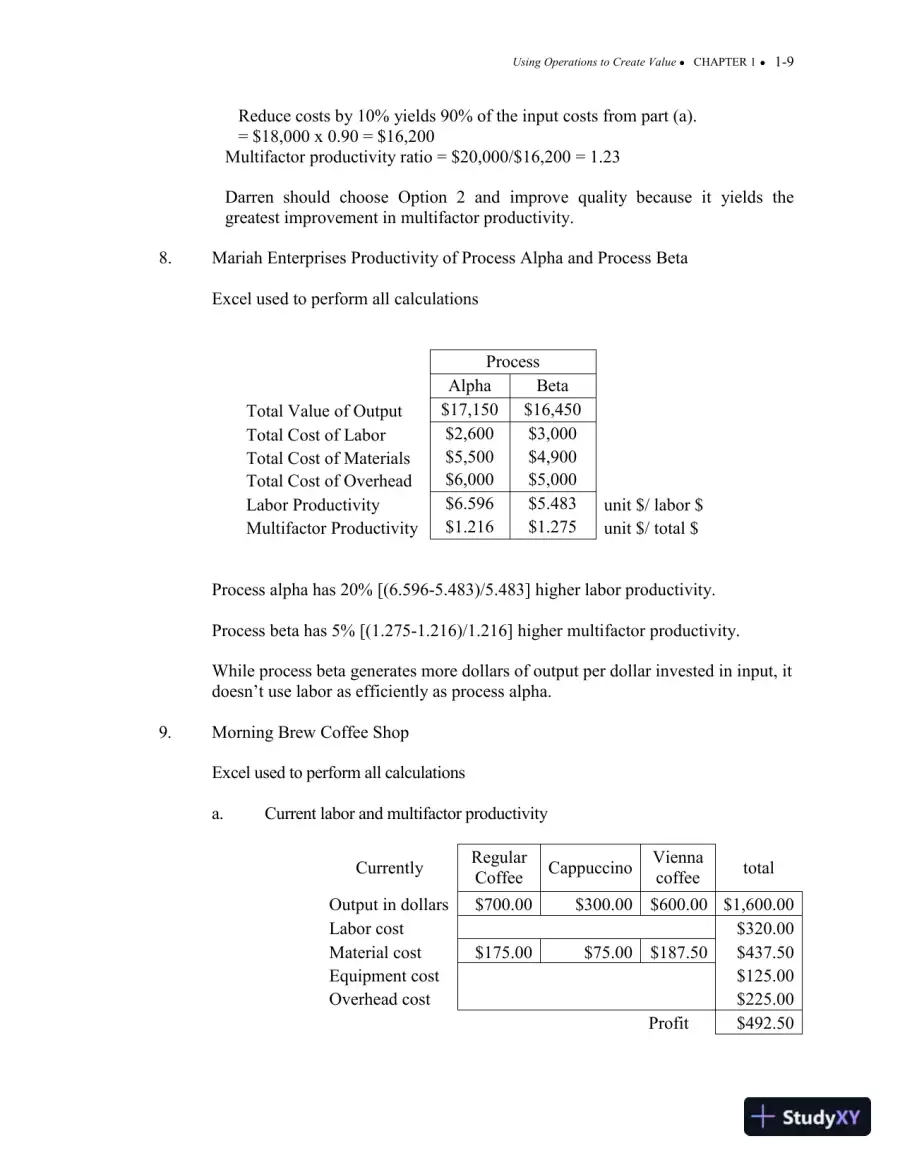 Using Operations to Create ValueCHAPTER 11-9Reduce costs by 10% yields 90% of the input costs from part (a).= $18,000 x 0.90 = $16,200Multifactor productivity ratio = $20,000/$16,200 = 1.23Darren should choose Option 2 andimprove quality because it yields thegreatest improvement in multifactor productivity.8.Mariah EnterprisesProductivity ofProcessAlpha andProcessBetaExcel used to perform all calculationsProcessAlphaBetaTotal Value of Output$17,150$16,450Total Cost of Labor$2,600$3,000Total Cost of Materials$5,500$4,900Total Cost of Overhead$6,000$5,000Labor Productivity$6.596$5.483unit $/ labor $Multifactor Productivity$1.216$1.275unit $/ total $Process alpha has 20%[(6.596-5.483)/5.483] higher labor productivity.Process beta has 5% [(1.275-1.216)/1.216] higher multifactor productivity.While process beta generates more dollars of output per dollar invested in input, itdoesn’t use labor as efficiently as processalpha.9.Morning Brew Coffee ShopExcel used to perform all calculationsa.Currentlabor and multifactor productivityCurrentlyRegularCoffeeCappuccinoViennacoffeetotalOutput in dollars$700.00$300.00$600.00$1,600.00Labor cost$320.00Material cost$175.00$75.00$187.50$437.50Equipment cost$125.00Overhead cost$225.00Profit$492.50
Page 12
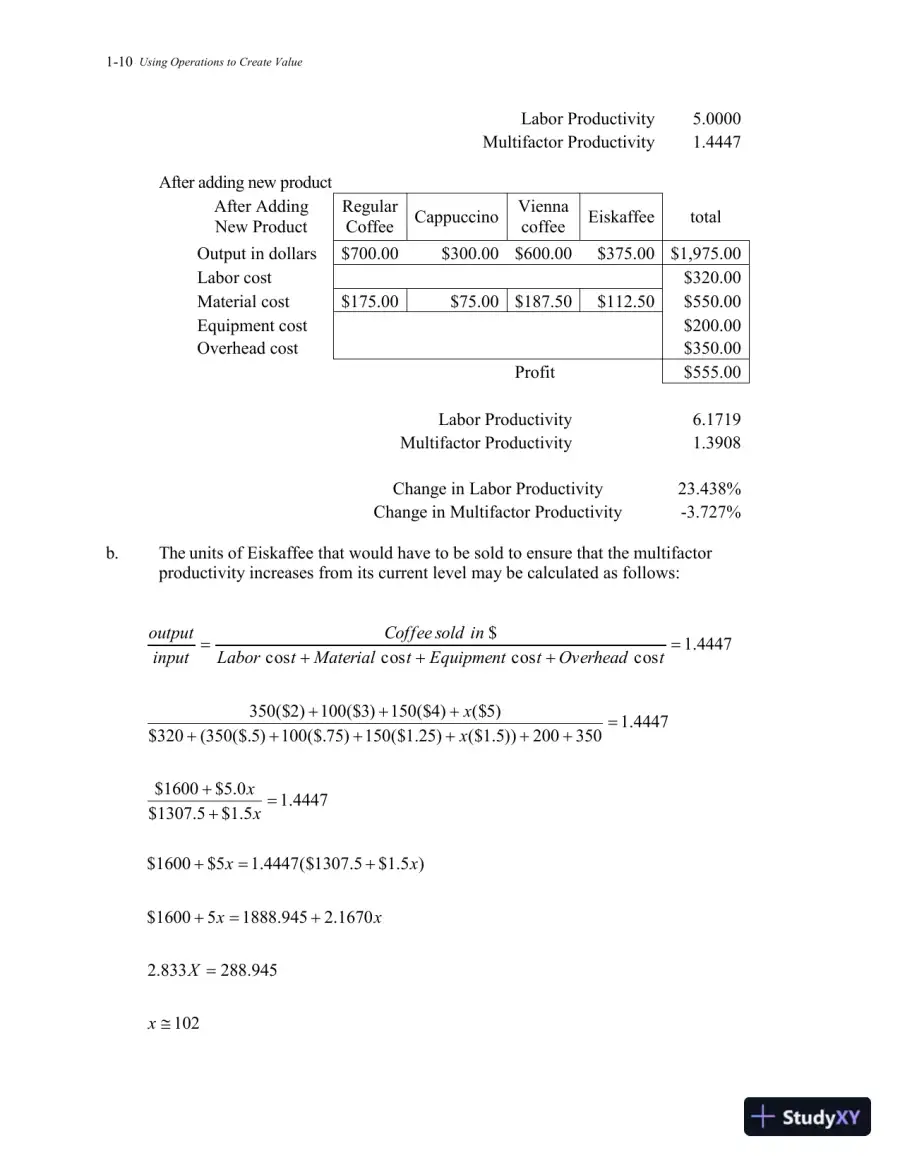 Using Operations to Create Value1-10Labor Productivity5.0000Multifactor Productivity1.4447After adding new productAfter AddingNew ProductRegularCoffeeCappuccinoViennacoffeeEiskaffeetotalOutput in dollars$700.00$300.00$600.00$375.00$1,975.00Labor cost$320.00Material cost$175.00$75.00$187.50$112.50$550.00Equipment cost$200.00Overhead cost$350.00Profit$555.00Labor Productivity6.1719Multifactor Productivity1.3908Change in Labor Productivity23.438%Change in Multifactor Productivity-3.727%b.Theunits of Eiskaffeethatwould have to be sold to ensure thatthemultifactorproductivity increases from its current levelmay be calculated as follows:102945.288833.21670.2945.188851600$)5.1$5.1307($4447.15$1600$4447.15.1$5.1307$0.5$1600$4447.1350200))5.1($)25.1($150)75($.100)5($.350(320$)5($)4($150)3($100)2($3504447.1coscoscoscos$xXxxxxxxxxtOverheadtEquipmenttMaterialtLaborinsoldCoffeeinputoutput
Page 13
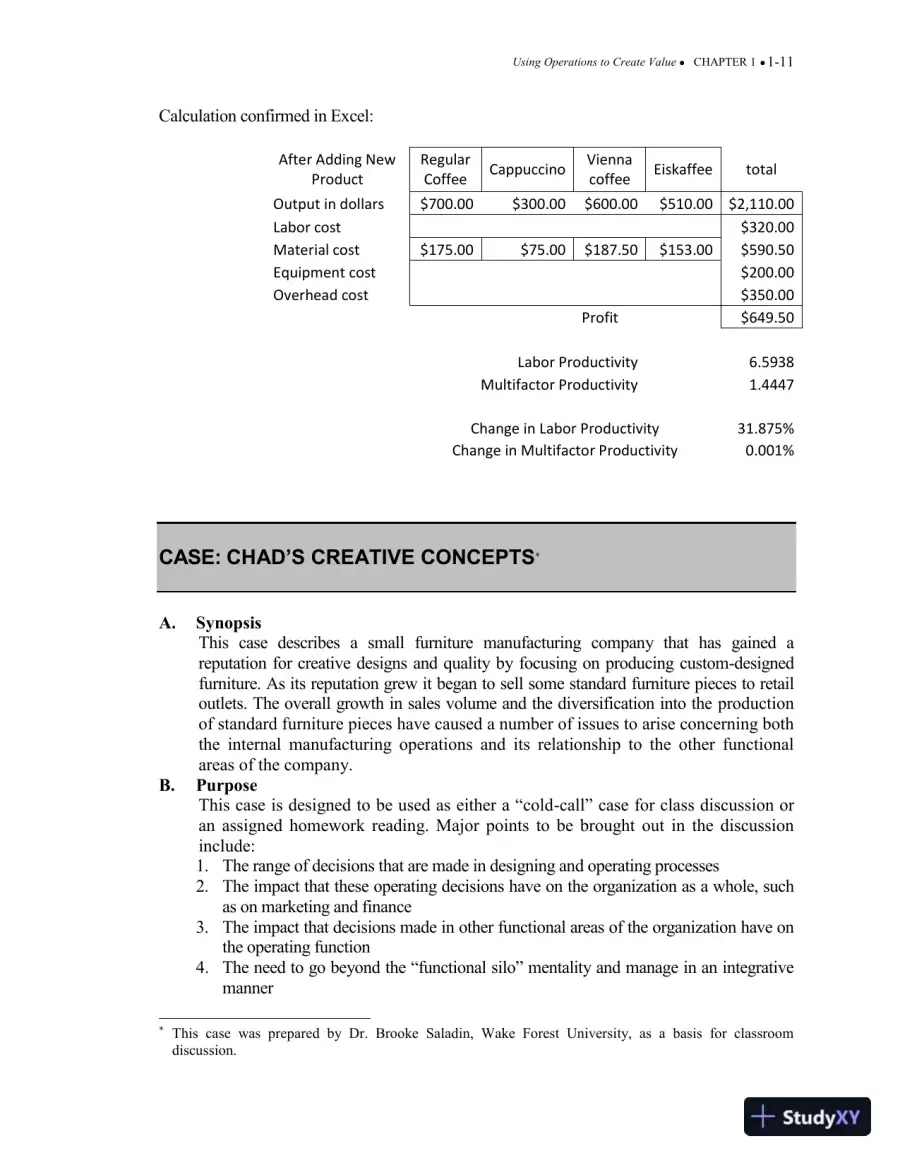 Using Operations to Create ValueCHAPTER 11-11Calculation confirmed in Excel:After Adding NewProductRegularCoffeeCappuccinoViennacoffeeEiskaffeetotalOutput in dollars$700.00$300.00$600.00$510.00$2,110.00Labor cost$320.00Material cost$175.00$75.00$187.50$153.00$590.50Equipment cost$200.00Overhead cost$350.00Profit$649.50Labor Productivity6.5938Multifactor Productivity1.4447Change in Labor Productivity31.875%Change in Multifactor Productivity0.001%CASE:CHAD’S CREATIVE CONCEPTS*A.SynopsisThis case describes a small furniture manufacturing company that has gained areputation for creative designs and quality by focusing on producing custom-designedfurniture. As its reputation grew it began to sell some standard furniture pieces to retailoutlets. The overall growth in sales volume and the diversification into theproductionof standard furniturepieces have caused a number of issues to arise concerning boththe internal manufacturing operations and its relationship to the other functionalareas of the company.B.PurposeThis case is designed to be used as either a “cold-call” case for class discussion oran assigned homework reading. Major points to be brought out in the discussioninclude:1.The range of decisions that are made in designing and operating processes2.The impact that these operating decisions have on the organization as a whole, suchason marketing and finance3.The impact that decisions made in other functional areas of the organization have onthe operating function4.The need to go beyond the “functional silo” mentality and manage in an integrativemanner*This case was prepared by Dr. Brooke Saladin, Wake Forest University, as a basis for classroomdiscussion.
Page 14
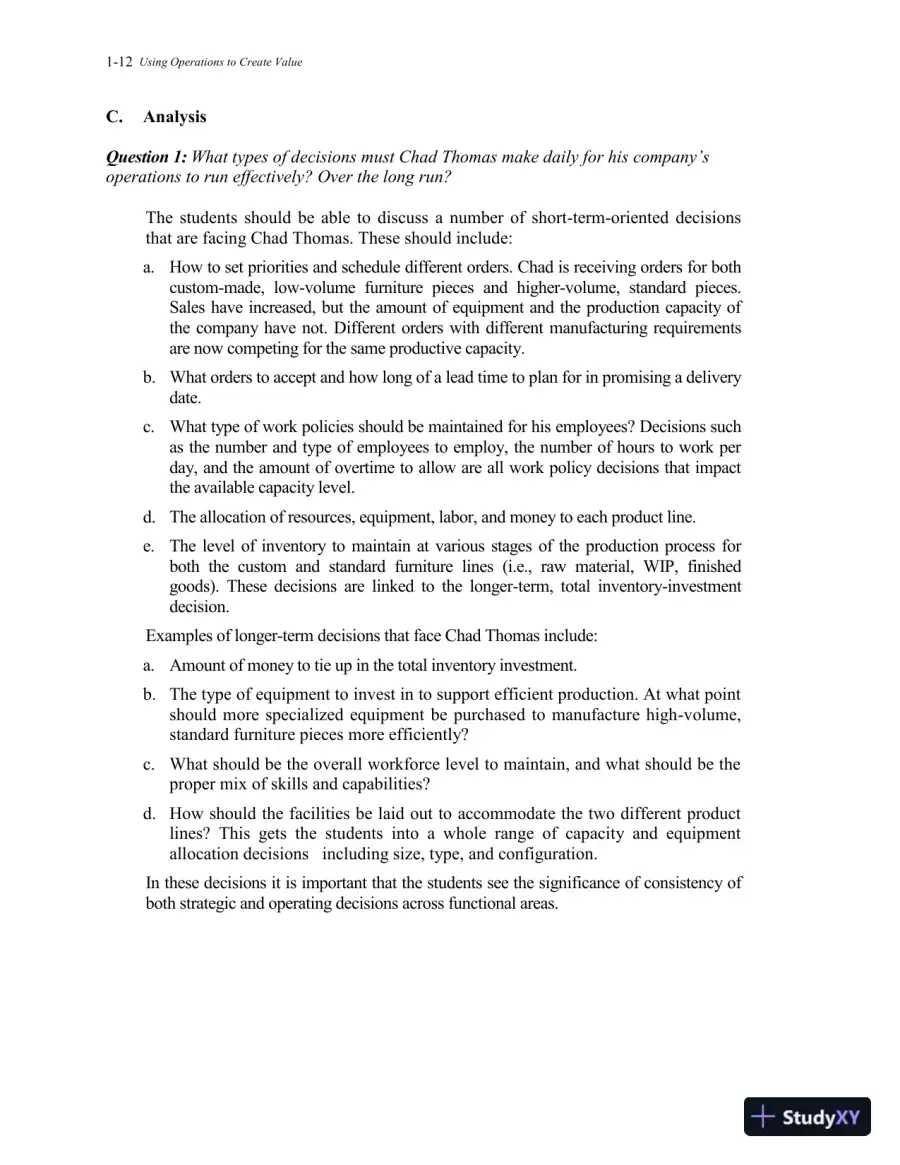 Using Operations to Create Value1-12C.AnalysisQuestion 1:What typesof decisions must Chad Thomas make daily for his company’soperations to run effectively? Over the long run?The students should be able to discuss a number of short-term-oriented decisionsthat are facing Chad Thomas. These should include:a.How to set priorities and schedule different orders. Chad is receiving orders for bothcustom-made, low-volume furniture pieces and higher-volume, standard pieces.Sales have increased, but the amount of equipment and the production capacity ofthe company have not. Different orders with different manufacturing requirementsare now competing for the same productive capacity.b.What orders to accept and how long of a lead time to plan for in promising a deliverydate.c.What type of work policies should be maintained for hisemployees? Decisions suchas the number and type of employees to employ, the number of hours to work perday, and the amount of overtime to allow are all work policy decisions that impactthe available capacity level.d.The allocation of resources, equipment, labor, and money to each product line.e.The level of inventory to maintain at various stages of the production process forboth the custom and standard furniture lines (i.e., raw material, WIP, finishedgoods). These decisions are linked to the longer-term, total inventory-investmentdecision.Examples of longer-term decisions that face Chad Thomas include:a.Amount of money to tie up in the total inventory investment.b.The type of equipment to invest in to support efficient production. At what pointshould more specialized equipment be purchased to manufacture high-volume,standard furniture pieces more efficiently?c.What should be the overall workforce level to maintain, and what should be theproper mix of skills and capabilities?d.How should the facilities be laid out to accommodate the two different productlines? This gets the students into a whole range of capacity and equipmentallocation decisionsincluding size, type, and configuration.In these decisions it is important that the students see the significance of consistency ofboth strategic and operating decisions across functional areas.
Page 15
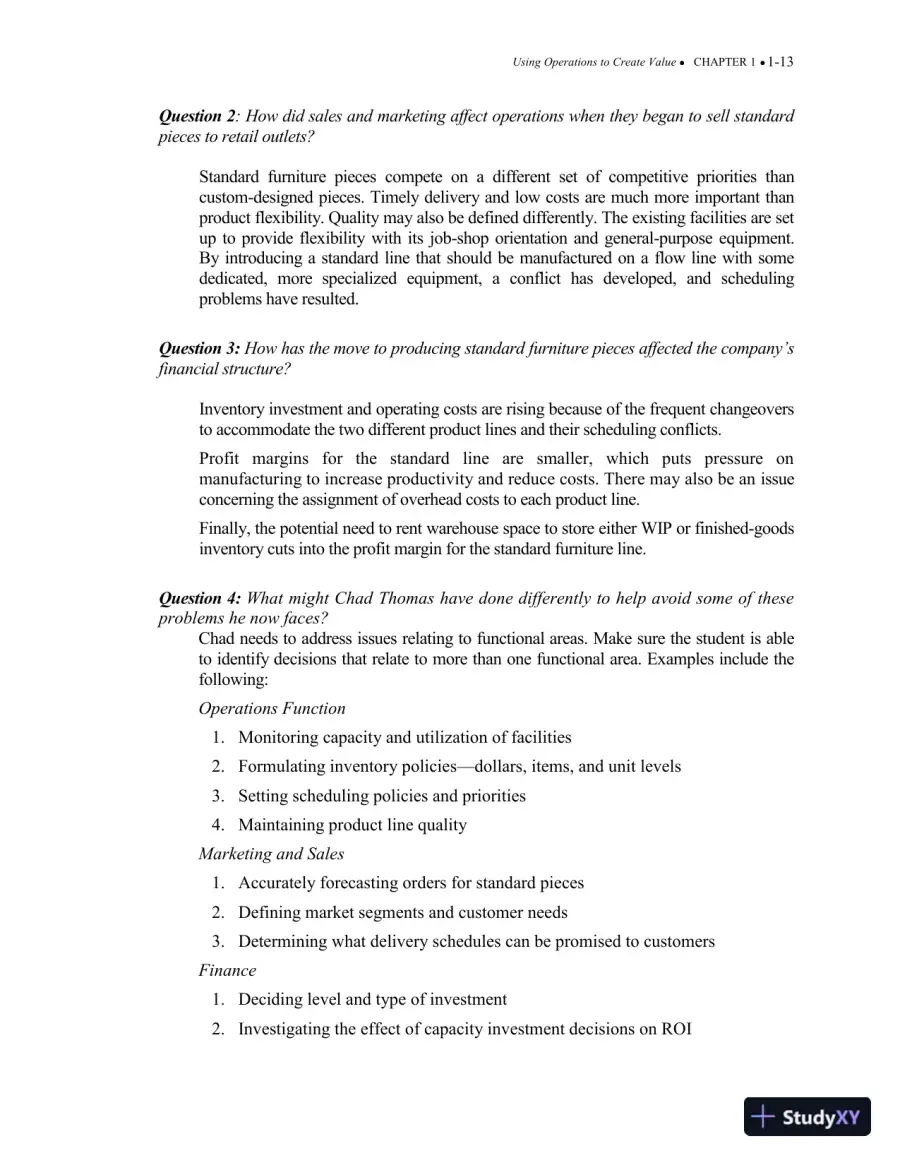 Using Operations to Create ValueCHAPTER 11-13Question 2:How did sales and marketing affect operations when they began to sell standardpieces to retail outlets?Standard furniture pieces compete on a different set of competitive priorities thancustom-designed pieces. Timely delivery and low costs are much more important thanproduct flexibility. Quality may also be defined differently. The existing facilities are setup to provide flexibility with its job-shop orientation and general-purpose equipment.By introducing a standard line that should be manufactured on a flow line with somededicated, more specialized equipment, a conflict has developed, and schedulingproblems have resulted.Question 3:How hasthe move to producing standard furniture pieces affected thecompany’sfinancial structure?Inventory investment and operating costs are rising because of the frequent changeoversto accommodate the two different product lines and their scheduling conflicts.Profitmarginsforthestandardlinearesmaller,whichputspressureonmanufacturing to increase productivity and reduce costs. There may also be anissueconcerning the assignment of overhead costs to each product line.Finally, the potential need to rent warehouse space to store either WIP or finished-goodsinventory cuts into the profit margin for the standard furniture line.Question 4:What might Chad Thomas have done differently to help avoid some of theseproblemshe now faces?Chad needs to address issues relating to functional areas. Make sure the student is ableto identify decisions that relate to more than one functional area. Examples include thefollowing:Operations Function1.Monitoring capacity and utilization of facilities2.Formulating inventory policies—dollars, items, and unit levels3.Setting scheduling policies and priorities4.Maintaining product line qualityMarketing and Sales1.Accurately forecasting orders for standard pieces2.Defining market segments and customer needs3.Determining what delivery schedules can be promised to customersFinance1.Deciding level and type of investment2.Investigating the effect of capacity investment decisions on ROI
Page 16
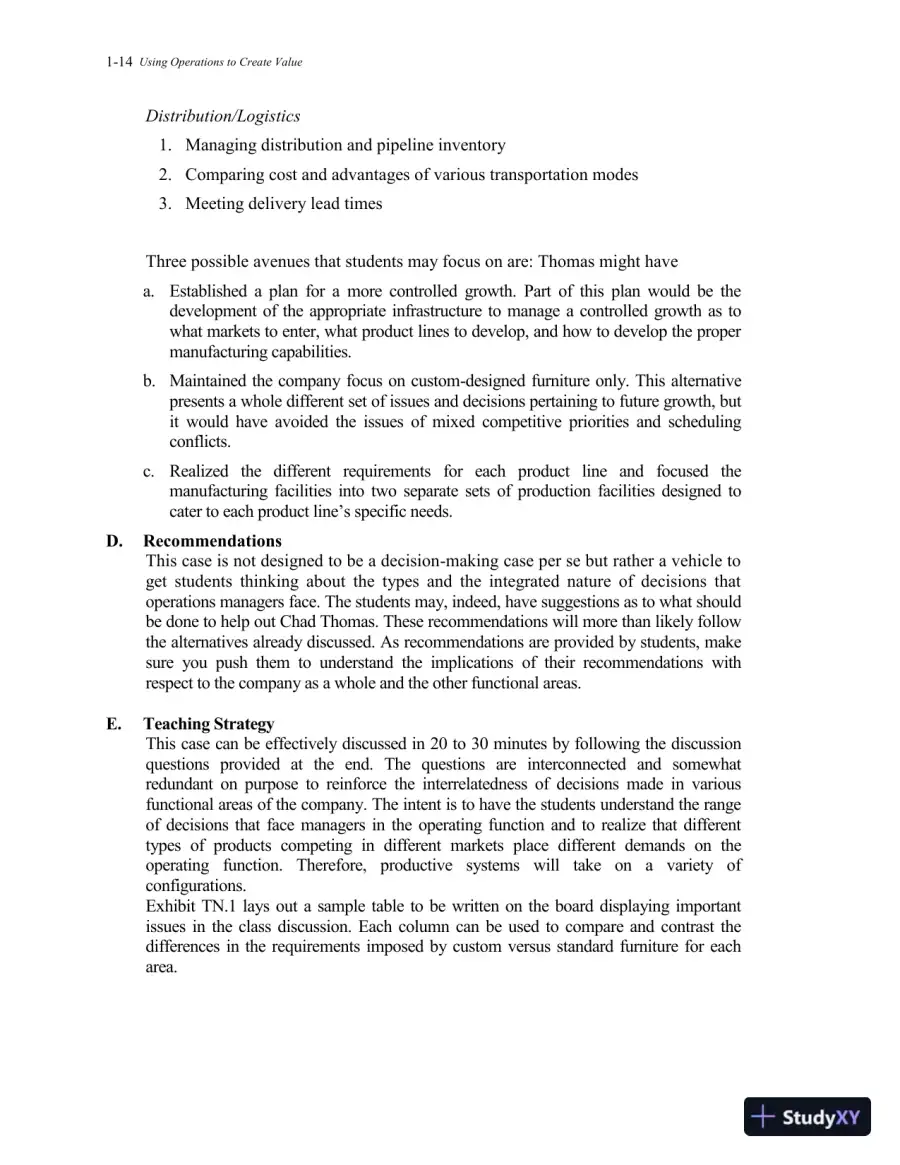 Using Operations to Create Value1-14Distribution/Logistics1.Managing distribution and pipeline inventory2.Comparing cost and advantages of various transportation modes3.Meeting delivery lead timesThree possible avenues that students may focus on are: Thomas might havea.Established a plan for a more controlled growth. Part of this plan would be thedevelopment of the appropriate infrastructure to manage a controlled growth as towhat markets to enter, what product lines to develop, and how to develop the propermanufacturing capabilities.b.Maintained the company focus on custom-designed furniture only. This alternativepresents a whole different set of issues and decisions pertaining to future growth, butit would have avoided the issues of mixed competitive priorities and schedulingconflicts.c.Realizedthedifferentrequirementsforeachproductlineandfocusedthemanufacturing facilities into two separate sets of production facilities designed tocater to each product line’s specific needs.D.RecommendationsThis case is not designed to be a decision-making case per se but rather a vehicle toget students thinking about the types and the integrated nature of decisions thatoperations managers face. The students may, indeed, have suggestions as to what shouldbe done to help out Chad Thomas. These recommendations will more than likely followthe alternatives already discussed. As recommendations are provided by students, makesure you push them to understand the implications of their recommendations withrespect to the company as a whole and the other functional areas.E.Teaching StrategyThis case can be effectively discussed in 20 to 30 minutes by following the discussionquestions provided atthe end. The questions are interconnected andsomewhatredundant on purpose to reinforce the interrelatedness of decisions made in variousfunctional areas of the company. The intent is to have the students understand the rangeof decisions that face managers in the operating function and to realize that differenttypes of products competing in different markets place different demands on theoperatingfunction.Therefore,productivesystemswilltakeonavarietyofconfigurations.Exhibit TN.1 lays out a sample table to be written on the board displaying importantissues in the class discussion. Each column can be used to compare and contrast thedifferences in the requirements imposed by custom versus standard furniture for eacharea.
632 more pages in the full document
Unlock it once and it stays in your library, ready to chat with or turn into flashcards.
Unlock the full documentMore Operations Management study materials
See all Textbook Guides
Solution Manual for Operations and Supply Chain Management, 14th Edition
Operations Management
342 pages133downloadsFeb 2025 Textbook Guides
Managing Quality: Integrating the Supply Chain, 6th Edition Solution Manual
Operations Management
262 pages115downloadsFeb 2025 Textbook Guides
Operations Management, (Mcgraw-hill Education Operations and Decision Sciences) 1st Edition Solution Manual
Operations Management
153 pages91downloadsFeb 2025 Textbook Guides
Solution Manual For Matching Supply with Demand: An Introduction to Operations Management, 4th Edition
Operations Management
76 pages36downloadsFeb 2025 Solved Assignments
Optimizing Scheduling for Academic Meetings: Minimizing Makespan and Managing Breaks
Operations Management
8 pagesMay 2025 Solved Assignments
Analyzing the Production Constraints for Ozark Furniture Company
Operations Management
2 pagesMay 2025 Class Notes
PROCESS DESIGNS AND SUPPLY CHAINS PART 2 - OPS/571
Operations Management
7 pagesMay 2025 Class Notes
Matching Supply with Demand: An Introduction to Operations Management 3rd Edition Class Notes
Operations Management
13 pagesMay 2025
Study this document with CramX
Once it is in your library, every tool can work from it.