
Solved Assignments
Optimizing Scheduling for Academic Meetings: Minimizing Makespan and Managing Breaks
- Operations Management
- 8 pages
- Shared May 2025
An analysis of optimizing scheduling for academic meetings, focusing on minimizing makespan and efficiently managing breaks to enhance productivity.
Preview · 3 of 8 pages
100%
Page 1
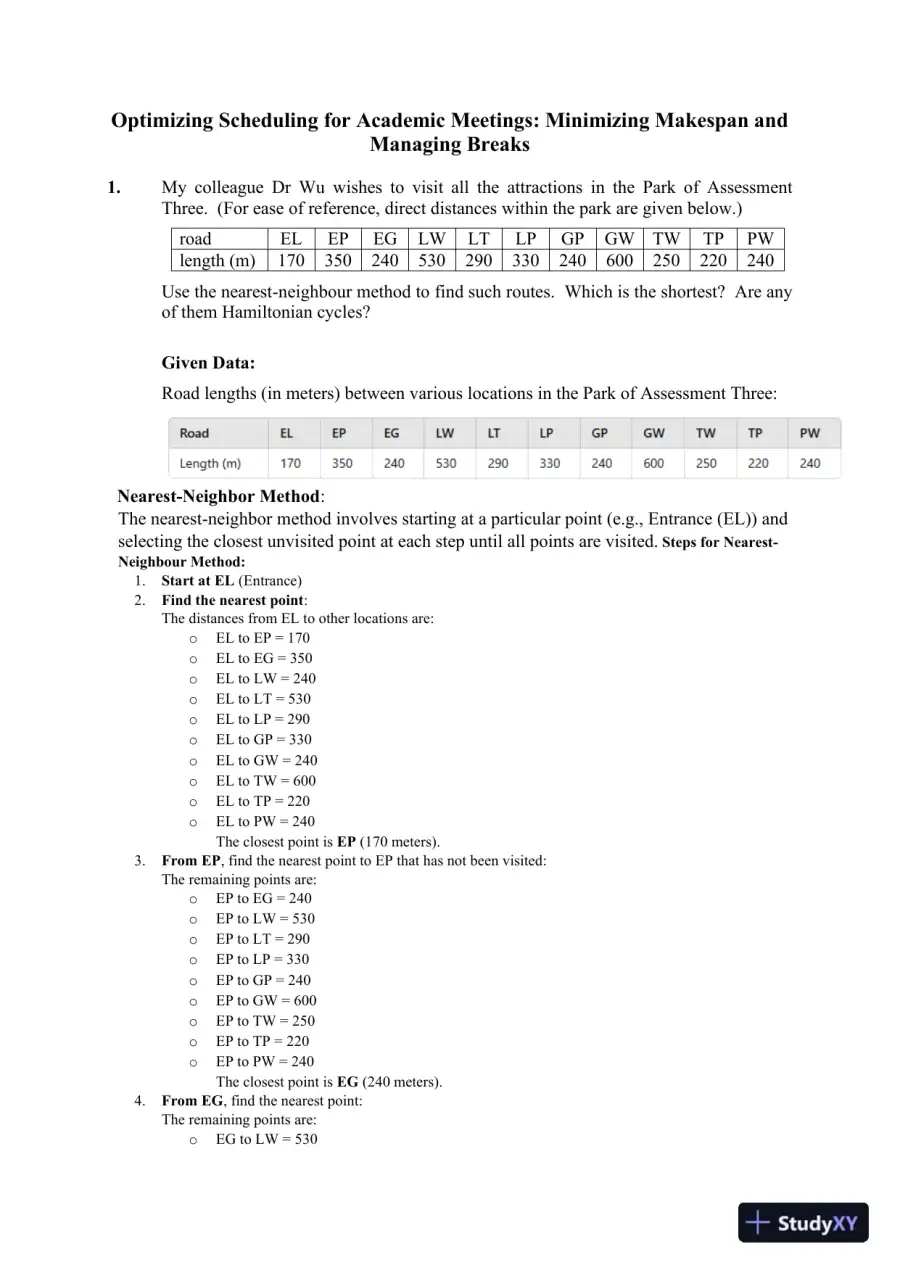 Optimizing Scheduling for Academic Meetings: Minimizing Makespan andManaging Breaks1.My colleagueDrWuwishes to visit all the attractionsin the Park of AssessmentThree.(For ease of reference,directdistances withinthepark are given below.)roadELEPEGLWLTLPGPGWTWTPPWlength(m)170350240530290330240600250220240Use the nearest-neighbour method to find such routes.Which is the shortest? Are anyof themHamiltonian cycles?Given Data:Road lengths (in meters) between various locations in the Park of Assessment Three:Nearest-Neighbor Method:The nearest-neighbor method involves starting at a particular point (e.g., Entrance (EL)) andselecting the closest unvisited point at each step until all points are visited.Steps for Nearest-Neighbour Method:1.Start at EL(Entrance)2.Find the nearest point:The distances from EL to other locations are:oEL to EP = 170oEL to EG = 350oEL to LW = 240oEL to LT = 530oEL to LP = 290oEL to GP = 330oEL to GW = 240oEL to TW = 600oEL to TP = 220oEL to PW = 240The closest point isEP(170 meters).3.From EP, find the nearest point to EP that has not been visited:The remaining points are:oEP to EG = 240oEP to LW = 530oEP to LT = 290oEP to LP = 330oEP to GP = 240oEP to GW = 600oEP to TW = 250oEP to TP = 220oEP to PW = 240The closest point isEG(240 meters).4.From EG, find the nearest point:The remaining points are:oEG to LW = 530
Page 2

Page 3
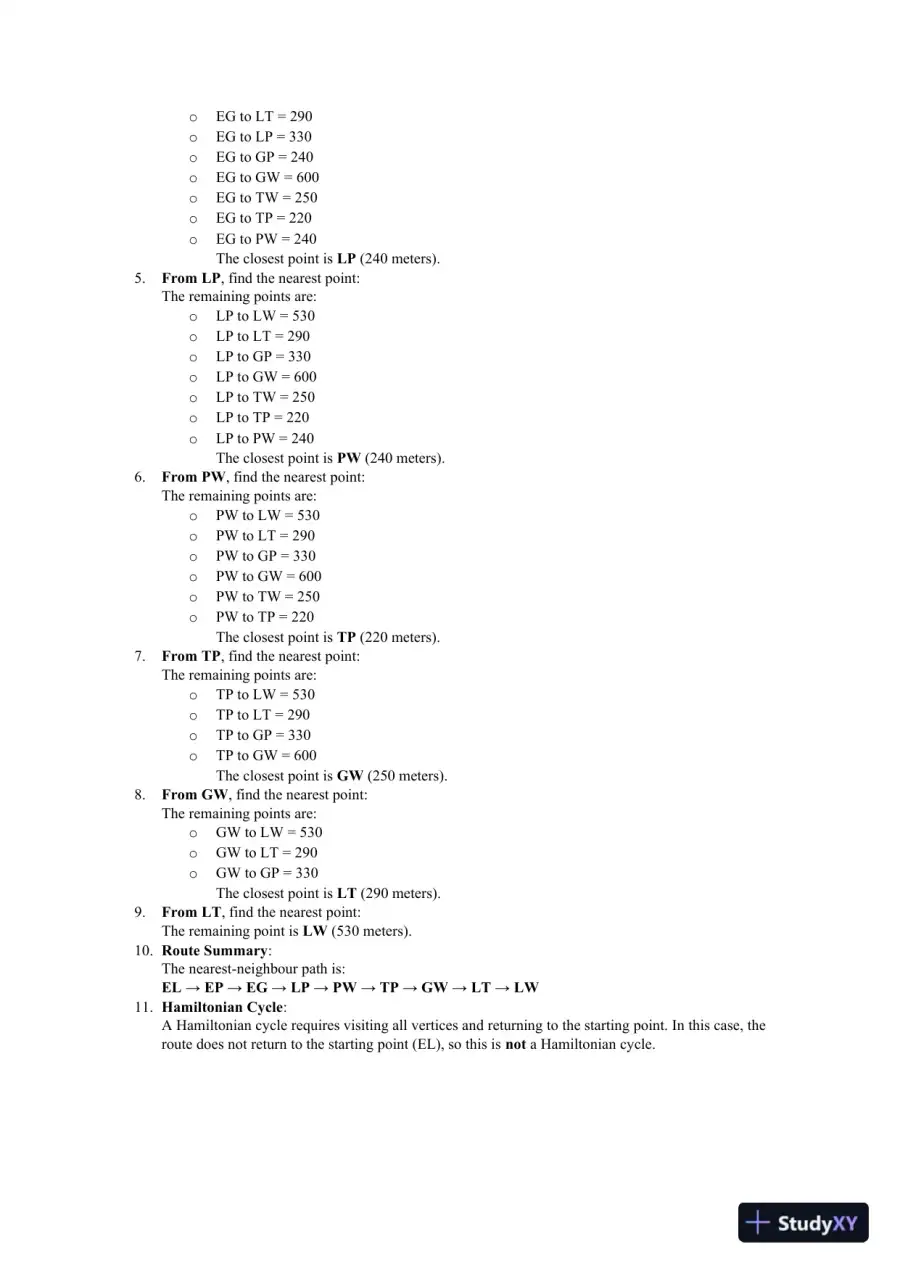 oEG to LT = 290oEG to LP = 330oEG to GP = 240oEG to GW = 600oEG to TW = 250oEG to TP = 220oEG to PW = 240The closest point isLP(240 meters).5.From LP, find the nearest point:The remaining points are:oLP to LW = 530oLP to LT = 290oLP to GP = 330oLP to GW = 600oLP to TW = 250oLP to TP = 220oLP to PW = 240The closest point isPW(240 meters).6.From PW, find the nearest point:The remaining points are:oPW to LW = 530oPW to LT = 290oPW to GP = 330oPW to GW = 600oPW to TW = 250oPW to TP = 220The closest point isTP(220 meters).7.From TP, find the nearest point:The remaining points are:oTP to LW = 530oTP to LT = 290oTP to GP = 330oTP to GW = 600The closest point isGW(250 meters).8.From GW, find the nearest point:The remaining points are:oGW to LW = 530oGW to LT = 290oGW to GP = 330The closest point isLT(290 meters).9.From LT, find the nearest point:The remaining point isLW(530 meters).10.Route Summary:The nearest-neighbour path is:EL → EP → EG → LP → PW → TP → GW → LT → LW11.Hamiltonian Cycle:A Hamiltonian cycle requires visiting all vertices and returning to the starting point. In this case, theroute does not return to the starting point (EL), so this isnota Hamiltonian cycle.
5 more pages in the full document
Unlock it once and it stays in your library, ready to chat with or turn into flashcards.
Unlock the full documentMore Operations Management study materials
See all Textbook Guides
Solution Manual for Operations and Supply Chain Management, 14th Edition
Operations Management
342 pages133downloadsFeb 2025 Textbook Guides
Managing Quality: Integrating the Supply Chain, 6th Edition Solution Manual
Operations Management
262 pages115downloadsFeb 2025 Textbook Guides
Operations Management, (Mcgraw-hill Education Operations and Decision Sciences) 1st Edition Solution Manual
Operations Management
153 pages91downloadsFeb 2025 Textbook Guides
Solution Manual For Matching Supply with Demand: An Introduction to Operations Management, 4th Edition
Operations Management
76 pages36downloadsFeb 2025 Solved Assignments
Analyzing the Production Constraints for Ozark Furniture Company
Operations Management
2 pagesMay 2025 Textbook Guides
Solution Manual for Introduction to Materials Management, 8th Edition
Operations Management
44 pagesMay 2025 Class Notes
PROCESS DESIGNS AND SUPPLY CHAINS PART 2 - OPS/571
Operations Management
7 pagesMay 2025 Class Notes
PROCESS DESIGNS AND SUPPLY CHAINS - OPS/571
Operations Management
7 pagesMay 2025
Study this document with CramX
Once it is in your library, every tool can work from it.