

Test Bank For Operations Management: Sustainability and Supply Chain Management, 13th Edition
- Operations Management
- 1051 pages
- Shared May 2025
Tackle your exam with confidence using Test Bank For Operations Management: Sustainability and Supply Chain Management, 13th Edition, filled with the most relevant questions and answers.
Preview 16 of 1051 pages
See the first 16 pages exactly as they appear in the document.
Page 1 Read page 1 as text
Operations Management Thirteenth Edition Principles of Operations Management Eleventh Edition Jay Heizer Barry Render Chuck Munson Test Bank (Download only) for Operations Management & Principles of Operations Management: Sustainability and Supply Chain Management Revised by Jianli Hu
Page 2 Page 3 Read page 3 as text
1 Operations Management, 13e (Heizer/Render/Munson) Chapter 1 Operations and Productivity Section 1 What is Operations Management? 1) Some of the operations - related activities of Hard Rock Café include designing music instruments and analyzing them for cost and labor requirements. Answer: FALSE Diff: 1 Objective: LO 1.1 Define operations management Learning Outcome: Discuss operations and operations management as a competitive advantage for t he organization 2) Because Hard Rock Cafés are themed resta urants, operations managers focus their layout design efforts on attractiveness while paying little attention to efficiency. Answer: FALSE Diff: 1 Objective: LO 1.1 Define operations management Learning Outcome: Discuss operations and operations managem ent as a competitive advantage for the organization 3) All organizations, including service firms such as banks and hospitals, have a production function. Answer: TRUE Diff: 2 Objective: LO 1.1 Define operations management Learning Outcome: Discuss ope rations and operations management as a competitive advantage for the organization 4) Operations management is the set of activities that creates value in the form of tangible goods, not services, by transforming inputs into outputs. Answer: FALSE Diff: 1 Objective: LO 1.1 Define operations management Learning Outcome: Discuss operations and operations management as a competitive advantage for the organization 5) Production is the creation of goods and services. Answer: TRUE Diff: 2 Objective: LO 1.1 Define operations management Learning Outcome: Discuss operations and operations management as a competitive advantage for the organization
Page 4 Read page 4 as text
2 6) At Hard Rock Café, t asks that reflect operations or operations management include: A) designing efficient layo uts. B) providing meals. C) receiving ingredients. D) preparing effective employee schedules. E) all of these. Answer: E Diff: 1 Objective: LO 1.1 Define operations management Learning Outcome: Discuss operations and operations management as a competiti ve advantage for the organization 7) An operations task performed at Hard Rock Café is: A) borrowing funds to build a new restaurant. B) advertising changes in the r estaurant menu. C) creating the company income statement. D) preparing employee schedules. E) overseeing financial reports. Answer: D Diff: 2 Objective: LO 1.1 Define operations management AACSB: Reflective thinking Learning Outcome: Discuss operations and operations management as a competitive advantage for the organization 8) Operations management is applicable: A) mostly to the service sector. B) to services exclusively. C) mostly to the manufacturing sector. D) to all firms, whether manufacturing or service. E) to the manufacturing sector exclusively. Answer: D Diff: 2 Objective: LO 1 .1 Define operations management Learning Outcome: Discuss operations and operations management as a competitive advantage for th e organization 9) ________ is the set of activities that creates value in the form of goods and services by transforming input s into outputs. Answer: Operations management Diff: 1 Objective: LO 1.1 Define operations management Learning Outcome: Discuss operations and operations management as a competitive advantage for the organization
Page 5 Read page 5 as text
3 10) Identify three or more operations - r elated tasks carried out by Hard Rock Café. Answer: Providing custom meals; designing, testing, and costing meals; acquiring, rec eiving, and storing supplies; recruiting and training employees; preparing employee schedules; designing efficient restaurant layouts. Diff: 1 Objective: LO 1.1 Define operations management Learning Outcome: Discuss operations and operations management a s a competitive advantage for the organization 11) Define operations management. Will your definition accommodate both manufa cturing and service operations? Answer: Operations management can be defined as the management of all activities directly related to the creation of goods and/or services through the transformation of inputs into outputs. Yes. Diff: 1 Objective: LO 1.1 D efine operations management Learning Outcome: Discuss operations and operations management as a competitive advantage for the org anization Section 2 Organizing to Produce Goods and Services 1) Which of the following are the primary functions of all or ganizations? A) production/operations, marketing, and human resources B) marketing, human resources, and finance/accounting C) sales, quality control, and production/operations D) marketing, production/operations, and finance/accounting E) research and dev elopment, finance/accounting, and purchasing Answer: D Diff: 2 Objective : LO 1.1 Define operations management Learning Outcome: Discuss operations and operations management as a competitive advantage for the organization 2) Which of the following tasks within a manufacturing firm is performed by the operations function? A) market research B) borrowing funds C) sales promotion D) stock issue E) quality assurance and control Answer: E Diff: 2 Objective: LO 1.1 Define operations management Learning Outco me: Discuss operations and operations management as a competitive advant age for the organization
Page 6 Read page 6 as text
4 3) Which of the following would NOT be an operations function in a commercial bank? A) auditing B) teller scheduling C) maintenance D) collection E) check c learing Answer: A Diff: 2 Objective: LO 1.1 Define operations management Learning Outcome: Discuss operations and operations management as a competitive advantage for the organization 4) The marketing function is concerned with: A) producing goods or p roviding services. B) procuring materia ls, supplies, and equipment. C) building and maintaining a positive image. D) generating the demand for the organization's products or services. E) securing monetary resources. Answer: D Diff: 2 Objective: LO 1.1 De fine operations management Learning Out come: Discuss operations and operations management as a competitive advantage for the organization 5) The purchasing function is concerned with: A) producing goods or providing services. B) procuring materials, supp lies, and equipment. C) building and ma intaining a positive image. D) generating the demand for the organization's products or services. E) securing monetary resources. Answer: B Diff: 2 Objective: LO 1.1 Define operations management Learning Outcome: D iscuss operations and operations manage ment as a competitive advantage for the organization 6) The finance function is concerned with: A) producing goods or providing services. B) procuring materials, supplies, and equipment. C) building and maintaining a positive image. D) generating the demand for the organization's products or services. E) securing monetary resources. Answer: E Diff: 2 Objective: LO 1.1 Define operations management Learning Outcome: Discuss operations and op erations management as a c ompetitive advantage for the organization
Page 7 Read page 7 as text
5 7) Which of the following tasks within an airline company is related to operations? A) crew scheduling B) international monetary exchange C) sales D) advertising E) accounts payable Answe r: A Diff: 2 Objective: LO 1.1 Define operations management Learning Outcome: Discuss operations and operations management as a competitive advantage for the organization 8) Marketing, production/operations, and ________ are the three functions that al l organizations must perfo rm to create goods and services. Answer: finance/accounting Diff: 1 Objective: LO 1.1 Define operations management Learning Outcome: Discuss operations and operations management as a competitive advantage for the organization Section 3 The Supply Cha in 1) Competition in the 21st century is no longer between companies; it is between supply chains . Answer: TRUE Diff: 2 Learning Outcome: Discuss operations and operations management as a competitive advantage for the organization 2) An accounting firm that provides tax services for a company would not be considered to be part of that company's supply chain. Answer: FALSE Diff: 2 AACSB: R eflective thinking Learning Outcome: Compare and contrast different sourcing strategies including outsourcing and insourcing
Page 8 Read page 8 as text
6 3) What is a global network of organizations and activities that supply a firm with goods and services? A) supply tree B) provide r network C) supply chain D) vendor network E) vendor tree Answer: C Diff: 1 Learning Outcome: Compare and contr ast different sourcing strategies including outsourcing and insourcing 4) Which of the following fosters specialization and worldwide supply chains? A) more expensive transportation B) instant communication C) economies of scope D) managers with a broad k nowledge of many things E) high trade tariffs Answer: B Diff: 2 Learning Outcome: Compare and contrast different sourcing strategies including outsourcing and insourcing 5) A(n) ________ is a global network of organizations and activities that supply a firm with goods and services. Answer: supply chain Diff: 1 Learning Outcome: Compa re and contrast different sourcing strategies including outsourcing and insourcing 6) Competition in the 21st century is no longer between companies; it is between _______ _. Answer: supply chains Diff: 2 Learning Outcome: Compare and contrast different sourcing strategies including outsourcing and insourcing 7) Identify up to four phenomena that foster specialization and worldwide supply chains. Answer: (1) a more techn ologically oriented society, (2) specialized expert knowledge, (3) instant communica tion, and (4) cheaper transportation Diff: 2 Learning Outcome: Compare and contrast different sourcing strategies including outsourcing and insourcing
Page 9 Read page 9 as text
7 Section 4 Why St udy OM? 1) One reason to study operations management is to learn how people organize themselves for productive enterprise. Answer: TRUE Diff: 1 Objective: LO 1.1 Define operations management Learning Outcome: Discuss operations and operations managemen t as a competitive advantage for the organization 2) Reasons to study operations man agement include: A) studying how people organize themselves for productive enterprise. B) knowing how goods and services are consumed. C) understanding what human resource managers do. D) learning about a costly part of the enterprise. E) A and D Answer: E Diff: 2 Objective: LO 1.1 Define operations management Learning Outcome: Discuss operations and operations management as a competitive advantage for the organization 3) Reasons to stu dy operations management include learning about: A) how people organize themselves for productive enterprise. B) how goods and services are produced. C) what operations managers do. D) a costly part of the enterprise. E) all of these. Answ er: E Diff: 1 Ob jective: LO 1.1 Define operations management Learning Outcome: Discuss operations and operations management as a competitive advantage for the organization
Page 10 Read page 10 as text
8 4) Brandon Production is a small firm focused on the assembly and sale of custo m computers. The f irm is facing stiff competition from low - priced alternatives, and is looking at various solutions to remain competitive and profitable. Current financials for the firm are shown in the table below. In the first option, marketing will incr ease sales (and co sts) by 50%. The next option is Vendor (Supplier) changes, which would result in a decrease of 12% in the cost of inputs. Finally, there is an OM option, which would reduce production costs by 25%. Which of the options would you recommend to the firm if it can only pursue one option? In addition, comment on the feasibility of each option. Business Function Current Value Cost of Inputs $50,000 Production Costs $30,000 Revenue $83,000 Answer: Marketing would increase sales to $124,500 ($83 ,000 ∗ 1.5) but in crease cost of inputs and production costs to $120,000 (($50,000 + $30,000) ∗ 1.5). This would net an additional $1,500 of profit ($124,500 - $120,000 - current profit of $3,000). Vendor (Supplier) changes would decrease cost of inputs to $44,000 ($50,000 ∗ .88), resulting in $6,000 of additional profit (savings) ($50,000 - $44,000). Finally, the OM option would save $7,500 ($30,000 - $30,000 ∗ .75), resulting in an additional $7,500 of profit. Thus, the OM option is the most profitable. C omments on feasibi lity should center on the near impossibility of increasing revenue by 50%, while noting the other two options are difficult but not impossible. Diff: 2 AACSB: Analytical thinking Learning Outcome: Discuss operations and operations manag ement as a competi tive advantage for the organization Section 5 What Operations Managers Do 1) The operations manager performs the management activities of planning, organizing, staffing, leading, and controlling of the OM function. Answer: TRUE Diff: 2 Objective: LO 1.1 Define operations management Learning Outcome: Discuss operations and operat ions management as a competitive advantage for the organization 2) "Considers inventory ordering and holding decisions" is within the strategic operations m anagement decision area of managing quality . Answer: FALSE Diff: 1 Objective: LO 1.2 Identify the 10 strategic decisions of operations management Learning Outcome: Discuss operations and operations management as a competitive advantage for the organizat ion
Page 11 Read page 11 as text
9 3) In order to have a career in operations management, one must have a degree in statistics or quantitative methods. Answer: FALSE Diff: 1 Objective: LO 1.3 Identify career opportunities in operations management Learning Outcome: Discuss operation s and operations management as a competitive advantage for the organization 4) What are the five el ements in the management process? A) plan, direct, update, lead, and supervise B) accounting, finance, marketing, operations, and management C) organize, pl an, control, staff, and manage D) plan, organize, staff, lead, and control E) plan, lead, organize, manage, and control Answer: D Diff: 2 Learning Outcome: Discuss operations and operations management as a competitive advantage for the organization 5) W hich of the following is NOT an element of the management process? A) controlling B) leading C) planning D) pricing E) staffing Answer: D Diff: 2 Objective: LO 1.4 Explain the distinction between goods and services Learning Outcome: Discuss operations a nd operations management as a competitive advantage for the organization 6) An operations manager is NOT likely to be involved in: A) the design of goods and services to satisfy customers' wants and needs. B) the quality of goods and services to satisfy c ustomers' wants and needs. C) the identification of customers' wants and needs. D) work scheduling to meet the due dates promised to cu stomers. E) maintenance schedules. Answer: C Diff: 1 Objective: LO 1.2 Identify the 10 strategic decisions of operation s management Learning Outcome: Discuss operations and operations management as a competitive advantage for the organization
Page 12 Read page 12 as text
10 7) All of the following decisions fall within the scope of operations management EXCEPT for: A) creating the company income state ment. B) design of goods and services. C) location strategies. D) managing quality and statistical process control. E) human resources, job design and work measurement. Answer: A Diff: 1 Objective: LO 1.2 Identify the 10 strategic decisions of operations management Learning Outcome: Discuss operations and operations management as a competitive advantage for the organiza tion 8) The 10 strategic operations management decisions include: A) layout strategies. B) maintenance. C) process and capacity strategi es. D) managing quality. E) all of these. Answer: E Diff: 1 Objective: LO 1.2 Identify the 10 strategic decisions of operations management Learning Outcome: Discuss operations and operations management as a competitive advantage for the organization 9) Which of the following is NOT one of the 10 strategic operations management decisions? A) layout strategies B) mainten ance C) process and capacity strategies D) mass customization E) supply chain management Answer: D Diff: 2 Objective: LO 1.2 Identify t he 10 strategic decisions of operations management Learning Outcome: Discuss operations and operations management as a competitive advantage for the organization 10) Which of the following is one of the 10 strategic operations management decisions? A) de preciation policy for tax returns B) advertising C) process and capacity strategies D) pricing E) debt/equity ratio Answer: C Diff: 1 Objective: LO 1.2 Identify the 10 strategic decisions of operations management Learning Outcome: Discuss operations and operations management as a competitive advantage for the organization
Page 13 Read page 13 as text
11 11) Which of the following are among the 10 strategic operations management decisions? I. design of goods and services II. managing quality III. layout strategies IV. marketing V. pric ing of goods and services A) I, II, V B) I, II, IV C) II, III, V D) I, II, III E) I, II, III, IV, V Answer: D Diff: 2 Objective: LO 1.2 Identify the 10 strategic decisions of operations management Learning Outcome: Discuss operations and operations mana gement as a competitive advantage for the organization 12) Which of the following influences layo ut design? A) inventory requirements B) capacity needs C) personnel levels D) technology E) All of these influence layout decisions. Answer: E Diff: 2 Object ive: LO 1.2 Identify the 10 strategic decisions of operations management Learning Outcome: Discuss operations and operations management as a competitive advantage for the organization 13) Which of the following is NOT a strategic operations management d ecisio n? A) maintenance B) price C) layout D) quality E) inventory Answer: B Diff: 2 Objective: LO 1.2 Identify the 10 strategic decisions of operations management Learning Outcome: Discuss operations and operations management as a competitive advantage for t he organization
Page 14 Read page 14 as text
12 14) Identify two operations - related tasks carried out by Hard Rock Café. Match each to its related area of the 10 strategic operations management decisions. Answer: Providing custom meals: design of goods and services; designing, t esting, and costing meals: design of goods and services; acquiring, receiving, and storing supplies: supply chain management; recruiting and training employees: human resources, job design and measurement; preparing employee schedules: scheduling; designin g effic ient restaurant layouts: layout strategies. Diff: 2 Objective: LO 1.2 Identify the 10 strategic decisions of operations management AACSB: Reflective thinking Learning Outcome: Discuss operations and operations management as a competitive advantag e for t he organization 15) Identify the 10 strategic OM decisions. Answer: Design of goods and services, managing quality, process strategies, location strategies, layout strategies, human resources, supply chain management, inventory management, schedul ing, an d maintenance. Diff: 3 Objective: LO 1.2 Identify the 10 strategic decisions of operations management Learning Outcome: Discuss operations and operations management as a competitive advantage for the organization Section 6 The Heritage of Opera tions Management 1) Henry Ford is known as the Father of Scientific Management. Answer: FALSE Diff: 1 Learning Outcome: Discus s operations and operations management as a competitive advantage for the organization 2) Shewhart's contributions to operatio ns management came during the Scientific Management Era. Answer: FALSE Diff: 2 Learning Outcome: Discuss operations and operati ons management as a competitive advantage for the organization
Page 15 Read page 15 as text
13 3) Walter Shewhart is listed among the important people of ope rations management because of his contributions to: A) assembly line production. B) measuring productivity in the service sector. C) just - in - time inventory methods. D) statistical quality control. E) information technology. Answer: D Diff: 2 Learning Outc ome: Discuss operations and operations management as a competitive advantage for the organization 4) Walter Shewhart, in the ___ _____, provided the foundations for ________ in operations management. A) 1920s; statistical sampling B) United Kingdom; mass production C) U.S. Army; logistics D) nineteenth century; interchangeable parts E) 1900s; queuing theory Answer: A Diff: 2 Learning Outcome: Discuss operations and operations management as a competitive advantage for the organization 5) Eli Whitney, in the ________, provided the foundations for ________ in operations management. A) 1920s; statistical sampling B) United Kingd om; mass production C) U.S. Army; logistics D) nineteenth century; interchangeable parts E) 1890s; queuing theory Answer: D Diff: 2 Learning Outcome: Discuss operations and operations management as a competitive advantage for the organization 6) Who was the person most responsible for popularizing interchangeable parts in manufacturing? A) Frederick W. Taylor B) Henry Ford C) Eli Wh itney D) Whitney Houston E) Lillian Gilbreth Answer: C Diff: 2 Learning Outcome: Discuss operations and operations managem ent as a competitive advantage for the organization
Page 16 Read page 16 as text
14 7) The "Father of Scientific Management" is: A) Henry Ford. B) Frederick W. Tay lor. C) W. Edwards Deming. D) Frank Gilbreth. E) just a figure of speech, not a reference to a person. Answer: B Diff: 2 Learning Outcome: Discuss operations and operations management as a competitive advantage for the organization 8) Henry Ford is note d for his contributions to: A) material requireme nts planning. B) statistical quality control. C) assembly line operations. D) scientific management. E) time and motion studies. Answer: C Diff: 1 Learning Outcome: Discuss operations and operations manage ment as a competitive advantage for the organizat ion 9) Who among the following is associated with contributions to quality control in operations management? A) Charles Babbage B) Henry Ford C) Frank Gilbreth D) W. Edwards Deming E) Henri Fayol Answer: D Diff: 2 Learning Outcome: Discuss operations an d operations management as a competitive advantage for the organization 10) The field of operations management is shaped by advances in which of the following fields? A) chemistry and physics B) industrial engineering and management C) biology and anatomy D) information technology E) all of the these Answer: E Diff: 2 Objective: LO 1.1 Define operations management Learning Outcome: Discuss operations and operations management as a competitive a dvantage fo r the organization
1035 more pages in the full document
Unlock it once and it stays in your library, ready to chat with or turn into flashcards.
Unlock the full documentMore Operations Management study materials
See all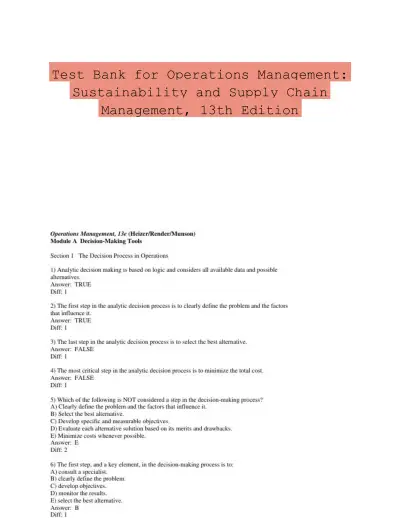 Exam Guides
Test Bank for Operations Management: Sustainability and Supply Chain Management, 13th Edition
Operations Management
1052 pagesMay 2025 Textbook Guides
Solution Manual for Operations Management: Sustainability and Supply Chain Management, 13th Edition
Operations Management
567 pagesMay 2025 Textbook Guides
Operations Management: Sustainability and Supply Chain Management, Second Canadian Edition Solution Manual
Operations Management
344 pagesMay 2025 Textbook Guides
Solution Manual for Operations and Supply Chain Management, 14th Edition
Operations Management
342 pages133downloadsFeb 2025 Textbook Guides
Managing Quality: Integrating the Supply Chain, 6th Edition Solution Manual
Operations Management
262 pages115downloadsFeb 2025 Textbook Guides
Operations Management, (Mcgraw-hill Education Operations and Decision Sciences) 1st Edition Solution Manual
Operations Management
153 pages91downloadsFeb 2025 Textbook Guides
Solution Manual For Matching Supply with Demand: An Introduction to Operations Management, 4th Edition
Operations Management
76 pages36downloadsFeb 2025 Exam Guides
Operations Management, 5th Canadian Edition Test Bank
Operations Management
1208 pagesMay 2025
Study this document with CramX
Once it is in your library, every tool can work from it.