

American Government - The Mass Media
- Political Science
- Texas A&M University
- 11 pages
- Shared March 2026
Preview 4 of 11 pages
See the first 4 pages exactly as they appear in the document.
Page 1 Read page 1 as text
Study Guide American Government – The Mass Media 1. The Evolu Ɵ on of the Mass Media (Summary & Explana Ɵ on) Although mass media play a major role in American politics, they are not formally part of the political system . Journalists are not elected officials, and they have no official political authority beyond protections granted by the First Amendment . Research also suggests that the media do not directly control public opinion — people are rarely persuaded simply by endorsements or biased coverage. Despite this, the media exercise significant indirect influence . They help shape how Americans: • View political candidates, especially early in campaigns • Understand and frame political debates • Decide which social problems deserve public and political attention Media outlets also serve as an informal communication channel within government, as officials and bureaucrats often rely on news reports to learn what is happening in other agencies. For these reasons, mass media are critical actors in American politics. 1.1 Types of Mass Media Mass media fall into two broad categories: 1. Print media – newspapers and magazines 2. Broadcast media – radio and television Historically, Americans relied mostly on print media. Over the past 50 years, television and electronic journalism have become dominant. Today, the Internet blurs the line between print and broadcast media, offering news alongside direct political content from candidates, parties, interest groups, and individuals. 1.2 Newspapers and Magazines Early American newspapers were openly partisan , tied to political parties and leaders. Examples include:
Page 2 Read page 2 as text
Study Guide • The Federalist Papers , published in newspapers to support ratifying the Constitution • Papers aligned with Alexander Hamilton’s Federalists or Thomas Jefferson’s Democratic Republicans In the 19th century, advances in technology (high - speed presses, the telegraph) and higher literacy led to mass - circulation newspapers . Intense competition encouraged sensational reporting, known as yellow journalism . William Randolph Hearst’s New York Journal famously used sensational stories to build support for the Spanish - American War (1898) . A backlash against this style encouraged more objective reporting , though sensationalism continues in tabloids and supermarket papers like the National Enquirer . Magazines such as McClure’s and Collier’s gained influence by publishing in - depth investigations. These magazines supported the muckrakers , journalists whose exposés on corruption and corporate abuse helped fuel Progressive Era reforms (1900 – 1920) . Later investigative journalism — most notably the reporting that uncovered Watergate — continued this tradition. 1.3 Radio and Television Radio From the 1920s through World War II, radio was the dominant news medium. • Franklin D. Roosevelt’s “fireside chats” allowed him to speak directly to Americans • Edward R. Murrow’s wartime broadcasts informed Americans about events in Europe Radio has since experienced a revival through: • All - news stations • Political talk radio • National Public Radio (NPR) • The president’s weekly radio address Television Television not only informs Americans but has become part of the political process itself : • Party conventions were first televised in 1952 • Dwight Eisenhower ran the first TV political ads • John F. Kennedy’s appearance in the 1960 debates is widely believed to have helped him defeat Richard Nixon
Page 3 Read page 3 as text
Study Guide Television coverage of the Vietnam War brought graphic images into American homes, significantly shaping public opinion and increasing support for withdrawal. With the rise of cable and satellite TV , government has become more visible: • Local stations air city council and school board meetings • C - SPAN broadcasts congressional debates and hearings • truTV covers major trials Key Takeaway While the mass media do not directly dictate what Americans think, they play a powerful role in shaping what Americans think about . Through framing issues, highlighting problems, and increasing transparency, the media have evolved into one of the most influential forces in the American political system — even without formal political power. 2. The Structure of the Mass Media and Government Regula Ɵ on In the United States, most mass media are privately owned , which provides strong protection from government control but also raises concerns about corporate influence and concentration. Public radio and television, funded in part by the federal government through the Corporation for Public Broadcasting (CPB) , make up only a small portion of the media market. 2.1 Concentra Ɵ on in the Mass Media Economic pressures such as rising costs, competition, and mergers have led to fewer independent media outlets : • Many cities now have only one daily newspaper • Large media chains (e.g., Gannett) own numerous papers • Fewer independent voices raise concerns about reduced diversity of opinion and corporate control of news In television: • Major networks ( ABC, CBS, NBC ) do not own their local affiliate stations • They face competition from Fox , cable news, and entertainment networks
Page 4 Read page 4 as text
Study Guide The Telecommunications Act of 1996 aimed to increase competition by loosening ownership restrictions. Instead, it led to greater consolidation , especially in radio, where ownership limits were largely eliminated except to prevent total market domination. 2.2 Hard News vs. Entertainment Television news is audience - driven : • Larger audiences bring higher advertising revenue • This incentive encourages entertainment - focused content over in - depth political coverage As a result: • Local TV devotes more time to weather, sports, and human - interest stories than politics • News is increasingly packaged for entertainment value • The boundary between news and entertainment has blurred Many young Americans now get political information from satirical programs such as The Daily Show and The Colbert Report , illustrating how political communication has shifted. 2.3 Print Media and the First Amendment Newspapers and magazines are strongly protected by the First Amendment . A key case was the Pentagon Papers (1971) : • The Nixon administration tried to stop The New York Times and The Washington Post from publishing classified Vietnam War documents • The Supreme Court ruled that stopping publication would be prior restraint , which violates press freedom Limits on the press still exist: • Media may not knowingly publish false information or libel individuals • Obscenity laws regulate certain content
7 more pages in the full document
Unlock it once and it stays in your library, ready to chat with or turn into flashcards.
Unlock the full documentMore Political Science study materials
See all Quick Guides
American Government - Public Policy
Political Science
11 pagesMar 2026 Quick Guides
American Government - The Judiciary
Political Science
16 pagesMar 2026 Quick Guides
American Government - Voting and Elections
Political Science
11 pagesMar 2026 Quick Guides
American Government - Economic Policy
Political Science
13 pagesMar 2026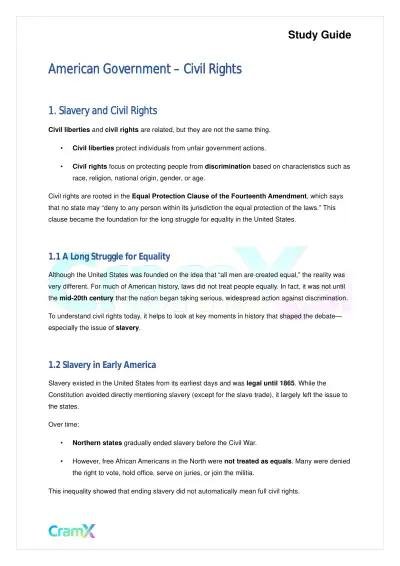 Quick Guides
American Government - Civil Rights
Political Science
18 pagesMar 2026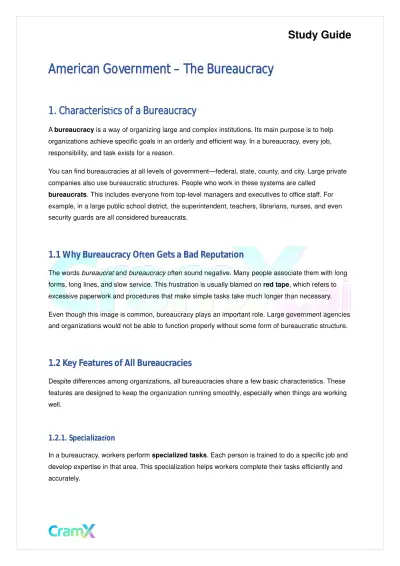 Quick Guides
American Government - The Bureaucracy
Political Science
11 pagesMar 2026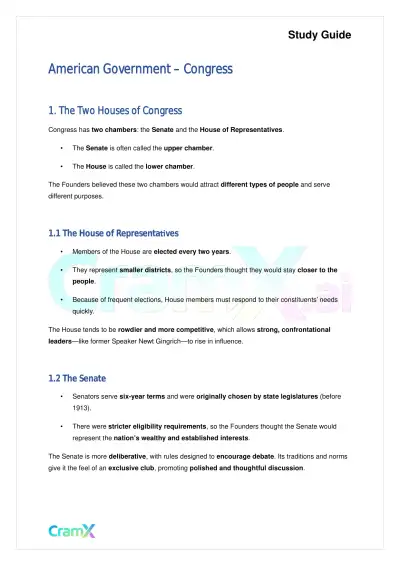 Quick Guides
American Government - Congress
Political Science
9 pagesMar 2026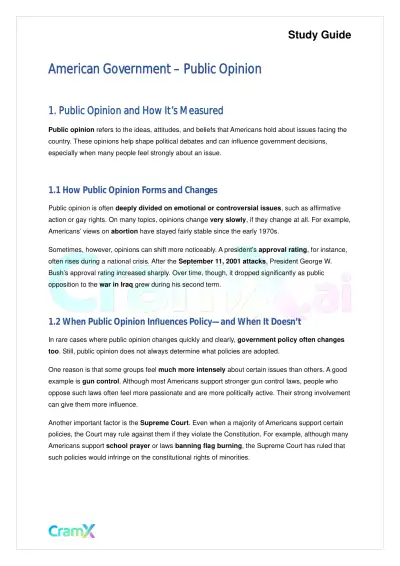 Quick Guides
American Government - Public Opinion
Political Science
11 pagesMar 2026
Study this document with CramX
Once it is in your library, every tool can work from it.