

3 Practice Tests + Review and Techniques PSAT/NMSQT Prep (2021)
- Preliminary Scholastic Aptitude Test
- 802 pages
- Shared February 2025
- 41 downloads
3 Practice Tests + Review and Techniques PSAT/NMSQT Prep (2021) provides real-world examples to reinforce your learning.
Preview 31 of 802 pages
See the first 31 pages exactly as they appear in the document.
Page 1 Page 2 Read page 2 as text
Downloaded from StudyXY.com [= Ww + StudyXY oi as . Za \ Rr ' BE \ Stu dy Anything This ContentHas been Posted On StudyXY.com as supplementary learning material. StudyXY does not endrose any university, college or publisher. Allmaterials posted are under the liability of the contributors. | 8) www.studyxy.com
Page 3 Page 4 Read page 4 as text
Editorial Rob Franek, Editor-in-Chief David Soto, Director of Content Development Stephen Koch, Student Survey Manager Deborah Weber, Director of Production Gabriel Berlin, Production Design Manager Selena Coppock, Managing Editor Aaron Riccio, Senior Editor Meave Shelton, Senior Editor Chris Chimera, Editor Anna Goodlett, Editor Eleanor Green, Editor Orion McBean, Editor Patricia Murphy, Editorial Assistant Penguin Random House Publishing Team Tom Russell, VP, Publisher Alison Stoltzfus, Publishing Director Amanda Yee, Associate Managing Editor Ellen Reed, Production Manager Suzanne Lee, Designer The Princeton Review 110 East 42nd Street, 7th Floor New York, NY 10017 E-mail: editorialsupport@review.com Copyright © 2021 by TPR Education IP Holdings, LLC. All rights reserved. Published in the United States by Penguin Random House LLC, New York, and in Canada by Random House of Canada, a division of Penguin Random House Ltd., Toronto. Terms of Service: The Princeton Review Online Companion Tools (“Student Tools”) for retail books are available for only the two most recent editions of that book. Student Tools may be activated only once per eligible book purchased for a total of 24 months of access. Activation of Student Tools more than once per book is in direct violation of these Terms of Service and may result in discontinuation of access to Student Tools Services. ISBN 9780525570288
Page 5 Read page 5 as text
Ebook ISBN 9780525570325 PSAT/NMSQT is a registered trademark of the College Board and the National Merit Scholarship Corporation, which are not affiliated with, and do not endorse, this product. The Princeton Review is not affiliated with Princeton University. Permission has been granted to reprint portions of the following: “Jumping Spiders Can Think Ahead, Plan Detours” by Michael Greshko. Copyright © 2016 National Geographic Creative. Originally published January 21, 2016. “Living in an Imaginary World” by Josie Glausiusz. Scientific American, MIND Special Edition. January 2014. Reproduced with permission. Copyright © 2014 Scientific American, a division of Nature America, Inc. All rights reserved. The Botany of Desire: A Plant’s-Eye View of the World by Michael Pollan, copyright © 2001 by Michael Pollan. Used by permission of Random House, an imprint and division of Penguin Random House LLC. All rights reserved. © Michael Pollan, 2001. Botany of Desire. Bloomsbury Publishing Plc. Never a City So Real: A Walk in Chicago by Alex Kotlowitz. Copyright © 2004 by Alex Kotlowitz. Used by permission of Crown Journeys, an imprint of the Crown Publishing Group, a division of Penguin Random House LLC. All rights reserved. “A Wandering Mind Reveals Mental Processes and Priorities.” Copyright © University of Wisconsin-Madison. March 2012. Reprinted with permission. “Bacterium counteracts ‘coffee ring effect.” ” Copyright © KU Leuven. Full text of study published in Nature Communications 4, Article number 1757, April 2013. Reprinted with permission. “Physicists undo the ‘coffee ring effect.”” Copyright © University of Pennsylvania. August 2011. Reprinted with permission. “A Third of All Food Never Gets Eaten. How Can we Fix This?” by Elizabeth Royte. Copyright © 2016 National Geographic Creative. Originally published October 26, 2016. “These ‘Indestructible’ Animals Would Survive a Planet-Wide Apocalypse” by Casey Smith. Copyright © 2018 National Geographic Creative. Originally published April 23, 2018. “Tardigrades Become First Animals to Survive Vacuum of Space” by Ed Yong. Copyright © 2008 Ed Yong. “The Ability to Discriminate Paintings Found in Mice” by Keio University. Released in 2013. The material in this book is up-to-date at the time of publication. However, changes may have been instituted by the testing body in the test after this book was published. If there are any important late-breaking developments, changes, or corrections to the materials in this book, we will post that information online in the Student Tools. Register your book and check your Student Tools to see if there are any updates posted there. + Studyxy
Page 6 Read page 6 as text
Editor: Eleanor Green Production Editors: Liz Dacey and Emily Epstein White Production Artist: Kris Ogilvie Cover art by Tzogia Kappatou / Alamy Stock Photo Cover design by Suzanne Lee a_prh_5.6.0_c0_r0 + StudyXy
Page 7 Read page 7 as text
Acknowledgments Special thanks to Sara Kuperstein, Amy Minster, and Cynthia Ward for their contributions to this edition, as well as Aaron Lindh for his expert guidance. Thanks also to Anne Bader, Kevin Baldwin, Gabby Budzon, Grace Cannon, Nicole Cosme, April Davis, Anne Goldberg-Baldwin, Brian Hong, Brad Kelly, Jomil London, Dave MacKenzie, Amanda Nowotny, Scott O'Neal, Danielle Perrini, Xander Posner, Jess Thomas, Christina Torturo, and Jimmy Williams. The Princeton Review would also like to thank Kris Ogilvie, Liz Dacey, and Emily Epstein White for their time and attention to each page. Special thanks to Adam Robinson, who conceived of and perfected the Joe Bloggs approach to standardized tests, and many other techniques in this book.
Page 8 Read page 8 as text
Contents Cover Title Page Copyright Acknowledgments Get More (Free) Content Part I: Orientation 1 What Is the PSAT/NMSQT? 2 All About the National Merit Scholarships 3 General Strategies Part ll: Practice Test 1 4 Practice Test 1 5 Practice Test 1: Answers and Explanations Part lll: PSAT/NMSQT Prep 6 Reading Comprehension 7 Introduction to Writing and Language Strategy 8 Punctuation 9 Words 10 Questions 11 Math Basics 12 Math Techniques 13 Advanced Math 14 Additional Math Topics Part IV: Drill Answers and Explanations
Page 9 Read page 9 as text
Part V: Practice Test 2 15 Practice Test 2 16 Practice Test 2: Answers and Explanations
Page 10 Read page 10 as text
1 Go to PrincetonReview.com/prep and enter the following ISBN for your book: 9780525570325 2 Answer a few simple questions to set up an exclusive Princeton Review account. (If you already have one, you can just log in.)
Page 11 Read page 11 as text
3 Enjoy access to your FREE content! Need to report a potential content issue? Contact EditorialSupport@review.com and include: « full title of the book
Page 12 Read page 12 as text
* ISBN * page number Need to report a technical issue? Contact TPRStudentTech@review.com and provide: o your full name + email address used to register the book o full book title and ISBN e Operating system (Mac/PC) and browser (Firefox, Safari, etc.) Once you've registered, you can... o Access and print out one more full-length practice test as well as the corresponding answers and explanations « Get valuable advice about the college application process, including tips for writing a great essay and where to apply for financial aid « If you're still choosing between colleges, use our searchable rankings of The Best 386 Colleges to find out more information about your dream school * Access printable resources, including a score conversion table, a study guide, and extra bubble sheets for the practice tests in this book
Page 13 Read page 13 as text
« Check to see if there have been any corrections or updates to this edition Book ONLINE ARTICLES PROVEN TECHNIQUES APPLIED STRATEGIES STUDY BREAK MORE GREAT BOOKS
Page 14 Read page 14 as text
Partl Orientation 1 What Is the PSAT/NMSQT? 2 All About the National Merit Scholarships 3 General Strategies
Page 15 Read page 15 as text
Chapter 1 What Is the PSAT/NMSQT? The PSAT/NMSQT—from now on, we'll just call it the PSAT—is a standardized test given primarily to high school juniors to give them a “preliminary” idea of how well they could do on SAT question types. The test is also used to determine which students are eligible for National Merit Scholar recognition. This chapter will give you a general overview of the test and how it is used, along with the basics to start your preparation. First, a glimpse at the other tests in the College Board’s Suite of Assessments: the PSAT 8/9 and the PSAT 10.
Page 16 Read page 16 as text
PSAT 8/9 Just like the SAT and PSAT, the PSAT 8/9, which is designed for eighth and ninth graders, contains a Reading Test, a Writing and Language Test, and a Math Test. The content of each subject is comparable to the content on the PSAT and SAT. According to the College Board, the “Evidence-Based Reading and Writing section asks you to interpret, synthesize, and use evidence found in a wide range of sources.” The bottom line: be prepared to justify your selected answer with evidence from the passage and/or graph provided. This test is still not about making up anything, but finding the correct answer based on the text. The College Board also claims that the “Math Test focuses in-depth on two essential areas of math: Problem Solving and Data Analysis, and Heart of Algebra.” The bottom line: expect to see Algebra I and II, some Geometry, as well as questions that have charts, graphs, data tables, scatterplots, or other form of data display provided. There's the PSAT 8/9, the PSAT 10, and PSAT/NMSQT. But when we refer to just the plain old “PSAT” in this book, we're referring to the PSAT/NMSQT. The Math Test is split into two sections: one in which a calculator may be used and one in which it may not be used. Even though a calculator is allowed in one section, it is up to the test-taker to determine whether the calculator will be a benefit in solving a question. According to the College Board, “students who make use of structure or their ability to reason will probably finish before students who use a calculator.” The bottom line: show your work and use the calculator for tedious calculations, but a calculator most likely will not be necessary to solve a majority of the questions. All questions in the Evidence-Based Reading and Writing section are
Page 17 Read page 17 as text
multiple choice. Most of the Math Test questions are multiple choice, with 18 percent of all Math Test questions in the grid-in, or student- produced, format. For each question answered correctly, one raw point is earned, and there is no penalty for an incorrect response or a question left blank. The bottom line: don’t leave anything blank! PSAT 10 Though this test is called the PSAT 10, it is identical to the structure of the PSAT/NMSQT in terms of both number of questions and time limits per section. The major differences are who takes the test and when: 1oth-graders and schools choose a date in the spring. Additionally, this test does not qualify you for National Merit Scholarship consideration. Just as with the SAT and the PSAT, the PSAT 10 includes an Evidence- Based Reading and Writing section and a Math Test. The Evidence- Based Reading and Writing section tests the ability to select, among the choices provided, the answer that is best evidenced in the provided passage and/or informational graphics that accompany select passages. The Math Test is divided into two sections: one in which a calculator may be used and one in which it may not be used. Even though the calculator is allowed in one section, it is up to the test-taker to determine whether or not the calculator will prove necessary. WHAT’S WITH ALL THESE SCORES? The PSAT (and the PSAT 8/9, PSAT 10, and SAT) is designed (according to College Board) to reflect how prepared you are for college and the working world. While we at The Princeton Review may take issue with that claim, this idea does inform both how College Board recommends you prepare and why there are so many different Scores on your score report. The College Board maintains that the best way to prepare for the test is to:
Page 18 Read page 18 as text
o take challenging courses ¢ do your homework o prepare for tests and quizzes » ask and answer lots of questions How Do You Pronounce PSAT/NMSQT, Anyway? Ah, yes—first things first. Well, to be honest, we're not really sure. You can pronounce it pee-sat-nim- squit if you want. However, we think it's easier just to call it the PSAT. College admissions advisors wanted a more “well-rounded” picture of the applicant, so the College Board did its best to meet the demand. The test provides a measurement of four Evidence-Based Reading and Writing Subscores (Command of Evidence, Words in Context, Standard English Conventions, and Expression of Ideas), and three Math Subscores (Heart of Algebra, Problem Solving and Data Analysis, and Passport to Advanced Math). In addition to the seven subscores reported, the College Board now provides two cross-test scores to offer more insight: one score for Analysis in History/Social Studies and another for Analysis in Science. Remain calm; these scores are gathered only from select questions that deal with appropriate subject matter and are not actual entire test sections. We will go into PSAT scoring in more detail later. When Is the PSAT Given? The PSAT is officially administered twice each year, typically on a Wednesday and Saturday of the same week in October. Your school will announce the exact dates at the beginning of the school year, or you can find out at PrincetonReview.com, or through the College Board at CollegeBoard.org. Keep on Schedule You'll officially take the PSAT in the fall of your
Page 19 Read page 19 as text
junior year. Plan to take the SAT anytime between the winter of your junior year and the fall of your senior year. How Do | Sign Up for the PSAT? You don’t have to do anything to sign up for the PSAT; your school will do all the work for you. Test registration fees can vary from school to school, so be sure to check with your school counselor if you have questions about how much the PSAT will cost you. What About Students with Special Needs? If you have a diagnosed learning difference, you will probably qualify for accommodations on the PSAT. However, it’s important that you get the process started early. The first step is to speak to your school counselor who handles learning differences. Only he or she can file the appropriate paperwork. You'll also need to gather some information (documentation of your condition) from a licensed practitioner and some other information from your school. Then your school counselor will file the application for you. You will need to apply for accommodations only once; with that single application you'll qualify for accommodations on the PSAT, SAT, SAT Subject Tests, and AP Exams. The one exception to this rule is that if you change school districts, you'll need to have a counselor at the new school refile your paperwork. Does the PSAT Play a Role in College Admissions? No! The PSAT plays no role in college admissions. It’s really just a practice test for the SAT. The one exception is for that very small group of students, about 4 percent of all students nationwide, whose PSAT scores qualify them for National Merit recognition. (We'll tell you more than you ever wanted to know about that in the next chapter.) Recognition as a commended scholar, semifinalist, or finalist for National Merit is a fairly impressive addition to your college admissions portfolio, and is
Page 20 Read page 20 as text
something that you should certainly pursue if you are seriously in contention for it. What Happens to the Score Report from the PSAT? Only you, your high school, and the National Merit Scholarship Corporation (which co-sponsors the PSAT) will receive copies of your score reports. They won't be sent to colleges. WHAT DOES THE PSAT TEST? As you begin your prep, it’s useful to remember that the PSAT is not a test of aptitude, how good of a person you are, or how successful you will be in life. The PSAT simply tests how well you take the PSAT. That's it. And performing well on the PSAT is a skill that can be learned like any other. The Princeton Review was founded 40 years ago on this very simple idea, and—as our students’ test scores show— our approach is the one that works. All of these changes to tests that you hear could heavily influence your college admission strategy can be extremely daunting. However, remember that any standardized test is a coachable test. A beatable test. Just remember: The PSAT doesn’t measure the stuff that matters. It measures neither intelligence nor the depth and breadth of what you're learning in high school. It doesn’t predict college grades as well as your high school grades do. Colleges know there is more to you as a student— and as a person—than what you do on a single test. Who Writes the PSAT? The PSAT is written and administered by the College Board and used for scholarships by National Merit Scholarship Corporation. You might think that the people at the College Board are educators, professors of education, or teachers. They're not. They are people who just happen to make a living writing tests. In fact, they write hundreds of tests, for all kinds of organizations.
Page 21 Read page 21 as text
The folks at the College Board aren’t really paid to educate; theyre paid to write and administer tests. And even though you'll be paying them to take the PSAT, you're not their customer. The actual customers the College Board caters to are the colleges, which get the information they want at no cost. This means that you should take everything that the College Board says with a grain of salt and realize that its testing “advice” isn’t always the best advice. (Getting testing advice from the College Board is a bit like getting baseball advice from the opposing team.) Every test reflects the interests of the people who write it. If you know who writes the test, you will know a lot more about what kinds of answers will be considered “correct” answers on that test. WHAT IS THE PRINCETON REVIEW? The Princeton Review is the nation’s leading test-preparation company. In just a few years, we became the nation’s leader in SAT preparation, primarily because our techniques work. We offer courses and private tutoring for all of the major standardized tests, and we publish a series of books to help in your search for the right school. If you'd like more information about our programs or books, give us a call at 800-2-Review, or check out our website at PrincetonReview.com. Shortcuts thing there is to a shortcut to the PSAT. However, there is no shortcut to learning these techniques. HOW TO USE THIS BOOK This book is divided into five parts. The first three parts of the book contain Practice Test 1 and general testing strategies and question- specific problem-solving instruction. Use the first practice test as a diagnostic to see which sections of the test you need to work when you
Page 22 Read page 22 as text
read through the content chapters. The last two parts of the book contain Practice Test 2 and drill answers and explanations. After working through the content chapters and checking your answers and the explanations to the chapter drills, take Practice Test 2 and apply everything you've learned to improve your score. The “Session-by- Session Study Guide” starting on this page will give you a plan of attack for these tests and the rest of the book. There is no single plan that will fit everyone, so be prepared to adapt the plan and use it according to your own needs. For additional practice, you can download one more practice test online by registering your book on our website and following the steps to access your online resources. (See “Get More (Free) Content on this page.) Practice Test 1 will give you an idea of your strengths and weaknesses, both of which can be sources of improvement. If you're already good at something, additional practice can make you great at it; if you're not so good at something, what you should do about it depends on how important it is. If the concept is one that frequently appears on the test, you should spend a lot of time on it; if it comes up only once in a while, you should spend very little time working on it and remember that it’s something you should either put off until you've completed easier things or skip it entirely. How do you know what’s important? We'll tell you throughout this book, when we discuss techniques like Plugging In and so forth, but you can also get an idea of what to focus on simply by observing how this book is laid out. The most important concepts in each section appear first in the corresponding section of this book. For example, if you're shaky on critical reading, you know you'll need to devote some time to Reading questions because there are a total of 47 such questions on the test. And if you're not so confident when it comes to geometry, don’t panic: geometry questions appear only in the Advanced Math chapter, which tells you that this topic isn’t as much of a priority as Plugging In or Math Basics. Time Management
Page 23 Read page 23 as text
To manage your PSAT preparation, make use of the study guide on the following pages. This guide will break down the seemingly daunting task of PSAT prep into bite-sized pieces we call “sessions.” We have mapped out tasks for each session to be sure you get the most out of this book. The tests will be the first and last sessions, so you should be sure to plan to have about three hours for these sessions. Most other sessions will last between an hour and two hours, so plan to take a short break in the middle, and if it looks like the session is going to exceed two hours, feel free to stop and pick up where you left off on the next day. When You Take a Practice Test You'll see when to take practice tests in the session outlines. Here are some guidelines for taking these tests: o Time yourself strictly. Use a timer, watch, or stopwatch that will ring, and do not allow yourself to go over time for any section. If you try to do so at the real test, your scores will probably be canceled. o Take a practice test in one sitting, allowing yourself breaks of no more than two minutes between sections. You need to build up your endurance for the real test, and you also need an accurate picture of how you will do. However, do take 5-minute breaks after the Reading and Math (No Calculator) sections. On the real test you will have a break, so it’s important not to skip it on the practice tests. o Always take a practice test using an answer sheet with bubbles to fill in, just as you will for the real test. For the practice tests in the book, use the answer sheets provided at the back of this book. You need to be comfortable transferring answers to the separate sheet because you will be skipping around a bit. o Each bubble you choose should be filled in thoroughly, and no other marks should be made in the answer area. * As you fill in the bubble for a question, check to be sure you are on
Page 24 Read page 24 as text
the correct number on the answer sheet. If you fill in the wrong bubble on the answer sheet, it won't matter if you've worked out the problem correctly in the test booklet. All that matters to the machine scoring the test is the No. 2 pencil mark. Session-by-Session Study Guide Session Zero You're involved in this session right now. Finish reading the first chapter so you'll know what the test is about, why it is important for you to take, and what to expect from the rest of the book. This step probably won't take you long, so if you have about three hours after you complete Chapter 1, you can go on to Session One and take the first practice test. Session One Take Practice Test 1 and score it. You'll use this result to get an idea of how many questions on each section you should attempt before guessing strategically, and the parts of each section you should concentrate on. Note that our explanations refer to concepts discussed elsewhere in this book, so you may want to wait until after Session Four before reviewing this test. Session Two Work through Chapters 2 and 3 of the Orientation and Chapter 6, Reading Comprehension. Session Three Read Chapter 7, Introduction to Writing and Language Strategy, along with Chapter 8, Punctuation. Session Four Work through the Math Basics in Chapter 11 and the corresponding drills. Session Five Work through the Math Techniques section in Chapter 12 and associated drills. Take a look at Chapter 9, Words. Session Six Review Advanced Math, Chapter 13. As you work through this chapter, be sure to apply techniques like Plugging In that you learned in Chapter 12. Since these techniques are central to doing well on the math sections, you can never practice them too much. If there’s
Page 25 Read page 25 as text
time, start Chapter 14. Session Seven Work through the Additional Math Topics in Chapter 14. When you finish, read through Chapter 10, Questions. This will give you a good idea of how the PSAT will put together all the things you've gone over for the Writing and Language section of the test. Session Eight Take Practice Test 2. Use the techniques you've been practicing throughout the book. Score your test and go through the explanations, focusing on where you may have missed the opportunity to use a technique and your decisions about whether you should have attempted a question or not, given your pacing goals and Personal Order of Difficulty. Some of the terminology in the study guide may be unfamiliar to you now, but don’t worry, you'll get to know it soon. Also, you'll want to refer back to this study guide at each session to keep yourself on track. Don't forget to download Practice Test 3 from your online student tools for more prep! While higher-level math may sound scary at first, stay tuned for further information from us on the most effective techniques to use on the PSAT that can, sometimes, drastically reduce the math complexity for many questions. One important note: In this book, some sample questions do not appear in numerical order within a chapter. For example, you might see a question 4 followed by a question 14. This is because on the Math sections of PSAT, a higher question number generally indicates a higher level of difficulty (this is not the case with Reading or Writing and Language). Chapter 3 has great advice on how to crack some of the most difficult questions. HOW IS THE PSAT STRUCTURED AND
Page 26 Read page 26 as text
SCORED? According to the College Board, the PSAT redesign of 2015 raised the complexity of questions across the board. For the Reading and Writing and Language Tests, this refers in part to the way in which all questions are now connected to full passages, which are written at the same level as writing expected in introductory college and vocational training programs. This means that there will be a good amount of
Page 27 Read page 27 as text
history- and science-based reading material. Additionally, there are no longer any fill-in-the-blank sentence completion questions or stand- alone sentence-editing questions. Instead, the PSAT tests your ability to demonstrate a full understanding of a source’s ideas. Moreover, the scope of math content focuses on a specific set of problem-solving and analytical topics, and it includes high-level content like trigonometry. You will also encounter more grid-in questions, and you will face topics that are both specifically geared to test your ability to use a calculator and for which calculators are not permitted. The Math Test is divided into two sections, one without a calculator, with 17 questions over the course of 25 minutes, followed by one with a calculator, with 31 questions administered in 45 minutes. Because of the tight time limit, particularly in the No Calculator section, you should work as efficiently as possible. To help you do this, even if you answer a question correctly, we recommend that you review the explanations for the questions in the drills and the practice tests. You may discover techniques that help to shave seconds from your solutions. A large part of what’s being tested is your ability to use the appropriate tools in a strategic fashion, and while there may be multiple ways to solve a given problem, you'll want to focus on the most efficient. Scoring on the PSAT The PSAT is scored on a scale of 320-1520, which is the sum of the two section scores that range from 160-760. The two sections are the Evidence-Based Reading and Writing section and the Mathematics section. Wrong answers to multiple-choice questions are not penalized, so you're advised never to leave a question blank—even if that means blindly picking a letter and bubbling it in for any uncompleted questions before time runs out.
Page 28 Read page 28 as text
Scoring Your Practice Tests As you can see, scoring is a little tricky. That's why we provide scoring tables to help you determine your approximate score. When we say that the score is “approximate,” we mean that the score is accurate for that particular test. However, the number of questions you need to get right or wrong to earn a certain score can vary depending on the PSAT'’s scale from test to test. For example, if you miss 10 Math questions and get a 680 on a practice test, that does not necessarily mean that 10 missed Math questions on the actual exam will result in a 680 as well; you may get that score from missing 8 questions or 12 questions In addition to the overall total score and the section scores, you'll find several subscores on your PSAT score report. Analysis in History/Social Studies and Analysis in Science cross-test scores are generated based on questions from all three of the subject tests (Math included!). These cross-test scores assess the cross-curricular application of the tested skills to other contexts. Relax! This doesn’t mean that you have to start cramming dates and anatomy—every question can be answered from the context of a given reading passage or the data included in a table or figure. The only changes have to do with the content of the passages and questions themselves. Additionally, the Math Test is broken into several categories, as we've done in this book. The Heart of Algebra subscore looks specifically at how well students understand how to handle algebraic expressions, work with a variety of algebraic equations, and relate real-world scenarios to algebraic principles. Problem Solving and Data Analysis focuses more on interpretation of mathematical StudyXY
Page 29 Read page 29 as text
expressions, graphical analysis, and data interpretation. Your ability to understand what the question is asking will come in handy here. Passport to Advanced Mathematics questions showcase the higher-level math that’s been added to the test, from quadratics and their graphs to the creation and translation of functions. Finally, there is an Additional Topics domain that’s filled with what you might consider wild-card material. Although these questions might not correlate directly to a subscore, two of these miscellaneous types will show up on the redesigned test. In the Verbal portions of the test, the Command of Evidence subscore measures how well you can translate and cite specific lines that back up your interpretation, while the Words in Context subscore ensures that you can select the best definition for how a word is used in a passage. The Writing and Language Test additionally measures Expression of Ideas, which deals with revising language in order to make more logical and cohesive arguments, and Standard English Conventions, which assesses your ability to conform to the basic rules of English structure, punctuation, and usage. HOW DOES THE SAT DIFFER FROM THE PSAT? The SAT does not differ significantly from the PSAT in structure and timing! Indeed, the PSAT’s Reading Test, which contains 5 fewer questions, is only 5 minutes shorter than the SAT’s Reading Test. The Writing and Language Test is the same in terms of length and timing for both tests. The PSAT’s Math Test has only 10 fewer total questions as compared to those of the SATs Math Test. The tables below summarize the differences—or actually, the similarities!—of the two tests. Here’s a breakdown of how the tests differ:
Page 30 Read page 30 as text
If you want to start preparing for the SAT, pick up a copy of our SAT Premium Prep, which is chock full of content review, strategy, and realistic practice! What Does the PSAT Score Mean for My SAT Score? The SAT is scored on a 1600 scale, whereas the PSAT is scored on a 1520 scale. However, because the PSAT and SAT are aligned by the College Board to be scored on the same scale, your PSAT score indicates the approximate SAT score you would earn were you to have taken the SAT on that same day. How Much Should | Prepare for the PSAT? If you're in that very small percentage of students who are in contention for National Merit recognition, it may be worth your while to put in a good deal of time to prepare for this test. After all, your extra hard work may well put you in a better position for National Merit recognition. Otherwise, you should prepare enough so that you
Page 31 Read page 31 as text
feel more in control of the test and have a better testing experience. (Nothing feels quite as awful as being dragged through a testing experience feeling like you don’t know what you're being tested on or what to expect—except perhaps dental surgery.) The other reason to prepare for the PSAT is that it will give you some testing skills that will help you begin to prepare for the tests that actually count, namely the SAT and SAT Subject Tests. The bottom line is this: the best reason to prepare for the PSAT is that it will help you get an early start on your preparation for the SAT. Study If you were getting ready to take a biology test, you'd study biology. If you were preparing for a basketball game, you'd practice basketball. So, if you're preparing for the PSAT (and eventually the SAT), study the PSAT. The PSAT can't test everything, so concentrate on learning what it does test.
771 more pages in the full document
Unlock it once and it stays in your library, ready to chat with or turn into flashcards.
Unlock the full documentMore Preliminary Scholastic Aptitude Test study materials
See all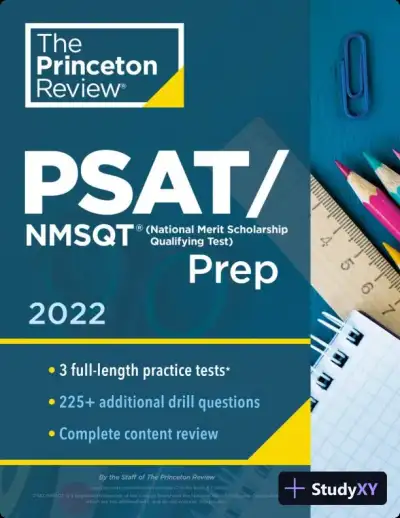 Certification Guides
Princeton Review PSAT/NMSQT Prep 2022 3 Practice Tests + Review and Techniques. (2022)
Preliminary Scholastic Aptitude Test
830 pages96downloadsFeb 2025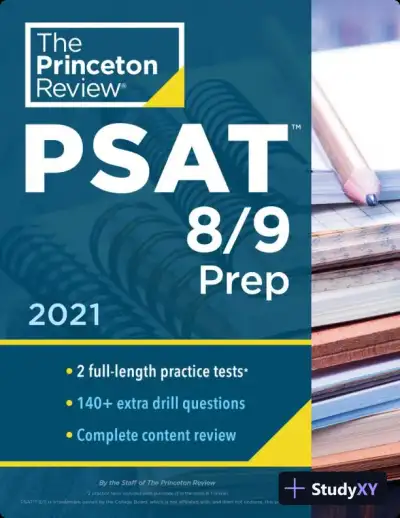 Certification Guides
Princeton Review PSAT 8/9 Prep (2021)
Preliminary Scholastic Aptitude Test
482 pages53downloadsFeb 2025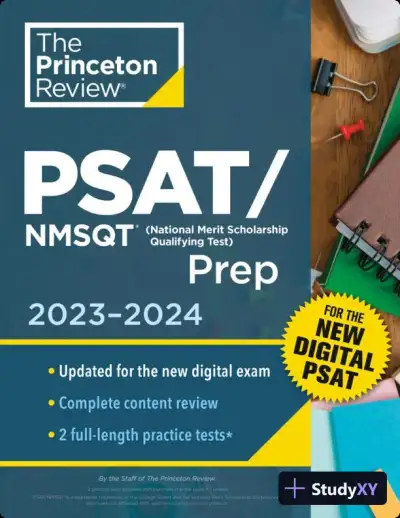 Certification Guides
Princeton Review PSAT/NMSQT Prep, 2023-2024 : 2 Practice Tests + Review for the NEW Digital PSAT (2023)
Preliminary Scholastic Aptitude Test
650 pages46downloadsFeb 2025
Study this document with CramX
Once it is in your library, every tool can work from it.