
QQuestionAccounting
QuestionAccounting
calculate the break-even point in units use the formula: Break-Even point (units) = Fixed Costs ÷ (Sales price per unit – Variable costs per unit) or in sales dollars using the formula: Break-Even point (sales dollars) = Fixed Costs ÷ Contribution Margin.
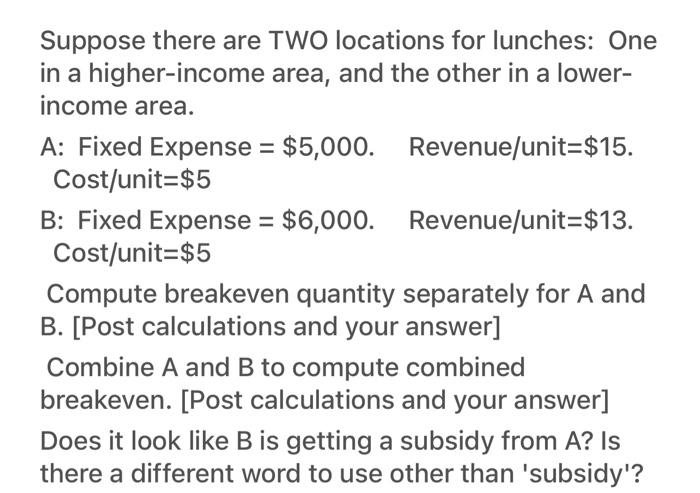
Suppose there are TWO locations for lunches: One in a higher-income area, and the other in a lower-income area.
A: Fixed Expense = \$5,000. Revenue/unit=\$15. Cost/unit=\$5
B: Fixed Expense = \$6,000. Revenue/unit=\$13. Cost/unit=\$5
Compute breakeven quantity separately for A and B. [Post calculations and your answer]
Combine $A$ and $B$ to compute combined breakeven. [Post calculations and your answer]
Does it look like B is getting a subsidy from A? Is there a different word to use other than 'subsidy'?
Attachments
10 months agoReport content
Answer
Full Solution Locked
Sign in to view the complete step-by-step solution and unlock all study resources.
Step 1:: Calculate the Break-Even Point (units) for location A using the formula: Break-Even point (units) = Fixed Costs ÷ (Sales price per unit – Variable costs per unit)
\text{Break-Even point (units) for A} = \$5,000 ÷ (\$15 - \$5)
Step 2:: Simplify the equation by first performing the subtraction inside the parentheses:
\text{Break-Even point (units) for A} = \$5,000 ÷ \$10
Step 3:: Divide to find the Break-Even Point (units) for location A:
\text{Break-Even point (units) for A} = 500
Step 4:: Calculate the Break-Even Point (units) for location B using the same formula:
\text{Break-Even point (units) for B} = \$6,000 ÷ (\$13 - \$5)
Step 5:: Simplify the equation by first performing the subtraction inside the parentheses:
\text{Break-Even point (units) for B} = \$6,000 ÷ \$8
Step 6:: Divide to find the Break-Even Point (units) for location B:
\text{Break-Even point (units) for B} = 750
Step 7:: Calculate the combined Break-Even Point (units) for locations A and B.
\text{Combined Contribution Margin} = \$10 \times (\text{units for A}) + \$8 \times (\text{units for B})
To do this, first calculate the combined Fixed Costs and the combined Contribution Margin.
Step 8:: Since we don't know the exact number of units for A and B at the combined Break-Even Point, let's call the number of units for A as x and the number of units for B as y.
\text{Combined Contribution Margin} = \$10x + \$8y
So, the combined Contribution Margin equation becomes:
Step 9:: Now, set up the combined Break-Even Point equation using the formula: Break-Even point (sales dollars) = Fixed Costs ÷ Contribution Margin.
\text{Combined Break-Even Point (sales dollars)} = \$11,000 ÷ (\$10x + \$8y)
Step 10:: Since we don't have enough information to find the exact values of x and y, we cannot calculate the combined Break-Even Point (sales dollars) for locations A and B.
\text{Combined Break-Even Point (sales dollars)} = \frac{11,000}{10x + 8y}
However, we can express it as a function of x and y:
Step 11:: To answer the question about whether location B is getting a subsidy from location A, let's analyze the Contribution Margin per unit for each location:
\text{Contribution Margin per unit for B} = \$13 - \$5 = \$8
Since the Contribution Margin per unit for location A is higher than that for location B, it can be said that location A is contributing more to the combined profit than location B. However, it is not accurate to say that location B is receiving a subsidy from location A. Instead, we can say that location A is more profitable than location B.
Final Answer
\text{Contribution Margin per unit for B} = \$13 - \$5 = \$8
Need Help with Homework?
Stuck on a difficult problem? We've got you covered:
- Post your question or upload an image
- Get instant step-by-step solutions
- Learn from our AI and community of students