

ACC 205 WEEK 4 DQ 1 Fraud Case Analysis: Key Control Weaknesses and Mitigation Strategies for Small Businesses
- Accounting
- National University
- 2 pages
- Shared May 2025
Analysis of fraud cases and mitigation strategies in small businesses.
Preview 2 of 2 pages
See the first 2 pages exactly as they appear in the document.
Page 1 Read page 1 as text
Fraud Case Analysis: Key Control Weaknesses and Mitigation Strategies for Small Businesses ACC 205 WEEK 4 DQ 1 Fraud Case 7 - 1 Levon Helm was a kind of one - man mortgage broker. He would drive around Tennessee looking for homes that had second mortgages, and if the criteria were favorable, he would offer to buy the second mortgage for “cash on the barrelhead.” Helm bought low and sold high, making sizable profits. Being a small operation, he employed one person, Cindy Patterson, who did all his bookkeeping. Patterson was an old family friend, and he trusted her so implicitly that he never checked up on the ledgers or the bank reconciliations. At some point, Patterson started “borrowing” from the business and concealing her transactions by booking phony expenses. She intended to pay it back someday, but she got used to the extra cash and couldn’t stop. By the time the scam was discovered, she had drained the company of funds that it owed to many of its investors. The company went bankrupt, Patterson did some jail time, and Helm lost everything. Requirements 1. What was the key control weakness in this case? 2. Many small businesses cannot afford to hire enough people for adequate separation of duties. What can they do to compensate for this? Fraud Case 7 - 1 Solution: 1. There was not separation of duties between cash disbursements and recording transactions in the
Page 2
More Accounting study materials
See all Solved Assignments
ACC 205 WEEK 2 DQ 2 Understanding the Accounting Cycle: Adjusting and Closing Entries
Accounting
2 pagesMay 2025 Solved Assignments
ACC 205: Week 2 Discussion - Ethical Issues and Adjusting Entries
Accounting
3 pagesMay 2025 Solved Assignments
ACC 205 Week 1 DQ 2 Debit and Credit
Accounting
4 pagesMay 2025 Solved Assignments
ACC 205: Week 1 Discussion - Ethical Issues in Financial Reporting
Accounting
2 pagesMay 2025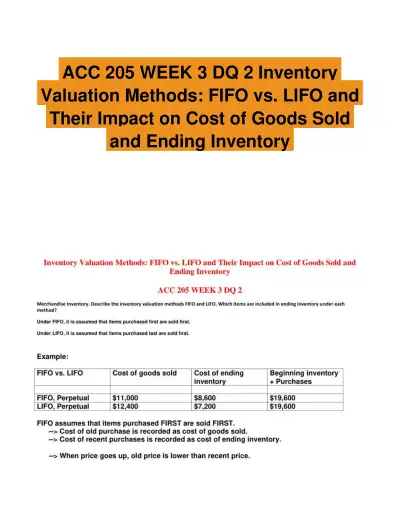 Solved Assignments
ACC 205 WEEK 3 DQ 2 Inventory Valuation Methods: FIFO vs. LIFO and Their Impact on Cost of Goods Sold and Ending Inventory
Accounting
2 pagesMay 2025 Textbook Guides
Introduction to Financial Accounting, 11th Edition Solution Manual
Accounting
524 pages173downloadsFeb 2025 Textbook Guides
Solution Manual For International Accounting, 4th Edition
Accounting
309 pages161downloadsFeb 2025 Textbook Guides
Solution Manual For Managerial Accounting, 7th Edition
Accounting
361 pages159downloadsFeb 2025
Study this document with CramX
Once it is in your library, every tool can work from it.