

ACC 300 Week 5 Final Exam Study Guide: Key Accounting Concepts and Principles
- Accounting
- University of Phoenix
- 9 pages
- Shared May 2025
Study guide for final exam on key accounting principles.
Preview 3 of 9 pages
See the first 3 pages exactly as they appear in the document.
Page 1 Read page 1 as text
ACC 300 Week 5 Final Exam Study Guide: Key Accounting Concepts and Principles ACC 300 Week 5 Final Exam Guide 1) Which of the following statements is true? A. Publicly traded U.S. companies must provide an annual report to their shareholders only when operating conditions change significantly. B. An unqualified independent auditor’s report must be included in the annual report. C. Notes to the financial statements do not need to be included in the annual report because that information is only for internal users. D. A Management Discussion and Analysis section is required in annual reports to shareholders even when financial results are positive. 2) Notes to the financial statements include which of the following: A. An independent auditors report. B. Explanations of uncertainties. C. Short - form Income Statement D. Subsidiary ledger for Accounts Receivable 3) Which of the following financial statements is divided into major categories of operating, investing, and financing activities? A. The income statement. B. The balance sheet. C. The retained earnings statement. D. The statement of cash flows 4) If the retained earnings account increases from the beginning of the year to the end of the year, then A. net income is less than dividends. B. a net loss is less than dividends. C. additional investments are less than net losses.
Page 2 Page 3 Read page 3 as text
D. net income is greater than dividends 5) If services are rendered on account, then A. assets will decrease. B. liabilities will increase. C. stockholders’ equity will increase. D. liabilities will decrease. 6) An investment by the stockholders in a business increases A. assets and stockholders’ equity. B. assets and liabilities. C. liabilities and stockholders’ equity. D. assets only. 7) Using accrual accounting, expenses are recorded and reported only: A. when they are incurred whether or not cash is paid. B. when they are incurred and paid at the same time. C. if they are paid before they are incurred. D. if they are paid after they are incurred 8) A small company may be able to justify using a cash basis of accounting if they have: A. sales under $1,000,000. B. no accountants on staff. C. few receivables and payables. D. all sales and purchases on account. 9) Stockholders’ equity can be described as claims of A. creditors on total assets. B. owners on total assets. C. customers on total assets.
6 more pages in the full document
Unlock it once and it stays in your library, ready to chat with or turn into flashcards.
Unlock the full documentMore Accounting study materials
See all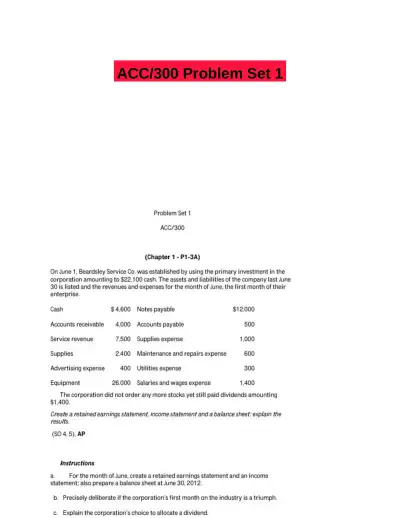 Solved Assignments
ACC/300 Problem Set 1
Accounting
7 pagesMay 2025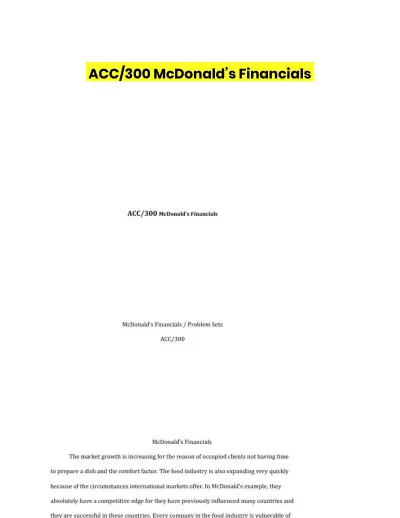 Solved Assignments
ACC/300 McDonald�s Financials
Accounting
8 pagesMay 2025 Textbook Guides
Introduction to Financial Accounting, 11th Edition Solution Manual
Accounting
524 pages173downloadsFeb 2025 Textbook Guides
Solution Manual For International Accounting, 4th Edition
Accounting
309 pages161downloadsFeb 2025 Textbook Guides
Solution Manual For Managerial Accounting, 7th Edition
Accounting
361 pages159downloadsFeb 2025 Class Notes
Class Notes For Advanced Accounting, 4th Edition
Accounting
149 pages159downloadsFeb 2025 Textbook Guides
Financial Accounting 6th Canadian Edition Solution Manual
Accounting
867 pages156downloadsFeb 2025 Textbook Guides
Accounting Theory, 7th Edition Solution Manual
Accounting
325 pages153downloadsFeb 2025
Study this document with CramX
Once it is in your library, every tool can work from it.