

Class Notes for College Accounting: A Practical Approach, 14th Edition
- Accounting
- 256 pages
- Shared February 2025
- 72 downloads
Master key topics with Class Notes for College Accounting: A Practical Approach, 14th Edition, your perfect class companion.
Preview 31 of 256 pages
See the first 31 pages exactly as they appear in the document.
Page 1 Read page 1 as text
College Accounting Fourteenth Edition Jeffrey Slater Mike Deschamps Instructor's Resource Manual for College A ccounting: A practical A pproach By Carolyn Strauch
Page 2 Page 3 Read page 3 as text
1-1 Chapter 1 Accounting Concepts and Procedures Chapter Overview The chapter begins with an introduction to accounting and the organizational forms of business: sole proprietorship s , partnerships, corporations , and limited liability companies . Learning Unit 1 - 1 has assets, liabilities, and equities defined and explained through examples and the accounting equation. Learning Unit 1 - 2 illustrates the steps necessary to prepare a balance sheet . Learning Unit 1 - 3 expands the accounting equation to include revenues, expenses, and withdrawals. Each element of the equation is further defined. A variety of transactions are analyzed along with their impact on the accounting equation. Learning Unit 1 - 4 discusses the income statement , the statement of owner’s equity, and the balance sheet. The accounting equation is used to illustrate how the income statement, statement of owner’s equity, balance sheet are developed and interrelated. The net income from the income statement is carried to the statement of owner’s equity, and the ending capital is carried from the statement of owner’s equity to the balance sheet . The demonstration problem and the solution tips help students record the effect of transactions on the accounting equation and to ultimately prepare financial statements. Learning Objectives After studying Chapter 1, your students should gain proficiency in the following: 1. Explain A ccounting, B usiness, and the A ccounting E quation . 2. Prepar e a B alance S heet . 3. Record T ransactions into the E xpanded A ccounting E quation . 4. Prepar e the T hree F inancial S tatements .
Page 4 Read page 4 as text
1-2 Chapter 1 Assignment Grid Estimated Level Learning Time in of Assignment Topic(s) Unit (s) Minutes Difficulty Discussion Questions and Critical Thinking/Ethical Case 1 Functions of Accounting 1 5 Easy 2 Types of Businesses 1 5 Medium 3 Business Classifications 1 5 Medium 4 Bookkeep ing and technology 1 5 Easy 5 Accounting equation 1 5 Easy 6 Capital 1 5 Easy 7 Accounting equation 1 5 Easy 8 Balance sheet 2 10 Medium 9 Account categories 3 5 Easy 10 Account categories 3 5 Easy 11 Account categories 3 5 Easy 12 Expenses 3 5 Medium 13 Income statement 4 5 Easy 14 Statement of owner’s equity 4 5 Easy 15 Ethical case 4 5 Medium Concept Checks 1 Classifying Accounts 1 5 Easy 2 The Accounting Equation 1 5 Medium 3 Shift versus Increase in Assets 1 5 Medium 4 The Balance Sheet 2 5 Easy 5 The Accounting Equation Expanded 3 5 Easy 6 Identifying Assets 2 5 Easy 7 The Accounting Equation Expanded 3 5 Medium 8 Preparing Financial Statements 4 5 Easy 9 Preparing Financial Statements 4 5 Easy Exercises ( Set A ) 1 A - 1 Accounting Equation 1 5 Easy 1 A - 2 Accounting Equation 1 5 Easy 1 A - 3 Balance Sheet 2 10 Easy 1 A - 4 Accounting Equation – Expanded 3 15 Medium 1 A - 5 Financial Statements 4 20 Medium Exercises ( Set B ) 1B - 1 Accounting Equation 1 5 Easy 1B - 2 Accounting Equation 1 5 Easy 1B - 3 Balance Sheet 2 10 Easy 1B - 4 Accounting Equation – Expanded 3 15 Medium 1B - 5 Financial Statements 4 20 Medium Problems (Set A) 1A - 1 Accounting Equation 1 15 Easy 1A - 2 Balance Sheet 2 15 Medium 1A - 3 Accounting Equation Expanded 3 20 Medium 1A - 4 Financial Statements 4 30 Medium 1A - 5 Financial Statements 3, 4 45 Hard
Page 5 Read page 5 as text
1-3 Estimated Level Learning Time in of Assignment Topic(s) Objective(s) Minutes Difficulty Problems (Set B) 1B - 1 Accounting Equation 1 15 Easy 1B - 2 Balance Sheet 2 15 Medium 1B - 3 Accounting Equation Expanded 3 20 Medium 1B - 4 Financial Statements 4 30 Medium 1B - 5 Financial Statements 3, 4 45 Hard Financial Report Problem Reading Amazon’s Annual Report 2 5 Easy Keeping It Real Suarez Computer Center 3, 4 45 Medium Learning Unit 1 - 1: Accounting, Business, and the Accounting Equation Summary : Accounting is the language of business . It provides financial information to users and helps the decision making process. The accounting process analyzes , records, classifies , summarizes, reports , and interprets financial information for decision mak ers . The four main categories of business organizations are (1) sole proprietorship s , (2) partnership s , (3) corporations , and limited liability companies . Business organizations can also be classified into service, merchandise , or manufacturing business es according to the need that they fulfill . Generally accepted accounting principles are the set of procedures and guidelines developed to assure the consistent preparation and interpretation of the accounting reports. The main difference between bookkeeping and accounting is the level of analysis and scope of duties . The basic accounting equation is presented as: Assets = Liabilities + Owner’s Equities. The assets are properties ( resources ) of value that the firm or business owns. Examples are cash, land, supplies, office equipment, buildings, and other properties of value . Liabilities are obligations that come due in the future or claims of the creditors to assets . An e xample is accounts payable. The owner’s equity is the rights or financial claim s to the assets of a business. The owner’s investment of equity is called capital. A shift in assets indicates that the makeup of the assets has changed, but the sum total of the assets remains the same. An increase of assets reflects an increase in the total amount of assets owned. Remember that the left - hand - side total of assets must always equal the right - hand - side total of liabilities and owner’s equity. Key Concepts : Accounting, sole proprietorship, partnership, corporation , limited liability company, service company, merchandise company, manufactur er , generally accepted accounting principles, International Financial Reporting Standards (IFRS) , bookkeeping, assets, equities, liabilities, creditor, owner’s equity, basic accounting equation, capital, supplies, shift in assets, accounts payable Lecture O utline : 1) Accounting is the language of business . It provides information to managers, owners, investors, government agencies, and others inside and outside the organization.
Page 6 Read page 6 as text
1-4 2) Businesses can be classified into one of four types of organization s: a) Sole Proprietorships are businesses that have one owner. i) Easy to form ii) Owner can lose personal assets to meet obligations of business iii) Ends with death of owner or closing of business b) Partnerships are businesses that have at least two owners. i) Easy to form ii) Partners could lose personal assets to meet obligations of partnership iii) Ends with death of partner or closing of business c) Corporations are businesses owned by stockholders. i) More difficult to form ii) Limited l imited personal risk – stockholders ’ loss is usually limited to their stock investment iii) Continues indefinitely d) Limited Liability Company (LLC) i) More difficult to form ii) Limited liability or limited personal risk – members’ loss is limited to their investment in the company iii) May end with death of member 3) Businesses can be classified into service, merchandise, and manufacturing businesses. a) Service company – Business that provides a service b) Merchandise company – Business that makes its own products or buys a product from a manufacturing company and sells it to its customers c) Manufacturer – Business that makes a product and sells it to its customers 4) Accounting (also called the accounting process) is a system that measures the activities of a business in financial terms, provides written reports and financial statements about those activities, and communicates these reports to decision makers and others. It does this by performing the following functions: a) Analyzing: looking at what happened in the past and how the business was affected b) Recording: Putting the information into the accounting system c) Classifying: Grouping all the same activities (e.g. all purchases) together d) Summarizing: Totaling the results e) Reporting: Issuing the statements that tell the results of the previous functions f) Interpreting: Examining the statements to determine how the various pieces of information they contain relate to each other g) Communication: Providing the reports and financial statements to people who are interested in the information, such as the business’s decision makers, investors, creditors, and government agencies 5) Difference between Bookkeeping and Accounting Bookkeeping is the recording function of the accounting process. Accounting uses the bookkeeping prepared information to prepare the financial statements used to analyze the company’s financial position . An accountant prepare s tax forms, prepare s budgets, and performs further analysis of financial information . 6) The accounting equation illustrates the relationship between assets, liabilities, and equities. a) Assets are properties (resources) of value owned by a firm: Assets = Liabilities + Owner’s Equity b) Equities are the rights or financial claim of creditors (liabilities) and owners (owner’s equity) who supply the assets to the firm . c) Liabilities are obligations that come due in the future. 7) A business transaction is an event that affects the financial position of a business and may be reliably recorded. 8) The accounting equation must balance after each business transaction is recorded.
Page 7 Read page 7 as text
1-5 Teaching Tips/ Strategy : The instructor may begin by discussing the accounting goals and the relationship with the business activities. In addition, the instructor can present the accounting function and how it helps business organizations identify key activities and help on the decision making process. To aid students in understand ing accounting, provide an example of how accounting can help in the decision making process. To explain business classification concepts, the instructor may use a group - based activity that consist s of listing familiar business names and indicate classification, category , and type of each business organization. This group - based interaction will aid in evaluating the level of understanding of this topic. Utilize as reference Table s 1. 1 and 1.2 for the students as example s of categories and classifications. Table 1.1 illustrates the business organizations and characteristic s of each organization , and Table 1.2 illustrates examples of Service, Merchandise, and Manufacturing Businesses . Teaching Tip s /Strategy : Utilize a group - based activity to aid in explaining the accounting equation elements . P resent familiar business organizations and identify what assets and liabilities they are likely to have. Concept Checks #1 and #2 can be used to assess the student’s knowledge of the accounting equation elements and account classification. Concept C heck #3 can aid in understanding the shift in assets versus the increase in assets. Exercises 1 - A1 and 1 - A2 are excellent as additional practice and/or homework assignment to evaluate the basic accounting equation understanding. Use the “Ten - Minute Quiz” questions #1, #2, #3, #4 and #5 to reinforce Learning Unit 1 - 1 Concepts. Learning Unit 1 - 2: The Balance Sheet Summary : The balance sheet or statement of financial position shows the financial position of a business as of a particular date. The balance sheet figures represent the basic accounting equation. The assets appear on the left - hand side of the statement while liabilities and owner’s equity appea r on the right - hand side Key Concepts : Balance sheet Le cture Outline : The b alance s heet is a statement, as of a particular date, that shows the amount of assets owned by a business as well as the amount of claims (liabilities and owner’s equit y ) against these assets . Statement of f inancial p osition is another name for a balance sheet. The proper form for the b alance s heet contains: a) Heading: the company name, the statement name, the statement date b) Shows asset s , liabilit ies , and equity amounts c) Dollar signs appear to the left of each column’s top figure and to the left of the column’s total d) A single underline appears above a total and a double underline appears beneath it e) It is important to align numbers f) P rovides a look at the financial position of the business T eaching Tips/Strategy : T he Exercise 1A - 3 is an excellent exercise to present and prepare a step - by - step balance sheet during lecture. Use the Figure 1 - 7 as reference for the proper presentation. As the exercise is finalized, comment on the various details of how the balance sheet has been presented ( moneta ry unit/ dollar signs, single and double underlines , and the alignment ) and why these particular details are essential to the reader . S tudents can comment or present their opinions / comment s on the financial situation of the business for which the balance sheet was prepared . Th is activity will enhance
Page 8 Read page 8 as text
1-6 the ir understanding of the basic elements of an accounting equation and help develop critical thinking and anal y t i cal skills . Exercise 1B - 3 is a good assignment to evaluate the student’s basic knowledge of the balance sheet statement and its proper presentation. Use the “ Ten - Minute Quiz” question s #7 and #10 to reinforce Learning Unit 1 - 2 Concepts. Learning Unit 1 - 3: The Accounting Equation Expanded: Revenue, Expenses, and Withdrawals Summary : As a part of doing business, all organizations earn revenue and incur expenses. A service company earns revenue when it provides services to its clients. When revenue is earned, the owner’s equity is increased. In effect, revenue is a subdivision of owner’s equity. A business’ s expenses are the costs the company incurs in carrying out necessary operations in its effort to generate revenue. Expenses are also a s ubdivision of owner’s equity . W hen expenses are incurred, they decrease owner’s equity. Expenses can be paid for in cash or they can be charged. When revenue totals more than expenses, the result is called net income . W hen expenses total more than revenue , the result is net loss . When owners need to withdraw cash or other assets from the business to pay living or other personal expenses that do not relate to the business, the transaction will be recorded in an account called withdrawals or owner’s drawing account. The w ithdrawals account is a s ubdivision of owner’s equity that records personal expenses not related to the business. Hence, w ithdrawals result in a decrease in the owner’s equity (see Figure 1. 3 ). It is important to remember the difference between expenses and withdrawals. Expenses relate to business operations . W ithdrawals are the result of personal needs outside the normal operations of the business. All business transactions are recorded in the expanded accounting equation that include withdrawals, revenues, and expenses. Key C oncepts : C ash basis, accrual basis, revenue, accounts receivable, expense, net income, net loss, withdrawal s , expanded accounting equation Lecture O utline : 1) The accounting equation expands to include revenue, expenses, and withdrawals: Assets = Liabilities + Capital - Withdrawals + Revenue - Expenses. a) Revenue is earned by a company when it provides services for its clients or sells goods to its customers . b) Expenses are the costs the company incurs in carrying on operations in its effort to create revenue. c) Net Income occurs when total revenues are greater than expenses. Net Loss occurs when total expenses are greater than revenues. d) Withdrawals are the recording of the owner’s withdrawing cash or other assets from the business to pay living or other personal expenses that do not relate to the business. 2) The owner’s equity portion of the accounting equation expands to illustrate beginning capital plus additional investment from owners, plus revenues, less expenses, and less withdrawals. 3) Various transactions are used to illustrate the transactional effects on the accounting equation. Teaching Tips/Strategy : Use as a lecture demonstration the“ Success Coach ” LU 1 - 3 Do It Right Now Check u p” (end of the chapter) to reinforce the Learning Unit 1 - 3 concepts.
Page 9 Read page 9 as text
1-7 Learning Unit 1 - 4: The Three Financial Statements Summary : The financial statements present how well the business has performed over a specific period of time. An income statement is an accounting statement that shows business results in terms of revenue and expenses. If revenues are greater than expenses, the report shows net income. If expenses are greater than revenues, the report shows net loss. An income statement typically covers 1, 3, 6, or 12 months. The statement shows the result of all revenues and expenses throughout the entire period and not just as of a specific date. An example income statement for Jess Bora’s Computer Consulting business is shown in Figure 1. 4 . The second statement , the statement of owner’s equity , shows for a certain period of time what changes occurred in the capital account . E xample s of the statement of owner’s equity are shown in Figure 1. 5 and Figure 1.6 . The third statement , the balance sheet , utilizes the expanded accounting equation (see Figure 1. 7 ) to present the asset accounts (cash, accounts receivable, and computer equipment) appear on the left side of the balance sheet , and the a ccounts payable and capital accounts appear on the right side. The ending balance of capital can be calculated within the accounting equation or can be found on the statement of owner’s equity as the ending capital amount . Key C oncepts : Income statement, statement of owner’s equity, ending capital Lecture Outline : 1) The accounting equation maintains totals for each component of the equation. 2) The Income Statement is an accounting statement that shows business results in terms of revenue and expenses for a specific time period. The proper form for the income statement : a) Cannot cover more than one year b) Heading – the company name, the statement name, the period covered by the statement c) Shows revenue, expenses, and net income or net loss d) Revenue is listed first e) Expenses are listed in alphabetical order, from largest amount to smallest, or a pattern established by the accountant f) Net income or net loss is the difference between revenue and expenses 3) The Statement of Owner’s Equity shows changes in capital. Proper form for the statement of owner’s equity includes: a) Heading – the company name, the statement name, the period covered by the statement b) Shows the beginning equity balance, investments by owner, net income or net loss, withdrawals by owner, and the ending equity balance 4) The Balance Sheet illustrates the balance in the accounting equation: assets equal liabilities plus owner’s equity. This statement was addressed earlier in the chapter. Teaching Tips/Strategy : Use the Exercise 1A - 5 as a classroom demonstration to reinforce the proper form and procedures while completing financial statements. Explain the relationship between the stateme n ts with an example such as a n “ A mazing R ace” or “ a scavenger hunt ” game. T he clu es fr o m the statement are needed to complete the rest of the statements . T he net income ( income statement ) is needed for the statement of owner’s equity ending balance . T he ending balance of the capital ( statement of owner’s equity ) is needed to complete the equity section of the balance sheet . The Exercise 1B - 5 is an excellent way to complete a team - based activity to reinforce this objective. Use the “ Ten - Minute Quiz” question s #7, #8, #9 and #10 to reinforce Learning Unit 1 - 4 Concepts.
Page 10 Read page 10 as text
1-8 Teaching Tips/Strategy : Each chapter contains a Try It! at the end of each Learning Unit. The Try its! are intended as practice for students and/or as checking of student understanding. There is also a Demonstration Summary Problem with each chapter to provide an overview of all the chapter concepts. Students can study and review these problem s to view how all the chapter concepts fit together.
Page 11 Read page 11 as text
1-9 Name Date Section CHAPTER 1 TEN - MINUTE QUIZ Circle the letter of the best response. 1. Select the accounts affected by the following transaction: TJ Rex invests $50,000 to open a music store. a. Assets and Owner’s Equity b. Assets and Liabilities c. Liabilities and Owner’s Equity d. Capital and Owner’s Equity 2. Select the accounts affected by the following transaction: TJ Rex uses credit to buy musical instruments to sell in the store. a. Assets and Owner’s Equity b. Assets and Liabilities c. Liabilities and Owner’s Equity d. Capital and Owner’s Equity 3. Select the accounts affected by the following transaction: TJ Rex provides guitar lessons for $25 cash. a. Cash and Accounts Payable b. Cash and Revenue c. Accounts Receivable and Revenue d. Cash and Expenses 4. Select the accounts affected by the following transaction: TJ Rex receives $100 for previous lessons provided on account. a. Cash and Accounts Receivable b. Cash and Revenue c. Accounts Receivable and Revenue d. Cash and Expenses 5. Select the accounts affected by the following transaction: TJ Rex receives the utility bill but will wait and pay it next month. a. Cash and Accounts Receivable b. Cash and Revenue c. Accounts Receivable and Revenue d. Accounts Payable and Expenses 6. Which of the following is not an asset? a. Cash b. Land c. Mortgage Payable d. Patents
Page 12 Read page 12 as text
1-10 7. Which of the following is reported on the balance sheet? a. Accounts Payable b. Fees Earned c. Depreciation Expense d. Withdrawals 8. Which of the following is represented on the income statement? a. Cash received from sale of equipment b. Accounts Payable c. Office Equipment d. Net loss 9. Which of the following will not appear on the statement of owner’s equity? a. Net income b. Withdrawals c. Capital d. Fees Earned 10. Which financial statement illustrates the accounting equation? a. Statement of Owner’s Equity b. Income Statement c. Balance Sheet d. Statement of Cash Flows Answer K ey to Chapter 1 Quiz 1. a 2. b 3. b 4. a 5. d 6. c 7. a 8. d 9. d 10. c
Page 13 Read page 13 as text
2-1 Chapter 2 Debits and Credits: Analyzing and Recording Business Transactions Chapter Overview This chapter transitions from analyzing transactions and listing each account in a potentially long accounting equation to double entry accounting. There are five steps used to analyze a transaction: 1) determin ing which accounts are affected; 2) determining which categories the accounts belong to (asset s , liabilities , capital, wit hdrawals, revenue, or expenses); 3) determining whether the accounts increas e or decrease; 4) using the debit and credit rules to determine if the result of step s 2 and 3 results in a journal entry debit or credit; and 5) computing the balance in the T account. T accounts are used to illustrate debits and credits and how to evaluate each account’s balance. A T account is a simpler way to illustrate an account. It has a debit and credit side and can be used to compute the balance in that account. Several examples are used to illustrate transaction analysis and the resulting journal entry and T account balance. N ext , how to use the balances in the T accounts to prepare a trial balance is illustrated . A trial balance is a listing of a company’s accounts and its resulting debit or credit balance in the proper debit or credit column. The information from the trial balance is used to prepare financial statements. Finally, the interrelationship between the financial statements is emphasized. The income or loss from the income statement is carried to the statement of owner’s’ equity. The ending balance in the statement of owner’s equity is carried to the balance sheet. Learning Objectives After studying Chapter 2, your students should gain proficiency in the following: 1. Explain T Accounts and H ow to Foot and Balance . 2. Use a Chart of Accounts to Record Transactions in T Accounts According to the Rules of Debits and Credits. 3. Prepar e a Trial Balance and the Financial Statements .
Page 14 Read page 14 as text
2-2 Chapter 2 Assignment Grid Estimated Level Learning Time in of Assignment Topic(s) Objective(s) Minutes Difficulty Discussion Questions and Critical Thinking/Ethical Case 1 Define ledger 1 5 Easy 2 Debit 1 5 Easy 3 Footings 1 5 Easy 4 Accounting cycle 2 5 Easy 5 Transaction Analysis Chart 2 5 Easy 6 Transaction Analysis Chart 2 5 Easy 7 Double Entry bookkeeping 2 5 Easy 8 Trial Balance 3 5 Easy 9 Financial Statements 3 5 Easy 10 Financial Statements 3 5 Easy 11 Trial Balance 3 5 Medium Concept Check s 1 The T account 1 5 Easy 2 Transaction Analysis 2 5 Easy 3 Transaction Analysis 2 5 Easy 4 Trial Balance 3 5 Easy 5 Trial Balance/ Financial Statements 3 10 Easy Exercises (Set A) 2A - 1 Chart of accounts 2 10 Easy 2A - 2 Transaction analysis 2 5 Easy 2A - 3 Transaction analysis 2 5 Easy 2A - 4 Account analysis 2 20 Medium 2A - 5 Financial Statements 3 20 Medium Exercises ( Set B ) 2B - 1 Chart of accounts 2 10 Easy 2B - 2 Transaction analysis 2 5 Easy 2B - 3 Transaction analysis 2 5 Easy 2B - 4 Account analysis 2 20 Medium 2B - 5 Financial Statements 3 20 Medium P roblems (Set A) 2A - 1 Transaction Analysis 2 2 0 Medium 2A - 2 Transaction Analysis 2 2 0 Medium 2A - 3 Trial Balance 1, 3 20 Medium 2A - 4 Financial Statements 3 40 Hard 2A - 5 Transactions, Trial Balance, & Financial Prep 2, 3 60 Hard P roblems (Set B) 2B - 1 Transaction Analysis 2 20 Medium 2B - 2 Transaction Analysis 2 20 Medium 2B - 3 Trial Balance 1, 3 20 Medium 2B - 4 Financial Statements 3 40 Hard 2B - 5 Transactions, Trial Balance, & Financial Prep 2, 3 60 Hard
Page 15 Read page 15 as text
2-3 Estimated Level Learning Time in of Assignment Topic(s) Objective(s) Minutes Difficulty Financial Report Problem Reading Amazon’s Annual Report 2 5 Easy Keeping It Real Suarez Computer Center 1, 2, 3 60 Medium Learning Unit 2 - 1: The T Account and How to Foot and Balance Summary : The T account is a tool to demonstrate the increase s and decreases in each account. The T account is a skeleton version of a standard account. A standard account form is the formal structure required for each account. All T accounts have three parts: account title, debit (left) and credit (right). The T accounts are footed to determine the balance or ending balance for the specific account. Foot is to (sum) add all debits and add (sum) all credits , and footing is totaling each individual column. The column balances are subtracted to compute the final total or ending balance for each account. The ending balance is always presented on the bigger or normal side . To record transactions, the accountant determines which accounts are credited or debited utilizing the debit and credit rules. The double - entry bookkeeping is an accounting system in which the recording of each transaction affects two or more accounts . Y ou must include at least one debit and one credit per transaction, and the total amount of debits is equal to the total amount of credits. Key Concepts : account, standard account, ledger, T account, debit, credit, footings, ending balance Lecture Outline : 1) Each transaction is recorded in the accounting equation under specific accounts: assets, liabilities , capital, withdrawals , revenue, expenses , and so on . 2) Accounts are used to record increases and decreases of business transactions relating to individual elements of the accounting equation: a) assets, b) liabilities, c) capital, d) withdrawals, e) revenue, f) and expenses. 3) The subdivisions or account categories (account classification) are: a) asset accounts, b) liability accounts, c) owner’s equity accounts, d) revenue accounts, e) and expense accounts. 4) The standard account form includes: a) columns for date, b) explanation, c) posting reference, d) debit, e) credit,
Page 16 Read page 16 as text
2-4 f) and total columns. 5) The ledger has all the individual accounts, and all transactions affecting an account are recorded on the form. a) A ledger is a book of accounts that records data from business transactions. b) Prepared manually in a traditional accounting format. c) Ledger accounts in a computerized system are updated automatically by software. 6) For simplicity sake, use the T account form for demonstration purposes. T account simple form includes: a) the title, which expresses the name of the account b) debit (left) side or Dr. c) credit (right) side or Cr. 7) Footing: (the totals for each column) a) process of adding all items on the debit side, b) adding all items on the credit side c) calculate the T account ending balance. d) Balance the difference between the amounts on each side of the T account. i) Total the debits (Dr.) ii) Total the credits (Cr.) iii) Subtract the debits and credits iv) The ending balance will be on the side that ha s the greater number. Teaching Tips/Strategy : Use the “ Success Coach ” LU 2 - 1 to assess the understanding of the following concepts: T account, rules of debit and credit, and the account normal balance. Explain the basic accounting equation elements (Assets = Liabilities + Equity) and how the debit and credits are presented. For example: items to the left of the equal sign are assets. Normally the assets will increase by the left or debit. Items to the right of the equal sign, such as liabilities and equity, increase by the right. The subdivisions of equity (revenue, expenses, capital and withdrawal s ) will increase or decrease based on their relationship to equity. The revenue or capital accounts, will increase the equity . T herefore, the account increases by the right or credit. If the account is an expense or a withdrawal, it decreases equity . T he account increases by left or debit. For lecture practice, utilize the Concept Check # 1 to use T accounts to foot and balance each account . Use the “Ten - Minute Quiz” question #2 to reinforce T accounting concepts . Learning Unit 2 - 2 : The Chart of Accounts: Recording Transactions in T Accounts According to Rules of Debits and Credits. S ummary : The accounting recording process starts with a business transaction , an exchange between two or more parties , sharing items of equal value. The double - entry analysis of transactions presents two or more accounts that are affected and the total of debits and credits that are equa l . This double - entry system helps in checking the recording of business transactions. All business transa ctions are recorded in accounts . An account is a tool used to record and summarize the effect s of the organization’s transactions . T he basic accounting equation contains the following account categories: assets, liabilities, capital, withdrawals, revenues and expenses . The chart of accounts is a system of accounts that summarize s increases and decreases of all individual accounts . This numbering system of accounts allows accounts to be located quickly . F or example, 100s are assets, 200s are liabilities, 300s are equity, 400s are revenues and 500s are expense s ( See Table 2.2) . A compound entry is a transaction that involves more than one debit or more than one credit .
Page 17 Read page 17 as text
2-5 The debit and credit rules are: all assets increase by debit side (left) and decrease by credit side (right), liabilities increase by credit side (right) and decrease by debit side (left), and equity accounts increase by credit side (right) and decrease by debit side (left). The equity subdivisions or categories will use the debit and credit rules to present the effect on the organization’s equity. The equity subdivision rules are: 1. Revenues increase the organization’s equity in the business. Revenue accounts increase by credit and decrease by debit (same as the equity). 2. The expenses decrease the organization’s equity. Therefore, all expense accounts will increase by debit and decrease by credit. (Note that any item that decreases the equity, the behavior is opposite to the main equity account.) 3. Capital accounts increase the organization’s equity. Therefore, any capital transaction will increase by credit and decrease by debit. Withdrawals by owner decrease the organization’s equity. Therefore, any withdrawal increases are recorded on the debit side. Key C oncepts : normal balance of an account, chart of accounts, compound entry, double - entry bookkeeping Lecture Outline : 1) Refer to Table 2.1 for the rules of debit and credit using T accounts affecting the accounting equation . a) For assets increases are on the debit (left) side. b) For liabilities increases are on the credit (right) side. c) For capital increases are on the credit (right) side. d) For revenue increases are on the credit side which is the same as for capital. e) For withdrawals and expenses increase s are on the debit side which is the opposite of how capital increases are. f) A normal balance of an account is the side that increases by the rules of debit and credit. g) The accounting equation balance must be maintained when transactions occur. 2) A chart of accounts is a numbered list of all of a business’s accounts. a) Assets use 100s (as an example). b) Liabilities use 200s. c) Owner’s Equity uses 300s. d) Revenues use 400s. e) Expenses use 500s. 3) Transaction analysis: f ive steps: a) Determine which accounts are affected. b) Determine which categories the accounts belong to : assets, liabilities, capital, withdrawals, revenue, or expenses. c) Determine whether the accounts increase or decrease. d) What do the rules of debit and credit say? e) What does the T account look like? 4) Compound entry is a transaction involving more than one debit or credit. 5) Double - entry bookkeeping refers to an accounting system in which the recording of each transaction affects two or more accounts , and the total of the debits is equal to the total of credits. Teaching Tips/Strategy : Use the “ Su c cess Coach” LU 2 - 2 (end of the chapter) to review the debit and credit rules. After review ing the concept s , complete the Concept Check s # 2 and #3 to check the debit and credit rules . Exercises 2A - 1, 2A - 2, 2A - 3, and 2A - 4 are excellent classroom practice to reinforce the objective # 2 concepts. Use the “Ten - Minute Quiz” questions #1 - #5 to reinforce the L earning O bjective # 2.
Page 18 Read page 18 as text
2-6 Learning Unit 2 - 3: The Trial Balance and Preparation of Financial Statements Summary : The trial balance is a list of all accounts with their balances in the same order as they appear in the chart of accounts. A trial balance is not a financial statement although it is used to prepare financial statements. A trial balance is a listing of each account with each account balance listed in its proper debit or credit column. Balances on the trial balance are taken directly from footings and ending balances on the T accounts. The total of the debit column should equal the total of the credit column. The financial statements include : income statement, statement of owner’s equity, and the balance sheet. All financial statements have two columns. The columns are used for subtotals and NOT for debit and credit format. There are no debits and credits on the financial statements. The income statement summarize s the revenues and expenses to calculate the net income or net loss . The statement of owner’s equity updates the ending capital balance for the period . It includes the beginning and ending balances of capital accounts, the net income or net loss , and the withdrawals account. The balance sheet is the representation of the accounting equation as the last day of the period or as a “snapshot”. The b alance sheet includes all assets, liabilities , and the ending balance of equity. Key Concepts : T rial balance Lecture Outline : 2) The trial balance: a) is a list of all accounts with their balances , b) the order of accounts is the same as they appea r in the chart of accounts, c) is not a financial statement but is a tool used to prepare financial statements, d) is a list of ending balances from the ledger, e) and the total of the debit column should equal the total of the credit column. 6) Preparing financial statements: a) All financial statements are related: i) the net income or net loss from the income statement flows to the statements of owner’s equity, ii) the ending balance of capital on the owner’s equity statement flow s to the balance sheet. b) The dollar sign or currency sign is used at the top of each column and on the final total amounts. c) One underline represents a list to subtotal d) Two underlines represent the end of the statement or the final “bottom line” number. 7) The I ncome S tatement: ( is generally prepared first) f) includes revenues and expenses g) includes gains or losses h) Net Income – revenues are greater than expenses. (Revenues – Expenses) i) Net Loss – expenses are greater than revenues. (Expenses – Revenues) j) The net income or net loss is carried to the s tatement of o wner’s e quity . 8) The S tatement of Owner’s Equity: a) Start with the capital balance as of the beginning of the period b) Add: Net income (from the income statement) c) Add: additional investments from the owners d) Deduct : Net Loss (from the income statement) e) Deduct : any withdrawals f) Calculate the new ending balance for the capital account or owner’s equity. g) The new balance for owner’s equity is carried to the Balance Sheet. 9) The Balance Sheet:
Page 19 Read page 19 as text
2-7 a) Lists all assets, liabilities and the new equity or capital account balance. b) The total of assets = total of liabilities and equity. Teaching Tips/Strategy : U se the “ Success Coach” LU 2 - 3 to review trial balance and financial statement concepts . After review ing the concepts , complete the Concept Check s #4 to illustrate the process needed to build a t rial b alance . The instructor can use the Concept Check #5 as a demonstration exercise to explain the importance of accounts and the proper classification within the financial statements. Exercises 2A - 5 and 2B - 5 are excellent classroom practice to reinforce the objective # 3 concepts. Use the “ Ten - M inute Quiz” questions #7, #8, #9 and #10 to reinforce the Learning Unit 2 - 3 concepts. Teaching Tips/Strategy : Each chapter contains a Try It! at the end of each Learning Unit. The Try its! are intended as practice for students and/or as checking of student understanding. There is also a Demonstration Summary Problem with each chapter to provide an overview of all the chapter concepts. Students can study and review this problem to view how all the chapter concepts fit together.
Page 20 Read page 20 as text
2-8 Name Date S ection CHAPTER 2 TEN - MINUTE QUIZ Circle the letter of the best response. 1. A lthough debits increase assets, they also a. increase revenues b. increase expenses c. increase owner's equity d. increase liabilities 2. The right side of a T account is the a. increase side b. decrease side c. credit side d. debit side 3. A compound entry is a. an entry involving more than one debit or credit b. an entry involving multiple transactions c. an entry involving more than one date d. an entry increasing and decreasing the same account 4. Which of the following accounts has a normal debit balance? a. Mia Wong, Capital b. Cash c. Accounts Payable d. Fees Earned 5. Which of the following accounts has a normal credit balance? a. Office Equipment b. Salaries Expense c. Accounts Receivable d. Accounts Payable 6. Payment of salaries to employees is recorded as a (n) a. asset b. liability c. revenue d. expense 7. The trial balance a. shows the income earned during the year b. shows the total amount of assets c. shows the accuracy of the general ledger d. is the first financial statement prepared 8. Which account is shown on the balance sheet? a. Cash b. Utilit ies Expense
Page 21 Read page 21 as text
2-9 c. Withdrawals by owner d. Revenue 9. Which account is shown on the income statement? a. Equipment b. Owner, Capital Account c. Accounts Payable d. Rent Expense 10. Which account is shown on the statement of o wner's e quity ? a. Fees Earned b. Accounts Receivable c. Owner , W ithdrawals d. Accounts Payable Answer K ey to Chapter 2 Quiz 1 . b 2 . c 3 . a 4 . b 5 . d 6 . d 7 . c 8 . a 9 . d 10 . c
Page 22 Read page 22 as text
3-1 Chapter 3 Beginning the Accounting Cycle Chapter Overview The chapter begins by explaining the accounting cycle is the accounting procedures performed over a period of time and t he accounting cycle takes place over a period of time called a fiscal year. The accounting cycle has several steps: the transaction occurs, is analyzed, recorded as a journal entry in the general journal, and posted to the general ledger. The information in the general ledger is used to prepare the trial balance. While the trial balance is not a formal financial statement, it is used to prepare formal financial statements: the income statement, the statement of owner’s equity, and the balance sheet. Transaction analysis is used to understand how to record a business transaction as a journal entry. Examples of increasing assets, decreasing liabilities, increasing expenses, etc. are used to illustrate the many possible types of journal entries. Posting the same journal entries to the general ledger is then illustrated. A trial balance is prepared from the general ledger information while the text also explains ways to troubleshoot if the trial balance does not balance. Demonstration Problems illustrate the entire process and offer tips to journalizing and posting . Learning Objectives After studying Chapter 3, your students should gain proficiency in the following: 1. A nalyz e and R ecord B usiness T ransactions into a J ournal . 2. Posting to the L edger . 3. Preparing the T rial B alance.
Page 23 Read page 23 as text
3-2 Chapter 3 Assignment Grid Estimated Level Learning Time in of Assignment Topic(s) Objective(s) Minutes Difficulty Discussion Questions and Critical Thinking/Ethical Case 1 Accounting Cycle 1 5 Easy 2 Accounting Period 1 5 Easy 3 Accounting Period 1 5 Easy 4 Interim Financial Stmts. 1 5 Easy 5 General Ledger 2 5 Easy 6 Posting and Balancing 2 5 Easy 7 General Journal 1 5 Easy 8 General Journal 1 5 Easy 9 Posting and Balancing 2 5 Medium 10 Posting and Balancing 2 5 Easy 11 Posting and Balancing 2 5 Medium 12 Posting and Balancing 2 5 Medium 13 Accounting Errors 3 5 Medium 14 Ethical Issue 3 5 Medium Concept Checks 1 General Journal 1 5 Easy 2 General Journal 2 5 Easy 3 Posting and Balancing 2 5 Easy 4 Trial B alance 3 15 Medium 5 Correcting Entry 3 5 Easy Exercises (Set A) 3A - 1 Journal Entries 1 10 Easy 3A - 2 Journal Entries 1 10 Easy 3A - 3 Posting 2 10 Easy 3A - 4 Journalizing, Posting, Trial Balance 1, 2, 3 20 Medium 3A - 5 Trial Balance 3 15 Medium 3A - 6 Error C orrection 3 10 Medium Exercises (Set B) 3B - 1 Journal Entries 1 10 Easy 3B - 2 Journal Entries 1 10 Easy 3B - 3 Posting 2 10 Easy 3B - 4 Journalizing, Posting, Trial Balance 1, 2, 3 20 Medium 3B - 5 Trial Balance 3 15 Medium 3B - 6 Error C orrection 3 10 Medium Problems (Set A) 3A - 1 Journalizing 1 30 Medium 3A - 2 Journalizing, Posting, Trial Balance 1, 2, 3 45 Hard 3A - 3 Journalizing, Posting, Trial Balance 1, 2, 3 45 Hard Problems (Set B) 3B - 1 Journalizing 1 30 Medium 3B - 2 Journalizing, Posting, Trial Balance 1, 2, 3 45 Hard 3B - 3 Journalizing, Posting, Trial Balance 1, 2, 3 45 Hard
Page 24 Read page 24 as text
3-3 Estimated Level Learning Time in of Assignment Topic(s) Objective(s) Minutes Difficulty Financial Report Problem Reading Amazon’s Annual Report 3 5 Easy Keeping It Real Suarez Computer Center 1, 2 , 3 45 Medium Computerized Accounting Application Sage 50 Software Simulation – Workshop 1 Atlas Company QuickBooks Software Simulation – Workshop 1 Atlas Company C hapter 3 Beginning the Accounting Cycle Summary : The accounting cycle consists of normal accounting procedures that take place over a period of time. The cycle begins with the recording of business transactions into a journal and ends with the completion of a post - closing trial balance. The accounting period is the span of time in which the accounting cycle takes place. Although the accounting period may var y , u sually , it is one year long. The fiscal year is the 12 - month period a business chooses for its accounting year. The calendar year is the 12 - month period between January 1 and December 31. The natural business year is the business’s fiscal year that ends at the same time as a slow seasonal period begins. While yearly financial statements are prepared at the end of the fiscal year, interim reports are prepared during the fiscal year. Interim financials may be prepared monthly, quarterly, or over other time periods deemed appropriate by management. Learning Unit 3 - 1: Analyzing and Recording Business Transactions into a Journal (Steps 1 and 2 of the Accounting Cycle) Summary : The General Journal is the simplest journal and records transaction information in chronological order according to the transaction date. This journal records the journal entry in its entirety. The general journal is the record of business transactions and is organized in chronological order according to the transaction date. The J ournal is the first formal record of a business transaction occurring and is also called the book of original entry and the Ledger is consider ed the book of final entry. As transactions occur, they are summarized into accounting form and recorded as a journal entry in the general journal. Compound journal entries are entries that have more than one debit and/or credit. Key C oncepts : A ccounting cycle, accounting period , calendar year, interim reports , journal, journal entry, journalizing, book of original entry, book of final entry , compound journal entry Lecture Outline : 1. General journal or Journal: a. is the simplest form of a journal b. records information in chronological order as they occur c. links the debit and credit parts of transactions together
Page 25 Read page 25 as text
3-4 d. called the “book of original entry” e. records the first formal information about business transactions f. the journal and the ledger are separate books 2. Journal entry : a. The format that transaction s (debits and credits) are recorded once it is analyzed. b. Journal entries rules: i. The debit portion of the transaction is always recorded first . ii. The credit portion of a transaction is indented a ½ inch and placed below the debit portion . iii. The explanation of the journal entry follows immediately after the credit and 1 inch from the date column. iv. One line space follows each transaction and explanation. v. Finally, as always, the total amount of debits must equal the total amount of credits. 3. Journalizing : a. The process of recording a transaction entry into the general journal. 4. Compound journal entry : a. A journal entry that affects more than two accounts on the debit or the credit side. 5. The se are examp les of the most common types of business transactions: a. T he owner investing cash (asset) in the business. (Fig. 3.2 on page 6 8 ) Dr. Cash XX Cr. Capital XX Initial investment by the owner b. The purchase of equipment with a down payment (cash) and the rest on credit . (Fig.3.3 on page 6 8 ) This is an example of a compound entry: a journal entry that affects more than two accounts on the debit or the credit side. Dr. Computer Equipment XX Cr. Cash XX Cr. Accounts Payable XX Purchase of computer e quipment c. P repayment of rent with cash (Fig. 3.4 on page 6 9 ) . Dr. Prepaid Rent (asset) XX Cr. Cash XX Rent p aid in advance d. P urchasing of computer supplies on account (Fig. 3.5 on page 6 9 ). Dr. Computer Supplies (asset) XX Cr. Accounts Payable XX Purchase computer supplies on account e. R ecording of fees earned (revenue) and ( cash ) received (Fig. 3.6 on page 6 9 ). Dr. Cash XX Cr. Graphic Design Fees ( r evenue ) XX Cash received for service s rendered f. R ecording of salaries paid (Fig. 3.7 on page 70 ). Dr. Office Salaries Expense XX Cr. Cash XX Payment of office salaries g. R ecei ve advertising bill (but unpaid) (Fig. 3.8 on page 70 ) Dr. Advertising Expense XX Cr .Accounts Payable XX Receive the advertising bill h. W ithdrawal of funds (cash) for personal use (Fig. 3.9 on page 70 )
Page 26 Read page 26 as text
3-5 Dr. Withdrawal s XX Cr. Cash XX Owner withdraws cash for personal use i. R ecording of fees earned (revenue) but not received (accounts receivable). (Fig. 3.10 on page 71 ) Dr. Accounts Receivable XX Cr. Graphic Design F ees (revenue) XX Bill customer for fees earned j. Payment of office salaries (Fig. 3.11 on page 71 ) Dr. Office Salaries Expense XX Cr. Cash XX Payment of office salaries k. P artial payment (cash) of an amount owed (accounts payable) . (Fig 3.12 on page 71 ) Dr. Accounts Payable XX Cr. Cash XX Paid half of the amount owed l. P ayment of the telephone bill (Fig. 3.13 page 72 ) . Dr. Telephone Expense XX Cr. Cash XX Payment of the telephone bill Teaching Tips/ Strategy : As classwork, your students should complete the L earning U nit 3 - 1 Try It! and discuss the Demonstration Summary Problem ( p age 83 ) to review the basic con cepts . Indicate and distinguish ke yword included on each transaction to facilitate the recording process. Example of transactions keywords are: Paid – indicate a check or a payment done = cash is decrease d (credit) Fees earned - indicate revenue was earn ed = revenue increases (credit) Cash received – indicate customers paid the business = cash increases (debit) Owner invested - the equity of the owner increase s (credit) Personal use – indicate the owner took cash or property from the business = withdrawal debit Purchase on account – asset purchase on credit = accounts payable increase s (debit) Payment of a debt – satisfying a debt, not purchasing again = accounts payable (debit) The Exercises 3A - 1 and 3A - 2 are excellent to teach how to a nalyz e transactions and complete journal entries. Problem 3A - 1 is a comprehensive problem to assess the full understanding of the learning objective concept . Review the “ Success Coach LU 3 - 1” ( page 87 ) and the “ Ten - M inute Quiz” questions #3 - #10 to reinforce the Learning Objective 3 - 1 concepts. Learning Unit 3 - 2: Posting to the Ledger (Step 3 of the Accounting Cycle) Summary : The transactions from the general journal are entered (or posted) to the general ledger which is also called the book of final entry . The General Ledger lists the balances and changes to each account within the business. The general ledger records all of the transactions in one location. A business needs to know these account balances in order to operate successfully and prepare financial statements. We do this
Page 27 Read page 27 as text
3-6 by transferring the information from the general journal to the general ledger. This transferring is called posting . The general ledger is organized by accounts and in the order of the accounting equation: A = L + OE . The general ledger usually consists of four - column account forms that include the debit or credit from the journal and the debit or credit running account balance. Cross - r eferencing is the process of adding to the PR (Posting Reference) column of the journal the account number of the ledger that was updated from the journal. Key Concepts : P osting, four - column account, cross - referencing Lecture O utline : 1. The General Ledger : a. lists the balances and changes to eac h account within the business, b. records all of the transactions in one loca tion, c. is organized by accounts and in the order of the accounting equation: A = L + OE, d. is a four - column account that includes the debit or credit from the journal , e. and the debit or credit running account balance. 2. Posting: transferring the information from the general journal to the general ledger . S teps for posting to the ledger : a. Record the date . b. Record the journal page number in the posting reference (PR) column of ledger. c. Record debit or cre dit amount in the appropriate debit or credit column. Compute the updated balance of the account . R ecord the updated balance in the appropriate debit or credit balance column. d. Record the ledger account number in the posting reference ( PR ) column of the journal. 3. Posting References : a. J ournal PR column illustrates which transactions have and have not been recorded. b. Ledger PR column in the ledger traces back to the original entry in the journal. Teaching Tips/Strategy : Revie w the Demonstration Summary Problem for an example of posting to ledger accounts. Use the “ Success Coach LU 3 - 2 (page 87 ) to check understanding of the objective concepts. Assign Exercise 3A - 3 or 3B - 3 to provide an opportunity to practice posting journal entries to the ledger . Learning Unit 3 - 3: Preparing the Trial Balance (Step 4 of the Accounting Cycle) Summary : A Trial Balance is an informal listing of the ledger accounts and their balances in the ledger that aids in proving the equality of debits and credits. It is prepared by l isting all accounts and record ing their balances in the appropriate debit or credit columns. The accounts are listed in the accounting equation order or balance sheet order. The debit and credit column s are total ed and compared for accuracy. Both credit and debit column s must balance and match. Key Concepts : T rial balance, slide, transposition Lecture Outline : 1. Trial balance is the list of the individual accounts with their balances from the ledger . ( Figure 3. 17 ) 2. If the information is NOT journalized or posted correctly, the trial balance will not be correct.
Page 28 Read page 28 as text
3-7 3. A t rial balance is not a formal financial statement and will NOT s how the beginning capital balance if additional investments were made during the year. 4. I f the trial balance does not balance , d ouble check the transactions for journalizing and posting 5. Errors in posting need to have an audit trail and be initialed by the person changing or correcting them. 6. Understand common mistakes made when preparing a trial balance: a. Mathematical errors often result in amounts being off by 10 , 100 , 1,000 , etc. b. A posting could have been missed if the difference between total debits and credits is equal to an individual account balance in the ledger. c. Divide the difference by 2, then check to see if a debit was posted as a credit , or vice versa. d. Slide – the error that results in adding or deleting zeros in the writing of a number. For example : 79,200 slides to 7,920 by dropping a zero . The difference between the two numbers is divisible by 9. e. Transposition – the accidental rearrangement of digits of a number. For example , 152 can be transposed to 125. The difference between the two numbers is divisible by 9. f. Compare the balances in the ledger with those in the trial balance to determine if the balances were copied correctly. g. Recompute balances in each ledger account. h. Trace all postings from the journal to the ledger. 7. Correcting mistakes when journalizing and posting: a. If the mistake was made before the posting, draw a line through the wrong information in the journal, write the correct information above it and initial the change. b. If the mistake was made after posting to the correct account, draw a line through the wrong information in the ledger including the wrong balance, write the correct information above it, initial the change , and calculate the new balance. c. If the mistake was made after posting to the wrong account, make a new correcting entry. Teaching Tips/Strategy : Indicate that a trial balance is not a financial statement but is used as a tool to verify the accuracy of the account ending balances before financial statement s are completed. Use the “ Success Coach LU 3 - 3 ( p age 87 ) to check understanding of the objectives concepts. Concept C heck # 4 is excellent as a critical thinking activity to identify the errors presented on the indicated trial balance. Exercises 3A - 4 and 3B - 4 give students the opportunity to prepare journal entries, post to the ledger and prepare a trial balance . A ssign p roblem 3A - 3 or 3B - 3 as an excellent way to tie all the concepts together.
Page 29 Read page 29 as text
3-8 Name Date Section CHAPTER 3 TEN - MINUTE QUIZ Circle the letter of the best response. 1 . Which of the following illustrates the accounting cycle? 1 - The Trial Balance is prepared. 2 - Postings are made into the General Ledger 3 - Journal entries are recorded 4 - Transactions occur a . 1, 2, 3, 4 b . 1, 3, 2, 4 c . 4, 3, 2, 1 d . 4, 2, 3, 1 2 . Which is not a General Journal? a . Book of original entry b . Book of final entry c . Journal d . Simplest form of journal 3 . Select the transaction that would increase assets . a . Purchase inventory for cash b . Provided c onsulting services for cash c . Received cash from a bill sent to customers last month d . Paid insurance for the next 3 months 4 . Select the transaction that increases owner's equity . a . Received cash from a bill sent to customers last month b . Paid insurance for the next 3 months c . Purchase inventory for cash d . Provided c onsulting services for cash 5 . Select the transaction that increases liabilities . a . Paid insurance for the next 3 months b . Purchase inventory for cash c . Received utility bill d . Received cash from a bill sent to customers last month 6 . The proper journal entry to record the $100 purchase of supplies on account would be: a . Office Supplies 100 Accounts payable 100 b . Cash 100 Office Supplies 100 c . Office Supplies 100 Cash 100 d . Accounts payable 100 Office Supplies 100 7 . The proper journal entry to record the $200 rent paid in advance would be: a . Prepaid Rent 200 Accounts payable 200 b . Cash 200 Prepaid Rent 200 c . Prepaid Rent 200
Page 30 Read page 30 as text
3-9 Cash 200 d . Accounts payable 200 Prepaid Rent 200 8 . The proper journal entry to record receiving the $150 advertising bill would be: a . Cash 150 Advertising Expense 150 b . Advertising Expense 150 Accounts payable 150 c . Advertising Expense 150 Cash 150 d . Accounts payable 150 Advertising Expense 150 9 . The proper journal entry to record the $150 payment of last month's advertising bill would be: a . Cash 150 Advertising Expense 150 b . Advertising Expense 150 Accounts payable 150 c . Advertising Expense 150 Cash 150 d . Accounts payable 150 Cash 150 10 . The proper journal entry to record the $170 receipt of a bill sent to a customer last month would be: a . Cash 170 Accounts Receivable 170 b . Fees Earned 170 Accounts Receivable 170 c . Fees Earned 170 Cash 170 d . Accounts Receivable 170 Cash 170 Answer K ey to Chapter 3 Quiz 1. c 2. b 3. b 4. d 5. c 6. a 7. c 8. b 9. d 10. a
Page 31 Read page 31 as text
4 -1 C hapter 4 The Accounting Cycle Continued Chapter Overview The chapter begins with an introduction to adjusting entries. Some tran sactions cannot be observed by the company and , therefore, are not recorded as often as a sales or cash payment entry . Examples of these transactions are wear and tear on equipment or the expiration of insurance. Adjusting entries are used to allocate revenue and expenses properly based upon the accounting period used and to adjust the balance sheet accounts and income statement accounts t o reflect an accurate balance. At the end of the accounting period and after preparing a trial balance, businesses record adjusting entries. They utilize a worksheet to organize and check the financial data before preparing financial statements. A worksheet c onsists of a trial balance, adjusting entries, and an adjusted trial balance. Each of these areas has its own debit and credit columns to help review the account balances. For each of these areas, the total debits will equal the total credits. The worksheet also contains columns showing the ledger accounts arranged according to financial statement location. There are debit and credit columns for the balance sheet accounts and for the inco me statement accounts. For each of these financial statements, the total debit a nd credit columns do not equal each other but are “off” by the same dollar amount. In order to balance the debit and credits, one financial statement needs that dollar amount added as a debit and the other as a credit . This amount is equal to the net income or net loss for the year. At this point in the accounting cycle, a ny errors in financial statement preparation are corrected . After the worksheet has been properly prepared, formal financial statements are easily prepared. Learning Objectives After studying Chapter 4 , your students should gain proficiency in the following: 1. Explain Adjustments and How to Record Them on a Worksheet. 2. Complete the Worksheet. 3. Prepare Financial Statements from the Worksheet.
225 more pages in the full document
Unlock it once and it stays in your library, ready to chat with or turn into flashcards.
Unlock the full documentMore Accounting study materials
See all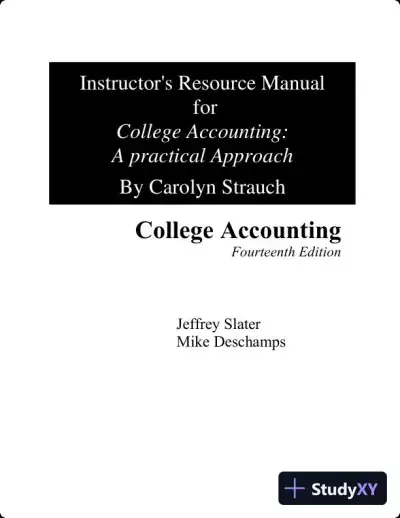 Textbook Guides
Solution Manual for College Accounting: A Practical Approach, 14th Edition
Accounting
715 pages77downloadsFeb 2025 Textbook Guides
Introduction to Financial Accounting, 11th Edition Solution Manual
Accounting
524 pages173downloadsFeb 2025 Textbook Guides
Solution Manual For International Accounting, 4th Edition
Accounting
309 pages161downloadsFeb 2025 Textbook Guides
Solution Manual For Managerial Accounting, 7th Edition
Accounting
361 pages159downloadsFeb 2025 Class Notes
Class Notes For Advanced Accounting, 4th Edition
Accounting
149 pages159downloadsFeb 2025 Textbook Guides
Financial Accounting 6th Canadian Edition Solution Manual
Accounting
867 pages156downloadsFeb 2025 Textbook Guides
Accounting Theory, 7th Edition Solution Manual
Accounting
325 pages153downloadsFeb 2025 Textbook Guides
Financial Accounting, 9th Edition Solution Manual
Accounting
1024 pages134downloadsFeb 2025
Study this document with CramX
Once it is in your library, every tool can work from it.