

Class Notes for Managerial Accounting, Second Canadian Edition
- Accounting
- 153 pages
- Shared February 2025
- 40 downloads
Class Notes for Managerial Accounting, Second Canadian Edition helps you review course material quickly and effectively.
Preview 31 of 153 pages
See the first 31 pages exactly as they appear in the document.
Page 1 Read page 1 as text
I NSTRUCTOR ’ S R ESOURCE M ANUAL Pam Quon Athabasca University Managerial Accounting Canadian Edition Karen Wilken Braun Case Western Reserve University Wendy M. Tietz Kent State University Walter T. Harrison, Jr. Baylor University Rhonda Pyper University of Ottawa
Page 2 Page 3 Read page 3 as text
Contents 1 Introduction to Managerial Accounting 1 2 Building Blocks of Managerial Accounting 12 3 Job Costing 25 4 Activity-Based Costing, Lean Production, and the Costs of Quality 36 5 Process Costing 49 6 Cost Behaviour 60 7 Cost-Volume-Profit Analysis 72 8 Short-Term Business Decisions 86 9 The Master Budget and Responsibility Accounting 99 10 Flexible Budgets and Standard Costs 110 11 Performance Evaluation and the Balanced Scorecard 124 12 Capital Investment Decisions and the Time Value of Money 136 Sample Syllabi for 10 weeks Sample Syllabi for 12 weeks Tips for Taking Your Course from Traditional to Hybrid, Blended or Online Tips for How to Get an A in This Class
Page 4 Read page 4 as text
CHAPTER 1 Introduction to Managerial Accounting CHAPTER OVERVIEW The chapter introduces managerial accounting along with the fundamental principle of the text, which is the importance of using managerial accounting data in decision-making. Students are introduced to the importance of cost of goods sold and to decision-making by discussing the primary responsibilities of a managerial accountant: planning, directing, controlling, and decision-making. To help students understand the managerial accounting focus, financial and managerial accounting are contrasted and compared. Managerial accounting has internal users relying on relevant information prepared specifically for management’s needs and financial accounting has external users using reliable and objective information in the form of financial statements. The importance of using managerial accounting for decision-making is illustrated through the presentation of organizational structures and the roles and skills required of management accountants. In addition to their traditional costing and reporting roles, management accountants also play an important role in developing budgets that influence the organization’s culture and strategy. Increasing the importance and profile of management accountants is a goal of the Society of Management Accountants of Canada which governs the Certified Management Accountants (CMAs). The Society of Management Accountants is the professional association for management accountants which also develops standards of ethics and standards of professional conduct. The Decision Guidelines and Summary Problems are useful examples of questions and outlines that help students summarize their learning. Two sets of Decision Guidelines are present in this chapter. The first set of guidelines focuses on decision-making. The next section of the chapter presents the implications of regulatory and business trends. These include the Sarbanes-Oxley Act of 2002, IFRS, XBRL, the shift towards a service economy, competition in the global marketplace, sustainability and social responsibility, time-based competition, advanced information systems, e-commerce, lean production, total quality management, and ISO 9001:2008. The Decision Guidelines illustrate some of the decisions managers need to consider in response to changes in the regulatory and business environment. An additional Summary Problem allows students to use cost-benefit analysis to determine whether a company should expand or not. LEARNING OBJECTIVES After studying Chapter 1, your students should be able to: 1. Identify managers’ four primary responsibilities. 2. Distinguish financial accounting from managerial accounting.
Page 5 Read page 5 as text
Chapter 1 2 3. Describe organizational structure and the roles and skills required of management accountants within the organization. 4. Describe the role of the three professional accounting designations in Canada and use their ethical standards to make reasonable ethical judgments. 5. Discuss and analyze the implications of regulatory and business trends. TEACHING OUTLINE 1. Identify managers’ four primary responsibilities a. Planning b. Directing c. Controlling d. Decision-making e. Exhibit 1-1 Managers’ Four Primary Responsibilities 2. Distinguish the differences between financial accounting and managerial accounting a. Users b. Purpose of information provided c. Accounting product d. Required information and reporting format e. Underlying basis of the information f. Information characteristic emphasis g. Business unit h. Timing i. Verification j. Required information k. Impact of reports on behaviour l. Exhibit 1-2 Managerial Accounting Versus Financial Accounting 3. Describe the organizational structure and the roles and skills required of management accountants within the organization a. CEO b. COO c. CFO d. Treasurer e. Controller f. Internal audit function g. Audit committee h. Exhibit 1-3 Typical Organizational Structure 4. Discuss the changing roles of management accountants 5. Discuss the skills required of management accountants
Page 6 Read page 6 as text
Chapter 1 3 a. Solid accounting knowledge b. Problem-solving and decision-making skills c. Knowledge of how a business functions d. Ability to lead and work on a team (team oriented) e. Professionalism and ethical standards f. Oral and written communication skills g. Exhibit 1-4 The Skills Required of Management Accountants 6. Describe the role of the three professional accounting designations in Canada a. Professional associations b. Certified Management Accountants (CMAs), Chartered Accountants (CAs) and Certified General Accountants (CGAs) 7. Identify the CMA’s ethical standards and how they are used to make reasonable ethical decisions a. Maintain professional competence b. Preserve confidentiality of information c. Perform duties with credibility d. Uphold their integrity e. Maintain independence f. Exhibit 1-5 Summary of Ethical Standards g. Unethical versus illegal behaviour h. Exhibit 1-6 The Society of Management Accountants of Ontario Code of Professional Ethics 8. Discuss current regulatory and business trends a. Sarbanes-Oxley Act of 2002 (SOX) b. Exhibit 1-7 Some Important Results of SOX c. International Financial Reporting Standards (IFRS) d. Extensible Business Reporting Language (XBRL) e. Shifting economy 9. Competing in the global marketplace a. Sustainability and social responsibility b. Tools for time-based competition i. Advanced information systems ii. Ecommerce iii. Lean production 1. Just-in-time 2. Throughput time c. Total quality management and ISO 9001:2008 KEY TOPICS This chapter is the foundation for the rest of the text. Without a good understanding of this chapter, the student will have a difficult time understanding the remaining content.
Page 7 Read page 7 as text
Chapter 1 4 After covering managers’ four primary responsibilities, consider offering the following example: A manager may wish to expand a company’s custodial service from only cleaning private homes to also cleaning corporate offices and plants. This goal is then developed into a budget (planning). That budget is analyzed thoroughly to determine both the price points and how to market the service (directing). After comparing the budget to the actual results, the managerial accountant determines that the expansion into the new market is somewhat slower than expected and decides to change its marketing strategy (controlling). Decision-making is the fourth responsibility and occurs at all levels of the process. For example, if the marketing strategy works and the corporation proceeds toward meeting its goals, the managerial accountant focuses attention on which new services will be offered, how much to charge for the services, and if loyalty discounts should be given to existing customers who purchase these services (decision- making). In teams or in partners, have students complete E1-18B Managers’ responsibilities , which should take about five minutes. Call on a student to give the answers. At this point, the accounting student has most likely only been exposed to financial accounting. Students sometimes have a difficult time making the adjustment from financial to managerial accounting. Use Exhibit 1-2 to emphasize the differences between financial and managerial accounting. This is a great time to review the role of financial accountants in our society and then explain the role of management accountants. In doing so, be sure to also point out some of the similarities between financial and management accounting, as this will help students understand that their study of management accounting focuses on external decision-makers, whereas managerial accounting focuses on internal decision-makers. Here’s an example: A manager is setting the price of items in the store. In order to make this decision, the manager needs to know the cost of the items, the other organizational costs, the sales prices for other similar items, etc. Of course, these matters are of great importance to an internal management accountant. An external accountant would not make the same decisions; instead, he/she would make decisions based on information contained in the financial statements. In team or in partners, have students complete E1-20B Identify users of accounting information (10 minutes). Point out that most decisions impact non-accountants and stress the importance for non-accounting majors to understand managerial accounting. Many students love to discuss ethical issues. Sometimes students may have ethical issues presented to them in a casual way. Here is an example: A supervisor requests that you don’t record your overtime on your timesheet. This will allow the supervisor to stay within the budget, but it doesn’t properly reflect what is happening within the organization. You feel pressure from the supervisor. Ask students what ethical issues are involved in this example. Ask students how many of them were left unsupervised when they first started a new job. How accurate was their work? Would the students feel responsible for making an error if they had been properly trained?
Page 8 Read page 8 as text
Chapter 1 5 Ask students to assume they work for a company. In this scenario, they will have heard that their company is being sold. The information is confidential, and they can’t speak about it. What would they do if their best friend wanted to buy stock? You can use E1-23B Ethical dilemma (5 minutes) as a group or partner exercise. When discussing the Sarbanes-Oxley Act, remember that many of today’s students probably don’t remember businesses before accounting scandals. Students have likely become cynical about accounting practices based on news media. Ask students to identify what would give them confidence in the accounting decisions of an organization. In the shifting economy section, ask students if they think Apple manufactures its own headphones or if they are manufactured by an outside company. Ask them what information might be part of Apple’s decision: How much it would cost Apple to make the headphones? How much would it cost to have someone else make them? If someone else made them, could that manufacturing space be used for additional funds? In the e-commerce section, ask students if they like to use self-checkout lanes. Why/why not? Ask how many students bought their textbooks online. Why/why not? In the lean production section, JIT management is easily illustrated by using milk as an example. If a company bought more milk than the space allowed on a store shelf, where would it be kept? Can it be kept cold? Is it worth paying for the refrigeration? How long can it be held to keep it fresh? JIT is more economical if the store does not buy large quantities of milk, but instead buys small amounts of milk more often. For a cost benefit example, ask students if they think retailers should attach large alarm tags on leather coats that would signal an alarm if someone carried the coat out of the store without paying. Would these same tags be effective on candy bars? What factors make it better for the coat than the candy? Answer: The tags would not be customer friendly and the cost of the tags would not be worth the amount of candy stolen from the store (cost-benefit). Personalize the expected value concept by comparing the cost investment in college to the expected increase in earnings the students expect to have with their education. Have student complete E1-27B Lean production cost-benefit analysis (5 minutes) in teams or partners.
Page 9 Read page 9 as text
Chapter 1 6 CHAPTER 1: STUDENT SUMMARY HANDOUT 1. Managers’ four primary responsibilities a. Planning b. Directing c. Controlling d. Decision-Making 2. Differences between Financial Accounting and Managerial Accounting 3. Organizational structure and how management accountants fit in a. Changing roles b. Skills required 4. The CMA and ethical standards a. Competence b. Confidentiality c. Credibility d. Integrity e. Independence 5. Regulatory and business trends 6. Competition in today’s global marketplace
Page 10 Read page 10 as text
Chapter 1 7 CHAPTER 1: ASSIGNMENT GRID Assignment Topic(s) Learning Objective(s) Estimated Time in Minutes Level of Difficulty Available in Excel Templates Short Exercises S1-1 Roles of managers 1 5 Easy S1-2 Contrast managerial and financial accounting 2 5 Easy S1-3 Accounting roles in the organization 3 5 Easy S1-4 Role of internal audit function 3 5 Easy S1-5 Importance of ethical standards 4 5 Easy S1-6 Violations of ethical standards 4 5 Easy S1-7 Identify current competitive tools 5 5 Easy Exercises (Set A) E1-8A Manager's responsibilities 1 5 Easy X E1-9A Define key terms 1 & 2 5 Easy E1-10A Identify users of accounting information 3 10 Easy E1-11A Classify roles within the organization 3 5 Easy E1-12A Professional organization and certification 4 5 Easy E1-13A Ethical dilemma 4 5 Easy E1-14A Classify ethical responsibilities 4 10 Easy E1-15A Define key terms 5 10 Easy E1-16A Summarize the Sarbanes- Oxley Act 5 10 Medium E1-17A Lean production cost-benefit analysis 5 5 Medium Exercises (Set B) E1-18B Manager's responsibilities 1 5 Easy E1-19B Define key terms 1 & 2 5 Easy E1-20B Identify users of accounting information 3 10 Easy X E1-21B Classify roles within the organization 3 5 Easy E1-22B Professional organization and certification 4 5 Easy E1-23B Ethical dilemma 4 5 Easy E1-24B Classify ethical responsibilities 4 10 Easy E1-25B Define key terms 5 10 Easy E1-26B Summarize the Sarbanes- 5 10 Medium
Page 11 Read page 11 as text
Chapter 1 8 Assignment Topic(s) Learning Objective(s) Estimated Time in Minutes Level of Difficulty Available in Excel Templates Oxley Act E1-27B Lean production cost-benefit analysis 5 5 Medium Problems (Set A) P1-28A Management processes and accounting information 1 & 2 P1-29A Ethical dilemmas 4 10 Medium P1-30A ERP, cost-benefit analysis 5 15-20 Medium P1-31A Ecommerce cost-benefit analysis 5 10 Medium X P1-32A Continuation of P1-31A: revised estimates 5 15 Difficult Problems (Set B) P1-33B Management processes and accounting information 1 & 2 10 Easy P1-34B Ethical dilemmas 4 10 Medium P1-35B ERP cost-benefit analysis 5 20 Medium X P1-36B Ecommerce cost-benefit analysis 5 10 Medium P1-37B Continuation of P1-36B: revised estimates 5 15 Difficult Other Decision Case C1-38 Ethical standards 4 5 Easy Ethical Issue I1-39 Ethical dilemma 4 5-10 Easy Team Project T1-40 Interviewing a local company about ecommerce 5 60 Difficult Discussion and Analysis All 60 Medium Application and Analysis All 30-60 Medium
Page 12 Read page 12 as text
Chapter 1 9 ANSWER KEY TO CHAPTER 1 QUIZ (Quiz on following pages.) 1. C 2. B 3. B 4. B 5. D 6. A 7. D 8. A 9. C 10. B
Page 13 Read page 13 as text
Chapter 1 10 Name_______________________________ Date_______________ Section_______________ CHAPTER 1 TEN-MINUTE QUIZ Circle the letter of the best response. 1. Which of the following are a manager’s four primary responsibilities? A. Budgeting, Directing, Controlling, Decision-Making B. Budgeting, Planning, Controlling, Decision-Making C. Planning, Directing, Controlling, Decision-Making D. Budgeting, Planning, Directing, Controlling 2. Which of the following is an example of controlling? A. Management decides to open a new storage facility in Canada. B. After comparing budget to actual, management adjusts its plan to keep the company on goal. C. After reviewing the daily sales, management revises its staffing schedule. D. Management sets goals to meet in the next fiscal year. 3. Which of the following is TRUE about managerial accounting vs. financial accounting? A. Both managerial and financial reports are prepared quarterly and annually. B. Managerial accounting is primarily utilized by internal users, while financial accounting is primarily utilized by external users. C. The primary information characteristics for managerial accounting are reliability and objectivity, while the primary information characteristic for financial accounting is relevance. D. The CMA requires managerial accounting reports and the SEC requires financial accounting reports. 4. Which of the following statements is FALSE? A. Managers are concerned with the internal use of accounting information. B. Managerial accounting information relies heavily on its reliability and objectivity. C. Managerial accounting reports are not required by any authoritative body. D. Managerial accounting information must be relevant. 5. Which of the following statements is FALSE? A. The treasurer and controller report directly to the CFO. B. The COO is responsible for the company’s operations. C. The board of directors hires the CEO to manage the company on a daily basis. D. The internal audit department reports solely to the CFO. 6. The individual responsible for managing all of the operations of the organization, such as product packaging, is the:
Page 14 Read page 14 as text
Chapter 1 11 A. COO. B. CFO. C. CEO. D. CMA. 7. Which of the following skills is NOT required of management accountants? A. Analytical skills B. Ability to work on a team C. Oral and written communication skills D. Speak a foreign language 8. Management accountants must comply with all of the following ethical standards EXCEPT: A. reporting ethical breaches to the CMA. B. maintaining professional competence. C. performing duties with credibility. D. preserving confidentiality of information. 9. Which of the following is NOT an important result of the Sarbanes-Oxley Act of 2002? A. Stiffer penalties and imprisonment were instituted for white collar crimes. B. The audit committee must be independent and include a financial expert. C. Employees are responsible for the financial reporting completed in their department. D. CA firms have limitations on non-audit service for audit clients. 10. Which of the following is NOT a current business trend? A. Total Quality Management B. Inventories delivered in large quantities at a discount C. Time sensitivity for purchase, delivery, & service D. ISO quality standards
Page 15 Read page 15 as text
CHAPTER 2 Building Blocks of Managerial Accounting CHAPTER OVERVIEW Chapter 2 begins with a discussion of the three most common business sectors: service, merchandising, and manufacturing, and describes the types of inventory held by each. The text then describes the six business activities that comprise the value chain, focusing on how important, yet costly, each business activity is to perform. Next, the chapter introduces the concept of cost objects and describes the difference between the direct costs and indirect costs of any chosen cost object. The first half of the chapter concludes by describing the difference between period costs (operating expenses) and inventoriable product costs. Examples of each cost concept are illustrated for both merchandising and manufacturing companies. The second half of the chapter illustrates the similarities and differences between the financial statements of service, merchandising and manufacturing companies. This discussion includes a fully-worked out example of how manufacturers compute the Cost of Goods Manufactured. The chapter concludes by discussing other cost concepts frequently used by managers, including controllable versus uncontrollable costs, relevant versus irrelevant costs, and fixed versus variable costs. All cost concepts introduced in this chapter will be revisited in later chapters of the text. LEARNING OBJECTIVES After studying Chapter 2, your students should be able to: 1. Distinguish among service, merchandising, and manufacturing companies. 2. Describe the value chain and its elements. 3. Distinguish between direct and indirect costs. 4. Identify the inventoriable product costs and period costs of merchandising and manufacturing firms. 5. Prepare the financial statements for service, merchandising, and manufacturing companies. 6. Describe costs that are relevant and irrelevant for decision making. 7. Classify costs as fixed or variable and calculate total and average costs at different volumes.
Page 16 Read page 16 as text
Chapter 2 13 . TEACHING OUTLINE 1. Distinguish among three types of companies a. Service b. Merchandising i. Retailers ii. Wholesalers c. Manufacturing i. Raw materials inventory (RM) ii. Work in process inventory (WIP) iii. Finished goods inventory (FG) 2. Describe the value chain and its elements a. Research and development b. Design c. Production or purchases d. Marketing e. Distribution f. Customer service g. Coordinating activities across the value chain 3. Defining cost a. Cost objects, direct costs and indirect costs 4. Identify inventoriable product costs and period costs of merchandising manufacturing firms a. Total costs for internal decision making b. Inventoriable product costs for external reporting c. Merchandising companies’ inventoriable product costs d. Manufacturing companies inventoriable product costs i. Direct materials (DM) ii. Direct labour (DL) iii. Manufacturing overhead (MOH) e. Review inventoriable product costs or period costs f. Prime and conversion costs g. Additional labour compensation costs 5. Prepare financial statements for service, merchandising and manufacturing companies a. Service company b. Merchandising companies c. Manufacturing companies i. Calculating the cost of goods manufactured ii. Flow of costs through inventory accounts
Page 17 Read page 17 as text
Chapter 2 14 d. Balance sheet comparisons 6. Relevant and irrelevant costs a. Controllable vs. uncontrollable costs b. Relevant and irrelevant costs i. Differential cost ii. Sunk cost 7. Classify costs as fixed or variable costs and calculate total and average costs at different volumes a. Behaviour of manufacturing costs i. Fixed costs i. Variable costs b. Calculating total and average costs KEY TOPICS Students can never review too many financial statements. The coverage of the management accountant’s role in service, merchandising and manufacturing companies is a great time to review the income statement. This can be done by reviewing Exhibits 2- 11, 2-12, and 2-13 and by contrasting the differences. Emphasize the logical flow of all three types of income statements. Have students work in teams or with a partner and complete E2-32B Identify types of companies and their inventories (5 minutes). Call on a student to report the answers. After discussing product costs (DM, DL, MOH) and period costs, prime costs and conversion costs, have students complete E2-37B Classify and calculate a manufacturer’s costs (10 minutes) in teams and report their answers. Students need to understand that manufacturing companies have a broad range of production activities that require tracking in three kinds of inventory: raw materials (RM), work in process (WIP), and finished goods (FG). Students should understand that all three of these inventories are assets. This is also a good time to explain to students that finished goods (FG) inventory is an inventoriable product cost with three cost components: direct materials (DM), direct labour (DL), and manufacturing overhead (MOH). Explain these three components in detail. The schedule of cost of goods manufactured summarizes the activities that take place in a manufacturing plant over the period. Use Exhibits 2-14 and 2-16 to explain the logical flow of costs in a manufacturing environment. Point out that the first two inventories (RM and WIP) show up on the schedule, while the third inventory (FG) shows up on the income statement. When describing the differences between fixed and variable costs, be sure to reinforce that these terms illustrate the way in which a cost behaves. If the total cost
Page 18 Read page 18 as text
Chapter 2 15 . increases/decreases as a result of changes in sales/production, then it’s a variable cost (or a mixed cost). Let them know that sometimes a fixed cost will fluctuate over different time periods, but that it is not changing as a result of changes in sales/production. Emphasize that the schedule of cost of goods manufactured must be prepared before the income statement as it’s needed to compute cost of goods sold for a manufacturer. Work through an example of a schedule and the income statement on the board. Suggest your students make and use flashcards for all the definitions/terminology in this chapter. In addition, some students are overwhelmed when they see a completed income statement for a manufacturer. Show them how to break it down into smaller pieces and then put it together. For instance, begin with computing gross profit. S – COGS = GP. Then show the detail for COGS: Beginning inventory + Purchases = Cost of Goods Available for Sale – Ending inventory = COGS. Abbreviations can help students as well: BI + P = GAFS – EI = COGS.
Page 19 Read page 19 as text
Chapter 2 16 CHAPTER 2: STUDENT SUMMARY HANDOUT 1. The three most common types of companies a. Service b. Merchandising i. Retailers ii. Wholesalers c. Manufacturing i. Raw materials ii. Work in process iii. Finished goods 2. Value Chain a. Research and Development b. Design c. Production or Purchases d. Marketing e. Distribution f. Customer Service 3. Cost Objects a. Direct Costs b. Indirect Costs 4. Costs for internal decision making and external reporting a. Total costs for internal decision making b. Inventoriable product costs for external reporting i. Specified inventoriable costs ii. Period costs (operating expenses) 5. Inventoriable Product Costs for Merchandising Companies a. Cost of the merchandise itself b. Freight-in and any import duties 6. Inventoriable Product Costs for Manufacturing Companies a. Direct Materials b. Direct Labour c. Manufacturing Overhead i. Indirect materials ii. Indirect labour iii. Other indirect manufacturing costs d. Prime and Conversion costs e. Additional labour compensation costs
Page 20 Read page 20 as text
Chapter 2 17 . 7. Income Statements a. Service Companies b. Merchandising Companies c. Manufacturing Companies i. Calculating Cost of Goods Manufactured ii. Flow of costs through the accounts 8. Comparing Balance Sheets 9. Other Cost Terms a. Controllable versus uncontrollable costs b. Relevant and irrelevant costs c. Fixed and variable costs d. Calculating total and average costs
Page 21 Read page 21 as text
Chapter 2 18 CHAPTER 2: ASSIGNMENT GRID Assignment Topic(s) Learning Objective(s) Estimated Time in Minutes(s) Level of Difficulty Available in Excel Templates Short Exercises S2-1 Identify type of company from balance sheets 1 5 Easy S2-2 Identify types of companies & inventories 1 5 Easy S2-3 Label value chain functions 2 5 Easy S2-4 Classify costs by value chain functions 2 5 Easy S2-5 Classify costs as either direct or indirect 3 5 Easy S2-6 Classify inventoriable product costs and period costs 4 5 Easy S2-7 Classify a manufacturer’s cost 4 5 Easy S2-8 Classify costs incurred by a dairy processing company 4 5 Easy S2-9 Determine total manufacturing overhead 4 5 Easy S2-10 Compute Cost of Goods Sold for a merchandiser 5 5 Easy S2-11 Prepare a retailer’s income statement 5 5 Easy S2-12 Calculate direct materials used 5 5 Easy S2-13 Compute Cost of Goods Manufactured 5 5 Easy S2-14 Consider relevant information 6 5 Easy S2-15 Classify costs as fixed or variable 7 5 Easy Exercises (Set A) E2-16A Identify types of companies and their inventories 1 5 Easy E2-17A Classify costs along the value chain for a retailer 2 10 Easy E2-18A Classify costs along the value chain for a 2 & 3 10 Easy
Page 22 Read page 22 as text
Chapter 2 19 . Assignment Topic(s) Learning Objective(s) Estimated Time in Minutes(s) Level of Difficulty Available in Excel Templates manufacturer E2-19A Classify costs as direct or indirect 3 5 Easy X E2-20A Define cost terms 3 & 4 10 Easy E2-21A Classify and calculate a manufacturer’s costs 3 & 4 10 Easy E2-22A Prepare the current assets section of the balance sheet 5 10 Medium X E2-23A Prepare a retailer’s income statement 5 10 Medium X E2-24A Compute direct materials used and cost of goods manufactured 5 10 Medium E2-25A Compute cost of goods manufactured and cost of goods sold 5 10 Medium E2-26A Continues E2-25A: Prepare income statement 5 10 Medium E2-27A Work backwards to find missing amounts 5 10 Medium E2-28A Determine whether information is relevant 6 5 Easy E2-29A Describe other cost terms 6 & 7 5 Easy E2-30A Classify costs as fixed or variable 7 10 Medium X E2-31A Compute total and average costs 7 10 Medium Exercises (Set B) E2-32B Identify types of companies and their inventories 1 5 Easy E2-33B Classify costs along the value chain for a retailer 2 10 Easy E2-34B Classify costs along the value chain for a manufacturer 2 & 3 10 Easy E2-35B Classify costs as direct or indirect 3 5 Easy E2-36B Define cost terms 3 & 4 10 Easy E2-37B Classify and calculate a manufacturer’s costs 3 & 4 10 Easy
Page 23 Read page 23 as text
Chapter 2 20 Assignment Topic(s) Learning Objective(s) Estimated Time in Minutes(s) Level of Difficulty Available in Excel Templates E2-38B Prepare the current assets section of the balance sheet 5 10 Medium E2-39B Prepare a retailer’s income statement 5 10 Medium E2-40B Compute direct materials used and cost of goods manufactured 5 10 Medium E2-41B Compute cost of goods manufactured and cost of goods sold 5 10 Medium E2-42B Continues E2-41B : Prepare income statement 5 10 Medium E2-43B Work backwards to find missing amounts 5 10 Medium E2-44B Determine whether information is relevant 6 5 Easy E2-45B Describe other cost terms 6 & 7 5 Easy E2-46B Classify costs as fixed or variable 7 10 Medium E2-47B Compute total and average costs 7 10 Medium Problems (Set A) P2-48A Classify costs along the value chain 2 & 4 10 Medium P2-49A Prepare income statements 5 10 Difficult P2-50A Fill in missing amounts 5 15 Medium P2-51A Identify relevant information 6 15-20 Difficult P2-52A Calculate the total and average costs 7 15 Difficult Problems (Set B) P2-53B Classify costs along the value chain 2 & 4 10 Medium P2-54B Prepare income statements 5 10 Difficult
Page 24 Read page 24 as text
Chapter 2 21 . Assignment Topic(s) Learning Objective(s) Estimated Time in Minutes(s) Level of Difficulty Available in Excel Templates P2-55B Fill in missing amounts 5 15 Medium P2-56B Identify relevant information 6 15-20 Difficult P2-57B Calculate the total and average costs 7 15 Difficult Other Decision Case C2-58 Determine ending inventory balances 5 15 Medium Discussion and Analysis All 60 Medium Application and Analysis All 30-60 Medium
Page 25 Read page 25 as text
Chapter 2 22 ANSWER KEY TO CHAPTER 2 QUIZ (Quiz on following pages.) 1. B 2. D 3. C 4. A 5. A 6. A 7. B 8. D 9. D 10. B
Page 26 Read page 26 as text
Chapter 2 23 . Name_________________________ Date_______________ Section_______________ CHAPTER 2 TEN-MINUTE QUIZ Circle the letter of the best response. 1. A portion of a company’s inventory is shown below: Sales $350,000 Cost of Goods Sold: Beginning Inventory $ 15,000 Purchases 250,000 Cost of Goods Available for Sale 265,000 Less: Ending Inventory 13,000 Cost of Goods Sold 252,000 Gross Profit $ 98,000 What type of company is illustrated? A. Service Corporation B. Merchandising Corporation C. Manufacturing Corporation D. Not-for-profit Corporation 2. Which of the following is NOT a value chain activity? A. Research & Development B. Production C. Distribution D. Quality Control 3. Which of the following is a direct cost in the production of tire jacks for a machine shop? A. Utilities B. Taxes C. Steel D. Rent 4. Which of the following is an indirect cost in the construction cost of a home for a building company? A. Insurance B. Paint C. Lumber D. Carpeting
Page 27 Read page 27 as text
Chapter 2 24 5. Which of the following companies has all costs along the value chain accounted for as period costs? A. Service Corporation B. Merchandising Corporation C. Manufacturing Corporation D. None of the above 6. A manufacturer would treat direct materials, direct labour, and overhead as: A. inventoriable product costs. B. period costs. C. both inventoriable product and period costs. D. neither inventoriable product nor period costs. 7. Which of the following is NOT a relevant cost when buying new manufacturing equipment? A. Sales tax B. Cost of machine being replaced C. Purchase price D. Insurance on the machine 8. Which of the following is a fixed cost for a plant that manufactures iPods? A. Plastic used to make the cases B. Employee wages for assembly C. Computer chip used in each iPod D. Straight-line depreciation on stamping machine used to form iPod cases 9. Which of the following is a variable cost for a plant that manufactures iPods? A. Advertising costs B. Salary of payroll clerk C. Straight line depreciation of warehouse building D. Wire used for the headphones 10. Rocketspray’s manufacturing costs for July are: * Materials cost: $4,000 * Labour cost: $3,200 * Overhead: $800 If Rocketspray’s one plant employee manufactured 10 bottles per hour, and worked 8 hours per day for 20 days in July, what is the cost per bottle? A. $3 C. $20 B. $5 D. $24
Page 28 Read page 28 as text
CHAPTER 3 Job Costing CHAPTER OVERVIEW This chapter outlines the two basic costing systems: job costing and process costing. Job costing is used when relatively small quantities of unique products are manufactured. Process costing is used when large quantities of homogeneous products are manufactured. The chapter begins by comparing and contrasting job costing and process costing. Next, the chapter explains the documents and system used to trace direct materials and direct labour to specific jobs. The text reviews how manufacturing overhead is allocated to each job using a predetermined overhead rate. Job cost information is then used to make various business decisions. The second half of the chapter discusses the how over- and underallocated manufacturing overhead, is typically closed to cost of goods sold. The final section of the chapter illustrates all journal entries associated with a job costing system. Finally, the appendix illustrates job costing at a service company (law firm). LEARNING OBJECTIVES After studying Chapter 3, your students should be able to: 1. Distinguish between job costing and process costing. 2. Understand the flow of production and how direct materials and direct labour are traced to jobs. 3. Compute a predetermined manufacturing overhead rate and use it to allocate MOH to jobs. 4. Determine the cost of a job and use it to make business decisions. 5. Compute and dispose of overallocated or underallocated manufacturing overhead. 6. Prepare journal entries for a manufacturer’s job costing system. 7. (Appendix) Use job costing at a service firm as a basis for billing clients. TEACHING OUTLINE 1. Distinguish between job costing and process costing a. Process costing b. Job costing
Page 29 Read page 29 as text
Chapter 3 26 2. Understand the flow of production and how direct materials and direct labour are traced to jobs a. Flow of inventory through a manufacturing system b. Using a job cost record to accumulate i. Tracing direct materials cost to a job ii. Tracing direct labour cost to a job 3. Compute a predetermined manufacturing overhead (MOH) rate and use it to allocate MOH to jobs a. Explain what allocating means b. Steps to allocating MOH i. Step 1) The company estimates its total MOH costs for the coming year. ii. Step 2) The company selects an allocation base and estimates the total amount that will be used during the year. iii. Step 3) The company calculates its predetermined MOH rate using the information estimated in Steps 1 and 2. iv. Step 4) The company allocates some MOH to each individual job. c. Discuss the point in time at which MOH is allocated to jobs 4. Determine the cost of a job and use it to make business decisions a. Reducing future job costs b. Assessing and comparing the profitability of each model c. Dealing with pricing pressure from competitors d. Allowing discounts on high volume sales e. Bidding for custom orders f. Preparing the financial statements 5. Compute and dispose of overallocated or underallocated manufacturing overhead a. Underallocated MOH b. Overallocated MOH c. Adjusting Cost of Goods Sold in most cases 6. Prepare journal entries for a manufacturer’s job costing system a. Purchase of raw materials b. Use of direct materials c. Use of indirect materials d. Use of direct labour e. Use of indirect labour f. Incurring other MOH costs g. Allocating MOH to jobs h. Completion of jobs i. Sale of units j. Operating expenses k. Closing MOH
Page 30 Read page 30 as text
Chapter 3 27 7. (Appendix) Use job costing at a service firm as a basis for billing clients a. Direct costs are traced to the client’s job b. Indirect costs are allocated to the client’s job i. Step1) Estimate the total indirect costs for the coming year. ii. Step 2) Choose an allocation base and estimate the total amount that will be used during the year. iii. Step 3) Compute the predetermined indirect cost allocation rate. iv. Step 4) Allocate indirect costs to client jobs using the predetermined rate. c. Finding the total cost of the job and adding a profit d. Invoicing the client using a professional billing rate e. Journal entries needed in a service firm’s job costing system KEY TOPICS Make it clear to students that both a job costing system and a process costing system provide the same basic production costing information. The difference in the two systems is the way they accumulate the costs. The first major distinction between the two systems is quantity and uniqueness of product while the second is costing. Process costing is used when large quantities of homogeneous product are produced; the total costs are divided by the quantity produced to give the average cost. Job costing is used by companies that produce smaller quantities of relatively unique products which vary in the manufacturing resources required. Direct materials (DM) and direct labour (DL) costs are traced to the product while manufacturing overhead is allocated to the product using a predetermined manufacturing overhead rate. Have students work in teams or with a partner and complete E3-32B Identify type of costing system (5 minutes). Call on a student to report the answers. Stress that there are three product or manufacturing costs: DM, DL, and MOH. Keep repeating this throughout the chapter presentation. All manufacturing costs flow into the WIP inventory account. MOH is allocated to jobs based on a predetermined rate using estimated data. Students are typically confused as to why overhead needs to be allocated rather than added directly to jobs as it is used. Explain that this is a timing problem. Companies need the cost information for decision making before the actual costs are known. Use E3-44B Analyze manufacturing overhead to illustrate how the MOH rate is predetermined and then how it’s used. Help students to understand that debits to the MOH account represent actual (or incurred) MOH costs and credits to the MOH account represent allocated MOH. Draw a T-account on the board and write “actual” on the debit side and “allocated” on the credit side. Enter the MOH entries into the T-account to show students how to determine whether MOH was over- or underallocated. Emphasize that the account is temporary and how to close the account at the end of the period.
Page 31 Read page 31 as text
Chapter 3 28 The job cost record is the subsidiary ledger supporting the Work in Process (WIP) general ledger account. The job cost records are used to “prove” the WIP balance. The subsidiary ledger keeps track of the specific jobs being produced by the company. Have students work in teams to solve E3-41B Determine the cost of a job (15 minutes). Ask students to explain the differences between the recording for materials and labour. Over- or underallocated MOH at the end of the period should, in theory, be divided among Finished Goods (FG), WIP, and Cost of Goods Sold (COGS) in proportion to their ending balances because these are the accounts in which the MOH costs lie. In reality, because most of the jobs have been sold, companies will close the MOH to COGS only. Most of the accounts involved in a job order costing system can be characterized as cost accounts. Relating cost accounts to expense accounts and asset accounts can help students quickly grasp the accounting flows. Use E3-48B Analyze T-accounts to illustrate the flow. Illustrate job costing in a service firm by using a maid service as an example. 1. Estimate total indirect costs-office rent, insurance, etc. For example, estimate $100,000. 2. Identify a cost allocation base-for example, number of homes cleaned per year. 3. Estimate total quantity of the indirect cost allocation base-for example, 1,000 homes. 4. Compute the predetermined indirect cost allocation rate: $100,000/1,000 = $100 per property. 5. Obtain the actual quantity of the cost allocation base used by individual jobs-for example, 995 homes cleaned. 6. Allocate indirect cost to jobs-for example, if 995 homes were cleaned and the allocation rate is $100 per property, the amount allocated to overhead would be $99,500. Students are interested to know that the cost mark-up varies greatly by industry. In the chapter they learn that the cross-trainer that sells for $1,900 cost the company $1,160 to produce. However, students tend to forget that the markup of $740 is not all profit, but must cover sales commissions as well as other non-inventoriable costs.
122 more pages in the full document
Unlock it once and it stays in your library, ready to chat with or turn into flashcards.
Unlock the full documentMore Accounting study materials
See all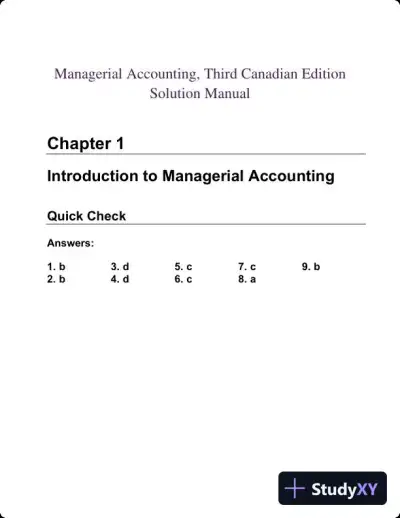 Textbook Guides
Managerial Accounting, Third Canadian Edition Solution Manual
Accounting
1539 pages84downloadsFeb 2025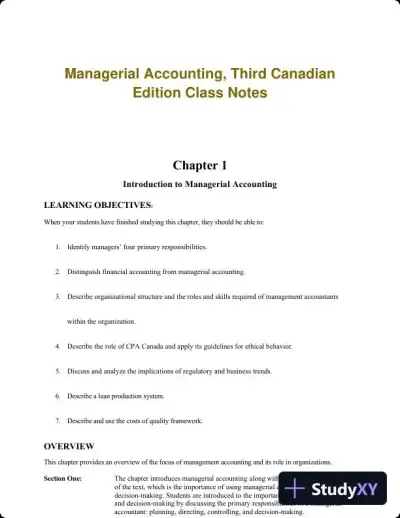 Class Notes
Managerial Accounting, Third Canadian Edition Class Notes
Accounting
221 pages70downloadsFeb 2025 Textbook Guides
Introduction to Financial Accounting, 11th Edition Solution Manual
Accounting
524 pages173downloadsFeb 2025 Textbook Guides
Solution Manual For International Accounting, 4th Edition
Accounting
309 pages161downloadsFeb 2025 Textbook Guides
Solution Manual For Managerial Accounting, 7th Edition
Accounting
361 pages159downloadsFeb 2025 Class Notes
Class Notes For Advanced Accounting, 4th Edition
Accounting
149 pages159downloadsFeb 2025 Textbook Guides
Financial Accounting 6th Canadian Edition Solution Manual
Accounting
867 pages156downloadsFeb 2025 Textbook Guides
Accounting Theory, 7th Edition Solution Manual
Accounting
325 pages153downloadsFeb 2025
Study this document with CramX
Once it is in your library, every tool can work from it.