

Issues in Financial Accounting, 15th Edition Solution Manual
- Accounting
- 529 pages
- Shared May 2025
Master your course with Issues in Financial Accounting, 15th Edition Solution Manual, featuring key textbook summaries and solutions.
Preview 16 of 529 pages
See the first 16 pages exactly as they appear in the document.
Page 1 Read page 1 as text
– 9781442561175/Henderson/Issues in Financial Accounting/15e 1 Chapter 1 INSTITUTIONAL ARRANGEMENTS FOR SETTING ACCOUNTING STANDARDS IN AUSTRALIA LEARNING OBJECTIVES After studying this chapter you should be able to: 1 identify the main sources of regulation of financial reporting; 2 identify the major developments in the institutional arrangements for accounting standard setting; 3 explain the present accounting standard - setting arrangements; 4 explain the process of developing accounting standards and concepts statements in Australia; 5 explain the process of developing interpretations; and 6 explain the process of enforcing accounting standards and interpretations. QUESTIONS 1 The three main sources of regulation governing accounting policies and financial reporting practices in Australia are government legislation, the Australian Securities Exchange Ltd (ASX) Listing Rules, and accounting standards and other pronouncements issued by the Australian Accounting Standards Board (AASB). Government Legislation : In the private sector, the most important legislation specifying financial reporting
Page 2 Page 3 Read page 3 as text
– 9781442561175/Henderson/Issues in Financial Accounting/15e 2 requirements is the Corporations Act 2001 . In particular, the Corporations Act specifies general requirements that require the financial report to comply with accounting standards and to present a true and fair view. The form and content of the statement of comprehensive income, statement of financial position, statement of changes in equity and statement of cash flows are considered in accounting standards issued by the Australian Accounting Standards Board (AASB) that are discussed in later chapters of this book. ASX Listing Rules: The listing rules of the ASX apply only to entities whose securities are listed on the ASX. The disclosure require ments of the ASX are contained in Chapter 3 (continuous disclosure), Chapter 4 (periodic disclosure) and Chapter 5 (additional reporting on mining and exploration activities ) of the listing rules. The listing rules specify the detailed disclosure of financial information and require the disclosure of some information not required by the Corporations Act (e.g. various disclosures relating to the 20 largest holders of each class of quoted equity securities) . If a listed company does not comply with the ASX Listing Rules, it may be delisted. The ASX has also issued Corporate Governance Principles and Recommendations with 2010 Amendments through its Corporate Governance Council . Figure 1.1 in C hapter 1 provides an overview of the eight guidelines to which 28 recommendations are attached. The guidelines and associated recommendations are not mandatory. However, the listing rules include two mandatory requirements relating to the corporate governance guidelines. First, ASX Listing Rule 4.10.3 requires listed entities to disclose in their annual reports the extent to which they have followed the guidelines during the reporting period. Second, ASX Listing Rule 12.7 requires t hat companies included in the S&P/All Ordinaries Index have an audit committee and that companies included in the S&P/ASX 300 Index have an audit committee that is constituted in accordance with the guidelines. Accounting Standards and Other Pronouncements I ssued by the AASB: The third source of regulation governing financial reporti ng is accounting standards and i nterpretations prepared by the Australian Accounting Standards Board (A ASB). Accounting standards and i nterpretations are concerned with both accounting measurement and disclosure. Authority is provided to AASB accounting standards by the Corporations Act. The Accounting Professional and Ethical Standards Board (APESB) provides similar authority for Australian accounting standards via APES 205 ‘Conformity with Accounting Standards’ (para. 5). 2 The role of the ASX’s Corporate Governance Principles and Recommendations with 2010 Amendments is to provide a voluntary code of best practice corporate governance to guide listed companies. There are eight principles supported by 28 recommendations provided to listed companies. The guidelines and associated recommendations are not
Page 4 Read page 4 as text
– 9781442561175/Henderson/Issues in Financial Accounting/15e 3 mandatory. However, the listing rules include two mandatory requirements relating to the corporate governance guidelines. First, ASX Listing Rule 4.10.3 requires listed entities to disclose in their annual reports the extent to which they have followed the guidelines during the reporting period. Second, ASX Listing Rule 12.7 requires that companies included in the S&P/All Ordinaries Index have an audit committee and that companies included in the S&P/ASX 300 Index have an audit committee that is constituted in accordance with the guidelines. The guidelines are considered evolutionary by the ASX Corporate Governance Council. That is, the Council is ‘committed to a continuing review of these principles and best practice recommendations to ensure that they remain relevant, take account of local and international developments, and continue to reflect international best practice’ (Corporate Governance Council, 2003, p. 7). 3 The Australian Professional and Ethical Standards Board (APESB) was established as an initiative of CPA Australia and the ICAA primarily to develop and issue appropriate professional and ethical standards for their membership. (The IPA has subsequently become a member . ) The APESB has reviewed existing professional and ethical standards such as the old Code of Professional Conduct and Miscellaneous Professional Statements (APS series) and guidance notes (GN series). The subsequent APES series of ethical and professional standards approved by the APESB are mandatory for accountants who are members of CPA Australia, the ICAA and the IPA . The specific professional standard and ethical standard APES 205 ‘Conformity with accounting standards’ requires members to comply with accounting standards as follows : 4.3 Members who are involved in, or are responsible for, the preparation and/or presentation of Financial Statements of a Reporting Entity shall take all reasonable steps to ensure that the Reporting Entity prepares General Purpose Financial Statements. 5.1 Members shall take all reasonable steps to apply Australian Accounting Standards when they prepare and/or present General Purpose Financial Statements that purport to comply with the Australian Financial Reporting Framework. 5.2 Where Members are unable to apply Australian Accounting Standards pursuant to paragraph 5.1, they shall take all reasonable steps to ensure that any departure from Australian Accounting Standards, the reasons for such departure, and its financial effects are properly disclosed and explained in the General Purpose Financial Statements. 5.5 Members in Public Practice shall take all reasonable steps to ensure that Clients have complied with Australian Accounting Standards when they perform an Audit or Review Engagement or a compilation Engagement of General Purpose Financial Statements which purport to comply with the Australian Financial Reporting Framework.
Page 5 Read page 5 as text
– 9781442561175/Henderson/Issues in Financial Accounting/15e 4 Compliance with APES 205 is mandatory for members of the professional accounting bodies, and non - compliance represents a breach of the code of ethics issued by the Accounting Professional and Ethical Standards Board. Failure by members to comply with the requirements of APES 205 could result in disciplinary proceedings being brought against them, which could result in the imposition of a fine or expulsion from the professional body. 4 The present institutional arrangements for accounting standard - setting in Australia are summarised in Figure 1.2 , p. 8 in Chapter 1. Financial Reporting Council: The Financial Reporting Council (FRC) is a statutory body under the Australian Securities and Investments Commission Act 2001 . It is the peak body responsible for the broad oversight of the a ccounting and auditing standard - setting process in Australia. The FRC is also responsible for monitoring the effectiveness of auditor independence requirements in Australia and has an oversight function of the Auditing and Assurance Standards Board (AUASB). In general, the FRC has responsibility for oversight of the AASB and for presenting reports and advice on the Australian accounting standard - setting process to the Minister for Superannuation and Corporate Law. The role of the FRC includes: • appointment of the members of the AASB (except for the full - time Chair who is appointed by the Minister for Superannuation and Corporate Law); • approving and monitoring the AASB’s priorities, business plan, budget and staffing arrangements; • determining the AASB’s broad strategic direction; • giving the AASB directions, advice or feedback on matters of general policy and the AASB’s procedures; and • monitoring the development of international accounting standards and furthering the harmonisation of Australian accounting standards with those standards, and promoting a greater role for international accounting standards in Australia. Although the FRC has wide - ranging powers, t he FRC cannot become involved in the technical deliberations of the AASB. For example, the FRC does not have the power to veto a standard formulated or recommended by the AASB, nor direct the AASB in relation to the development or making of a particular standard. Under section 235A of the Australian Securities and Investments Commission Act 2001 , members of the FRC are appointed by the Treasurer and hold office on terms and conditions determined by the Treasurer. <www.frc.gov.au> . Australian Accounting Standards Board : The Australian Accounting Standards Board (AASB) began operations in 1991, replacing the Australian Accounting Standards Review Board (ASRB). At this time, the ASRB was Australia’s sole standard - setting body for the private sector and its activities
Page 6 Read page 6 as text
– 9781442561175/Henderson/Issues in Financial Accounting/15e 5 were complimented by the Public Sector Accounting Standards Board (PSASB) which developed accounting standards applicable to all other reporting entities. The passage of CLERP in October 1999 resulted in the activities of the PSASB merging into those of the AASB. The recon stituted AASB is an Australian government a gency under the Australian Securities and Investments Commission Act . It has responsibility for making accounting standards applicable not only to entities coming under the jurisdiction of the Corporations Act but also for entities in the public sector and the remainder of the non - corporate sector. The AASB’s major functions are specified in section 227(1) of the Australian Securities and Investments Commission Act as follows: 1 to develop a conceptual framework, not having the force of an accounting standard, for the purpose of evaluating proposed accounting standards and international standards; 2 to make accounting standards under section 334 of the Corporations Act 2001 for the purposes of the national scheme laws; 3 to formulate accounting standards for other purposes; 4 to participate in and contribute to the development of a single set of accounting standards for worldwide use; and 5 to advance and promote the main objectives of Part 12 of the Act as set down in section 224 , which include reducing the cost of capital, enabling Australian entities to compete effectively overseas and maintaining investor confidence in the Australian economy. The Minister for Superannuation and Corporate Law appoints the chairman of the AASB, and the chair is subsequently accountable to the Minister regarding the operations of the AASB. The AASB comprises 12 part - time members plus the full - time chair. Member appointments to the AASB are made by the FRC from nominations received from a number of bodies including CPA Australia, the ICAA, the Business Council of Australia and the ASX. In addition, the AASB presently has three observers – the Australian and New Zealand member of the International Accounting Standards Board, the Australian representative of the International Public Sector Accounting Standards Board of the International Federation of Accountants, and the Australian member of the Standards Advisory Council. Meetings of the AASB are open to the public. <www.aasb.com.au> . The Office of the AASB: The Governance Review Implementation (AASB and AUASB) Bill 2008 was passed by Parliament in June 2008. Inter alia , the Bill established the Office of the AASB to support the operations of the AASB through the provision of technical and administrative services, information and advice. The chief executive officer of the Office is the chairman of the AASB, who is also responsible to the Minister for the financial management of the Office.
Page 7 Read page 7 as text
– 9781442561175/Henderson/Issues in Financial Accounting/15e 6 The Minister for Superannuation and Corporate Law : The Minister for Superannuation and Corporate Law is one of three Treasury Ministers from the Federal Government. 5 The AASB will typically issue material for public comment and discussion with stakeholders in the form of: • Discussion Papers (DP) outlining a wide range of possible accounting policies on a particular topic; • Exposure Drafts (ED) of a proposed standard or amendment to a standard; • Invitations to Comment (ITC) that seek feedback on broad proposals; or • Draft Interpretations of a standard. At present, constituents’ comments on the materials issued by the AASB are obtained from the following avenues: Focus Groups, Project Advisory Panels and Interpretation Advisory Panels. Focus Groups : There are currently two Focus Groups – the User Focus Group and the Not - for - Profit Focus Group. In general, these groups serve as a resource to the AASB in formulating standard - setting priorities, advising on specific agenda projects and providing feedback to assist on developing standards. The User Focus Group generally comprises eight to 10 investment and credit professional s and the Not - for - Profit Focus G roup comprises eight to 10 professional s with expertise and involvement in charitable and related organisations. Project Advisory Panels : Input is also received from Project Advisory Panels that work with the AASB staff to develop agenda material relating to specific standard - setting projects for consideration by the Board. Invitations are issued to experts in a parti cular field or topic area to join a Project Advisory Panel. Interpretation Advisory Panels : As part of the process of issuing i nterpretations , the AASB decides, on a topic - by - topic basis , whether to appoint an Interpretation Advisory Panel . The role of the Advisory Panel is limited to preparing alternate views on a specific issue and , where relevant, recommendations for consideration by the AASB. An Interpretation Advisory Panel normally comprises between four and eight members. These members include the AASB Chairman, at least one other AASB member, and other members appointed on the basis of their professional competence and practical experience in the topic area. Members are typically drawn from a register of potential Interpretation Advisory Panel members maintained by the AASB.
Page 8 Read page 8 as text
– 9781442561175/Henderson/Issues in Financial Accounting/15e 7 6 (a) The due process used to develop an accounting standard is summarised in Figure 1.3 in C hapter 1 . The first step is identification of a technical issue to be added to the AASB’s work program. This can happen in one of three ways: (1) Inclusion in the AASB’s program of issues on the International Accounting Standards Board’s (IASB) and the International Financial Reporting Interpretations Committee’s (IFRC) work programs ; (2) Inclusion in the AASB’s program of issues on the International Public Sector Accounting Board’s (IPSASB) work program; and (3) Inclusion in the AASB’s work program of issues identified by AASB Board members and staff, as well as Australian organisations and individuals . ( I ssues relating to for - profit entities are normally referred to the IASB or IFRIC for consideration, while issues relating to not - for - profit entities may be referred to the IPSASB or addressed domestically .) The second step involves the development of a project proposal by the AASB. This contains an assessment of the potential benefits of the project, the potential costs of not undertaking it, resource availability and timing. After reviewing the proposal the AASB makes a decision on whether to place the project on its agenda (and therefore work program). Once an issue is included on the AASB’s agenda, the third step involves the preparation of agenda papers by AASB staff. Agenda papers consider the scope of issues, alternative approaches, and the timing of outputs. They are prepared using material drawn from the IASB, IPSASB, the New Zealand Financial Reporting Standards Board, and other such organisations. The fourth step involves the exposure of the results of the research conducted in step three to facilitate public comment and discussion with stakeholders in the form of: • Discussion Papers (DP) outlining a wide range of possible accounting policies on a particular topic; • Exposure Drafts (ED) of a proposed standard or amendment to a standard; • Invitations to Comment (ITC) that seek feedback on broad proposals; or • Draft Interpretations of a standard. Feedback from the public and stakeholders may be obtained through round - table discussions with stakeholders, Focus Groups, Project Advisory Panels and Interpretation Advisory Panels. The fifth step involves Board discussion of the results of the feedback received on an agenda item. There are two possible outcomes from this discussion: (1) A standard is not issued. In this situation, the Board notes its view in the minutes of a meeting or in a formal Board agenda decision. (2) An accounting standard is issued. (b) Students should visit the AASB website < www. aasb. gov .au >. Issues currently under consideration can be fo und on the AASB homepage under ‘ quick links ’,
Page 9 Read page 9 as text
– 9781442561175/Henderson/Issues in Financial Accounting/15e 8 ‘ open for comment ’ and ‘ latest news ’. Further issues can be identified by following the links from the AASB’s homepage to its latest work program. 7 (a) The due process used by the AASB to develop accounting standard s is outlined in the answer to Q uestion 6(a). (b) Currently, the AASB issues i nterpretations a s a means of providing timely guidance on urgent financial reporting issues. For example, AASB Interpretation 13 ‘Customer Loyalty Programmes’ deals with how to account for customer loyalty programmes whereby an entity will grant a customer award credits that can be redeemed for items such as free or discounted goods or services (e.g. Frequent Flyer programs associated with airlines). Several issues had arisen in practice including whether the award credit transaction should be treated separate to the underlying sale and , if so, how to measure the award credit transaction. Interpretation 13 addresses these issues. The due process used to develop an i nterpretation has a much shorter timeframe than the due process necessary to develop an accounting standard. To illu strate, the AASB will issue an i nterpretation as follows: • Interpretation Advisory Panel s may be formed, as required on a topic - by - topic basis. The role of a panel is to prepare alternative views on the issue and , where appropriate, make recommendations to the AASB. • The due process will include publishing the composition of each panel and its recommendation on the AASB’s website for an appropriate period. Where the AASB proposes to issue an i nterpretation, the proposed i nterpretation will be further exposed on the AASB’s website for an appropriate period before the AASB considers it for formal adoption. 8 AASB Interpretations are designed to provide timely guidance to preparers of financial statements on various financial reporting issues. For example, sometimes after an accounting standard is issued, problems occur in its implementation. In addition, financial reporting problems may arise which do not warrant either amendments to an existing standard or the preparation of a new standard. In these cases, it may have been appropriate to reso lve the problems by issuing an i nterpretation to clarify, explain or elaborate upon existing standards. Thus, i nterpretation s have a much narrower scope than accounting standards. 9 An answer to this question should identify the differences between a ccounting s tandards and a ccounting i nterpretations as follows: (a) Scope • Accounting s tandards address m uch broader issues/topics than i nterpretations. Accounting s tandards prescribe accounting and disclosure requirements relating to a broad area/topic, for example, AASB 117 ‘Leases’ and AASB 137 ‘Provisions, Contingent Liabilities and Contingent Assets’.
Page 10 Read page 10 as text
– 9781442561175/Henderson/Issues in Financial Accounting/15e 9 • Interpretations prescribe accounting and/or disclosure requirements relating to very specific/narrow issues, for example, Interpretation 4 ‘Determining Whether an Arrangement Contains a Lease’ and Interpretation 132 ‘Intangible Assets – Web Site Costs’. (b) Context/Framework • AASB evaluates proposed accounting s tandards in the context of the conceptual framework. • Interpretations are prepa red in the context of existing accounting s tandards and the conceptual framework. (c) Due Process • Accounting s tandards are developed by the AASB after an extensive due process, including consultation with a broad range of constituents, and the preparation of discussion papers, exposure drafts and draft standards. • Interpretations are prepared after a much less extensive due process, which does not involve the same constituent consultation, or preparation of documents for public comment. (d) Approval Process/Veto Power • After an a ccounting s tandard is finalised by the AASB, it may be disallowed by Parliament within 15 sitting days of it being tabled in Parliament. • There is no such veto power in relatio n to i nterpretations. (e) Authority • AASB Accounting Standards : The Corporations Act 2001 requires reporting entities to comply with AASB Accounting Standards and ASIC enforces compliance with those standards. • Interpretations : Paragraph 5 of APES 205 ‘Conformity with Accounting Standards’ APS1 requires members of CPA Austral ia and the ICAA to comply with accounting s tandards and UIG and AASB Interpretations. CPA Australia and the ICAA enforce compliance with Australian Accounting Standards and UIG and AASB Interpretations. • The Corporations Act 2001 does not explicitly require compliance with i nterpretations, but ASIC has indicated support for the i nterpretations by attending and participating in meetings of the Interpretations Agenda Committee as an observ er. Effectively, i nterpretati ons have the same authority as accounting s tandards. 10 The AASB’s Interpretations model has been effective since 1 January 2008 and its major features are as follows. 1 Interpretation Advisory Panels may be formed, as required on a topic - by - topic basis. The role of a panel is to prepare alternative views on the issue and , where appropriate, make recommendations to the AASB. 2 A public register of potential Interpretation Advisory Panel members is maintained
Page 11 Read page 11 as text
– 9781442561175/Henderson/Issues in Financial Accounting/15e 10 on the AASB website and it is from this register that Panel members are drawn. 3 Interpretations of IASB accounting standards are made by IFRIC. Since AASB accounting standards are equivalent to IASB accounting standards, the IFRIC Interpretations will be relevant in Australia. Additionally, if an is sue arises that relates to the i nterpretation of an AASB accounting standard that is equivalent to an IASB accounting standard, it will be forwarded to IFRIC for consideration and possible inclusion in its work program. However, if an issue arises in relation to an AASB accounting standard that does not have an IASB equivalent, the issue will be resolved by the AASB. 4 The due process will include publishing the composition of each panel and its recommendation on the AASB’s website for an appropriate period. Where the AASB proposes to issue an interpretation, the proposed i nterpretation will be further exposed on the AASB’s website for an appropriate period before the AASB considers it for formal adoption. 11 In 2006 the Australian Government established a Financial Reporting Panel (FRP) <www.frp.gov.au> to resolve disputes between ASIC and companies over the application of accounting standards in their financial reports. The objective of establishing the FRP is to remove the need to initiate legal proceedings in c ourt in order to resolve a financial reporting matter, thus providing an efficient and cost - effective way of dealing with disputes. Referrals to the FRP may be lodged by either ASIC or the company (with the consent of ASIC). Upon receipt of an application, the FRP considers whether the application is within its jurisdiction and whether proceedings will commence. If proceedings commence, the chairperson appoints three members, free of a material conflict of interest, to be the sitting panel. The proceedings take place in private unless otherwise requested by the lodging entity. From the date of referral, the FRP has 60 days to review the financial report and provide a copy of its findings to the parties involved and the market operator if the involved party is a listed company or listed registered scheme. The FRP’s findings are not binding on either ASIC or the company, and the dispute may be pursued in c ourt, although the c ourt has the option of considering the FRP’s findings in determining whether the company complied with the relevant accounting standards. It is not clear that ASIC has fully utilised the FRP. For example, at the time of writing only four cases have been referred by ASIC to the FRP and the y all occurred during the 2011/2012 financial year. The discussion paper on the ‘Future of the Financial Reporting Panel’ (2011) prepared by Treasury list s the following factors that may have contributed to this situation: • Adoption of IFRS – t his was a significant learning experience for many entities, which may have been more inclined to voluntarily change their accounting practices in response to an accounting - related query from ASIC than to seek resolution through the FRP. • The mere existence of FRP provides a deterrent effect .
Page 12 Read page 12 as text
– 9781442561175/Henderson/Issues in Financial Accounting/15e 11 • Lack of market recognition – until a large listed company uses the FRP pro c ess, the FRP’s profile in the business community as an impartial dispute resolution organisation may remain limited . • Economic conditions – during part of the operational period of the FRP, Australia has had favourable market conditions which may have resulted in less incentives for companies considering creative interpretations of financial reporting requirements. 12 There are three groups responsible for enforcing the accounting standards issued by the AASB. They are : the accounting bodies; the Australian Securities and Investments Commission; and governments. The enforcement mechanisms employed by each of these groups are considered in turn. Accounting Bodies : The profession’s attitude toward s accounting standards has changed from regarding them merely as recommendations during the 1960s to making them mandatory in the 1990s. The Australian Professional and Ethical Standards Board (APESB) was established in 2006 as an initiative of CPA Australia and the ICAA primarily to develop and issue appropriate professional and ethical standards for their membership. Of these professional standard s and ethical standards, APES 205 ‘Conformity with accounting standards’ requires members to comply with accounting standards as follows. 4.3 Members who are involved in, or are responsible for, the preparation and/or presentation of Financial Statements of a Reporting Entity shall take all reasonable steps to ensure that the Reporting Entity prepares General Purpose Financial Statements. 5.1 Members shall take all reasonable steps to apply Australian Accounting Standards when they prepare and/or present General Purpose Financial Statements that purport to comply with the Australian Financial Reporting Framework. 5.2 Where Members are unable to apply Australian Accounting Standards pursuant to paragraph 5.1, they shall take all reasonable steps to ensure that any departure from Australian Accounting Standards, the reasons for such departure, and its financial effects are properly disclosed and explained in the General Purpose Financial Statements. 5.5 Members in Public Practice shall take all reasonable steps to ensure that Clients have complied with Australian Accounting Standards when they perform an Audit or Review Engagement or a compilation Engagement of General Purpose Financial Statements which purport to comply with the Australian Financial Reporting Framework. Compliance with APES 205 is mandatory for members of CPA Australia and the ICAA, and non - compliance represents a breach of the Code of Professional Conduct of the accounting bodies. Failure by members to comply with the requirements of APES 205
Page 13 Read page 13 as text
– 9781442561175/Henderson/Issues in Financial Accounting/15e 12 could result in disciplinary proceedings being brought against those members, which could result in a fine or expulsion from the professional body. Australian Securities and Investments Commission : Accounting standards issued by the AASB are supported by the Corporations Act 2001 . This law applies only to those entities required to report under the Corporations Act 2001. Under section 296 of the Corporations Act 2001 , the governing board of a company is required to comply with AASB accounting standards in preparing financial reports. Failure to comply is an offence under the Corporations Act which could lead to prosecution by ASIC. Governments : A standard - setting board cannot issue accounting standards that are legally binding on governments. It is the responsibility of the relevant legislatures to require compliance with accounting standards. Various pieces of legislation require the use of accounting standards in the preparation of financial reports by reporting entities in the public sector. For example, Commonwealth statutory authorities and some Commonwealth departmental authorities are required to comply with accounting standards as a result of guidelines issued pursuant to the Audit Act 1902 . Queensland government departments and statutory bodies are required to comply with accounting standards by Public Finance Standards issued pursuant to the Financial Administration and Audit Act 1977 . Tasmania’s state authorities are required to comply with accounting standards pursuant to the Financial Management Act 1990. 13 (a) The Board agreed that accounting costs could be reduced by avoiding compliance with standards that apply only to reporting entities … The Board believes that, while listed companies are always reporting entities, other companies can make an accounting policy choice and elect to be either a reporting entity or a non - reporting entity. (Note: the answer to this question also includes consideration of the reporting entity concept ( SAC 1 ) which is discussed in C hapter 2 . ) (CA = Corporations Act 2001 ) Compliance with all AASB accounting standards imposes additional accounting c osts. Therefore, cost savings will result by avoiding the extensive disclosure required by accounting standards that apply only to reporting entities. It is true that companies listed on a stock exchange are disclosing entities and reporting entities. Although, Granite Ltd is an unlisted public company it is possible for an unlisted public company to be classified as an unlisted disclosing entity (CA s111AL(2)).
Page 14 Read page 14 as text
– 9781442561175/Henderson/Issues in Financial Accounting/15e 13 Conclusion: the Board is incorrect in its belief that reporting entity status is an accounting policy choice. Reporting entity status depends on meeting criteria in SAC 1 Definition of the Reporting Entity . Under SAC 1 criteria, reporting entity status is based on the existence of users of accounting information that depend on published, general purpose financial reports (GPFR) for information useful in making economic/financial decisions. Since financial reports of all disclosing entities, both listed and unlisted, must comply with all relevant accounting standards (CA s296) it is also necessary to decide whether Granite Ltd is a disclosing entity. Is Granite Ltd a reporting entity? Does Granite Ltd meet the SAC 1 guidelines on whether users dependent on published accounting information exist? • Spread of owners hip is 3 000 shareholders. Yes – dependent users. • Separation of management and ownership: There are seven directors on the Board and 3 000 shareholders so there is substantial separation. Yes – dependent users. • Economic/political importance: There is no information on this point. No – dependent users. • Financial c haracteristics: Sales, employees and possibly assets may indicate RE status. Some indication of dependent users . There is a sign ificant numbers of employees (5 000). Yes – dependent users . Dependent on trade creditors to finance operations . Yes – dependent users . Conclusion: Granite should be classified as a reporting entity and cannot avoid compliance with AASB standards . Is Granite Ltd a disclosing entity? A company that has ‘ enhanced disclosure ’ (ED) securities is classified as a disclosing entity (CA s111AC(1)) . Noting that Granite Ltd has 3 000 shareholders , it seems probable that the company has, at some past time, issued a prospectus or other disclosure document inviting members of the public to subscribe for a public issue of shares in Granite. Granite Ltd will be an unlisted disclosing entity if the following conditions hold (CA s111AF):
Page 15 Read page 15 as text
– 9781442561175/Henderson/Issues in Financial Accounting/15e 14 1. The company has issued shares under a prospectus or other disclosure document to at least 100 shareholders ; and 2. At least 100 Australian shareholders have held the shares issued under (1) above since the date of that share issue. The Board also agreed that, apart from the effect on its status as a non - reporting entity, listing on the Australian Stock Exchange (ASX) would have no effect on the extent of financial and other information disclosed by Granite Ltd. Since Granite is already a reporting entity, listing on the ASX will have no effect on Granite’s reporting entity status. The statement that the ASX does not influence information disclosed by listed entities is not correct because all listed companies must comply with ASX listing rules. Listing rules require disclosure such as: • Disclosure of an operating and financial review in the Directors’ Report. • Extensive disclosure of methods in place to ensure appropriate/effective corporate governance . • Continuous disclosure – timely release of information to keep the market informed as to developments that may affect share prices. • Information concerning the distribution of equity securities (including twenty largest shareholdings). (b) The Board of Granite Ltd also concluded that there was no need to comply with interpretations issued by AASB because compliance is not mandatory under existing accounting regulations. It is incorrect to say tha t compliance with accounting i nterpretations is not mandatory. The applicable regulation is AASB 1048 ‘ Interpretation and Application of Standards’ . AASB 1048 is a service standard that is c ontinually updated by deleting i nterpretations subsequently incorporated into new or amended accoun ting standards, and adding new i nterpretations issued by IFRIC and adopted by the AASB. UIG Interpretations are listed in Table 2 and i nterpretations adopted from IFRIC are listed in Table 1 of AASB 1048 . One director remarked , ‘ It is not only Interpretations that are irrelevant, essentially, the entire system of regulation can be disregarded because there is no mechanism to enforce compliance with accounting regulations ’. The statement that there is no mechanism to enforce compliance with accountin g regulations is not accurate. Mechanisms include the following: • Accounting bodies have issued pronouncements that require members to comply with Au stralian accounting standards. An example is APES 205 Conformity with Accounting Standards which defines Aust ralian accounting
Page 16 Read page 16 as text
– 9781442561175/Henderson/Issues in Financial Accounting/15e 15 standards as ‘ Accounting Standards (including Australian Accounting Interpretations) promulgated by the AASB ’ . • Accounting standards issued by the AASB are supported by the Corporations Act 2001 . Under the Act, company directors are required to comply with AASB Accounting Standards in preparing financial reports. ASIC is the overall corporate regulatory and has a duty to ensure compliance with the Act . ASIC conducts an annual review of financial reports and id entifies areas of concern. If ASIC considers that a company’s financial report does not comply with accounting standards, ASIC can refer the matter to the Financial Reporting Panel but must give the company written notice of elements of the financial report that do not comply and also identify changes that ASIC requires to ensure compliance. The chairman disagreed and said , ‘ No , that is not correct. The Financial Reporting Council (FRC) wa s formed for just that purpose. The FRC’s major duty is to enforce compliance by Australian reporting entities with international accounting standards ’ . The statement that the FRC was formed to enforce compliance with AASB standards is not correct. The FRC’s major duties are: • Promoting the adoption of international best practice accounting standards and providing broad oversight of the setting of Australian accounting and auditing standards. • Monitoring the effectiveness of auditor independence requirements. • Appointing the members of the AASB – other than the Chair. • Giving the AASB and the Office of the AASB advice/feedback on priorities, business plans, budgets and staffing. 14 There are two issues to be addressed in this question. First is the argument that without regulation there would be no incentive for entities to prepare financial reports. There is plenty of evidence which suggests otherwise. For example, companies were preparing financial reports long before companies’ legislation required them to prepare such reports. Second is the argument that financial reporting would be seriously deficient without regulation. This would be the case, for example, if there were imperfections in the market for information. This issue is considered in some detail in Chapter 7. 15 (a) Continuous d isclosure obligations require the Company to keep the market fully informed of information which may have a material effec t on the price or value of the c ompany’s securities and to correct any material mistake or misinformation in the market. The Company discharges these obligations by releasing information to the
513 more pages in the full document
Unlock it once and it stays in your library, ready to chat with or turn into flashcards.
Unlock the full documentMore Accounting study materials
See all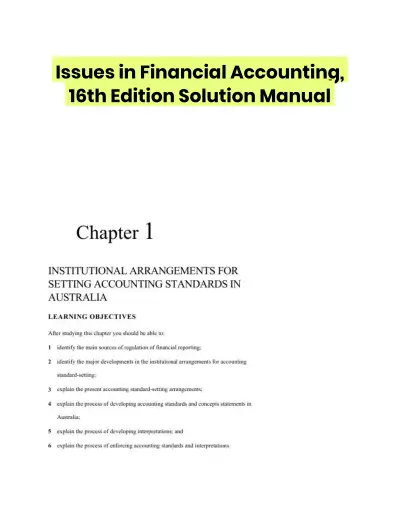 Textbook Guides
Issues in Financial Accounting, 16th Edition Solution Manual
Accounting
599 pagesMay 2025 Textbook Guides
Introduction to Financial Accounting, 11th Edition Solution Manual
Accounting
524 pages173downloadsFeb 2025 Textbook Guides
Solution Manual For International Accounting, 4th Edition
Accounting
309 pages161downloadsFeb 2025 Textbook Guides
Solution Manual For Managerial Accounting, 7th Edition
Accounting
361 pages159downloadsFeb 2025 Class Notes
Class Notes For Advanced Accounting, 4th Edition
Accounting
149 pages159downloadsFeb 2025 Textbook Guides
Financial Accounting 6th Canadian Edition Solution Manual
Accounting
867 pages156downloadsFeb 2025 Textbook Guides
Accounting Theory, 7th Edition Solution Manual
Accounting
325 pages153downloadsFeb 2025 Textbook Guides
Financial Accounting, 9th Edition Solution Manual
Accounting
1024 pages134downloadsFeb 2025
Study this document with CramX
Once it is in your library, every tool can work from it.