

Solution Manual for Accounting Theory: Conceptual Issues in a Political and Economic Environment, 9th Edition
- Accounting
- 214 pages
- Shared May 2025
Solution Manual for Accounting Theory: Conceptual Issues in a Political and Economic Environment, 9th Edition breaks down difficult textbook problems into simple solutions, making your study time more effective.
Preview 16 of 214 pages
See the first 16 pages exactly as they appear in the document.
Page 1 Read page 1 as text
Chapter 1: An Introduction to Accounting Theory Accounting Theory (9 th edition) Page 1 of 14 C HAPTER H IGHLIGHTS The chapter is concerned with what accounting theory is and where it fits within the “structure” of financial accounting. The definition of accounting theory used in this chapter is broad and complements the objectives of the text. Theory itself helps to explain and predict phenomena that exist in a given field, and this likewise holds true in accounting. In accounting, theory can be developed in response to needs arising from practice, including concepts such as realization and matching. However, as an “infrastructure” has developed in financial accounting, theory is formulated in a more institutionalized way by means of the research process. Along with political factors and economic conditions, accounting theory contributes to the standard-setting process. The process of developing standards or making rules is itself largely a deductive process and is certainly concerned with accounting theory. The relationship of theory to measurement is very important. While some see measurement as closely related to but separate from theory (as we did in earlier editions), its importance relative to theory is so great that we now consider it to be part of theory. Measurement is the assignment of numbers to the attributes or properties of objects being measured. The different types of measurements and the quality or “goodness” of measurements are examined. The latter embodies (1) the usefulness of the measurement, illustrated here in a predictive context but showing up later in an assessment mode and (2) verifiability or objectivity, which is the degree of consensus among measurers in the statistical sense. The various valuation models are presented in Appendix 1-A. The models come under the scope of accounting theory. In addition, the different models are mentioned in several theory chapters. Q UESTIONS Q-1 What does the term “social reality” mean and why are accounting and accounting theory important examples of it? The term social reality pertains to the measurement of social phenomena and the use of these measurements. The measurements may be representationally faithful (low in bias) and have a high degree of objectivity (verifiability). Or the opposite for either or both of these qualities may be the case. The important thing to grasp, however, is that important consequences stem from the measurement, whether they are “good” or “bad.” For example, an excellent year in terms of income could cause management to be highly rated by shareholders and other interested parties, resulting in high management bonuses, or provide increased dividends to shareholders. All of this could occur even though income is a “construct”: not a “real” factor but a conceptual artifact. This example shows why accounting is an important area relative to social reality measurements and constructs. Hopefully, accounting theory can improve the fairness and usefulness of these measurements.
Page 2 Page 3 Read page 3 as text
Chapter 1: An Introduction to Accounting Theory Accounting Theory (9 th edition) Page 2 of 14 Q-2 Why do the value choices (entry value, exit value, and historical cost) fall within the domain of accounting theory? These are examples of different concepts involved with measuring income which have different underlying purposes. These different purposes—which affect social reality—are discussed in the appendix. Q-3 Of the three inputs to the accounting policy-making function, which do you think is the most important? Of the three inputs ( economic conditions , political factors, and accounting theory) to the policy- making function, economic conditions is clearly the most important input. Economic conditions can easily influence the accounting theory track as well as the policy-making function. Inflation, for example, in the USA during the 1970s and 80s triggered a significant amount of theoretical work. Theory responded to the actual economic environment. Another prominent example of the influence economic conditions has is the merger and acquisition wave of the 1960s, which lead to APB Opinion Nos. 16 and 17. Many other standards have also been triggered by economic conditions. Q-4 How can political factors be an input into accounting policy-making if the latter is concerned with governing and making the rules for financial accounting? Those who are affected by the rules will usually try to influence what those rules will be. The investment tax credit provides an excellent example. When APB Opinion No. 2 did not allow flow through, lobbying led to APB Opinion No. 4, which did allow immediate recognition in income of investment tax credits. The stock option battles of the 1990’s (and continuing today) is another example of the political process and its effect on rule-making. From a predictive standpoint, we are concerned with how and why political factors play a role in the standard- setting process. Q-5 Is accounting theory, as the term is defined in this text, exclusively developed and refined through the research process? Absolutely not. Many concepts such as conservatism and revenue recognition arose on a “common law” type of basis. They were responses to particular problems. Research has, of course, dealt with these issues. Any attempt to leave these concepts outside of the definition of accounting theory would make the subject matter of accounting theory artificial and incomplete Q-6 What type of measurement is the measurement of objectivity in Equation (1.1): nominal, ordinal, interval, or ratio scale? It is ordinal, due to the squaring effect on each individual deviation from the mean. The zero point, however, is unique. Hence, there would be perfect consensus among measurers. It would mean that each individual measurement would be the same for all measurers.
Page 4 Read page 4 as text
Chapter 1: An Introduction to Accounting Theory Accounting Theory (9 th edition) Page 3 of 14 Q-7 The measurement process itself is quite ordinary and routine in virtually all situations. Comment on this statement. This is not necessarily the case. Measurements can be extremely complex. For example, measuring the temperature of the earth’s atmosphere is extremely difficult. The increasing temperature has led both to the hypothesis of the greenhouse effect and to the theory that the warming global temperatures are simply a fluctuation, a naturally occurring variation. Measuring the success of a man’s life can be perplexing. How does accumulation of Bill Gates’ monetary wealth compare with the accomplishments of Ghandi, Nelson Mandela, or Wolfgang Amadeus Mozart? What does one actually measure to determine success? Measurements in accounting are significantly less complex, but should not be taken lightly. For example, determining the replacement cost or exit value of a firm’s machinery and equipment is not an easy task. Determining net income or earnings during a specified period of time may be more complicated that it appears to be on the surface. Q-8 Can assessment measures be used for predictive purposes? Though an assessment measure concerns an attribute or characteristic of an object at the present time, it could be used as a surrogate for a prediction measure if none exists. For example, the best indicator of the current ratio of a firm in a year may be the current ratio today, if budgets have not been prepared. Q-9 A great deal of interest is generated each week during the college football and college basketball seasons by the ratings of the teams by the Associated Press and United Press International. Sports writers or coaches are polled on what they believe are the top 25 teams in the country. Weightings are assigned (25 points for each first place vote, 24 for each second place vote, . . . one for each 25th place vote) and the results are tabulated. The results appear as a weekly listing of the top 25 teams in the nation. Do you think that these polls illustrate the process of measurement? Discuss. An argument can be made that a number is assigned to a team on the basis of a property that might be called the “goodness” or “strength” of a team. However, these measurements do not have a great deal of precision. How good a team is relative to other teams is a property or quality that is extremely intangible compared to other measurements such as median weight of interior linemen, average speed of running backs per 100 meters, etc. Unquestionably, the measurements are indirect. The qualifications of the measurers are also open to question. Do sportswriters really “know” football? Constraints are also present because the voters may have seen very few teams and they may also have regional biases. The numbering scale used is basically ordinal because 1 is considered to be better than 2, which is better than 3. However, the “goodness” of the interval between rankings is not uniform. For example, a voter may feel it is a virtual “toss-up” between 1 and 2, both of which he considers to be vastly superior to 3. As a result, the aggregating process is open to serious question.
Page 5 Read page 5 as text
Chapter 1: An Introduction to Accounting Theory Accounting Theory (9 th edition) Page 4 of 14 It is also not clear whether the pollsters are making assessment or prediction measures. The measures would be prediction measures if the voter presumes that 1 would beat 2 if they played the following week. We suspect, however, that an assessment measure is being made. The property being assessed is the team’s record to date. Hence, a team with a 6-0-0 record is usually ranked higher than a team with a 5-0-1 record. Q-10 Accounting practitioners have criticized some proposed accounting standards on the grounds that they would be difficult to implement because of measurement problems. They therefore conclude that the underlying theory is inappropriate. Assuming that the critics are correct about the implementational difficulties, would you agree with their thinking? Discuss. This question brings together the relationship among theory, policy, and practice. It also brings up Larson’s warning of the necessity to differentiate between theory and measurement even though we believe that Larson’s statement is too strong. Hence, even though the practitioners may be correct about the measurement process recommended by the proposed standard, it does not necessarily mean that the underlying theory is inappropriate. Some theories may indeed lead to dead ends in terms of implementation. More time may also need to be taken to make the measurements operational. Q-11 Some individuals believe that valuation methods proposed by a standard-setting body such as FASB should be based on those measurement procedures having the highest degree of objectivity as defined by Equation (1.1). Thus, some assets might be valued on the basis of replacement cost and others on net realizable value. Do you see any problems with this proposal? Discuss. The problem here is basically the opposite of that presented in question 10. In this case, part of the measurement problem might be solved, but at the cost of sacrificing the theoretical base. Hence, the cart is put before the horse, conceptually speaking. However, there are other measurement problems presented by this proposal. It is questionable whether replacement cost dollars and net realizable value dollars can be meaningfully added together, even if computed for the same point in time (this is the problem of additivity). Moreover, if firms were given latitude to employ valuation methods for their various balance sheet items that were more objective in their own particular cases, there could well be a major problem of lack of comparability in the resulting financial statements between and among firms.
Page 6 Read page 6 as text
Chapter 1: An Introduction to Accounting Theory Accounting Theory (9 th edition) Page 5 of 14 Q-12 What type of measurement scale (nominal, ordinal, interval, or ratio scale) is being used in the following situations? a. Musical scales b. Insurance risk classes for automobile insurance c. Numbering of pages in a book d. A grocery scale e. A grocery scale deliberately set 10 pounds too high f. Assignment of students to advisers, based on major a. Musical scales, Interval, there is no natural zero tonal point. b. Insurance risk classes for automobile insurance: Ordinal, Class 1 is “better” than Class 2 to the extent that people have had fewer accidents. However, within classes people do not have uniform accident records, and the “accident interval” between classes is not totally uniform. c. Numbering of pages in a book: Interval (possibly nominal). d. A grocery scale: Ratio. e. A grocery scale deliberately set 10 pounds too high: Interval — In effect, the “zero” point is set at 10 pounds, but interval differences remain constant. f. Assignment of students to advisers, based on major: Nominal Q-13 If general price-level adjustment is concerned with the change over time of the purchasing power of the monetary unit, why is it not considered to be a current value approach? Current value approaches (replacement cost and exit value) are concerned with questions such as what would it cost to replace an asset today with the same type of asset in the same condition or how much would an asset sell for if it were sold today. General price-level adjustment attempts to restate historical cost of assets in terms of the contemporary purchasing power of the money expended. Q-14 How do entry- and exit-value approaches differ? As noted previously, entry value (replacement cost) concerns the cost of replacing an asset already owned in markets in which the asset is generally acquired by the firm. Exit value is the price the firm could get for the asset less costs of getting rid of the asset (e.g., removal costs, transportation). Exit value is generally lower than replacement cost because of restricted access to the market, disposal costs, and the possibility of “the perception of a lemon” on the part of prospective buyers.
Page 7 Read page 7 as text
Chapter 1: An Introduction to Accounting Theory Accounting Theory (9 th edition) Page 6 of 14 Q-15 Why is discounted cash flow extremely difficult to implement in the accounts? The difficulty relates to measurement. Which discount rate should be used, how far in the future should one go, and how should one estimate cash flows? In addition, many assets contribute jointly to generating future cash flows. Problems of separating the cash flows for valuation purposes are virtually impossible to solve. Q-16 How do measurement and calculation in accounting differ from each other? Give three examples of each. Measurement in accounting is concerned with determining real economic phenomena such as current values (entry and exit values) and discounted cash flows. Calculations are simply mechanistic assignments of the monetary unit to accounting categories. The word calculation is very similar to allocation as developed by Arthur Thomas (see Chapter 8). Calculations thus abound under historical costing. Some examples would be inventory amounts determined by LIFO, FIFO, or weighted average; depreciation calculations; and marketable securities carried at cost. Measurements would include inventories and marketable securities when carried at market; acquisition of inventories and fixed assets in general (but only at the acquisition point) as well as assets acquired in a purchase type business combination; and the carrying of accounts receivable (net) at net realizable value. Q-17 Are issues of costliness and timeliness as they pertain to accounting standards part of accounting theory? Costliness and timeliness are part of accounting theory (refer to Statement of Financial Accounting Concepts No. 2 and No. 8 of the conceptual framework). Benefits of a standard should exceed their costs. Thus it could be too costly to improve the accuracy (representational faithfulness of a particular measurement of a desired characteristic of an asset). The same pertains to timeliness. A more accurate measurement requires more time, but the delay necessary to attain the increased accuracy makes the more accurate measurement less useful. Q-18 Do you think that changes brought about in accounting standards by failures of publicly traded companies such as Enron should be classified under political factors or economic decisions? Support your position. We classify these as political factors. The inability to draft workable rules to bring special purpose entities (SPE) to the balance sheet is definitely political in nature. Q-19 Political factors are an adverse influence on the accounting standard-setting function. Discuss this statement. This is tough issue. Prior to the Enron, WorldCom, etc. scandals we would have said that to get firms to buy into the standard-setting process, those who must work to apply the standards
Page 8 Read page 8 as text
Chapter 1: An Introduction to Accounting Theory Accounting Theory (9 th edition) Page 7 of 14 should have input to the process. We still believe this, however, we now know that skeptical eyes and ears are important necessities when reviewing interested party inputs. Trust with a skeptical eye. Q-20 Did the 21 st century begin on January 1, 2000? By popular acclamation the 21 st Century began on January 1, 2000. Since there was no year zero, each century ends with a year ending with an even hundred or a thousand. This question is a good example of a social reality—the effect of the odometer turning over—overcoming measurement theory. Q-21 Do you think that the color-coded terrorist threat system instituted by the Department of Homeland Security involves a measurement system? Explain. Absolutely. Different colors refer to different degrees of danger. It would be an ordinal-type scale because the difference in degrees of danger between color codings is not uniform. For example, the highest point on the scale indicates that a terrorist attack is virtually imminent. This is a large step above the next level on the scale. Q-22 Since the FASB makes the standards that are used by business and industry, they make accounting theory. Comment on this statement. FASB uses accounting theory when developing accounting standards, but it does not make it. Does an aircraft manufacturer make aerodynamic theory when producing a new airplane or does it use specific theories to help design and produce a high quality product? C ASES , P ROBLEMS , AND W RITING A SSIGNMENTS 1. Assume that three accountants have been selected to measure the income of a firm under two different income measurement systems. The results for the first income system (M1) were incomes of $3,000, $2,600, and $2,200. Under the second system (M2), results were $5,000, $4,000, and $3,000. Assume that users of accounting data believe that dividends of a year are equal to 75 percent of income determined by M1 for the previous year. Users also believe that dividends of a year are equal to 60 percent of income determined by M2 for the previous year. Actual dividends for the year following the income measurements were $3,000. Determine the objectivity and bias of each of the two measurement systems for the year under consideration. On the basis of your examination, which of the two systems would you prefer?
Page 9 Read page 9 as text
Chapter 1: An Introduction to Accounting Theory Accounting Theory (9 th edition) Page 8 of 14 Designating the three accountants as A1 . . . A3 and using Equation (1.1) for measuring objectivity, we get: M1 ( x i – x ) 2 A 1 (3,000 – 2,600) 2 = 160,000 A 2 (2,600 – 2,600) 2 = 0 A 3 (2,200 – 2,600)2 = 160,000 $320,000 ÷ 3 = 106,667 M2 ( x i – x ) 2 A 1 (5,000 – 4,000)2 = 1,000,000 A2 (4,000 – 4,000) 2 = 0 A 3 (3,000 – 4,000) 2 = 1,000,000 $2,000,000 ÷ 3 = 666,667 To arrive at the bias present in the measures, solve for what income should be in the first period ( I * 1 j ) in terms of user decision models from Equation (1.2): M1 M2 D j2 = f(.75 I * 1 j ) D j2 = f(.60 I * 1 j ) $3,000 = .75 I * 1 j $3,000 = .60 I * 1 j $4,000 = I * 1 j $5,000 = I * 1 j Now solve for bias by using Equation (1.3): B = ( x – x *) 2 i: M1 (2,600 – 4,000) 2 = 1,960,000 M 2 (4,000 – 5,000)2 = 1,000,000 Combining the two measures that are additive to arrive at an overall measure of reliability, we have: M 1 M 2
Page 10 Read page 10 as text
Chapter 1: An Introduction to Accounting Theory Accounting Theory (9 th edition) Page 9 of 14 R = V + B R = V + B $2,066,667 = $106,667 + $1,960,000; $1,666,667 = $666,667 + $1,000,000 M2 appears to have more reliability than M1. M2’s poorer objectivity is more than offset by its better predictive power in this example. These numbers give a quantitative grasp of objectivity and bias, but one cannot claim that M1 is approximately six times more objective than M2 or that M1 has twice as much bias as M2. Standard deviation might have been used for objectivity, in which case the objectivity ratio would come down to less than 3 to 1. Hence, the measures can give a comparative ordering for reliability—but that is all. 2. J & J Enterprises is formed on December 31, 2000. At that point it buys one asset costing $2,487. The asset has a three-year life with no salvage value and is expected to generate cash flows of $1,000 on December 31 in the years 2001, 2002, and 2003. Actual results are exactly the same as plan. Depreciation is the firm’s only expense. All income is to be distributed as dividends on the three dates mentioned. Other information: The price index stands at 100 on December 31, 2000. It goes up to 104 and 108 on January 1, 2002 and 2003, respectively. Net realizable value of the asset on December 31 in the years 2001, 2002, and 2003 is $1,500, $600, and 0, respectively. Replacement cost for a new asset of the same type is $2,700, $3,000, and $3,300 on the last day of the year in 2001, 2002, and 2003, respectively. Revenue is $1,000 per year and the internal rate of return is 10% and all cash flows are received (and distributed) on December 31. Required: Income statements for the years 2001, 2002, and 2003 under: Historical costing General price-level adjustment Exit valuation Replacement cost Discounted cash flows 2.1 Historical costing : 2001 2002 2003 Total Revenue $1,000 $1,000 $1,000 $3,000 Depreciation 829 829 829 2,487 Net Income $ 171 $ 171 $ 171 $513
Page 11 Read page 11 as text
Chapter 1: An Introduction to Accounting Theory Accounting Theory (9 th edition) Page 10 of 14 2.2 General price level adjustment : 2001 2002 2003 Total Revenue $1,000 $1,000 $1,000 $3,000 Depreciation 829 862 a 895 b 2,586 Operating Income $ 171 $ 138 $ 105 $ 414 Purchasing Power Loss — 33c 66d 99 Net Income $ 171 $ 105 $ 39 $ 315 a $829 × 1.04 = 862 b $829 × 1.08 = 895 c $829 × [(1.04 – 1.00)/1.00] = $33 ($829 represents the firm’s cash holding on January 1, 2002) d $1,724 × [(1.08 – 1.04)/1.04] = $66 2.3 Exit valuation : e 2001 2002 2003 Total Revenue $1,000 $1,000 $1,000 $3,000 Depreciation 987 900 600 2,487 Net Income $ 13 $ 100 $ 400 $513 2.4 Replacement cost : e 2001 2002 2003 Total Revenue $1,000 $1,000 $1,000 $3,000 Depreciation 900 1,000 1,100 3,000 Net Income $ 100 $ 0 $100 $ 0 e Purchasing power gains and losses might be computed but are omitted for simplicity here 2.5 Discounted cash flows : f 2001 2002 2003 Total Revenue $1,000 $1,000 $1,000 $3,000 Depreciation 751 826 909 2,486 Net Income $ 249 $ 174 $91 $514 f The problem was structured so that the asset has a 10% internal rate of return
Page 12 Read page 12 as text
Chapter 1: An Introduction to Accounting Theory Accounting Theory (9 th edition) Page 11 of 14 3. Objectivity (also called “verifiability”) and bias (usefulness) are two extremely important characteristics of accounting. Discuss each of the following situations in terms of how you believe they would impact upon objectivity and bias. The latest standard on troubled debt restructuring, SFAS No. 114, calls for newly restructured receivables to be discounted at the original or historical discount rate. Two board members disagreed with the majority position because they thought the discount rate should be the current discount rate, given the terms of the note and the borrower’s credit standing. SFAS No. 115 requires marketable equity securities to be carried at fair value (market value). Its predecessor, SFAS No. 12, required marketable equity securities to be carried at lower-of-cost-or-market. Assume that a new standard would allow only FIFO in inventory and cost of goods sold accounting with weighted average and LIFO being eliminated (you may ignore income tax effects). This situation shows how even a minimum exposure to “accounting theory” can sharpen reasoning power. Other examples of the type illustrated here can be easily generated. The original historical rate would be more verifiable since it is precisely determinable, whereas the current rate would not be exact but should be restricted to a very narrow range. The current discount rate should be more useful because its use would help to determine the current value of the restructured debt. On balance, we agree with the dissenters. Verifiability problems with the current discount rate should be quite small. While conservatism in accounting should not be totally thrown out, we believe that it is relied on too heavily. We believe that SFAS No. 115 has an absolute advantage in value terms over SFAS No. 12. Historical cost is not particularly useful for decision-making purposes. The consistent use of fair value is more useful, we believe, than lower-of-cost-or-market. If anything, verifiability should be better under SFAS No. 115 than SFAS No. 12, since one value is involved rather than two under lower-of-cost-or-market. The new standard would be more verifiable since only one calculation is allowed rather than two. Relative to usefulness, the usual argument might arise: LIFO is “better” in the income statement because costs used up are more current and thus give a better “matching,” but LIFO would be less useful on the balance sheet. Since neither of these calculations has an absolute advantage over the other, we would opt for the exclusive use of FIFO. In addition to being more verifiable, only one method would be less ambiguous for users. While the advantage is not absolute, we believe it is clearly in favor of FIFO only. 4. Accounting theory has several different definitions and approaches. Using Hendriksen and van Breda (1992, Chapter 1) and Belkaoui (1993, Chapter 3), list and briefly discuss these definitions and approaches. From the perspective of a professional accountant, evaluate these approaches in terms of their usefulness. Chapter 1 in Hendriksen and van Breda is devoted to accounting theory. Accounting theory is not defined until the conclusion of the chapter on page 21. Using Webster’s Dictionary as a background, accounting theory is defined as a “. . . coherent set of hypothetical, conceptual, and
Page 13 Read page 13 as text
Chapter 1: An Introduction to Accounting Theory Accounting Theory (9 th edition) Page 12 of 14 pragmatic principles forming a general frame of reference . . . ,” which is fairly close to the definition used here. The chapter talks about different “approaches” to theory, including tax, legal, ethical, economic, behavioral, and structural, hence, different frames of reference would evidently apply to each of these approaches. This entire framework is then related to philosophy of science issues such as the use of language involving pragmatics, semantics, and syntatics and theory as reasoning involving deductive and inductive approaches. Chapter 3 in Belkaoui is devoted to accounting theory, which is defined as “. . . a set of interrelated constructs (concepts), definitions, and propositions that present a systematic view of phenomena . . . with the purpose of explaining and predicting the phenomena.” His “approaches” then include pragmatic versus theoretical approaches with the latter mirroring the Hendriksen and van Breda approaches by covering deductive, inductive, ethical, sociological, economic, and eclectic approaches. We suspect that for both books, as well as this one, defining accounting theory has been a difficult task. The whole question of what do we know and how do we know it (and know that we know it) is an extremely interesting area. Epistemology is as important for accounting as for other disciplines. 5. What theoretical issues are involved in Statement of Financial Accounting Standards No. 2 which calls for expensing research and development costs? SFAS No. 2, Accounting for Research and Development Costs, issued in 1974, establishes standards of financial accounting for research and development (R&D) costs. It requires that R&D costs be expensed when incurred. It also requires a company to disclose in its financial statements the amount of R&D that it charges to expense. Theoretical issues relate to: measurability (how to measure future benefits of R&D expenditures, especially given the associated uncertainties) and matching (recognizing costs as expenses on a cause and effect basis). 6. Read “The Margins of Accounting” by Peter Miller in “The European Accounting Review (Volume 7, Number 4, 1998). What is Miller’s main point? Discuss the examples he uses to illustrate his main point including those pertaining to management accounting. What do you think the significance of his article is for understanding accounting? This 17-page reading is available through the EBSCO library database. Miller argues that practices at the margins of accounting today may be at the core in the future and vice-versa. “accounting innovation is not the preserve of any single group.” His examples include cost accounting and nonfinancial measures. This article emphasizes how accounting has developed in relation to “localized concerns and issues,” much like medicine and law. It implies that accounting will change, evolve as time passes and environmental factors vary.
Page 14 Read page 14 as text
Chapter 1: An Introduction to Accounting Theory Accounting Theory (9 th edition) Page 13 of 14 C RITICAL T HINKING AND A NALYSIS 1. Is accounting theory really necessary for the making of accounting rules? Discuss. This question should hopefully shake students up. We doubt that a sophisticated answer that might arise when students have finished Chapter 4 suggesting that regulation, in some views, is unnecessary—will arise. Even prior to the appearance of any standard-setting agency, unifying themes such as realization and matching arose. In today's extremely complex environment, it is difficult to imagine financial accounting operating without a standard-setting body and that body operating without some type of conceptual (theoretical) guidelines since issues such as who the users are and what their information needs are, costs and benefits of different alternatives, verifiability issues, attaining comparability, and increasing information symmetry are all issues which must be considered by standard setters. 2. Every fall U.S. News and World Report comes out with a much awaited ranking of American colleges and universities (you may have even used it yourself). While there has been much criticism of the methodology that the magazine employs as well as some “fudging” of the numbers by universities in their response to the questionnaire, this report represents what the chapter calls a “social reality.” What is meant by “social reality” and why does this college and university ranking provide a good analogy for accounting? From Question 1: The term social reality pertains to the measurement of social phenomena and the use of these measurements. The measurements may be representationally faithful (low in bias) and have a high degree of objectivity (verifiability). Or the opposite for either or both of these qualities may be the case. The important thing to grasp, however, is that important consequences stem from the measurement, whether they are “good” or “bad.” For example, an excellent year in terms of income could cause management to be highly rated by shareholders and other interested parties, resulting in high management bonuses, or provide increased dividends to shareholders. All of this could occur even though income is a “construct”: not a “real” factor but a conceptual artifact. This is a particularly interesting application because the U.S. News & World Report survey is well known and widely used. It may well help many students in terms of narrowing down colleges and universities that they would be interested in by giving various “bottom line” summaries of the schools. Yet we might well ask how “good” and how meaningful these numbers are. Unquestionably, they influence actions. We know of college administrators who would “kill” to improve their ratings.
Page 15 Read page 15 as text
Chapter 1: An Introduction to Accounting Theory Accounting Theory (9 th edition) Page 14 of 14 3. Accounting rule making should only be concerned with information for investors and creditors. Discuss. This is a good discussion question. You may want to also ask your students to determine who the two primary standards-setting bodies (FASB and IASB) identify as their primary customers of standards. Should the customers be all those using the information for making economic decisions or more limited to only one audience (e.g., investors, creditors, the entity alone)? Where do current and past employees fall in this investor-creditor classification? How about communities? Taxing authorities? Environmental regulatory agencies? This is a critical question, “Exactly, who is the customer?”
Page 16 Read page 16 as text
Chapter 2: Accounting Theory and Accounting Research Accounting Theory (9 th edition) Page 1 of 9 C HAPTER H IGHLIGHTS The chapter provides the student an appreciation for the contribution of research to the general growth of our knowledge about accounting. It shows how accounting research affects the standard-setting process in financial accounting. The chapter focuses on the roles of deductive and inductive reasoning and how they relate to financial accounting. It is also important to stress that these methods are complementary and not an either/or orientation. It is important to stress that empirical research generally looks at fairly small, manageable types of questions. It thus can provide input to the standard-setting process. Making accounting rules, however, must still be seen as a normative function. The chapter also stresses that empirical research cannot be value-free. Values are embedded in the questions that are asked and the parameters that are used in attempting to measure phenomena. Given the rise of formal approaches to theory and a concern for the process of measurement discussed in Chapter 1, the question arises as to whether accounting is an art or a science. A science might be defined as a discipline or area where considerable measurement problems exist. In the physical and natural sciences, there should be a high degree of consensus among measurers. This will be less the case in the social sciences simply because of the variability of human behavior. Nevertheless, they should come under the domain of science. Accounting could certainly move closer to the science realm as a result of the rise of scientific method and the concern for measurement. The chapter also briefly discusses accounting research directions or trends. These are expanded throughout the text. The chapter closes with a look at the question, stemming from Kuhn, concerning whether a “scientific revolution” is occurring in accounting. At this time, the answer appears to be a fairly clear “maybe.” The included PowerPoint, revolutions and paradigms.ppt, references an article from The Wall Street Journal , that suggests the beginnings of a paradigm shift. Q UESTIONS Q-1 Do you think that the work of a policy-making organization such as the FASB or the SEC is normative (value-judgment oriented) or positive (oriented toward value-free rules)? Discuss. It is unquestionably normative because judgments must be made in accordance with objectives or other criteria. While a standard-setting group may attempt to be neutral, it usually must decide among different positions, each of which will have its adherents. A standard-setting organization may use empirical research (which attempts to be descriptive or positive) as part of its input into the standard-setting process. Ijiri used the term “policy science” to describe financial accounting.
198 more pages in the full document
Unlock it once and it stays in your library, ready to chat with or turn into flashcards.
Unlock the full documentMore Accounting study materials
See all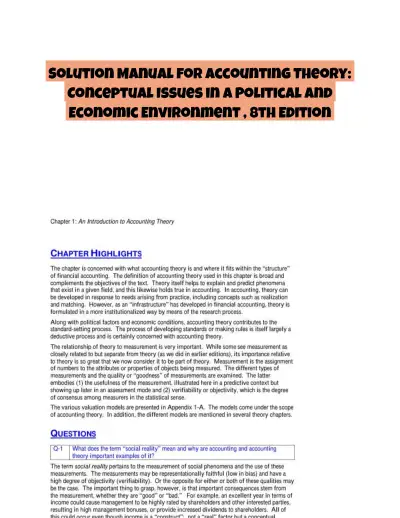 Textbook Guides
Solution Manual for Accounting Theory: Conceptual Issues in a Political and Economic Environment , 8th Edition
Accounting
214 pagesMay 2025 Textbook Guides
Introduction to Financial Accounting, 11th Edition Solution Manual
Accounting
524 pages173downloadsFeb 2025 Textbook Guides
Solution Manual For International Accounting, 4th Edition
Accounting
309 pages161downloadsFeb 2025 Textbook Guides
Solution Manual For Managerial Accounting, 7th Edition
Accounting
361 pages159downloadsFeb 2025 Class Notes
Class Notes For Advanced Accounting, 4th Edition
Accounting
149 pages159downloadsFeb 2025 Textbook Guides
Financial Accounting 6th Canadian Edition Solution Manual
Accounting
867 pages156downloadsFeb 2025 Textbook Guides
Accounting Theory, 7th Edition Solution Manual
Accounting
325 pages153downloadsFeb 2025 Textbook Guides
Financial Accounting, 9th Edition Solution Manual
Accounting
1024 pages134downloadsFeb 2025
Study this document with CramX
Once it is in your library, every tool can work from it.